Monday, June 29, 2009

Review: Jonathon Strange & Mr Norrell, by Susanna Clarke

As a rule, I try to avoid harboring prejudices, but sometimes they're difficult to avoid. With an American Colonial history buried deeply in the nooks of one side of family, and an Irish line on the other, I must occasionally fight a reflexive anti-Englishness. Or maybe not a prejudice: better call it a distaste for certain aspects of my own east-coast cultural heritage, which I see as largely a refutation of the gentility of English classism, but which, like a rebellious teenager, never ended up so far away from Mom and Dad as it imagined. Our vaunted revolutionaries trended pretty aristocratic too (albeit Enlightened), even if our landed gentlemen were uncouth sorts, the pre-industrial agrarian society that spread through (the aptly named) New England was an outgrowth of the Old(e) England model. We're still telling our kids English fairy tales and English nursery rhymes, emphatically re-imagining some snug English pastoral spirit every single Christmas. (That the uptight breed invented "twee" is almost reason enough to detest them.) And like the English, we romanticized the lost inner frontiers once we tamed them, even if the brutal pacification of ours was only recent history and the landmass proved a lot bigger. Our nasty Empire is a take on the British model too, complete with state protection of favored lucrative industries, a similar missionary zeal to export our exceptionalism to the brown hordes even as we enrich satraps and butcher the lowly. The British of the early nineteenth century were particularly loathsome to us Yanks, given that 1812 was among the stupidest of wars fought on this soil, although perhaps we can cut them an ounce of slack over the next several years for resisting the Continental imperialists.

Which isn't to say that there are no fine stories to be crafted from this upper-crust milieu--some of the finest are, of course--it's just that any writer who dares present a bunch of gouty windbags (I mean, there's crazy old George the fucking Third ferchrissakes!) unironically congratulating themselves for their Englishness has got a bit of a handicap to overcome. And really, all this is a lengthy apology, because when Susanna Clarke served up a helping of these tobacco-reeking indolent old farts, I loved them from the first sentence. And if Clarke's aristocratic England is mildly romanticized, then it's tempered with an equally understated, but devilish, subversiveness. She is not shy, for example, about presenting servants who are superior in character than their masters, nor for subtly criticizing the absence of women from the circles of self-defining meritocracy. These things are shown, not lectured, and they are in the context of a historical verisimilitude that works at least here, considering she's taken the liberty of exorcising (or, perhaps, dramatically understating in a footnote or two) the differences that the real Christian church had with witchcraft, and to create a history which included magician-kings and in which the roads to Fairie could be mapped, even as the destination remained as inscrutable as in any old country tale.

How does the literary evolution of Faerie go again? Something like from the backyard gods of a woodsy people, to compilations, to Bowdlerized children's versions, to serious rediscovery in various nostalgic forms that have suited any convenient version of the people's lost connection to the world, whether thanks to the Great War or just under the usual thick layer of coal smoke and asphalt. I like faeries this way, as timeless natural spirits, creatures faintly adversarial, untrustworthy but beautiful, inhuman but representative of an ancient ecosystem that includes humanity, of a mysterious but familiar natural universe that people can neither tame nor do without. Clarke navigates this landscape of character pretty well, playing up one supernatural gentleman who has been in a thousand-year groove of wickedness and mystery, but generally working Faerie, into the countryside and into forgotten corners society too, keeping up with the general consensus of modern fantasy writers, without feeling very derivative of anything. Her magicians--the titular characters--are the bridge between the wild magic intrinsic to northern England and to modern society.

Although this conflict underlies everything in the story, it's not developed very explicitly. Much of the conflict is underdeveloped, even while all the elements for it are in place, and should work. There's a prophecy about the two magicians, that while brilliantly conveyed in a character, carries no logic or force. There is the matter of Mr Strange's wife, whose interactions with the faerie occur far too late in the novel, and which, as a plot-moving elements, are strangely attenuated. I've little idea why Strange had to spend so much time in the (largely bloodless, but chalk that up in part to the cultivated English understatement) battlefield, and given the events, it's a bit off to see the likes of Canning and Castlereagh doffing about with such casual pipe-scented aplomb. And I suppose these conflicts are all approximately resolved by the end, but without sufficient tension, there was no particular satisfaction. Pleasant as it is, the book still sagged in the middle, and I don't think it was entirely due to my damn job interfering so much in my reading schedule. The book didn't quite reach the point of being nice to read but easy to put down--I didn't get bored in 800 pages--but it did approach that point.

And the conflict between Strange and Norrell, I should add, was well-executed, and satisfying. Clarke's general strength is character, and both the men are pretty great ones. Norrell particularly: here's a timid little bookish bore of a man, completely unsuited to society, politics, or generosity. If anything else, the novel is an entertaining portrait of how it turns this unlikely little fellow, nothing worse than a packrat of knowledge really, into an influential tyrant, scooping up information from the reach of his betters and leaving the world to swallow his own viewpoint, so tediously expressed that no one can make it past the first couple of sentences. That Clarke could conceive that he and the ambitious, carefree Strange should find intellectual communion is a quality bit of writing, but in truth, every character is improved in the vicinity of Norrell. He's such a font of negative interest (and her best trick is showing him charmingly in spite of this), that his servants, collaborators, sycophants, must be that much more compelling to overcome his utter boringness.

So, call it good writing, and pleasant telling, and with only just enough plot to keep it from being merely atmospheric. I recommend reading it by a roaring coal fire, snug from the rainy February chill, with, of course, tea.

Monday, June 22, 2009

From the Annals of Erotic Fruit...

I know it's a big internet, but I wonder: is there yet a blog devoted to suggestively-shaped produce? Because if not, then I want to lay claim to the idea. It could finally be the do-nothing path to personal wealth that I've longed for since that first summer job.

[Editor's note: This picture just got less tasteful the more I looked at it. Eventually, I started thinking of the children... --KH]

Strangely, no one was interested in seeing my scrotum-berry yesterday. Or at least no one was interested until I explained it a little further (after which, no one was interested for different reasons).

And speaking of dangling modifiers (and where the hell is switters anyway?), before I went to bed last night, I caught the first few minutes of a Food Network show called, "The Best Thing I Ever Ate ....Totally Fried!" Um, yeah, I'm sure I don't remember.

[book review in a day or two]

[...or three or four. Busy week, and I'm preparing for a remarkably un-busy week off, which may include reviewing books, so long as it doesn't happen to feel like work. Both upcoming selections are twiffer-approved, by the way.]

Friday, June 19, 2009

The Beats of Different Drummers

More proclamations from the Royal Wii.


There are various versions of the story about how the musical odyssey began at Chateau Keifus. Was it the failed attempt at violin lessons? The short-scale mandolin that Dad managed to foist off on us one day? C.'s kiddie music class? All of these things certainly happened six or seven years ago as parts of a sort of uneven group awakening, one of those creeping gestalt dealies after which we began to see ourselves as a musical family for some reason (and without much evidence). All of the variations are about equally true if we're looking to plot out the beginning of a chapter in the family saga, and with that in mind, I've got to go with the drum set as the beginning of it all.

I know that I've told this story before (to hipparchia if I recall), buried down some thread or other. My wife had been interested in playing drums for years, and so on her birthday--or maybe it was Mother's Day, or Valentine's, but you get the idea--and lacking funds to purchase a drum kit outright (and, I admit, anticipating certain outcomes enough to be cautious about a big investment), I rented out an unladen snare and purchased an instructional video for my sweetheart. Naturally enough, the video recommended a more complete arrangement, with at least a high-hat and a bass drum to occupy the other hand and the feet, and better to work on the basic backbeat pattern that will get you farthest when trying to fake American music. A couple of toms and a crash cymbal are also obviously necessary because they sound cool. A careful observer may note that my initial cash outlay contained none of these things, and rather than hurry back to the music shop, I instead thought it more romantic to cobble together various approximations of these devices. In the photo, the multipurpose cymbal is a trash can lid, painstakingly and lovingly mounted, and you bet that random plastic vessels made fine toms. I regret that my foot pedal, which never did leave the base of the trash can (because where else would the sound come from?), doesn't show up in the picture as well. It had already been removed with extreme prejudice, I guess. The experiment didn't work as a musical instrument, but all in all, I feel it was funny enough to make it worth it.

Playing pretend music better suits our talent level anyway. Fast-forwarding half a decade to my daughter's birthday, we had more disposable income than in the single-drum times (and wisely, we didn't rely exclusively on my personal version of thoughtfulness), and sprang for Rock Band 2, complete with USB mike, plastic Stratocaster, and, of course, drum pads. (We have also a tambourine, a real one, so that whoever's stuck fourth, can at least be a backup singer or just keep time.) My little angel--yes, that same thoughtful wee poet you may have met a few days ago--enjoys certain mildly inappropriate tunes (guilty!) and we'd been eyeing the game as a potential family outlet for awhile now. It took the timely coincidence of her duodecannual and the release of the AC/DC trackpack with her to put us all over the edge. [And it's another thing entirely to sing along with the printed karaoke, isn't it? MTV games (surely a bad sign) mutes the curses ("you can say 'poop' if you want to, dear"), but there's metric tons of suggestion in there, which is a lot more unnerving than a "shit" or two. I'm hardly sure I'm doing the right thing here, but I'm thinking it's a safe place to explore somewhat controversial ideas, and at twelve, you're starting to learn that your traitor body is discovering suggestions all its own, like a walking innuendo. Moreover, if the thought does take her to rebel, here's the stuff she'll be rejecting. The eight-year-old, meanwhile, remains happily clueless.] If you were thinking about purchasing the game, be aware that this post officially makes it not cool anymore.

Rock Band is immensely fun. It's as if that air guitar you carried around since you were twelve somehow acquired a kickass amp connected, and without actually learning how to do very much, you can sound like you've spent countless hours in your bedroom learning the basics and mastering every famous riff. Playing together as a group, you do get some sensation of feedback, or, if someone isn't keeping up their part, of collective failure. (And when the tambourine is off time, we really hear it.) We were all doing our living room rock moves before very long--it just felt natural. After the first week, we'd all stayed up past our bedtimes every single night, unlocking half the tour, and we shambled around during the day like zombies, night creatures out of our element, nursing the wounds we suffered in the name of our imitation art. Junior lost her voice for a while. My wife's shoulder and kick-pedal leg got sore. My damn finger went numb--the counterfeit guitar doesn't have nicely sanded and careworn surfaces a real one does, and the injection-molded neck evidently has been digging into the base of my fragile pointer, but the show must go on. It was fun to make rocker versions of ourselves too, to which the game gives the characters convincing band mannerisms, and the video bits synch up impressively with the music. I'm pretty sure I've caught the Keifus avatar lusting after the cartoon drummer.

My conclusion about drumming back then, incidentally, was that's it's fucking hard. Too many body parts acting completely independently--walking and chewing gum, but also waving, and being sure to count the cracks. It takes a certain type, I think. Out of all the ersatz equipment, Rock Band only pretends that the drum pads are anything approaching a real instrument, and there's a drum jam tool buried in there somewhere--might even work with old training DVD. I guess they have a sufficient number of things to hit at the appropriate moments, representing all of a basic kit. As for the guitar, it only has one "string," and since the fret buttons are only loosely associated with the notes the recorded guitarist is playing, there's no knowledge of music that will help you very much, and if your hand is in the wrong position there's no immediate feedback (wrong note), even if it's obvious you're doing something that's not right (no sound at all). On the easier settings the sham guitar is pretty pointless beyond informing you a little of the fundamental shape of a song. On the harder settings (or at least on the harder settings on the easier songs), you fret most of the notes that are played, and if you're willing to suspend disbelief, you can almost convince yourself that those great sounds are coming from you. Which rules.

My imaginary music playing is cutting into my actual music playing time. (And much as I love the thing, a mandolin doesn't substitute a good electric guitar. It's like when you just want a good burger, already.) When I get my reduced time on the little mando, I surprise myself to find that I'm not any worse for the lack of practice. Even if my pretend guitar playing is meaningless pitch-wise, it does force me to keep a good rhythm, which hasn't ever been my strong point, which is something of a problem when you're playing a rhythm instrument. As for the quasi-fretted notes, I have the same issues, actually. Poor accuracy, and there's a speed threshold I can't generally surpass. I have never been able to gradually ramp it up to sneak my way into a faster tempo. At some bpm, my fingers just go from "adept" to "flail."

Since C. is summoning me to play, I need to wrap this up, and indeed, here's where I originally intended to end it, but I learned this morning that they have published an expansion pack of a certain Canadian progressive rock trio (shut up! that's why!). Which is badass. I figure I have to do better at it than these guys:


Wednesday, June 17, 2009

Health Care - Fight Night

"Iiiin the Red corner, it's the man with the private plan, the carefully coiffured caregiver to the Commonwealth, the mighty Mormon middleweight, Miiiiiiiitttttt Romneeeey!"

[lights flash, random crowd noise, incoherent thunder from the gigantic woofers]

"And in the Blue corner, weighing in at 50 billion bucks, she's the heroine of human services, the diva of discretionary spending, the hyena of the budget subpeona, Czarina Kathaleeena Sebeeeeeeeelius!"

[thunder ramps up, crowd cheers.]

"Let's get ready to rrrrrruuuuuuuummmmmble!"

[brass noises increase in volume and crowd cheers "charge," then hushes.]

"It's an epic fight, wouldn't you say, Chris? Kathy's got the Democratic health care plan, and Mitt, well, he used to legislate this stuff."

"That's right Bob, and she's armed with secret documents. Look at her dance around those voters."

"Free Market Mitt looks a little dragged down out there. I thought he'd been training."

"Well, his platform has taken a few blows, and he's been trying to change his style too much. He doesn't want competition, but he still wants to advocate competition."

"He's going for the mental battle then. A chess master!"

"That's right Bob, if people could afford a government plan, they might actually buy it, and where would that leave his trainers?"

"His plan is to keep private coverage from getting better? A bold move! No wonder they called him... Er, what did they call him in Massachusetts, Chris? Wow, look at that feint!"

[oohs from the crowd.]

"Not even close to her, but she flinched. A Trojan horse! Whoa, pony!"

"Look! Sebelius is back on him. She wants competition. Her boss wants competition. U! S! A!"

"Mitt says there's enough competition!"

"You ever had a choice in yours, Bob?"

"They're going to have to make the plan awfully useless to keep consumers from defecting to it, Chris. The industry doesn't want her throwing any haymakers either. No hitting below the money belt.

"We don't make the rules."

"My God, Mitt might strike a blow! Unbelievable!"

"He hasn't been near a voter in five years, Bob."

"Look, Chris! The employers could defect. They could drop their workers and wash their hands of the whole thing, whatever service they all end up with."

"No wonder Kathy's dodging!"

"You hear that? She said that dismantling private coverage would discourage more employers from coming into the market place."

"Brilliant diversion!"

"It looks like a bad play to me, Chris. What good does insurance do for employers? It just makes hiring people more expensive."

"You're not thinkging about insurance employers"

"Masters. Chess. Masters."

[crowd oohs]

"It sounds rough down there. What's going on?"

[oohs turn to boos]

"It's a heckler! How'd she get in here? Hey Al, think we can get a feed down there?"

[various thumps, screech of feedback]

"...bzzt...ingle pay...crkrk...alf the costs!...sqwawjkivilized world...brrrr...anada and Fr[bleep!]"

"My God, get her out of there!"

"For the folks watching at home, we are aware this is a family-friendly fight, and we run a small time delay to keep it in FCC code."

"Any response from the fighters?"

[dingdingdingding]

"It looks like that's the round. Mitt's wandering back to his corner, maybe one of those other guys will replace him."

"Well, they all have a copy of something in their hands, and they're wearing the same suit.

"It looks like Kathy might have said something to the heckler, but no one seems able to make any sense out of it."

"The crowd's still booing."

"Neither of them look very damaged, Chris, or even particularly interested. Will this fight ever end?"

"It'll go to decision, Bob."

"Right, and hopefully by then, the audience will forget about it."

"Stay healthy, everyone. Stay employed."

"Good night, America"

Monday, June 15, 2009

Five More Thoughts: Relativism Ed.

rel•a•tiv•ism (rěl'ə-tĭ-vĭz'əm)
n. Philosophy
A theory, especially in ethics or aesthetics, that conceptions of truth and moral values are not absolute but are relative to the persons or groups holding them.
It's as good a starting place as any. In my usual halfbaked way, and egged on a little by two of my favorite readers (which, relatively speaking, is quite a high fraction of them), I was intrigued to write a little point/counterpoint from the scary edges of moral relativism. My divinity, like the man said, is caught between the colors of a butterfly.* The second two thoughts are add-ons, uninspired observations about the tedious and narrow relativism that one needs to employ in order to take American politics seriously. And even the number five can be relative, of course.

A relatively weak theme, to be sure, but hey, what else is new?

1. And it doesn't mean a goddamn thing
It's hard to deny that despite our efforts to describe the experience of being, our thoughts and actions are merely products of the underlying physics, be they deterministic or probabilistic. Consciousness, whatever it feels like, whether or not it can be predicted, and, paradoxically, whether or not the basic phenomena are knowable enough for us to use them to sufficiently describe ourselves, nonetheless has to be the result of these processes. Thinking meat is weird stuff to be sure, but those choices and rationalizations it makes are manifestations of fundamental physical processes, the elaborate details of some long-term and ridiculously complicated path the universe takes down another cosmic entropy sink.

Not that anyone wants to fall down that rabbit hole. My goal here is more empathy, and the point is, no matter how satisfying it can be to undercut a moral argument, you can always go down one further, and really, what fun is that?

So we wretched Adams make our indispensible approximations, practice moral relativism on some scale or other. From my point of view, philosophy, in its broadest sense, is the art of exploring the consistency of ideas in light of some common assumptions necessary to keep ourselves sane: math works, free will exists, that sort of thing.

But at the bottom line, those assumptions are just good guesses. If we're into ethics, then they're practically arbitrary. Even considering that moral development is based on optimizing things like individual and group happiness, food supply, and genetic propagation, at heart our moral stance is whatever we choose to believe it is. It's like faith that way: true because we choose it to be true. And it leaves a lot of room for elective ethical frameworks. We can believe that our urge for compassion and that the organization of nature is a divine order, and it may as well be. Or else we like to believe that equality is a righteous humanist impulse, and so it is.

The practicing political ethos makes a lot more sense when you think about it that way. Why not go ahead and build your ethical system on the party platform? Why not acknowledge exceptionalism as the primary motivator of the populace, as most other societies have, in fact, admitted, right along with the corollary that other groups are naturally inferior. Why not lust for the glory of battle, get a little warrior worship going, accept violent death as the preferred end to inevitable suffering? I'd tell you that I don't accept that morality, and I really don't. I'd tell you that one of the offensive things about the American way of doing things is that we pretend one moral pose and practice another. I'd tell you that a good philosophical framework is consistent with observation and doesn't contradict itself. But calling inconsistency a vice is arbitrary too.

2. And if pigs can fly, then surely so can I
[And I type the first draft of this here on the plane. Is there any vehicle to which the human element is so obviously secondary? It's like sitting in a torpedo which has ludicrously lobbed itself into the air, using 90% of its mass to temporarily and futilely defy gravity. Inside the tube, people are lined up and watered like cattle in a barn, lonely together for the miles of thin, dark air that separates this slim silver dart from any other object. The earth itself is invisible under clouds we can't look down to see. There is solidarity here, unspoken and ignored, but should anything happen, in the exceedingly unlikely event it would be given an opportunity to play out, it's understood that we make up some core of a human civilization, with thoughts, prejudices, relationships all nascent and unexplored. Somehow it's understood that everything human can be represented in or developed from this small population, or in any of the other small isolated populations that are currently racing through the sky. Some passengers will share pieces of themselves to pass the time. We bump elbows and knees and look uncomfortably at our neighbors, reduced to the sweaty, tired, undisguised essence of our human selves. There is a thump, the nose of the plane tips forward. Was it supposed to do that? The lights flicker. Je--]

3. Like a bullet, as a friend
It's often said that there's no difference between the American parties, and it's not that they don't they stand for slightly different things, but there is surely a political society that has never evolved far from its expansionist, patrician roots, and it takes in most of the government.

I seem to have inherited an annoying habit of overusing words like "the state" and "the system" when I make political arguments, but there is some sort of continuous bureaucratic entity that appears to operate with its own arbitrarily defined, but predictable, ethical framework, reflected even in the few operatives who were sincere in their stated desire to change it. Maybe the better word for that thing is "the company," which makes our leaders quintissential company men and women.

The description seems to fit. In the company, the customer is always right, but the goal is really to make a buck off him, and the marketing to that effect is intense. Everybody works hard, and if they succeed or not, whether or not they agree with the corporate aims, the employees, owners, and bondholders are deeply invested in its persistence.

Perhaps Obama really did crave sunshine in government when he campaigned, but on issues like state spying, executive authority, and government-sponsored torture, he's been drawing the blinds as hurriedly as the last guy (and certainly as quickly as well-documented douchebags like Sens. Lieberman and Graham). The idea that this will inflame our enemies and threaten our soldiers is the starkest bullshit, of course. It's really just maintaining company policy.

No corporation fears ennobling the competition. The competition already resents your market position, and will resort to whatever means to take it that it is willing to risk executing. And we get that there's a marketing campaign for our competitors lurking in the bad press, but surely, they are already daring enough. What we've actually done to them, they already know with deadly certainty. The real fear here is that the torture photos would lose America customers. It's us that Obama doesn't want viewing the things. For the good of the company.

4. Add it up, extract a lesson
And see, that's why I find political writing so damn tiresome most of the time. Whether you side with the stockholders or bondholders, it's still, if you want to talk about your relativism, rah-rah for the company.

We read it because we're angry, and because we care, but political writing is a marketing entity all to itself. If you want to call that sort of analysis a literary genre, and you can, then partisan opinion writing is fucking fanfic. But still, a good writer can transcend his fiction aisle (the bar may, in fact, be higher for talented genre authors), and on the political blogging scene, there are precious few that can get away with hard partisanship. As always, it helps to write well, be aware of larger dynamics than some silly Republican/Democrat debate, and I'll tell you, well-delivered humor never, ever hurts. (Since the Republican party has had thirty years to write its own straight lines, it's no surprise that the list over there is a more than a little left-leaning.)

Anyway, the gang at The Poor Man Institute is one of the few who get away with using words like "wingnut," challenging the genre establishment a little bit. Good humorists, good general understanding, and an occasional engineer's sensibility that takes pleasure in mocking the likes of Gregg Easterbrook. I like them. So maybe you can understand why I found this a little disappointing:
Half the time Obama considers himself kind of lucky to be following George W. Bush’s opening act: it was such a profoundly colossal disaster of an administration on so many levels that all Obama has to do is not wreck the economy, start a catastrophic war of choice on false pretenses, let a treasured American city drown AND try to gut social security all at once and he should coast to re-election by landslide.
I mean curv3ball's point is fairly cynical in that sure, anyone would look peachy following that act. But even there, we're talking, what? Two out of four? And that's before the start of hurricane season.

5. Can that be all there is?
Well, it's all for today.


*here (and borrowing liberally throughout)

Saturday, June 13, 2009

Better Poetry Than Mine

I'll have a normal post up soon (tomorrow, or Monday at the outside). In the meantime, I want to take advantage of this verbal lull to turn the spotlight to one of the coolest girls I know. These are some of her poems, which, as something of an incentive, I offered to show off on her Daddy's blog if they made the grade. They are from a book ("No Listening Allowed") that she recently dedicated to her great-grandmother, and before we drop it in the mail, I am upholding my end of the bargain. She's got more voice than I had at that age (and she's not doing so bad against the old man right now...), a bit of a naturalist evidently, and fond of naked word associations. Her silly streak makes me proud. Enjoy.

(untitled)
Gentle butterflies in my stomach
Waiting, watching, listening
I plea, "Robins sing your first chirp
Sun RISE!"
First day of spring right around
the
corner.

Walrus (Cinquain)
Walrus
Fat, majestic
Swimming, spitting, maneuvering
Mounds of blubber
Upside-down beast

I am Earth
You know me for the eldest land you worship.
My mother is earthquakes.
My father is volcanic eruptions.
I was born in a meteor shower.
I live in the cracks of every rock.
My best friend is the Moon
Because she keeps the world balanced.
We like to frolic in circles.
My enemy is Mars
Because he throws meteors at me.
I fear losing Moon
Because of constant climate changes.
I love the flowers
Because they hide the rocks under the luscious scent.
I dream to go green.

Summer Day (Diamante)
Summer day
Sunny, bright
Sweating, blistering, showering
Sunburns, flip flops, stars, crescents
Soothing sleeping, comforting
Chilly, fresh
Winter night.

5 Ws Poem (included at her request)
Zoot
Eats bugs
On the floor
On Saturdays
Because it's extra yummy that day.

Saturday, May 30, 2009

How to Get a Moron out of a Tree

[6/1: edited slightly. still opaque.]

Vaguely, this post is based on a stimulating comment at Unqualified Offerings that I read several weeks or months ago (on a post about physics education, which limits it to maybe 1 in 3, and by someone who's obviously a more enthusiastic sort of nerd than I am, which also doesn't narrow things down very much--naturally, I couldn't track down the original, so when the time comes, just assume I'm paraphrasing someone who knew what they were talking about), and the fact that this particular month, I'm busy feigning expertise in the gray areas between physical optics and acoustics. Now, if I were a better scientist, I might get worked up about some clever solution, or about some amazing counterintuitive result, or an impressive discovery, or I might keep myself up nights dreaming about my own rudimentary maths or Rube Goldberg apparati, and okay, sometimes I do those things, but what really tends to impress me are the things that good scientists have long since chalked up and left behind for the challenging problems--it's the remarkable fact that any of this shit works at all.

(And perhaps it's an appropriate moment to explore here the raison d'etre of this-here blog, if, in fact, there is one. I update much too rarely, and I'm never sufficiently on any particular point to grab readers (limited politics), and this particular sort of post has just got nothing for anyone. It's below the level of people who would know what they're doing in these fields, and it is yet too pointlessly geeky to entice any hypothetical passersby. It's as if I'm getting giddy over the overview chapter in my (company's) Optics book. But I admit that this is a triviality that I find satisfying and slightly amusing. And since I was motivated enough to draw a picture today, there could be no going back. Somebody please wave to that poor guy.)

The commenter in question stated that one potentially great thing to teach budding scientists would be the idea that not every goddamn term in the expansion is physically significant. "Yes," I thought at the time. "Damn straight." I had a vivid recollection of some group meeting back when where some solution of somethingorother resulted in several terms, and the authors went out of their way to make up meaning for each of them, independent of any theoretical justification. I had a hard time that day expressing just what it was that irritated me about the work, and here it was, years later, with the sort of pith I appreciate.

Mathematical series expansions are important tools, don't get me wrong. They come up in the physical sciences in an effort to simplify nonlinear problems, or else as solutions to the equations governing wave motion. Through them, you can generate functions represented as sums of other (ideally easier) functions, but is that a real physical picture? Are waves made up of actual little wavelets? Are those squared and cubed terms really physically significant in their own right?

I recall power series in various sorts of chemical engineering applications. For example, a useful equation of state (relating temperature, pressure and density of some fluid) generally varies from the simple ideal gas law, and one way to account for this is a power series expansion on one of the parameters, to get successively more accurate approximations with every term. [A general power series looks like A1x + A2x2 + A3x3 + ... on out forever. Generally there's a mathematical formula to derive the coefficients if you're trying to increase the accuracy of your function of x, but for physical reality, you can go with just fitting curves too, and in ideal cases terms will fall out of physical theory, possibly allowing for some fudge factors.] I don't know if it started with Van der Waals, but his corrections to the ideal gas law used the most intuitive ideas (molecules take up space), and it generated a few extra terms, much like a formal expansion would. Virial equations of state (as they came to be called) were developed based first on just the convenient mathematical expansion, but eventually the terms were assigned physical significance based on statistical mechanics. I like that they were made to mean something, but I don't really believe that any significant data could be made on for those high-order interactions with the tiny coefficients.

In science, Fourier series, which are sums of sines and cosines (and which add harmonics instead of powers, A1sin x + A2sin 2x + ...), get a lot more traction than power series do. There are a lot of reasons for this, most fundamentally because a lot of natural phenomena oscillate. Waves are everywhere (everywhere! thanks, Schmutzie), from sound to vibrating solids to light, and trigometric functions, which like to bob up and down, are an obvious way to represent them. Not that natural waves are always exactly sinusoidal, but most any periodic function can be represented by a Fourier series with enough terms. When you add periodic functions, you get new periodic functions, which is a handy thing when you want to describe how acoustic or electromagnetic waves interact with one another. The smaller waves superpose (i.e., add) to create some other wave, also represented by some Fourier series, whose properties it may be useful to consider separately. Conversely, some wave pattern can be imagined to be the sum of a whole lot of smaller wave patterns.

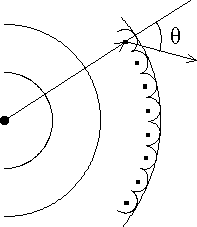
One of the basic ideas in optics--and one of the student's first what-the-fuck moments--is Huygens' principle, which he imagined as a physical explanation. Huygens averred that a propagating wave--whether in matter or (as he thought of it) the luminiferous aether--was in fact the sum of a whole bunch tiny spherical wavelets, which could be thought to exist at every point in the advancing phase front, which all superposed to form the wave as it was observed. As the wave progressed, new wavelets would be generated and propagated forward too. It went far (and goes far) to describe phenomena like diffraction of light and other waves when it passes through an aperture.

This was in the seventeenth century, by the way, contending some of Newton's famous points, and it's interesting that the physical interpretation apparently came first. (Maybe I should check this? People were monkeying with infinite series by then and maybe it informed the idea?) Auguste Fresnel (remember him?) fixed one of the big basic hangups before too long (spherical wavelets needed some justification for not radiating backwards as well as forwards), but it took quite awhile before Huygens' principle was shown to satisfy a general wave equation for propagation (with, I believe I've read, some dubious boundary conditions). And yeah, that's the other great thing about Fourier series: harmonic functions turn out to be solutions for any number of differential equations that you can derive for mechanical motion or electromagnetism. These predict the oscillatory phenomena that appear throughout classical physics, and as you might imagine, a solution that can be represented by a Fourier series, can be represented by more than one Fourier series, or by sums of Fourier series. But that's math. As a physical matter, this Huygens thing remains pretty brazen: sure you can add up the cosines, but is a real wave one oscillation and a zillion wavelets both at the same time?

Huygens' principle has had its doubters, a quiet dissent that's evidently (with a little background reading) persisted. Einstein dismissed any significance of wavelets beyond a mathematical convenience. And Feynman thought that it wasn't the right physical picture either, although by then he was advancing the quantum mechanical nature of light: not wavelets, he argued, but probability distributions, which then sum up to physical observation. (Quantum mechanics can probably be taken as a more "real" picture for the action of fundamental particles, but this idea of wavelets helps out in diffraction of mechanical waves too, which don't need quantum. Quantum mechanics, at least as it applies to electrons in matter, likes to take on (sums of) harmonic functions too, and the huge conceptual leap there is that it evolves probability distributions instead of any clear picture of motion. Which isn't so bizarre until you try to wrap your head around the idea that these fundamental particles are odd physical things. I won't pretend to any useful understanding of QED, however.)

When waves travel through some medium, they cause sympathetic disturbances within it, and any amount of localized funny business ensues, propagating waves interacting with the vibrations they excite in the first place. (It occurred to me recently that I've spent years now, off and on trying to artificially create physical media that capture the quantum or the classical dynamics explicitly, on larger-than-usual scales.) Classical wave theory can get you pretty far even in these modern times. Generally speaking, it gets more challenging the more the waves interact with their media, and there are any number of degrees of description between, say, Maxwell's equations in free space and an entirely quantum picture. Acoustics generally works fine only considering matter as a continuum (but quantum vibrations exist, which matter in some fields).

When waves in media get intense, they can alter the properties matter as they pass through it, which can make the (classical) physics a lot harder. I don't know much about nonlinear optics, but when I've dabbled with nonlinear acoustics, second-order terms in various power series could be developed to explain those high-amplitude phenomena--you take another expansion to bring those second-order effects into reality. (Coincidentally enough, adding up powers of cosines, which you might do for that nonlinear acoustics problem, is basically the same thing as adding up harmonics of cosines as in a Fourier series, by virtue of some basic trigonometric identities. "Second order" often means the same thing in a conversational sense.) So a second harmonic can be teased out of the power series, a double-fast wave which the superposition principle tells us could have really been there all along. Sure, it's the next-best mathematical formula, but damned if the frequency double that evolves in a real measurement doesn't look a pure thing all by itself. Was it there lurking under there under the primary wave all along?

(How to get a moron out of a tree? Wave to him. Get it?)

Tuesday, May 19, 2009

Roamer, Wanderer, Nomad, Vagabond

My father sometimes requests that, should the unlikely combination of loneliness and health occur simultaneously late in his life, he simply be released into the wild. From some dark hidey-hole in the shrinking Connecticut backwoods, he'll range around, tramp on needles and leaves, and wear a circuit back and forth to his favorite places, emerging occasionally from the boughs to accept charity, scare children, or tell stories to willing listeners. His clothing will tatter--he'll definitely have to get a hat for the ensemble--and his beard will get appropriately bushy and twig-filled as he takes on the role of Local Color, a rarely-glimpsed town phenom thrown back from an earlier breed of vagabond, Crazy Old Man So-and-so. They'll tell stories of the old man who wanders the state land, and on certain summer nights, teenagers will imagine sprightly fiddle tunes echoing across the reservoir for decades after his demise. He will probably miss eating meat, drinking beer, hot water, and talking to people, but of course, I'll know some drop-off points, and will check in regularly (beneath the notice of the Law, not to mention well-meaning relatives), as he fulfills a final lonely dream of mapping the details of the geological and rotted-out cultural landscape of what minor folds of southern New England forest as remain.

Hey, if the old man can fantasize about doing it, I can fantasize about enabling it. I'm rooting for anyone who can buck the trend and reinvent their existence a little, on their own terms. In my dad's case, however, it's hard to imagine a good way to cross the arc from civilization and family to a solitary hut in the woods.

The Leatherman In the old neck of the woods (so to speak) where I grew up, Dad would be following some of the footsteps of at least one famous old eccentric, who camped in a number of wooded caves (less wooded than now). The Leatherman was one of those nameless drifters, special in that he managed to acquire local acclaim, forever making a clockwork circuit of southwestern Connecticut and eastern New York, covering the 365-mile loop in a dependable month, regardless of the weather. His nickname name came from his obviously home made clothing, and his caves have since been discovered, and named. One of them is a pleasant hike not far from my parents'.

The Leatherman must have suited the contemporary conception of an 1860s vagabond, must have touched something that otherwise felt lost to the urbanites and farmers of his day. Or maybe it was just the fact that he showed up so regularly that his returning presence was comforting to the locals. The Leatherman was given special dispensation to roam through the towns who'd otherwise outlawed vagrancy, and he was the frequent recipient of charity, gifts of food received on the back steps, and frequently eaten in the presence of the givers. Sometimes he bought supplies, using unknown means.

A local paper gave the Leatherman a proper name, and storywhich looks for all the world like some crappy Victorian melodrama. If you confine your reading to nineteenth century novels, you'll take home a mixed view of madness. Idiocy wasn't much loved, but there was endless intrigue in what makes a human let go of worldly associations, some bittersweet drama of betrayal or trauma. And the American stories were brimming with rugged individualists and wandering frontiersman. During a forced hospital stay, the Leatherman was pronounced "sane but emotionally afflicted," whatever the hell that means. I have to imagine there was a lot of emotional affliction seething just under the surface in those years, among that surviving generation. Even in the best of times, to be alive is to be emotionally afflicted.

The economic shakeups of the Civil War and industrialization made for lots of vagrants in the Leatherman's time, and a new means of travel got them a new name, but with an exception or two, that shit obviously got old soon enough in gentle society, to the point of public complaint about the tramp problem. (I think it took a big injection of the recently stable into the ranks to bring a measure of romance to the life of the Depression-era hobo.) The Leatherman's days must have had many less-loved wanderers and hermits floating around. The public attachment to this man, must have been tied up in what literary torment he invited. We seem more fascinated with the voluntary outcasts, with those willing to go feral by conviction or by choice. I guess the more mundane tragedies that force a body into rugged individualism don't carry the same dramatic depth as the martyr's self-imposed exile. In the case of the itinerant tramps, there was an issue of strangeness that the Leatherman had overcome. But did the mere wanderers-about-town enjoy the same kind of charity he did? Did the madmen holing up the town woods? Did the urban homeless?

And you know, there's always a temptation to look at the road ahead and just keep going. And always a good reason to turn back. The woods thing is my Dad's unlikely fantasy--I'm still working out my own pointless cubicle dreams, which involve a more urbane sort of withdrawal, a less dramatic restatement of principles. I'll let you know if I figure it out.


(Here's a bonus documentary on the leather dude. Stay away from tobacco, kids.)

Saturday, May 09, 2009

Crepuscular

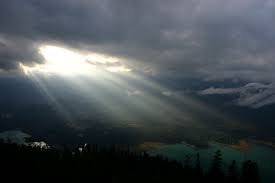
The Eye of God If you're ever lacking evidence that the world is a set, that it's some elaborate and nearly-convincing ruse built to test your endurance against injustice, uncertainty, and some unconscionable proposition of inevitability (and who's testing, you might ask, and isn't the whole experiment more than a little unethical, and what the fuck, why me anyway, who does that make me in this whole ridiculous equation? ...well, never you mind about any of that), then the place to look is up. Sunbeams stretch out misleadingly from breaks in the clouds, and spread like divine fingers to the earth, or maybe like some benevolent or retributive holy gaze. MAD Magazine ruined meI've often taken sunbeams reaching through the clouds as a meaningful representation of God, casting His beatific essence from the sky to the earth, a view supported by a wasted youth of studying comic illustrations.

But it's a fake, right? A prop? If you think about the alleged distance of the sun to the earth, not to mention the relative diameters of the bodies, then we're talking a mighty slim solid angle. These photons are clearly jetting down to the little blue globe like soldiers in a column, marching at lightspeed to cross this uniquely flyblown orb all in line. There are, like, five spotlights hereThat's the story, anyway, and I call bullshit on it. It's bad enough that y'all act so unconvincingly, but at the right time of day, the awkward backlights couldn't be more obvious. What else am I supposed to think? And if it looks bad on the ground, get up in an airplane at one of the crepuscular hours, and witness, motherfucker. The sunbeams splay out from a dozen spotlights that are plugged in at various points only just barely behind the clouds, each converging at its own infinity, and not a common one. I can only believe they're quietly clicked off in sequence by the Cosmic Designers when night is designated to commence. In any case, wherever the beams finally do co-locate, it's some point a lot closer than a hundred-million-mile-distant perpetual H-bomb. As if.

I expected a more exotic explanation when I finally got around to looking this business up, some unlikely scattering event at the edges of the clouds maybe, or perhaps some ramification of being forced to shine through the dynamic array of cloud droplets. But it's nothing so complex as that. The image of sunbeams is a boring matter of perspective, more like watching the road recede infinitely before you and converge to a point than a sophisticated manipulation of the light. The counterintuitive trick is that the opening in the sky is the size of a New England county, and the sky itself is more enormous that it looks, at least a mile or two distant depending on the altitude of the phenomena. The perspective is greater than it appears, and yet, and yet...

You can spot crepuscular rays whenever light is shining down through a hole in the firmament and there are enough scatterers to make it look like a beam, and, as the word suggests, they're more likely to be observed at the right times of day. Vertical I hadn't realized it when I first thought to complain about the phenomenon, but there are anticrepuscular beams up there too, streaks of light pitched clear across the opposite horizon, that complete the other half of the surprising arc, and on rare occasions (I read), you can see the beams stretch across the length of the sky. Great, and now I'm going to be looking for them.

My favorite beams are the ones that streak out right before sunrise and just after sunset, that unitary burst, when a single ray streams vertically from just below the edge of the world, a godly claw reaching up to the sky to carve a path for the rising fireball.

It's backlit!Although the optical effect has grown into its definition, "crepuscular" is an unworthy word for this chunk of atmospheric beauty. It sounds, well, like crap. I can understand the motivation to attach a better significance to the way the light arcs across the sky. Jacob, it's said, could climb the ladder to heaven along these beams, and the Greeks believed (or preferred to believe) that water ascended by these illuminated staircases too. Rain had to come from somewhere, after all. I don't know if the Maori picture of roping back the sun is unique to their culture, but it's the favorite story I've found so far. If the old Polynesians had managed a more developed science of lighting before Whitey stumbled in with the muskets, then maybe they would have picked up on the multiple point sources before I did. I like the idea of lassoing flaming giant back. It's a myth with the right attitude to confront this obnoxious and glorious illusion.

[I had this post in mind before Smutty got going on about paddling the midwest in the prime of his life, but here's a bonus sunburst. His series is a great one. This is one of his photos.]

Out of the loop

Friday, May 01, 2009

Review: Call of Cthulhu and Other Weird Stories, by H. P. Lovecraft (edited by S. T. Joshi)

Yes, I have been aware of the hints in that accursed book of the incipient horrors of the sleeping Old Ones, and sure, I too have received witness of His recent presidential campaign (infesting the dreams of sensitives is a less effective campaign tool than phone banking and booking TV spots, turns out), but somehow, for all these years on the internet, I've never managed to pick up any of the source material before now. Now that I've read a collection of Lovecraft short stories and novellas, I can finally get in on the jokes, which, of course, should put an end to their humor once and for all.

As a writer, Lovecraft occupies an interesting transitional space between the nineteenth century horror (he reeks of Poe and Shelley, especially in his earlier stories), and pulp. The usual vibe is that of a dime novel doctored up with a satisfying facsimile of Romantic prose stylings, horror conventions, and histrionics. Throw in some genuine bits of underlying cleverness, a continuity that spans pretty much all the stories, goofy but oddly compelling alien names, and some quality local scenery, and I get the appeal. And Lovecraft does deserve credit for the new directions in which he took the horror genre, replacing the gothic supernatural environment with a malevolent, impersonal science fictional universe, advocating rational inquiry, but leaving the horrors of the cosmos still beyond human explanation, but still looking for it the spooky old places and populating it with scary beings. It makes for a really odd mix: stylistically, thematically, like some kind of nerd horror. I couldn't really let go of the image of a prissy boy Howard writing stern letters to the pulps over their editorial standards; I pictured him tearing through unconventional texts like the young Victor Frankenstein (or his young creature), letting their presumed truth lead to his own bizarre interpretations; I pictured a young traveler defensively clutching his valise to his chest on a train as he follows through with his various New England correspondences.

I loved Lovecraft's old New England--I recognize a lot of the places--but it's an unlikely place to expect to find eldritch beings, having been populated (by people Lovecraft would recognize) for only a couple hundred years. The old places the author knew were the backwoods of the Northeast, and the old people were isolated Puritan farmers mucking about on dilapidated homesteads on the distant outskirts of small towns. Lovecraft frequently tried to work in some metaphysics involving ancestral human memory though, and was completely disinclined to entertain any Christian mythology to develop those ideas of ancient evil (although I suppose The Festival and Nyaralthotep come a little closer than some of them). How well any of these themes work within the limitations of the setting depends on the story, and I think the fact that even early America isn't so very old is what pushed Lovecraft to populate stories with his memorable aliens.

In addition to the contention between setting and theme, Lovecraft also often suffers from deciding badly what to tell and what to show. It's as though he absorbed the lesson that horror is sometimes better hinted at, but it took a lot of practice to get the hang of applying it. I rolled my eyes at all of the unseen and unnameable. When he does decide to describe more, the stories are invariably better. The Colour out of Space* creates the best presence out of the collection, doesn't shy so much from describing the extraterrestrial decay infecting the countryside, logs in the most details of the adversary, and for that matter, captures the Massachusetts countryside best (it's the Quabbin reservoir!), and is easily the scariest and most intriguing entry of the bunch.

The earlier stories don't find their balance as well, and probably the author thought so too, compelled as he was to revamp some of his first takes. The Call of Cthulhu is obviously Dagon rewritten, The Shadow over Innsmouth is Arthur Jermayne with fish instead of apes. Cool Air uses the same ideas in Herbert West: Reanimator to tell a story that doesn't suck so much the second time around. As far as the compilation goes, I don't think it was a good idea to present Lovecraft's work chronologically to new readers. There are a couple decent Poe pastiches early on (The Outsider and The Hound), and the very short pieces present nothing particularly objectionable, but when the editor tells me in interminable footnotes that Lovecraft found this or that story overwritten, I kept thinking, "how could anyone possibly tell?" Lovecraft sure likes to pile on the macabre adjectives, and to a character, every one of his good skeptics is on the verge of suicide in superlative despair. His scientific minds, again like Frankenstein's, were cursed with a curiousity that was unable to bear the revealed evil when it goes too far. (Didn't any of these scientists find some of the less-malevolent aliens just plain intesting? Fuck it, but I would have thought long and hard about putting my brain in a can for a chance to see Pluto.)

When Lovecraft does find a place for all of his diverse influences, he can get a good story out of it, and he does have a fair knack for unsettling dreamlike imagery and for digging deeply into local scenery. It's worth reading, but I'd probably recommend going after the four or five stories in the canon and leaving it at that.


* Although let me say that this business of "no known color" annoyed the hell out of me. Color is that set of electromagnetic radiation that people see, the stuff that is known by definition. Something colorful in some other part of the spectrum doesn't mean it's not colorful in the visible, and people ain't going to see it anywhere else. I'll cut Ambrose Bierce some more slack, but The Damned Thing, which Lovecraft is borrowing from here, and which I've improbably read, was also annoying.

Saturday, April 25, 2009

Breakfast Sausage Party!

I love sausage a lot more than it deserves to be loved. In a purely gustatory way, mind you, not that there's anything wrong with that. Just thinking about its steaming meaty stiffness, the burst of juices in my mouth, the fatty drizzle as I prick it with my fork... well, never mind. With the better stuff, you can at least pretend it's made from identifiable cuts of meat, but as far as I'm concerned, a nice succulent and spicy Italian pork sausage with plenty of mystery gristle is where it's at. (My good wife sensibly disagrees, although the homogenized turkey product she insists we buy instead is hardly a substitute. If I'm planning on a Saturday meal when she's working, then sometimes I'll go out of my way to get my greasy hands on the store-made snouts-and-tails special.)

On the other side of the Mason-Dixon line, they know how to breakfast, I'll give them that. A land that laughs in the face of heartburn. When I travel, I try to be sure to pick up biscuits and gravy if I get a chance, although like a number of staples, I've got my own thing going by this point, and tend to be slightly disappointed on the outside. Mine's a healthy beige, instead of paste-white, and gets a little more flavor going than pepper and Jimmy Dean.

Also, there's little excuse not to make your own baking powder biscuits. It's a hell of a lot easier than making real bread, and it's well worth avoiding that tangy evil that comes in a prepared package. (And there is just no logical excuse for the existence of BisquickTM, for that matter: inferior result for the exact same amount of work.) Which isn't to say that there's not still a touch. My wife's biscuits are consistently more attractive than mine, but I can, uh, wield the sausage in an well-practiced but imprecise way that she simply can't match. It makes every biscuits-and-gravy morning like the Gift of the Magi.

A lot of times we'll do this when there are either leftover biscuits or leftover sausage. If you use fresh sausage (I like "breakfast" or Italian, but no doubt you can experiment here), then use the oil evolved from the sausage for the recipe, and go easy on any extra herbs (except the thyme). I'm going to assume that you're using leftovers, or forced, like me, to make turkey taste like something. When I make this basic bechemel sort of sauce, I don't worry about how much oil (it's the flour/water ratio that gets your thickness, and the oil is just to disperse the flour first--a little extra won't kill it), stir the flour in it, and then add liquid until I get to the consistency I want. That way is easier than measuring. (Baking, you do have to measure.)

The recipe for the sausage gravy came originally from a Sheila Lukins cookbook, and the biscuits came from Mom, but of course I've fucked with them both. Buttermilk has a nice flavor in this, and it's great with baking powder breads--a little extra acid to get that nice bit of, um, fluffing everybody likes.

The gravy might get a little skin, but if you don't have a wife, make that first. The biscuits are too good hot out of the oven.

Sausage Gravy
- 1/2 to 1 pound (I am pretty sure I normally go on the low end) of turkey sausage or leftover sausage
(Or you know, use the good shit, and skip the next few ingredients, up till the flour. I try to add my spices to compensate for lesser links.)
- three or four tablespoons of fat (Often I'll use butter, olive oil, and chicken fat skimmed off the frozen stock, in roughly equal parts. But it's all good.)
- about a teaspoon of ground coriander
- about half a teaspoon of fennel seeds (if you like them)
- about a teaspoon of fresh black pepper
- about a quarter teaspoon of ground red pepper
- half an onion
- 1-2 cloves of garlic
- 3 tablespoons flour (or so...I use a little less than the quarter cup that sits in the flour bin)
- 1/2 to 3/4 cup of chicken broth (if you must use a can, add the whole friggin can, and then hardly any milk)
- 1/2 to 3/4 cup of milk or cream (basically, you add it until you have the texture you want when it's hot)
1-2 tsp fresh thyme

Cook the sausage and onions together in a pan, adding as much fat as you need. (If you use fresh good sausage, rinse the pan with water and cook them slowly. You probably won't add any fat.) You should have maybe 3-4 tablespoons of fat when they're done. Add the garlic and cook for another minute. Add the spices.

Add the flour, and stir it until dissolved (and pasty). Turn up the heat and quickly stir in the stock until the liquid is thick and homogeneous, add the thyme. Mix in the milk until you get the consistency you want when it's hot and bubbly. Turn the heat to low, and wait for the biscuits.

Baking Powder Biscuits
- 2 c. flour
- 3 tsp baking powder
- 1/2 tsp salt
- 2 tablespoons cold butter
- 2 tablespoons vegetable shortening
- 1 c. buttermilk.

Preheat the oven to 450 degrees.

Sift all the dry ingredients into a bowl. Add the shortening and butter, and cut it in. (In the past, I've advocated doing this with your hands, but my wife uses a pastry cutter, and her version comes out better. So do that. When she's done, it's pretty well cut in, it appears about as granular as road sand (an analogy no good southerner would make, by the way).)

Add the buttermilk, and mix as little as it takes to just blend it. Drop the sticky dough onto a well floured surface (MGW uses waxed paper here, easier to remove and clean up), and press to about 3/4 to 1 inch thick (this is critical! Too thin here, and you get dusty hockey pucks). Cut circles with a cookie cutter or a floured, upside-down glass. (Mom says don't twist. I've never figured out if this is bullshit or not.)

Bake 12-15 minutes. They should be just golden brown. When you open the biscuits, they ought to flakily split down the center (making two skinny pucks), and steam awesomely. Split them, and spread the gravy over the tops. Don't forget to visit your heart surgeon in thirty years.

Tuesday, April 21, 2009

The Urban Gardening Project

There are at least three things that grow exceedingly poorly on my quarter acre: grass, roses and vegetables. And for perspective, it's been long enough now that the grass has finally almost filled in the old vegetable garden, or at least filled in according to that piebald way that passes for a lawn here. The section is still tastefully cornered by a bed of perennials and bordered by a row of sickly roses, which are gradually and mercifully getting subsumed by plants that actually thrive in our sandy verminous soil. We're slowly learning which plants do and don't, see, and surrounding the sorry things, gradually figuring out when to plant grass, and where to just give it up to landscaping, and god help me, I've mentioned it all before. Suffice to say that it looks nice in the spring.

The lofty goal of all my landscaping effort is to achieve a state of minimal maintenance, perfected for independent natural(ized) and vegetable beauty. If the grass don't grow, try a perennial, or a gravel walk. The devotion to chemical lawn care is one of the more horrifying suburban sins I can think of, and paradoxically, I'm willing to expend a good deal of backbreaking labor to get to that point where it all just glides along without my guidance, hand-weeding invasive species so that the (allegedly) locally appropriate population of grass blend can have a shot, and not fretting when it turns naturally arid in the summer. I've put together a list of ground rules for yard projects:

1. use space well (grow stuff only where it grows)
2. be beautiful (and obscure the neighbors)
3. utility is a bonus
4. cost approaching zero (sustainability, baby)
5. maintenance approaching zero
6. there's no goddamn rush (except when there is)

The old vegetable garden failed in the beauty, use of space, and maintenance deparatments--actually it failed in utility too--but I've always felt guilty about abandoning it, especially as I hunger to stuff my craw with garden-fresh goodies every spring. Last year, my mother gave us a cherry tomato seedling, and we just potted it and let it grow up along one of the filigreed black columns that almost hold up the carport. And bingo: it's the same wholesome experience but now interpreted in an urban-compatible way. The mere act of using a pot managed to nail criteria one through five. No more impoverished plants and bales of weeds; just a tasteful salad-enhancing accent to an already pointlessly trellissed corner of the house, watered and harvested occasionally, and otherwise happily ignored. The small herb garden is another floral success. Tastefully surrounded by perennial flowers, the chives, mint and oregano come back every year, and I can plant the other stuff in the spring, and otherwise forget about it except when needed or when I care to enjoy the view and the aroma. Urban gardening just fits the location better than keeping our own private Dust Bowl going.

This year, I'm expanding the project. I've got some more wrought iron corners to support a few more pots of tomatoes, and I've got the idea to plant a halo of shallots (a nuisance to shp for in the benighted 'burbs) to fill in the lower reaches of the plants, and to get more produce out of the same tastefully occupied space. Similarly, I came across the idea for "vertical potatoes" somewhere, where you stack up old tires and add dirt around the plant as it grows over the summer. The tubers grow in each new layer of dirt, yielding, the advertisement goes, a substantial poundage of taters per plant compared to the space-intensive horizontal yard plot. Old tires aren't very pleasing to the eye, of course, and I made up some modular, stackable planters to house the spuds as they grow, and cleverly located them near the tomatoes' nook (it's the second-choice location, but my wife convinced me to try the experiment in better sun first), and painted them to match the house. If it works, then I'll spread out a few more next year.

It's the optimization game that really motivates me here, an ongoing engineering project that is somehow a lot more gratifying than anything I ever attempt at my actual job. I have this fantasy that I'll be mentally prepared to endure the dystopic future when the big machines all sieze up as a statement of God's wrath, and I'm thankful to supplement my diet of overlord-surplus soy gruel to whatever extent I can. Okay, that's exagerrating (and yet it's a disturbing running theme), it's really more the geeky thrill of living an efficient life.

The no-cost criterion is an important one, and usually overlooked for us modest suburbanites. What's worse than spending two hundred bucks on an ugly gardening project that yields a three dollars worth of nasty wizened produce? The potato planters rose from hoarded bits of surplus lumber (that experienced carpenters sanely refer to as "shit"), free and scroungeable from one of the zillion condo construction projects still mysteriously underway. And to be clear, I'm talking utilization here: any urge to store potentially useful crap is counteracted by an extreme resentment of undesired crap taking up my precious living space. No pack rat, me, and the odds and ends are stored in perpetual purgatory. Eliminating clutter, but shunting its imminent ride to hell, is another motivation for actually doing these things. I can't stand to see it sitting there, and I hate to waste it.

This year's vertical potatoes may meet some of my guidelines, but they're doomed from a financial standpoint, because I had to buy twelve bucks worth of dirt in which to plant my dollar's worth of seed potatoes, and it's hard to imagine recouping that cost. An aggravating development to be sure--buying dirt--but it has inspired my most brilliant outdoor project yet. Yup, the new compost bin is cleverly situated behind the woodpile (tree work and an ice storm--it feeds my fire pit) on a lifeless piece of forest floor behind the shed, where only the hated neighbors can really witness it's undesirable nature. It consumed the huge leftover beams from the shed, and I'm gradually tacking the sides up with suitable-only-for-burning (but free!) pallet lumber. It diverts a fraction of my natural waste stream toward consumption, making my household notionally more sustainable, and it makes the lousy microfauna work for me, dammit, rotting something useful instead of my precious roots, to ultimately turn my garbage into dirt I can finally grow vegetables in. I'm a genius!

Tuesday, April 14, 2009

Review: Frankenstein, by Mary Shelley

Frankenstein is such a fundamental piece of Gothic horror (or Romantic literature, depending on your preferred classification here), reinterpreted and refaced in so many awful ways, that getting back to the source is much like knocking off generations of spackle and dirt to get a look at the original design with new eyes. Well, sort of new: I've held on to one passage of Mary Shelley's novel with suffient clarity to imagine it as one of my personally influential literary tidbits, a fact that is made odd by the mental blank I had for the rest of the story. None of the other plot and theme came back to me on a reread, and I must conclude that those five paragraphs where the creature identifies the lovely moon from a storm of unformed sensation is all that I had ever read. (I've also never caught more than a five-minute segment of any Frankenstein movie not made by Mel Brooks. So it all works out.)

As a whole, the novel suffers mildly from the literary sins of the period: it rambles, in terms of pacing, language and location; it's dripping with overwrought emotion of every flavor; and every character is a naturally gifted windbag with a rich command of adjectives and sentence structure, and is possessed of an uncanny skill to accurately recreate someone else's lengthy spoken reminiscences. The characters need this ability, because the novel actually employs multiple framing devices, nested within one another. The whole text is formally contained in an explorer's (Robert Walton's) letters to his sister during a failing arctic expedition. He finds Victor Frankenstein dying on an ice floe, and the record of the scientist's story of hubris and attendant consequences includes the creature's story, reported at length when he meets his creator. It's awkward, and it distracted from the book's more compelling parts.

The scientist, as we all know, fabricates a creature* but then abandons it in an epiphany of horror. Terrible events follow, perhaps invetably so, thanks to the character of man and, well, man. Shelley is subverting some of the conventions of her times here. Frankenstein is meant to evoke pathos. He's painted with such effort as sincere and empathetic (with one big exception), but he is also intentionally something less than noble. His neglected responsibility is not forgiven, and his family is ruined at the hands of it. He's the Prometheus of the subtitle after all, who has damned both himself and his creation by the act of granting knowldedge. His fervor, illness, and later misery are not symptoms of madness, as a hundred shitty knockoffs would have you believe, but workoholism toward a noble goal, that leads to personal tragedy. The introduction** made a reasonable case that this is an early feminist critique of the male-dominated field of science. Obsession is not the fatal flaw in the Greek sense, it's more like a gender problem. It doesn't undo the men (Walton is also on a consuming quest, and so is the creature), it infects their character at all levels. It's unfortunate for readers that Victor is given such an operatic streak, where even his happy emotions are expressed in the superlative. The book succeeds easily in evoking the sense of Frankenstein's self-involvement, but it took a lot of murders to register any empathy for the guy--I had no idea why all of the wonderful people he described ever thought to love him.

[Frankenstein is usually considered the first science fiction novel. Morality plays aren't foreign to the genre, and like her heirs, Shelley gets at her metaphysics by way of physics (or near-physics), taking the conceit that would eventually become the hallmark of nerd fiction: not "merely weaving supernatural tales," but relying on science that "affords a point of view to the imagination for the delineating of human passions moer comprehensive and commanding than any which the ordinary relations of existing events can yield."*** Well, and good, but it makes the above reading kind of an amusing chore for SF geeks. A science fiction novel that played to the usual modern sensibilties would have celebrated the devotion to craft a little, wouldn't have neglected the cool details about the project that kept the man going. Shelley hid the half-built creature on the table without description (it was evidently built bottom-up, and something much more interesting than stitched-together body parts), and begged off on describing the reanimation process (no wonder filmmakers would get googly with the lightning bolts). Frankenstein is perhaps better appreciated for the small handful of modern Promethei that eventually followed in the doctor's footsteps, but I don't see the scientist who turns his back on his success as the norm, really. In Frankenstein's case, creating life doesn't necessarily pass my test of soul-crushing horror--it's certainly not enough that he's ugly--and I don't understand the doctor's lack of empathy for the sad being on the table.]

It also took a depressing quantity of murder to make the creature fiendish. From the beginning, he is the most engaging member of the cast, forced to develop his consciousness and his morality unguided. Learning the art of being human from Milton and from surreptitious observation, hungering in obscurity for the familial acceptance that his appearance forbids him. His behavioral development may be called simple--he is motivated from hunger, loneliness, and anger--but his intellectual character is clearly more multifaceted than Victor's, and at least as capable. He's more honestly contemplative of his own nature, and his simpler desires are the more poignant because of it, and more sincerely lamented. His confrontation with the cottagers is the best scene in the book, as the creature lays his hopes of human kindness on a confrontation.

In his lesson from Paradise Lost, it is strange that the creature should reject comparing himself to Adam and put himself in the role of the envious Satan instead. Lucifer occupies a similar mythological space as Prometheus, which is to say, damned for effort. Adam, the being reasons, has the comfort of knowing his place in creation, of acknowledging a benevolent creator. And he's got it exactly wrong. The creature is unique in knowing where he came from (even if it's not fulfilling to know), and it's we poor bastards in Adam's role that must suffer along without a place in the universe, struggling with the ideas of inscrutable mythical beings. Frankenstein fits Prometheus well enough as a flawed shaper of clay, but bringing Paradise Lost into it, it starts to spell out the same implication or the big good Daddy Himself. In truth, both the man and the creature take on multiple matching roles of nobility, genius, and unfortunate capability. She does link their creative monomania, for example. "A frightful selfishness hurried me on," the creature exclaims over the body of dead Frankenstein, "while my heart was poisoned with remorse." It is interchangeable with his maker's lament about his project. There's one part Adam in there, torn up by the misery of his existence, and one part Satan, who acts on it. It's hard to be (hu)man.


* Really the right word here. He is not a monster, but he has been created. We might call him artificial, for similar etymological reasons.
** Walter James Miller, in the "Signet Classics" paperback edition.
*** from the preface.

Tuesday, April 07, 2009

Defense Budget

So there are new funding and procurement priorities for the DoD budget. They'll almost certainly affect the nature of funding for whatever exactly it is I do. A push toward more practical soldier-level defenses will probably favor the more dinky, nimble research outfits a tiny bit more, even while it rewards less basic research, which basically continues the trend toward ever more applied R&D that Defense has been going on for as long as I've been working.

But by the same token, I don't share the enthusiasm about seeing some of the big boondoggles go. I support budget innovations for taking care of wounded soldiers, addressing family concerns, and improving safety of the people on the ground, but it's hard to deny that they'd be even safer if they weren't fighting. The budget priorities reinforce a national commitment to soldiering, to warfighting as the parlance goes, and removes some of the comforting notions we like to tell ourselves about this big cash monster that is our defense budget. One of the appealing things about the technological military, much like the volunteer military, is that it diverts our attention from the things militaries actually do. I don't mean that just in terms of sanitizing the idea that people are getting killed out there when all you see are clean people in cold white rooms, but heavy investment into developing something that isn't likely to be used in war also keeps up the idea of a (relatively) benign standing army that is reserved for only potential threats, where we just dump that money into big piles of planned obsolescence without killing too many people in the meantime. God knows it keeps communities afloat, but defense contracting is a welfare program for eggheads too, where the big primes can soak up the excess semiconductor guys, and optics guys, and materials guys, and mechanical guys, and give them jobs and a place to use their skills. For the little league, the DoD and related entities are also supportive of anything that can be sold independently of Defense, which is a good thing. It may be wasteful, but in some ways I'd rather keep geeks working out advanced technical gizmos than releasing mindless leagues of shovel crews to the highways.

And this budget, if it's indeed repurposed toward warfighting (which is going to be hard to get past the representatives of boondoggle-rich districts) takes that fantasy away just a little bit more. You sort of wish the public sector would procure solar energy or something instead.

Tuesday, March 31, 2009

Five More Thoughts: Let Them Eat Cake Ed.

Don't we all wish I could shut up about this stuff? If you're tired of sarcastic half-baked economic thoughts, skip to #4. If more suspicious foodie-ism isn't your bag, just go to the last one. If the antics of clueless fathers and husbands bore you too, then I guess I'll review another book eventually. Does anyone remember when these things used to be frivolous?

1. Warmed Over Red Meat
Like most Americans, I've developed a growing animosity toward the financial management of our country. In my case it's tempered by a certain long-term, big-view fatalism, but still, I look at the criminal Madoffs and whining DeSantises compared to my negligible prospects of ever getting out from the immobilizing weight of debt--never mind the prospects of ever getting rich--that a prescribed life of education, family and salary stick you with, and I can understand revolutionary fervor. Then I think about the sickening possibility of actual mob violence, and how the mob, when it has managed to win, has tended to produce mammoth injustices of its own, and I downgrade my smoldering class resentment into patriotic-feeling thoughts about the threat of the mob when the aristocracy gets out of hand, and, short of violence, how great it would be to put these motherfuckers in a position where they have to work to get by like the rest of us.

So I settle on the happier counterfactual where R&D is remunerative and finance is an exhausting niche for overspecialized geeks. Because that would be different, oh yes, the believers in reason would rule the world at last! Unfortunately, and speaking of working for a living, this leads to speculation about what exactly it is I'm producing, and then to the conclusion that I've spent nearly a decade leveraging my limited technical skills to a similar (over-)extent as the banks have with their finite capital reserves and debt obligations, selling the idea that someone down the chain will come through with the intellectual goods, or that my own skills will catch up in time to perform the increasingly unlikely stuff I propose. I suppose financially lucrative R&D would also attract a different kind of scientist, and companies like mine would be filled to the rafters with confident young men with more attitude than talent, and the halls would be thick with power ties and greasy smiles and stress. Even more marketing, in other words, to the eventual exclusion of any product at all. Then I sigh and go back to surfing the net.

2. Manna
One positive thing this finanical mess shows us however is that a gigantic shadow economy based on very little tangible value, can, in fact, exist, at least for awhile. The basic iniquity of this situation isn't that we have a high standard of living based on nothing much, it's that the standard of living is highly unequal within the same system. It doesn't have to be that way, or rather, it wouldn't have to be that way if humans weren't collectively such a bunch of assholes. If it could somehow enter our species' consciousness to do so, we could base an economy on nothing more than telling each other jokes, swapping files, gambling, and blogging. If "productivity" can just grow forever, then that's a logical enough conclusion.

Now, naysayers might argue that someone under that imaginary system would still have to grow the food, maintain the transmission lines, clean up, produce the pictures, and so forth, but the truth is that we have more potential workers than there are jobs needed to generate all the crap that makes us happy. This is true in the United States certainly, where for decades, we have been able to increasingly count on automation, an endless supply of willing menial labor overseas, and plentiful oil energy to make our society go at the pace we enjoy. At some point, we could get out of the "production" mindset entirely, and finally abandon the annoying pretense of distributing wealth by "working for a living," and instead share the sort of effortless ride that the fat cats have been on for generations, without even their ulcers and burgeoning self-importance.

You know, at least for a while.

3.Soylent Green
And hey, we've already solved the challenging half the problem. One thing our--cough-cough--free market economy does pretty well now is distribute the cost of the pesky externalities. Sure there are political ramifications to oil and electronics being produced in regions that live more poorly than us consumers of them. The cost of that delicate diplomacy or that ballsy belligerence (as the case may be) doesn't come out just in the prices, but is also spread out among all of the consumers that benefit from it by other means. (Profits, of course, are another matter.) Similarly, it would be alarming if all the costs of controlling the waste streams were included in the prices of all our favorite products. (Hey, the selenium all leaches downstream, and you can't prove anything.) Can you imagine if the price of invading Iraq went into our gas tank? If the entire cost of cleaning up the shit lagoons went into our hamburger (if, in fact, we thought so far ahead as cleaning up the shit lagoons)? If the entire cost of maintaining the banking sector came only from our retirement savings? If the entire cost of our consumption came from the value of the stuff we produced?

When we hit that fantastic Star Trek apogee of labor-free production worldwide (hey, we'll still have automation), then management of natural and political resources will be the only things left to worry about, and fortunately, that social machinery is already in place. Maybe by then we'll have it pointed the right way.

4. Cake
I had a fourth short rant puttering along when I realize I'd already written it six months ago, right down to citing Doghouse Riley (who you should read in general). While I disagreed with his main point this time around, his complaints about foodie magazine pretensiousness came through loud and clear. We subscribe to a handful of these recipe magazines in Chateau Keifus, which vary in articles from endless filler variations on mashed potatoes to boutique faux-cultural items presented for your envy (I'm convinced that the "busy mom" articles are engineered to be crappier than the "summertime memories of Montalcino" spreads), profiles of unaffordable or unavailable key ingredients, the celebration of a local food culture that never leaves California, or disappears from upstate New York from October to May, to the column on how J. Random Celebrity eats better than you.

And it's reasonable to assume that the pretty people do eat more fashionably than I do: they have more cash, wider travel, and more opportunities to get tired of fine dining. There's a lot going for the skill in preparation, but I suppose you'll never get Mom's meatloaf either. Or something. The foodie-tainment industry has to strike some sort of balance there, but I don't like it when they rub in how hopelessly provincial I am.

5. Spicy Meatballs
While we're on the subject of celebrity food...

"Hey, Keifus, do you know who you look like with your hair pulled back like that?"

"Uh, no."

"Mario Batali!"

"Are you shitting me, dear? The dude is half my height, and at least twice as big around. He wears clogs. Mario Batali? You wound me."

"Well, he does have a beard. And with your hair pulled back..."

"He looks like a giant friggin' pumpkin."

"I don't know what your problem is. I'm giving you a compliment. He cooks great food."

And to be fair, doing something as well as Mario the Red appears to do is sexy. Maybe someday I'll afford to take my wife to one of his restaurants. It'll be payback for years of general relationship cluelessness.

The story might end here, but in the pretend genealogy of housecats I find myself unwillingly Marioed again, and since the children must be the parents of our cats, that leaves me, chillingly, as the grandfather, or "Grandpa Mario," as it works out, thanks to some passing resemblance to the curly proprietor of a famous Japanese-Italian plumbing and pest control firm.

"Mario? Are you kidding me? He dresses like Mickey Mouse."

God, I'm shallow.

Wednesday, March 25, 2009

Hunching Back: A Couple of Tangents

An online Spanish/English arts and literature magazine called Yareah--a myth-and-legend, cultural-roots sort of thing--is evidently hungry enough for material to Google certain occasional book reviewers and solicit them for contributions. They've asked to reprint my review of The Hunchback of Notre-Dame in an upcoming issue (April 1). Their theme will be ugliness in literature, and after all, who's uglier than that deformed little sprout, Quasimodo? I did take the trouble to modify the review a little for their theme, but they're still getting what they paid for it.

Looking back to Hunchback, I was struck again by a couple of thoughts, stuff that didn't get expressed very thoroughly in either the new or old version...

1. The tranlation of Notre-Dame that I read I had really annoyed me with its persistent use of the archaic English "you," filling up the book with thees and thous, which to my jaded ear, reads either like a half-assed effort to recreate the speech of the middle ages, or else a clumsy attempt to recreate the original French word flow. Since I was now submitting my crappy review to a bilingual magazine, I thought I might find something clever to say about the absence of a formal second person in English, which I've never decided is a blessing (given all the people I half-know, I'd hate to wrestle with vous or tu in every single greeting--it's bad enough figuring out who to grandma-hug among the people I know intimately) or a flaw (because after all, it does take away nuance). It's my understanding that the formal second person has been falling out of favor in the Romantic languages too for some years, to the irritation of traditionalists, something on par with how no one in America (not in the decadent North anyway) addresses anyone as sir, and everyone lets kids call adults by their first names. I'd always assumed that the "thee" cognates were the dropped formal forms, abandoned on Albion a few centuries before the continent got around to ditching them. This, it turns out, is flat wrong.

The T-V distinction in English (Wikipedia tells me) originated as a singular/plural distinction, and the weight of formality that it later grew stemmed from the early French habit of turning the king into a pluralized synecdoche for authority. In other words, the respectful use of vous comes from the French royal we,* and the old English plural "ye" took on the same pattern following the Norman injection of 1066. "Thee" is the old singular form, and it came into use as the informal second person for the next 600 years. Cast thee back, varlet!

So in English, the informal/singular form is the one that eventually disappeared. The whole thing is complicated by holding on just barely long enough for Shakespeare to intermittently use it, by later bad authors of archaism, and by persistent religious use (from bible translations which adhered strictly to the singular/plural distinction, and not the informal/formal one--it's interesting that the "thee" got that dignified sense round about the time of the Reformation, reducing God to an informal invisible Buddy maybe, or alternatively enhancing the status of the singular pronoun because, hey, you don't sing how great Thou art to just anyone) which lent the singular a new assumed solemnity. In any case, Victor Hugo's speakers were using their pronouns correctly in the 1482 French sense, and I have to conclude that the nameless translator did a fine job after all.

2. There's a lot of madness lurking around within nineteenth century writing. Mental illness wasn't particularly well understood in those days, but writers tend to be good observers, and a lot of those plausible conditions of human nature can be represented without understanding the mechanics of it very much. Those Dickensian crazies really told us more about the problems of the relatively sane anyway, and what shape sanity took in a heartbreaking time that was filthy with disease, religious injunction, poverty, and death looming around every corner, but still cursed with a modicum of badly enlightened hope. I'm not 100% content with modern descriptions of brain malfunction, either. Diagnosing depression or PTSD or ADD is useful, but absent any real neurochemical understanding, the expertise is less perfect than the guys in the white coats would have you believe. Worse, those sorts of behavioral pathologies seem to get around talking to the basic horrors and absurd beauties of our existence, which, for all their faults, those Romantic-era writers had down in spades.

Putting madness on the same spectrum as physical deformity and moral ugliness fits the Romantic ideas pretty well (and I'll review Frankenstein really soon now, I promise). I'm not sure that it helped their development that these ideas were tied into (if you'll forgive my philosophical naivete) the ideas of innocence and morality that had been recently getting hashed out by the likes of Rousseau and Hobbes, whose philosophies were slowly filtering down to practice for some captive subjects in the middle of the century. Quasimodo is given to us as developmentally disabled (I should stop joking with the word "retarded," but then it's the same thing that happened to "idiot" decades ago), and inhibited cognitively by his physical handicap, which is not a bad portrayal given what limited technical understanding Hugo would have had at his fingertips. The problem is that Hugo was playing with--mostly satirizing--themes of redemption, and even giving Quasimodo a partial transformation through beauty and love seemed a little too credulous to me.

Victor Hugo wrote Notre-Dame at an interesting time in the west's understanding of mental disability. Victor, the famous wild boy of Aveyron, was discovered near Hugo's boyhood home, but the idea that he was a template for Quasimodo is evidently apocryphal. Victor (whether he was really wild or not) was taken as a case study in the Enlightenment notions of mankind's natural state, and it's not surprising that Hugo would entertain similar ideas that his own unsocialized character could graduate to the more touted human qualities through some kind of personal moral Renaissance.

In the mid-1800s, the field of mental health was growing up a little too. The idea that a scientific basis for behavior could be sought led to a greater desire to understand the nature of the handicapped. Previously, and at various times, retarded people had been taken care of in the church, as Quasimodo was, or in the community, or by the public. The thought that idiocy could be understood, categorized, or even cured in some cases, led to a spate of study in Hugo's time, and France, though home of one of the more notorious asylums, was progressive about it in those days. The inmates of Bicêtre were unchained around 1900, and Édouard Séguin, who classified idiocy into four categories based on capability,** was advocating more humane treatment for these people while Victor Hugo was still writing.

Regrettably, early brain science wasn't much up to its hoped-for task, and Séguin's humanitarian notions gave way to awful pseudosciences like phrenology and eugenics, and eventually to a return to mere custodial care for "moral degenerates", giving the science a bad name for the better part of the following century. I wonder if the still considerably qualitative nature of some kinds of brain science slows down the more substantive research, or if it damages public perception, as it did in the later nineteenth century. (Not that I'm so very on top of the state of the art. Where the hell is TenaciousK when I need him?)

(Some google finds that informed this: 1, 2, 3)

UPDATE! Study questions for non-idiots.
1. Was Charles Dickens a Romantic-era writer?
[Well, if you concentrate on "era," then I suppose he was writing at the same time as the Romantics. If you stress the "Romantic," I think he may have shared some of the sensibilities, but was not in quite the same mold. I should be more careful.]

2. For that matter, were all those Gothic horror elements (which was closer to my actual train of thought) part of of the Romantic movement?
[I'd argue yes, although maybe it's an argument that needs acknowledging, since I don't really know how serious literature people tend to view the distinction. These handful of writers I've been reading lately were all about (violation of) beauty and nature, and had all of the melodrama. And even their ugly was beautiful, really.]

3. Did Romantic writers find life's beauty an absurd, unlikely sort of beauty?
[Probably not in the way I do, although it's fair to say they were also struggling to incorporate, or just struggling against, a growing scientific understanding of nature. Bad wording, though.]

4. Didn't a revolution in psychoanalysis occur around 1900, which is, in fact, "well into the next century" after ~1850?
[Well, my criticism of psychoanlysis even now is that it's still pretty qualitative, and in the early days, basically unprovable and possibly even in pathological science territory. But there's a lot of prejudice in that statement, and I don't really have the first clue how the Freud boys dealt with the more obviously physiology-based cognitive problems.

I don't feel too bad about more modern classification of behavior patterns based on observation, and I think categorization of them is more or less useful, although it still loosk pretty qualitative. What little I read now of cutting-edge brain science seems like a different world than these earlier twentieth-century views, even from only a couple decades ago, and also a lot more like actual science than all those behaviorist experiments I remember reading about in that one psychology class.]


* I really should have titled that post "The Royal Wii." Dammit.
** Not those four, Dave.