Showing posts sorted by relevance for query John Crowley. Sort by date Show all posts

Tuesday, May 01, 2007

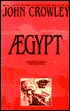
Doorways to Elsewhere IV: Review of Ægypt by John Crowley

Grade: A
Sticking with the external theme here, Crowley's Elsewhere, in a trivial geographic sense, circumscribes the Litchfield Hills, the Catskills, nips western Massachusetts, and maybe the southern tip of the Adirondacks. It includes New York City, sort of by reluctant default, but digs its magic out of the distant and wooded suburbs. Ægypt strays to different continents, and it's a whole lot bigger than eastern New York state, but it's hard to imagine that magic manifesting in any place other than the (fictional) Faraway Hills. (I'll admit that gives it a certain personal appeal.) In previous novels, Crowley has let the mythology of the British Isles immigrate to the Northeast. This time, it's legends of the Renaissance.

Given these aspects of the setting, I'm tempted to compare this novel to Winter's Tale, by Mark Helprin: it's filled with a similar sort of magic-infused history, swinging similarly wide, epic loops. It's got a common quality of breathless observation that's beautiful but ends up all going down the same. With no special destination evident plot-wise, it was an easy enough novel to put down, and it took me twice as long to read as something this length normally would. But of the two, Crowley is really the superior writer. Where Helprin couldn't help himself from pouring it on ever thicker, Crowley prefers to meander inward (and the deeper you go, the bigger it gets). Crowley is better at remembering the childlike dimension of wonder. And as the shape of the story finally begins to resolve itself, it does get more gripping. It's all about having faith that the author is in control.

You could probably say that Crowley pointedly goes nowhere at all. The plot, such as it is, mainly involves a Renaissance historian (or alternate historian) moving from the city to the hills to write a book. This book, most likely. In one of the several self-referential nuggets, he "'would attempt one more book...a book composed of groups ambiguous but clear, great solitutes that look on and look away from each other; a book empty and infinte at its center...' Actually, though...these enormous thoughts were a little premature." And certainly a little bold. Ægypt tries to straddle the transition between any number of mystical dichotomies, and the door between fiction and reality is just one of them. (Whole sections of the novel are excerpts from other fictional histories of magic.) It recursively bridges dreams and waking, heaven and earth, cosmos and microcosm, reality and memory (the universe itself is the ultimate mnemonic palace of the universe). The author character delves richly into Hermetically flavored magic, a Renaissance vision of occult Egypt (Ægypt) brought into being--or maybe into acknowledgement--by nothing more than it's belief. It imagines a universe permeated and held together by countless angels, significant of numerology, full of heretics, Elizabethan sages, and astrological mutterings. In 400 pages, John Crowley takes us through one single door, across which nothing changes but history, and even if it looks exactly the same on either side, the transition is astounding.

[Note: This novel hasn't been in print for some time. The structure suggests that this it is missing several parts (the sections are named after houses of the zodiac and there are only three), presumably as sequels, and he's published others in the same universe. I've not read them yet, but alarmingly, it looks like Crowley's been descending into (more) verbose plotlessness. I'll reserve judgement.]

Obligorati
Author:
Title:
Genre: , , , ,

Monday, May 24, 2010

Media Monday


0. Luv.
I don't watch the televisions at the gym, and can't listen to them (why they haven't figured out closed captioning, I have no idea), but in context, there is no amount of stationary biking I could do, no number of squats--and playing tennis never got me close--that could ever fill out my woefully flat, quintessentially white-guy hindquarters. And that's why I was looking--I'm just sensitive to these things.

I was too far away this morning (and honestly, I was trying to not look) to realize that Venus Williams was, in fact, wearing flesh-colored bottoms on her bottom, and that the presentation spread coverage the attention that was given to her outfit across five simultaneous screens was relatively unfounded. I suspect the usual combination of titillation and disapproval was being employed by the networks, bringing in the entire middle American Good Morning America demographic, both the prudes and the unhappy people they're married to. ABC was definitely showing her off as they scowled, and the local news didn't hesitate either. Oddly, Fox and Friends made their angry faces without highlighting any revealing serves. (CNBC and the NFL network did not mention the incident at all.)

And if she looks that good, well, who can blame her for showing off? Venus is a badass cool.

1. Lost.
I still haven't seen a single episode, not even the pilot, which I avoided only due to the usual confluence of business trips and mild aviophobia. I don't necessarily shun commitments requiring lengthy analysis of lesser art, and even though I consider my time too valuable these days to comb the waste for improbable diamonds, I can't deny that I've wasted many happy hours discovering how the discussion and speculation can blow up into something far more entertaining than the story itself (and sometimes the story can pleasingly confound your expectations too).

Anyway, I got into a conversation with the microscopy guy on Friday about this very thing, and he attempted to convince me (as others have tried) that Lost really did so have it all plotted out from the get-go, and that it's totally worth the five years of your life. I've got far too much invested in being a non-watcher at this point, so I'm not likely to engage until well after the post-mortem, if at all. Nonetheless, it's fun to have opinions, and here's my top five predicitons, based on knowing not a goddamn thing about this show:

  • It was all a dream. (c.f., The Wizard of Oz.)
  • It was all a simulation in which the characters have participated, willingly or no. Something universal about human nature is asserted, in this case probably at the last minute, through the experience. An experiment on humans by higher beings is a likely possibility. (c.f., The Matrix. Also a number of sf books, my possible favorite of which is The Deep by John Crowley.)
  • It was a mysterious simulation, and these characters dissolve in a horrifying fade-out with the realization that none of them are "real". (I'm sure I've read or seen more than one story of this type, but I've got no canonical example. My favorite short along these lines is Forlesen, by Gene Wolfe. Maybe The Unpleasant Profession of Jonathon Hoag by Robert Heinlein qualifies.)
  • They all died in the crash, and the time on the island has been a sort of Purgatory, as they unknowingly defend their lives for the appropriate torment, or else it's the last mad flailings of their minds before they all let go and pass on to oblivion. (The prime example is A Strange Occurrence at Owl's Creek Bridge, by Ambrose Bierce. For a more afterlife-themed version, see the movie, Jacob's Ladder. Aging is such a weird, slow disappointment that sometimes I wonder if I'm really in the back of an ambulance back in 1994 or something, hallucinating the whole thing.)
  • They're participating in some alternate reality, that is possibly just as true, due to death or delirium. The increasing madness of life on the island is a symptom, or maybe an unconscious metaphor, of trying to break free into "real" reality. (My favorite example of this is The Iron Dragon's Daughter, by Michael Swanwick.)

    What do I win?

    2. Iron Man 2
    (Okay, let's note a certain method to the numbering here. Ain't I something.)

    Speaking of surpassing expectations, there was a lot to like about the first Iron Man movie. To be sure, there was quality acting (including the Dude taking a turn as a meticulous, technologically savvy villain) that could sell it, but there was almost a--I don't want to go so far as to label it verisimilitude--there was also a low threshold for suspension of disbelief that let me accept Tony Stark flying around at unsurvivable accelerations and looking totally kickass. It's fairly obvious that they hired a technology consultant for the films, and even if putting a little fusion reactor into his chest made little medical sense (what, it was an electromagnet meant to prevent the migration of shrapnel? That's silly.), what makes Iron Man believable over Marvel's panoply of mutants is that you could convince yourself that these are merely engineering challenges overcome, not outright magic. The reactor in particular was a smart touch, with throwaways that it was a long-running failure by the company. It resembles a tiny tokamak (and the one in their lobby was a a more plausible big one, if you could imagine they'd build 'em with glass walls, or would keep one running down the grid as a demo piece), a real device and actual long-running failure, which is screaming for some revalatory inspiration from a gifted scientific mind. The suit too, in a compelling discovery sequence (a directorial achievement given its length) had its struggles and successes, to the extent that it was believable enough to warrant viewer apology (we assume that Stark Enterprises must have already developed some wicked shock absorbers, etc.).

    Good stuff, but on to the sequel, and we're running into problems. First of all, palladium is a noble metal, and considering it doesn't react with things very much, I am not convinced that it's especially toxic. (Hey Tony, I realize that in the comics universe radiation often gives you powers instead of kills you, but maybe the neutron damage is, you know, the problem.) You encounter this in science, where a limited set of material properties (usually with complicated interdependence) gets in your way and I suppose with enough computational effort, you could identify hypothetical materials that are more amenable (and then hind them in your futurama floorplan for some reason). But a new element? What the fuck is up with that? Did they find a new number between 1 and 107 that no one has thought of before? And that shit isn't toxic and radioactive? Let's ask the science consultant how one might go about doing this. It was great that Tony built a particle accelerator in his garage, on top of old milk crates and piles of laundry, though I'm even more impressed that he could shoulder it and wing around a glowing beam like a laser. (See all that stuff inside, Homer? That's why your cyclotron didn't work.) And all he had to do was hit that little slab with his harmless high energy proton beam (or whatever), and blammo, a little coathanger made out of unobtainium. Man, if nuclear chemistry is that easy, then I'm back to the basement to work on my gold machine. Meanwhile, some nerd chucks off his glasses in disgust.

    It's the sort of thing that makes me look for other flaws. The antogonsist Ivan Vanko, now given the run of a defense contractor's full secret facilities, can run giant production items without using any of the people on the floor, no people at all, except an occasional complaining visitor. Ivan had great potential for a character, and Mickey Rourke damn near sold him as both an impressively scary motherfucker and a brilliant physicist, but given his origin story, whatever's contributing to this guy's amorality really needed to be filled out. Revenge is usually a passionate enterprise, you know? (Also, did Iron Man just cold-cock him in a suit powerful enough to throw a tank? And he lived?) And Sam Rockwell was unpleasant and non-technical enough, but I'd no indication of how he could possibly run a big company. So at least that part was plausible.

    Of course I wish that I could age as well as Robert Downey Jr.. Getting older has only made him better looking, and I was surprised to learn that Gwynneth Paltrow shares this quality. Scarlett Johanssen plays an alluringly blank-faced enigma, which, beautiful as she may be, might best be described as her "entire range." The silliest casting was Samuel L. Jackson as Nick Fury, a pointless excercise that lengthened an already-long movie with sequel tie-ins: have they learned nothing from casting this guy as Mace Windu?

    And they dared to crack open the military/technology/arms race can of worms, but then left it there stinking up the joint. Maybe it was better that way, at least approaching some basic philosophical challenges about the very existence of this stuff and leaving the questions open to the fanboys. I found myself thinking that the world would be bad enough off with one Iron Man, accountable to anyone only by his acquiescence, but an army full of them was even more terrifying. I'm not expecting deep political analysis from a superhero movie (and it's implied that Iron Man, as well as a number of other too-dangerous-for-just-anyone technologies will be relegated to oversight by special entities which would never, ever be tempted to fight covert or unjust wars), but no good is coming out of this. Didn't anyone regret the collateral damage when 20 giant robots started blowing up Madison Square Garden?

    At least in comic book land, we can count on moral resolve from the good guys when we need it.

    3. Treme
    I like this show enough to only stay a week or two behind. There's the well-developed character dramas, of course, but you can watch it for the music alone, for what it means (and doesn't mean) in the culture. Sneaking in that many of the local artists was an act of sheer brilliance, but I want to tell Mr. Simon that there's a threshold for this sort of thing. Anyone who's routinely featured on television, or who's crossed the bar in record sales is going to be conspicuous, and their introduction needs a deft hand. When the dialogue reads, "Oh my god, that's Elvis Costello, famous musician and record producer," then something's a little off in the way you're bringing in your special guest cameos, even if some characters might actually talk like that in the situation. "That's Tom Colicchio, and he brought along Eric Ripert and Wylie DuFresne. They're notable New York chefs!" Or maybe there's just no good way. Why wouldn't people like that show up? Of course they would.

  • Friday, February 16, 2007

    Myths of Summer

    [This is a little bit of a Pierce Penniless pastiche. (I warned him.) Also has corn snobbery.]

    In winter, summer is a myth; a report, a rumor, not to be believed. John Crowley, in Little, Big

    I'm looking out over my scraggly excuse for a rose hedge in my front yard. It forms half a rectangle, twenty paces by ten maybe, brown twigs poking up through the snow like skeletal and desiccated hands. The make their obscene gestures, reminding me that I didn't prune them back in the fall like I'm fairly certain I should have. (It wasn't entirely my fault. Winter didn't make up its mind to visit until the end of January or so. I got tired of waiting and moved on.) The roses don't do well there, as, indeed, nothing does. Even spraying them every few weeks for the aphids and fungus doesn't prevent them from accruing a blackish skim that kills them from the ground up. The bushes, if you can call them that, valiantly put new shoots and leaves at the tips of their stems, while all is death beneath, and by late summer they end up tree-like, a couple of pallid blossoms and a few miserable bits of green struggling on the top of a skinny, wasted frame. They'll spend the dog days mocking my failure as a gardener, as, in fact, they do right now as they poke out of their snowy grave.

    Last summer, the sickly rectangle of roses enclosed a little garden patch. There was little choice about the location. Not only was it boxed in by these poor stunted plants, it's the only place in our yard that gets very much sun. Five years past saw a new homeowner cheerfully turning over withered grass, pulling nasty, viney weeds from between the roses, raking out stones, and working in vintage manure (donated by my mother from a state away) by the 5-gallon pail into the sand and road salt that comprises my fill. Visions of wholesome veggie goodness danced in my avaricious little head, and I plotted quiet revolution against the cardboard-flavored South American oppressors that held the hated supermarkets in their sway.

    It was obligation too. Boy Keifus grew up with this stuff, and the torch had, with the purchase of a home and a dinky parcel of land, been passed to the next generation. That boyhood garden began in my mother's back yard, thanks to her generally granola sort of integrity, but it didn't take long to spread from there. The backyard supplied vegetables for a couple of years as my mom toiled over it. She had a tan and a figure that maddened my friends' mothers ("she's so thin," they'd natter as I did my best to tune it out) and calves as thick as a boy's thigh. It was, of course, from the endless bending to pull weeds, to cultivate, to hill and to harvest. This should have told me something, probably. But her house is full of plants too, and her thumbs are so green, her indoor plants constantly outgrow their window pots, trailing lush runners from ceiling to floor. Half a dozen spider and pothos children have suffered ignoble fates under my own care. This should have told me something too.

    The single back yard patch certainly was too small for my mother. Satellite gardens sprouted up for asparagus (along with obnoxious poled yellow 'bag-a-bugs' to fight the brand new Japanese beetle grubs and the moles that chewed asparagus roots in search for them), and ones along the foundation of our little house for herbs and flowers. Under the porch, buckets of manure tea from the neighbor's farm fermented until they were ready for the next season, and in the summertime, everywhere was the tangy smell of vegetable matter and the aroma of freshly turned, enriched black earth.

    But the yard was only so big, and a gang of boys were constantly tearing through it. The farm up the street was (is) a dairy farm, with cowfields nestled in the biggish space between two residential streets, widening in the middle like an eye, bordered by rows of houses like lashes. Forty or fifty back yards overlook the green space filled with a little pond, electric-fenced squares, and endless cow patties. Some of the lots were empty though, and these were included in the farm property, as access points to the roads, I guess. One of these was across the street from my house and was basically unused. Over the years, Mom befriended the family up the street (they had horses back in the day, which may have broken the ice, and kids my age--bad influences--to play with). After a particularly acrimonious divorce, we still kept on with the crusty old farmer and his (too) young sons. I suspect this was partly for the garden access, but there was also fresh whole milk gathered every morning, and good bulk deals on just-butchered beef and pork. It was awesome.

    Mom and the farmer reached some agreement in which she "developed" and gardened in the lot across the street. Picture now horizontal rows of onions, peppers, tomatoes, and several vertical rows of peas (that I'd be coerced into shelling every June). Neatly hilled potatoes, with little olive jars of kerosene at the end, filled with the ballooned and stinking corpses of hand-picked beetles. It ended up producing more than could be eaten in a season, and that's when the canning and freezing started. A few rows of corn on the end of the plot turned into a dozen, and before long, the tall green stalks took up half the across-the-street garden. Mom convinced the guy to open up a couple more of his cow acres to corn, and July and August soon turned into sixty days of maizelicious gluttony. Every year, new varieties were attempted and their maturations were staggered just so, to keep us fed until September with all of the hottest, sweetest, and riskiest new breeds. She sold bushels of the stuff, sharing revenues with the property owner, and they evidently broke close enough to even to get new seed every year. I remember trucking the stuff around the neighborhood in a wagon, knocking on doors, peddling dozen and half-dozen bags.

    How we lorded it with the corn! Some customers complained about the size of the ears, to which my mom would retort that the taste was incomparable (and it was). Of course, even the savvy buyers were getting screwed, because you weren't really eating corn unless it was in the pot within thirty seconds of getting picked. We'd scoff at the naïve purveyors of antiquated 'butter and sugar' varieties at the local farmer's market (yup, I got drug to those too). "Better than 'Silver Queen,'" Mom had the audacity to paint on a sign at one of these, as we sat across from someone else selling the allegedly inferior strain.

    "It's good. I guess. But it's nothing like 'Country Gentleman.'" This from my grandfather, recalling the old days. I loved the guy, but there's no denying he was exactly that sort of prick. One year, my mother grew a stand of his treasured Country Gentleman, and paired it surreptitiously with a few ears on a plate for him.

    "Which one did you like better, Dad," she asked sweetly.

    The old man was a crafty bastard, but not in matters like these. He never played much defense. He told her the truth. It was one for the annals: my mother got my granddad to concede, to disavow a treasured tidbit of his past. To this day, my aunt calls us a family of corn snobs.

    I never had ambitions for maize in my own pathetic experiment, but I thought it might be nice to have some fresh tomatoes and stuff. The first year, the tomatoes did OK, but the squash had a similar disease as the roses, excepting that the black death swarmed up the vines faster than they could grow. We got maybe three peppers. By the second year, the nasty fungus had infected the tomatoes too, and everything else basically didn't grow or died before it bore fruit, choked in teeming crabgrass. Last summer, we planted some potatoes--Mom's potatoes--late in the year next to the usual failures. As the tomatoes and beans and whatnot succumbed without fruit, we strewed grass seed over them (which also grows poorly there), but somehow the damn potatoes flourished, and late in the fall, we enjoyed them.

    Under the snow, there's two bare rows of dirt amid the new grass, where the potatoes were harvested late. Come the revolution, maybe I'll seed my yard with spuds, but until then, it's back to the withered grass that we inherited when we first moved in. It's no secret: the soil is beyond poor, and there is simply not enough sun. It doesn't stop me from feeling like a failure, letting down the family somehow.

    My yard is actually nice in the spring. There are many hearty perennials waiting under the frozen ground to poke their shoots out in a month or two, and to bloom in the warm season. But now all I can see is the dead tips of the roses. Summer can hardly be believed.

    Saturday, July 08, 2006

    Book Reviews: M. Helprin; K. Roberts; V. Vinge; C. Priest; R. C. Wilson

    Note: As promised, here they are. Let the solipsism commence.

    These are reviews that I've written in the last two months or so. I've been keeping a book log for a couple of years, but have little desire to go back and edit my earliest screed, so May/June seems a good enough place to start. The letter grade, if you were wondering, refers more to my enjoyment and less to any objective level of quality.

    Spoilers abound, and I don't care.

    Mark Helprin, Winter's Tale (A-)

    Winter's Tale is is a tall tale, and an intimate one, dense with hyperbolic prose, as though Helprin has an abundance of color (blues, whites and grays, mostly), stuffing about four hundred pounds worth of it into what's essentially a fifty pound story. All that fanciful description is nice though, and Helprin is evidently one of those guys that can just turn the crank and spew out the magic. Read it and let those words just keep washing over you.

    But the book is long enough so that some language patterns get annoyingly reused. And it's not much in the way of plot either, and the millenialist latter two-thirds of it seems like an unnecessary appendage. He introduces whole new characters and a whole new perspective and a whole new historical setting, all after the good part wraps up the nineteenth century Peter Lake. The worst failing of the story, however, is that for a story that's about New York, it's not much like any New York I've visited. It sneaks by on the stuff that's hard to fact-check--I've never noticed the maritime geography much (and I doubt even the residents do) and I don't have a time machine to 1880--but the vitality and scenery and streets and cars and the rest all seem off. The existence and life of some characters never is quite explained or never quite makes sense (and Jackson Meade, Cecil Wooley, Mootfowl are a lot worse for the effort at explanation). The upstate mysticism increases over the course of the novel.

    Still, Helprin is so effortless with the language almost every fault or faux pas can be forgiven.

    Though Winter's Tale is in many ways inimitable, it still draws comparisons with other inimitable works. Foremost, it draws one with Mervyn Peake's Gormenghast, which is also about a city. One much more bizarre and disfunctional than the other, and altogether quirkier. Helprin's probably the better talent (by a nose), but Peake's imagination and visual sense really rule that contest. (And Peake nailed a few paragraphs that are just plain untouchable.) Another comparison is with John Crowley's Little, Big what with the end of the world and all, and the return of innocence (Tolkein in reverse--the recovery of the Wild Wood and not it's loss), as well as other, lesser (and more, uh, imitable) gentle EOTWAWKI fantasy fiction (Stephen King's Dark Tower maybe).

    Vernor Vinge, Rainbows End (B+)

    I feel a little guilty about plugging this guy's "(growing) writing chops." He's still a wonderful idea man, the best in the business maybe, but, well, he's not like Mark Helprin, who made the magic seem cheap. The characters grow and stuff, but not really in an organic manner. I like where he's trying to take them, but they just kind of drift there instead of develop. It's not that they're badly drawn, really, they just don't arc very well. A worse sin, he's got men who are poets, and well, he's got no poetry written into the story. (That would take real literary balls mind you, but the absence is conspicuous. One or two couplets would have done it.)

    The plot turns the pages though, and the people are interesting enough to sell the ideas. The ideas really are great though. Better than anyone, Vinge can put together not just an idea, but a complete universe of ideas, and make it fit together with all the ramifications and all that subtext. We're dumped into a world of highly integrated wearable computing. Vision is enhanced with information. Touch interfaces are catching up. Present-day culture has adjusted believably. It's pre-Vingean singularity but things are moving fast. The characters repeat "it's hard to keep up." Kids are smarter than their parents, and mastery of the video game-like manipulation of technology is much more important than any mastery of the physics (a neat, but frightening angle, which Vinge credibly explored). Information is everywhere, and it is king. The distributed computing is similar to that in Neal Stephenson's in The Diamond Age, and no doubt elsewhere, borne out by ubiquitous and invisible network nodes.

    (As is often the case in books like this, I wonder first, where the power comes from, and second, what do the rest of the 5.9999 billion inhabitants of the earth fill their time with.)

    I really can't state enough that no one weaves a technological society better than Vinge does,
    even if he's a so-so literary writer. Oh well.

    Keith Roberts, Pavane (B+)
    6/25/06

    Pavane is an introspective alternate history hinged on the untimely assassination of Elizabeth I and the 400 extra years of middle ages which occurred as a consequence. I'm okay with the downer mood, but I can see why new writers are often advised to move things along with dialogue and to go easy on the adjectives (especially for shorts, several of which this novel is composed). Roberts does a lot of telling, less showing. He's a tolerable writer for all that, though, and I do like his name. You don't necessarily have to rely on those snappy plots when you're good enough, and Roberts almost is.

    Pavane as a whole is better than some of its parts. Occasional stumbles in pacing and too-much narration persist, but the story improves drastically when, the greater arc finally becomes apparent (about the fourth segment in, which is too long to wait), and by the novel's end, things are fitting together fairly nicely. There's a sweeping theme that's revealed as well, a theory of alternate histories, wheels of time, and fairies that holds together better than I would have guessed, had I read a synopsis of it. (A pavane is a court dance, with a formal pattern. So's history, Roberts would say here.) It's a long way to get there, however, and the early cues are pretty subtle.

    (Pavane was brought to you by the word "skirled")


    Christopher Priest, The Separation (A)

    Starry-eyed review: Whoa!
    Cynical review: I liked it better when it was called The Prestige

    But hey, you see that grade? I've got little cynicism in store for this one. It's just that it's difficult to miss Priest's general fascination with twins, and almost impossible not to compare his different twin stories. (He's got twin children of his own, according to the book jacket, and I've gotta wonder how comfortable they are with it.) The Separation is the superior of the two. It's all that, plus a nice bag of alternate history.

    The Prestige was a great story in it's own right--playing with doubles and twins and with the intriguing secrecy (and disappointing reality) of professional magicians--but it was regrettably scuttled by a really stupid science fictional premise (Nikolai Tesla had built and endowed a teleporter that left behind plastic corpses). Priest gets out of this one by avoiding revealing the premise altogether. It's twinning in the verb sense, splitting of a single entity, here about a historical turning point.

    The main characters are twins too, formerly close but now estranged, and they pull a switcheroo of sorts into alternate realities. We're introduced to the pair via a war historian, in whose reality the second world war ended in 1941 with an accepted German peace proposal. The story is told in fragments, including notes of (imagined) history texts, letters, and, prominently, the diaries of each twin. It's hard to do justice to how well Priest weaves these all together.

    The first twin is a pilot, and while passing the German peace delegation (twice) over the English channel, somehow enters another reality in which his brother dies, and, we slowly realize, it's the reader's (i.e., our) universe. The second twin survives in his version, but has realistic sidebars in several other alternate realities, each increasing in length, and each going kablooey with a sudden and dream-like fraternal confrontation. There is evidence for at least two of these being "real" under the premises of the story, however (our historian and the deliverer of the notebooks are real people in different timelines), but I suppose it's best to assume that the most real is the one in which the reunion was indefinitely forestalled.

    A final note: the historian is the only part (and it's the dullest part) told in a third-person omniscient viewpoint. Some definitive closing this voice was very much in order, but it's infuriatingly neglected. I'm sure Priest did it on purpose. I don't know if I approved.

    (The word that Christopher Priest couldn't get out of his head: "obsessed")


    Robert Charles Wilson, Spin (A+)

    Robert Charles Wilson may well be my favorite author. He writes in a manner and on themes that appeal to me greatly on a personal level. I can't think of anyone who speculates more interestingly and more sensitively on the biggest questions of all. Why are we here? Are we alone? Is there a point to it all? Even when he answers no (or a plaintive I don't know), he makes it feel like there's a point in asking, even if it's only from the worm's perspective. Especially when it's from the worm's perspective. Yeah, there are better eyes for character and better stylists and tighter plotters even in science fiction (but you have to look hard for them in the ghetto: I'm more inclined to delve among the famous or canonical), but Wilson is unparalleled in defining just how small is the scope of humanity and in the face of that, just how much it's worth caring about. And as ideas go, they're always big and brave and smart (even when they're silly).

    I can't say he's ever really disappointed me, but just the same, one leg of the stool or other was always a little weak. I've been waiting for some time for Wilson to crank one out of the park on every level. I've been waiting for something I could take to my wife and my friends, hold it up proudly, and say this is what science fiction can do. Spin just may be it.

    Read it already.

    (R. C. Wilson brings this to you with the word "regolith")
    Monday, January 30, 2012

    Review: Jack of Kinrowan, by Charles De Lint

    Jack of Kinrowan is an omnibus edition containing Jack the Giant-Killer and Drink Down the Moon. They’re urban fantasies set amid the greener corners of Ottawa, following the adventures of Jacky Rowan, who, along with a few other twentysomething types, weaves in and out of the parallel faerie dimension to face an assortment of its more unpleasant denizens, and nudge the fair folk from their habitual fecklessness in the pursuit of a quest or two. The plot of Jack the Giant-Killer is nearly revealed by the title: it has Jacky and her more pragmatic friend Kate barge rather recklessly into a serious political situation among the magical people, but they manage, with timely help, quick judgments, and an amazing dose of luck, to confront and prevail over the darker hordes. In Drink Down the Moon, Jacky and Kate, now promoted to official guardianship roles, come in late to assist against a new threat to the unaligned faeries of the Ottawan Elsewhere, which has already dragged in human musician Johnny Faw, and has robbed the wild sidhe of a leader for their life-sustaining full-moon wander.

    So. As a personal bit of background, I recall Giant-Killer, getting some informal praise on the science fiction circles I lurked back in the early 90s, to the extent that I thought it might be worth reading at some point or other. The first of the two was published in 1987, at a time when urban fantasy was gelling into something of a sub-genre, but a good decade and a half before it took off deeply into teen fiction. Emma Bull’s War for the Oaks, for example, came out in the same year, and I read that one based on similar acclaim from that group; John Crowley’s Little Big, which is one of the most brilliantly endearing books ever, came out just a couple years before (and if it didn’t define the genre, then it should have retired it). Authors were still busy updating the world of fairytales to modern times, and reclaiming them for adult readers. Meanwhile, one of my real-life friends enjoys Charles de Lint, and for this reason alone, I am inclined to find out what’s good about these particular stories.

    The de Lint stories are both quick and economical reads, and I take them as quality little escapes. They’re not especially heavy on inner psychological drama, but they offer just enough depth of character to make the people interesting, just enough personal challenge to get us on their side, just enough threat from the mages and goblins to worry about them making it out of it. Jacky’s had some bad luck with relationships, and we catch her feeling sorry for herself at the end of one, but her strength is credible enough, something that people with better judgment can readily see. It’s fun to put an independent woman in a fantasy quest role too, without ever once turning her into an action hero or giving her a savior complex. Johnny we find facing the recent loss of his grandfather and musical mentor, and uncovering the inherently tragic relationships the old man had in his life. The human characters are all young and single, and if their world-wide-open mindset, and the mild romantic subtext that doesn’t neglect to pair off the attractive people appropriately at the end, tends to be a little much for my old jaded self right now, then I’m at least assured that all the characters are pushing 50 here in 2012.

    Although there is some necessary dissection of “the rules,” and a background of how the (even) fair(er) folk immigrated to North America, it doesn’t strive to the ponderous level of Big Idea. The magical characters remain true to their natures, but de Lint doesn’t make them inaccessibly mercurial and fey, or which are convenient for them. They think and reason like anyone else, and have made the concessions to modernity that they have to. Refreshingly, the humans react fairly understandably to discovering them. They doubt it’s real, but de Lint doesn’t take the conceit that the characters have somehow never read the same stuff that everyone has. They know their fairy stories as well as I do. I think de Lint’s aim, and his greatest success, is to capture the enthusiastic spirit of the old characters of the plucky beanstalk climber or the clever tailor and find who they’d be in a modern context. The characters act and react, make their decisions by thinking fast. It makes for a few enjoyable afternoons.

    Thursday, October 29, 2009

    Review: Son of a Witch, by Gregory Maguire

    On the face of it, "The Wicked Years" series, which re-examines, of all things, L. Frank Baum's Oz to uncover all sorts the bitter political tension and personal injustice lurking beneath the children's narrative, is not high on the list of books that really needed to be written. Wicked only entered my consciousness because it was ubiquitous in the airports, and little did I realize that it'd already been adapted to a popular musical, and following that, Maguire was moved to write sequels. I could have bought a Wicked tote bag with my purchase if I wanted to, and the book came with a sheet of little promotional witchy stickers. Now that I'm into the series, it means that I'm in on the whole phenomenon, and I hate that! Thanks a lot, bright.

    I liked how Wicked managed to carve out a complex and sympathetic individual out of what had heretofore been a cardboard evil, and Son of a Witch performs the same feat for what had been, until then, a non-character. I don't mean to say that Liir had been overlooked by the author, but rather that he was written as a Ralph Wiggum, an unwelcome tagalong of probable-but-unsure progeny, an uncomfortable little non-sequitur, a chubby blank slate of a kid that tended to gravitate toward authority only to get ignored or abused by it. [And why "Liir"? I'm pretty sure he's Maguire's creation, and it's a name with mountains of connotation for an English-language writer, approximately none of which is yet evident.]

    The bulk of the second novel has Liir, older now, struggling to fill in the body of motivations and sympathies that drives ordinary people, and to get past his own burgeoning self-contempt at this apartness. Liir witnesses state-sanctioned horrors, but nonetheless gravitates to an anonymous military career as a means to keep himself fed, and because it relieves him of choosing his own path. The atrocities that he sees--and under orders, finally commits--eventually break through his rationalizations, and the plot is pieced together from that point, but I wouldn't call it an epiphany. The compelling part about the character is that there is no moral bluster about his conversion, and there's not really any forgiveness. Liir retains much of his fundamental weakness and bitterness, but (I don't think it's spoiling the novel to say), he manages to move history forward through what would only be called strength of character by an outside observer. It's a well-handled balance, and it is satisfying that Maguire had no obligation to topple the edifice of Liir's individuality to satisfy the source material, like he did with the original witch. The world of the sequel is, on the whole, better thought-out and fit-together than in Wicked, as the best middles often are.

    The blurbs spin the series as an analysis of the subtleties of good and evil. I don't think that's accurate. Elphaba (the witch) and Liir have unlovable personality faults (a simmering misanthropy in the former, an uncentered character in the latter), but their sin is dissidence and their motivations for revolt are humanitarian (or rather, Animalitarian). It's certainly not malice. The evil in the book is the official sort, popular, codified and systemic, but it is not vague. If there is difficult nuance at work here, it comes from mapping this story onto the original Oz books, and onto our lives outside of the book.

    Maguire doesn't quite cross the line into political and religious satire though, even if he gets close, and the story isn't exactly a "straight" version of fantasy either, as there is some typical magic-and-wonder stuff here, and things seem to behave, at least partly, by fairyland rules. Like many a good fantasy yarn, the whole thing is set in motion by an external cross-worlds plot device that unfolds like destiny, but played out by typical human motivations. Or maybe not typically human. The characters border on the archetypical, but don't quite get there either. Our Ozians seem to be, as a rule, more articulate, intelligent and self-aware than your normal Earthling (and to be more than they imagine themselves). Letting every character be a walking info-dump, even a coy one, can be annoyingly facile, but I found that I liked it here, found it organic to Maguire's not-quite-mythical Elsewhere. Early in the book, for example, Liir has a conversation with the Scarecrow (that one), who reveals himself as a political pawn, and gives the boy some advice. The wordplay on knowledge is entertaining, and it's clear that the Scarecrow is a canny but self-deprecating fellow, whose brains, or lack thereof, are more about ignorance than anything. What little we see of Dorothy, we find her more normal by human standards, which is to say direct, insipid, and loathed.

    A land like Oz (which let's not forget, was originally written as a sort of escape from midwestern life of the Populist era) is ripe for this sort revisionism--the story of such a harmonious productive land really does have a resemblance to some bullshit political propaganda. The land is a little weird. It feels a little small and underpopulated (the approximate acrage of Kansas seems about the biggest it might be) to support that combination of diversity, technology, military and economy, and no one really marvels at these malevolent, intelligent dragons, which are dispatched from the plot far too easily and anticlimactically (even if teh circumstances worked well for the characters). The landscape seems artificial and staged compared to the reality of the characters, and I want to compare it to books that explore human nature honestly, but in odd microcosm, like, as I mentioned last time, The Iron Dragon's Daughter, or John Crowley's The Deep. But for all that, the Wicked years don't quite trip over into allegory either. If anything, Maguire twists this notion just a little more, intending that our world--Dorothy's world--imitates theirs as much as the reverse, where we are the alien.

    So, it's a more interesting literary niche than the embossed, cut-out covers and the popularity would have you believe, but I seem to recall a saying about that. Strong in character and an intriguing setting. I bought the third one, but discreetly. I neglected the tote bag.


    [As an aside: there was a musical instrument featured that had two sets of strings, one across the other at right angles. I took it that the second set wasn't fingered or plucked (although maybe they could be struck), and was meant to resonate with notes on the normal set. I thought it was a clever idea which may actually work. I'm not sure how much just-resonating strings would add, and if the thing wasn't perfectly tuned, I think they'd sound like total ass, but still. Is the instrument completely made up?]