Showing posts with label Food. Show all posts

Tuesday, July 24, 2012

Vegetable Innuendo

Yeah, I know sparse blogging, etc., but man, the world's a depressing place lately, and I gotta leave the horrors of war, climate, corporate governance and Mitt Romney to people of better wit and stronger stomach than me. Instead, let me take you to a place that's really more my wheelhouse: gluttony, amusingly-shaped food, and sausage jokes. I have admitted that I love those gristly meat wands beyond their value as a perpetual straight line, and while I feel no shame in massaging that vein, I constantly find myself wishing I had a place to actually put some.  Hey, if it's impossible to leave all the girthy double entendres out of the discussion, then I say ram 'em in wherever they're allowed.

Zucchini is almost as funny as sausage, but it's not remotely as tasty. It maybe has a little more of the herbal and a little less of the soapy flavor of yellow summer squash, but that hardly makes up for its general blandness and, as I find, the very slightly gag-inducing quality it possesses, which gets even worse when you let it grow big and knobby. I really do like the stuff, but if you could concentrate whatever that essence is, it'd make a fine emetic. Unfortunately, at this time of year, zucchini moderation is not much of an option, as I manage to always find myself overrun with the stuff. Perhaps you, like me, want an easier way to choke it down. I am here to help.

And okay, I actually hate to be offering up a casserole on general principles, but this one is, at least, an exercise on how young garden vegetables are just plain better than the supermarket garbage you're stuck with for the rest of the year. I make this one on rare occasions in the winter, and it amounts to little more than the uninspired American cuisine we all regret growing up with. But we had some awesome little fennel bulbs from the CSA recently and more baby zucchinis than I could carry out on my back, and loading it up with quality veggies pretty well transformed this thing. Hell, maybe next time I'll just do it up as a ragout and serve it over some obscure starch so as to preserve what's left of my culinary dignity. Given the whole running theme here, it should clearly be ladled on top of gently simmered wheatberries. Maybe I can somehow find blue ones.

So anyway, my zucchini and sausage casserole. My favorite wine to have with this is an inexpensive New Zealand Savignon Blanc called Vavasour, and not just because of the giant cock on the bottle. (It was a delightful find on the discount rack a few years ago, and I'm giving away a guarded family secret by telling you about it.) No, this stuff has an aroma and slight flavor of pepperoncini peppers, which maybe isn't something you want every day, but it's perfect for this dish, so go out and pick up a couple of magnums already. Here's the recipe:

1 box of bowties (or your favorite casserole pasta)
olive oil
1 lb. turkey sausage (or else, you know, good sausage)
1-2 large onions, chopped
2 smallish fennel bulbs, cored and chopped
maybe 1.5 teaspoons salt
maybe a little red pepper (if you have turkey sausage, it might need even more help)
about 4 cloves garlic, minced
2-4 cups chopped zucchini
1-2 tablespoons flour
1/2 - 1 c. chicken stock (you really just want a little sauce to coat the pasta here)
about 1 c. crumbled feta cheese
about 3/4 c. sliced pepperoncinis
freshly ground black pepper
1 c. grated cheddar cheese.

Preheat the oven to 400 °F. Cook the pasta in boiling water and drain.

Heat some oil in a large skillet or pot. Remove the sausages from their casings (if that's what you got), and add them to the skillet with the onion and fennel and some salt, crumbling them as they brown. As the vegetables get soft and the meat gets cooked, add the garlic and cook for another minute, then add the zucchini and saute until it's as soft as you prefer. Mix in the flour, adding a little more oil if necessary. (The zucchini will evolve a lot of water, and I try to let it mostly evaporate off, but I can't say I've ever had a problem mixing in the flour at this point.) Whisk in the broth and simmer a minute to thicken. Then toss in pasta, feta, and pepperoncini.

Add it all to a large baking dish and top with the cheddar cheese. Bake for about 20 minutes.

#
What, you say you still have a monster ton of summer squash left over? Well, pickles are pretty funny too (especially gherkins!), a natural, zesty enterprise if you will, and so let's go with that.

Here's a recipe for pickled squash, I think based on a magazine article at some point or other, and it originally had green beans in there too, so add that if it floats your boat. I find it's good for about a once-a-year thing, and you can make a few pint jars and leave it in your refrigerator for awhile, serve them alongside some grilled shrimp or something, and drink heavily with whatever's on hand. Or better yet, pass them off on your friends, who will be delighted to add to their own reluctant stockpile of squash (but these aren't preserved pickles, and must be stored cold, so don't kill anyone). I think this recipe makes about 2 pint jars.

2 c. rice vinegar
2/3 c. sugar
1 tsp. salt
Several green or yellow squash, cut into spears
1-2 thinly sliced shallots
1 tablespoon sesame seeds
1/2 tsp. crushed red pepper
black peppercorns
small handful of cilantro sprigs
about 1/2 in. ginger root, julienned

Stuff the squash spears, shallots, and whole herbs and spices passionately into a couple pint jars. Combine vinegar, sugar, and salt in a saucepan and heat until the solids dissolve. Pour the hot, wet vinegar into the jars and cover. Refrigerate for 8 hours, turning (on) occasionally.

Thursday, September 08, 2011

Review: Blood, Bones, and Butter, by Gabrielle Hamilton

Full title: Blood Bones and Butter: The Inadvertant Education of a Reluctant Chef. Look, you know that the self-selected memoirs of anyone who has been lucky enough to find they've received an inadvertant education, and land a somewhat prestigious creative job are going to be just a little bit precious. I mean, who is even able to discover the things that really satisfy them, never mind make a successful (dual) career of them? It might be something you usually get from memoirs), but quite a lot of my investment here is puzzling out just how much I like and trust Gabrielle Hamilton. (I am struggling that I might having be a sexist reaction, but to be fair, I brought in similar suspicions about Anthony Bourdain's famous book, to which this one most easily compares, and while I find his self-deprecating sarcasm a slightly more palatable contrast to the underlying ego than her unremitting authenticity, the key difference between the two reads is that Hamilton is a much more personal and composed--that is, better--writer.) It's a hell of a story: a suddenly neglected kid in a 1970s suburbia that I can relate to, a teenage cokehead with a chip on her shoulder that I can't quite connect with, a talented serial dropout (at least she doesn't bullshit us that she's not also a writer), an itinerant American, a lucked-into career boost, a difficult marriage of convenience. It reads like so much self-mythologizing, but on the other hand, Hamilton's writing is very approachable, entertaining, and impeccable in the basic-but-elegant mode she's aiming for, and she doesn't offer any simple arcs for the development of her character. She is not unaware (nor is she apologetic) about the role she herself has played in the challenges she writes about, and she is thoughtful enough to keep turning around and questioning her instincts and understandings about her own story. It's the sort of honest exploration which really warms up this reader, and this sort of analysis was much appreciated. If I found myself occasionally annoyed to hear about some of the breaks, then the difficulties with people brought home a believable balance of both tragedy and a sort of privilege.

No, being left (possibly, arguably) alone for a summer as a thirteen-year-old, a big feature of the first third of her story, is no break, and it's hard not be taken aback by that one. On the other hand, let's not pretend that she's missing the chance to brag what a badass she was, and as she tells it, she (more than once) managed to push the resulting self-destruction just to the point of Reversible Damage, only to then get things together, not without the help of some timely benefactors. All that life experience, and considering the mean streets she roamed, few of the scars. When it comes to a cooking philosophy, she's turning the authenticity up to eleven as well. She takes on a book-jacket-worthy viewpoint of well-crafted simplicity, of real food, culled from an experience of growing up with it, from living poorly among it, of constantly falling back into the restaurant business, in environments ranging from deep integrity to the bullshit fads of the high-end catering world of the 1980s. Detouring a year of your life to work food service among the primitive farms in France, or living in a hut on tiny island in the Aegean will no doubt tune you in to real eating, genuine local character, close to the source, but from my lowly vantage, it's as unattainable as all the foo-foo technical cuisine that I also can't afford. You haven't had an egg until some wine-buzzed Frenchman with hay on his sweater yanks it warm from the nest and brings it to your door that morning, etc. Well, it is a wonderful inspiration, even if she often realizes the downsides too (not for dilettantes), but it's noted that it is one which sets me just as firmly among the have-nots.

And needless to say, it is probably with a conscious effort that she approaches writing with the same outlook, with a genuineness that she feels is missing from the joyless context-heavy anaysis that her finally-successful graduate education swam in. The fact that she's effective in writing with this earthy but artful style also makes me want to eat her food.

I've never realized how affirming it is to read a memoir from someone of your own generation (Hamilton is only a few years older than me). Long-time readers of this blog will understand the resonance I might feel of living through a transitional neighborhood, one caught in the moment between farmland and sprawl, with a soft spot for the few surviving geezers that kept the simpler life going for a bit longer than everyone else. I didn't want to live like that either, but on the other hand, I was pretty damn happy that my parents patronized the old folks as much as hers did. It's still interesting to me that American food chic has evolved, in a way, to a version of the source purity I remember, which, now that the lifestyle has all but disappeared, is considered a luxury, and I sort of wished Hamilton had somehow managed to fully Americanize her foodie inspirations (although maybe pulling from polyglot European country influences is Americanizing it). Of course my parents' friends didn't include legions of artists, and they didn't have theme parties, or Kerouac-style bashes with stream-cooled jug wine and mountains spit-roasted lamb either--even at nine years old, Hamilton is more authentic than you or I will ever be--but damn, I sure wish they did. I can see why the author would be driven to re-create that with her own family in her own life, and how she would be driven to write by the resistance she finds in everyone else. I mean, I don't think I needed the teen drug years, but that sort of missing adult experience is killing me too.

Tuesday, July 19, 2011

Peas In Our Time

A true confession: I blew this one tonight. We did it last weekend, and it was of those dishes that transcended at least two of my senses, but tonight...not so much. Part of the problem was just the peas. Peas are one of those things that are heavenly for about a week out of the year, after which they become fodder, and this week's peas are just not the same as last week's peas, and moreover, we did them no favors by making the dish two fucking days after they were bought and shelled. (Yes, that is in fact shame I feel—I was brought up better than this—but it may not be too late for my dear mom, who didn't even manage to plant the things until May, which is the main reason I am writing this down.) But even worse was knowing that I just munged up the balance of things.

I should point out that we basically copied a recipe we had in New York way back in May, at Eataly, and merely put the peas and mint on the outside instead of in the filling. I suppose in the city that never sleeps, you can get some quality legumes overnighted from a few states down if you have the culinary pull. We were stuck waiting until they came ready in north central Massachusetts, but fresher is always better anyway. Here in ____, we also have a tremendous Italian population, but evidently not an impressive Eatalian one, and after at least three remarkably craptastic ethnic restaurant adventures, we gave up on 'em almost a decade ago. And so we were completely and pleasantly surprised to have discovered a little old lady with a good pasta shop in town. We made the dish with a combination of her gnocchi and cheese-filled ravioli, which all I had to do was not screw up. Making me one for two, I guess. If you make this, go with the nicest fresh pasta you can make or get your hands on.

My wife tells me that we have had the combination of peas and mint before, and it's both natural and obvious, she says. To me, it seemed revelatory in May, and then even better eight days ago. The nuttiness (a food adjective I find annoying) of the brown butter pushes the sweet and aromatic, the vegetable and salt and toast together like a seventh predicts the tonic. When it's good, it's very very good. My advice, just don't fuck it up.

The ingredients:

  • about 1-2 c. fresh peas, shelled. (Look, I am not a farmer, but I am a glutton, and grew up with people who cared about this sort of thing. If they're touching in the pods, it's no doubt too late, and if the skins of the pods are thinned and dry, it's really too late. But you know, just taste them. They will be that good.)
  • about 1 lb. fresh cheese pasta. (Best you can get your hands on. Maybe you make pasta. If so, now would be the time. I'm horrified to think of Marie Callender clodhopping the toes of this fine little dance. Find a real old lady.)
  • about 3/4 c. finely grated fresh parmesan cheese. (Here I am not a zealot. Yet.)
  • 1 stick of butter
  • about 2-3 T. mint chiffonade. (I wish I knew the variety in the herb garden that's Mom's mint. Probably not spearmint, certainly not peppermint, and definitely not the ridiculous furry "apple" crap that is taking over everything. It's just "mint." It also makes outstanding mojitos. Maybe I'll write that one up this weekend, if it's a good one.)
  • couple twists of pepper.

    So salt your water, and boil your pasta, like you are supposed to. Don't overcook it. I have heard that gnocchi, if you go that way, can be a little sensitive, or something like that. Don't know where I got that idea. I did not find it critical to time the pasta (it finished a little before), and while I sure didn't rinse it, I removed it, and did not any of the water to make up the sauce. Just butter and cheese.

    Melt the butter in a large saucepan, then raise the heat to medium-high and cook the butter until it foams and just starts to brown. Pull it off and reduce the heat. Add the peas and mint, and cover for a minute or two, not past "warm" on your cooling burner. Stir in the cheese and pepper. Then gently toss or fold the pasta. Garnish with a sprig of mint, if you're so motivated.

  • Monday, October 18, 2010

    Lesson Two: Wine and Food

    Wine education at Chateau Keifus has turned out to be a sporadic but pleasant and social family activity. We've done our best to package up our early lessons on tasting and bring relatives and friends into the mix, especially if the grownups are willing to foot a big part of the bill. This year, lacking funds to fly off to preferred destinations in France or Tuscany or something along those lines, we settled that the once-a-decade trip (as either reader of this blog is no doubt tired of hearing by now) would take us to California wine country to immerse ourselves in the grape, and provided we succeeded in learning anything, proceed to a suitable Lesson Two for the rest of the hometown amateur crowd. It coincided closely enough with my mother's birthday to build it into a celebration. I've promised a couple interested people that I'd share the recipes and other secrets, and this is a convenient place to do that. I go through the lesson below, and recipes follow. (As far as the regular blog thing goes, it serves nicely to fill up space as well. Election season has made the state of the country more ridiculous and loathsome than usual, and the press narrative more puerile, and while that all fuels a rant or two, it doesn't scare up too many entertaining ones.)

    The wine and food evening was in two parts. For the first, we examined the basic flavors that you find in wine and food, and did some clever experiments to see how they interact. The results, as they say, will astound you. This was followed by a tasting dinner, where wine was paired for each dish. We had to adjust to east-coast pantries, and the fact that the growing season here is winding down. If you can somehow find fresh peas in October, in other words, you deserve whatever horror they taste like. (And it turns out they don't ship in kumquats year-round from Chile, even if the asparagus got us by.) This was followed, as it generally does in our family, with general consumption, so maybe it's more accurate to say that the evening was a three-parter. As I told my dad: you can learn something and get drunk.

    Finally, before the nitty gets gritty, I need to make a couple of acknowledgements. I did cook it all, expanding where I thought to, but my wife did the hard work of organizing the damn thing, including acquisition of place settings and making party books, and the tasting itself we pretty much cribbed from Duckhorn Vineyards in St. Helena, CA. The kid did a good job hosting—and gave us an excellent brewpub recommendation to satisfy our less pretentious pleasures—and I tried to copy his style for my mom's party. Maybe for the sake of free advertising, they'll forgive me for using their ideas and recipes to make myself more popular.

    Alright, I know you all know this, but to review the basic wine flavors or sensations—mostly in terms of the stuff you get on the tongue—we have five:

  • Acidic (Our token crisp wine was a Fume Blanc by Dry Creek Vineyard. I get the acid in this and in most white wines more as a sour green-apply bite on the tongue than a pleasant tingle, and I think I'm getting tired of them. It worked well for our experiment though.)
  • Tannic (A selection of reds, including a 2005 Merlot from Franciscan and a Bear Boat Pinot Noir which were mildly tannic, and a Cabernet from Oberon (uh, not that Mondavi, the other one) which was aggressively so, especially after sipping the other two; usually I smell fruit on the nose with a cab, but not so much on this one. Both the Bordeaux styles had sort of "unrefined" tannins, that stood not unpleasantly against the red and dark fruit flavors, but it wasn't exactly a seamless transition--none of the wines are very spendy, which is good for education.)
  • Barrel (I tried to describe the oak flavors as consisting of specific spice and chemical notes, specific signatures like vanilla, toast, clove, diacetyl (which isn't quite correct), and things like that. Not to mention "oak," if you've ever sawed it. The Merlot had the most definable of these sorts of flavors. Here's me blathering more about barrels here.)
  • Sweet (Since I forgot the "sweet" until the extreme last minute, I pulled a cloyingly floral Moscato from Jacob's Creek at the packy on my way home from work Friday night. It wasn't ideal.)
  • Alcohol (This is more of a concern for the young or the congenitally sober. Regardless, it's the fiery and vapory sensation you get from a shot of vodka or something.)

    These wine sensations were set off against the five food tastes (five?) we all know: sour, salt, bitter, sweet, and, to throw a little curveball at the apple-polishers in the class, spiciness. On little tasting plates, we neatly arranged a couple lemon wedges, a little mound of salt, a walnut segment, a little pile of sugar (raw sugar so it looked different from the salt), and some spicy cheese with one end dusted with a hot curry powder.

    I want to include the lesson, just because I found it so damn useful. Resourceful oenophytes can do it themselves without divesting much scratch. It goes like this: "Take a sip of the sauvignon blanc, and describe it." It's reassuring to realize that not everyone's palate is the same, and we register flavors differently depending on our physiology as well as our experience. The composition of everyone's glass was the same, however, and while I tried to suggest acidity, but to hold onto that thought. "Now take a good bite of that lemon, and sip the wine again. Does it taste the same?

    I encourage you to try it if you haven't and come to your own conclusions, but since it's less boring to read an anecdote than a lesson plan, I can give you my own set of punchlines. The acid in the lemon pretty well washes out the acid in the wine, and our Fume Blanc doesn't really have a whole lot else going on. The rule of thumb (imparted on us from chef Eric down the street, and you should eat there too, if you ever get the chance) is that the wine should be more acidic than the food, at least if you want to taste the wine. Since tannins are acids too, you should get a similar effect for red wines. We tasted the Merlot with the lemon too, and although it was much less dramatic, I thought it did wash out the back end a lot, or maybe say it was replaced with some brighter stuff, which didn't feel necessary.

    Next comes the salt. The Merlot gives us a dramatic lesson in saline. Put some on your tongue, and sip again, go ahead. When I did this, it was like a magic trick. The Merlot vanished in my mouth, leaving not much but a ghost of barrel flavors. It did a similar thing with the cab too (and presumably the Pinot). We tried it with the Sauv. Blanc and the Moscato too. Salt cut the sweet and sour less dramatically, and less unpleasantly. Eric says that it's basically the chips and lemonade thing; salt makes you crave sour, and vice versa. Chips and lemonade, or, if you prefer, chips and Champagne.

    Munch on that walnut for a couple seconds, and you get some nice oily and bitter flavors. After careful screening, I felt that this went best in an experiment with the Merlot. Mmm-mm, give it a try and find that somehow the bitterness brings out all of that barrel flavor, and for that particular Merlot, it was very nice to have them brought out. Now, my wife and I have been talking about it and haven't reached a conclusion. Flavor subtraction makes sense if there are competitive receptors for what you are trying to taste—you've flooded your tongue with the other stuff, and the wine doesn't manage to get in. (Either that or your buds get fatigued, receiving such a shock of sour (or whatever) that you spike the detector. Your brain has done its job to register that tartness is there, and refuses to acknowledge further.) Plausible so far as I understand these things, but then tell me why bitter flavors are additive. Why does the walnut enhance the barrel notes? My best guess is that it neutralizes mysterious taste entities that otherwise drown those chemicals out. Or something. I'm working on it.

    When you get to sugar, although you obviously have taste receptors for that too, it's thought of more as coating the tongue. (Fat coats the tongue even more effectively, but who'd want a dollop of Crisco on the taste plate.) Putting sugar on your tongue tends to cut the tannins more than other things, and I thought that it toned down our Cabernet in a pleasant way. And for people who hated tannic wines, or who'd only eat them with a steak, I took the chance to act like a know-it-all. Cutting those tannins can make a difficult wine very agreeable, and free up subtler flavors to play nice with the nuances in your dish. Or leave you something to enjoy once the food has taken its share of the tastes.

    For the last tasting, we note that spicy food doesn't coat the mouth, but scours it, making it sensitive to alcohol (and vice versa, I guess). None of the wines were very boozy, so no good lesson there, but tongue-coating can compete favorably against tongue-scrubbing. A nice sweet wine should tone down spicy elements in food, which is why Margaritas are so awesome with Mexican. Our pairing of pepperjack and Moscato wasn't particularly pleasant though. My favorite sweet wine pairing with red spicy food is an extremely local one. Last plug, and the end of the class.

    The following dinner consisted of small bites. The Fume Blanc went against some cheese-filled spring rolls with a lemon aioli. I didn't have a thermometer for the oil and didn't heat it enough, and although these tasted nice, the texture was disappointing. Neither roll nor sauce was aggressively lemony, and the wine filled in that role nicely. Our next bite was (my favorite), the duck meatballs in porcini broth, paired with the Pinot, lots of earthy savory flavors, and the five spice blended nicely with the minimal barrel notes that the wine gave us. We bought a beautiful whole duck from Long Island for this, and ground it up, which was difficult to get myself to do. The short rib had plenty of salt and fat, as well as some citrus (it was really great), and it was paired with the Merlot. At the winery they did this with lamb and a lighter stock, I think because they had available small riblets, with the bones exposed so you could pick it up. Ours is much darker, fattier, and deeper and I liked it more. We warmed it by braising twelve bite-sized pieces for another hour with all of the liquid, and it probably made it that much better. The tannins in both wines were subdued, which made most of our guests happy. The Merlot was acidic enough, I guess, to deal with the cooked-down orange and lemon. The cab, of course, went with our steak bite. The kids made parfaits for dessert, and it was followed by the usual general-purpose shnookering.

    Here are the recipes:

    Duck Meatballs in Porcini Broth
    • Meatballs:
      • 1 lb. ground duck (best if you have a meat grinder: buy a whole duck, grind the meat, and reserve the bones to make the broth)
      • 2 eggs, beaten
      • 1 c. fresh bread crumbs
      • 2 tsp. fresh thyme leaves
      • 1 small onion, minced
      • ¼ c. Parmesan cheese, grated
      • 1 tsp. five spice powder
      • 4 tsp. salt
      • 2 tsp. fresh pepper

    • Meatballs:
      • bones from the duck (or use 2 lb. chicken bones)
      • 1 large onion, large diced
      • 1 c. carrot, large diced
      • 1 c. celery, large diced
      • 4 cloves garlic, whole
      • 4 quarts chicken stock
      • 1 c. dried porcini mushrooms
      • 4 parsley sprigs
      • small handful of thyme sprigs
      • 2 bay leaves

    Combine all the ingredients for meatballs (makes a loose mixture). Cover and refrigerate for at least two hours. When ready, roll out to about ½ in. spheres. Refrigerate until ready.

    For the broth, place the bones, onion, carrot, celery, and garlic on a sheet tray and bake at 375 °F for about an hour. Drain excess fat (and use a little water to get any of the brown bits stuck to the tray), and add the bones and vegetables, and remaining broth ingredients to a big stockpot. Simmer for about an hour and then strain.

    To cook the meatballs, put 1-2 c. of the broth in a small saucepan, and bring to a boil. Add meatballs in batches and cook 7-10 minutes or until they are cooked. Discard the cooking broth.

    To serve, heat remaining broth. Place cooked meatballs in a bowl, and pour the hot broth over them.

    New York Strip Steaks with Turnip Puree
    • Puree
      • 1 T. butter
      • ¼ c. spring onions (or leeks), thinly sliced
      • 1 c. turnip, small dice
      • 1 c. milk
      • 1 bay leaf
      • ½ tsp. fresh grated nutmeg
      • 1 tsp salt
      • ¼ tsp. white pepper

    • 8 oz. NY strip steak
    • fresh chives

    For the puree, melt the butter over medium heat. Add the spring garlic (or leeks) and sweat until soft (don't brown). Add the turnip, cover with milk, and add bay leaf and nutmeg. Simmer 20 minutes or until turnips are soft and starting to fall apart. Remove the bay leaf and puree the turnip with half of the milk (until texture). Season before serving.

    Season the steak and grill or pan-sear it in grapeseed oil to medium rare. Let rest and then slice when ready to serve.

    To serve, reheat the puree if necessary. Spoon a little into a Chinese soup spoon and top with the sliced beef, and a little fresh chives for garnish.


    Orange and Olive Short Ribs

    (I don't think you can call a dish "Moroccan" without the properly available ingredients, and kitchen infrastructure. So I don't.)

    • about 4 lb. beef short ribs (4 servings with six short bones apiece.)
    • Rub (ras el hanout, more or less):
      • 1 tsp. cumin
      • 1 tsp. ground ginger
      • 1 tsp. turmeric
      • 1 tsp. salt
      • ¾ tsp. cinnamon
      • ¾ tsp. pepper
      • ½ tsp. white pepper
      • ½ tsp. ground coriander
      • ½ tsp. cayenne pepper
      • ½ tsp. ground allspice
      • ½ tsp. fresh grated nutmeg
      • ¼ tsp. ground cloves

    • 6 c. beef stock
    • 1 c. orange marmalade
    • 2 c. cured black olives or kalamata olives
    • 2 heads of garlic, split into cloves
    • 2 bay leaves
    • candied lemons:
      • 12 very thin lemon slices
      • 1 c. sugar
      • water

    Preheat the oven to 375 °F. Rub the ribs with the ras el hanout, and place them on a sheet ban. Bake for 30 minutes.

    For lemons, blanch for 1-2 min. in boiling water until softened. Then, in a skillet, make a simple syrup of 1 c. sugar and 1 c. water. Bring this to a simmer and place in lemons. Simmer gently for 1 hr, then remove to cool.

    Remove from the oven, and place the ribs in a baking dish (or split into two dishes). Add remaining ingredients. Cover tightly with foil, and return to the oven, and bake for 2 hours or until tender.

    Remove ribs and set aside. Strain cooking liquid and set aside olives. Remove garlic cloves and bay leaves.

    To serve, garnish with the lemons.

    Spring Rolls with Asparagus, Ricotta and Lemon Aioli

    (This didn't work very well for regular spring rolls; they don't seal as well, and needed to cook a little longer, which lends to filling exploding.)

    • 12 wonton wrappers
    • ~½ c. spinach leaves
    • ~½ c. asparagus, julienned (or use fresh peas if in season)
    • 3 cups canola oil for frying
    • Filling:
      • 6 oz. ricotta cheese
      • 2 oz. chevre, room temperature
      • 1 tsp. tarragon, finely chopped
      • zest of one lemon
      • 1 tsp. salt
      • ½ tsp. white pepper

    • Aioli:
      • 1 egg yolks
      • ½ tsp. fresh garlic paste
      • 2 tsp. lemon juice
      • ¾ c. grapeseed oil
      • 1 tsp. tarragon, finely chopped
      • 1 tsp salt
      • pepper to taste

    Mix together filling ingredients.

    Place a new wrapper on a clean work surface. Put on a spinach leaf, add a small spoonful of the cheese filling, and some asparagus. Roll into tiny spring rolls. Lay on a lined cookie sheet, and place the rolls in the freezer.

    For the aioli, mix the egg yolks, garlic and lemon juice. While whisking, drizzle in the oil. Spoon into a bowl, and mix in tarragon, salt, and pepper. Refrigerate until time to serve.

    To cook the rolls, heat the oil to 325 °F. Carefully drop in the frozen rolls, and cook about three minutes, or until golden brown.

  • Tuesday, July 06, 2010

    Dope, Smoking

    INTRODUCTION

    I like to think of myself as resistant to marketing, but I just couldn't take it any more. All of these loudmouth food personalities (now there's a job) hawking piles of stringy brisket, pulling apart ribs, slurping up pulled pork, with the sauce dribbling down there chin. Look, it's another barbecue competition in Texas (dry rub) or Tennessee (look at that sauce), with a parade of prunefaces dourly judging what, by all appearances, is a tower of animal sacrifice enticing enough for even the most observant vegan to cast aside his sacred vows and convert to the profane church of the flaming hog. It's only dirty if you're doing it right.

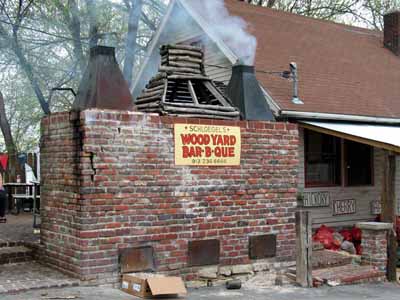
    There were few saving graces in the strip mall paradise of Northern Virginia I was unfortunate enough to relocate to at the beginning of the aughts. Here's one: right off I-95 if you happen to be driving through. I can't tell you if it compares to infernally tempting meats of the deep south, but it sure as hell was the best thing around. It was stupid to ask how they made it taste so good. Having a family tradition helps, but at a minimum you need one of these things, or these, or, if you sell your soul completely, maybe one of these. It may also work if you're the kind of person who has ready access to a junked home oil tank and brazing tools. The point being, you, you little suburban pissant you, can't possibly do it right. I think that's why it makes such compelling tv.

    EXPERIMENTAL

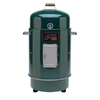
    But a decade of this kind of pressure, and we finally bought a home smoker last month. A $60 Brinkmann charcoal smoker, looks like a little capsule, or a footless R2-D2, or--and I think this is the real inspiration--a half-size prettified version of your standard 55-gallon industrial drum. They stocked a ceramic version too, which cost an order of magnitude more, and with the various doodads and the heft of it, looked like a Flintstones submersible robot. I imagine they perform the same function, if you ever actually use it, but are mainly decorations for your McMansion and I am not that far gone. For the price of the little Brinkmann, I figure if I get one good meal out of it, it will make up for its costs in comparable restaurant fare, factoring in wood (there's some oak and possibly some not-yet-rotten cherry in the woodpile, but not much mesquite around these parts), and the gas to get to Cambridge. Casual observation finds it is indeed cheaply made with the ill-fitting top an actual problem even before I dropped it off the porch, but still functional, main failures being the lack of any means to adjust the airflow (and hence, the temperature) and a badly conceived thermometer. I can't believe it would have cost any more to put some damn numbers on it, and let me judge for myself what temperature is "ideal."

    Right, so week by week, I've been running experiments with smoked meats. The first was a rack of ribs and a beer can chicken, done at the same time. Hickory smoke, which was, approximately a thigh-sized log, broken up into chunks, and a couple big handfuls of these compressed hickory pellets we've had around the house since forever. I lit the charcoal with lighter fluid only for this trial. (You can probably guess the result, dear reader, but I don't want to get ahead of myself.) The second week, it was a rib eye roast, smoked with three or four large chunks of woodpile oak. Third week, it was more ribs, with mesquite, properly soaked this time, and about three handfuls of chips in all.

    This weekend it was hickory-smoked trout. For reasons I'll describe below, here is the fish recipe:

    - three whole trout (about 10 inches), gutted.
    - 2 lemons
    - fresh marjoram (I have bales of this stuff growing around the house, and have little idea what to do with it, other than a nice garnish and decoration once it blooms. It's like oregano--would that the oregano did so well--subtracted of flavor. I figured it wouldn't mess up the fish.)
    - fresh thyme
    - fresh parsely
    - fresh-ground black pepper
    - pickling salt (no iodine, which I understand can get you off flavors)

    Add 25 Tablespoons salt (12.5 oz in your measuring cup) to 10 cups of water, and add one and a half sliced-up lemon for the brine. Soak the fish in there for about half an hour. In the fish's cavity, I put a generous sprig or bunch of each herb, two half-slices of lemon, and a nice twist of pepper. I smoked it over hickory for 1 hr 15 minutes (three smallish chunks, soaked in water while I got all the charcoal going and fish prepped). The four pounds of charcoal or so that I put in there wouldn't have gotten me any further.
    I tried to smoke some corn on the cob (July 4th is early enough, turns out), but you need more than fifteen minutes to do this. It was pretty great on the regular ole grill in any case.

    RESULTS AND DISCUSSION

    I had visions of these weekly experiments conducted joyously, an attempt to perfect something that was already awesome. I'll tell you though, it's possible to just have too damn much smoke. The hickory ribs were so strong with the stuff that they were nearly inedible. The chicken wasn't bad when you took the skin off, but it dried out even with the beer can. And yes, I managed to leave some beer in it. It was shitty beer. (Oddly, the meats were pretty good once they mellowed in the fridge for a couple of days. This step is not going to get adopted as part of the procedure, however.) The mesquite ribs achieved a good level of smoke flavor, but I didn't keep the damn things on there long enough, and they were unpleasantly tough. Going back on for a couple more hours did the trick, but my wife doesn't give me a second chance on that sort of thing, and so although the experiment earns a valuable data point, it still gets marked as a failure.

    As for the rib eye roast, keep in mind that this is a boneless prime rib. Would you cook one of those over a campfire? And oak smoke, as any New England camper knows, is a nasty, acrid, almost chemical sensation when you get a faceful of it, and on a fine cut of meat, it's not much different. You could eat the stuff if you don't like throwing your money away (I made sandwiches for as long as I could stand it), but there's a reason they usually smoke brisket and ribs instead. What the hell was I thinking?

    The little bullet smoker is designed to approximate the industrial versions, but I don't think you can really make up for the basic problem of volume ratios. In the small guy, you've got just as much smoke choked up all in a tiny cavity, really close to the wood. It's the slow heat, and it's steady application of a low-concentration flavoring in the big cookers that's so wonderful--the goal isn't to toxify it. Number one lesson has been that it's very easy to choke your meat to death in a white cloud. (And I also wonder how much Food Network barbecue I really want to eat after all. The green pill has me questioning gluttonous gospel. I repent!) Getting the balance right has got to be harder in that small and direct space, or at least it took me some trial and error to get it even to "pretty good." I didn't have too many more chances to whiff on this, but then on Sunday I did the trout...

    For starters, it looked great. A whole fish makes a good presentation, and the skin and the stuffed center kept it deliciously moist till the end. The flavor came on strongest with salt and lemon and fish, and the herbs and smoke filled out the rest of it deliciously. I think the strong flavor of the trout helped calm down all the other intense elements, and I got a wonderful balance. A citrusy savignon blanc (or the local equivalent) makes a nice pair, and, after some consideration, a pitcher of mojitos (the marjoram only bows before the mint) did the trick too. Here's a plate, with some recovered garnishes, and the last scrap of early corn pulled from my complaining daughter's hands. (I gave it back after the photo.)


    CONCLUSIONS

    Smoking dopes can be good to you, at least after a few attempts. That trout was so tasty that I'm seriously considering taking up fishing.

    Wednesday, September 30, 2009

    Seasonal Eats

    Winter Squash Soup
    Pork Chops with Ginger Carrot Sauce
    Harvard Beets


    Now, see, here's why I find it so hard to imagine going to the nouveau farming lifestyle (other than the compelling fact that I suck at it). How the hell could I continue to eat this well? Well, tonight's dinner might have made the grade. Presumably, I'd have grown bushels of leeks, fennel, and root vegetables and would have made a year's worth of stock six weeks ago or so and frozen it (or else most of the veggies would have kept at least till now--we've already stipulated access to refrigeration--and even my herbs are hanging on out there), and it's traditional hog-butcherin' time--don't want to keep 'em fat through the winter, after all--which we'll celebrate with some choice cuts. I don't know where you get fresh ginger in the historical reenactment.

    If you're going to make a savory vegetable soup, it is imperative that you use a tasty vegetable stock. I haven't figured out a veggie stock that works without the combination of leeks, fennel, and turnip, so I call each of those ingredients non-negotiable too. I generally eyeball the amounts, but you do have to be careful about adding too much turnip. Surely you had some delicious broth on hand, but just in case, I added the recipe I use. Someday, I'll figure out what do do with the veggie mush that comes out at the end, which is not untasty. (Maybe make a puree?)

    The pork chop is a tweaked up version of an old magazine recipe I found. I am pretty sure that today's issue would call the sauce a puree instead, which the teevee suggests is trendy to serve (so I think we can safely assume that the foodie fashion world has in fact already moved on). My only issue with this meal is that the sauce resembles the soup in texture and color. I think if I make it again, I'll make it mashed potato consistency and put the meat on top, just like they would on Top Chef.

    As for the Harvard beets, Mom sent up a bagful of roots, and hey, I'm in Massachusetts. (Did you know that Hahhhvid is a wealthy town in central Mass as well as a prestigious university fifty miles away?) I am sure you remember the slimy, rubbery cubes that got slopped onto your lunch tray by some gruff, hair-netted, cigarette-reeking crone every Thursday, and you know what? Fuck you, I love them. The beets are fresh, they add a nice color contrast, and the flavors fit in perfectly. Plus, of course, they are deadly serious. I served up the beets and a generously sauced chop on a plate, and garnished with a little bit of orange zest (which ties the flavors up beautifully, but matches the color of the sauce, which definitely means puree underneath next time.) A tiny dollop of cream or a wilted sage leaf probably would have been nice to dress up the soup, but the kids were getting antsy.

    Winter Squash Soup
    Vegetable stock:
    about 3/4 cup vegetable oil (my wife swears canola makes it foul; I obey)
    2 lb. carrots, diced
    2 lb. celery, diced (can that be right? seems like a lot)
    1 lb. leeks, diced (use the whole thing--be sure to cut lengthwise and clean out the sand first)
    6-8 cloves of garlic, roughly chopped
    1 fennel bulb, diced (I chuck in the tops too)
    4 oz. turnip, diced (maybe 1 baseball sized one)
    about 1.5 cups white wine
    2 bay leaves
    good handful of fresh thyme
    small handful of fresh parsley (or use a bunch of stems, you cheapskate)
    water to two gallons (uh, I think that's the size of my pot)
    salt

    I actually divide the vegetables into two pots, and saute them in oil with a little salt to help them sweat, stirring now and then, until they are really soft and there's some sticky light brown on the bottom of the pan (that's why I start a bigger batch in two pots). Add the wine to deglaze the pan(s), and then add the water, more salt, and other herbs (now I combine them, because what the hell, I've taken up enough space) and simmer for an hour or so, and strain. Make sure there's enough salt. Freeze what you don't use.

    Winter Squash Soup
    (makes maybe three quarts)
    -2 butternut squash (or whichever), peeled and roughly cubed
    -2 leeks (just the white/light green sections--I bought too many for the stock and they're like $2.50 a pound!)
    -butter, maybe three tablespoons
    -1 or two large apples, peeled and cored
    -decent-sized handful of fresh sage
    salt and pepper to taste.

    In a large saucepan, saute the leeks in butter until they're nicely golden, add the apple and sage and saute until the apple is soft. Add the squash and a few cups of stock, and cover and simmer till the squash is soft. Then dump the whole thing into a blender, with more stock as needed to get the texture you like. Return to the pot (with more stock if the blender got too full) and season with salt and pepper. I made it Sunday, and it was still delicious tonight.

    Pork Chop with Ginger Carrot Sauce
    (or you know, ginger carrot puree)
    -1 lb. carrots, cut up
    -1/3 cup cream (Really? What would happen if I used half a cup? This ain't baking.)
    -about a tablespoon fresh minced ginger
    -a couple tablespoons honey
    -salt
    -ground coriander (I buy the seeds in bulk and use a little coffee grinder)
    -four pork chops (The number for Chateau Keifus. We actually have a meat guy, where we can get slightly better steaks, but I think he has a similar distributor as the supermarket)
    -veg. oil.

    Boil the carrots, covered, for half an hour with a little bit of salt. Then into the blender with them, along with the cream, honey and ginger, and add enough of the cooking liquid to blend to the texture you like and season.

    For the chops, rub on salt pepper and ground coriander, and just fry in the pan. Easy peasy.

    Harvard Beets
    (Shut up, that's why)
    beets, enough to make about three cups when cubed
    1/3 cup sugar (1/3 comes from Mom's recipe, I'd restate my aversion to odd fractions, but the beets are already pretty sweet, and lets not get carried away)
    1 tablespoon cornstarch
    1/2 teaspoon salt
    1/2 cup vinegar
    about 2 tablespoons butter ("Mounting in butter." Um...yeah.)

    Cook those nice seasonal beets whole, until tender, and cool a little. The skins come off easily when they are cooked. Do that, and slice into a pleasing aspect ratio that doesn't remind you of middle school. In a saucepan, stir in the sugar, cornstarch, salt and vinegar. Heat over medium until it thickens, then add the beets and the butter.

    Hunker down. It's a long time till spring.

    Saturday, April 25, 2009

    Breakfast Sausage Party!

    I love sausage a lot more than it deserves to be loved. In a purely gustatory way, mind you, not that there's anything wrong with that. Just thinking about its steaming meaty stiffness, the burst of juices in my mouth, the fatty drizzle as I prick it with my fork... well, never mind. With the better stuff, you can at least pretend it's made from identifiable cuts of meat, but as far as I'm concerned, a nice succulent and spicy Italian pork sausage with plenty of mystery gristle is where it's at. (My good wife sensibly disagrees, although the homogenized turkey product she insists we buy instead is hardly a substitute. If I'm planning on a Saturday meal when she's working, then sometimes I'll go out of my way to get my greasy hands on the store-made snouts-and-tails special.)

    On the other side of the Mason-Dixon line, they know how to breakfast, I'll give them that. A land that laughs in the face of heartburn. When I travel, I try to be sure to pick up biscuits and gravy if I get a chance, although like a number of staples, I've got my own thing going by this point, and tend to be slightly disappointed on the outside. Mine's a healthy beige, instead of paste-white, and gets a little more flavor going than pepper and Jimmy Dean.

    Also, there's little excuse not to make your own baking powder biscuits. It's a hell of a lot easier than making real bread, and it's well worth avoiding that tangy evil that comes in a prepared package. (And there is just no logical excuse for the existence of BisquickTM, for that matter: inferior result for the exact same amount of work.) Which isn't to say that there's not still a touch. My wife's biscuits are consistently more attractive than mine, but I can, uh, wield the sausage in an well-practiced but imprecise way that she simply can't match. It makes every biscuits-and-gravy morning like the Gift of the Magi.

    A lot of times we'll do this when there are either leftover biscuits or leftover sausage. If you use fresh sausage (I like "breakfast" or Italian, but no doubt you can experiment here), then use the oil evolved from the sausage for the recipe, and go easy on any extra herbs (except the thyme). I'm going to assume that you're using leftovers, or forced, like me, to make turkey taste like something. When I make this basic bechemel sort of sauce, I don't worry about how much oil (it's the flour/water ratio that gets your thickness, and the oil is just to disperse the flour first--a little extra won't kill it), stir the flour in it, and then add liquid until I get to the consistency I want. That way is easier than measuring. (Baking, you do have to measure.)

    The recipe for the sausage gravy came originally from a Sheila Lukins cookbook, and the biscuits came from Mom, but of course I've fucked with them both. Buttermilk has a nice flavor in this, and it's great with baking powder breads--a little extra acid to get that nice bit of, um, fluffing everybody likes.

    The gravy might get a little skin, but if you don't have a wife, make that first. The biscuits are too good hot out of the oven.

    Sausage Gravy
    - 1/2 to 1 pound (I am pretty sure I normally go on the low end) of turkey sausage or leftover sausage
    (Or you know, use the good shit, and skip the next few ingredients, up till the flour. I try to add my spices to compensate for lesser links.)
    - three or four tablespoons of fat (Often I'll use butter, olive oil, and chicken fat skimmed off the frozen stock, in roughly equal parts. But it's all good.)
    - about a teaspoon of ground coriander
    - about half a teaspoon of fennel seeds (if you like them)
    - about a teaspoon of fresh black pepper
    - about a quarter teaspoon of ground red pepper
    - half an onion
    - 1-2 cloves of garlic
    - 3 tablespoons flour (or so...I use a little less than the quarter cup that sits in the flour bin)
    - 1/2 to 3/4 cup of chicken broth (if you must use a can, add the whole friggin can, and then hardly any milk)
    - 1/2 to 3/4 cup of milk or cream (basically, you add it until you have the texture you want when it's hot)
    1-2 tsp fresh thyme

    Cook the sausage and onions together in a pan, adding as much fat as you need. (If you use fresh good sausage, rinse the pan with water and cook them slowly. You probably won't add any fat.) You should have maybe 3-4 tablespoons of fat when they're done. Add the garlic and cook for another minute. Add the spices.

    Add the flour, and stir it until dissolved (and pasty). Turn up the heat and quickly stir in the stock until the liquid is thick and homogeneous, add the thyme. Mix in the milk until you get the consistency you want when it's hot and bubbly. Turn the heat to low, and wait for the biscuits.

    Baking Powder Biscuits
    - 2 c. flour
    - 3 tsp baking powder
    - 1/2 tsp salt
    - 2 tablespoons cold butter
    - 2 tablespoons vegetable shortening
    - 1 c. buttermilk.

    Preheat the oven to 450 degrees.

    Sift all the dry ingredients into a bowl. Add the shortening and butter, and cut it in. (In the past, I've advocated doing this with your hands, but my wife uses a pastry cutter, and her version comes out better. So do that. When she's done, it's pretty well cut in, it appears about as granular as road sand (an analogy no good southerner would make, by the way).)

    Add the buttermilk, and mix as little as it takes to just blend it. Drop the sticky dough onto a well floured surface (MGW uses waxed paper here, easier to remove and clean up), and press to about 3/4 to 1 inch thick (this is critical! Too thin here, and you get dusty hockey pucks). Cut circles with a cookie cutter or a floured, upside-down glass. (Mom says don't twist. I've never figured out if this is bullshit or not.)

    Bake 12-15 minutes. They should be just golden brown. When you open the biscuits, they ought to flakily split down the center (making two skinny pucks), and steam awesomely. Split them, and spread the gravy over the tops. Don't forget to visit your heart surgeon in thirty years.

    Thursday, January 22, 2009

    Layered Roasted Goodness

    It's not a good week when you come home too tired to drink. It's depressing when you're so damned important that by Thursday, you've already suffered through three late lunches with the boss, and skipped the fourth. Job security in tough times, sure, but if I really must work, then the whole enterprise is a lot more bearable when I have my daily allotted hour to hole up in my office and eat the food I cook as I dejectedly denote my inconsequence.

    So all week, my fabulous leftovers--roasted vegetable lasagna--have been gathering mold in the nasty, crowded corporate fridge while I scarf free sandwiches on the fly. The original recipe below comes from my wife's chef, as a rough outline. It's one of those where the exact quantities are sort of flexible, at least as far as satisfaction goes, but we're still working out some of the ratios to get the flavors and textures we like best.

    Roasted vegetables are one of those food items that are just great, so use a lot of them. Almost anything becomes distinctive and delicious when roasted, even things most people tend to hate. Roasted Brussels sprouts rule, as do roasted turnips. My Dad grew up with a special loathing for parsnips until Wifey and I roasted them for him. If you start out with something that everyone already loves, onions say, then you roast them then the result is heavenly. For the recipe, I go with most carrots, onions, and mushrooms, fewer parsnips, turnips, maybe a little Brussels sprouts or fennel or green beans or sweet potatoes if they're kicking around. I recommend avoiding red peppers, or none at all--at least if you want taste anything else--and zucchini works, but it's not my favorite. Generally, I roast them at 350o for an hour or so, but if you're cooking something else, you can do in whatever oven. Here, it doesn't really matter if they're crispy.

    As for eggplant, I'm not, as a rule, a fan, but when you process it enough it enough to abolish the spongy mouthfeel and infuse it something like taste, then, hey, it's fine. My favorite eggplant preparations roast it to goo and then flood it with savory goodness. Someday (soon, if I keep finding nothing to say), I'll post a recipe for Indian "eggplant mush," which is where the idea of grilling whole eggplant comes from. Just poke a few holes in the skin so it doesn't explode, and then cook the whole squash over low heat on your covered Charmglow. (If it's January, you can do it in the oven with veggies, but there won't be that slight smoky taste.) It'll get soft inside and a little burnt on the outside, and that's when it can be most convinced to be delicious.

    This lasagna recipe has no tomatoes, by the way, and a good amount of pasta, and it doesn't ever come out like soup. It's not as starchy as it sounds, and it tastes wonderful. Here's a recipe for approximately one large and one smaller lasagna.

    Roated Vegetable Lasagna:
    - about 4 cookie sheets worth of vegetables (carrots, onions, mushrooms mostly, and whatever else you like), cut up into ~3/4' chunks and spread in a single layer
    - 3 good-sized eggplants
    - 2 lb. marscapone cheese
    - 3 lb. fresh mozzerella, sliced or grated as best you can (I get the soft packaged logs usually, but real fresh mozz is surely better. Whatever you do, don't buy the bagged shredded crap, not for this.)
    - about 1 cup fresh grated paremsan cheese
    - stale bread or dry breadcrumbs
    - lasagna noodles (you know, "enough" noodles. Two boxes, maybe, I forget.)
    - olive oil, salt, fresh pepper

    Toss the vegetables in oil, salt and pepper, and spread them on their pans. Prick the eggplant. Roast the vegetables and grill (or roast) the eggplant, as discussed above--the veggies are done when they're a little black and crispy on the outside (and you can't stop putting them in your moth); they'll shrink a lot. About halfway through, turn or toss them (they'll stick to the sheets a little, which is fine), turn the eggplant every once in a while too. The eggplant are done when they're soft. Do this in advance and let the eggplant cool. Set out the marscapone too and let it come to room temperature, so it's spreadable.

    Peel the eggplant and dump the pulp in a food processor. Add the parmesan and some bread/breadcrumbs. Process, adding bread until the mixture is firm but spreads easily.

    Cook the noodles until almost done. (Usually, I leave them in the water and let it cool a little, pulling them out with tongs as I nee them: a venial sin probably.)

    To assemble the lasagna, drizzle a little olive oil on the bottom, then place a full layer of noodles. (I leave a little extra noodle going up the sides, for the first layer anyway.) On top of this, I spread some marscapone, layer some mozzarella, then more noodles, then the eggplant spread, then the vegetables, then noodles, etc. I try to get two whole rotations. The top is a layer of noodles, and on that, I distribute more mozzarella over it all, maybe add a couple twists of pepper.

    [You can prep this on Sunday, by the way, and leave it in the refrigerator to cook during the week. I freeze the second lasagna, and then thaw and cook it during a less enthusiastic food week.]

    Bake the assembled lasagna at 325 o for an hour. The top will get a little crispy, but since there's relatively little liquid, you don't need to let it rest very long before you serve it. Dig in.

    Friday, January 09, 2009

    Piccata!

    My wife nailed the good lunch this morning, dammit. I'm dreaming of my savory, lip-smacking piccata, and the little lady is no doubt gloating with every bite.

    I don't think there's a better optimum in the cooking parameter space of effort, reward, and cost than chicken piccata. It's the number one meal requested by my kids, and it's ready to go in half an hour, even starting from scratch. My wife and I have judged restaurants by this dish, because it's so wonderfully unfuckuppable, and making it well is a good sign that the chef is at least awake. (Now you may wonder why on that extremely rare excursion to some place we actually want to be, we order something we do better at home. the answer is because we're idiots.)

    Piccata translates as "pricked" (which only happens if comes out real good), but generally it's taken to mean cutlets cooked in some kind of lemon sauce. Since my version is so lemony, I like to drink one of those potently citrus down-under savignon blancs with it, which is great for cooking too, but as an inveterate cheapskate, I more often use the yeasty California stuff in the pan. (We keep it on hand for my Mom if she visits, or else for the occasional binge.) If I'm planning to make this stuff during the week, I'll usually buy a couple chickens on Sunday and fillet the breasts and thighs, and pound them out to paillards, using the backs and other assorted remains to make the stock (canned stock is pretty serviceable here too).

    I get the fried lemons from Lidia Bastianich's cookbook, which also more or less supplies the recipe below. The lemons are delicious little wagonwheels of leathery tartness, with a flavor a that's identifiably the fruit, but not the same as raw juice, richer, less acid. They're almost impossible to catch at that golden moment, and you'll inevitably end up with some black specks of burnt pulp in the pan. Sometimes I continue with the same oil for that extra lemon flavor, but the floaties aren't that appealing, and sometimes I am motivated to change it. You simply can't wipe out the pan after cooking the chicken, however. Piccata comes out even better when you make more servings, cycling through a couple batches of cutlets and ending up with more fonds sticking to the bottom of the pan. If you prefer a colorless piccata to a flavorful one, I'm not sure I can help you.


    Chicken Piccata:

    ~3 lemons
    1-2 lb. thin chicken cutlets
    2-3 tablespoons of fresh minced garlic (thinking closer to 2)
    olive oil
    butter
    flour
    salt and fresh pepper
    ~3/4 cup white wine
    ~2 cups chicken stock
    ~1/4 c. capers (or more; I like the little nonpariels)
    chopped fresh parsely (optional)
    pasta for serving

    Thinly slice up enough lemon for two or three slices per plate. Squeeze out the rest of them for juice. Anywhere between a third and half a cup is pretty good.

    Fry the lemon slices over medium heat in olive oil, flipping when one side is golden brown. Keep an eye on them, because they're black (but still edible) about a second later. When you've cooked both sides, remove them and set aside. Wipe out the pan if you want to.

    Salt and pepper the chicken. Add oil and butter to the pan. Dredge the chicken in flour, and in batches, brown the cutlets nicely on each side. Add oil between batches if you need to. Set aside when done.

    Add the garlic, and let it cook a minute or two, just until that sauteed aroma really begins to float up, then deglaze the hot pan (with the garlic and brown junk in it) with the wine, scraping the bottom and letting the liquid reduce. Add the juice and the stock, the capers, and the cooked chicken, and let it simmer until the flour on the meat thickens the sauce a little. It can sit for awhile like this.

    Add a little chopped parsely at the end. Serve over pasta, with plenty of sauce, with the lemon rings on top.

    Friday, August 22, 2008

    How Much for One Rib?

    Barbecue is one of those truly easy foods. Well, a pause here: real meat recipes--your dry rubs and your smoke--are for sure more challenging, but since they require either $1200 worth of smoking hardware if you want to half ass it, or infrastructure if you want to slowly smoke the whole animal (which is to say, do it right), then within some approximate Puritan bailiwick, I'm doing my best with respect to real food. (And by the way, here's the only thing about the area I miss even a little. Worth the stop if you're going down I-95.) To make real pit barbecue, it helps if you have an aproned paunch, drawl, and only the minimum necessary number of teeth to leer. Because, you know, authenticity matters. Fortunately however, there are things you can get away with here in the Northeast, and it's likewise no coincidence that the cooking magazines all have a barbecue issue that conveniently centers, every July, on the sauce. If you have even a vague sense of proportion, the sauce is nearly impossible to fuck up. I have little explanation as to why any bottled sauce is so reliably treacly and vile.

    Barbecue sauce speaks to exactly the sort of chemist I am, one who's better at influences and trends than at punctilious quantitation. Truth be told, I let my wife take care of the dirty mechanics of grilling, and I prefer to chuck in dashes of flavor on the range, according to music or mood. She can't reproduce a single sauce I make, but she's a much better baker, and to the point, can make our crap-sack grill cook more or less evenly.

    Ribs are forgiving like sauce is, which is another reason they make the cover of Bon Appetit every summer. They're better grilled for hours--I get that--but they're delicious just by nature too. If you're making do with that middle-class schedule and that middle-class technology, then trust me, you can cut corners by chucking them in the oven for an hour, so long as you're sure to braise or steam them, so long as you don't think of applying any drying heat until those last twenty minutes or so on the grill, where that aforementioned sauce graciously agrees to take one for the team.

    We have three or four sauce recipes that range somewhere between awesome and kickass, and the beauty of any of them is that they're all totally forgiving on proportions and whatnot. Garlic or horseradish? Ginger or red pepper? Cola or molasses? The answer is yes.

    We're a little hard up for friends here at Chez Keifus, which I may have mentioned, you know, like, often. It's some unfortunate combination of geeky intelligence, debt-constructed poverty, and early-inflicted parenthood that wedges us poorly into this blue-collar town. We're sensitive to like minds, though they appear to be rare here, but still, you have to give people credit. My younger girl's friend's parents, it turns out, are pretty damned agreeable, got that cynicism and wit, and it's working for us, for that now and again. They're evolving food dorks too, and that's one good connection.

    Let's call them Jim and Patty. Jim toughs it through a thankless night shift while Patty works days and somehow crawls her way through grad school at the same time, gets on with the path that will make them prosperous some time in the indefinite future, or so the story goes. They like food for similar reasons we do, life's short and all that shit, and anyway, everyone loves barbecue, right? Who doesn't drool over ribs?

    Jim had planned to stop by for dinner, and we circled the hearth like witches hoping to entrap Greek soldiers or Scottish kings. Triple triple, shimmer and ripple, sugar glaze and bourbon tipple. Ear of corn, leaf of chard, hack the back of a newborn hog. How much for just one rib? Obligations came up though, as they do, and he arrived (with warning) too late for dinner. Still. Come on, Jim, one bite, have you nothing better to do? Will you go home hungry? Dude, it's ribs. One bite bro, one bite.

    Like in any quality neighborhood, I grew up with a surrogate parent or two, and it's good to have second-generation friends, because the old world has kept track of traditions that Americans have evidently forgotten, and not all of them suck.

    "Keith, will you stay for dinner?"

    "Uh, gee, Mrs. V., I-I'm full, and my Mom, she, uh, ummm..."

    The pressure would mount here, perilously enough, and now and then, back in those days, Mr. V. would also wander into the scene. "The pierogies? I made them myself," he'd say, and he'd clap me on the shoulder, as if I were a son-in-law. "Stay."

    And how could I refuse? I liked to eat then, too, and if the pierogies were great--and oh man, they were great--then let me tell you someday about the Polish delis that dot eastern Connecticut. I frequently made those trips with my friend too. Yeah, good times.

    Mrs. V. had a habit of pushing against my weak will until she gained purchase, at which point she'd dig in and push harder. "Stay. Eat," she'd plead, and I'd frequently find myself broken to her matronly resolve. She'd push food, and accepting it would put me in her thrall, some kind of passive-agressive exchange of power, and there I was at the bottom of it. To the right person, it set hooks. She broke me, and I love her to this day. She gets more beautiful every year she gets older.

    And so here I am yesterday with Jim, and if I haven't mastered gingerbread, then we've got a bitchin' approximation of barbecue. "One rib, Jim. Come on."

    "Well, Keith, I-I- my wife--"

    "Dude, one rib."

    "Well ...okay." He pokes carefully with a finger. "Well, shit, I may just take you up on that. They smell so good."

    Yes. Yeeessss.


    (Thanks Michael, I didn't bothered to search for it.)

    UPDATE: The recipe got a request (or maybe two). This one my wife has made the last couple of times, so I don't know all the twists she's worked in. Good chance there's a little freshly snipped rosemary (got a little tree in the kitchen), possibly a little chipotles in adobo sauce (if she thought of it), possibly some ancho chili powder. Good chance we up the vinegar content too. But the basic version just comes from a magazine. Here it is:

    couple cloves of garlic
    half an onion
    olive oil (or butter, or clarified butter)
    about a cup of catsup (or pureed tomatoes)
    1/3 cup brown sugar (that's what it says--does it hurt to add a little more or less? not for something like this)
    1/4 cup vinegar (more?)
    1/4 cup of bourbon (Omit if Keifus drank it all. D. tells me it calls for apple juice, and she used it. As if.)
    squirt of honey
    dash worcestershire
    tsp liquid smoke
    salt and pepper
    dash of cayenne
    dash celery seeds
    chipotles/adobo
    (ancho powder?)

    a little can of pineapple juice
    (fresh snipped rosemary?)
    pork ribs.

    We wrap the ribs in foil usually, season the crap out of them, pour over the pineapple juice and wrap 'em up. Bake them in the oven for an hour. (Or else here is where you smoke 'em if you got 'em.)

    Mince up the onions and garlic and saute them until they're soft, and then add the rest and cook it a while, simmering down and/or adding vinegar till you get consistency and flavor you want. We then grill the ribs over modest heat for maybe twenty minutes, basting each side with the sauce till it gets gummy and toasted.

    Wednesday, July 09, 2008

    How I spent my vacation (and my rebate)

    Much as I like to eat well, I don't like to consider myself a foodie. Part of that is just budget: getting that powerful culinary mojo is unattainable under my family's surprisingly modest circumstances (we continue to piss it away on college, after all these years), and the last damn thing I need is to develop a taste for truffles. As it is, the edjumucational wine extravaganzas we've taken on every year or so have left me, in their aftermath, skulking broken-hearted through the aisles of the local booze emporium, leaving face-prints on the glass cabinets that secure the French and Tuscan table vintages, sifting disconsolately through the mass-market exports and the unlimited bottles of oak-a-rrific California varietals. It's not that you can't get decent wine for under fifteen bucks a bottle--and just because it's common or local doesn't mean it sucks either--it's just that it's hard to find the bargains, and discovering exactly what you like takes a lot of sampling and research. Rewarding work perhaps, but doubly time consuming when you're on a budget, and even then, pricey enough.

    Another reason that I'm a non-foodie foodie is that I think the foreign and the exotic can be over-emphasized amongst the movementarians. That is, some cuisine is popular precisely because we lowly hoi polloi can't get us none. Spending top American dollar to import European or Asian peasant ingredients, celebrated fresh in their own neighborhoods, strikes me as a particularly quixotic, and the obvious antidote, American local cuisine that doesn't suck, is a fucking embarrassment in most of the country. Top-notch fresh produce, or at least a tradition of it, is the purview of the wealthy, while the poor people choke down Twinkies and McNuggets. There are exceptions, mind you: peasant (and slave!) food has filtered up through the American south, and it's awesome. The natural foods movements of my parents' generation kept some awareness of actual produce growing among the dirty hippie types. But this nation of imports hasn't, by and large, been here long enough to establish a real culinary tradition of its own, and we have a habit of discarding the old ones, or putting them in a sweetened box. More importantly, we have heavily invested, subsidized, and mechanized food production in order to keep the crappier stuff cheap, and it's gotten to the point that trying to use your food better* takes cost and effort to learn, not at all unlike drinking wine well.

    But there are places you can go, even in these benighted lands. In a rare confluence of events that included a restaurant shut-down, an anniversary, several summer vacations, a suggested destination, and a bribe from the federal government, my wife and I finally went out, after all these years. We took our mandatory loan and diverted it from its intended target--the heating oil company--and spent it on a vacation across the Sound. I've never been enamoured by Long Island. It's nice enough, but from the suburbs to the Hamptons, my experiences always saw too much money chasing not enough class. But if you live in the Northeast, you can do worse than to take your Champagne appetite to the North Fork. It's wine country over there, and farm country, and the locals have been working their brand long enough (the oldest vines were planted 30 years ago or so) that it's got some decent product. We spent two days driving up and down the strip, ducking into tasting rooms built by the two or three dozen local wineries, and eating fine meals that were almost worth the expense. As an aspring wine culture, the North Fork has its corresponding food movement going on, and the chefs all advertise ingredients grown just down the street. There are some big and impressive wine shops, but the best ones, more often than not, with the tastier wines, were smaller (my favorite). Random folks (not tourists) would filter in and out and have intelligent conversations about the product. Appropriately enough, there's a great cheese shop in the area too, another habit I should be careful about cultivating. Mostly the wineries grow your Bordeaux style grapes, but mixed together according to the Long Island tastes: a little heavier on the Cabernet Franc than elsewhere, and if the wines didn't taste quite French, I have a lot of posthumous (Keifus lives for a day) scribbles telling me they didn't really taste American either (caveat: I'd inevitably forget to take notes until four or five tasting sets in, after my palate went to total shit).

    The economy of the North Fork is evidently supplying living wages, because, after all, people manage to live there, but it ain't cheap. Even knowing where to eat and shop, I can't imagine you're getting by if your family doesn't run the place (or commute, or considerately inhert it). We got into the occasional conversation with a local--the knowledgable kid at the cheese shop, the bus-girl, the wine pourer--and while obviously underpaid, they were usually into the whole culture. Some of them were taking the financial hit to follow their love, and I totally envy them for that. I can better understand how Alexander Payne caught the dynamics between the visitors and the residents in California wine country in Sideways. The tourists fantasize a better life of poverty in the name of good living. And from the viewpoint of the normals, a genuinely appreciative tourist is probably interesting. I saw a lot of annoying visiting retards (of course), and I flatter myself to think that my wife and I were better than the usual ugly Americans as we went through our comically awful cold-readings of flavor and aroma, but tried to take the experience for all it was. Call it the opposite of the story of the rest of my life.

    Andrea Immer, in Great Wine Made Simple, includes an anecdote from Tuscany wherein customers brought their cherished ancient (at least as old as I am) Brunello Di Montalcinos** to be lovingly re-corked, such are they worth the wait. My wife's chef (and no, that doesn't help my resistance to foodie-ism one bit) recently returned from Italy on his honeymoon, glowingly describing the backyard garden culture. The restaurant salads were really local there, and everyone slavered over the perfect tomato, cheese, rabbit, whatever. Tiny pockets of the U.S. aspire to that, but regrettably the rest of the country has its head up its industrialized agricultural ass. One of the pourers we talked to, some 22-year-old kid, described how she spent a year in Italy, verifying chef Steve's picture of the idyllic, appreciative populace. For my own poverty years, I was living below alarmingly fecund rednecks, and nursing my professional ambitions with cheap-ass beer. I wouldn't say I've wasted my life, not at 22, but still.

    Of course, Europe isn't that different from any wine country. Visiting Italy gets you to the ruins, to the tourist traps, but that experience is ultimately pretty lame. You don't learn a culture by just dropping by, and the appreciation (of both the good and bad aspects) only comes from living it for awhile. My wife and I left the North Fork happy, but more impoverished, and less fulfilled, than I care to admit.

    The yearly oil contract politely arrived within days of our return, and it doubled last year's bill, which was about twice the increase we expected. After some serious sweating, I found an out: I've got nearly six years of unused vacation time, and I cashed a chunk of it out.

    So to sum up, I accepted the federal tax break and took a couple days to get pleasingly drunk, and then pissed away my remaining time off so that I could heat my house. Is there anything more American?

    I want better.

    UPDATE: Mr. Riley's take on this is brilliant. Required reading.


    * Really one of my best posts. Don't be shy to follow the link.

    ** I haven't been able to get enough of the Tuscan wines since the Italian experiment, and the Brunello knocked the socks off all the rest of 'em. Not exactly the ten bucks a bottle variety. Only one of the dozens of wineries we visited on the North Fork grew Sangiovese grapes--something about microclimates--and it was a tasty basic Chianti. Even there, I wish I bought a bottle or several.

    Wednesday, December 19, 2007

    Pie blogging, by request

    Apparently, my wife and I aren't the only fans of crystallized ginger. It's delicious in apple pie (which is what got us hooked), and another favorite place to use the stuff is chopped up fine in cream cheese icing (itself a miracle of culinary inspiration, one of those pieces of simple perfection), and spread on carrot cake.

    I can't claim too much credit for this recipe, it came from a book, a gift from my not-quite-yet-then mother-in-law ten years ago, almost to the day. Evidently it won a blue ribbon by somebody named Wende. The original recipe calls for Granny Smith apples, which I'm pretty sure we've never tried in any of our yearly attempts. Our own experiments are mostly to find the right variety of forbidden fruit, preferring it a little less firm, a little more flavorful. Gravensteins have been the best-tasting so far, which are available for about one delicious August week, but resulting pie the comes out a little soupy when warm, even if it sets nicely when it cools.

    Also, even if you can get away with sweet-ass bourbon when you're cooking with it, that doesn't work with fruity liquors. You'll be better off here getting decent apple brandy.

    Anyhoo:

    - about 5 cups of sliced apples, enough to fill the plate well high of the top
    - juice of 1 lemon
    - 1/2 cup of brown sugar
    - 4 oz. (or so, we usually guess up) of crystallized ginger, chopped fine
    - 2 tablespoons of cornstarch
    - 1 1/2 teaspoons of cinnamon
    - butter (it makes everything better)
    - pie crust (if you're considering buying one, you're not allowed to use this recipe)

    Do the usual. Toss all the ingredients (except the butter) together and dump 'em into the bottom crust. Dot the top with butter, then put the top crust on. Do an egg wash if you like it shiny. Bake at 375 °F for an hour, or until the juices are nice and bubbly. Cool and enjoy.

    Primordial Soup

    My wife has been taking anatomy classes this fall, getting me closer to embracing a fact that I've been secretly flirting with for a while now: the human body is just fucking disgusting. It's true that people, and mammals in general, are less unappealing than the rest of the biosphere by virtue of being occasionally warm, soft, and dry on the outside, but it doesn't change the fact that we're still each of us a nasty sack of salty meat, every body filled up with a squishy assortment of quivering globes and slimy pustules shooting humors and ichors at one another. It's not pleasant to think of animals like this, nor to think of ourselves as animals, but we eat other animals with abandon, slurping them up in liquid bites, sucking down their nerves and veins like spaghetti, invading them on the cellular level with enemy acids and enzymes, apoptosizing their fundamental components, bursting them in our foul gaping maws and slowly turning them into excrement in our own fetid and swollen guts. Milk is one of the most wholesome fluids we can name, right? But thinking about it, it's foul: secreted out of a cow's gland, just like bile or spit, it amounts to a network of microscopic loogies suspended in a chalky plasma, flocculating and floating, splotching onto the sides of the glass, sliding down like a viscous slimy plaque across our equally slimy tongues and lips. Ever drink it warm and fresh? Might as well be sucking down blood or pus.

    Our macroscopic topologies are simpler than the scrambled-eggs confusion of the subsystems of organs and tubules would have one believe, with the "insides" and "outsides" defined more by elaborate folds of the same gelatinous sheets than by actual closed-in geometries. On the microscopic level, a bunch of spiderwebbed protein networks and sloshing lipid membranes twist and congeal to make the twelve dozen or so kinds of specialized amoebas that work together to comprise people, transferring information around by nothing more than electrochemical diffusion and redox chemistry. True, a cell has the decency to be walled off and isolated by a little sheet of organized fat, a glorified soap micelle, with other little bubbles floating in it like tiny disembodied eyeballs, chasing around with other biomolecules a gummy little pile of DNA.

    The body is, I can hardly deny, a fabulous machine, but the details of it seem needlessly complicated. I don't know what sort of addlepate could look at that pile of Rube Goldberg goop and scream "design," because frankly, it's such a mess that the miracle is less how it works, and more the fact that it works at all. It's as if one could shake up a trillion vats of biomolecules, and one of them might splatter around just so and manage to effectuate oxygen transport or waste removal or process some other damn thing we slathered into the soup, and now it's called life. Woo hoo. The fact that everything's chemical, that everything's diffusion screams inefficiency to an engineer. And isn't each one flawed in some way? Is not a defect-free individual a rarity worthy of celebration? A billion intra- and extracellular chemical signals and channels are a billion things that can go wrong. Never mind the usual macroscopic design flaws (the proverbial recreational areas built on waste sites, the bad knees, the self-destructing prostates, the dissolving bones, the myopia), but the microenvironment is also a mess. One botched transmission mechanism, and it's cancer, palsy, or a hundred horrible and debilitating varieties of autoimmune depth charges ticking away in half the population. Yuck!

    #

    None of these things, I'll add, makes me enjoy the experience less, it just makes the whole thing a little more absurd. This grotesque meatbag, beyond all expectations, is conscious, it garners sensation from it's ropy inefficient networks, lets its sloppy gelatinous computer feel a million variants of pleasure, enjoys the existence of all these other grotesque meatbags quite well, thanks very much. The medium is gross, but it doesn't mean that living in it isn't transcendent. In another little bit of divine or cosmic humor, the slimiest bits of us are also the most exciting ones. The drippy twitching orbs in our forehead are our most gorgeous and mysterious aspect. Our slippery, oozing genitals and that overmuscled sphincter of a mouth give the most tangled, overwrought, wrinkly organ of all (our brain) the most sublime perceptions of existence. And there's nothing wrong with that. A smile or a kiss? Making love? Who doesn't live for that sort of thing.

    #

    Somewhere in his scathing inside take on restaurant and food culture, Anthony Bourdain made a few points to would-be gourmands wondering why their food isn't as appealing as high-class chef's fare. One of the suggestions he makes is make your own stock, making the point that it's both easy and it tastes far better than the salty yellow or brown canned garbage that they peddle for convenience.

    I'll add that the convenience is really overrated at that. Yes, it's easy to open up a can of broth, but it's easy to pull something you've already made out of the fridge too. It takes time to roast bones and to simmer things, I suppose, and there's cleanup at the end, but it's not as if the whole thing requires very much attention. And if you don't go through the minimal effort of making stock, then you'll fail to suffuse your home with the wonderful aroma of roasting things. This alone is worth it--you could go ahead and chuck out the pot when you're done, and just do it to enjoy the savory air freshener of caramelizing carbohydrates, denaturing proteins, rendering fats, and volatilized aromatics. The marketing assholes that brought you GladeTM have a lot to answer for.

    If you go into the supermarket with the intention of producing your own broth, you'll find the items that go into it are suspiciously overpriced: it costs almost as much for a pound of marrow bones as it does for an (admittedly subprime) one-pound steak with a bone in it, as much for fatty ham hocks as it does for an actual ham. I'm convinced it's a ploy to sucker the casual cook. If your goal is to cook this way, with stock, it actually requires a cultivation of habit--prep your own meat (within reason--I'll admit I don't always have time) and utilize the scraps instead of throwing them away and then buying bones. I'll try and make stock whenever I cook meat, or sometimes when I've built enough vegetable matter that it has to be used. I've taken to saving the onion tops, carrot peelings, celery leaves and that sort of thing too. Along with the bones and offal, you're giving those foods one last fling at getting some flavor, getting just a bit more out of them, ennobling, perhaps, the poor dumb beast that gave his life for it all. Keep the fat even, and sauté with it, even for that very dish. I've got a goal of preparing a perfect meal this way, with nothing thrown away that I couldn't have extracted an atom of deliciousness from.

    All those structures that were once so perilously balanced in the living organism now get broken down into fundamental bits, and you don't need a pound of psychobabble to understand how satisfying it is to smell them, to taste them. I'm bothered by eating some organs (but not others), but the stock pot is an equalizer in that regard, so chuck in the giblets and turn them into broth. A lot of that irrationality (if not all of it) disappears when the meats are broken down into constituent fats and proteins, all the same stuff in the end, and getting them there has such pleasant effects. Maybe in a more just universe, we could absorb all those primordial bits without having to first render plants and animals down to get them. But we are what we are, we have to draw the 'what's food' line somewhere, and it's perhaps an even bigger sin to consume without cognizance, enjoyment, or respect. As the man said, it's only messy when you're doing it right. When it comes to living this life, get the flavor you can.

    Saturday, September 22, 2007

    Pie Blogging (for rundeep, Dawn, or whomever)

    My wife, before she started her classes, thought of starting a blog for awhile, thinking she had enough material about what holds us together. (Rest assured, I'd have been sure to link.) But shit, as it does, happened, and she never got the project going. Here's an entry that wouldabeen.

    Some background: fifteen years ago or more, my mother sent me away with a box of recipes, the tried and true favorites of my youth. Mom's less a chemist than an empath however, and she wasn't in the habit of rigor when it came to transcribing her technique, more's the pity. When she attempted to put the coveted pumpkin pie variation to paper, it was a negligent wreck, instigating a solid decade of feelings of inadequacy. I mean, how fucking hard is it to balance ten ingredients? But I got Dad's genes too, and a cook + a machinist = a chemical engineer, and I'd be damned if a platter of custard was going to get the best of me. Ten years of tweaking Mom's "dumping" with, you know, measurements and stuff, gets you the recipe for the best pumpkin pie ever. I'm feeling indulgent tonight (which is to say drunk...again), so here you are:

    • 1 small pumpkin, cut in half and baked for about an hour facedown on a cookie sheet
    • 2 cups sugar
    • 1 tsp salt
    • 2 tsp grated fresh ginger (sub a teaspoon of powder if you must)
    • 2 tsp ground cinnamon
    • dash ground cloves
    • 1-2 tsp lemon and orange zest
    • some grated nutmeg (even though this recipe originally comes from Connecticut, you'll want a real one)
    • 3 eggs
    • 1-2 Tbsp Amaretto. (Add that much again to the pie. A surprising lot of our secret ingredients are booze.)
    • light cream or half and half (roughly half a cup)
    If you have a good blender, put all the ingredients in there (scoop the pumpkin meat from the skin, of course). Blend, adding just enough cream to get a pourable consistency. Pour it into a pie crust (lately, I've been going 2 parts crisco to one part butter to great results). Bake it at 425 F for 15 minutes, then reduce the heat to 350 and continue baking for 50 minutes or so. It's done when the center is just set (when it jiggles rather than sloshes when you tap the edge). Cool thoroughly before eating. Thank me later.

    I'd be lying if I said I'll be thinking of any of you when I enjoy this tomorrow. Good night, everybody!

    K