Showing posts sorted by relevance for query Mark Helprin. Sort by date Show all posts

Saturday, July 08, 2006

Book Reviews: M. Helprin; K. Roberts; V. Vinge; C. Priest; R. C. Wilson

Note: As promised, here they are. Let the solipsism commence.

These are reviews that I've written in the last two months or so. I've been keeping a book log for a couple of years, but have little desire to go back and edit my earliest screed, so May/June seems a good enough place to start. The letter grade, if you were wondering, refers more to my enjoyment and less to any objective level of quality.

Spoilers abound, and I don't care.

Mark Helprin, Winter's Tale (A-)

Winter's Tale is is a tall tale, and an intimate one, dense with hyperbolic prose, as though Helprin has an abundance of color (blues, whites and grays, mostly), stuffing about four hundred pounds worth of it into what's essentially a fifty pound story. All that fanciful description is nice though, and Helprin is evidently one of those guys that can just turn the crank and spew out the magic. Read it and let those words just keep washing over you.

But the book is long enough so that some language patterns get annoyingly reused. And it's not much in the way of plot either, and the millenialist latter two-thirds of it seems like an unnecessary appendage. He introduces whole new characters and a whole new perspective and a whole new historical setting, all after the good part wraps up the nineteenth century Peter Lake. The worst failing of the story, however, is that for a story that's about New York, it's not much like any New York I've visited. It sneaks by on the stuff that's hard to fact-check--I've never noticed the maritime geography much (and I doubt even the residents do) and I don't have a time machine to 1880--but the vitality and scenery and streets and cars and the rest all seem off. The existence and life of some characters never is quite explained or never quite makes sense (and Jackson Meade, Cecil Wooley, Mootfowl are a lot worse for the effort at explanation). The upstate mysticism increases over the course of the novel.

Still, Helprin is so effortless with the language almost every fault or faux pas can be forgiven.

Though Winter's Tale is in many ways inimitable, it still draws comparisons with other inimitable works. Foremost, it draws one with Mervyn Peake's Gormenghast, which is also about a city. One much more bizarre and disfunctional than the other, and altogether quirkier. Helprin's probably the better talent (by a nose), but Peake's imagination and visual sense really rule that contest. (And Peake nailed a few paragraphs that are just plain untouchable.) Another comparison is with John Crowley's Little, Big what with the end of the world and all, and the return of innocence (Tolkein in reverse--the recovery of the Wild Wood and not it's loss), as well as other, lesser (and more, uh, imitable) gentle EOTWAWKI fantasy fiction (Stephen King's Dark Tower maybe).

Vernor Vinge, Rainbows End (B+)

I feel a little guilty about plugging this guy's "(growing) writing chops." He's still a wonderful idea man, the best in the business maybe, but, well, he's not like Mark Helprin, who made the magic seem cheap. The characters grow and stuff, but not really in an organic manner. I like where he's trying to take them, but they just kind of drift there instead of develop. It's not that they're badly drawn, really, they just don't arc very well. A worse sin, he's got men who are poets, and well, he's got no poetry written into the story. (That would take real literary balls mind you, but the absence is conspicuous. One or two couplets would have done it.)

The plot turns the pages though, and the people are interesting enough to sell the ideas. The ideas really are great though. Better than anyone, Vinge can put together not just an idea, but a complete universe of ideas, and make it fit together with all the ramifications and all that subtext. We're dumped into a world of highly integrated wearable computing. Vision is enhanced with information. Touch interfaces are catching up. Present-day culture has adjusted believably. It's pre-Vingean singularity but things are moving fast. The characters repeat "it's hard to keep up." Kids are smarter than their parents, and mastery of the video game-like manipulation of technology is much more important than any mastery of the physics (a neat, but frightening angle, which Vinge credibly explored). Information is everywhere, and it is king. The distributed computing is similar to that in Neal Stephenson's in The Diamond Age, and no doubt elsewhere, borne out by ubiquitous and invisible network nodes.

(As is often the case in books like this, I wonder first, where the power comes from, and second, what do the rest of the 5.9999 billion inhabitants of the earth fill their time with.)

I really can't state enough that no one weaves a technological society better than Vinge does,
even if he's a so-so literary writer. Oh well.

Keith Roberts, Pavane (B+)
6/25/06

Pavane is an introspective alternate history hinged on the untimely assassination of Elizabeth I and the 400 extra years of middle ages which occurred as a consequence. I'm okay with the downer mood, but I can see why new writers are often advised to move things along with dialogue and to go easy on the adjectives (especially for shorts, several of which this novel is composed). Roberts does a lot of telling, less showing. He's a tolerable writer for all that, though, and I do like his name. You don't necessarily have to rely on those snappy plots when you're good enough, and Roberts almost is.

Pavane as a whole is better than some of its parts. Occasional stumbles in pacing and too-much narration persist, but the story improves drastically when, the greater arc finally becomes apparent (about the fourth segment in, which is too long to wait), and by the novel's end, things are fitting together fairly nicely. There's a sweeping theme that's revealed as well, a theory of alternate histories, wheels of time, and fairies that holds together better than I would have guessed, had I read a synopsis of it. (A pavane is a court dance, with a formal pattern. So's history, Roberts would say here.) It's a long way to get there, however, and the early cues are pretty subtle.

(Pavane was brought to you by the word "skirled")


Christopher Priest, The Separation (A)

Starry-eyed review: Whoa!
Cynical review: I liked it better when it was called The Prestige

But hey, you see that grade? I've got little cynicism in store for this one. It's just that it's difficult to miss Priest's general fascination with twins, and almost impossible not to compare his different twin stories. (He's got twin children of his own, according to the book jacket, and I've gotta wonder how comfortable they are with it.) The Separation is the superior of the two. It's all that, plus a nice bag of alternate history.

The Prestige was a great story in it's own right--playing with doubles and twins and with the intriguing secrecy (and disappointing reality) of professional magicians--but it was regrettably scuttled by a really stupid science fictional premise (Nikolai Tesla had built and endowed a teleporter that left behind plastic corpses). Priest gets out of this one by avoiding revealing the premise altogether. It's twinning in the verb sense, splitting of a single entity, here about a historical turning point.

The main characters are twins too, formerly close but now estranged, and they pull a switcheroo of sorts into alternate realities. We're introduced to the pair via a war historian, in whose reality the second world war ended in 1941 with an accepted German peace proposal. The story is told in fragments, including notes of (imagined) history texts, letters, and, prominently, the diaries of each twin. It's hard to do justice to how well Priest weaves these all together.

The first twin is a pilot, and while passing the German peace delegation (twice) over the English channel, somehow enters another reality in which his brother dies, and, we slowly realize, it's the reader's (i.e., our) universe. The second twin survives in his version, but has realistic sidebars in several other alternate realities, each increasing in length, and each going kablooey with a sudden and dream-like fraternal confrontation. There is evidence for at least two of these being "real" under the premises of the story, however (our historian and the deliverer of the notebooks are real people in different timelines), but I suppose it's best to assume that the most real is the one in which the reunion was indefinitely forestalled.

A final note: the historian is the only part (and it's the dullest part) told in a third-person omniscient viewpoint. Some definitive closing this voice was very much in order, but it's infuriatingly neglected. I'm sure Priest did it on purpose. I don't know if I approved.

(The word that Christopher Priest couldn't get out of his head: "obsessed")


Robert Charles Wilson, Spin (A+)

Robert Charles Wilson may well be my favorite author. He writes in a manner and on themes that appeal to me greatly on a personal level. I can't think of anyone who speculates more interestingly and more sensitively on the biggest questions of all. Why are we here? Are we alone? Is there a point to it all? Even when he answers no (or a plaintive I don't know), he makes it feel like there's a point in asking, even if it's only from the worm's perspective. Especially when it's from the worm's perspective. Yeah, there are better eyes for character and better stylists and tighter plotters even in science fiction (but you have to look hard for them in the ghetto: I'm more inclined to delve among the famous or canonical), but Wilson is unparalleled in defining just how small is the scope of humanity and in the face of that, just how much it's worth caring about. And as ideas go, they're always big and brave and smart (even when they're silly).

I can't say he's ever really disappointed me, but just the same, one leg of the stool or other was always a little weak. I've been waiting for some time for Wilson to crank one out of the park on every level. I've been waiting for something I could take to my wife and my friends, hold it up proudly, and say this is what science fiction can do. Spin just may be it.

Read it already.

(R. C. Wilson brings this to you with the word "regolith")

Tuesday, May 01, 2007

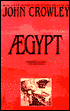
Doorways to Elsewhere IV: Review of Ægypt by John Crowley

Grade: A
Sticking with the external theme here, Crowley's Elsewhere, in a trivial geographic sense, circumscribes the Litchfield Hills, the Catskills, nips western Massachusetts, and maybe the southern tip of the Adirondacks. It includes New York City, sort of by reluctant default, but digs its magic out of the distant and wooded suburbs. Ægypt strays to different continents, and it's a whole lot bigger than eastern New York state, but it's hard to imagine that magic manifesting in any place other than the (fictional) Faraway Hills. (I'll admit that gives it a certain personal appeal.) In previous novels, Crowley has let the mythology of the British Isles immigrate to the Northeast. This time, it's legends of the Renaissance.

Given these aspects of the setting, I'm tempted to compare this novel to Winter's Tale, by Mark Helprin: it's filled with a similar sort of magic-infused history, swinging similarly wide, epic loops. It's got a common quality of breathless observation that's beautiful but ends up all going down the same. With no special destination evident plot-wise, it was an easy enough novel to put down, and it took me twice as long to read as something this length normally would. But of the two, Crowley is really the superior writer. Where Helprin couldn't help himself from pouring it on ever thicker, Crowley prefers to meander inward (and the deeper you go, the bigger it gets). Crowley is better at remembering the childlike dimension of wonder. And as the shape of the story finally begins to resolve itself, it does get more gripping. It's all about having faith that the author is in control.

You could probably say that Crowley pointedly goes nowhere at all. The plot, such as it is, mainly involves a Renaissance historian (or alternate historian) moving from the city to the hills to write a book. This book, most likely. In one of the several self-referential nuggets, he "'would attempt one more book...a book composed of groups ambiguous but clear, great solitutes that look on and look away from each other; a book empty and infinte at its center...' Actually, though...these enormous thoughts were a little premature." And certainly a little bold. Ægypt tries to straddle the transition between any number of mystical dichotomies, and the door between fiction and reality is just one of them. (Whole sections of the novel are excerpts from other fictional histories of magic.) It recursively bridges dreams and waking, heaven and earth, cosmos and microcosm, reality and memory (the universe itself is the ultimate mnemonic palace of the universe). The author character delves richly into Hermetically flavored magic, a Renaissance vision of occult Egypt (Ægypt) brought into being--or maybe into acknowledgement--by nothing more than it's belief. It imagines a universe permeated and held together by countless angels, significant of numerology, full of heretics, Elizabethan sages, and astrological mutterings. In 400 pages, John Crowley takes us through one single door, across which nothing changes but history, and even if it looks exactly the same on either side, the transition is astounding.

[Note: This novel hasn't been in print for some time. The structure suggests that this it is missing several parts (the sections are named after houses of the zodiac and there are only three), presumably as sequels, and he's published others in the same universe. I've not read them yet, but alarmingly, it looks like Crowley's been descending into (more) verbose plotlessness. I'll reserve judgement.]

Obligorati
Author:
Title:
Genre: , , , ,

Monday, November 27, 2006

Five (minus two) More Thoughts - Social Justice Ed.

(A "five thoughts" feature that I sporadically generate. I only had three this time.)

1. Killing people, that is, looking them in the eye and murdering them (ignoring for the sake of discussion the usual realpolitikal weaseling of the biblical shalt nots), is a bad thing. Most of us grade the badness on a curve based on the level of malice committed, as probably we should. For example, if you commit murder in a spontaneous rage, it's less bad than if you spend a month contemplating it, and less bad than if you torture somebody over the course of days (again ignoring...). You can consider the cumulative evil as, roughly, the area under the violence-time curve.

(Parenthetically, the resistance to this evil is a good definition of toughness. In materials science, toughness is the area under the stress-strain curve. It measures how much ill treatment can be absorbed before failure, how much overall. Although it's cumulative, it also varies with the rate of abuse.)

Here's the thing though, we happily let people fall off the bottom edge of the evil scale. The bullying boss, the browbeating wife, the inconsiderate smoker, each of these people is likely to commit more stress over a longer period of time than someone who puts a knife through someone's heart. And even if the end result is the same--death through a broken spirit or through lung cancer--only the murder that peaks high in violence is a serious crime. Although it's no doubt unworkable from a criminal justice standpoint, it would be interesting (and better?) if our notions of social acceptance were wired differently. The victims of these long-simmering traumas are also tougher, of course, than people usually give them credit for. Our animal selves are not wired to love the people who willingly take shit every day of their lives. Paradoxically, they only attain social status when they resist their slow oppression with sudden violence.

It's the rate we respect.

2. For reasons I myself don't fully grasp, I try to keep content on this blog full of my more "writerly" stuff (um, usually), while the fluffier or more irrelevant gets shipped elsewhere. (I am reconsidering this model, maybe dumping it all here.) One thing I do that seems appropriate in that more literary motif is regular book reviews of whatever I'm reading. If you have a StatCounterTM tool, one thing it can do is keep track of what search queries caused people to land on your blog. For a low-traffic site like mine, book reviews are a magnet for new arrivals, and it gives me a warm fuzzy in those rare instance when they go on to look at pages other than the one they landed on.

Not that they ususally do, mind you. I'm pretty sure it's been a common source of ill-researched book reports. (There are the .edu domains for one thing, and when someone googles "book report of XXX," I take that as sort of a hint.) I don't know what to make of this, really. I'm probably less sanctimonious about plagiarism than a lot of people, but on the other hand, even I can see how wrongness accrues as an area-under-the-curve thing. It's not as though any of these hapless schmucks is going to pass for me (in the unlikely event they'd want to) but I'm enough of a prick that I'd be happy if I knew a way to encode some bombs to alert a wary teacher that some kid is skating by on my material. Any ideas?

Popular book report queries, if you were wondering, are Winter's Tale by Mark Helprin, and Jailbird by Kurt Vonnegut. I wish I'd tried harder on those reviews. Maybe brilliant writing would have been enough to out the sneaky little bastards.

3. Plagiarists aren't a big deal but I actively hate spammers, and if they are not as bad as murderers, they still deserve a special place in hell. Just the same, they are quirky enough to provide me with amusement from time to time. It's tough to imagine that any sane email reader would answer an intimate letter from Melinda, especially when he's sitting on a boxful of identical ones from Raul, Julio, Ingrid, Courtney, Alice, Davey, Mustafa, Clementine, Axl, Stimpy, and Masumi and all of these old and unremembered friends are suspiciously eager to sell their stores of Viagra and Ambien at discount rates. Penny stocks aren't much better--you'd have to be stunningly naïve to conclude that the landslide of insider information from people you've never heard of constitutes some kind of clever tip.

Sure, you'll land some suckers with those techniques--stunning naivete being all too abundant--but smart spammers, should they exist, need to capitalize on subjects to which people spend lifetimes conditioning themselves in gullibility. The stock market is not a bad stab at this, I admit, but the real suckers are religious. If J. Random Idiot got 114 emails telling them that Jesus Christ (or Mohammed or Krishna) asked--no commanded--them to donate a dollar or to buy into Avalanche Pharmaceuticals (AVP, now trading at $1.98/share--last chance!), then that would really strike to the cultivated heart of their unreason. You just know that otherwise functioning members of society would be squirming themselves into knots about donating. Because what if God really does want me to do it?

So send $1.25 to Keifus at the address below or risk eternal damnation. Ganesh commands you!

Saturday, January 27, 2007

Over the Abbey Wall II: Review of The Rebel Angels by Robertson Davies

Grade: A

You have to love those Renaissance-era scholars. I mean they were just so cute. They had all the brains, but (saving Aristotle and his buds, a Roman or two, and a double handful of carefully ignored Arab luminaries) a shortage of giants with big shoulders--so much of the arrogance they had, but so little of the being right about stuff. So the unfortunate (or comical, depending on your disposition) aspect of all that scientific awakening was that real empirical theory had to go through its requisite hocus-pocus phase. You couldn't keep the alchemy, the Hermeticism, the astrology--and certainly not the accepted mystical dogma of the Roman Catholic Church--out of the more legitimate scientific pursuits. You may want to ask a real historian, but there can be no coincidence that the reformers started to take swipes at the pope's miter at roughly the same time that the scientists began to challenge the sacred natural assumptions. The two centuries or so that separated the original Doctor Mirablis (1214-1294) from the loopy Doctor von Hohenheim (1493-1553) seem a hell of a lot shorter than the one century that separated the latter from Newton and Pascal. (Even the scant decade between Paracelsus' death and Galileo's bawling entry into the world seems like it must have held a metric eternity tucked away in it.)

(And hey, wouldn't it be fun to see Roger Bacon battle Paracelsus in a rasslin' style steel cage match? Or, say, Rabelais take on Thomas More? Unfortunately, MTV stopped answering my letters in 1988 or so.)

Davies takes a fun stab at academia in The Rebel Angels. It's set, according to the book jacket, in a modern University, but his characters are medieval and Renassaince scholars mostly, and share much of their personalities with their antiquated research subjects. The professors are secluded, romantically stunted, bookish, collegial types with well-defined relations to the holy church (Anglican of course, we're talking Canada). One is even a degenerate, renegade monk. Even the science professors are shown pursuing ridiculous antique theories on body shape and bathroom habits, and theorizing about determinism of character. Davies presents the sort of academy that Rabelais envisioned, a utopia infested with amusing and obscene crackpots. (Davies even offers a running lowbrow theme of scatology, to which he manages to give an intellectual gloss, succeeding at the impossible task of turd-polishing). I wish I could tell you whether Davies does Rabelais credit in this modern reimagining, but as usual, I'm under-read on the primary sources. I will tell you that he does a hell of a job in his own right.

Which isn't surprising. Robertson Davies is just a hell of a writer. He crams in observation and philosophical detail to beat some of the windier geniuses I've reviewed (Mark Helprin, say, or Don DeLillo), but damn, he does it with lean prose and laser-precise (though not always laser-accurate) observations. The characterization is deeply detailed, and as a bonus, in The Rebel Angels, compared to some of the other Davies books I've read, I actually liked these people. And it's fun. Davies reads like he was having a blast as he wrote this, and it comes through in the reading.

I've a few nitpicks, of course. Davies doesn't fail to include a conspicuous Canadian-ness to this novel (a distinction which seems such a Canadian thing to stress).* He also has an unforgivable penchant for trilogies, but in this case I may break my proscription against reading the same author twice in a row. My more serious complaint is that the novel doesn't map very well to my own time in the academy. Davies takes a rather conservative definition of the liberal arts in this book, relegating by action (if not design) engineering and the physical sciences to the realm of lesser trades. (One of his best scenes is a faculty dinner, and he succeeds at being esoteric and irreverent, but I so wanted the computer scientist or the astronomer to pipe up and do something respectable.) I didn't spend a lot of time with those grad students, but I strongly suspect that their bosses had no more opportunity to occupy rarefied realms of pure thought than did the science and engineering advisors, and similarly had to divert a lot of research ideas to their students for tutelage and to also harvest the work of their busy young brains and hands. And any discipline that requires funding can only afford to be so removed from conferences, and marketing, and demonstrating some value of the effort. (Though arrogant liberal arts types have told me differently--I've got a small chip on my shoulder, it appears.) I only hope that Davies' parodies of classicists and historians are as biting as his parody of a biologist, but frankly, he seems to love those former types of people a lot more.

Keifus (If I were projecting Renaissance kooks to the modern era, I'd have gone more with the alchemy)


* Don't get me wrong, I love Canadians. They're like Minnesotans with diction, or Mainers with teeth (and diction). I've yet to meet a Canadian man who couldn't out-fight, out-skate, and out-drink me, and never seen a population of males who can wear mustaches with such comfortable ease. Canadian women are real women, their clipped accents are indescribably cute, they're lean and strong, with not one of 'em a useless dainty effete. I only wish I was ever man enough to fight any of their brothers. (Plus their govt isn't the same brand of authoritarian jingo-slinging imperialists as mine, and they've got a health care system that sorta works.)

(I still lost half my readers, didn't I?)

Obligorati
Author:
Title:
Genre: ,

Wednesday, August 23, 2006

Book Review Index

Since I bother to rate my enthusiasm for the books I review, it will be helpful to both of my readers to get a feel of my tastes. Here's the index since 2004, when I started keeping it. I omitted books that I either couldn't remember well enough or reviewed too poorly to re-grade. I also omitted most of anthologized shorts, and all of the world-events and opinion stuff I read when I am supposed to be working (and of course the technical stuff I read when I actually am working).

The grades reflect my subjective enjoyment more than any objective evaluation. (How else to explain how Conrad did so poorly? Tuan Jim just didn't have the snappy move-along plot I needed at the beach that summer.) The grades may seem to be on a curve, but I think that's less due to inflation and more to my care in choosing reading material.

  • Anderson, Poul Operation Chaos (B)
  • Bellairs, John, The Face in the Frost (B+)
  • Benford, Gregory Cosm (A)
  • Blake, Katharine The Interior Life (B)
  • Blish, James A Case of Conscience (A)
  • Bourdain, Anthony, Kitchen Confidential (B)
  • Brown, Dan Angels and Demons (C+)
  • Bujold, Lois McMaster Diplomatic Immunity (A-)
  • Carroll, Jonathon After Silence (A)
  • Carroll, Jonathon Sleeping in Flame (B+)
  • Chabon, Michael The Amazing Adventures of Kavalier and Clay (A+)
  • Clarke, Arthur C. Childhood's End (B)
  • Clarke, Arthur C. Rendezvous with Rama (B)
  • Coatzee, J. M., Elizabeth Costello (A)
  • Conrad, Joseph Lord Jim (B)
  • Dahl, Roald The Roald Dahl Omnibus (B-)
  • Davies, Robertson, The Rebel Angels (A)
  • Daniel, Tony Superluminal (B+)
  • Dean, Pamela The Secret Country (B+)
  • Dean, Pamela The Hidden Land (B)
  • Dean, Pamela The Whim of the Dragon (B+)
  • DeLillo, Don Underworld (B+)
  • Eco, Umberto Baudolino (C)
  • Friesner, Esther Wishing Season (C+)
  • Gaiman, Neil Anansi Boys (A)
  • Gibson, William Idoru (B+)
  • Gibson, William Pattern Recognition (B+)
  • Gibson, William Neuromancer (B)
  • Goldman, Willian, The Princess Bride
  • Greene, Brian The Elegant Universe (B)
  • Greene, Graham The Power and the Glory (A)
  • Harris, Bob Prisoner of Trebekistan (B+)
  • Helprin, Mark Winter's Tale (A-)
  • Holman, Sheri The Dress Lodger (A-)
  • Juster, Norton The Phantom Tollbooth (A+)
  • Kay, Guy Gavriel The Last Light of the Sun (A+)
  • King, Stephen Wolves of the Calla (A-)
  • King, Stephen Song of Susannah (B+)
  • King, Stephen The Dark Tower (B+)
  • Kushner, Ellen Swordspoint (B+)
  • LeGuin, Ursula K. The Dispossessed (A)
  • LeGuin, Ursula K. The Left Hand of Darkness (A)
  • LeGuin, Ursula K. The Telling (A-)
  • Levitt, Steven and Stephen Dubner Freakonomics (B+)
  • Lieber, Fritz The Big Time (B+)
  • McCarthy, Cormac The Road (A)
  • McEwan, Ian Saturday (B)
  • Mirrlees, Hope Lud in the Mist (A-)
  • Morrow, JamesTowing Jehovah (B+)
  • Nafisi, Azar Reading Lolita in Tehran (A-)
  • Noon, Jeff Vurt (B+)
  • O'Connor, Edwin The Last Hurrah (A)
  • Park, Paul Celestis (B+)
  • Park, Paul Soldiers of Paradise (A)
  • Patterson, James and Andrew Gross The Jester (C)
  • Powers, Richard, The Echo Maker (A-)
  • Powers, Tim The Drawing of the Dark (B)
  • Powers, Tim Declare (A)
  • Powers, Tim Last Call (A+)
  • Pratchett, Terry Maskerade (B)
  • Pratchett, Terry Soul Music (B-)
  • Pratchett, Terry The Wee Free Men
  • Pressfield, Steven, Gates of Fire (B)
  • Priest, Christopher The Separation (A)
  • Robbins, Tom Jitterbug Perfume (B+)
  • Roberts, Keith Pavane (B+)
  • Ryman, Geoff Air (A)
  • Saberhagen, Fred The Berserker Throne (B)
  • Stephenson, Neal Zodiac (A-)
  • Stephenson, Neal Snow Crash (A)
  • Stephenson, Neal Cryptonomicon (A)
  • Stephenson, Neal The Diamond Age (A-)
  • Stewart, Jon Naked Pictures of Famous People (B)
  • Stewart, Sean The Night Watch (B+)
  • Swanwick, Michael Bones of the Earth (B)
  • Tolstoy, Leo War and Peace (A)
  • Twain, Mark Letters from the Earth (B)
  • Varley, John The Golden Globe (A+)
  • Varley, John Millenium (B-)
  • Vinge, Vernor Across Realtime (A-)
  • Vinge, Vernor Rainbows End (B+)
  • Vinge, Vernor Tatja Grimm's World (C+)
  • Vonnegut, Kurt Cat's Cradle (A-)
  • Vonnegut, Kurt Jailbird (A-)
  • Westlake, Donald E. Bad News (B+)
  • Westlake, Donald E. Drowned Hopes (B)
  • Williams, Walter Jon City on Fire (B+)
  • Wilson, Robert Charles Blind Lake (A)
  • Wilson, Robert Charles The Harvest (B+)
  • Wilson, Robert Charles Spin (A+)
  • Wolfe, Gene The Knight (A-)
  • Wolfe, Gene The Wizard (A)
  • Wolfe, Gene Nightside of the Long Sun (A)
  • Wolfe, Gene Lake of the Long Sun (A)
  • Wolfe, Gene Calde of the Long Sun (B+)
  • Wolfe, Gene Exodus from the Long Sun (A)
  • Wolfe, Gene On Blue's Waters (A)
  • Wolfe, Gene In Green's Jungles (B)
  • Wolfe, Gene Return to the Whorl (A)
  • Wolfe, Gene Soldier of Sidon (A)
  • Zelazney, Roger Changeling (D)
  • Zelazney, Roger Damnation Alley (C-)

  •