Showing posts with label Filler. Show all posts

Friday, October 12, 2012

Word To Your Mother

Posited: Paul Ryan is to serious political thought as Vanilla Ice is to serious music.

Stop.  Collaborate and listen....

And no, I don't really support the tactic of making fun of people for looking silly in pictures, but man, it's different when you pose, and Paul Ryan is a tremendous poseur.  Here is a man who chose to release this image because he thought he looked badass, with his hat on backwards like that, and those buff calves.  Deadly, no doubt, when he hears that dope melody.  If there was a problem, yo he'll solve it.  Kick it.

I am embarrassed for my generation.


Monday, November 21, 2011

Why I Have Trouble Following the Narrative of Current Events

"[T]he contents of the Book had been crafted and refined over many centuries to be nonsensical, maddening, and pointless[...] It was a maze without an exit, an equation that after weeks of toil reduced to 2=3. Much harder to memorize and to answer questions about were writings that almost but did not quite make sense; that had internal logic, but only up to a point. Such things cropped up naturally in the mathic world from time to time—after all, not everyone had what it took to be a Saunt. [...] [I]f [these writings] were found to be the right kind of awful, [they were] made even more so, and folded into later and more wicked editions of the Book. To complete your sentence and be granted permission to walk out of your cell, you had to master them just as thoroughly as, say, a student of quantum mechanics must know group theory. The punishment lay in knowing that you were putting all of that effort into letting a kind of intellectual poison inflitrate your brain to its very roots."
--from Anathem, by Neal Stephenson. [I am so loving this book so far.]

Oh, ain't I so smart and above it all. But then again, consider that I'm the guy who finds that following the bullshit narrative, even if it's just to complain about it, can still be more stimulating than the soul-crushing branch of science work where I landed myself. I mean, for god's sake, don't ask me anything about group theory.

Tuesday, August 02, 2011

Friday, July 08, 2011

Public Service Advisory

Nope, it's not a hiatus (so sorry about your position in the pool, bright), just going to try an experiment with all the book reviews. That's right, I'm going to try and monetize the motherfuckers. Ooo-ooh.

Although the number of regular readers here (and I love you all) is, um, not large, I have been following the Statcounter recently, and the poorly-named Keifus Writes! somehow gets about 75 search hits a day, most of them from people who are looking for book reviews. (People also look for mandolin fingerings and a chance to buy my virginity.) Some of these regularly come up in the top ten google hits, which is pretty surprising to me. So I'm going to start putting links to Amazon, in case I manage to convince anyone that they want to purchase those items.

If anyone reading this post wants to use one of those links as a portal to purchase your next big-screen TV, then I won't complain, but I'm not trying to make money off of my friends, and I encourage you, if you are so motivated, to go and patronize someone who needs the money more than I do. (And if the whole idea really bothers y'all, I'll just take out the ads.) I'm just thinking I might round up enough scratch from casual interlopers to purchase a new book once in a while. Worth a shot anyway.

K

Saturday, January 29, 2011

Random Roundup

1. Obama's State of the Union speech last week announced, in a way that has become customary for this sort of thing, an increased emphasis on math and science education. I think it's a line that gets more guffaws than it used to, not without reason, and I've followed some conversations from some of my very favorite out-of-network blogs, where American technololgical exceptionalism was derided with some of the good, bitter humor that our situation has earned. I'm tempted to laugh along with, but wait... I'm not joking, this is my job! I guess I feel stung enough about these points to offer a mild rebuttal. Since those posts are, like, already from last week, and since I do not wish my infrequent commenting to be limited to the dickheaded antagonistic variety, I guess I'll just deposit the thought here.

It's worth asking how much power scientists and engineers command in American society right now. It's a solidly middle-class occupation, and in an era when the middle class is shrinking and the price of extensive training is skyrocketing, that's at least something. It's not the sort of career that makes you rich or a leader, and I often cynically suspect it's lauded in the press precisely because it's a non-threatening pursuit. Even in pricey endeavors like defense contracting and medicine, scientists aren't running things, or if they are, they need to abandon science in order to get on the management track. And as Ed points out, it's not as if the people doing R&D are immune from cut-rate Asian competition. The folks working in the field today understand that (outside of the military-industrial complex), technical work is quietly getting frog-marched out of the country right behind Labor.

I did add a pallid point to one of those posts that I fear the tyranny of humanities majors who can't assess technical data at least as much as I do the inhumanity of technical people, and that's true, although I may have understated it. I also agree that the humanities is important (if you have seen any portion of my craptacular archives, then you're aware of what I spend my time writing about). But look, oppression by the innumerate is what we have right now, and if you don't believe me, then please let me interest you in my homeopathic cures, Amway sales, and supply side economics. If we break down the leadership class by occupation, then observe how we're ruled by lawyers, lobbyists, financiers, and managers, perfectly respectable occupations and all, but these are people for whom persuasion is more important than evidence, and they're the ones reminding us that the atmosphere can't possibly be affected by the megatons of carbon we pump into it. We're constantly pushed around by the professional definition of poli-sci geeks (politicians) and visual artists (advertisers). No fair you say, to define humanities and social sciences by the evil versions. Well, that's my point.

2. Why the hell is it that I can never sleep in on weekends but on Monday through Friday, I can't wake up with the alarm? I think the answer is that my body is actually accustomed to waking up at 5:39 or 5:48 every morning, which is a weekday challenge and a Saturday travesty.

3. The two most useful links I've found all week, via the Roy Edroso gang:
- What's happening in Egypt
- What happened in Iraq (and Afghanistan--to another abyss, motherfuckers)

Both of them provide an easy entry point to describe a situation that is considerably more complicated (and in the second case, depressing) than official announcements and the evening news would prefer to discuss.

4. I've complained at length about new and improved information business models that force you to subscribe to your own content. This is an egregious way to distribute books and music, which many people prefer to keep for decades, and for which, now that digital formats are more fungible, they can otherwise no longer scam you to replace your collection every couple of years.

But there's a place where this kind of business makes a hell of a lot more sense, a business where you don't necessarily hold onto the content for a long time, but frequently reference a very small fraction of a very large body of it. (Hell, like cable TV, which is maybe why the fuckers are trying to get away from subscription to more pay-per-view.) Additionally, let's replace a system where the current subscription model is so prohibitively expensive and onerous that only your large overpriced institutions can handle it. I'm thinking subscriptions to scientific journals.

I work at a small scientific company (Massachusetts is littered with these) that can't afford this kind of thing, and I'm constantly forced to sneak onto various university library systems to get the papers that I routinely need to understand to do my damn job. Why can't I find a Rhapsody-like service, a virtual library, that fronts the ridiculous prices of journal services and then lets second parties subscribe to some number of downloads per month for a modest fee? That would be incredibly useful. (Most journals will let you download a pdf for a one-time charge of 20 or 30 bucks, which I guess helps if you have a corporate card, and are willing to take the risk that this low-impact paper is not a likely piece of shit. Note this is a pay-per-view model too. The fuckers.)

Friday, December 24, 2010

Happy Christmas

I'm not going to leave off with that one!

Light posting this month has been mostly due to the year-end silly season at work, all kinds of stress from that medical scare, and the fact that every single night for the past five weeks has included some kind of children's activity.

I'm not complaining--it's not lost on me that these are the good times, and I'm thrilled to be getting a week off to spend with my family. Merry Christmas, everyone.

Tuesday, October 05, 2010

All right, this is cool

I hate to "blog," that is, to post clips and useless comments instead of trying to write something, but just one more thing before the boss catches me here...

Andre Geim has won the Nobel prize in Physics for his work with graphene. [Graphene? It's interesting stuff to be sure, and I don't doubt the worthiness of the research, but on the other hand, we've known the structure and properties of graphite (stacked graphene layers) since forever, and didn't Smalley just get the Nobel 15 years ago for fullerenes?]

What's awesome about this (if you follow the link) is that Geim had previously won the Ig Nobel prize in 2000 for performing one of the coolest experiments ever: diamagnetically levitating a frog. I believe he is the only person to move from the Annals of Improbable Research to the Nobel Lectures, at least outside of the Peace Prize.

Wednesday, September 22, 2010

Conferee II

"'Christmas,' said Dr. Drinkwater, 'is a kind of day, like no other in the year, that doesn't seem to succeed the day if follows...every Christmas seems to follow immediately after the last one; all the months that came between don't figure in. Christmases succeed each other, not the falls that follow.'"—from Little, Big

My current job doesn't usually spot me a trip for the big meetings (for reasons including both stinginess and my usual failure to impress), but as I mentioned earlier, having been prepped and then somehow gainfully employed in the sciences for a decade and a half makes it difficult to completely avoid them. Here I am at a mini-symposium at the nearby university, my first permitted outing since the disaster in December, maybe let out because I don't have to actually talk at this one. Whether or not I succeed at identifying like-minded friends at these things (I am not likely to even stay for the open bar tonight), I still recognize a lot of recurring faces and names, some I've seen for the better part of that 15-year span, for the purposes of a handshake or even just to note and observe. The good doctor didn't quite nail it: it's not unique. Technical conferences follow Christmas time too. Even for those folks you see on the outside, the hotel-confined microcosms proceed one after the other in a succession of neckties and nametags, with elves, perhaps, (or grad students) filling new data and research trends into the talks like the gifts that must have somehow been purchased and deposited from outside the Christmas continuum.

This more or less yearly schedule makes observing people an unsettling experience. It's bad enough that time keeps eroding our bodies in analog, but watching our colleagues decay in a discretized, time-lapsed slideshow, it's horrific. Occupying some independent timesteam, the lost intervals are confused with a continuous experience, and the sudden eruption of wrinkles and unburdening of jowls appear to be the action of intervening hours instead of missing months. It's actually similar to what you notice in actors, when you catch a long-running series all at once, graying and drooping in the ivisible spaces between each year's shoots. Even finding forgotten acquaintances on Facebook hasn't been this bad. Ten years later, I expect us to have all noticably aged; my mind registers the intervening years in a way that is obviated during these recurring encounters in supertime.

Since I personally recognize a handful of these characters, I am pretty sure that my impression is correct, but I do have a competing theory. As I said before, there's a whole taxonomy of conference archetypes to be examined (and if they can make good hay with categorizing web personalities, someone really has to go to the trouble to describe them. It's not going to have to be me, is it?). I feel like I'm cheating, but one thing I've noticed about my own aging process is that I increasingly cast people I meet into a big array of character types. If I identify enough people who remind me of each other, then they become family in my limited mind. So running with that thought, there's a possibility that I don't actually recognize anyone here at all, that I've mapped them all to people I noticed back in grad school (or maybe grade school). I guess the test would be to start attending conferences in completely alien fields, to see if I can convince myself I know anyone, or everyone, or if it feels more like I'm crashing someone else's Christmas party.

Friday, June 18, 2010

And now a word for our sponsors...

Dear Gatorade company,

I wish to share with you some observations I've made regarding your new 3-stage "hydration system" of sports beverages. It might be fair to call me a loyal Gatorade customer. I've certainly popped an occasional bottle of lemon/lime consistently over the years. It took some time to acquire a taste for that flat, almost salty mouthfeel, but when I'm really thirsty, I admit that it does seem to do the trick better than water. Adding electrolytes to make my body absorb the stuff faster actually violates everything I know about osmosis, but frankly, I am not so knowledgeable about the anatomy of food absorption that I can rule out some cellular mechanism that clams up when presented with improper ionic strength. Or something. At any rate I can pull down your product a lot faster than I can as much water, which works for me, and even my flop sweat has got to be costing my body precious sodium that I'm unlikely to get from any other conceivable source.

So it's interesting to me that you've sought new additives for other chemicals I might crave before, during, or after physical exertion. Good idea, but I'm struggling with the marketing. See, it might be my physical resemblance to Peyton Manning, but I tend to associate my image as an athlete with your product. I may come off as a chubby dork in the office, but when I'm wiping my drenched brow, arching my back, and slugging down a Gatorade, that's when I feel awesome, like a real man. Now, it was bad enough when you started to put those little retractable nipples on the bottles a few years ago. No one feels manly when they slobber over one of those things to open it, and then suck plaintively at its tip. You had to hold it inches away from your mouth and squirt juice everywhere to avoid embarrassing yourself as you flop all over the stair-skier at the gym. So now there's a little sippy pouch full of Gatorade #1, and I've got to tell you that making this smaller doesn't help the coolness problem at all. (Although to be fair, I can see why you might avoid selling a bottle of yellowish liquid marked "#1.")

I mean, take a look at the guy you found to model it. This dude is a finer human specimen than I've ever even been able to imagine myself (and I used to whack my brother with a stick and yell, "I'm Conan!" which is even funnier if you ever saw the loincloth). He'd've zipped around the field three or four times while I was procrastinating my fat ass out of the car. And yet if we happened to meet up at the track for whatever reason, I'd be the one chortling at him. Do you see where I'm going with this? Your pouch of prime combines all of the serious, competitive athletic connotations of a baby bottle crossed with a juice box. Perhaps you might be better off marketing this stuff to my kids as a fun drink, just like all the other toxic crap they always ask me for.

Speaking of which, I happened to grow up in an artificially sweetened era that convinced me that primary-color red was the color of cherries, grapes glowed neon purple, and, most mysterious of all, that raspberries were bright blue. I'm used to associating these unnatural colors with liquified sugar-delivery mechanisms....but protein? You can suspend your disbelief and admit that fruit is in fact brightly colored, and that adding chemical colors only perfected what advertising nature had already begun. But good god, man: day-glo meat, garish dairy, fuzzy green nuts? Those are associations I have with with fumigating the refrigerator.

And while I'm offering this marketing advice, I can't leave out the fundamental flaw of this whole approach. Even with all this product development, you only get so thirsty as you work out. Offering different products for different stages of your workout is clever (and okay, it might get you back some market share, and the packaging industry might be happy with it), but it's not going to cause Gatorade drinkers to now purchase three times as much of your beverage. If they buy into the system, they'll still only be drinking the same volume of three different products. If you move just as many units but have more kinds of units, you've only made your life more complicated.

So here's my suggestion, and I think you'll like it. What you need to do is to convince non-athletic people to drink Gatorade for other purposes. Athletes only can drink so much, but what about Gatorade mixers for depressed housewives and husbands (just add grain alcohol)? Have you thought about high-tech throat hydration products for smokers and public speakers? Gatorine, that lemon/lime flavored oral antiseptic (with electrolytes!)? My best suggestion is based on why I ever thought it was a good idea to drink the stuff in the first place:

I'll be looking forward to the first royalty check. Thanks.

Friday, June 11, 2010

Beware the Ides of Bloomsday

Which I think is also Bloomsday Eve. Wait, no, all-knowing Wikipedia tells me that in June, the ides are the thirteenth, so the ides are the antepenultimate day before language nerds commemorate Lil' Leo's famous stroll. I'll be back soon enough with an 800-word review of a book from which people crank off theses by the bale--no doubt it'll be great--it just ain't going to happen by the sixteenth. Even the gigantic turd of a post that I've been simmering in the meantime--the one that sometimes keeps me from repairing to these damn idées fixes--doesn't look like it'll be cooked through by that time.

Oh well. Back soon.

Monday, May 24, 2010

Media Monday


0. Luv.
I don't watch the televisions at the gym, and can't listen to them (why they haven't figured out closed captioning, I have no idea), but in context, there is no amount of stationary biking I could do, no number of squats--and playing tennis never got me close--that could ever fill out my woefully flat, quintessentially white-guy hindquarters. And that's why I was looking--I'm just sensitive to these things.

I was too far away this morning (and honestly, I was trying to not look) to realize that Venus Williams was, in fact, wearing flesh-colored bottoms on her bottom, and that the presentation spread coverage the attention that was given to her outfit across five simultaneous screens was relatively unfounded. I suspect the usual combination of titillation and disapproval was being employed by the networks, bringing in the entire middle American Good Morning America demographic, both the prudes and the unhappy people they're married to. ABC was definitely showing her off as they scowled, and the local news didn't hesitate either. Oddly, Fox and Friends made their angry faces without highlighting any revealing serves. (CNBC and the NFL network did not mention the incident at all.)

And if she looks that good, well, who can blame her for showing off? Venus is a badass cool.

1. Lost.
I still haven't seen a single episode, not even the pilot, which I avoided only due to the usual confluence of business trips and mild aviophobia. I don't necessarily shun commitments requiring lengthy analysis of lesser art, and even though I consider my time too valuable these days to comb the waste for improbable diamonds, I can't deny that I've wasted many happy hours discovering how the discussion and speculation can blow up into something far more entertaining than the story itself (and sometimes the story can pleasingly confound your expectations too).

Anyway, I got into a conversation with the microscopy guy on Friday about this very thing, and he attempted to convince me (as others have tried) that Lost really did so have it all plotted out from the get-go, and that it's totally worth the five years of your life. I've got far too much invested in being a non-watcher at this point, so I'm not likely to engage until well after the post-mortem, if at all. Nonetheless, it's fun to have opinions, and here's my top five predicitons, based on knowing not a goddamn thing about this show:

  • It was all a dream. (c.f., The Wizard of Oz.)
  • It was all a simulation in which the characters have participated, willingly or no. Something universal about human nature is asserted, in this case probably at the last minute, through the experience. An experiment on humans by higher beings is a likely possibility. (c.f., The Matrix. Also a number of sf books, my possible favorite of which is The Deep by John Crowley.)
  • It was a mysterious simulation, and these characters dissolve in a horrifying fade-out with the realization that none of them are "real". (I'm sure I've read or seen more than one story of this type, but I've got no canonical example. My favorite short along these lines is Forlesen, by Gene Wolfe. Maybe The Unpleasant Profession of Jonathon Hoag by Robert Heinlein qualifies.)
  • They all died in the crash, and the time on the island has been a sort of Purgatory, as they unknowingly defend their lives for the appropriate torment, or else it's the last mad flailings of their minds before they all let go and pass on to oblivion. (The prime example is A Strange Occurrence at Owl's Creek Bridge, by Ambrose Bierce. For a more afterlife-themed version, see the movie, Jacob's Ladder. Aging is such a weird, slow disappointment that sometimes I wonder if I'm really in the back of an ambulance back in 1994 or something, hallucinating the whole thing.)
  • They're participating in some alternate reality, that is possibly just as true, due to death or delirium. The increasing madness of life on the island is a symptom, or maybe an unconscious metaphor, of trying to break free into "real" reality. (My favorite example of this is The Iron Dragon's Daughter, by Michael Swanwick.)

    What do I win?

    2. Iron Man 2
    (Okay, let's note a certain method to the numbering here. Ain't I something.)

    Speaking of surpassing expectations, there was a lot to like about the first Iron Man movie. To be sure, there was quality acting (including the Dude taking a turn as a meticulous, technologically savvy villain) that could sell it, but there was almost a--I don't want to go so far as to label it verisimilitude--there was also a low threshold for suspension of disbelief that let me accept Tony Stark flying around at unsurvivable accelerations and looking totally kickass. It's fairly obvious that they hired a technology consultant for the films, and even if putting a little fusion reactor into his chest made little medical sense (what, it was an electromagnet meant to prevent the migration of shrapnel? That's silly.), what makes Iron Man believable over Marvel's panoply of mutants is that you could convince yourself that these are merely engineering challenges overcome, not outright magic. The reactor in particular was a smart touch, with throwaways that it was a long-running failure by the company. It resembles a tiny tokamak (and the one in their lobby was a a more plausible big one, if you could imagine they'd build 'em with glass walls, or would keep one running down the grid as a demo piece), a real device and actual long-running failure, which is screaming for some revalatory inspiration from a gifted scientific mind. The suit too, in a compelling discovery sequence (a directorial achievement given its length) had its struggles and successes, to the extent that it was believable enough to warrant viewer apology (we assume that Stark Enterprises must have already developed some wicked shock absorbers, etc.).

    Good stuff, but on to the sequel, and we're running into problems. First of all, palladium is a noble metal, and considering it doesn't react with things very much, I am not convinced that it's especially toxic. (Hey Tony, I realize that in the comics universe radiation often gives you powers instead of kills you, but maybe the neutron damage is, you know, the problem.) You encounter this in science, where a limited set of material properties (usually with complicated interdependence) gets in your way and I suppose with enough computational effort, you could identify hypothetical materials that are more amenable (and then hind them in your futurama floorplan for some reason). But a new element? What the fuck is up with that? Did they find a new number between 1 and 107 that no one has thought of before? And that shit isn't toxic and radioactive? Let's ask the science consultant how one might go about doing this. It was great that Tony built a particle accelerator in his garage, on top of old milk crates and piles of laundry, though I'm even more impressed that he could shoulder it and wing around a glowing beam like a laser. (See all that stuff inside, Homer? That's why your cyclotron didn't work.) And all he had to do was hit that little slab with his harmless high energy proton beam (or whatever), and blammo, a little coathanger made out of unobtainium. Man, if nuclear chemistry is that easy, then I'm back to the basement to work on my gold machine. Meanwhile, some nerd chucks off his glasses in disgust.

    It's the sort of thing that makes me look for other flaws. The antogonsist Ivan Vanko, now given the run of a defense contractor's full secret facilities, can run giant production items without using any of the people on the floor, no people at all, except an occasional complaining visitor. Ivan had great potential for a character, and Mickey Rourke damn near sold him as both an impressively scary motherfucker and a brilliant physicist, but given his origin story, whatever's contributing to this guy's amorality really needed to be filled out. Revenge is usually a passionate enterprise, you know? (Also, did Iron Man just cold-cock him in a suit powerful enough to throw a tank? And he lived?) And Sam Rockwell was unpleasant and non-technical enough, but I'd no indication of how he could possibly run a big company. So at least that part was plausible.

    Of course I wish that I could age as well as Robert Downey Jr.. Getting older has only made him better looking, and I was surprised to learn that Gwynneth Paltrow shares this quality. Scarlett Johanssen plays an alluringly blank-faced enigma, which, beautiful as she may be, might best be described as her "entire range." The silliest casting was Samuel L. Jackson as Nick Fury, a pointless excercise that lengthened an already-long movie with sequel tie-ins: have they learned nothing from casting this guy as Mace Windu?

    And they dared to crack open the military/technology/arms race can of worms, but then left it there stinking up the joint. Maybe it was better that way, at least approaching some basic philosophical challenges about the very existence of this stuff and leaving the questions open to the fanboys. I found myself thinking that the world would be bad enough off with one Iron Man, accountable to anyone only by his acquiescence, but an army full of them was even more terrifying. I'm not expecting deep political analysis from a superhero movie (and it's implied that Iron Man, as well as a number of other too-dangerous-for-just-anyone technologies will be relegated to oversight by special entities which would never, ever be tempted to fight covert or unjust wars), but no good is coming out of this. Didn't anyone regret the collateral damage when 20 giant robots started blowing up Madison Square Garden?

    At least in comic book land, we can count on moral resolve from the good guys when we need it.

    3. Treme
    I like this show enough to only stay a week or two behind. There's the well-developed character dramas, of course, but you can watch it for the music alone, for what it means (and doesn't mean) in the culture. Sneaking in that many of the local artists was an act of sheer brilliance, but I want to tell Mr. Simon that there's a threshold for this sort of thing. Anyone who's routinely featured on television, or who's crossed the bar in record sales is going to be conspicuous, and their introduction needs a deft hand. When the dialogue reads, "Oh my god, that's Elvis Costello, famous musician and record producer," then something's a little off in the way you're bringing in your special guest cameos, even if some characters might actually talk like that in the situation. "That's Tom Colicchio, and he brought along Eric Ripert and Wylie DuFresne. They're notable New York chefs!" Or maybe there's just no good way. Why wouldn't people like that show up? Of course they would.

  • Wednesday, April 28, 2010

    Stupidity has compound interest

    Yesterday morning I took my car to the gym as usual not that you'd know it by looking at me but I remain a regular even if I can't convince myself to swim eight miles a week anymore and anyway just like I always do I locked my wallet and other valuables in the car before I went in which is fine but little did I remember to take it out of the car later you see because I needed to take my wife's car which is bigger and has a moonroof but I didn't need it for the pre-morning routine but more for the afternoon to pick my cousin up from college in Boston where she attends or her stuff does and it was a pile of boxes that I really had to pick up to save the kid a few bucks on shipping two hundred pounds of near-worthless dormroom accessories to the Northwest and back again which would be a pretty pointless and expensive exercise so I don't mind stuffing the boxes in the attic for a couple months except that my wallet remember was in my other car and I didn't realize it until I got to work and I didn't have my id to get into her building and I didn't have the toll transponder either which also resides in the other car but not my wife's and I didn't have any cash for the ever-increasing fare to enter the city and so I gathered up the change under the seats and mooched a couple of bucks off of my co-worker worrying that I might not even have enough cash to get into Boston and quite confident indeed that I won't be able to drive out of it and I'd have to ask my cousin for a couple more which is embarrassing because she's just a broke college kid and what the hell I'd rather offer to buy her dinner out or something like that to show an example of how nice and responsible try to act which in essence is something other than mooching off of broke people and she's got an injured leg and had to bin up her crap and take it down herself because I can't sign in especially with my seedy badly shaven shaggy-haired thirtysomething maleness and don't I feel like an idiot but it's not like I have a credit card either to identify myself or an atm card to get toll cash and I beg my couple of quarters from my cousin and head out on the Pike thinking that if the toll adds up to more than $3.25 then I'm screwed because my absence of cash is going to make me more likely to run a toll which is going to make it more likely get pulled over which my absense of a license is going to really exacerbate to the level of court appearance and I'm humming along and failing to resist the urge to speed and my knuckles are pale on the steering wheel and I'm beating myself up for the minor error that added up to such a ineluctably dumb situation and I think back to the stupid things I did in college and since too for that matter and it comes to me that this near-panicked sense of intense embarrassment and belayed consequences all deriving from some trivial fuckup or failure to plan some minor detail isn't exactly unfamiliar and while it hasn't happened all the time it's still been a companion all my life and I figure I really have to re-evaluate but re-evaluate what exactly and what then?

    Monday, February 01, 2010

    How Do You Get To Carnegie Hall?

    I always knew that if I stayed in one place long enough, coolness would eventually catch up with me. I wonder if it's too late to actually learn to play the thing.

    The instrument in the picture is called a banjolin (or a mandolin-banjo--why "manjo" didn't fly, I have no idea), and it was featured (okay, "present") at last night's Grammy awards.* It's evidently got your regular mandolin tuning and string set, as it has eight pegs and I recognized the chords. With the drum head and resonator, it's got to sound twice as obnoxious as your normal mando. The guy playing it is Butch Walker, an eclectic musical dude about whom I'll clearly have to learn more. Butch was just chopping along here, threw in a nice fill or two, made it easy to keep up.

    Butch's manjo could have lots of meanings
    [UPDATE: I found the photo with a google search, which ended up here. Will be happy to credit it properly if anyone happens to know.]


    *For the record, the show was just background noise. My daughter was trying to stay up late enough to see AC/DC awarded. I only got up and looked for the spectacle of Stevie Nicks playing a duet with whatsername phenom Taylor Swift.

    Wednesday, January 20, 2010

    Random

    1. Massachusetts
    Well, the circle's complete. For the third consecutive time since I moved here, Massachusetts elected the empty suit over the girl. Granted, it couldn't have been easy to get worked up over Kerry Healey or Martha Coakley, although it didn't take much for Shannon O'Brien to look like a candidate against Mitt Romney, despite the best efforts of the press. (In 2006, I voted for Grace Ross, the Green candidate, who wiped the floor with both Healey and Deval Patrick in the debates--the libertarian kook was more compelling than either of them too--but in addition to being a third party candidate, she was worse than a normal woman, an open lesbian who eschewed pantsuits.) When I first signed the papers on the new place, the local media was in the middle of crucifying acting governor (never spoken without the adjective) Jane Swift for being a new mommy and governor at the same time. Maybe it's a series of coincidences, but electorally, it looks like the Bay State continues to wrestle with some daddy issues or something.

    Refreshingly, and on top of the generic right-wing blather, our new guy (did I call it or what?) is a climate change "skeptic." (It's part of the Obama agenda, says this guiding intellectual light.) I wonder what his views on evolution might be? He's also the pro-war, pro-secuirty candidate [and as of his speech this morning, the man who will protect our Medicare] who's against government spending. He's the independent candidate unbeholden to special interests who somehow bankrolled an immense, well-produced ad buy in the last two weeks of the campaign. At least I'll have something to complain about and amuse myself with for the next six years. My best hope now is that he turns out to be yet another Republican closet case. At least get us some entertainment value.

    2. Aphorism
    War and peace, revolution and stability, misery and abundance, human assets and liquidity---all merely macroeconomic functions?

    He was probably baiting me, but I responded. Here's how I wish I had phrased it:

    Human behavior is described by macroeconomics, it is not governed by it. Social sciences, describing war and peace, politics, etc., are also descriptions of group human behavior. It's not surprising that they sometimes bump into one another.

    3. Ivory tower silage?
    Was I just singing their praises? I like working with grad students well enough: they're generally pretty motivated, and smart, and will work long hours doing the more boring, repetitive sorts of scientific tasks. But on the other hand, it's easy to get in a situation where they run in circles, and where inexperience leads them to unproductivity or to surprising conclusions. Very often, grad students do need to be led, and there's something to be said for wily veterans after all.

    Although as with any other employees, it's great to get a good one (my advisor must have been as disappointed as my boss is now).

    4. Hyundai
    Mom's Subaru went off to auction on Monday. We would have sported the (at least) $3500 repair bill if we had liked the car better--turns out the exhaust noise wasn't so much a leak as an obstructed catalytic converter, which was building up some backpressure. The exhaust and the head gasket problem may well have been related (which is why you should maintain your cars, kids), although I can't guess which was chicken and which egg.

    We replaced it with a Hyundai, whose all-wheel drive is some rpm-based power-rationing thing with, basically, automatic transmissions on each front/rear wheel pair. AWD was something we shopped for, but this version is far inferior to the Subaru drive mechanism, even if it gets the vehicle through the snow eventually. With the weather, we've had plenty of opportunity to compare this week both versions. On the other hand, it's comfortable, with some luxury features that please my wife, and Korean cars, despite serious improvements in the last 20 years, don't yet suffer the reputation of value that leads to the inflated prices of Japanese models. (How far we've come, eh?) Maybe that's how the American automotive industry catches up again, by manufacturing good bargains. I see some irony that the only car we had that really lasted was a Ford...built by Kia.

    Friday, January 08, 2010

    Nature Trail to Hell

    I still haven't seen the film, although I intend to sooner or later, hopefully while it's still on the big screen. I can (and expect to) enjoy a souped-up B-movie of a blockbuster as much as anyone, and I do appreciate the big visual and sound experience, even though I remain deeply suspicious of the merits of 3-D technology itself. And I believe the many reviewers when they say that Cameron over-invested heavily in his own writing genius, which will no doubt shame him all the way to the bank. For groundbreaking legacy, it would have been nice to hire some screenwriters and all, but for something like this we don't expect much more than reaching for the fastest cliché-ridden quasi-heroic epic that the nearest body can put to paper. And to his partial credit, it took James Cameron a longer resume than George Lucas to get to this point.

    (Actually the problem with Star Wars is that Lucas did outsource for one of his flicks, and it turned out to be the good one.)

    No, what it's going to take for Avatar to finally irritate me, is when they start believing their own bullshit, and we may already be in the event horizon of that. Star Wars was bad enough, and in that mold, we're about ready for four too many Making Of Avatar features, and worse, endless documentaries about the deep philosophical implications of the bargain-bin script, probably invoking three pounds of Carl Jung and ten pounds of Joseph Campbell, maybe a dash of whoever likes to say that science fiction is really about today, dude, to describe how the story is not some cheap-ass derivative piece of crap, but something timeless.

    Avatar has also set the media abuzz with how 3-D television, introduced this year, is going to Change Everything. I am sure that they can do better than the awful, headache-inducing cardboard glasses that they (used to?) distribute in the theaters. Wikipedia says that more advanced versions use glasses with polarizers, or which have shutters synched to a rapidly flickering screen. The latter has got to be better way to go about it, and could justify dedicated hardware to manage that control link. And the refresh rate on the screen would have to be twice as fast as usual, which may even be why they were pushing 120 Hz last year, come to think of it.

    But now you've introduced ergonomic variables (Not everyone's eyes are the same distance apart; not everyone is sitting in the same position relative to the screen; people may wish, at times, to briefly divert their attention to something else) that are sure to make many users highly uncomfortable. And let's be honest, stereoscopic vision just isn't all that. Don't believe me? Try closing one eye, and tell me how much less real everything fails to seem. I mean, the big mover for 3-D television is ESPN, and if you actually watch live sports, you'll notice that they tend to be, you know, far away, and coming right at you doesn't change the perspective much at all. I mean, except for horror or sci-fi flicks with big cluttered screens and objects you want to believe are near the lens... Christ, the worst thing about 3-D TVs, if they're adopted, will be what they direct the content to.

    Monday, December 14, 2009

    Random Notes on the Climate Debate

    Drafted this while I was not feeling well in Atlanta last week. In all honesty, the post is boring as shit, and I defer any actual valuable analysis to the unspecified future, so read on at your peril. Is it better to write a post a month that's actually interesting, or to keep the train rolling with whatever crosses my mind? Wish I knew, but at the end of the day, it's only my crappy blog, and where else would I write it? Stay tuned for a review of Cloud Atlas, which will probably be better.

    I thought I said all I cared to about global warming, but a few things have happened to bring it to the forefront of my awareness. The first is that one of my Facebook friends, in his indignant (is there any other kind?) conservatarian crusade, keeps trumpeting articles that, allegedly, debunk the whole argument. Horrors! Could it be true? How many nails is this coffin going to need anyway? The other, of course, is the scandal of the month, elevated to the always retarded "-gate" status, involving hacked emails from the East Anglia University's Climate Research Unit. Might as well opine while the audience is still lukewarm, after all.

    (There are places to inject politics, and I expected Facebook to be sufficiently analagous to a conventional social setting that one might be cautious about starting an unsolicited argument. Especially when it's predictable bullshit. Am I supposed to just let the gloating slide when it's based on so little? Blogging's different. Shut up.)

    Actually, I don't have much to say on the CRU email scandal itself. Hard to see why instructions to delete email messages should ever be made, although I don't know the context. (Talking bad about people of note might be one such context that has nothing to do with the data itself.) The dastardly word "trick" isn't remotely unusual for anyone who's ever processed graphics or used math, and tellingly, the biggest outrage is reserved for calling the critics a bunch of assholes. Bad politics, I guess, but (1) they're internal emails, and (2) who could possibly disagree with the assessment? (Go ahead and click the link to look at that Delingpole guy's picture. He looks like someone who's turned a snit into a professional career.)

    My Facebook friend did introduce me to the best deniers in the business however. you can survey Climate Audit and find people who actually use numbers. CA is like the evil twin of Real Climate, a blog that discusses issues rather equanimously to my eye, but then I again, I happen to agree with them, which always makes people look smarter. Here's RC's support of the "hockey stick" (a reconstruction of thousand-year historical temperatures that shows a recent increase in mean global temperature corresponding to CO2 increases). The CA commenters run on the intellectual bullying side of the fence, and the posters themselves generally want you to use their code and other annoying things before they'll talk to you. I don't think they've refuted the physical understanding of the dynamics of global climate, which remain (I believe) reasonable enough, and is certainly where I take a passing interest, but they do their best to discredit the pre-thermometer data itself. It's too bad statistics is almost as boring as reading a daily argument with 500 comments to a post, or I might have generated some more substantive comments by now. Much as I try not to judge by style, I have to admit that I find CA's stand not overly friendly to even the casual scientist, but you can find at least one summary of their arguments by McKitrick (they evidently removed a better one between when I first drafted this and now). Feel free to judge the content for yourself; I'm unenthusiastically working through it. They at least deserve a better analysis than a shitty vanity-pressed pamphlet offered by a congenital crank. They're still assholes, though.

    I don't really approve of CA's argument by vendetta. And I can't help but note the lesson as it applies to makers of political opinion too, especially those that choose to identify themselves by the crayon-drawn philosophical tract of a given political party. (As for me, I can't vow to stick only to important critique, but I will at least try to fucking entertaining about it. And I just might occasionally join in the mockery of the people that are making all the noise and/or have all the power, which only seems only fair.) I don't object to citizen journalists, if they're accurate and convincing, and I guess the same should go to citizen scientists. Of course in science, the barriers to publication or conference attendance are smaller if you satisfy the condition of having a quality argument (smaller than in journalism! they certainly exist in science, and developing a quality argument can sometimes be rather expensive if you need equipment n'shit), and it's the right way to get attention.

    I like this quote from RC about these guys:
    There is however a different way of criticizing scientific papers that is prevalent in blogs like ClimateAudit. This involves challenging, ‘by all means necessary’, any paper whose conclusions are not liked. This can be based on simple typos, basic misunderstandings of the issues and ‘guilt by association’ though there is sometimes the occasional interesting point. Since these claims are rarely assessed to see if there is any actual impact on the main result, the outcome is a series of misleading critiques, regardless of whether any of these criticisms are in fact even valid or salient, that give the impression that every one of these papers is worthless and that all their authors incompetent at best and dishonest at worst. It is the equivalent of claiming to have found spelling errors in a newspaper article. Fun for a while, but basically irrelevant for understanding any issue or judging the worth of the journalist.

    And I noted last time, but it deserves repeating, that arguing for the status quo (high consumption is great!) is not bold. Granted, a protected platform to argue against it can make the pissants a little annoying, but it's pretty clear who has the real power to move the world, and that's the people who agree with with the CA team.

    The reason that I don't completely write them off is that they spend most of their efforts trying to refute the core data. The climate model is important, and the supporting data should be as solid as possible, so, like, go ahead and pick at it. I dug deeply enough into CA to question omitting some tree-ring records in some papers, although the practice seems to be defended well by the titled scientists. On the other hand, I only trust multivariate analysis, or epidemiology (or economics) up to a certian point, and I'd also only extrapolate a computer model cautiously in any case, and when it encounters conditions that are anomalous with respect to the historical record I'd be even more cautious. I also am skeptical that we're causing a new steady state conditions of climate and geological activity, but neither did Chicxulub, if you catch my meaning. Human activity is a tremendous perturbation to the system (shaking it badly, regardless of whether it knocks the train off the track), which is plenty dangerous enough.

    The most rewarding part of the reading was to learn a little about principle component analysis, and I have to admit it's kind of neat. It's a sort of generic eigenvalue analysis of a data set, an exercise analagous to finding the components (vectors, harmonics) of some function, and in this case prioritizing them by impact, using as many as you need to reconsturct the data accurately. You subject data to Fourier analysis (I've been known to get goofy about that, as it's followed me the last couple of years, and I still don't know if I want to keep it) along the same philosophical guidelines, which of course involves another sort of eigenvalue program. PCA is more exclusively a tool to analyze trends from noisy data, however, and I take amusement that it doesn't need any physical interpretation at all to work. Nature doesn't need our interpretation either, and you can design systems by "genetical" or "evolutionary" processes, although it's tough on the pursuit-of-knowledge thing. The idea is to select for desired traits taht come out of some network, system, or complex mathematical construct, varying the working parameters among the "surviving" generation and then repeating the task. It's just like breeding--except you write some algorithm to guess the next variations for you--and of course you can make living things do weird tasks this way too. I don't know if people have applied genetic algorithm ideas to raw data sets, or if they should. Anyway, a digression, and I apologize.

    Finally, I think we can all agree that Sen. Inhofe is a moron.

    Friday, December 11, 2009

    Conferee

    You know, at nearly 37 years old, and having done this sort of thing for 15 of them, you'd think I could count on my ability to present in front of people without freezing up like a wild animal hypnotized by a headlight. I had no less faith in my work than I usually do, and I can't say I felt shy--I don't know who that was up there. I go along for months, years, at a stretch without that shivering dweeb breaking through and spazzing out in front of everyone, but I can never quite exorcise the twerp. It was like discovering, years later, I still have the ability to bomb my first job interview. Maybe it was the hair.

    On the other hand, the vertigo is still here two days later, and might not be just stagefright. (My Mom was recovering from a viral infection with these symptoms when I saw her the time before last.) Great.

    Still, a technical conference. It's been awhile.

    PROS:

  • Constructive criticism! I was sitting across from my boss and our marketing guy, and the timing with which they broke their conversation to sadly look at me was priceless. On a dime, the conversation turned to my many faults. I wasn't an embarrassment, you asshole, my nerves (or something) just got the better of me and I gave a bad talk. The data is still there.

  • Food! A good conference will feed you, and I'm still childish enough to savor any slop I don't have to pay for. A better conference will have at least one cocktail reception around the posters.

    If I can ditch the corporate whip-masters, then there's even a possibility of a pleasant, quality dinner. On Wednesday night, I escaped to sample this guy's tasting menu, which didn't disappoint. I'm going to have a hard time fitting it into the per diem, but it was totally worth it.

  • Swag! The number one reason anyone attends these things. That's a nice fucking ball-point.

  • I'm not dead! I'm trying not to notice, really, and wouldn't be tempted in a million years anyway. But it's a secret all nerdboys know: smart girls are sexy. Not that I'm looking.

  • Ideas! Meetings are really where all of the cutting edge ideas first turn up to the public (I chuckle when I read technology journalists whining about the journals' monopoly on the scientific scoop). There's just so much cleverness and genius flying from so many directions, that even a lazy cynic like me can caught up in the inventive whirlwind. There's nothing like furiously scribbling out a notebook full of stimulating research and your own whip-smart corrolarries, only to scratch your head over it when you get back. Back in the day, my advisor used to photocopy notes like this for the benefit of his students. It was even worse than trying to figure out my own notes now.

    CONS:
  • Integrity! Marketing a program isn't the same thing as reporting data. Even when the two are pointing in the same direction, as they are this time really, you can still feel the friction if you're reporting. I mean, the data are promising and encouraging and whatnot, but there's a strong motivation to really celebrate what there is, which simply isn't the way I operate. Hell, I can barely get the self-analysis up to neutral territory, never mind something positive. When the data and the pitch are far apart, then things can be really stressful. I have to think that even marketing people can feel it then.

  • Nerds! Nerds! Nerds! There's some fine posts that can come out of analyzing the social behavior of highly-educated technical types. Anyway, you can spot the schoolyard asserting itself here as much as anywhere else--you still have to decide who you'll sit with during lunch. Among the young-ish types, there's the squeaky overachievers, the intellectual show-offs, the self-imagined rogues, we're-all-from-the-same-group gangs, and people too geeky even for the geeks. Your older conferees have gradually infected themselves with standard varieties of professor, colonel, salesman, and kook archetypes. It can be fun to imagine how one becomes the other, and of course to watch the dynamics when they're put next to one another.

    And for all this, I am sure the majority are workaday schlubs too, even if I find them surprisingly hard to pin down. Not much interested in talking shop outside of working hours, my grand strategy has always been to identify the people who'd rather be elsewhere, and pair off so as to mock from the sidelines, or just go get a beer, but it's never once worked. Usually, I forgo socializing altogether and just go off to read books.

  • Airplane! I hate air travel just a tiny bit more every time I do it.

  • Thursday, October 01, 2009

    I'll go to hell, then

    On one hand, I scored way better (over 20%) than usual for this sort of thing, but I'll be damned if I ever get so bored as to read Tom-not-Thomas Wolfe, or, god forbid, Ayn friggin' Rand. (And for that matter, you're On Notice, Updike.)

    I too am impressed with the scope of the banning (if I am reading that list right? Surely Atlas Shrugged isn't on the hundred best, but if we're including banned books that just miss the century cut, then where the hell is Huck Finn?). I don't know if it counts that at least half of these were assigned reading at one point or another.

    1. The Great Gatsby by F. Scott Fitzgerald
    2. The Catcher in the Rye by J.D. Salinger
    3. The Grapes of Wrath by John Steinbeck
    4. To Kill a Mockingbird by Harper Lee
    5. The Color Purple by Alice Walker

    6. Ulysses by James Joyce
    7. Beloved by Toni Morrison
    8. The Lord of the Flies by William Golding
    9. 1984 by George Orwell

    10. The Sound and the Fury by William Faulkner
    11. Lolita by Vladmir Nabokov
    12. Of Mice and Men by John Steinbeck
    13. Charlotte's Web by E. B. White

    14. A Portrait of the Artist as a Young Man by James Joyce
    15. Catch-22 by Joseph Heller
    16. Brave New World by Aldous Huxley
    17. Animal Farm by George Orwell
    18. The Sun Also Rises by Ernest Hemingway

    19. As I Lay Dying by William Faulkner
    20. A Farewell to Arms by Ernest Hemingway
    21. Heart of Darkness by Joseph Conrad
    22. Winnie-the-Pooh by A. A. Milne
    23. Their Eyes are Watching God by Zora Neale Hurston

    24. Invisible Man by Ralph Ellison
    25. Song of Solomon by Toni Morrison
    26. Gone with the Wind by Margaret Mitchell
    27. Native Son by Richard Wright
    28. One Flew Over the Cuckoo's Nest by Ken Kesey
    29. Slaughterhouse-Five by Kurt Vonnegut
    30. For Whom the Bell Tolls by Ernest Hemingway
    31. On the Road by Jack Kerouac
    32. The Old Man and the Sea by Ernest Hemingway
    33. The Call of the Wild by Jack London

    34. To the Lighthouse by Virginia Woolf
    35. Portrait of a Lady by Henry James
    36. Go Tell it on the Mountain by James Baldwin
    37. The World According to Garp by John Irving
    38. All the King's Men by Robert Penn Warren
    39. A Room with a View by E. M. Forster
    40. The Lord of the Rings by J. R. R. Tolkien
    41. Schindler's List by Thomas Keneally
    42. The Age of Innocence by Edith Wharton
    43. The Fountainhead by Ayn Rand
    44. Finnegans Wake by James Joyce
    45. The Jungle by Upton Sinclair
    46. Mrs. Dalloway by Virginia Woolf
    47. The Wonderful Wizard of Oz by L. Frank Baum
    48. Lady Chatterley's Lover by D. H. Lawrence
    49. A Clockwork Orange by Anthony Burgess
    50. The Awakening by Kate Chopin
    51. My Antonia by Willa Cather
    52. Howards End by E. M. Forster
    53. In Cold Blood by Truman Capote
    54. Franny and Zooey by J.D. Salinger
    55. The Satanic Verses by Salman Rushdie
    56. Jazz by Toni Morrison
    57. Sophie's Choice by William Styron
    58. Absalom, Absalom! by William Faulkner
    59. A Passage to India by E. M. Forster
    60. Ethan Frome by Edith Wharton
    61. A Good Man Is Hard to Find by Flannery O'Connor
    62. Tender Is the Night by F. Scott Fitzgerald
    63. Orlando by Virginia Woolf
    64. Sons and Lovers by D. H. Lawrence
    65. Bonfire of the Vanities by Tom Wolfe
    66. Cat's Cradle by Kurt Vonnegut
    67. A Separate Peace by John Knowles

    68. Light in August by William Faulkner
    69. The Wings of the Dove by Henry James
    70. Things Fall Apart by Chinua Achebe
    71. Rebecca by Daphne du Maurier
    72. A Hitchhiker's Guide to the Galaxy by Douglas Adams
    73. Naked Lunch by William S. Burroughs
    74. Brideshead Revisited by Evelyn Waugh
    75. Women in Love by D. H. Lawrence
    76. Look Homeward, Angel by Thomas Wolfe
    77. In Our Time by Ernest Hemingway
    78. The Autobiography of Alice B. Toklas by Gertrude Stein
    79. The Maltese Falcon by Dashiell Hammett
    80. The Naked and the Dead by Norman Mailer
    81. Wide Sargasso Sea by Jean Rhys
    82. White Noise by Don DeLillo
    83. O Pioneers! by Willa Cather
    84. Tropic of Cancer by Henry Miller
    85. The War of the Worlds by H. G. Wells
    86. Lord Jim by Joseph Conrad
    87. The Bostonians by Henry James
    88. An American Tragedy by Theodore Dreiser
    89. Death Comes for the Archbishop by Willa Cather
    90. The Wind in the Willows by Kenneth Grahame
    91. This Side of Paradise by F. Scott Fitzgerald
    92. Atlas Shrugged by Ayn Rand
    93. The French Lieutenant's Woman by John Fowles
    94. Babbitt by Sinclair Lewis
    95. Kim by Rudyard Kipling
    96. The Beautiful and the Damned by F. Scott Fitzgerald
    97. Rabbit, Run by John Updike
    98. Where Angels Fear to Tread by E. M. Forster
    99. Main Street by Sinclair Lewis
    100. Midnight's Children by Salman Rushdie


    via

    Tuesday, August 11, 2009

    Blogger's Résumé

    Blogging bores you;
    Email's choked with spam;
    The news depresses you;
    And op-eds ain't worth a damn.
    Titillation is nsfw-al;
    The boards are full of jerks;
    Facebook quizzes are awful;
    You might as well work.

    (with apologies, etc.)

    Thursday, August 06, 2009

    Random

    1. I figure at 36 years old, I'm finally ready to buy a personal item like a watch all by my own self. Specifically, I want something that has a timer that I can use while swimming (more for bunches of laps than individual laps, because, well, look at me), but also which I can wear with my usual office-casual hobo look, as well as with a shirt and tie, when those circumstances arise. Basically, I want something that doesn't look out of place in the gym or when I'm giving a presentation, and can take a beating in chlorinated water. Unfortunately, almost all of the sports watches I've seen look like something I'd think was really cool when I was in eighth grade. (Look! The date flashes!) Any suggestions for an attractive men's watch that fits the bill? Twif, I know you're a man of high fashion.

    2. Vacations and summer fun are over, the Missus is gainfully employed, and we are all getting close to the new version of everyone's miserable normal schedule--it's really been time to get back to those healthy habits that've been so hard to keep alive this last year. And jumping in for the last ten days, I just ain't been right. I've had this awful, listless, tired, outside-myself sensation, less intensity of feeling, slightly anxious where I'm not normally, a shitty night's sleep more often than not. It's most likely some combination of the sudden change in work habits (getting back), diet (better), exercise (more), and schedule (why am I doing all the cooking? how the hell can it be 5 AM already?!), but if I'm being really honest with myself, I can't quite rule this out either. Never worried before.

    3. Just so you know: I'm not a fig plucker, nor a fig plucker's son, but I'll pluck the figs till the fig plucker comes.

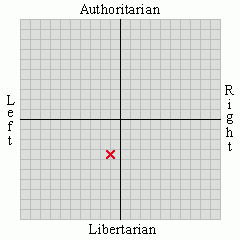
    4. I would have thought I'd drifted much further to the flaming radical end of the political spectrum, but I guess I don't trust any authority enough for that. (I came out strongly non-interventionalist and culturally liberal, so don't ask me how the silly quiz calculates the political vector. Probably the confusion is that I am not very emphatic about many of my opinions, especially when they don't match the offered wording. They should have a "difficult" axis, I'd nail that one.) I'll say that as my fearless leaders continue to drift toward full-on corporate whoredom and a militarized state, who won't spend a dime to actually help people even when the data is in that the programs are effective, and remain basically unresponsive to the various externalities the private owners ain't paying for, then those conditions make me feel like a fucking socialist. Anyway, I don't think this has changed very much at all since last time I took it a couple years ago, which was a surprise.
    My Political Views
    I am a centrist social libertarian
    Left: 0.89, Libertarian: 3.66

    Political Spectrum Quiz


    5.I looked over some old posts quoting that old quiz (failed to find it, of course). The posts are about 70% of them godawful. And really, next time I feel the need to cough up yet another general statement of my political beliefs, the exact same hairball I apologetically presented six months ago, feel free to just smack me upside the head.

    6. This is one of those things that looks like a possible upside to all the senseless killing, but is almost certainly batshit retarded in its own right. Turning the Monsanto corn crop into a global monoculture (the stuff is everywhere!), especially in some of the more bizarre climate zones, sounds like a recipe for worldwide food disaster. Here, it's being established at gunpoint (soldier farmers?), so score another one for the profiteers. What are the words to the Workers' Marseillaise again? (Via, uh, Newshoggers? I can't find the linking article. I suck.)