It's hard to ignore the national argument about guns these days. Between the president's recent executive efforts, the ravings of lunatic acquaintances on Facebook, and actual conversations with those old friends I am required to accept as sane, it's hard for me to resist formulating some kind of internal statement of principles in response to all the unsolicited opinions. (I know I coughed up something along these lines a couple years ago; I recall it was one of my more obnoxious posts.) As I probably mentioned then, I don't have any particular issues with gun ownership, collecting, or sports, and I recognize firearms as occasionally useful tools of land stewardship. It's not my bag, but hey, if you like the things, then more power to ya. And as far as hunting goes, I feel similarly about that as I do about smoking in bars, other people's backyard parties, or leaf blowers. Which is to say, I would greatly prefer the public space to accommodate my activities more than those of some orange-jacketed yahoo who might accidentally put lead in me, but I accept that some kind of compromise is probably appropriate here.
I don't reflexively hate the things, but I've arrived at a few considered points in my internal process that I can't work past, and which I've never seen adequately refuted in the public conversation. And, well, here they are.
Owning a gun is one thing, but carrying a gun, on the other hand, makes you a dangerous asshole. You are dangerous because you're carrying a gun. And you are an asshole because you feel the need to be dangerous in my company.
Any reading of the second amendment that gets around the "well regulated militia" part is incredibly tendentious. For something held so proudly forth as an unassailable totem of gun rights, it's front-loaded with weasel words.
Gun manufacturers (and their lobbyists) don't necessarily have citizens' best interests at heart. Their goal is to sell guns, which may well be inimical to the well-being of the people, considering you can sell more guns when groups of locals are inspired to point them at one another. I won't address exporting them into conflict-rich zones (I don't know enough to comment), but let's take the NRA formulations as stated: the bad guys with guns, the world where only outlaws have guns. They didn't mysteriously appear in their hands of all these scary people. They bought arms that you, the gun companies, manufactured and sold to them. Are you seriously using the threat of the people you've already armed to sell even more guns to the rest of us? Fuck you, the NRA.
It's not your imagination: mass shootings in the U.S have gone up in the last 15 years, according to the FBI. Meanwhile, our murder rate is higher than other developed countries, and guns make up the majority (like 60%) of those homicides. Guns are reported to increase the risk of suicide, at least among young people. I'm aware that statistics can be massaged, but these seem as reliable sources as anyone's going to find. I'm aware that overall, violent crime is down here, as it is in many parts of the world. But it's not too adventurous a hypothesis to propose that what gun access does is to change the nature of violence. They're death-enabling. Would-be murderers are empowered to take dozens of victims along with them. People down a rough path can have them right there when they're feeling their most desperate. Maybe this isn't for the best.
You're almost never going to get the jump on a prepared armed person. Any self- or home defense scenario which requires you to grab a hidden pistol from your person, or fish it out of your possessions, you've already lost. Seriously, playing cat-and-mouse through your sleepy house, standing off a mugger, preemptively intimidating a violent display, it all presumes you've identified the offender and his intentions (not to mention established the safety of everyone in your dangerous path) before he's had a chance to perpetrate his crime. Good luck with that. It also presumes your threat identification skills are top-notch, and let's be honest here...
In order to ever put the odds of these kinds of scenarios in your favor, you have to be constantly prepared. There are situations where this level of perpetual adrenalized vigilance is warranted, but it is very stressful. Usually it's limited to people whose job it is (cops, soldiers, gang enforcers), and because it demands abnormally high commitment, they get paid for it.
It's true that sectors of normal life can also come under such routine threat as to require hyper-awareness, but when the social contract has broken down to such a degree as that, the equation changes. There are marginalized enough people in this country, sadly, but promotion of American gun rights has almost always been from a position of social privilege. I realize that I've been lucky, world-citizen-wise (as have the president, those Facebook loonies, and my friends). I'm not really at much risk getting wasted in the path of some neighborhood strongman or some aggressively deranged bastard, and I think obsessing about them is kind of chickenshit under the circumstances. I'm currently much more worried about drunk drivers, cancer, house fires, and botulism--you know, the perfectly rational stuff--none of which can be deterred with firearms.
Undoubtedly, the number one perk of civil society--arguably the definition of civil society--is that walking out the door isn't an invitation for death. A few legal hurdles don't sound too onerous to reserve guns for those who want them for nonviolent ends. The people who feel otherwise, I just wish to hell they'd make the honest argument that they feel the tradeoffs are worth it to them. If the increased risk of horrible violence (for someone) is worth the security/enjoyment/empowerment a gun provides (to you), then demonstrate your steel-eyed toughness and say so.
Several months ago, I put aside a post about the Daredevil series that had recently aired on Netflix. I couldn't file it down to the narrow point I wanted to make at the time (and I was also conscious that I have one about the Marvel live-action universe still on the page), but last night, I stayed up binge-watching (as the kids do these days) the followup series, Jessica Jones, and I think I want to work a few things out here.
Daredevil was the only reason I gave in and got a new Netflix subscription early this year. On the whole (and like most people), I thought it was fantastic. There are any number of ways to take on the space-aliens-and-superheroes fare and keep it entertaining--god knows that like 90% of these books I read fall neatly in the sci-fi/fantasy basket--but I've always liked the stories best when they keep a strong connection to known reality. I think this was as important for the oldest hero stories as it is for the new ones: you can't make anyone larger than life if no one around them is life-sized. Almost always, the believable angle comes as a plausible approximation of human nature in the response to all the craziness (I always love the sane, marginalized characters who point out just how nuts everything around them is, or who can't help lampshading the plot flaws), but what I'm finding so interesting about Marvel's live-action efforts is how they've been very creative about the places the stories touch ground.
I don't think Iron Man would have worked nearly as well, for example, without a 20-minute cut of Tony Stark's touch-and-go experimentation. Something in there got the process of innovation some exaggerated flavor of right. Shit never works too well at the beginning, even when you're a tech genius. Agent Carter wasn't in the same league as the Netflix dramas, but it was occasionally very strong, and that one was held to earth by the unexpected tethers of institutional bias. When I write it like that, it sounds like it's been done before, but it's a very different animal here, and the distinction is important. Peggy isn't smashing her way through the sexist 1940s and punching oppression-themed villains in the eye (not yet anyway), she is more like a well-realized character who is struggling within a confining peacetime reality.
Daredevil went on to do a whole bunch of things right in this regard too. The grounding theme of this show was the human consequences of movie-theater violence. In a stroke of genius, the aftermath of all the skyscraper toppling in The Avengers reverted New York to an old film-school version its corrupt, shabby self. (Because for anyone who's been there recently, today's Hell's Kitchen is a world of safe boring storefronts, and modern Times Square looks like some unholy lovechild of Disneyland and Tokyo.) And of course when the hero can get his ass kicked, get ground down, get laid up as painfully as Matt Murdock did, it makes any of his successes feel earned. Seriously: Daredevil was a great urban Kung Fu story before anyone got in spitting distance of the red suit. It would have worked every bit as well if he were just an athletic blind guy--the story didn't really need the "abilities." I bought wholly in to the first ten episodes, even as syndicates of mystical old ninjas were running through the city, and this viewer didn't bat an eye. Those places where it gave in to its comic self, that's when it stumbled a little.
(The other way that Daredevil established its emotional stakes--and this is a strength of Jessica Jones as well--was by giving the characters room to act like believable friends. To get close to someone as likeable but remote as Matt, you'd have to keep ignoring all of his subtle keep-away vibes, and they found a couple sorts of people who could. It required some decent acting and direction to communicate it.)
So on to Jessica Jones, a character I was only vaguely aware of through the nerdblogs, who came out 15 years after I gave up on comics. On TV, she is more obviously powered with enhanced strength and (at least some) resilience, and it's terrifying how all of that power means precisely fuck-all when it comes to the emotional challenges of acting like a hero.
If Daredevil was about the consequences of violence, Jessica Jones is about the consequences of abuse. Looking back on the binge, I see it mapped on every character thread, but as before, this is the tether to human realism. David ("Tenth Doctor") Tennant plays the villain Kilgrave, who can make people obey him, who can make people want to obey him (and what good is super strength against that?). This is an abuser who is additionally enabled by mindfuck powers (and it's not at all clear which came first), and it's damn interesting how often he resorts to conventional abuse too, because that's the kind of person he is. It's damn interesting how willing the show is to get right in the head of people like this and develop it as a theme (not just Kilgrave, but a number other male and female characters act abusively as well), treating them with empathy, encouraging the viewer to understand their motives and to weigh their charming apologies, without forgiving a damn thing about what they do, and without ever ceding the agency of the victims. It's a bit of a spoiler, but Kilgrave starts out as casually menacing, and the show gradually recasts his behavior as obsession, and then as petty obsession. And the truth is, the Purple Man would be nowhere near as scary if he were bent on world domination, or revenge, or any of the standard supervillain schtick. Nor is Luke Cage (Jones's lover, and total badass) allowed to ride in as a savior, even though if anything he is more powered than she is. He understands that this is her demon to overcome, and the wannabe good-guy types who feel it is their job? The ladies don't even let them drive. It only sounds like a textbook in hindsight, because it's a character drama before anything else, and they do an good job of keeping it real.
You know, I was looking forward immensely to using that title, and meanwhile, despite my best plans to hoist it up there in a timely fashion, Captain America came and went. Today, the X-Men will take the reins of cinematic superheroes-of-the-month, which actually gives me some good points to compare and contrast (and a reason to finish the post!), even before I see the movie.
But first, I want to say that I enjoyed the hell out of the new Captain America flick. My first thoughts about it were less to do with the title character, or with comic book movies in general, and more to observe just how far action movies have come in these late days. Winter Soldier doesn't really develop as a cerebral Cold War-style political thriller (maybe they thought Robert Redford would carry the office scenes? He didn't.), and maybe that wasn't the intent, but it does communicate the emotional immediacy that I associate with movies of that era, now with a sense of explosiveness that modern cinematography can actually deliver, which kind of balances the whole equation. As viewers, we know that the rumbling threat of shit going down, can, if necessary, and with good enough direction, be delivered with full fan-splattering spectacle.
And they got the kinematic balance right in this one, in a big way. The scenes in Washington traffic were great, as one small example. Somehow people and cars were depicted at the right first-person level--the aggravation and frantic energy of disrupted driving in that town was believable--and when the holdup turns out to be an armed weirdo standing stock still in the middle of the road, it was incredibly intimidating. I'm reminded of Paul Greengrass style tension again, and maybe that's part of the development of the art, except that these couple of guys were apparently directing sitcoms two years ago. What a break for them.
As a character, Captain America was always a tough sell in a modern age. Like Superman, he's one of the lazier concepts of the comics world, and like Superman, he's a throwback from a time when readers were, apparently, more comfortable with silly patriotic hyperbole. I thought the first Cap movie was somewhat enjoyable in its attempt to bring the yay-rah goofiness into a contemporary framework. The movies confront it (as did the comics, or so I understand) head-on. The first Captain America flick gave a big hat tip to the cuffed boots and dollar-bill shield of the character who once punched Hitler in the jaw (putting silly patriotic hyperbole right where it belongs--in entertainment!), and it wisely allowed some measure of cynicism about it from people who were the actual bloody, tired fighters. I've read that the directors of Winter Soldier intentionally kept the CGI to a minimum, as though people are finally learning that even with comic exaggeration, these movies aren't better as cartoons, and Chris Evans does a very good job of communicating the character with a kind of pure-hearted capability--Americans as we pretend ourselves to be--struggling to find a footing in a more cynical time, and his performance in the role gives credibility to everything else.
I only really read comic books with any kind of seriousness for a year or two of my life. Even then, I didn't care enough to actually spring for the damn things, and if my friend hadn't convinced his mom to buy him a stack every month, I was unlikely to have smeared as much teenage acne grease over as many collectible pages as I did. I never got much from the power fantasies they laid out, but I did relate to the otherness that these characters endured with such over-the-top pathos, and I absolutely loved the full-spectrum weirdness that Marvel added with a combined universe--where every story is epic, and you have gods, war heroes, scientists, freaks, aliens and athletes working at similar purposes and on improbably equivalent scales, and everyone looked impressive in spandex, which they probably needed less to show off their abs than to keep the requisite two tons of angst crammed tautly into every 180-lb body. I admit it was fun while it lasted.
The Marvel universe was just huge, with a gigantic B-list of characters, connected to itself on hundreds of levels. It was brilliant in its way, but it was also a problem, because with so many writers pulling these characters in different directions, it proved impossible to keep anything like a consistent story or even vision going. And it didn't take me long to realize that even within a given title, any investment I made in the story, setting, or character growth would never be rewarded, doomed instead to be split prematurely on the rocks of the next writer's unfaithful (and inevitably worse) vision, buried unceremoniously in some awkwardly shoehorned retroactive continuity. The word "retcon" comes out of the comics world in the first place, thanks to this pervasive, and fundamentally inconsiderate, practice. It's one of the main reasons I stopped reading them. (The other one was that in those days, nerds weren't cool.)
Adaptations in the movies have suffered the same problems, and also added new ones. Even with the ability to lift and adapt the best stories from decades of comics, it's a challenge to stuff something that develops slowly over many issues, using a large cast, into a two-hour film. I am looking forward to the next X-Men flick, but Days of Future Past is one of the few arcs I do remember from my brief fandom, and if I'm hopeful that it's maybe an easier (that is, shorter) one to adapt, even as they omit or combine characters, I still haven't forgotten that the "Dark Phoenix" storyline, goofy and elaborate as it may have been, couldn't have been Ratnered any worse in X3, so we'll see. A diversity of directors and writers have utterly wrecked any hope of continuity for those mutants, and poor Spiderman's a similar mess of reboots and overstuffed villains. So that part is just like the old comics, then, and it's kind of a shame.
I think the most forgivable way to look at all these disorganized and diverse efforts (some of them ranging over 70 years), is that through repetition and retelling, they've produced icons, characters that have been averaged out to a set of timeless and identifiable traits, fighting characteristic battles over and over again, living and dying, but never really changing. Ironically, this imbues them with something like the mythic status they originally copied.
Well, it was like this until recently. Captain America and the rest of the Avengers properties are taking a different and (for this kind of material) innovative path. I know from reading the nerdblogs that the film rights for the Avengers cast are owned by a different studio than the others (which means they'll never meet the Silver Surfer), and the tie-ins and cameos have all been intentionally part of a loose, overarching plan by the producers. (I'm on record as thinking this approach was gratuitous and unlikely to work. And I was wrong--it's great.) It's allowed for hit-or-miss individual films (really, this is the first one that's as good as the original Iron Man), in a variety of styles, but it's brilliantly correcting something that ruined the comics for me 25 years ago. These characters are actually developing over the course of the big arc. They're aging (live actors give you little choice on that one), and they're getting wiser. Superheroism is affecting the world around these guys, and those changes keep growing into more developed settings for the next movies. My inner fourteen-year-old fanboy is squealing at finally seeing the dream done right. And it's big, it's weird, and it's all kinds of fun.
August 6, 2014: Bain Capital cancels the complimentary employee expense account with CoffeeStop Cafe at the ground floor of the home office building, saying consumption of caffiene conflicts with Mr. Romney's Mormon principles.
December 18, 2014: The staff of Google, Inc. is surprised to find that their expected Christmas bonuses have been canceled because they do not comport with the founders secular humanist beliefs. (This creates a minor lawsuit, but Google lawyers hold the day by pointing out that a "private company" doesn't necessarily mean a privately-held one, just a company that is owned by shareholders and not the government.)
January 23, 2015: Earthlink (which apparently still exists) strikes all prescription coverage from their company health plan. According to founder Sky Dayton, just too many medical drugs interfere with the mental and spiritual wellbeing of thetans, and he and the current owners have a religious objection to providing them.
April 1, 2015: The managers of The Christian Science Monitor completely remove medical benefits for the entire company, because, duh, Christian Science. Prayer consultation, however, is offered at a discounted rate.
June 20, 2015: The Boston Manufacturing Company requests that female employees remain on campus the entire day, all week, locked in with low light, so that their good Christian morals remain uncorrupted by the external world. Oh wait--sorry--that happened in 1815.
February 12, 2016: Citing their devotion to Mammon, Goldman Sachs announces that they will completely suspend the pay for all janitorial staff, then the office assistants, and finally all positions up to low-level brokers by the end of the year, even though everyone will still be expected to work. In press interviews, senior management embrace former CEO (and now Treasury Secretary) Lloyd Blankfein's 2009 claim that 'god's work' gets done at Goldman.
January 10: 2042: M. Cletus Sitwell, current CEO of Massey Energy, requires that employees supply all of their own safety apparatus, although it is discouraged entirely around the flaming pits, especially on bring-your-kid-to-work day. "Don't forget," said Sitwell, "the M. stands 'Molech,' and when I am in charge, every year is a bull year for Massey!"
[Edit: Um, that is, "Hobby Lobby v. Sebelius." Who's suing whom, Keifus?]
In honor of Valentine's day, I present to you a couple of quick links to stories that have somehow penetrated my gruff, jaded exterior to find the tender-hearted boy within and wake him up with a mighty slap across the face. (Which of course reminds the little weenie why he built the scabrous shell in the first place, but I guess it's nice to know that he's still breathing in there.) Here are two stories touching enough to get even to me:
When I think of a template for the world's most romantically devoted men--Romeo, Orpheus, McLovin--about the very last person to come to mind would be Carl Sagan. Yes, I am talking about the popular astronomer, the man who drawled Cosmos on tv when I was an impressionable kid, the professional skeptic and rationalist who, on his deathbed, refused to accept any faith at all. That guy. I could imagine an academic sort of passion from a person like that, a bookish devotion to knowledge, but to another human being? It seems so unlikely, and yet there it is.
Sagan worked on the famous Voyager message, the gold record that was sent along with the craft. During that time, he was close, as friends, to his collaborator on the project, Ann Druyan. While exchanging phone messages about one of the musical entries, they discovered something more compelling than their work and stronger than their friendship. With the clichéd suddenness of Cupid's archery, they both realized they were deeply, impulsively, and irrevocably in love. [It worked out so sweetly for Carl and Ann, but what his wife at the time came to think of all this is not part of the story.] There is certainly a rare power in discovering chemistry with someone, but that is not even the part of the story that makes my inner romantic get misty-eyed. What Sagan and Druyan proceeded to do was to put an audio translation of her brain patterns onto the record, and the human biological noises that were added were also hers. The idea of pitching a doomed probe eternally into the void is sad and sweet and hopeless enough all by itself. In the infinitesimal chance it's discovered by alien civilizations, if they manage to decode it (if they even even get so far as to put together that we odd beings perceived the universe with gestalt images of narrow-band scattered light and linear mechanical vibrations), then it will happen millions of years after our species has guttered out and gulped its last. And if these hypothetical intelligences do get the LP turning properly, then what they will hear is the heartbeat of a woman who is newly and crazily in love.
[I first heard this on an NPR story a year or two ago, and it made me cry while driving into work.]
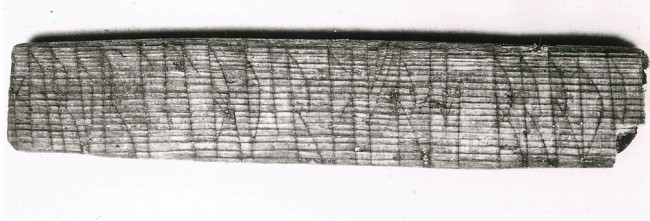
We humans lack the span of billions and billions, but hidden messages seep forward even from our meager past. Some 900 years ago, people in Norse cultures (when they weren't sailing away to massacre my ancestors) would write messages to each other, and remnants of carved notes on wood or bone are found occasionally in archaeological digs. Although Norse writing is known and can be translated today, these small totems can be hard to decipher, sometimes because they were copies of messages chiseled in by illiterates, but the carvers would also tend to get playful with the writing, using phonetic codes or decoratively bastardized script, which were pretty accessible then, but can be hard to pull from context when you don't happen to live in medieval Scandinavia. When one of these "Norse rune codes" was cracked last week (link via), it was a big deal.
What does the message say? What was important enough to painstakingly gouge out of a plank and pass on?
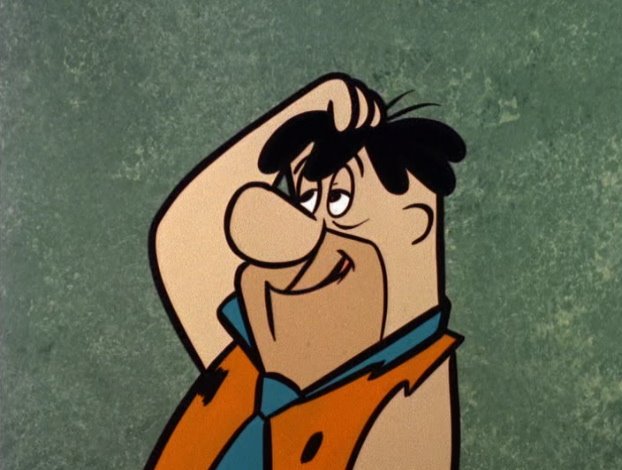
Like many a cartoon American male (actual photo!), I've been drawn (heh), more or less against my will, into watching Downton Abbey. Of course, I don't like to think my initial aversion is so comical as all that: the show basically encourages the viewer to empathize with the idle lives of a bunch of repressed, inbred, aristocratic motherfuckers. Yes, there are real struggles with class and status presented on the show, sometimes with a shred of cleverness and sometimes more as a scrubbed and kind-hearted anachronism, but on the whole, these mostly are just props to steer the characters, highborn and low, toward soap-operatic plots. (God help me, I think Maureen Dowd has just the right take on it, which has got to happen about as often as a hit shows airs on PBS. Downton Abbey as Gone with the Wind? Yowch!) My own opinion of the show is that when the omnipresent reality of ruin is better presented--in the war or in the workhouses, say--then it is more compelling than when it's just a drama of manners of these surprisingly egalitarian-minded overlords. [And sure, I agree the individual characters are well-enough conceived so that I care what happens to them, and that the costume is great, and that most of the (gulp) casting and acting is a whole lot better than the actual writing deserves.] But the ultimate case for Downton Abbey is the one that the show itself makes again and again. It is, well, Downton Abbey itself. The message is that even though change happens, nice things are worth having because they are nice things.
Granted, this is an insufferably English view of nice things (and it's one that I've seen often enough in British novels to pick right up on), but it's a hell of a step up from the "glory and conquest" view of nationalism (er, not to say the self-styled empire lacked that either). The motif of Downton is preservation, and the principle conflict in the show is one of sustainability. It's made of idealized rustic green estates that are topped off with a comfortable grandeur, one which imagines that all of its elaborate gimcracks and mannered conventions--livery, variegated flatware, gravelled walking paths, riding and hunting, all the forelock-tuggings and "m'lords"--hell, the nobility and the smiling peasants themselves--all are explicitly useful, that there's a good reason the chairs are a set distance from the table and you that you should pull up the right claret from the cellars, just like there's a good reason to rotate crops and to pass on the right. Downton Abbey imagines that the land and its customary adornments are things worth holding on to, that they are essential parts in a long-ago optimized machine which needs to produce nothing but itself. Of all the apologia for aristocracy, conservation of nice things is the only one that I have found not to be laughable on its face. The family is allowed to inhabit the manor because the estate is worth having, not because the family is.
Downton Abbey, in other words, is a community that is valued as such. The community needs to be complicit in the concentration of its wealth, to support the estate. It's an enabling fiction of a community, and I don't forgive that. It's built on the backs of those kindly-seeming laborers, on net ancestral plunder, and on a system that allows one entitled and unproductive class to drain its resources from others. The antebellum American south copied the model consciously, and it was a horrorshow. (Meanwhile, the somewhat more communitarian settlement of the colonies to the north set up some of our nation's enduring conflicts.) The recent pretense to democratize American greenspace only got us the suburbs, a boring, shoddy clapboard fiction built on consumption instead of conservation. The people's revolutions of last century--though you have to appreciate the generations of effort it took to get outside the thought box--often earned central parties and widespread repression. It's a real conflict of the human animal, and it sucks that we can't seem to have nice things without massive inequality railing along with it. Authoritarianism, stifling of individual expression, and a devolution to oligarchy seems to be part and parcel with any of them.
One novel I recall very fondly is Gypsies by Robert Charles Wilson. This author uses science fiction constructs to flesh out and deliver some sock-you-in-the-eye humanist themes. In this one, a family of young people possesses the power to step between alternate realities--some are better than others--but only, as the painfully delivered climax reveals, worlds which they are capable to conceive. We are limited, he says, all of society is limited by our collective imaginations. It's Candide with a quantum-mechanical kludge, that only keeps 99% of the cynicism. It's a nice empirical shortcut to allow a writer: some societies do evolve to be more sustainable, beautiful, and happy, and it would be nice if we could somehow sample for them with better tools than history, theory, and propaganda. The problem is that I wouldn't believe anybody who told you that any one of them is as good as it can be, or that this is the way it must be. Anyone who spews that is romanticizing some nonexistent ideal (as they do on DA), or else is using you. I've been a technical guy all my life, and I place a great value on evidence, consistent thinking, and proper weighting, which certainly applies to something as grand and important as culture. As I get older, however, I understand that we need to cultivate imagination every bit as much. If we don't let ourselves dream better, then we also fail.
[Edit: Whoa, it's been a while, and I should have a title. Status of the hiatus? Who knows, but I'd be pretty happy to get Paul Ryan's mug off the front page one of these days.]
In 2002, Jan Hendrik Schön, a researcher at what was left of Bell Labs, was accused of scientific misconduct by a formal investigative committee. He was caught falsifying data, sometimes drawing curves and pretending they were measured, other times swapping them from other pieces of data, and it was a huge scandal at the time, judged among the worst things you can do in science, or at least in premiere science. He was spotted because other researchers noticed that some of his plots looked exactly the same, even when he was reporting different conditions or phenomena. That is, they did not follow the same predictable shape, as you might hope data will do, but they bounced around their trendline in exactly the same way in both plots. This is what I remember of the scandal back then: one of my coworkers smugly pointing this out to me. See those two graphs, Keith? There's no way they should look exactly the same. (That's not just a fraud, but a lazy one. For the dedicated forger, how hard would it have been to introduce false instrument noise?)
When the Lucent committee looked more closely at his work, they found the bullshitting to be pervasive. No wonder he was able to publish a paper every week! Since this stuff was getting cranked through Science and Nature--relatively groundbreaking results in what was a sexy field at the time--Schön was ridden out of the scientific community on a rail. His awards and even his doctorate were rescinded (but the latter was re-awarded; evidently the guy's been fighting for his degree as recently as three years ago). The journal editorials tend along reputation-preserving retrospectives to the tune of how the hell did this happen, and let's never allow physics to be besmirched this way again.
I'll add that Schön is roughly my age, and even though I was a total academic nobody, there's still only a degree or two of separation between us. We worked in a similar field I am sure I read some of his papers late in my grad school days (which isn't to say I remember them specifically). My advisor had done his post-doc at Bell Labs, and some of his remaining friends there, to whom I'd been introduced, would become Schön's occasional co-authors. In defense of that community, the fact that Schön's data were hard to replicate isn't a total indictment by itself. Studies of organic electronics were notoriously difficult to reproduce in those days (and probably are now too), even for the same people, doing the same experiments. This was much more a matter of trying to force soft, quasi-pure, and reluctantly ordered systems to behave like near-perfect semiconductor crystals than it was a matter of dishonesty. Electrical behavior that was extremely sensitive to barely-tangible properties of an interface was hardly a rare thing. And in defense of Schön's co-authors, it's actually really easy to get listed as a middle contributor in a bustling, incestuous place like Bell Labs. That place (in that field at least, and in the 1990s) was more liberal than anywhere when it came to spreading names across the mastheads. You might get listed as an author for having prepped one or two samples, for overseeing one of the instruments, or contributing a paragraph of text from one of your publications. Take that nice piece of resume fluff, and move on, it's not terribly necessary to know what the lead was ever really up to. And more than that, Bell Labs was in its sad death spiral in the late 90s. It's got to be hard to care about what the guy down the hall is doing when you're investing all your free minutes in an effort to get yourself out from under the headsman's axe. Schön was dishonest as fuck-all, but he was in a niche where he could ramp it up a little higher than usual before getting caught.
So. It's months old now, but the economics world was rocked--no, better to say that it should have been rocked--by two researchers who published a report explaining that national debt levels above 90% of GDP cross a drastic threshold that's correlated with low or negative growth. Now, this was published in a conference proceedings (they give you big grains of salt at the door to these things, along with the pens and other swag--you publish in proceedings when you don't want to go through all the work of satisfying reviewers), so it's not, I sure hope, premiere economics, except that it became a leading-edge study because it got swiped up as a wand of legitimacy by pro-austerity policymakers and pundits, and we have all had to keep hearing about this crap. But when Reinhart and Rogoff's analyses were put under any kind ofscrutiny at all, it was, well, not good: bizarre weighting procedures and cherry-picked data ranges, along with spreadsheet manipulation (is it really cool with Harvard that its researchers chuck numbers into Excel and call it research?), later claimed as a mistake, that was painfully obviously designed to produce the foregone conclusion. And even if they've claimed only correlation, causation has been implicit when the work is reported by their supporters.
(I'll add too, that I don't think national debt is awesome myself. I see it as a trick that clears itself up so long as there's GDP growth, but there's no good reason to monkey with the accounting like that, well, other than to be obfuscatory about imbalances. The solution isn't to starve the lower orders; it is support them while showing the books properly. That debt doesn't correlate with growth, or that it correlates much more weakly than they claimed, is supportive of the "black box" theory.)
Anyway, my argument isn't so much what happened. You get academic tendentiousness for all sorts of reasons, and even thinking people are still hierarchical herd animals in lots of ways. Their rise went farther than it should have too. I've said before that since it's fundamentally based in the logic of agreements, economics is more like law than it is like science, which is to say that it's a matter of both rationality and, to a much higher degree than physics is, advocacy. Reinhart and Rogoff were probably not as dishonest as Jan Schön was--it was more likely they were just caught being lazy--but on the other hand, it doesn't seem to have hurt their careers, but for a few necessary defensive letters. Their work appears to remain influential.
I mean, fucking seriously. Here's Larry Goddamn Summers defending it, doing the opposite of protecting his own intellectual reputation and that of the field. They are friends, Summers says, and he openly admits that their work supports his agenda. Why does this guy, in the face of bad data, and his own awful history of being wrong policy-wise--not to mention occupying the smug embodiment of shitty low-empathy ethics of austerity--retain so much pull? Why was he a chief economic advisor, and why is that slimy piece of crap on the short list to run the Fed? I mean we know why, but still.
Economics is far from useless, but it's also farther from hard science than it pretends. In more ways than one.
Although we've had a number of them who veered toward the paternal, professorial, or patrician, Americans under (like most people in the world) powerful male leaders, are not strangers to masculine display from our presidents. Whether it was war-hero Harrison brazenly removing his coat and hat for a chilly inauguration, or the real reason big-shootin' Andrew Jackson was known as "Old Hickory," muddling our way inside a miasma of machismo is hardly anything new, but as contemporary ideals shift and change, and as the science of image management has grown more subtle and refined, the representations of presidential manliness have shifted over the years, and it's interesting to observe and note the progression of styles. The military mode of expression has always been there, from George (Washington) to George (Bush), and we can argue who earned the uniform more. Two things that I think changed the game very quickly, however, were (1) the development of quality photography and (2) the rise of popular sports.
Theodore Roosevelt is best rememered as the president who sold himself as an athlete, but there are a few others that most people know well. Gerald Ford was a star football player, for example, and George W. Bush cheered football, and Ronald Reagan played the role of a football coach once, all of which are pretty much exactly the same thing. And every last one of them inaugurated after 1950 golfed religiously. President Obama moves like someone in smooth control of his body, and it's been odd that conservatives have occasionally tried to portray a man who's been known to drain a three-pointer on demand as an effeminate, uncoordinated wimp, but then, they seem to be the ones who put more value on alpha-hood. Maybe the racists among them don't want to credit a "black" sport like basketball--more likely they just don't want to give him any credit for anything--but either way, it's been funny as hell to watch certain corners squirm at his recent photo release, firing a shotgun and looking good doing it. It's not that I approve of the technique even a little--what he's doing here is not much different than Bush's flight suit--but on the other hand, I've got to hand it to the president: that's one hell of a good troll.
The fact is, there have been a lot of athletic presidents, and many of them even tried to campaign on it, even though success doing so was rare. The problem is that it gave their opponents some grist too, and like Obama's hoops, it has had a way of getting subverted, eventually shelved quietly and rarely spoken of again. Archival photos of our earlier sportsman/presidents are surprisingly hard to find. I've been researching it carefully though, and I thought I'd share some surprising presidential trivia with y'all, along with vintage photos. Every entry on this list is 100% historically accurate.
1. William Howard Taft
America, desperate for a diversion after the war, caught baseball fever in the 1860s. (Baseball fever, though evidently contagious, proved much less deadly than yellow fever, scarlet fever, rheumatic fever, grippe, ague, cholera, smallpox, or consumption. It bears repeating that the nineteenth century was a septic, tubercular shithole.) The sport became spread out and standardized during the conflict, and afterwards grew rapidly all across the nation, becoming a fully professional enterprise by the turn of the century. Bookish, portly, and from an aristocratic family, William Howard Taft seems hardly the type to have made a showing in the scrappy small-ball leagues of the late 1800s, but after graduating Yale (where he'd wrestled), he moved back to the midwest and tried to get his weight behind a bat for a couple of seasons.
He played in four separate clubs between 1880 and 1882, and while a prodigious hitter, he had increasing difficulty making it all the way around the bases by the end, and before long, he took up his role in the legal and political world. (Designated hitters weren't common until the American League adopted the rule in 1973.) Shown here is his baseball card from 1880, when he played first base for the Indianapolis Whoppers.
2. Woodrow "Woody" Wilson
Another president remembered for being scholarly, Wilson was a baseball prodigy as well. Unlike Taft (whom he never played against), he was lithe, quick, and witty, known for chasing down balls and making daring catches. Both had magnificent moustaches in their day, however, which, even more than a uniform, was a requirement for professional play before 1900, especially in New York. Historians still debate whether the entire character of the Republic changed on the day Wilson shaved it.
He earned the nickname Woody because even with a big dramatic swing (Joe Dimaggio, it's been said, was inspired by early photos of the president, such as the one below), he wasn't a powerful hitter, but he could almost always make contact with the ball.
3. Dwight Eisenhower
Ice hockey had not penetrated very deeply into the U.S. in the 1920s, and it seems like an odd game for a kid from Kansas, and a West Point football player with a busted-up knee, to eventually gravitate, but that's exactly what happened with young Eisenhower. He was a phenom on the ice for several years, nearly making it onto the first American pro team--the Boston Bruins--when they formed in 1924. He is best known for making a dramatic overtime goal, but he retired from sport soon after. It's a wonder, because even flying around like that without a helmet, he clearly enjoyed every second of it.
His early campaign buttons were meant to read "I Like Ice," but no one on his campaign team got the reference. His friends started calling him Ike soon after, and it stuck.
4. Jimmy Carter
Jimmy Carter was a basketball star in high school, and later played football at the Naval Academy, at the position of quarterback. For all the modern presidents who were known to play football, it's strange that Carter is so often overlooked. With arms like iron beams, he could hurl the ball nearly level across the entire length of the field, earning the nickname "Le Sueur" from one of his Minnesotan teammates, who thought it sailed as if across the ice on the frozen lakes of his home city. It wasn't for another decade and a half that the moniker could have any connection with stimulated emission light devices, but nonetheless, Carter has claimed for years that being called the "laser" is what inspired him to pursue nuclear engineering.
Carter was also notoriously vulgar on the field, even among sailors, constantly dressing down the opposing defense with his impressively foul mouth and large academic vocabulary. Shortly after this photo was taken, he was quoted as saying "He's building a Disneyland? Is that some kind of narcissistic mindfuck? What a mouse-buggeringly stupid excuse for an idea."
And a color photo in 1947 no less. The man was a walking anachronism.
5. Ronald Reagan
Ronald Reagan played many hypermasculine roles during his acting career, and, arguably, in his old age, he would sometimes get them confused with his actual life story. But he never portrayed a boxer on film, despite experiences right in underbelly of the sport, and kept it impressively quiet even into old age. Many of his closest friends never knew when he was alive. Always intensely private about his experiences in the ring, it wasn't until the posthumous release of The Reagan Diaries in 2009 that his pugilist history was revealed to the public. Some surviving political opponents have recently speculated that the eventual onset of his dementia was exacerbated by a few too many blows to the head.
By his own admission, he wasn't a strong fighter, but he was steely-jawed with good features (this is an older photo), resembling a softer, thinner Jack Dempsey, and his managers would heavily promote him by looks alone, usually as an opponent to the local champ, a kind of record-booster for the hometown guy. He boxed professionally in several leagues, changing his name and moving on when his record inevitably would start to catch up with him. The experience of being a professional loser depressed him immensely, and he was unable to come out of that melancholy until he took a chance at a radio gig and met success in another field. From that point on, he took care to craft his image as a winner, someone on top, a man who manages, not one who gets managed.
[Edited to smooth out some uneven language. You know, a whole lot of these guys really were jocks--figures--which kind of robs the joke.]
As smarter men than me have suggested, easy access to guns is the difference between a killing and a killing spree. If that guy only had a knife--or even a hunting rifle--it seems unlikely he'd have been able to take 30 other people out along with the one he actively hated. And if you're down to advocating armed kindergarten teachers as the thin line between order and chaos, then you might want to step back and reconsider your notions of "freedom."
Gun controls? I don't know if that fixes very much, really. Even if they seem to be effective elsewhere, we've got our own brand of advocacy here in America, and we have different local stresses, and neither of those will ever be what's addressed. If there's a solution to this, I am pretty sure that all of the hero fantasies I keep reading in response, all those revenge fantasies, all those delusions of steely competence, those things are closer to the problem.
[Appended: I keep going back and forth about posting my feelings to my "friends" on the various social media that I am reacting to. Part of my growing disgust is all that unsolicited sanctimony, and unfortunately, what I have to say can only be included in that category. At least anyone reading my shitty blog is here because they want to read what dumb things that are on my mind.]
The devil's in the details, they say, and god is in the gaps. We organize the world into thoughts, clauses and words, even though the real conversation happens in the transitions and in the spaces in between them. True meaning requires context and nuance, and true dialogue requires some understanding beyond what the words are saying, some faith of intent, some invisible working models of yourself and your partner (and of reality itself) which are always the hidden participants in any exchange, interacting above the robotic flow of data. Inflection matters. What's not said matters. It's why we go nuts over irony. Or poetry. Or fiction. It's why online conversations can be difficult sometimes. And it's what, in music, gives life to what is otherwise a bunch of notes.
Music is just one more thing that we humans--or maybe the universe itself--has made an annoying effort to discretize. And I'm not just talking about rhythm here. In many ways, pitch, to be arranged artfully into music, has to get stacked in set intervals in frequency space. The urge to do this may well be biological. The pleasure of hearing harmonics--frequencies that are integer (or simple integer fraction) multiples of each other--may well be a necessary artifact of being blood-and-guts machines. Deep in our inner ears, the actual business of sound detection occurs via arrays of tiny electromechanical resonators, and while the transduction of sound into nerve signals is complex and interesting, the vibrations themselves still must be supported on a bunch of actual, physical things, in order to get the sensation funneled into our brain. The fact that we have, fundamental to our hearing, all these bunches of guitar-string cells, each tuned to different notes, means that the same receptors will be sensitive to harmonics, and when we register "consonance," we're thrumming groups of hair cells that naturally buzz together, massaging them in a similar way, in somewhat different proportions, and it can't help but feel good, like scratching each other's itch.
To step it back for the non-nerds, we can envision sound harmonics as waves on a string. When the string is plucked, it will want to vibrate back and forth, keeping the ends anchored. It can move in lots of ways under these conditions, but after a very short time, only a few stable vibrations (standing wave modes--the picture shows a few of them, taking a few snapshots in time) will emerge, corresponding to how many wavelengths can fit neatly on the string's length. The second mode has half the wavelength, and, as though a string was fretted at that node point, it will move back and forth twice as fast as the first mode, and so on. Likewise, when a string encounters an external source of motion that pushes it at one of its natural frequencies, then it will start to buzz there on its own (what it means when a mode is "excited"). Some wiseass is going to say, "Hey Keith, sound waves are longitudinal, man, those vibrations breathe in and out instead of bend up and down," but the modal analysis is the same--a solid sustaining a vibration at some frequency (possibly in a complex way) will radiate longitudinal sound waves into the air. Maybe less obviously, the modes are evenly spaced here only because we're imagining the string as a one-dimensional system, where the disturbance at points along the straight line is the only one that matters. That's a fine approximation when it comes to your hair cells, which are rod-shaped, and for almost all musical instruments, which excite strings like in the picture or the air inside a pipe. (I think the brass family is the only group of instruments that is designed to excite higher order modes when it's played, however. Usually, you just change the length of the cavity. Imagine how fast you'd have to blow across a flute to get the n=2 stuff out! You can do it on a stringed instrument, if you hit it just right, tap it halfway down its length, but there's not a whole lot of point to that.)
You might argue that once you choose a frequency to tune the band on, you're pretty well stuck with the corresponding set of modes. And it's true! There are entire volumes of musical conversation that are ruled out once you define your key. But fortunately, not all is lost. We can add in a lot of obscure modes to give a given instrument a unique timbre, and there are an important class of instruments that don't work this way (and more on this later). Even all the ones that do, they allow varying access to this space, letting the skilled player suggest all the drama that lies just off resonance. Also, we are given to work with the fact that Western tuning is inherently fucked.
Personally, I find the intersection of musicianship and acoustics to be vexing. It's irritating to me that a "third" interval has nothing to do with the third harmonic up there, that a "fifth" is a half, and so on. (The problem is really the English language: the ordinal number and the fractional number should never have been the same word.) In the usual convention, we break up every doubling of the frequency (every octave) into twelve equal divisions. (Equal on a logarithmic scale, that is. It's twelve even ratios, really, and, well, people seem to have a biological imperative to divide things by twelve too.) But let's note that in terms of harmonics, this makes sense only going from the fundamental to the second one. Let's also note that any in-between harmonics that might please our ears--however many 1/3s and 1/2s it'd take to add together to sound consonant to our ears (as though we were hearing the double and triple of some lower frequency)--don't get represented very well in this scaling.
It's a lot easier to see that when it's written out. I put some notes and frequencies in a table here, starting with the reference A at 440 Hz and proceeded up the "equal temperament" chromatic scale. It gets pretty close to true with the fourth (1/3) and the fifth (1/2) which is presumably the primary point of it. The fact that our music hammers so hard on the IV and the V chord no doubt has a lot to do with tuning, but these are important harmonic intervals, and we probably would have stressed them anyway. The major and minor thirds (1/4 and 1/5, grrrrr...) carry a lot of musical weight too, and now we're getting a little degraded. Every other step is struggling to get any real harmonic significance, and I swear they're there only to make more use of the frequency space, to give some means for the musician to move on and off of the scaffold imposed by the more basic harmonics.
[I mean, okay, the point of equal temperament is to universalize twelve keys too. I understand that they used modulation before they began to tune instruments this way, but did standardizing the space make it easier to wing chord progressions around? I don't really know, but that is my suspicion. Because for anything with fixed frets or pipes, tuning with a just (as in, "just the harmonics, ma'am") temperament is going to be pretty damn limiting. The question of tuning is an old one though. When you got instruments that could efficiently hit multiple strings, the wizards of the day quickly realized that tuning could be easily designed to support some harmonics or other ones, as well as more universal temperaments that fudged them. I know even less about music history than I do about music, and I realize that the tuning argument had been circulating for a couple hundred before his time, but from this angle, I'm convinced that the only reason J. S. Bach didn't solve every remaining technical question in the field was because no one had invented the pianoforte yet. I almost wish he ended up on team leftbrain instead.]
I understand a lot of the musical conversation as dissonance that resolves to a more pleasing consonance. (I don't mean to suggest that I can carry on such a conversation, mind you--which ones are the blue notes again?-- but you don't necessarily need to be able to build a house to have a feeling for how a hammer works.) And the scale notes are in there to lead us toward or away from the (more) harmonic chords or intervals, which is great and all, but it's still holding us back. We're better off when we can weave in and out of consonance on a smaller level. You goddamn well need to have slurs and slides and hammer-ons, vibratos and bends. Honestly, it's what makes playing with feeling worth a damn. A minority of instruments are really flexible in this regard, either by using a fretless fingerboard, or else they have a sensitive enough action that you can change the pitch continuously within some range. On a fiddle or an electric guitar--or with the human voice--we can pinpoint the harmonics precisely (choirs often do it by sheer instinct), or we can wheel nauseatingly away from them, and do it all on purpose. I imagine that this is about 2/3 of the reason violins came to rule the orchestra, and why Les Paul came to rule the rock band. [Why not the trombone, slide whistle, dobro, or theremin? Because those instruments just aren't as cool. Sorry.] Man, when you're playing them right, nothing sounds more lugubrious than a violin or an electric guitar. And that's because they can avoid or accept the tyranny of harmonics at will.
I mentioned timbre. Even though instruments are producing the same pitch, or almost the same pitch, they all have different sounds. Any given instrument is going to have enough subtleties in its structure or action so that a number of minor vibrations can get through into the output as well. The one-dimensional assumption is great, but it only goes so far. Shaped cavities and resonators are the usual way to do change the voice, increasing or decreasing the quality factor (a measure of how "wide" in frequency the modes are, how much impure sound can sneak in at the edges) to soften or strengthen the tone, or which can set the instrument's modes just off even so as to avoid producing the overtones. Materials of construction can be more or less lossy, and even odds and ends such as handles and bolts might resonate at some unexpected frequencies and contribute to the sound as well. The nature of the input matters too. A vibrating reed is going to produce a different spectrum of frequencies at the front end, which may or may not be supported in the tube, than buzzing lips or a bowed string will (and when you strike things, the input is really different). If you took an oscilloscope and measured the waveform, you'd see it was periodic at the expected frequency, which is where the primary pitch comes from, but the shape of the pressure wave would be pretty funny-looking, with a bunch of little spikes and blobs in it. It's as if a whole bunch of clean sine waves that might have "fit" in that frequency were added to the primary one. Which would be exactly how to think of it mathematically.
The math would suggest that any periodic function can be correctly represented as combination of a lot of simpler periodic functions. That the physics suggests that it really does contain smaller waves is something I have occasionally found a little spooky, but it's not really any different than breaking things out in terms of other orthogonal components, just like on a rectangular grid. The idea is that any periodic function can be represented exactly by a sufficient number of sines and cosines. When you have a wave that can be imagined to persist for so many cycles that it doesn't matter where it begins or ends, then adding simple waves together is easy to imagine, but it really does get a little more mystical when you mix it in with the time domain. A quick pulse is fundamentally different than a blown or a bowed note.
If you think of the latter as a wave extending, for all practical purposes, infinitely, then that's what a sine function looks like. A pulse, although it has a discernible duration, is different because it disappears at the ends. Maybe you get something close to this from a really stiff drum, just one big and more or less uniform burst of pressure coming out its ass end. For a moment, let's ignore what happens far from the ends and just imagine a square pulse--on suddenly, and then off suddenly--as if it's inside one period. (For math purposes, we have to think for now that it repeats after this period.) One big bubble of a wave is obviously what you need to get the basic size of it right, and from there on, you can keep adding waves of different integer frequencies, each with smaller and smaller contributions (which you can calculate), to make the ends and the top get flat. That's Fourier analysis, and it's cool stuff. To make an exact square wave, you'd need an infinite many small sine waves. But even here, you could rightly argue that we're still using lots of little harmonics to finally address the non-harmonic space. Well, we did have to assume that the pulse repeated...
To describe just one pulse, you need to imagine frequency as a continuous thing, and the contribution of frequencies as a smooth curve too. (This is the Fourier transform now, and not just the coefficients of an added-up Fourier series.) It's got a straightforward formula, that we can at last apply it a single pulse, which is what has been done in the right side of the figure below. The wavy curve represents how much any given frequency contributes to the simple beat. (If we were, by contrast, to take the Fourier transform of a continuous sine wave, it would only have one value, and not be curvy. A sine wave is only defined by just one frequency.) This has some interesting implications. First, a pulse has an infinite number of frequencies associated with it, even though they get really small far away from the center line. If the pulse is shorter, the frequency curve will widen, and the strongest frequency component will be higher-pitched. If the pulse is stronger, then the Fourier transform of it has higher amplitude too, and the fading end bumps are more likely to be noticed.
There is only one part of the band that produces pulses of sound, and I had never quite managed to cross the line and think of drums as musical instruments before. But last week, talking to my friend switters, I had an epiphany, and music hasn't looked the same since. (I'm going to steal a little from that conversation here.)
Here is the only access we have, in tuned music, to all of the dark and lonely corners of sound spectrum. At last. Rhythm is powerful all of itself, don't get me wrong, but good lord, it's the sound of the drums that is used evoke deep spirits and eldritch horrors, the primitive hordes, all the powerful forces that are unseen. (Hell, we "drum them up," don't we?) It's accord and discord rolled together all at once. Here is why, in the movies, a sonar ping sounds so heavy and ominous. We don't march to drums just to keep time, we do it because the sound of them compels hidden forces within us. Strings and horns will stroke our ears and minds, but drumbeats slug us right in the guts. A drum corps will move us in a way that a wind ensemble never will. In a way that it can't.
[Plucked strings might count as a middle ground, although most of the time you let them ring, so that the secret frequencies fall right out. Redneck bands use the mandolin for rhythm usually, and there you try to "chop" it, arguably working it like a drum--whack the strings and then immediately deaden them. Done right, it gives a pop that only suggests the chord. Good rhythm players will have a little conversation of their own, opening the chops and closing them back up.]
Do drums really produce a pure pulse? Well, a taut drumhead does have a set of vibrational modes of its own (2-dimensional now, so hitting the surface in different locations can excite different ones, and the modes are no longer consonant), and there is a very short resonator section. And you can, to an extent, control the duration of the strike (expand that envelope of frequencies or narrow it) by softening the head or the mallets or by hitting it harder. So obviously, different drums and drummers have different voices. Some orchestral ones are built to sound more tuned (evidently for depth), and that's great, but I'll take a deader head to fuzz out the harmonics, hit hard, with a deep primal voice. Get some of that big voodoo to come out the other end.
I think that the primal sound is difficult to get with a single drummer, and that modern popular music too often fails to get all that it can from the shadowy acoustical depths. (Although I believe that this is exactly why the standard rock drum break is a couple of quick hard-pounded phrases down along the heavier toms. Whacka whacka, thudda thudda, boom.) Two ways you can try and get it with the one-man kit, either with an overwhelming quantity of accurately placed and voiced notes (color, as switters calls it) or to just beat the living fuck out of the things in order to get a denser (not just louder) piece of sound to come out. On the drum kit, for normal human beings, this seems like it must involve a serious tradeoff. If you hit the skins hard, it's going to be more difficult to hit them with speed and precision. I suspect that a bomber type needs a very good time sense (but what drummer doesn't?) if he's going to get by with fewer whacks.
We can all name some of the bombers--Keith Moon, Jon Bonham and Lars Ulrich immediately came up. I'm going to add this clip though, because for me, the itch started here. I never much thought of Bad Religion until I got this CD, and the difference is entirely this young guy with the sticks. This track might make an especially good example, because the lyrics are pretty sub-par for these guys (a shitty pun, a cheerleader chant, and no rhyming big words) and the musical flavor is pretty damn unsubtle (talk about hammering on that fifth interval) without much contribution from of the usual vocal harmonies. I'd call it a phoned-in effort, but sweet holy fuck, those drums. They fill the lower register with ominous power. If you have to hear it first on this youtube clip, at least make sure you put on some headphones to get any of the effect. When that phrase at about 2:13 comes in, you can feel from the first roll that the whole thing is going to explode in a couple of bars. Well, too bad the rest of the song wasn't better.
I've had that BR itch for a year or two now. But of all places, the revelation came while watching and discussing the Battlestar Galactica remake, which has a surprisingly excellent score. And while I have never considered myself a real audiophile, I have come to absolutely love this home theater setup I sprung for; it gets a lot of the primal sound fidelity that I never knew I was missing. To go with the clever orchestration, the show incorporates some serious drum rhythms (more than one player, I think, judging by all the darkness they're getting out of them) fit in with some complexity and nuance, pulling you every which way, and for a drama that slugs you in the guts so much, it's just a brilliant touch.
That conversation went to a lot of interesting places, and at this point I have a lot of things I need to be off listening to. That's all for now!
I realize that this is not a very timely post, but I've been thinking off and on about one of our local running news stories, of Annie Dookhan, the forensic chemist arrested last month for falsifying data. If you missed it, she had worked in one of the state's drug labs, and managed to deliver an unbelievable amount of throughput, with an astounding number of positives to a starved organization. Massachusetts is now re-investigating hundreds of drug cases, and has already overturned a few dozen convictions. They're calling it a scandal, but having worked in at least one place like that, and being married to someone who's been working in an equivalent medical industry position for a few years, the whole situation seems tragic, but it doesn't seem terribly shocking. Not so much a scandal, as an inevitable artifact of institutional mandates, in this case on behalf of the ever-awful War on Drugs. I'd call all the re-investigation unfortunate, but frankly, I'm happy that these people can get this overturned.
Character is part of her story, although all I can really do is speculate about Dookhan herself. By all reports, she was a studious sort, a person who had a habit of quietly applying herself. She did well on tests, didn't miss a homework assignment, but didn't draw a lot of attention. She'd apparently been going through some personal issues, but even before that, she already had a reputation for churning out a much higher level of test output than her colleagues. One of them called her "Superwoman." My thought is that she was mostly doing what she saw as her job, and wasn't a creative enough (or empathetic enough) thinker to work through the consequences. I also suspect that her supervisors and coworkers had some idea that something was amiss, but had little incentive to call her on it.
Workaday analytical chemistry doesn't normally require many serious judgement calls. The method is to turn around as many tests in as short a time, and with as much accuracy, as possible. Someone can be smart in terms of manipulating complex machines and in terms of processing numerical test data to efficiently generate results, but it doesn't necessarily require much wisdom of interpretation. Absent any kind of habitual check or cultural pressure for accuracy, then someone like Dookhan can flourish in an analytical environment by just appearing to be conscientious. And when there's a backlog, or when the lab isn't sufficiently staffed (or sufficiently equipped) to meet test demand, then second thoughts don't thrive. Anyone who calls attention to flaws or otherwise slows down the system had better do so only with damn good reason.
The medical labs don't seem so bad, if you were worried. Even if sloppy work ever gets done on suspect machines, confirming trials are routine, and there's not any particular pressure to produce one result over another. That doesn't say that everyone working in there is thinking in an abstract way about what getting things right will mean to the patients (although my wife is one of those people)--they're often just focused on the task level--but there are some safeguards for medical testing. Other industries or companies are not the same. When there is pressure to go one way, and when there's little or no consequences to getting it wrong, then things can easily go much differently. I worked one college summer in a QC lab for a small chemical retailer (which I won't name; evidently they are still somehow in business). Our job in that environment was, explicitly, to provide an "inspected" label so that customers could be reassured they weren't receiving a pile of degraded shit. Which they often enough were. Our analyses were cursory (and if no physical data were available, then we'd call down lab manager "Elsa" to tell us "oh, yeah, that's okay," and that's what would go into our notebook), and would only get rejected if it was real obvious garbage, and in that case one of the more senior chemists would recrystallize or distill it and sell it anyway. There, the pressure was to get stuff out the door, regardless of quality, and that is what we did. In the drug lab, I doubt that falsifying tests was encouraged, but on the other hand, turning out positives is simply what they were paid to do.
It's good to remember what are the actual interests of the employers when it comes to judging scandal. Often enough, people working in the trenches have no encouragement whatsoever to redirect the organization. It was a common theme on The Wire (gather so many arrests); it's sometimes used as a sharp criticism of politics and journalism, and of advertiser-funded media; this is one of the best-articulated examples of employers interest in recent memory. It's a common refrain: be aware of who is paying these people, and what are their goals.
Also, it gets me all skeptical of science education as a route to real impartial science philosophy (thanks, Arch). Yes, I absolutely think that we're better off when we value training in the natural sciences over training in less empirical fields, and I've said so often enough. But that's not to say it's a panacea. It doesn't necessarily lead to critical thinking. Or to better understanding of each other. Technical education gets us Annie Dookhans too.
Not long ago, I found an old letter to the editor that I wrote, and (thank god) never sent, from back in my college days, defending that redoubt of callousness and misogyny, the greek fraternity. The argument wasn't that godawful--amounting to "it's different for a bunch of socially inept nerds in engineering school, we need to drink irresponsibly, waah!"--but I know the style, the sort of precocious, self-affirming, fake-earnest crap that I'd later associate with bullshit-reasoned libertoonian writing, and I'm embarrassed that it ever came out of me. I have strong thoughts about going back and burning it, but on the other hand, it's my moral duty to belittle this kind of thing, maybe even more so now that I've gone and caught myself doing it, twenty years ago. In my limited defense, my conscience was making noises even in that one about people who might live beyond a bubble of other straight middle-class white dudes, and, generally speaking, I tried to talk to people sometimes at that age, cultivate some empathy, read freely, and accept that I might be wrong, and some would say that I generally grew the fuck up over time. Also in my defense, even if the fraternity system in general can be a hiding spot for a whole lot of college-guy nastiness, I think it was much better in my microcosm, and these sorts of things make a more easily assailable target than, say, college sports. The basic thing is that if you get a collection of pigs in one place, then they'll act like a bunch of pigs. A bunch of drunken geeks like we were? Some were better people than others, but I mostly spent those days sitting around with my friends making sarcastic jokes at their expense and mine. Good times.
People have made a lot of assumptions about this over the years, and one that's galled (because it's true), is that an organization like this is pretty inauthentic at its core. The design of a fraternity isn't really to accomplish anything other than pulling in students before it knows them especially well, and jam them into a sort of friend-making boot camp. I can't come down on whether this is fundamentally a bad thing or not. Some of them became real friends and some didn't, and if an opportunity comes your way to get to know people you have a good chance of getting along with, then why not take it? Especially if you're a dork in engineering school. (And there's the 2012 version of the argument.)
The trick to indoctrinate new guys is to build experiences together, make them hang out with each other and also with the people in the group. That was most of the hazing we gave, and the purpose of all of it, and if I had to show up and fetch beers for a month, or if I got encouraged to try and get away with things that were funny and harmless, then hell, it was nice when it was my turn to drink and laugh. It's pretty obviously a knockoff of military initiation, or gangs, or the clergy, or high school, or any group that makes a case for its bureaucratic existence rather than just its members. And the format of the rite is similar. Set a group of people apart from the rest, push them into a shared experience that's hard to understand in any other context, and let them join fully when they start to bond. It's team-building, in the horrible corporate sense. If my fraternity had conducted this with anything but mock-seriousness, then I'd have been deeply offended, but when it comes to human organizations, mockery is the exactly appropriate response to an abundance of seriousness. (And this may be how they got to me, the sneaky bastards.)
It's an adage that as empires crumble, life tends to go on for most of us--meet the new boss and all that. I hate to take that one too far: it's terrifying how much they can take down with them (and have taken down), but there's truth too that the failure of power structures most seriously threatens the empowered. [It's a thought that often pops up with me whenever the "ready flow of credit" is allegedly held at gunpoint by the financial establishment, but of course it applies generally to straight middle-class white dudes too.] I don't want to beat on Debt much more than I already have, but I find the historical contention interesting that when externally imposed institutions or governments lost their local grip, as he says they did for much of the middle ages in much of the world, then civilization tended to replace them with persistent hierarchical arrangements, where people were guided by tradition into castes, instead of by institutions. The roles in that arrangment are passed on by collective habit, and over time become difficult to confront. Inequality is assumed instead of coerced, and you learn it at birth. I'm not convinced this makes a better world, and in fact, it unnerves me that this is the only alternative that's much panned out on a civilizational scale, but the argument was that it was somewhat less violent.
You can't really escape it, and it's a topic that I periodically wander back to, maybe moreso than your typical engineering nerd. We are initiated into the game before we even get a chance to question it. The fact that we share non-genetic information from one generation to another, one group to another, that we pass it on, is the very essence of what makes us human. We're pulled into existing conversations before we even know how to talk. To really re-think things, you'd need to make a clean and thorough break from ten thousand years of evidence of other people existing, and who'd get to be the architect of that experiment anyway? In the real world, if there is a better and more fair way to organize humanity, it will be because a tradition of such practice emerges slowly, and we will still have to initiate people to get up to speed with that improved starter packet of information. Even if the guiding idea is a rejection of system, you still have to initiate people into the tradition of challenging it. You have to be conditioned to reject authority. Is it any wonder this species is so fundamentally confused?
I recently read the novel Things Fall Apart, by Chinua Achebe (a longer review is forthcoming), only to find myself unsettled, a little, by some of my reactions to the first part of it. It tells the story of a transitional time in west African tribal culture near the end of the 19th century. It had survived more or less intact from the days of the transatlantic slave trade (or at least the communities in the novel had), but was now facing cultural imperialism by the British. Achebe presents tribal life with hardly any explicit moralizing (one reason it's such a powerful little book), and as he got into Igbo life, my mind kept rebelling--what an unsatisfying way to live! Not, I mean, in terms of abstracts--in those areas, the Igbo peoples had the Europeans squarely beat, even in terms of whitey's own stated secular values. The tribal organization that Achebe describes put modern notions of democracy and egalitarianism to shame. The villages weren't ruled by kings or caste, and titles are awarded through accomplishment and are more tokens of respect than actual authority. The closest thing they had to government were priests (who advised on superstitions), and occasional meetings among decision-making elders. It's presented in the book as ideal a non-authoritarian society as humans have yet produced, ruled for a thousand years by traditions rather than by people. Nor does Achebe communicate that these folks lacked intellectual or emotional sophistication. The book itself, though parable-like, is a walk through that very landscape.
Nope, I was thinking more shallowly in terms of the habitual western quality of life. The Igbo villagers could expect a lifetime of toil, of violent superstitions (infanticide, circumcision, threat of exile, conflict with other tribes), and believing things that are tragically untrue. Their diet sucked--yams are on the high labor and low nutrient side for a staple crop--and outside of domestic labor, they don't have a fuck of a lot to do. Women, like in many cultures, could look forward to lives of drudgery, sexual obligation, and the occupation of lesser social spheres. It's almost enough to make you understand missionary zeal. Those poor bastards live in dirt huts!
The Christian missionaries that sailed up the Niger River no doubt had the best intentions, but they brought their own corruptions, including, as Achebe states it, a government too. The moral argument for the new Christian faith varied greatly with the missionaries who made it, and Achebe appears to harbor some sympathy (as I do) for those inspired to great humanity through faith, and to acknowledge some universality of all belief. The British that came to semi-fictional Umuofia brought in a religion that accepted society's rejects, and although it won converts by refuting local gods through empiricism, it still was a faith (and this is the very definition of faith) that was apart from available evidence. (It's just that Christianity by then had learned to scope itself outside worldly cause and effect.) History tells us that the Igbo would soon fall for Christianity in huge numbers, but was it an improvement? Hard to really say.
You'll have to forgive me here. I've been wrestling with a gigantic post for some time, about 20% of which (the part about life expectancy) came out a couple years ago in one big installment that was boring enough to scare me straight, and yet here I am again, about to liberate another chunk of it. It's trying to address a paradox of modern times: the world has improved, right? But human nature has remained the same.
Improved for whom, you might first ask? And by what measure? And for how long? The global metric I prefer is, more or less, better lives for more people, sustainable for longer—these are things that morally justify our social nature. What else is there, really?
Technology and organization let us achieve more spectacular evil, but they also seem to palliate some burdens of living. In my past blatherings, I've attributed the general condition of the species to population density, resource availability, and the level (or manner) of technological development (for which "improvement" isn't linear, or a given). Modern America may net a better score than the colonial powers of the late nineteenth century, a hideously overrated time if there ever was one. Igbo social taboos arguably existed to accommodate high-impact slash and burn agriculture and to manage a sustainable population (even amidst horrifying infant mortality). However, at least to hear Chinua Achebe describe it, they avoided the iron rule of oligarchy better than most societies (although maybe tell that one to the women), and offered a simple and satisfying life. Could the more egalitarian parts of Igbo tribal culture really survive with modern scientific inquiry, population level, and global communications?
If I had to define "standard of living," I would put in terms of how difficult it is to do the stuff that we want to do. If we have few impediments to performing those things that our minds suggest are fulfilling and feasible (travel, eat, surround ourselves with beauty, enter and exit places freely, accomplish entertaining tasks), then our standard of living is high. If, however, we can afford few of the comforts we can conceive, then it's not so high; if we can't get our hands on the necessities of life (nutritous food, sanitation, optimum health), then things are officially squalid. If we're looking across centuries or across cultures, I'd take a normalized standard of living as a measure of, given the known options and preferences, how much of it a can body hope to enjoy.
As an economic term, it normally refers to, more or less, how much stuff we have. GDP per capita is a measure that is often connected to standard of living, and it's imperfect for the various ways that Wikipedia describes. [If you must go that route, I think energy consumption is probably a better scorecard than currency. Kilowatt hours describe how much we actually do per capita, not like these things aren't correlated.] By this measure, standard of living suffers from inevitable fallacies of small or large numbers; when we are measuring our happiness in stuff, there are rapidly diminishing returns at play. Attainment matters immensely when we have next to nothing, but there's also some threshold at which we don't--or shouldn't--experience a greatly increased standard of living due to additional television inches, or housing square feet, or asset valuation. And of course we're about due for a horrifying lesson in the environmental consequences of overconsumption as well.
In a way, standard of living is always subjective, and based on what we think is possible, that in turn increases with existing understanding, scientific knowledge, and social precedent. Innovations eventually become necessities because we know that they are available. Medical care, for example, wasn't a necessity back in the barbarous days of medieval barbering, but now that medicine is sufficiently advanced to improve health more than damage it, it has become an important component in the equation, as reasonable to expect as shit-free drinking water, which is to say, because we know better. That's not to say that people wouldn't already imagine a better life without cholera (or cancer, or oppression, or aging, or managers, or the aristocracy, or…), but it's another thing entirely to believe existence is without them is attainable. What did the Igbo people think of infant mortality? They imagined life without it, and believed (falsely), that they could reduce it drastically through superstition. Did that wrong belief further reduce their standard of living? (I'd say yes.) Would they have been happier with improved medicine? (Probably if it didn't come with the British district commissioner. It's not so clear the British could have provided it in 1900 either, mind you.) Would a people in possession of improved medicine be wrong to withhold such information (probably), and is it hopeless paternalistic to intervene with it, assuming without nuance what another group of people can and can't imagine, and what they do or don't value? Or, for that matter, is it hopelessly paternalistic to assume that we understand very well what we think we know now? (Please, let's take a moment to laugh at the Victorians again.) Anthropologists must make for terrific basket cases.
Qualitative changes exist though, differences in kind, not number, that really do improve the game at a basic level. Incremental technical innovations can be oversold, but there are a few that really did change the human experience: agriculture, air travel, telephones, washing machines, that sort of thing. It's grown, and increasing the options for human happiness might be a good argument for increasing accurate knowledge in general. Better to devote energy to understanding how electricity works than to appease the proper gods, right? But there's more too. A counterargument is that technical progress has always increased the options for human misery as well. Another is that it rules out simpler, more isolated options.
Mostly we Americans accept obligations for all of the other things, continuing to do so even as productivity (measured per unit American anyway) increases. There is an ideal where productivity shoots to infinity (zero man-hours to make all the shit we feel we need), in which people would at least not want for things, feeling free to waste their days wreaking their philosophical havoc. Let's posit infinite energy, and look at fun literary experiments from Player Piano (suggesting it's deeply unfulfilling to violate our natures like that) to The Diamond Age (or that we'll find other ways to ensure inequality) to Steel Beach (or maybe find new ways to be a bunch of useless gadflies, so long as we can prevent our nearly omniscient helper from being too much like us) to The Cassini Division (when the means of production is trivial, Communism will finally work). I love reading this kind of stuff.
Modern America, Europe, Japan, all look great in terms of standard of living, at least if you take the self-affirming view that those regions tend to, and exclude people who don't fit the story. Here in modern America, a young black man was killed--a sadly unremarkable fact in itself--last week in a manner that managed to highlight, even in our cynical times, a class of people that half of this allegedly Enlightened country would still prefer to exile. (There's little doubt that the arrest, investigation, and the interpretation of "self-defense" would have been different had Mr. Martin been white.) A small wealthy group consolidates its power at the expense of most of the rest of us, fighting hard to define obligations which preserve their financial wealth, and dismantle any state mechanisms that share the wealth. And even the reasonably well-off waste their lives unhappily in front of a computer instead of in front of a hoe. As well, the U.S. is doing its level best to recreate the British experience in Afghanistan, inspired as much (and as little) by revulsion at their backward religion as the colonial British were. Even our staple crop, maize (which Igbo people also grew at the time of the novel), is another nutritionally inferior one, no matter how much we can creepily over-engineer the stuff. Our own times tend to overestimate themselves.
Happiness, satisfaction, contentment--these things are what really matter. Forming gigantic social groups may have allowed the technological development that has improved our chances of finding these things. On the other hand, advanced civilization also takes happiness away just fine.