Showing posts sorted by relevance for query sinclair lewis. Sort by date Show all posts

Tuesday, November 09, 2010

Review: It Can't Happen Here, by Sinclair Lewis

It Can't Happen Here, published in 1935, is a famous book. It retains a cultural cachet (in way that political predictions do, but scientific predictions don't) for its contemporary awareness, for having been accurately cognizant of fascism when it was not politically nescessary in this country to be so, and for anticipating some of its expansionist aims. It is, as the title suggests, the development of an American version of the movement, developed shamelessly from our own national myths, and opposed (or not opposed) by various liberal cultural or philosophical elements. Having cultivated this sort of cynicsm for a couple of years, I was expecting to find some connection to this book, at least as a warning against the self-proclaimed authorities. And, so, how to put this exactly? It has a couple of moments, but I don't think it was a great work, maybe not even an especially good one.

Sinclair Lewis (I learn) made his living, and eventually garnered a Nobel prize, for chronicling the middle class American angst of his pre-Depression day. This puts him as his generation's Franzen maybe, or Updike, or any of that stable of writers that I've neither read, nor can get myself to notice outside of their tedious "great writer" acclaim, which for me anyway, doesn't add up to an optimum set of associations, but still hardly enough to condemn. In any case, It Can't Happen Here is considered one of Lewis's late novels, published after his prime, and no doubt it got some penetration based on the famous name. The blurbs stress "important" and damn the reading with a faint "almost-as-good" praise when compared to his earlier works. Failing an easy connection to himself, you might be tempted to compare this novel with those of other authors who've also been astute and lonely critics of power, something like The Quiet American, but it doesn't hold as well as a character or a political study. As well as being observant, Graham Greene's will also go down as being an objectively good novel (to the extent that these things can be considered objective of course). Not to say it's awful--It Can't Happen Here has an impressive comic start, taking the gimlet to a couple Rotarian speakers—from the military and the DAR—but it doesn't decide well where it wants to be. The humor and the cuts don't keep up past the first 30 pages or so, and after that, the reader can look forward to only two or three episodes later in the novel that remind us that there was ever a satirical intent. The book makes a sorry bridge between the wit of Mark Twain and the bitter satire of Vonnegut or Heller. To my mind, It Can't Happen Here is closer in spirit to any number of late-model counterfactuals, and if AH writers like S.M. Stirling or Harry Turtledove might include more armchair generalism and less couched liberalism; more heroic violence and less subversive penmanship, the literary depths are similarly plumbed as by those more niche-oriented authors. Not necessarily a bad read, but it ain't indispensible.

Here's the basic problem: it's not enough to say it can happen here, what made it happen here? There's only a smidgen of this, in the brief satirical opening and in the description of the growing appeal of president Buzz Windrip, but mostly what we get is mechanism, a sequence of events, a lot more what and not much why. Even there, the sections where external drama is given to unfold (outside of the protagonist's, Doremus Jessup's, point of view) are told in summary form, a lot of this-happened-and-then-that-happened, and the higherups don't develop into particularly understandable characters. These parts are like reading an outline of a novel instead of the book itself, breaking the cardinal rule of showing instead of telling. What's in the national (or hey, human) character that leaves us open to dictators? We don't get a good deal of the psychological landscape that let Windrip-mania take root, other than what's revealed through a few meetings and dismissive opinons of Jessup, who is standing in as an obvious proxy for the author. Jessup is the only real point-of-view character we get, the only head we get too far inside, and he's likeable enough, coming together as a gentle critique of the American liberal, drawn by circumstances into radicalism.

Lewis was a writer, and his wife a journalist. Making heroes and martyrs out of writers and journalists (Doremus was an newspaper editor, and the plot revolves around his criticism of, punishment by, and resistance to the fascists; team Jessup worked against the "Corporate State" by printing and distributing pamphlets) may be drawing on autobiographical fantasies. We all like to think we'd be the ones to stand up to tyranny, and those of us with a wordy inclination like to think that we see the world clearer than others, and that anything we write matters. If we switch to a contemporary context, it's hard not to see Doremus as a blogger. I spent an inordinate time (supported by Lewis of course, and I bookmarked a bunch of well-written paragraphs that maybe I'll remember to throw at people who annoy me later, but which don't seem terribly relevant for the purposes of a review) wondering just what his political philosophy was. He identifies as liberal, but he starts out with a healthy (in that downplayed upstate Yankee way) wisdom about authority and politics and general. In a few occasions, Doremus defends middle-class intellectualism (we're not the same as the proletariat, he thinks, and that's okay), and finds both common ground and ultimate differences with the radical leftists of the 1930s brand. His viewpoint solidifies a bit in opposition to the Corpos, and maybe Lewis is offering a lesson that we resist to a degree that's appropriate to the political environment, mildly cynical in civil times, and bravely defiant in violent ones, a revolutionary that (somehow!) resists the formation of alternate tyrannies. This moderation moves from a weakness to, as Jessup's role solidifies, something definitive of the American version (evidently similar to the writer's own views), perhaps giving in to some myths of national character after everything. Pinning a philosophy on Corpoism is harder, and after some reading (particularly as he opens a succession of chapters with excerpts from Windrip's intentionally risible Mein Kampf knockoff), it's obvious that the actual version is vacuous. Some egalitarian-seeming or even Socialist measures are offered to the public, in a way that doesn't offend power interest too much, which I might have taken differently if Jessup didn't take a moment to pick it apart. It's funny how a fascist takeover is fronted by language of freedom and liberty.

A couple of odds and ends. Increasingly, I'm looking, when possible, for personal figures to help place novels in time. Jessup's daughter Sissy (who seems like a great kid even though she was stuck with awkward dialogue) was born in 1917, the same year as my grandmother. In 2010, she'd have had a full life behind her, which feels like a strange and sad perspective. Also in 2010, we're living in the wake of a banking, um, crisis, sufficient to generate some real antipathy for the industry. In 1935, a complaint against "bankers" was often veiled anti-semitism, and Lewis certainly intended this to be an element of the Corpoist rhetoric. Is that the case today? It never before crossed my mind to make a connection like this when I get mad at the current financial industry. I wrote in my last post "the Democrats didn't exactly give the lenders a hard time." I was going to write "didn't exactly chase the lenders from the temple" but suddenly sensitized, I didn't want to go there. I guess I'll have to be careful to be precise about those sorts of things.

Thursday, October 01, 2009

I'll go to hell, then

On one hand, I scored way better (over 20%) than usual for this sort of thing, but I'll be damned if I ever get so bored as to read Tom-not-Thomas Wolfe, or, god forbid, Ayn friggin' Rand. (And for that matter, you're On Notice, Updike.)

I too am impressed with the scope of the banning (if I am reading that list right? Surely Atlas Shrugged isn't on the hundred best, but if we're including banned books that just miss the century cut, then where the hell is Huck Finn?). I don't know if it counts that at least half of these were assigned reading at one point or another.

1. The Great Gatsby by F. Scott Fitzgerald
2. The Catcher in the Rye by J.D. Salinger
3. The Grapes of Wrath by John Steinbeck
4. To Kill a Mockingbird by Harper Lee
5. The Color Purple by Alice Walker

6. Ulysses by James Joyce
7. Beloved by Toni Morrison
8. The Lord of the Flies by William Golding
9. 1984 by George Orwell

10. The Sound and the Fury by William Faulkner
11. Lolita by Vladmir Nabokov
12. Of Mice and Men by John Steinbeck
13. Charlotte's Web by E. B. White

14. A Portrait of the Artist as a Young Man by James Joyce
15. Catch-22 by Joseph Heller
16. Brave New World by Aldous Huxley
17. Animal Farm by George Orwell
18. The Sun Also Rises by Ernest Hemingway

19. As I Lay Dying by William Faulkner
20. A Farewell to Arms by Ernest Hemingway
21. Heart of Darkness by Joseph Conrad
22. Winnie-the-Pooh by A. A. Milne
23. Their Eyes are Watching God by Zora Neale Hurston

24. Invisible Man by Ralph Ellison
25. Song of Solomon by Toni Morrison
26. Gone with the Wind by Margaret Mitchell
27. Native Son by Richard Wright
28. One Flew Over the Cuckoo's Nest by Ken Kesey
29. Slaughterhouse-Five by Kurt Vonnegut
30. For Whom the Bell Tolls by Ernest Hemingway
31. On the Road by Jack Kerouac
32. The Old Man and the Sea by Ernest Hemingway
33. The Call of the Wild by Jack London

34. To the Lighthouse by Virginia Woolf
35. Portrait of a Lady by Henry James
36. Go Tell it on the Mountain by James Baldwin
37. The World According to Garp by John Irving
38. All the King's Men by Robert Penn Warren
39. A Room with a View by E. M. Forster
40. The Lord of the Rings by J. R. R. Tolkien
41. Schindler's List by Thomas Keneally
42. The Age of Innocence by Edith Wharton
43. The Fountainhead by Ayn Rand
44. Finnegans Wake by James Joyce
45. The Jungle by Upton Sinclair
46. Mrs. Dalloway by Virginia Woolf
47. The Wonderful Wizard of Oz by L. Frank Baum
48. Lady Chatterley's Lover by D. H. Lawrence
49. A Clockwork Orange by Anthony Burgess
50. The Awakening by Kate Chopin
51. My Antonia by Willa Cather
52. Howards End by E. M. Forster
53. In Cold Blood by Truman Capote
54. Franny and Zooey by J.D. Salinger
55. The Satanic Verses by Salman Rushdie
56. Jazz by Toni Morrison
57. Sophie's Choice by William Styron
58. Absalom, Absalom! by William Faulkner
59. A Passage to India by E. M. Forster
60. Ethan Frome by Edith Wharton
61. A Good Man Is Hard to Find by Flannery O'Connor
62. Tender Is the Night by F. Scott Fitzgerald
63. Orlando by Virginia Woolf
64. Sons and Lovers by D. H. Lawrence
65. Bonfire of the Vanities by Tom Wolfe
66. Cat's Cradle by Kurt Vonnegut
67. A Separate Peace by John Knowles

68. Light in August by William Faulkner
69. The Wings of the Dove by Henry James
70. Things Fall Apart by Chinua Achebe
71. Rebecca by Daphne du Maurier
72. A Hitchhiker's Guide to the Galaxy by Douglas Adams
73. Naked Lunch by William S. Burroughs
74. Brideshead Revisited by Evelyn Waugh
75. Women in Love by D. H. Lawrence
76. Look Homeward, Angel by Thomas Wolfe
77. In Our Time by Ernest Hemingway
78. The Autobiography of Alice B. Toklas by Gertrude Stein
79. The Maltese Falcon by Dashiell Hammett
80. The Naked and the Dead by Norman Mailer
81. Wide Sargasso Sea by Jean Rhys
82. White Noise by Don DeLillo
83. O Pioneers! by Willa Cather
84. Tropic of Cancer by Henry Miller
85. The War of the Worlds by H. G. Wells
86. Lord Jim by Joseph Conrad
87. The Bostonians by Henry James
88. An American Tragedy by Theodore Dreiser
89. Death Comes for the Archbishop by Willa Cather
90. The Wind in the Willows by Kenneth Grahame
91. This Side of Paradise by F. Scott Fitzgerald
92. Atlas Shrugged by Ayn Rand
93. The French Lieutenant's Woman by John Fowles
94. Babbitt by Sinclair Lewis
95. Kim by Rudyard Kipling
96. The Beautiful and the Damned by F. Scott Fitzgerald
97. Rabbit, Run by John Updike
98. Where Angels Fear to Tread by E. M. Forster
99. Main Street by Sinclair Lewis
100. Midnight's Children by Salman Rushdie


via

Friday, December 10, 2010

Review: Berlin: City of Stones, and Berlin: City of Smoke, by Jason Lutes

Berlin: City of Stones and Berlin: City of Smoke are the first two of a series of graphic novels by Jason Lutes, depicting the city at the end of the Weimar republic.

I've started a ramble on graphic novels before, and this is a fine excuse to elaborate. I am not the best ambassador for the form. I don't read a whole lot of them, and my tastes reflect a strong imprinting on silver age styles, that happened between 1978 and 1989 maybe, starting at the point I could ever convince Mom to buy me one off the carousel and ending when I outgrew too many of the dramatic elements and finally got sufficiently disgusted with the constant disregard for Our Story So Far. The art of that era was undoubtedly marketed to teenage boys, and it came with hyperkinetic action, exaggerated perspectives, and a human form (male and female) idealized to the point of eroticism--the artistic equivalent of overacting--but there was some fabulous drawing going on, and anything I've leafed since has been sorry (certainly it hasn't been pale) in the comparison. I realize I'm biased, but I think I was lucky to catch the artistic peak, not just for the highly-detailed lines that the era favored, but I also think digital colorization turned everything to shit.

I read up: in those earlier days, artist hand-colored proofs according to an industry palate, and further indicated shading and tone for the benefit of the printers: the color plates were made up by these specifications. (Previously, I thought that colored proofs were photographed through filtered cameras to generate the plates--maybe this was done too?). Details of shading were no doubt lost, but I think that hand coloring kept the artists close to the detail work, and, I think, gave us a great deal of black-ink shading to compensate for the paucity of available colors. You know, art benefiting from constraints and all. Over the years (and at the time I was reading the things), an expanded palate emerged, and eventually (around the time I stopped), it went digital, producing as unlimited a choice as you can generate with your favorite computerized painting tool. Personally, I think old medium produced much better art than the solid photoshopped fills they use today, now paint-bucketing the careful lines with virulent computer-provided patches of monochrome. I can't look at the things these days--they're garish, and while I like to think that there's good storytelling to be developed in that medium, it's mostly the art that keeps me away.

In the small handful of "serious" graphic novels I've read since I turned 17, and most of the newspaper strips, the drawing itself appears to be less important than the art layout. How do the frames and the objects in them relate to tell the story, move along a conversation, create a kinetic sequence, whereas the drawings themselves are expected to be sylized according to the medium, about only as much as to be identifiable. And the emphasis on well organized frames is important, but I need some minimum drawing ability for my appreciation. I know it's been noted the cartoons too: I remember Bill Watterson complaining in the introduction to one of his Calvin and Hobbes anthologies about the general low quality of drawing in his medium (which he since recanted, I believe), and he had something of a point, and made up for it in some of his strips, which is no small part of why I loved 'em. (Now there was a guy who knew how to quit when he was ahead.) My tattered pile of old MADs sort of spanned the spectrum between raw art and layout.

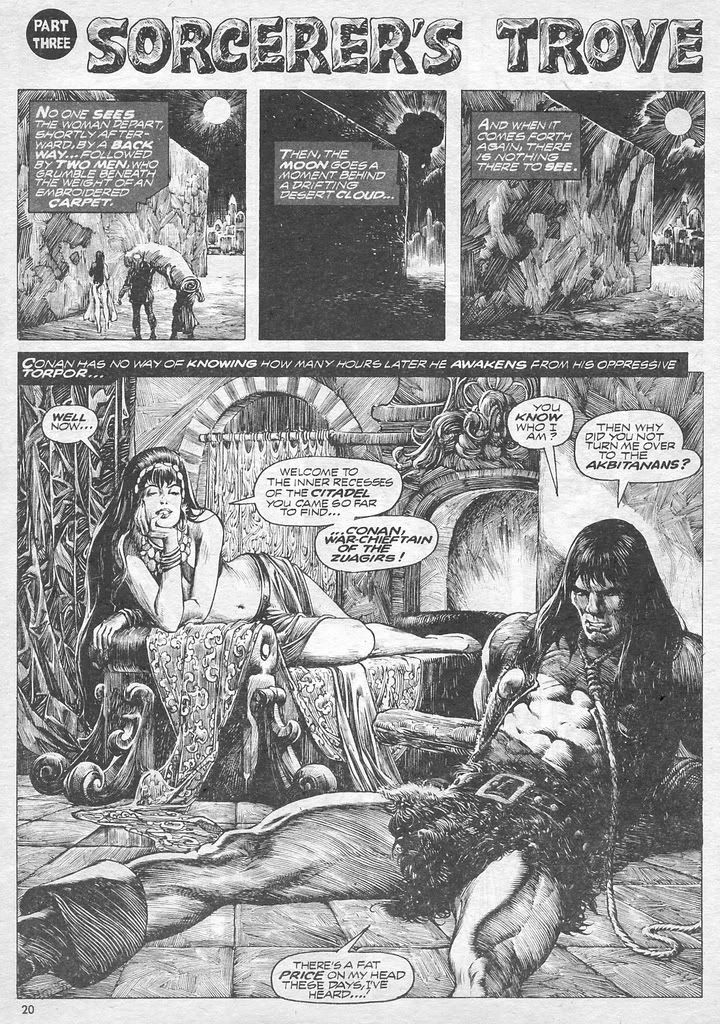
It's a long segue, but a lot of my reaction to things like Berlin ends up closely related to how I look at them. I spent some time in the above contexts trying to pinpoint Lutes' syle. The drawing is decent, passing the art bar, and including nice scenery shots, and I think is improved by avoiding color in the first place. It's a far cry from the tradition of the gory and lascivious detail you'd get in an old black and white Savage Sword of Conan, and if it did make use of all kinds of city views, the creative layouts are rarely rolled into large complicated images, and the scene changes are more in the lines of storytelling transitions than tricky artistic ones. When he does go there--I'm remembering the way he worked in art-school technique in one series of panes about a lecture, and how in a different series, he brought some full-bacchanal scenery in his glimpses of underground nightlife, and there were a couple intrusive uses of white space--it instantly becomes more interesting. Given the clever vehicle of making one of his characters sketch compulsively, you kind of wish he worked that conceit into his own art more. I will say that I enjoyed the way Lutes moves between a character's dreams and reality as a means to shift the point of view from the dreamer to the dreamed-of, and he does a nice job of employing the comics-equivalent of a roving camera to lead us between plot arcs too, but these aren't things that are contained in the drawing.


The usual dialogue balloons, thought balloons, and text boxes seem more ingrained to the medium to the point they're unnoticable. Lutes is big on thoughtful dialogue and faces, not really on any of the raw action and cheesey drama of the superhero tradition. He lets the characters' expressions reveal emotions most of the time, but still not in a way that feels very new. There's something familiar about doing it that way: it frequently reminded me of an old Lighter Side strip, where the point is more about writing, that is, more about setting up and delivering a piece of dialogue. The ways Lutes' conversations get spaced-out in a series of panels, the way that situations are introduced with people-free panes, and the use of facial shots with minimal background drawing, it all lends a strange quiet feeling to the book, and when Lutes falls back on comics tropes like punctuation marks over people's heads, big-graphic sound effects, and swirl lines, it feels like he's regressing. The quiet space does seem appropriate to convey the impending political fate that we know is coming for all of these characters.

Berlin did what I wanted it to do, what Sinclair Lewis failed to do, which was to set up a feeling of how it happened there. I'm falling back too much on my history-for-engineers classes here, but as I remember learning it, the usual story of the fall of the republic and the rise of fascism is told as a series of calculated political moves and power grabs by you-know-who, against a backdrop of economic depression. The classroom version sort of leaves out the city as a hub of European culture, the hopeful liberalism of the Weimar Republic, the personal wounds of the Great War, the vibrancy of urban life, and Lutes gets a good chunk of that in his comic, as well as the sense of how it is beginning to untie. Here in America, we also tend to leave out the Communist influence in prewar Germany and the National Socialist's definitional opposition to it. Lutes doesn't give up much love for the actual Reds--they're given to rallies and thuggery too--but he expends a great deal of sympathy toward those characters attracted to the philosophy, and none towards those inclined toward authoritarian Nazism. (Curiously, he has yet to draw a swastika--flags are represented with a big blank space devoid of party emblem.) A great deal of dialogue is devoted to the spectrum of characters' resistance to the growing popular ideas, and to their bonds of class, at a time, in the story so far, when they still feel free to express these things.

Berlin is advertised as a graphic novel with as much texture and depth as a regular novel. I contend that it makes good use of the comic form (with the caveats noted above) to tell the same kind of story, but if this is novel-like, then it's wicked thin. I think I knocked off each of the volumes in about an hour, less time than it's taken me to write about them, and I am not a fast reader. The art is reasonably well-done, but it's not so engaging as to make the eye linger. I think the bigger problem is that we have an ensemble cast in which none of the characters have enough pages under their belt to be especially memorable. This many people in a 150-page prose novel would be just as difficult to develop. It's worse that Marthe Muller, the closest thing we have to a protagonist, is devoid of much defining personality. She's a little introspective, and a little independent-minded, has a ghost or two, but her spontaneity, devotion, and likeability don't really seem to come from anything we can see her say or do. Worse, she's the most generically drawn of all of them (defined with a weariness in her face that marks her as slightly older than the other students, but younger than the workers and newsmen, but that level of detail varies by pane, and sometimes I was reduced to carefully checking noses to make sure I knew who the story was following at the time). The journalist Severing is a little better realized, but a downer, and mostly I wait for his descent into real depression. Marthe's friend and lover, Anna comes off the more sincere, with actual challenges with a modern identity and mixed cues in a straight socity, and the Jewish boy David is given some interesting private life beyond the external story as well. The bigger drama we see is from the folks from the working and poorer classes, but it's also a cheaper sort, more basic stories of violence and sacrifice. A runaway girl, and dead mother, and some unlikely compassion, and finally I'm finding myself engaged.

Berlin takes a look at a transitional place, and recovers the forgotten human and social elements, and I think this is very much its strength. As a comic, it's not deeply innovative, but it uses the medium well in getting this story told. As a novel, it's readable, but I can't bring myself to see it as the great black and white hope, whatever NPR would like us to believe.