Wednesday, March 30, 2011

Yes Asshole, the Rich Are Getting Richer


I visited my parents last weekend, and as I once mentioned before, these excursions usually include a lazy Sunday morning with the old home-town news rag. The city of Waterbury is most recently famous for the frightening habits of former mayors, but many years before that (maybe stretching into my early youth) the region I grew up was part of an important industrial hub. It's an urban mix peculiar to the northeastern United States: decades of corporate flight that should, you'd think, have given them some perspective by now on how difficult it is to run a city—whipping up its economy or providing services, depending on which church of ideas you attend—when the local hiring firms keep disappearing and abandoning the tax base. Despite this long trend, the Waterbury paper remains a bastion of conservative opinion, dancing with the one that brought 'em (down) over this timespan, and is currently and constantly worked up about Big Government as well as the scarier, swarthier immigrant population which is no longer from European countries that begin with the letter "I" (and which lacks those erstwhile job prospects). [Although maybe there's something to the Big Government points: no doubt any incentive the city can now offer—tax breaks, loans, industrial sites with all the hookups—is piddling consolation for taking away the freedom to dump all of the tailings you can directly into the Naugatuck river, and that pesky Superfund law clearly did slow down that mall project a few years ago, but those fine, fine minimum wage retail jobs got there anyway, they did.]

Which is not really what I'm getting at, beyond to say that the old local paper grants me a special annoyance. When my wife turns on the news at home or when I drive back listening to All Things Considered, then I only need to marvel about how extreme the mainstream has become, and the distress doesn't last. When I steal time online, I see the accepted conservatives actually subjected to the comments they so richly invite, which sates me enough to not have to write anything about it myself. But when I go to visit Mom and Dad, and the op-eds are framed in official-looking black-and-white, and what letters filter in through the editors are as supportive as they are illiterate, when, it's editorial policy aside, it's a pretty decent paper for its market size, then I find that no one is getting livid here but me. Among the usual inveterate assembly of Malkins and Wills and Krauthammers, the Republican American trucks in your more shameless (and artless) variety of deniers and class warriors for its editorial page. On Sunday, it was some guy named Steven R. Cunningham of the American Institute for Economic Research. (The version I read is behind a subscription wall, but you can find plenty of copies online from other venues.) I don't really know anything about the AIER, other than it's in the most beautiful part of Massachusetts, but if this guy is an example of its alleged mission of objective economics education and not representing concentration of wealth, then its founders are surely spinning in their graves. More likely it's just your standard pro-power think tank. Cunningham is out to skewer "one of the most enduring economic myths" that the rich are getting richer.

"It isn't true. When most people think of the rich, they probably are thinking of people with great wealth. When they think of the poor, they probably are thinking of people with low incomes. While there's obviously a correlation between wealth and income, they're not the same. And we shouldn't confuse them."
I'm going to limit the line-by-lines for this guy—the full FJM thing is not my bag, and I'm not quite making that the central point either—and excessive charts are boring (I'll link for you though), but that article should not pass without comment. From the opening graf, he proceeds from here to thrash, not this alleged myth, but a fairly irrelevant straw person, noting that people who have the most wealth are generally older, which may or may not mean something or other, but certainly leads the reader away from the important distinctions he didn't make between wealth and income, and rich and poor.

Most people consider "rich" or "poor" to be a state of concern about meeting basic necessities, extraneous pleasures, and once those things are taken care of, of attaining status. I suppose it's nice that we weren't treated to the usual false equivalence between modern pleasures (like iPods and TVs) and necessities (like cost of living and, if we wish to outlive our pre-industrial counterparts, medical care, and, of course, the indenture that most people accept to attain those things), but since richness is in part something you feel, then it's not surprising there's some subjectivity in the definitions.

But income and wealth are more quantitative. And yes, it's an important distinction, but as an economics educator (yar har), Mr. Cunningham might understand that the reason people prefer to discuss income distribution is because it's just easier to come by. Most countries keep statistics on this sort of thing, which is handy if you try to make informed economic arguments, comparisons between countries, and other stuff you'd think would be important to economics educators. Wealth assets, meanwhile, are more varied in form, and more likely to be undisclosed and private. Wealth can mean less liquidity than the numbers on your paycheck represent, but lets not kid ourselves that the "wealthy" are exemplified by the old people receiving fixed annuity payments in Cunningham's hypothetical anecdote, or that the very wealthy are in any way not rich. Steve-O is counting on his readers to neglect looking very closely at the wealth distribution he mentions, which in Waterbury is evidently a good bet. When you do look at those numbers, they're far more damning than income distribution when it comes to inequality: the top 1% of the wealthy own about 35% of it, and the top 20% own about half. It's slightly less unequal in terms of net worth (because lots of people have home equity) than it is for financial wealth, but either one is sufficient to roundfile his whole thesis. Yes, based on analysis of wealth, more of it is concentrating in the upper levels and yes, there is less distributed among us proles in the lower 80% as time goes by. The rich are getting richer, and the wealthy are getting wealthier.
"For example, from 2000 to 2009, inflation-adjusted household income fell 4.5 percent, but consumer spending increased 22.4 percent. This raises an obvious question: How did people dramatically increase spending on shrinking paychecks? The answer is: They didn't."
Hey, I wonder if anything else changed in 2000-2009! I won't keep you in suspense. Among other things, household debt increased in this timeframe by about 12% per year, while income fell as stated. I'm sure there's a relationship to spending here somewhere.
"They did increase spending. But paychecks weren't shrinking. Instead, the number of individuals per U.S. household was shrinking, which lowered the average. Real disposable income, which is essentially total after-tax income, rose 25.2 percent from 2000 to 2009. At the same time, however, households got smaller, as more people divorced, or rejected or delayed marriage. So total spending went up, while average household income - due to the larger number of households - went down."
I'm the last person to buy into the idea that economics is a field with engineering precision and scientific understanding, but we can still endeavor to put useful numbers to this sort of thing for the purposes of estimates, and some of these institutional numbers are publicly recorded and pretty easy to come by.

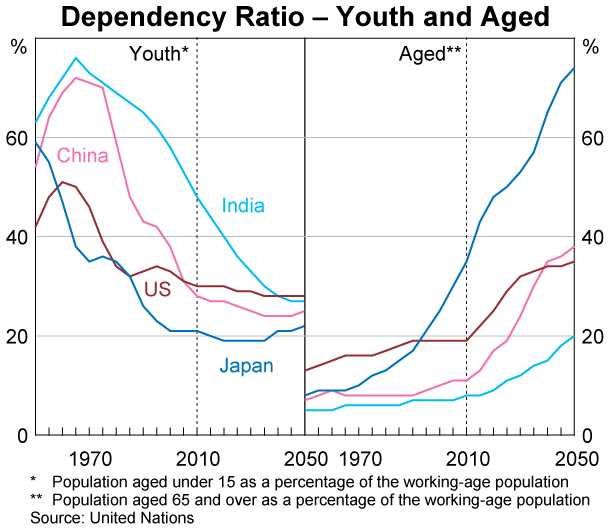
Households only shrank a little in this time period, but there's definitely been a downward trend since the 1960s. Cunningham is probably tooting some social dogwhistles here, but the down-slope has correlated pretty strongly with decreased fertility rate, and the smaller households are largely a result of there being fewer children in all, and more people living alone (e.g.). We can look at this a little more objectively using useful variables such as the dependency ratio, which is the ratio of the too-young and/or too-old (depending on how it is broken down; the latter usually trotted out for Social Security scare stories, but the former is more relevant to household size) compared to people of working age, and this has also declined in the cited time frame, most of the decline coming from, again, fewer children. We can also look at the participation rate, which is the number of people of working age that are in fact working. Eyeballing the graphs and applying some simple math gives relevant ratios:

2000: 1.1 children per worker
2010: 1.3 children per worker

So people are, on average, supporting more kids, contrary to Cunningham's statement, but hold the phone for a minute here... The trend since the sixties has been fewer children. If you click on the chart for participation rate, you'll note another awesome economic revolution that happened in about 2000, when the bubble burst: all of a sudden there turned out to be a lot more people than jobs. Household size shrunk slightly, but the fact that the number of available jobs dried up affected the number more.

[Most of the post-1960 growth in the participation rate is due to women entering the workforce, which no doubt has contributed to the decreasing fertility rate as well. But these two trends before 2000 (not to mention extant retirement schemes since 1935 or so) have overall been to drastically reduce the number of dependents per worker. Cunningham is, of course, prevaricating here in a general sense, even if he's picked out a little patch on which he can daub on some bullshit. Fewer dependents from 1960-2000 probably did help people feel richer though, but I don't think the increased participation rate did. Are you richer when you need two incomes to do what your dad managede with one? (If you are a woman, you may indeed be freer.) This is a reason that household income is relevant.]
"The problem is that we are not told that the top 20 percent of households includes four times as many workers as the bottom 20 percent, and nearly six times as many full-time, year-round workers. Knowing this makes a lot of difference in interpreting the original statement."
People in lower quintiles have fewer earners per household, but they also have fewer children to support. The ratios of earners per household are pretty shocking, really. The summaries in the Wiki article are consistent with all of the above figures. And what exactly do they prove? Rich households, we are pretty sure from experience and data, do not tend to have six earners in them, not without some hefty violations of child labor laws, nor are they comprised of sprawling complexes filled with in-laws and cousins, or at least that's not the sort of arrangement that pops up on the lifestyle shows. Rich households (obviously) top out at a little less than two earners per home. You have to conclude that poorer households have not only a significant fraction of zero income people, but to approach four-to-one, over half of them need to have no earners in them at all. And among those working in the bottom 20%, most of them are only doing it part time. This seems to be a horrifying reason that they're poor, and not really a point in favor of the awesomeness of the rich. I mean, it's another way of looking unemployment—of course the lowest income group is going to include all the people who have zero income—but these numbers are telling us that that comprises a hell of a lot of people. Is this sinecured fucker really ginning up contempt for all those lucky duckies with no jobs at all? (Yes.) And it's clear from the same data that working part time isn't going to do a damned thing for you either.

And needless to say, the income that the quintiles receive is well-published, and only the top two really have made gains, before or after taxes, in forty years. The fact that the lowest quintile is largely unemployed does not refute this.
"Yet, economic mobility is a characteristic that helps differentiate the United States from many other countries. Between 2004 and 2007, for example, roughly a third of the households in the lowest income group moved up to a higher income group, according to the Census Bureau, while roughly a third of the households in the highest income group moved down."
Sure, income mobility is a great thing in this country. The fact that it's less great than it used to be, or is less great than in other countries (even historically aristocratic ones), well, we peasants should shut up and be thankful for what we've got.

#

And look, I'm sorry, but that had to be exorcised. It used to be even longer. If I am so motivated, I'll take out the hyperbole and send it as a letter to the editor to be unpublished. Here's the part that's getting me though, the actual point if you want to call it that. I can understand why people employed by the AIER write and publish this sort of crap—they're paid to, directly, by people who have the wealth and power they're apologizing for—but I'm disgusted by people who continue, despite evidence, to lap it up and sell it on the retail market. You'd think that anyone above drinking age might have noticed some general economic trends by this point, and yet the entire News-o-verse has already let go of Two Thousand Eight. I don't expect Truth to be folded up and handed to me, but a little more than a thin gruel of shallow marketing disguised as evidence would be okay. Hell, just losing the certitude would be a plus, especially when you're peddling the same crap you were two decades ago, during which time the wealth community has gotten pretty much everything it's asked for. At least this Cunningham guy's an obvious whore, obviously shilling for interests that aren't mine. What the hell is the editor's excuse? What power is he speaking the truth to?

The game I usually see played with things like this (and that I am playing here too) is one of competing narratives, of different takes on the same data. Commenters like me don't usually angle straight for the lie, and call it. We like to see the twists of truth instead, different takes on it, and target a rebuttal that harvests the seeds of refutation that the writer himself sowed, and there's plenty of that here. (Maybe this thought would be better spared for the next someone who is inclined to fact-check a Megan McArdle column or something, but whatever.) But Steven Cunningham is doing more than misleading with statistics. When he poses the idea that the rich are getting richer and leads with "it isn't true," it's baldfaced.

Thursday, March 24, 2011

Review: Axis, by Robert Charles Wilson

Axis is the sequel to Spin, which I (much more succinctly than usual) enjoyed. A worthy followup I suppose, but I the enjoyment this time around was somewhat less. (Spin was well-received and won some awards, and maybe Wilson worked fast to sell a few books while his brand was hot.) I found the characters likeable, but not especially compelling. Or rather, I found that the intersting people were the ones who spent most of the novel offscreen while protagonist Lise Adams, in her effort to find out about the disappearance of her father, gets turned into too many expository circles for the purposes info-dumping. Wilson does a lot of telling of the background, stuff which, in other novels I remember, he was decent enough to get into a story of discovery or else just remain decently unanswered. It might be because this version has a substantial backstory that it needs to submit to the reader, in order to get to the questions of What's Really Happening down there with the deep magic.

He gave himself a lot of good stuff to work with. There's a sudden injection of the world into a universe a couple billion years older, and populated a bit more completely by a thin, slowly expanding skein of self-replicating hardware. There's the big puzzle of its baffling, disconnected attention to human society. There's humanity's brash attempts to understand it, a sort of self-exiled biochemical Manhattan project with human subjects. There's the boy Isaac (said subject) and Sulean Moi, an unwelcome observer in the compound getting on as outcasts' outcasts. There's competing ideas of human anthropological development in different circumstances. The polyglot colonial landscape that set the detective and chase scenes is well-conceived too, but, while not especially horrible, that particular plot was only just enough to keep the pages turning until the last quarter of the book, where the characters finally come to face the strangeness. I could have done with more Sulean and Isaac, more evidence of crazed obsession among the true believers. More internal conflict needed here please, and less 'splainin.

And while I liked the large questions that Wilson plays with, a little bit more philosophical meandering on the ideas wouldn't have upset me too much either. I mean, he's basically, and later explicitly, offered a plausible--on a science-fiction level--conception of what a powerful and indifferent god might actually look like. And it's just a damn cool idea: a universe that's full of designed machines that (very slowly, and with the aid of some fourth-dimensional physics without which they couldn't cover much volume (these don't even get a handwave, which is just as well)) reproduce and expand and communicate with each other among the cold vast reaches of space. Is it evolutionary and insensate, the characters ask, or is it thinking out there, mimicking meat heads on an impossible scale? Does it live and die too, is it finite? The manifestations of the big celestial mind, the behavior of its "cells", are pretty cool too, machine-like, life-like, weird, and pretty innovative when seen from the ground. It's use for civilization, we learn, is to grow itself. Biological societies at a certain state of development will eventually launch hardware into the void, and when they encounter evidence of that network, will want to swap collected information on that scale too. Maybe, like our jelly life, the cosmic mind is out to create pockets of information in eternal defiance of the second law.

It's likely that many of Wilson's novels (well, that I've read) could get retconned back into this same universe. The themes presented here are definitely his usual schtick, which I've always liked. The couple requisite moments of sentimentality are not forgotten, finding compassion in that weird juxtaposition of the cosmic against the human.

Sunday, March 06, 2011

In between the bright lights and the far unlit unknown...

You know, there's a pretty good incentive to get that current turgid blob of a post off of the top of the queue and try to write something which, at least for me, passes as entertaining. Well, better luck next post. That I'm feeling somewhat less than entertaining is obviously part of the problem, and my mood these last few weeks has been anchored by the disheartening realization of the mutually exclusive financial realities of cultivating my own damn garden and giving my children future opportunities to do the same. If only...blah blah blah, it's not like I haven't been over it before. And anyway, gardening has its own share of commitment and frustration. Even in an ideal world of unfettered self-actualization, there it's hard to figure out what your passions and skills are, and in this bizarre world where livings have to be made, then good luck on that passion, if you have one, keeping you fed. At thirteen years old? Did you know what you wanted to do at thirteen?

I'm not unaware that I'm talking about problems of relative privilege. What I'm really doing is pissing and moaning about the governing social paradigm (handy concept, that) which for all of its papered-over inequity, evil, structural inequality, and destructiveness has in this country at least managed to foster a middle class full of crackers like me for almost 80 years now. Lots of different treadmills, many of them decently upholstered, and even those of us without connections have some options about which one we hop on, and the sooner we decide the sooner we can put in a down payment.

Okay, at thirteen I did have a vague idea, if not a passion. I'm thinking that I must have seemed like a promising kid, and god knows that my parents tried to keep doors open and encourage things. When I was little, I alternatively wanted to be an astronomer or a chef (I was joking to a friend last month that I split the difference and went into chemistry). Mom cooked a lot at home, so that makes sense, but I don't where the science bug came from. And all these years later, I am acutely aware that there's something that keeps me apart from passionate scientists too, and that I'm a mediocre performer, and I have reservations about role of the field and its future, but I don't know what the hell else I'd do (although doing honest work with a science hobby seems like it could be more rewarding than the current arrangement). That general orientation helped my parents do what they could to get things started in my life. Strange to think of it that way, but I was pretty lucky for that.

My daughter will be entering high school next year. She's already presented with a choice between technical and academic programs, and these too are mutually exclusive. The tech ed seems like a good program, but it definitely takes her off the academic path. If she takes the culinary arts training, there aren't, at a minimum, any advanced placement courses available (I think AP is a scam, but as a synonym for "more challenging classes", this is annoying), and by junior or senior year, it's special alternative tech courses, a recent innovation, thanks to Massachusetts' graduation requirements. The kids, the instructor told me, tend to go on to culinary college, which seems to me like a strange metric. While I'm happy that cooking is taken as a serious vocation in this country now, it's disappointing to be reminded how far we're down the Player Piano timeline. I mean, that's what sets trades apart, right? Learning by doing, and a tradition of apprenticeship? Do you need that cooking doctorate before you take the $4/hr dishwasher job to get started in the actual industry? (I bet the chemistry requirements would be pretty cool though.) On the other hand, assuming the normal vocational path is still available, then I'd be happy to support that route too (with the fortune I save an added bonus). Adding to it all, there is my opinion that general high-level education is good for humans, and the way we tend to squander it when we're young, well, that can be too. (Good times.) But if she's got a real passion there, then she's ahead of the game.

And speaking of paradigms, I wish I could shake the sense that this is all about picking teams for the next generation's class structure. There are lots of ways to live even within the system, and since my town offers so few examples of them, we (by which I mean my wife) have doing a lot of research for enrichment programs for young people. We've just enrolled Junior for what is basically an educational summer camp, which, at least as far as I can gather from the brochure and the orientation seminar, is totally awesome, with not only classes and workshops, but also optional cruises and outings and all kinds of genuinely fun activities—stuff I wish I had some excuse to do as an adult. It's not exactly the Bohemian Grove, but there's a strong networking component here, and there's much they're encouraged to do together in a variety of overlapping groups: let's forge bonds among the kids labeled up-and-comers, build up those intra-class intangibles. A stronger experience is expected with those that supply more cash, and I expect my little girl might find a small cultural divide between her and the residential students.

The administrator of the program gave us parents a short presentation last week, talking how much more satisfying (and easier) this job is for him than actually teaching middle school. Well, sure, when you run a word-of-mouth sort of program among the helicopter set, and when you keep the riffraff out with a stiff $2500 minimum requirement for enrollment, no credit cards, thanks, then it probably makes it all a little easier. The imagination and enthusiasm is impressive so far, don't get me wrong, but as for the kids without these opportunities or motivations, then they're left to the same devices as before.

And for all this, the course themes, all these new opportunities, they're are all targeting the petit-bourgeoisie. They have cooking, woodwork, art and music, production, sports, along with some business- and law-themed classes, and a smattering of medical industry sorts of enrichment. Some themed chemistry too, I note approvingly. Not a lot of financial analysis or "leadership" training. And it's fine, I guess, from one point of view, as these are all things that people do in the part of working America that doesn't have it too easy or too hard. And it's a fuller set of ideas than we've been able to showcase so far. Welcome to the middle class, kiddo. I'll do my part and start getting used to the crippling payments that go along with your indoctrination.

The future looks vast from far away, and has a habit of shrinking as you meet it. You find the wide open road gets narrower as you walk , and its direction depends on many more people than you. It's great to be young, to be starting out on the journey. I hope my daughter can find more paths than I've been able to show, wish I were better at pointing them out.

Wednesday, February 23, 2011

On The Structure of Scientific Revolutions. Part 2: Kuhn's Epistemology

Here's the second part of my post. These are the points that are more closely connected to the various discussions I had that motivated me to read Thomas Kuhn in the first place. I do want to reiterate that I think that his idea of paradigm- and revolution-based science history is usefully descriptive, and I mostly like it very much. I do take some exceptions here and there, however, and have some disagreements with respect to its universality. Mostly, I'm interested in challenging it against this epistemological paradigm that I've gone and developed in spite of myself.

A TEXTBOOK MISTAKE
Kuhn generally equates the current mature scientific paradigm to the stultifying stuff taught in textbooks. I have a few texts written before 1962, but those tend to be either highly specialized (not yet obviated I guess by new ways of looking at things) or else artifacts that I picked up and keep around as souvenirs instead of sources of information. Maybe things were a little different forty years ago. I mean, yes, textbooks serve to indoctrinate people into the current state of knowledge, but no, I don't think that these texts define very well what science is. To some smaller points of his, advanced book-writing isn't really frowned upon, and I also disagree somewhat that science separates itself from the larger community quite so much. There's a reputation of intellectual superiority that I think scientists vainly like to keep, but on the other hand, premier publications such as Nature and Science, really aim for general understanding of highly complicated fields. Or (I just added) go read the Feynman lectures (these clock in a couple years after Kuhn's essay). My introductory college textbooks often talked about past and current controversies, including the paradigms that stuck and the ones that didn't. The story of a gestalt switcheroo that turns a bug into a feature is an enduring favorite. The sort of triumphant narrative of toppling a progression of barriers that made Kuhn bristle? I don't know if I got that one quite as much, and when I did, it was more concerning the early discoveries. (We'll go back to classical waves, in other words, but not to a continuum of angels.) In my observation, the idea of thriving within a heady open-ended scientific crisis period is closer to the idealized self-congratulating story of many "top tier" scientists (as a colleague once liked to say) today. Even here in the dregs of applied science, "innovation" is the name of the game.

I think anyone working in a research field understands that scientific paradigms are articulated almost like a correspondence, a slow-motion argument consisting of innumerable published articles, conferences, and less-formal meetings. Underlying this communication is the normal science that Kuhn describes, but I don't think the subject matter is chosen solely to gratify a bunch of expected hypotheses. The popular sessions at a conference are the ones chasing after the sexy new field and lighting up the current controversies. Scientists, at least certain kinds of scientists, are just plain hungry for anomalies to fight about. They go looking for a crisis. And even for the bigger paradigm busters, there's plenty of room for brilliant kookery (e.g.) out there on the fringes.

Kuhn made a lot of hay about the seminal insights that John Dalton, a meteorologist, brought to the early days of chemical theory. The mode of thinking that he brought from a different discipline gave him tools to look at chemistry problems in a new way. Again, I don't know what it was like in the early 1960s, and maybe it's Kuhn that helped to begin this newer intellectual paradigm, but much like sexy research, digging around for nuggets in other fields is accepted, common, and encouraged these days. "Interdisciplinary" has become a buzzword too.

WHERE DOES A PARADIGM END AND NORMAL SCIENCE BEGIN?
Kuhn often implies that not all paradigm changes are the same, that there's a gradation in revolutionary goodness. Roentgen did more than just articulate his paradigm when he discovered x-rays, but on the other hand, he was no Copernicus. We can scale down and down too. Every scientific experiment (or thought experiment) has a challenge and a reconciliation built into it. It's meant to test the paradigm and explain the results. Most researchers will be presented with anomalous measurements even in the course of normal science—if everything goes as expected on the first try, then you really are doing common engineering—which they might ignore, fail to notice, or suitably explain within the existing paradigm. Paradigm shift, Kuhn explains, is a consequence of this kind of normal puzzle-solving difficulty, a question of only how important and persistent the anomalies seem to the community. Kuhn also notes that one person's anomaly is another's puzzle problem, depending on what viewpoint they subscribe to. There is no bright line.

Furthermore, while "paradigm" describes the full body of communication, everyone carries around an individualized understanding of it. If other fields (perhaps even the impure ones) are allowed to come in and interact, it can be a source of competing ideas. As we introduce the idea of competing paradigms, subdivided fields, when we don't let the unpopular ones quite fade away, then we might observe that all of these ideas, dead and alive, can always be compiled into a paradigm-of-paradigms that we can never approach from the outside. I don't have much to add to that, except to note that it does give an unpleasant point from which to voice disagreement, and also from which to advocate, when a paradigm can have a broad or a narrow meaning as the discussion demands.

DOES AN UNDERSTANDING OF PARADIGMS INVALIDATE THE SCIENTIFIC METHOD?
Prior to reading, as well as throughout the text, I imagined the description of scientific paradigms as a meta-construction built around the normal operation of science. Kuhn calls out normal science as the process of hypothesizing and delivering (until the point where this process fails to deliver) expected results. The anomalies he discusses, the ones that are seen as significant enough (and timely enough, and seen by the right eyes) to demand a new way to look at things, he stresses do come out of the normal operation of science. I don't think he means his views to invalidate this established investigatory process (even if they might require us think of it differently).

I tend to think of the scientific method mostly as a flowchart, starting with observation, study or review, followed by hypothesis, tests for agreement, and conclusions based on results of the test, adding and constantly revising the body of work. I've said that I don't think of this dogmatically, and see it mostly as a general guideline. Kuhn mentions that scientists tend to proceed day-to-day without thinking very much about the rules they're following, and this is true in my experience. I agree that research is goals-biased, and certainly test methods, standards of proof, and so forth are informed by (or are) the paradigm. The scientific method might count as a rough approximation of the quotidian work ("hey, let's see if this idea works"), and even if it's an imperfect decision-making hierarchy, it gets reinforced at the higher level in the conventions of scientific reporting (the customary sections of a paper—Introduction, Experiment, Results and Discussion, Conclusions—restate it outright) and also at the level of scientific funding decisions (write a proposal, and get money to see if it works). The scientific method is a beloved part of our current science philosophy paradigm, but much more than that, it is also part of a fundamental literary one. It maps the process of investigation on to a classic story: what is our subject like, what happened to him, and how did he change.

We like to construct narratives around science, just like everything else. If that can be seen as a template for the scientific method, then can the paradigm approach be mapped that way too? Is the articulation of normal science equivalent to a background study? Is investigating the anomaly the test of normal science? Do the conclusions and revisions amount to the delivery of a revolutionary new paradigm (or the reconciliation with an old one)? Well sure, if we are willing to speak broadly enough.

WHAT DISTINGUISHES SCIENCE?
There remains a need to evaluate theory with respect to observations, and when Kuhn discusses the acceptance of new theories, he addresses this in terms of scientific validation. He denies a Popperian sort of straight-up falsification (rightly I think), and also more probabilistic sorts of validation (that is, accepting things more strongly when they agree better; extraordinary claims require extraordinary evidence). We might take on a new paradigm that's popular, or elegant, or simpler, or seems to promise richer articulation, or fits with the other ones, or maybe it's all just arbitrary. Kuhn speculates that what makes it science isn't necessarily the acceptance criteria, but maybe the fact that it's imagined as intellectual progress. I don't agree with that. I think what makes it science instead of something else is that it's evidence-based.

I remember a quote from my freshman physics book, paraphrasing, that in reality, electrons are neither particles nor waves, they're electrons. Kuhn eventually gets to a similar point and cites it as the resolution of a scientific revolution. I don't want to give him this one. I think that the probabilistic way of looking at things, more than Kuhn's, suggests that nature is an independent thing, and that more than one view can be held simultaneously, within some range of validity. Of course, that could be just me thinking like an engineer, bringing in a less-than-pure-science viewpoint of my own, which perhaps has more of a most-workable-understanding-given-the-data sort of culture. I prefer to couch my understanding of science as a series of known assumptions and constraining rules (maybe the same thing as a paradigm as Kuhn means it), under which some theory is known to be useful, sometimes only good-enough useful, and sometimes only preferred because it's consistent with other theory. I don't feel anyone has to take one rigid outlook to the table.

I concede that science revolutions may not always go to the best theory (it's too early to tell when they're busy being all radical), and certainly doesn't result in the best possible one, but to say that it's a competition between existing paradigms doesn't, to me, refute very well a probabilistic validation approach. At a minimum, there's a requirement of descriptiveness that contributes to the appeal of a new paradigm.

BEWARE OF FALSE SYLLOGISMS!
The old understanding of the scientific method is also useful for categorizing ideas. It's good to keep in mind that a "hypothesis" is a proposal, while a "theory" is well-understood within its definition and constraints. Mostly, this serves as a helpful tool for dealing with poorly-informed blowhards.

One thing that a probabilistic validation is good for (and which I think a paradigm model deals with less effectively) is to keep down the poorly supported competing theories. It's a continuation of the point, but it deserves a special heading. It's true that all iconoclasts don't fit in within the popular paradigm. On the other hand, just because you are out there taking a chisel to everyone's favorite statues doesn't mean you're a revolutionary. Maybe you're just an asshole. It's good to have some rules of thumb here. You'd better have a damn good argument if you want to show me your perpetuum mobile.

WHY PICK ON SCIENCE?
I am most comfortable spotting paradigms outside of science, as well I might be. Politics and economics seem, to me, to be filthy with the things, and far more than with scientific study, they are unburdened by the rigors of empiricism. Why do people come to suddenly believe in Communism, in consumerism, in American party politics, in popular revolution, in abolition? These are more gestalt-style shifts, nudged on, I often like to think, by events as well as the evolution of scientific paradigms, but colored more heavily by the whimsical human imagination. The failure of old networks to address perceived social crises, suddenly perceived broadly enough, precipitates revolutions of a more political (and generally violent) sort. Kuhn touches on this at the end (it may have been his starting point), but if you've ever witnessed a debate between an American liberal and conservative, then you've seen very clearly a failure to accept the other's set of assumptions and evaluations, not to mention a rather questionable concept of progress, in addition to a craptastic analysis of data (usually worse for the person with a threatened advantage). Living in a political climate that I loathe is difficult, especially when the tools I have for analyzing it are also the ones it provides. I give the social dissenters some major props, including, and maybe especially, those who can spot the system and find a way to conscientiously object to it. I think that much of the alternative social paradigms come from literature and art (and science may owe more to these than is usually acknowledged—I liked Kuhn's point that in the Renaissance, there was little distinction between science and art). I love to see when scientific principles are applied in a more honest manner than number-crunching your way to a foregone economic conclusion from dubious assumptions, and it's governed a lot of my reading in the past few years. My minor observation is that a more evidence-based approach would do wonders for the world.

Boring! But it's out of my head.

Tuesday, February 22, 2011

On The Structure of Scientific Revolutions. Part 1: The Evolution of Science

The Structure of Scientific Revolutions is, it would seem, a seminal book in the philosophy of science. I admit that, while I am supportive or at least open to many of Kuhn's points and find the general concept to be extremely useful, my thoughts on the subject matter have been negatively biased by a couple of very special groups of people. This first is the small handful of insufferable bastards who, in their embrace of this structure, feel that they're members of some elite clan of practical philosophers, who regard anyone laboring under an older paradigm as their inferiors, and talk past their interlocutors, as Kuhn suggests they must, as if in validation of their superior worldview. (Such indignation is obviously a very loaded interpretation of my own, but Kuhn is very sympathetic to people reasoning in the old motif, and doesn't judge them as "wrong.") This group of people resembles the sorts of college sophomores who discover Bayesian inference and then parade around like they've personally set upon a secret of the universe revealed to all but a few, instead of understanding that these models have already been worked into the existing paradigm to the extent that they've been judged collectively useful. (It's possible that subjects in epistemology attract a generally tedious and narrowly doctrinaire lot, which would actually explain a great deal about how Kuhn came to his worldview.) As for the second group of bad influences, keep in mind that Kuhn is the guy who coined the term "paradigm shift" as a description of scientific revolutions, and we know who uses that sort of language these days, the class of leaders who found similar inspiration in such philosophical classics as Who Moved My Cheese. But it's not really the fault of the thinker that his magnum opus got reduced to a chit for buzzword bingo, and it is more likely a sign of his success. Everyone knows what "paradigm shift" is. It's deeply within the paradigm.

In his long essay, Thomas Kuhn proffers a historical interpretation of scientific progress. It is not so much a cumulative process, he argues, so much as it is an evolutionary one, where governing paradigms (the dominant way of looking at the world, that is, the set of theories, methods, tools, analogies, governing assumptions, and evidentiary standards) progress under a process that he calls "normal science" (meaning, predictive experimentation with reasonable expectation of success under the paradigm), until this process reveals sufficient anomalies, until it leads to enough doubtful interpretation to generate a crisis in the field under which new, competing paradigms can be generated and normalized. Some of his favorite examples of scientific revolutions of this sort are Newtonian mechanics (adios, Aristotle), Lavoisier's discovery of oxygen (farewell, phlogiston) and Copernicus' description of celestial motion (toodles, Ptolemy). Current (or recent) fields in sufficient crisis to regard no paradigm as quite satisfactory may include celestial mechanics at sufficiently large scales (dark what-now?) or the continued challenge of understanding gravity in similar terms as the other forces on perhaps smaller scales (how many dimensions again?).

And I should say that basically, I agree with the Kuhn's general outline, but then again, I'm not particularly dogmatic about this sort of thing (and I'm not sure it's wise to be) despite having some strong convictions here and there. The thing is, if Kuhn did indeed help to establish a new paradigm, then I'm already 40 years into it, and it tempers my analysis a great deal, as Kuhn tells me it must. (I am always suspicious of philosophies that use this sort of self-updating definitional argument to protect themselves from criticism. If I could perceive any sense of humor in there, I'd suspect Kuhn was getting a laugh out of it.) I wonder, for example, how a community can be so wed to any set of theories, so closed to alternatives, that it discards them in all available circumstances. But see, I would say that in the post-Kuhn paradigm. Anyway, I apologize for what is shaping up to be an exceedingly long post. For those who are already bored, consider the above the "book review" and go click on one of the many better blogs along the sidebar. I'm going to proceed to outline a number of specific thoughts and criticisms, that I collected while reading the book. Many of these simmered in my brain through much of the book, some of them even before I cracked it, some have been percolating for years now. Toward the end, Kuhn actually got to a good bunch of the things I've been thinking. While that all makes me look smart in my own mind, it doesn’t make me look as sharp in front of you people. To compensate, I have linked myself gratuitously, like a true schmuck.

For my own long essay, since this thing bloated up so much, and since I can only steal time in small increments, I'm going to split it into two parts. This first part includes some of the points that I could tie to an evolutionary paradigm. The second does more to rate the structure of scientific revolutions against my other thoughts on epistemology.

SCIENCE AS AN EVOLUTIONARY PROCESS
Kuhn's system of changing paradigms looks a lot like an evolutionary model, specifically, the stasis-and-change sorts of dynamics advanced by Stephen Jay Gould. In that, the species is better considered the evolutionary entity as opposed to the organism, locked in (that is, prevented from variation) by reproduction. A great deal of genetic intermingling helps average things out. In that sense, a species is much like a scientific paradigm, preserved by the prolific but sadly figurative intercourse of individual scientists. The sudden speciation that Gould sees is not so different from the scientific revolution that is advocated here, and is probably similarly brought on by crisis, by sudden new requirements for fitness, that tends to produce an adequacy of performance from the genetic tools at hand. Much as we like to attribute the contributions of scientist-individuals, it may be more accurate in terms of science history to think about paradigm-individuals, even while recognizing the genius (and the sometimes big brass balls) of outstanding human practitioners. Kuhn spends an entire section on discovery and attribution, noting that it's the guy who converts it to a new paradigm who tends to get the credit more than the one who found it (who is often the foil in the story), and that it's impossible really to see any aspect as the solo effort. A skim of Punctuated Equilibrium confirms that Gould definitely did see this parallel with scientific paradigms, and it informed his work. Kuhn gets half a dozen cites.

Kuhn also acknowledges the evolutionary analog somewhere late in his essay. He asserts, like Gould does with respect to genetic evolution, that it's fallacious to look at scientific progress as some sort of achievement, reaching toward some pinnacle which generally includes us, right now or soon. But in biological evolution, old species don't necessarily go away. The growth of ecological diversity of course depends on the destruction rate of species as well as their creation. Is this the case for scientific history as well? Kuhn thinks that old paradigms need to die in order to generate the new versions. I disagree with that generality.

NO GOOD PARADIGM EVER DIES
So, did Gould's idea of punctuated equilibrium scuttle the origin of species? I think (and Kuhn would agree) that it asked and answered a different question. It used additional knowledge about the fossil record and a greater body of data about living species, it starts to touch on contemporary genetics (although I think Darwin might have readily grasped many of these logical extensions), and more importantly, it utilizes an intellectual tradition that had already thoroughly assimilated Darwin. But does it necessarily abandon the old man? Punctuated equilibrium rejects gradualism, but it doesn't (at least as far as I remember) present an alternative paradigm for species change. It observes that groups separated from mixing their genes with the rest of the species might be more likely to undergo a Darwinian selection. Which sounds more like a modification than a revolution. Kuhn presents some different cases where this has been closer to the historical process too, but his argument is that it's still a necessary reversal. He states that this idea of theory expansion is (like gradualism in biological evolution) one that the intellectual heirs to a paradigm tend to prefer, or which can appear less disruptive to scientists outside the field. His example for this is that when Roentgen advanced the understanding of x-rays, it wasn't quite so illogical to people studying electromagnetism—just a modification to what they already knew—but to chemical physicists it added some unsettling angles to chemistry, and they needed to think about their field in a new way as a consequence.

And maybe it's a better case that Einstein did strike Newton down to his very fundamentals, and the inarguably broader way of looking at the universe may have ended up including Newton, but could no longer pretend to think on his terms even if they liked his math. I don't know if there's cutting-edge research in classical mechanics, but it sure as hell survives in engineering, which I don't commit so readily as Kuhn to the rabble hovering below even normal science. (I mean, ask Buckminster Fuller.) Getting closer to modernity, statistical thermodynamics didn't quite kill off the classical version either. Even knowing that there's an information basis to thermodynamic quantities, it doesn't change a great deal of the classical understanding—or the usefulness of the classical understanding—heat is still thought of as something that flows phenomenologically with intrinsic states helpfully washed out. Neglecting the ability to predict every possible state of every damn particle in the universe, choosing the appropriate granularity is always necessary for science as well as engineering. Electrical fluid models are in Kuhn's bozo bin too, but a great deal of that analysis still works pretty damn well with the same ancient (by technological terms) differential equations, and you wouldn't have invented the transistor—an engineering-style paradigm-cracker right there—without soaking in that lowly level of (semi-)classical understanding.

I could go on. The basis of the modern understanding of chemistry is damn near entirely about the quantum behavior of electrons, and yet in teaching the paradigm, plenty of more primitive versions are held on to quite happily, and are used. For example, you don't need to get past Lewis's science to get to the plastics revolution of the 1940s. In optics, articulation of Fresnel's and Maxwell's paradigms remain on the cutting edge without invoking a single corpuscle. Now, Kuhn's answer to this is probably that by judging usefulness I'm talking mere engineering, which is not the same as the pure science revolutions he intends, but I don't agree with that. To my mind, these researchers are still busy as hell articulating the old paradigms. (Kuhn would further contend that the old paradigm didn't include an acknowledgement of a newer one, so no dice. That's a semantic purity argument that I maybe can't win.) For another example, I've spent the last couple of years researching metamaterials, possibly a small revolution on the order of Roentgen's, in that it expands (or claims to expand—a lot of scientific revolution these days is in the marketing, as hinted at in the introduction) the ideas of what materials are, and what properties they are allowed to attain. And yet it can be, and usually is, explained completely in terms of classical wave mechanics.

Some paradigms do die complete deaths, deemed too unfit for any niche. No scientist worth her salt really believes in phlogiston anymore, for example, and I very nearly reject Kuhn's idea that there were some ideas that the spooky substance was better at describing. I don't reject that there were questions more readily suggested by phlogiston theory, but (no doubt my paradigm talkin' here) I don't think it raises many interesting ones. If those ideas remained worth knowing (because we do have engineering now to make science do tricks), then chemical theory has found an alternate way of getting there. But even down there among the truly obsolete, people do seem to return to the same sorts of assumptions when confronted with a scientific crisis: maybe things interact with an invisible permeating substance; that fudge factor might amount to something; categories of things have intrinsic properties; stuff is made out of tiny essences.

HISTORY AND EMBIGGENING
Kuhn frequently cites a pre-paradigm period in which science, when practiced, was very nearly limited to the investigations of a single scientist. There just was not enough community to keep up a good correspondence, nor a tradition of communication that might reach that critical mass of feedback from your peers. But it's not as though there were only ever two modes at play.

It's interesting to look at the governing social paradigms that were involved with science. Study has moved splotchily through various settings: philosophical schools, monasteries, gentlemanly pastimes, universities, patronage, structural civic funding (with, no doubt, plenty of throwbacks to pre-paradigmatic practice along the way). There have been periods of a pure research ideal, periods burdened by philosophical and logical traditions, the weight of authority, or theological conformity, periods strangled by applied military research. Even Kuhn here is evidently male- and certainly Eurocentric, not to mention oblivious to the science still done under older paradigms, which rather limits his own point of view.

Kuhn makes a dramatic attempt to generalize the whole post-paradigm period, but my question now is whether history has been consistent enough in that time to generalize. Connecting to the evolutionary point, is there instead a larger trajectory of paradigm development? (A meta-meta-structure? Sheesh.) Maybe there really is progress, but much like the biological sort, it increases diversity more than it increases in some absolute measure of awesomeness. Science gets bigger as new paradigms evolve, especially if the old ones tend to stick around in some fashion. I'm inclined to look at the sheer amount of our usefully accurate (or paradigmatically fit) descriptive power as a less-arbitrary measure of going foward intellectually. As science has developed, the general move has been to describe more things. If there's an absolute yardstick for progress, it's that science now covers way more ground with fewer self-contradictions. It does too go somewhere.


Enough for now. I'll try and post the rest of this monster tomorrow.

Tuesday, February 15, 2011

Review: Spook Country by William Gibson

Perhaps, dear reader, you can help me to find the right metaphorical space here. I keep wanting to go with cooking--it had good ingredients, but didn't bake quite long enough; mixed nicely but the souffle fell; something along those lines--but that doesn't seem appropriate for a story about spycraft and secret lives and subterfuge. Maybe it was as artlessly manipulated as a CIA-sponsored foreign election? No, see, that kind of awareness needs to stay on the outskirts. It's not a bad novel, doesn't invite the word "bungled," and it's not, despite the forces that have developed and honed these various characters, about a great evil. Or rather, it's not about a great menacing evil, or [spoilers!] better still to say that it's more about the nonviolent side effects of a great evil, a colorful spinoff of a violent interventionist American foreign policy. And while the note is lightly played, Gibson doesn't let pass the nasty spookery that enabled the plot in the first place, and more than I recall with other of his novels, he shows a glimpse of the amoral ways that incredible wealth can drive the social inequities that so many of his characters have found themselves looking at from the underside. Spook Country probably owes more to spy novels than it does to actual espionage: I'm thinking of the incredibly high level of competence on display, the strange international and parallel-world existence of the characters, and this whole business of respected opponents clambering through the spook world for no net gain and with amazing budgets. As such, Gibson does bring an interesting, and I think by genre terms, unconventional humanity to these sorts of characters and a gratifyingly weird dynamic to their actions,* and he pens a quick observational wit in some places (but a couple of infelicitous phrases stuck out in others, and the barrage of brand names that Gibson likes to use is generally annoying). Not bad stuff here at all, and the problem is mostly that it needed a little more elaboration. How about "underplotted?" I knew I'd find a metaphor eventually.

The story trails three separate groups of characters in a more or less evenly shuffled series of very short chapters. The book suffers that the first, and primary, subplot is the weakest. Former rock star and now freelance journalist Hollis Henry is assigned to write about an interesting new cultural scene. Quickly, she's pushed toward shady characters that enable some of the "geohacking" technology the artists use, by equally mysterious benefactors and employers. Locative art (not sure how real an item it is), which uses computer viewers to paint in artistic comments onto real-world space, is a compelling way to imagine annotated reality creeping into the mainstream, and I liked how Gibson nabs a cultural element as an introduction. It's a stretch, however, to elevate the idea of geolocation (which I'm pretty sure that I was doing on my Blackberry, if not in 2007, then at least in2008) to the status of a terrifying cautionary tale about technology (and naming its practitioner after the transcendent beauty of some numerical integration package is dorky enough to make me to feel a little embarrassed). As a character, Hollis occasionally borders on interesting when her post-celebrity life is poked very hard, although mostly that's just provided for color. She is surprisingly quick to commit to dubious conspiracies, and while she doesn't much trust her benefactor, she expresses, to my mind, too little journalistic curiosity as to how this advertising giant, who doesn't appear to ever do any marketing, or anything at at all beyond setting up clients in obscenely wealthy trappings as he whispers hints to them from the shadows, has achieved this amazing commercial status. Hubertus Bigend's (that's his name) dangerous curiosity and Hollis's selective caution would have made for great television characters in the sort of fun drama that moves along faster than the viewer can spot the holes, but you get the feeling that the aspirations of Spook Country are a little higher than fridge logic. (I think the reader is meant to know that Bigend's marketing is the viral sort that also wasn't very convincing in Gibson's last novel, Pattern Recognition, and he may even be a crossover character. I no longer remember.)

The other two plot threads, showcasing life among the perpetually shadowy, were more fun and stocked with more compelling people. In one, young Tito (last name unknown) lives a quiet life but for his involvement in the family spy business, an unquestioned custom that has been steeped in Cold War era espionage and a little Caribbean magic culture just for fun. It's taken a few tolls on Tito (he lost his father, and the flight from Cuba was hard on his mother), but he comes off as a fundamentally nice, sincere kid, despite making such an impermanent footprint on the world, and despite his Bruce Lee level kung fu skills and James Bond level spycraft. It sounds like it should be cornball, but he's interesting and well done. Chasing Tito are Brown and Milgrim, the former a dickhead cop type, and the latter a translator of intercepted texts (how do you spell LOL in Russian, using an English key set?) who he's conscripted and kept in line with a managed drug addiction. This section is told entirely from Milgrim's point of view, and this is entertaining too, presenting a druggie's almost entertaining difficulty with resolve, childlike defiance and mental escapes. Milgrim's decency, humanity, and intelligence come through too, even though he's such a collossal fuckup.

Between Milgrim's benzedrine-inspired hallucinations, Tito's spirit riders, and the machine-produced ghosts that Hollis was reporting on, there was plenty of room here for thematic explorations of the title, but most of that is unfortunately left to the reader. Similarly, explaining the book's worth of mysterious motivations in a final unifying sequence is a fine way to put together a story, and I can imagine that Gibson thought one about the lives of the world's shadow operators naturally fit this sort of structure. But in this case, putting it off to the end delayed engagement with the characters. I don't think the story would have been any worse if the the good spooks and bad spooks were identified much earlier. That the authoritarian prick ended up as the bad guy is clear enough from his character, and is completely unsurprising to anyone who remembers cyberpunk. Or any kind of punk. (Writing Tito's people as good guys, against the war racket, inspired by example and loyalty, cautious of other people, is a bigger stretch considering the arena in which they had to develop those kinds of skills.) To be fair to my earlier description of Hubertus Bigend, he is seen doing a little actual business at the end of the novel too, and that may have been intended as part of the revelation, but man, the climactic twists weren't so mind-blowing that they couldn't have been added earlier as badly needed background.


*but I'll say, if you want to go here, go read Tim Powers' Declare .

Saturday, January 29, 2011

Random Roundup

1. Obama's State of the Union speech last week announced, in a way that has become customary for this sort of thing, an increased emphasis on math and science education. I think it's a line that gets more guffaws than it used to, not without reason, and I've followed some conversations from some of my very favorite out-of-network blogs, where American technololgical exceptionalism was derided with some of the good, bitter humor that our situation has earned. I'm tempted to laugh along with, but wait... I'm not joking, this is my job! I guess I feel stung enough about these points to offer a mild rebuttal. Since those posts are, like, already from last week, and since I do not wish my infrequent commenting to be limited to the dickheaded antagonistic variety, I guess I'll just deposit the thought here.

It's worth asking how much power scientists and engineers command in American society right now. It's a solidly middle-class occupation, and in an era when the middle class is shrinking and the price of extensive training is skyrocketing, that's at least something. It's not the sort of career that makes you rich or a leader, and I often cynically suspect it's lauded in the press precisely because it's a non-threatening pursuit. Even in pricey endeavors like defense contracting and medicine, scientists aren't running things, or if they are, they need to abandon science in order to get on the management track. And as Ed points out, it's not as if the people doing R&D are immune from cut-rate Asian competition. The folks working in the field today understand that (outside of the military-industrial complex), technical work is quietly getting frog-marched out of the country right behind Labor.

I did add a pallid point to one of those posts that I fear the tyranny of humanities majors who can't assess technical data at least as much as I do the inhumanity of technical people, and that's true, although I may have understated it. I also agree that the humanities is important (if you have seen any portion of my craptacular archives, then you're aware of what I spend my time writing about). But look, oppression by the innumerate is what we have right now, and if you don't believe me, then please let me interest you in my homeopathic cures, Amway sales, and supply side economics. If we break down the leadership class by occupation, then observe how we're ruled by lawyers, lobbyists, financiers, and managers, perfectly respectable occupations and all, but these are people for whom persuasion is more important than evidence, and they're the ones reminding us that the atmosphere can't possibly be affected by the megatons of carbon we pump into it. We're constantly pushed around by the professional definition of poli-sci geeks (politicians) and visual artists (advertisers). No fair you say, to define humanities and social sciences by the evil versions. Well, that's my point.

2. Why the hell is it that I can never sleep in on weekends but on Monday through Friday, I can't wake up with the alarm? I think the answer is that my body is actually accustomed to waking up at 5:39 or 5:48 every morning, which is a weekday challenge and a Saturday travesty.

3. The two most useful links I've found all week, via the Roy Edroso gang:
- What's happening in Egypt
- What happened in Iraq (and Afghanistan--to another abyss, motherfuckers)

Both of them provide an easy entry point to describe a situation that is considerably more complicated (and in the second case, depressing) than official announcements and the evening news would prefer to discuss.

4. I've complained at length about new and improved information business models that force you to subscribe to your own content. This is an egregious way to distribute books and music, which many people prefer to keep for decades, and for which, now that digital formats are more fungible, they can otherwise no longer scam you to replace your collection every couple of years.

But there's a place where this kind of business makes a hell of a lot more sense, a business where you don't necessarily hold onto the content for a long time, but frequently reference a very small fraction of a very large body of it. (Hell, like cable TV, which is maybe why the fuckers are trying to get away from subscription to more pay-per-view.) Additionally, let's replace a system where the current subscription model is so prohibitively expensive and onerous that only your large overpriced institutions can handle it. I'm thinking subscriptions to scientific journals.

I work at a small scientific company (Massachusetts is littered with these) that can't afford this kind of thing, and I'm constantly forced to sneak onto various university library systems to get the papers that I routinely need to understand to do my damn job. Why can't I find a Rhapsody-like service, a virtual library, that fronts the ridiculous prices of journal services and then lets second parties subscribe to some number of downloads per month for a modest fee? That would be incredibly useful. (Most journals will let you download a pdf for a one-time charge of 20 or 30 bucks, which I guess helps if you have a corporate card, and are willing to take the risk that this low-impact paper is not a likely piece of shit. Note this is a pay-per-view model too. The fuckers.)

Wednesday, January 26, 2011

Your Free Market at Work

So let me get this straight: One of the great triumphs of Milton Friedman-style American capitalist economics is monetarism, wherein the currency is manipulated to achieve a couple of macroeconomic and/or social goals. China also manipulates its currency to achieve a couple of macroeconomic and/or social goals. The opinion of this practice isn't as salutory when foreigners do it, but that's to be expected, just garden-variety hypocrisy.

If I understand things correctly, the economic do-si-do between these two countries relies on extremely cheap credit provided to American consumers and extremely cheap wages (and inexpensive social programs, regulations, etc.) provided to Chinese workers, neither of which valuations are especially well connected to what either group actually produces. Although this situation generates tension (at least so far as macroeconomics properly describes international relations), it's currently very lucrative to people who facilitate lending to American consumers, hiring Chinese workers, or selling their low-overhead products. While fear of instability may be real (and hence the occasional mild pokes against exchange rate manipulation), it's unlikely to change before the feces actually makes contact with the whirling blades (and if the finance crisis has taught us anything, probably not even then). Presumably this will happen if Chinese workers can command some more compensation for their effort, if Americans' consumer debt becomes too hopeless, if they can find a new population to do technical work on the cheap, or something like that. Pessimistically, China will prefer to open up its markets to consumer credit, American wage and job growth will still be held in check, and the mechanisms of wealth consolidation will be maintained as global resource limitations finally begin to resist the edges of growth. I think I understand the gist of all that. As practiced, at large enough scales, capitalism and communism concentrate power, just like everything else. Check. Free trade ain't no such thing. Got it.

I don't keep up well with the blogosphere when it comes to making this entertaining or intellectual, and this story's already a week old, but it's noteworthy when these relationships condense into such a powerful and relatively open meeting. (What do you suppose goes on at those things? I imagine it's a bunch of dull yay-rah powerpoint speeches full of mission statements and global visions, followed by a dinner that breaks down, as usual, to jostling over where the cool kids sit, or which are the power tables, and after that there are a hundred informal breakout discussions, filled with harrumphing, agreeing to talk to your people or theirs, awkward cross-cultural affection: what, no cocktail? ha ha do we shake hands or bow first?) This is expression of political power at its more outward and banal, and it's hard to see them agreeing to any arrangement that makes them less rich. I'll give Obama the benefit of the doubt and assume that he really does want to see clean energy products exported to China (whose environmental concerns are probably real), and maybe we'll even do better than the usual tactic of exporting clean energy jobs there. Well, at least GE is a surviving American non-defense company that actually makes stuff, so there's that, even if society can't seem to rid itself of Lloyd Blankfein.

Worth noting, however, that this inner party arrangement is our leader's preferred mileu, none of that weenie Carter-style public incentivizing that worked so poorly for, say, Germany. Meeting with business interests to orchestrate the economic push and pull is probably inevitable to the process of governance, and the moral balance comes down to which parties Obama or Hu feel they represent, and to achieve what ends. If the presidents are representatives of their populations, then they sure are outweighed by business interests in meetings like this. Personally, I think that Barack Obama (or any other president in memory) represents the people about as much, and in a similar capacity, as Jeff Immelt (or any other CEO of a gigantic multinational corporate empire) represents his employees, which is to say that the minions are an inevitable component to their power, a necessary evil, probably not hated, but of secondary and sometimes contradictory concern to the governing idea of the organization, as voiced by those who get rich by owning or administering pieces of it. I'm sure they'd rather not and all, but fucking the lower-downs is certainly on the table, while fucking themselves is not. And I don't think it's necessarily a question of evil so much that representation has inherent limitations—when the problem becomes the entrenchment of an elite group that is insulated from the concerns of everyone else, then the process of elevating someone to the elite makes it hard to accomplish things.

Has conservative economics disowned Milt Friedman yet? I know that the Fed is a pariah among the freedumb wing, not that they slow it down, but even so, it still has to be difficult to advocate for the idea of "competitiveness" when so much of the economy is the flow-down of executive decisions rather than market forces or other cost optimization. Mostly, I kind of wish the usual assortment of advocates would just shut up for a while.

Friday, January 21, 2011

Review: Mission Child, by Maureen F. McHugh

Science fiction has a strong tradition of short story writing. It's a great length to elaborate an idea, and in the best cases, a writer can build the tension around the underlying concept as effectively as with the more conventional constructs of characters or plot. I think the desire to elaborate these quick poses must be common among many writers of the form. The Missionary's Child, the short that this novel built from was published in 1992, and I read it about ten years ago in a science fiction anthology. I liked it enough to try and remember to find the novel version, which evidently I did at some point in the intervening decade, because there it was in the pile. I have usually enjoyed McHugh's short stories when I've found them, but it is difficult to formulate a readable novel whose only purpose is to exhibit an idea. It's hard to support a story in the long form when there is not any special plot. There's a character and setting, and there's conflict here—our protagonist, Janna, has no shortage of external or internal struggles—but these do not really suggest or deliver any clear resolutions. It's more a matter of unfolding the understanding the character and where she lives setting, but here too, there's not a well-conceived pace of the discovery, it's really more like a tour. The world is not earth, but it is earth-like, populated with human societies that have been around long enough to be considered aboriginal, now struggling with a cultural invasion of well-intended colonial types. Maureen McHugh creates an environment with enough intimate and honest detail that it makes the outré circumstances of the story take a back seat to the cultural and personal issues. On one hand, it's an impressive accomplishment to make the unreal realistic, but on another, it sort of takes the fun out of it. It's difficult to generate a (cheap) skiffy thrill when the book features believable people who spend most of their time going about their boring lives. The only other novel of hers that I read was utterly sunk by the mundane: it had a city under the sea, cool Voudon rituals, and it bored me to the point of depression. Mission Child is much better than this, chiefly because it's a central character that is sympathetic, troubled, resourceful, accessible, and alien—you know, interesting.

McHugh is making some direct comparisons to known societies here, a couple that are chosen to reflect less a background of outright conquest and more the unintentional casualties of European expansion, which suits the mood she's trying to build. The story starts on the cultural fringe of a fictionalized version of the nomadic Sámi people (I had to look that one up—Lapplander is considered derogatory these days), comprised of a tribal Scandinavian-ish population moving between semi-permanent settlements up north of that planet's arctic circle, supported by an economy of genetically engineered reindeer which have long since run as wild as the people. The push from more recent Earth settlements in the south is probably, inadvertantly, the cause of the violent consolidation of the nomadic clans that claims Janna's family, the early tragedy around which she's forced to define her character. Janna starts her life in an ecumenical mission (run by an Indian couple, trying to teach the white locals technical culture at a non-threatening rate), a mixed background from the start, and is lucky enough to survive an encounter from a neighboring clan that escalates to the murder of nearly the whole settlement. The poor kid flees into a war (which also has few survivors) and then from it (even fewer), becoming a wife, a mother of a sick baby, a pariah, a widow in the process. While her age is purposefully left indeterminate, she can't be more than sixteen or so by the time she wanders into a refugee camp two (local) years later, and decides, for her own protection as well as psychologically complex reasons she is unable to assess, to compartmentalize her gender and present herself as a male. This gender confusion eventually gets reinforced by her spiritual practices, and later by some modern magic as well. Janna makes it out of the refugee camp to another mission, now in an industrial city further south, where she's sharp enough to expand her English and land a job and a training program for a factory technician. The story here is more of a back-country girl skirting the modern urban culture and counterculture. The final setting brings us to something of a South China Sea that Conrad might have recognized, an already robust trading economy recently beset with new pressures from outside. (Or maybe it's more like the end of the 20th century than the end of the 19th, a handful of hopeful NGOs have also recently arrived of the scene.)

For all this not-entirely-unfamiliar changing of times going on, McHugh does a very good thing with Janna, letting her take on a "native" view of the cultural invasion, and an individual one. This may be one of those cases where science fiction is a good tool to explore an otherwise sensitive or typically ill-informed setting. Coming from a survival culture, Janna makes for an interesting narrator. She is pragmatic instead of introspective, is relatively stoic, and has difficulty forming an internal conception this character of hers, divided between both worlds and genders. She lends herself to terse matter-of-fact descriptions of violence, death, and hunger that leave it more poignant. Janna has a moral sense, but she impressively (and believably) maintains little investment in foreign cultural baggage (both the good and bad kind; the author isn't given to the sort of moralizing that lets her character adopt modern notions of charity and tolerance while rejecting the general bullshit of working for a living or the danger of street culture), and mentions them as irrelevencies or sources of confusion, or in some cases finds the right analogy from her own experiences. We sophisticated readers can spot a great deal of childhood trauma in her, but she gives us a worldview that doesn't include the concept that our character is defined through formative events.

I wonder how much of this thematic weight can be pinned on female authorship. We have endurance trumping triumph here, and flight a bigger motivator than exploration, neither of which is the usual stick used to poke around brave new worlds. We have some gender identity issues, a focus on how those affect relationships, a theme that is much more self-acceptance than it is self-discovery or self-motivation. We have an ambiguous opinion of charity and conquest and culture, which worries more about lost self than it does lost dignity. Mission Child is a view of cultural change from the receiving end, with some clear connection to our own history. Anyone want to recommend a similar novel in a real historical setting? (All I can think of for the moment are one or two stories about Native American that I didn't read in high school. It'd be interesting to compare science fiction vs. the historical kind, or male vs. female writers.)

Thursday, January 13, 2011

Finally, a Serious Subject: Blogging The Biggest Loser

With a mountain of work on my desk (most of it recently prioritized by my twice-weekly chewing out, and no, morale has not improved, thanks so much for asking), then the obvious course of action is Road Trip! to waste an hour or two blogging about some utterly pointless piece of cultural trash. I'm not quite in stupid and futile gesture territory yet, but we'll see how next week's meetings go.

So yeah, as I mentioned, I'd never seen the show before this season. That makes me seven years and eleven seasons behind it's peak popularity, with an interest that is, I have to admit, less than completely sincere. But that's just how I like to approach fandom. And, like with most Americans, I find some personal relevance here. Although I don't know how I could ever hit a quarter ton, I've nonetheless slid far enough up and down the BMI scale to appreciate just how hard it is to lose weight and keep it off. I have an intimate understanding of what it takes to do that through exertion and discipline, how damn much more that takes for some people than others, and how even small changes of habit, not all of which you have a good handle on (for example, your sedentary job may be unhealthy, but so is not paying the mortgage), can tip you right back to an unattractive equilibrium porkulence. Watching this show makes me appreciate the minor blessing that my own Weebley resting poundage is only in the lower 200s. This, of course, is one of the major unstated selling points of the show. The others include Americans' undying love for cheap sanctimony, and the fact that there's no easier straight line to set up than one for a fat joke. I'll do my best to be sensitive.

1. Let's first dissect the show's basic premise. Yes, we have some people who have really let themselves go, and they've been selected thanks to some (I imagine) intense psychological and physical screening to help predict that the success rate will be high enough among this carefully chosen sample so they will at least not to depress the entire viewership in their where-are-they-now spot. These folks are then subjected to a grueling supervised workout schedule, every filmable moment of which (again I assume) is recorded in order to mine for positive storylines, in an effort to drop the pounds.

JaredAnd really, good for them, they have every reason to be proud of themselves. But the corrollary to all that production is that unless you have 16 hours a day available for exercise under the direction of a crack personal trainer and a team of possibly competent doctors, then don't expect to lose 3% of your body mass every week. Obviously not everyone has this option. It's encouraging how they follow up and all, but I wonder how the average contestant does 2 or 5 years out, because unless your job is "personal trainer" (and more about that in a second), then your regimen is unlikely to be sustainable, or to be compatible with full-time employment. Even here, beyond the careful screening, the TBL constentants have a better shot at staying thin than your average schlub does, because they always have a chance at making a career of their minor celebrity. If they keep the weight off, there's always an endorsement to be had, maybe not full Jared, but there's the opening the new GNC in the Niceville mall and that sort of thing.

2. The show does not neglect to include a smidgen of contempt for its participants by inviting fat jokes. (You'll notice that this formulation cleverly removes the moral responsibility from me, the sarcastic viewer, who is responding to those invitations.) I'll give them a pass on the title, whose backhandedness is overt, and instead present the location as exhibit A. Do the biggest losers compete on a compound? On a set? In a complex? A retreat? A campus? Even a farm or a camp? Nope, it's the Bigger Loser Ranch. Moooo-ve over, losers.

3. I don't know if the whole season is like this, but the first two episodes of the damn show have been drawn out to two interminable hours. Now look, as hinted above, the sedentary but stressful lifestyle of Americans, often forced on them, is an important factor contributing to our general rotundity. (Independent of exercise level! An ariticle in a high-impact journal, but man, if there's any medical research that needs airtight scrutiny, it's obesity research.) This show which exhorts us to get off our expanding asses is all about dulling up the programming in an effort to extend the fraction of precious free time that we spend sitting on them.

(On the other hand, maybe it prepares us for the tedium of riding an exercise bike for 16 hours a day if we do get the bug.)

4. The show is decent enough to limit its advertisers to (among the usual purveyors of cars, investment assistance, and penis stiffeners) to diets and healthy things. I don't believe for a second that this is done out of decency, however. I suspect that the producers have spent some quality time with their actuarial models and concluded that the recriminatory backlash of Very Concerned Viewers would cost more than the substantially increased profits they could get from pitching Doritos and Twinkies to hungry and self-loathing viewers.

5. One of the female contestants is an opera singer. For some reason, I have her to make the finale.

6. I understand the need to milk every emotional angle, but I can't be the only one who finds this policeman's family situation horrifyingly unlikely to lead to fulfilling reconciliation. Dude, if your son said that he doesn't love you because you're a fatass, the problem is not that you are obese, it is that your son is a dick.

7. And okay, I know this is wrong, and I feel like a terrible person mentioning it, but can we please get a shot of Dan and Don on tiny motorcycles. Just one quick clip?

8. Contempt for the contestants exhibit B: they really played up that doughnut thing last night, lingering on the torture the poor guy was feeling about tossing that pancaked cruller into the dumpster. I mean, I thought for sure he was going back for it as soon as the cameras were off. I expected to learn this at the big weigh-in ceremony. (Good for him though.)

9. In my own life, it took some time for me to realize that aches and pains from exercise weren't an effect of my general conditioning. When I get a regular enough cycle going, I can look forward to constant discomfort of one kind or another. Now I realize that if you get fat enough, you will be pretty uncomfortable already, but I'm impressed that they are not complaining constantly about screaming knees, shin splints, stiff-as-hell muscles. These poor folks must be so sore they need to be pried out of bed with a canoe paddle in the morning, and correct me if I'm wrong, but I didn't see anybody stretching once.

What?! 10. What was interesting about Rulon Gardner wasn't precisely that he was an olympic wrestler, but that he was a kind of unlikely one even ten years ago, a doughy kid with a strained but honest grin who somehow bested a Russian genetic cyborg by the space of a quarter-inch of a lost hold. Presumably there are legal reasons for not including Alexander Karelin's picture in there, but the images of the two of them together were what really told the tale of the match.

Judging your lifetime fitness level against your prime bulemic high-effort wrestling best is a forbidding standard, and while he seems like a nice guy, even in 2000, you could see that he was on the thin side of his normal weight. You could see that those heavy-guy features were ready to threaten the integrity of his unitard about five minutes after he stopped training. More than most of the contestants, he's well-suited to a mad dash of weight loss, and while they need the pounds off, feast or flail is not the strategy they need for the rest of their life.

11. I don't much like Bob and Jillian. I mean, it's somewhat refreshing that Bob is fit and attractive into his forties (and even Jillian would have been retired from MTV ten years ago), but the cult of Bob and Jillian is creepy. Look what those contestants gave up last week just to bask in their twin glow.

I do think that the two of them are sincere in their drive for the Losers to succeed (who wouldn't be?), but I'm not buying the shows of empathy for a second. Not only are they high-metabolism people feigning to understand folks cursed with a low one, but exercise is their job! That Jillian confesses to having been tubby when she was twelve years old or so is telling. Adolescence is a tough time, and there are lots of kids who grow out of it late, but it's not really the same thing as weight maintenance as an adult. I think trainers have a valuable role as teachers, for people who don't know how to exercise, or who need some new suggestions. But inspiring? How is a normal person supposed to relate?

12. I'm ambivalent about the trainers, but I attained an instant and active loathing for that smarmy blonde doctor they trotted out. First, you figure that your average doctor on the show has about as much professional integrity as the medicos who signed off on the treatment of prisoners in Iraq. (Given the size of these people, and how hard they're pushed, it's a bit alarming. The wiki article on TBL doesn't suggest that everything is perfectly kosher, even though a heart attack would take a worse toll on the viewership than an advertisement for Little Debbie.) That age calculator he drags is about as scientific as that computer simulation that told Lisa Simpson she needed braces, and his accusing "evidence" hurled at Dan (or was it Don?) was about the lamest tv-drama bombast that ever failed an audition.

But what really gets me is that here's the guy on the show who's not holding back to belittle these people in the bad way. I mean, they're here because they want to make a change and are willing to do it. Does it help to rub it in their face how badly they've been fucking their lives up?

Sunday, January 09, 2011

Obligatory thoughts on the Arizona shooting

Obviously nobody's pestering me for my thoughts here, but I've seen so damn much CNN in the last two days, that it's hard to avoid forming an opinion or two. I'd like to get it off my chest before I go and try to be entertaining.

1. A nine-year-old girl as well as half a dozen grownups were killed. This kind of thing just ties me up in knots, and I wish I could stop thinking about it. I mean, if you're losing your positive outlook on the human race, then the best thing you can do is to get to know a well-balanced nine-year-old girl. Taking that away is the stuff of enduring heartbreak and terrifying nightmares. When little girls start to fall under your vision of acceptable collateral damage, then maybe it's time it's time to give a serious second thought to what you imagine it is you're trying to accomplish.

Of course, this draws up the usual unsettling disconnect. How many little girls are getting shot, orphaned, abused, and starved thanks to accepted violence? It happens far too commonly outside of society's purview or its capability to control, and that's awful enough, but we're out there killing them too, on purpose, or as an accepted consequence, through intentional policy, domestic and foreign. Political violence is common and condoned, while violence against politics has been pretty rare here by comparison in the last hundred years, and roundly condemned. Increasingly, I find I am sick with both. If you want to remember what the middle east wars cost, then try to imagine the thousands of nine-year-old kids, if you can take it.

2. I tend to agree that inflammatory rhetoric and the more-belligerent pose of the right wing is partly to blame here. I think that actual concentration and expression of economic power is also part of the problem. Powerlessness and ignorance seem to be common themes of many a confused American revolutionary poser, if you want to call in the Truthers and Birthers and the rest, not to mention the Tea Party. I don't think that's an entirely wrong perception: the political representation in our system is not engineered to make the system fair even according to the points of its own narrative, or to give these folks much of a voice. I mean, people have obviously been incited from time to time in history, and oppression and (limited) freedom are the fuel and oxygen of certain kinds of political conflagration. Are we there yet? I don't know. I think it's early to spot a general trend from this (not that it matters what I think), and occasional violent outbursts seem to be part of human behavior, no matter what causes the stress.

Of course, glibly supporting violence and throwing around martial rhetoric beforehand sure does make you look like an asshole when it finally does occur.

3. I liked the sherriff dude abetter on an extended interview this morning (I actually plugged into the sound!), but still, "consequences" sounds like a menacing addendum to free speech. It's worrying what people choose to believe, but if we're talking susceptibility to propaganda, then I find that our media is similarly infuriating. I think I'd still care, but if it weren't for twenty-four hours of concerned opinion, then I don't think I'd be this fucking irritated. Every time I calm down, I go a round on the hamster wheel and read one of the zillions of blog posts on the subject and I get annoyed again. We have several familiar themes emerging in the professional press, including that the dude was nuts, that you shouldn't challenge authority, that he was incoherently political, that both sides have troublemakers, that the political climate is just too nasty and it must unite for healing. Maybe he's nuts, and probably he's a poor thinker, and sure, people should calm the fuck down, but I'm not learning anything here about what people get angry about. I'm annoyed that this lone whackjob is a standard script for someone who does not speak with an accent. I think reporting like this is why people question authority.

I worry about cracking down, as false syllogisms continue to emerge with respect to violence and dissent. All terrorists disagree with the system, but not all complainers are violent, right? A high fraction of people against the establishment are selfish and too stupid to breathe, but that's true of people for it too. If our governing outlook does change as a response, it will probably be at the expense of the lower economic orders, who usually bear it. I suspect that amendments 1 and 4-10 are at more danger of being compromised than the second one. More than that, I'm worried about what we get for this affirmation of bipartisanship, if no one dares protest a crazy idea from the establishment. The last few times they came together as a concerned whole, we got bailouts, and a war, and a Patriot act.

4. This kind of false syllogism thing writes itself: Obviously these damn white dudes are nothing but trouble, and the only rational response is to crack down on them. I don't think we should randomly pull them over or anything, but airports? In schools? The bleeding hearts call it "profiling" but if they are the ones who commit these terrorist acts, then that's only a matter of using the information we have. Maybe there are good white guys out there (maybe!) but until they get together and keep their nutjobs in line, then they obviously don't deserve to be treated like real citizens. If they want respect, they have to earn it. They say it's a culture of peace, but really, who we kidding here?

5. What to make of the reading list? The nooze cites Animal Farm, The Communist Manifesto, and Mein Kampf, and although you can sense a theme there, that's a pretty contradictory set of inspirations. The liberal blogs add that an Ayn Rand doorstop or two was in the mix, perhaps omitted in the media since that's too close to our own governing madness. Now, I've read Animal Farm a couple of times, and the first time I did it was assigned. I haven't read Marx's manifesto but I've heard that it is powerful as a critique (and not so controversial as advertised), even if it turned out to be a terrible prescription when it got into certain hands. You couldn't fucking pay me enough to read Mein Kampf, but I think that there's an argument that it should be read, to help understand where a fascist monster came from. I don't see the reading list as sufficient evidence of lunacy, in other words, but it's been hauled up a lot.

Based on reports from people who read his screeds, the guy really does look unhinged, but I still think it was an early call by the media. Like "radicalized," it's a facile judgement that dismisses all disagreement with the dominant narrative as bonkers. Meanwhile, the same simple view can be applied to policy and our dominant ideologies when we look at what those things actually do--they're nuts too!

Well, maybe they all are. Maybe the sane people are the ones who don't waste their lives thinking about this crap. Right up to the point when they have to live with it.