Sunday, January 09, 2011

Obligatory thoughts on the Arizona shooting

Obviously nobody's pestering me for my thoughts here, but I've seen so damn much CNN in the last two days, that it's hard to avoid forming an opinion or two. I'd like to get it off my chest before I go and try to be entertaining.

1. A nine-year-old girl as well as half a dozen grownups were killed. This kind of thing just ties me up in knots, and I wish I could stop thinking about it. I mean, if you're losing your positive outlook on the human race, then the best thing you can do is to get to know a well-balanced nine-year-old girl. Taking that away is the stuff of enduring heartbreak and terrifying nightmares. When little girls start to fall under your vision of acceptable collateral damage, then maybe it's time it's time to give a serious second thought to what you imagine it is you're trying to accomplish.

Of course, this draws up the usual unsettling disconnect. How many little girls are getting shot, orphaned, abused, and starved thanks to accepted violence? It happens far too commonly outside of society's purview or its capability to control, and that's awful enough, but we're out there killing them too, on purpose, or as an accepted consequence, through intentional policy, domestic and foreign. Political violence is common and condoned, while violence against politics has been pretty rare here by comparison in the last hundred years, and roundly condemned. Increasingly, I find I am sick with both. If you want to remember what the middle east wars cost, then try to imagine the thousands of nine-year-old kids, if you can take it.

2. I tend to agree that inflammatory rhetoric and the more-belligerent pose of the right wing is partly to blame here. I think that actual concentration and expression of economic power is also part of the problem. Powerlessness and ignorance seem to be common themes of many a confused American revolutionary poser, if you want to call in the Truthers and Birthers and the rest, not to mention the Tea Party. I don't think that's an entirely wrong perception: the political representation in our system is not engineered to make the system fair even according to the points of its own narrative, or to give these folks much of a voice. I mean, people have obviously been incited from time to time in history, and oppression and (limited) freedom are the fuel and oxygen of certain kinds of political conflagration. Are we there yet? I don't know. I think it's early to spot a general trend from this (not that it matters what I think), and occasional violent outbursts seem to be part of human behavior, no matter what causes the stress.

Of course, glibly supporting violence and throwing around martial rhetoric beforehand sure does make you look like an asshole when it finally does occur.

3. I liked the sherriff dude abetter on an extended interview this morning (I actually plugged into the sound!), but still, "consequences" sounds like a menacing addendum to free speech. It's worrying what people choose to believe, but if we're talking susceptibility to propaganda, then I find that our media is similarly infuriating. I think I'd still care, but if it weren't for twenty-four hours of concerned opinion, then I don't think I'd be this fucking irritated. Every time I calm down, I go a round on the hamster wheel and read one of the zillions of blog posts on the subject and I get annoyed again. We have several familiar themes emerging in the professional press, including that the dude was nuts, that you shouldn't challenge authority, that he was incoherently political, that both sides have troublemakers, that the political climate is just too nasty and it must unite for healing. Maybe he's nuts, and probably he's a poor thinker, and sure, people should calm the fuck down, but I'm not learning anything here about what people get angry about. I'm annoyed that this lone whackjob is a standard script for someone who does not speak with an accent. I think reporting like this is why people question authority.

I worry about cracking down, as false syllogisms continue to emerge with respect to violence and dissent. All terrorists disagree with the system, but not all complainers are violent, right? A high fraction of people against the establishment are selfish and too stupid to breathe, but that's true of people for it too. If our governing outlook does change as a response, it will probably be at the expense of the lower economic orders, who usually bear it. I suspect that amendments 1 and 4-10 are at more danger of being compromised than the second one. More than that, I'm worried about what we get for this affirmation of bipartisanship, if no one dares protest a crazy idea from the establishment. The last few times they came together as a concerned whole, we got bailouts, and a war, and a Patriot act.

4. This kind of false syllogism thing writes itself: Obviously these damn white dudes are nothing but trouble, and the only rational response is to crack down on them. I don't think we should randomly pull them over or anything, but airports? In schools? The bleeding hearts call it "profiling" but if they are the ones who commit these terrorist acts, then that's only a matter of using the information we have. Maybe there are good white guys out there (maybe!) but until they get together and keep their nutjobs in line, then they obviously don't deserve to be treated like real citizens. If they want respect, they have to earn it. They say it's a culture of peace, but really, who we kidding here?

5. What to make of the reading list? The nooze cites Animal Farm, The Communist Manifesto, and Mein Kampf, and although you can sense a theme there, that's a pretty contradictory set of inspirations. The liberal blogs add that an Ayn Rand doorstop or two was in the mix, perhaps omitted in the media since that's too close to our own governing madness. Now, I've read Animal Farm a couple of times, and the first time I did it was assigned. I haven't read Marx's manifesto but I've heard that it is powerful as a critique (and not so controversial as advertised), even if it turned out to be a terrible prescription when it got into certain hands. You couldn't fucking pay me enough to read Mein Kampf, but I think that there's an argument that it should be read, to help understand where a fascist monster came from. I don't see the reading list as sufficient evidence of lunacy, in other words, but it's been hauled up a lot.

Based on reports from people who read his screeds, the guy really does look unhinged, but I still think it was an early call by the media. Like "radicalized," it's a facile judgement that dismisses all disagreement with the dominant narrative as bonkers. Meanwhile, the same simple view can be applied to policy and our dominant ideologies when we look at what those things actually do--they're nuts too!

Well, maybe they all are. Maybe the sane people are the ones who don't waste their lives thinking about this crap. Right up to the point when they have to live with it.

Tuesday, January 04, 2011

Review: The War of the End of the World, by Mario Vargas Llosa

[This review contains spoilers. Cleaned up a little too.]

To recap from previous comments, when Mario Vargas Llosa won the Nobel literature prize last year, the choice was lauded from many quarters, a sometimes political novelist (and a sometimes politician novelist) who found supporters from many surprising quarters. When pressed the crack team of commenters over at alicublog recommended The War of the End of the World as particularly impressive, and that was a good enough excuse for me to pick it up.

The story involves a relatively large cast of players and several significant intertwining threads, moving along approximately linearly, which keep up tension despite a few gigantic giveaways, despite this being a story whose outcome is already known anyway. It's a fictionalized account of the "War of Canudos" that took place in Brazil in 1897, a stunningly tragic affair in which the government, at great cost to its own military, mercilessly eradicated some twenty thousand souls that had founded a religious colony in the dusty backlands of the state of Bahia. The villagers, composed of fanatics, pilgrims, and former bandits, turned back three invasions before being overwhelmed and butchered by an ovewhelming final force. The conflict was by various respects an extension of the struggle between the country's contemporary republican and conservative political factions, an assertion of state authority over independent homegrown autonomous movements, or even an understandable attempt (gone horribly awry) to curtail extortion of the neighboring localities by the upstart community. Modern American parallels might include the massacres at Waco or Jonestown, although those were at not nearly the scale.

The Canudos war was chronicled by a Brazilian war correspondent named Euclides da Cunha, who published Os Sertões (the title is usually translated, apparently not well, as Rebellion in the Backlands) in 1902 after his experinces there. Now, Os Sertões is highly acclaimed in its own right, thought by some to rival Tolstoy, a comparison which, when it comes to scope and its morally tinged realism, is easy to draw for The War of the End of the World as well. (Or if not War and Peace, then at least War.) Although he remains unnamed in the novel, da Cunha is one of Llosa's primary characters, and the author does not present him very favorably. His physical deficiencies are used instead of his name (he is "the nearsighted journalist"), and no mention passes without a reference to his irritating voice, his ungainliness, his social awkwardness, his crippling myopia, his insufferable allergies. (I would add cowardice to the list, but I don't think Llosa condemns cowardice so much, and it may even be a byproduct of relative sanity.) He is moreover offered as a shallow hipster sort, possessed of a tiny, spent cachet of coolness among the other journalists, which only makes him more of a misfit among the serious people and ascetics. The actual journalist's Wikipedia entry has a photo of a handsome man, however, and while I don't want to add much approving weight to ideologies in this review, he seems to have been motivated by a reasonably decent naturalist one. And of course there's that great book he wrote. As one of a handful of survivors, Llosa's journalist is also one of the two people to experience a positive character evolution from the conflict, and may be the only one gifted with both intelligence and, at the end, something like maturity. I wish I had read Os Sertões too, wish I knew what comment Llosa was making on it and why he felt one was needed. Is he looking to remove that early 19th century gloss? To call out its simple ideologies? Possibly The War of the End of the World is ultimately a novel of becoming Euclides da Cunha.

I have the characters in War divided loosely among three types: the mad idealists; the pragmatists; and lastly, the group that includes the journalist, the dependents at the mercy of the rest. The first are the most striking, and include the inscrutable Counselor (Antônio Conselheiro) who founded the place, Colonel Moreira César who led the second expidition against the rebels at Canudos, the peasant guide Ruffino, and the itinerant revolutionary Galileo Gall. As a group they favor extreme views of their individual philosophies (the Counselor's Catholic-derived teachings; Moreira César's Republicanism; Ruffino's code of personal honor; and Gall's anarchism) and they have considerable overlap in terms of personality and even the structure of their ideas, but the intensity of conviction makes them utterly incompatible with one another, to the point of death for each one of them.

The pragmatists temper their belief with necessity, and great examples of this are Antônio Vilanova and Abbot (a.k.a. Satan) João who lead Canudos' surprisingly effective administration and military staff. They are motivated by idealism, but it's tempered enough to make them useful people. This category could also include the baron de Canabrava (monarchist and the nominal landowner of Canudos, gradually losing his grip to the republicans) and his opponent Epanimondas Gonçalves (the schemer of the other political faction). These people tend to survive, or at least die less fantastically, in the novel. They're shown capable of change, but don't necissarily manifest any worthwhile personal growth. The baron shrinks in moral stature; Vilanova's left to re-start his life yet again; and Epanimondas continues to shift around like a perpetual Reynard. Further down the spectrum, other dependant types include Ruffino's wife Jurema, a circus dwarf (doesn't every epic novel have to have a traveling circus?), and the deformed, lenonine scribe of Canudos. These people are given to fear, doubt, and childish displays of need. You might call them the victims, the real people (although these are all of them novel-style people) least infected with zealotry, and in the absence of spiritual salvation or other true belief, they're the ones who at least have a chance of a hward-won literary redemption.

[In addition to the journalist, known historical figures include the Counselor and Colonel Moreira César. My guess about Epanimondas Gonçalves is that his name is meant to suggest a political provocateur that history forgot, but I had similar and stronger suspicions about a militant little shit named César, and I was wrong about that one. Presumably there was a real Baron de Canabrava at this time; hopefully history did not give us a Galileo Gall.]

Now this can clearly lead to a lot of smaller personal conflicts and all kinds of compare-and-contrast kinds of exercises, and that's the meat that Llosa fills his book up with. (The skeleton is a story of sad deaths and unlikely survivals, and a hate-to-admit-it gripping military tale of plucky underdogs versus the hostile empire.) Although I had early difficulties with some aspects of the book, I really loved the way he could jump gears to weave in a background story or a subplot into the body of the text. There is no loss for words or ideas here. The story of Canudos is, as the journalist describes it late in the novel, in reality a tree of stories, with expansive roots, and branching everywhere.

I want to put the uniting theme of the book as a failure of idealism, but there's the troubling fact that Canudos, as Llosa presents it, basically works as an idealist society before it's squashed. Is it a story specifying the conditions for ideology's success then? Well, the town works nearly in spite of the loopy counselor and his inner core of whackos; and the various other modes of belief presented in it could have similar interpretations. There's a more-or-less effective Brazilian state or of a more-or-less successful mutualism going on in town.(It happens that the faithful follower of Proudhon has no hope of understanding it, but he is also sort of right about it.) Is it about the correctness of that faith, of that brand of libertarianism? No, the counselor's specific objections to the Republic are basically silly (at best a well-motivated misunderstanding), and Gall is a philosphically ineffectual but personally monstrous buffoon (his ideas are cast off as naive and he unrepentently fails to practice them when it comes to individual people--he's a real Alden Pyle type). Is it a contrast between European (Gall's) vs. Brazilian ideas of liberty? Not really--it'd take some familiarity with European history to use "Jacobin" as an epithet for the political ascendents. Speaking of the rapist Gall, is the message to put the abuse of women and the poor in the inevitable denominator of society? Well not even that: a woman is the other character lucky enough to catch an epiphany through all that; the poor rebels were happy as well as oppressed; and the rich had their successes and failures too. It's maybe all of those things. Or maybe it's just given as a bunch of stuff that happened, with a healthy nod to how things relate to ideologies, but aren't really.

I'll have you know that it's a bitch to type out all of those special characters, and I found the early abundance tilded, carated, and accent-marked proper nouns (the first 50 Brazilians that you meet are all named either Antônio or João) for which I had little feeling of a correct pronunciation to be an extra difficulty. Add to this that I didn't have a good intuition for the geography, and was learning fast to loathe this redheaded Scottish asshole featured so prominently at the front end of the book, and the first 75 pages was actually a bit of a slog. After that, however, (and maybe because I was home and had time to read) I caught the groove of it, and the book suddenly flew. I enjoyed the rest of the novel enough to go back and reread the first parts, which no longer seemed so slow.

The geography issue wasn't the backlands of Bahia, which are presented in great fine detail. As I mentioned yesterday, I got a distinct Victor Hugo vibe from their description, as Llosa lovingly and condescendingly re-introduces to the reader these superstitious country folks that modern society has stopped thinking about. He gets across that we're in an arid climate of scrub forest and Andean pampas in this part of the country. No, what I really missed here was any useful contrast between that and the coastal parts of Bahia. I didn't get a good picture of Salvador as an urbane, cosmopolitan place, and it took a while to figure out that Queimadas was the railway terminus, the cutoff point between civilization and the rest of the state. I mean, Llosa is writing to a South American audience which has some of the requisite cultural baggage, and that's all fine, but I kept thinking that if this was straight fiction instead of the historical variety, I'd have been content to have it spelled a little clearer. In a great departure from the inability of the characters of the novel to communicate with each other and the difficulty they had in traveling out there, I scouted out Canudos and environs with Google Maps, and it helped a lot.

Friday, December 24, 2010

Happy Christmas

I'm not going to leave off with that one!

Light posting this month has been mostly due to the year-end silly season at work, all kinds of stress from that medical scare, and the fact that every single night for the past five weeks has included some kind of children's activity.

I'm not complaining--it's not lost on me that these are the good times, and I'm thrilled to be getting a week off to spend with my family. Merry Christmas, everyone.

Inheritance

It's anecdote time, everyone!

At the end of October, my grandmother proved, despite the growing evidence, the limits of her resilience. She'd shown an impressive constitution for an old lady. In her eighties, a little less than ten years ago, she broke her hip, and within a year, recovered from it. A handful of years after that, she moved from her own house in Florida to be closer to family, opting for a new life in an assisted living facility. It's not the worst arrangement for someone who is used to independence: basically it's an apartment of your own that comes with a red phone to care facilities, a common meal a day, and someone who is paid to notice if you don't show up for it. She'd been increasingly unsteady on her feet however, and five or six months ago, she fell once more, and this time broke her pelvis. At 92 years old, it really fucked her up, not just laying her flat, but taking an exceptional mental toll as well. Confusion and depression isn't something you want to see in someone in that state. I got sad emails from my mom and my aunt, fearing it was the end, but she dug in and started pulling around from this injury too. She moved in with her daughter, and when I saw her in August, she was confined to a wheelchair, showing her age, but nearly herself, despite everything. Unfortunately, a bacterial infection took root at some point in her stomach and progressed unknown on the inside for a while, and when she was rushed to the hospital intravenous antibiotics at least drove out the bugs. Amazingly, she appeared to be recovering from this too, but the 93-year-old body only had so much of a rally left in it.

[The point is that she needed care, but still had a lot of life going on. I don't want to neglect to say how great a person she was, and I miss her a lot. She was a woman who liked pretty much everyone she came across, enjoying the conversation and company, not generally thinking to notice people's flaws and issues. She had friends wherever she went, and it wasn't so much that she was sweet and nice, although she was very nice, but she wasn't about drama. My cousin said at her funeral that she was cool without having the slightest notion that she was cool. She was someone who made decency look effortless.]

Her care was financed mostly by the investments that my grandfather had put together over the years. (I think that he would have been happy to know that these did indeed provide over all that time.) Caring for her pretty much wound down the whole shebang though, including the house the old man had built with his own hands. They don't keep me in the loop with all the details, but I understand it came extremely close to breaking even. The state may have picked up a few bucks right at the end.

On the other side of the family, years before, my father's mother's odd behavior after her husband's death turned out not to be, as 25-year-old Keifus would have preferred to believe, the natural product of solitude and her own quirkiness, but rather the early stages of Alzheimer's, and it slowly worsened over a period of years. She lived by herself, with lots of visits from her children, for as long as she was capable of doing that, and afterwards moved to a nursing home when she was not so capable. I wasn't around all that much at the time (winding up grad school, moving to the DC area), but I still failed to take many of the opportunities to visit that I did have. I feel terrible about this. It may well be one of the three or four clinging regrets that I rave about when it's my turn for my mind to disintegrate. It deserves to be.

She was my family's first encounter with long-term medical finances, and, on top of watching someone's warmth and wit dissolve, I remember that it was pretty damn wrenching to have to work the system. These grandparents were also frugal (a more throwback Yankee sort of frugality), but it didn't take long at all to burn through all their assets, and after that it was years of government assistance to maintain that modest level of care.

[Both of my grandfathers, if you were wondering, were done in by prostate cancer and predeceased their wives. They'd both received hospitalization and some home care. I don't know how it was taken care of financially.]

Here's some final anecdata, what's actually driving the post. There's been a health scare from my wife's side of the family this month too, from someone not so old. Complications from routine surgery led to weeks in the ICU (a close thing, but now recovering, thanks). A completely different set of finances there (veterans and state retirement benefits), but my wife came back with tales from the waiting room of the humiliating dissolution of wealth and dignity that everyone else was dealing with as their loved ones were making the transition to state aid to cover their massive medical burden.

It's not in most of our characters to put our elders on the nearest ice floe at the first signs of impairment. We'd rather, if possible, that they decline with comfort and dignity: because we owe them, because we love them, because we'd like to limit the pain and humiliation for ourselves too when it's our turn. Because they're still human beings dammit. And if that's insufficiently cynical, then remember that the senior care industry only grows, and there's more than adequate economic motivation for the governors to allow it continue to hoover our last dimes.

In Weldon's last post, he had a line that got me. The context was different, but the point the same: A lot of people won’t get help before they’ve lost everything.

Long-term care was part of the Medicare discussion when it was drafted, but that didn't really survive into the ultimate legislation. Medicare is more designed for hospitalization and any coverage for convalescence is meant in the context of recovery from an acute illness or injury, and it only will cover limited care in this regard (a little over 3 months is all, by specialized providers, following at least 3 required days of hospitalization). Non-specialist care in an assisted living center or in a nursing home (I am not what proportion, although this is no doubt depressing too) is provided for the "medically needy" through the Medicaid program, the specific requirements and benefits of which vary by state. We all know about Medicaid for the unwashed poor, and our cracker classes are plenty indignant about that idea of course, but it's a good chance that even your typical pasty boomer, if those that hang on long enough, is going to wind up there, just like their parents did. You typically becomes medically needy by spending all of your liquid assets and all of your income on medical care. It's not a euphemism, it's actually a requirement: you have to spend everything you own before they will give you a nickel. If you were wily enough to see this coming and started giving it away, then (within three years) that's illegal too. In 2004, 56% of nursing home expenditures were provided by Medicaid, a good measure, I suspect, of how long people currently outlive that 100 days, or their fortunes.

The budget alarmists are afraid of escalating trends in medical costs, and for long-term care of the aged, and no doubt they should be. Unfortunately, the policy argument to address this tends to be between people who want to provide some level of care without using the word "Socialism" and without threatening the precious health industry with regulation, and people who flat out don't want to provide it at all. In the CBO report linked above, the prescription that it advocates, or the question it begs, is private long-term care insurance. (I realize this is Bush-era stuff, but (a) it's the damn CBO, and (b) the spectre of entitlement reform hasn't exactly disappeared with the Harvard cowboy.) After presenting its data and offering the correct observation that people are not incentivized to accumulate extra savings when the price of keeping them in pudding and rough-handed orderlies in their waning days corresponds exactly to how much they got, it then concludes that Medicaid benefits should be cut, that whatever few breaks still exist should be quickly removed in order to provide more tough-love incentives to save or buy private insurance. This is good evidence of why you should never mistake establishment-friendly economists for human beings. I mean, what the fuck else is Medicaid going to take away from you? And an automatic impoverishment in the last phase of your life is only one reason to avoid savings, but let's not pretend it's the only one: zippo return on reasonably secure vehicles, a bigger take of your life for homes and educations, and 40 years of increased credit instead of increased wages. Fuck you, the CBO.

But it'd surely be worse if we lost Medicaid, wouldn't it? For the people, yes, but more important than that, we're talking money that people are willing to pay, and that always has a voice. The way I see it, there is a constituency that stands to get rich off of expensive care (medical providers), and one that stands to get rich off of expensive administration of it (medical insurers). A push toward private long-term care insurance may be more expensive and less efficient for the people (assuming it follows other kinds of health care), but it's a win win for the favored sons.

My grandfather was a smart and resourceful guy. He got his P.E. in middle age without any of the usual college attainment and changed his career path. (I'm sincerely impressed with this--I keep some of his old-school slide rules and drafting tools to remind me what a sorry excuse for an engineer I turned out to be by comparison). He managed his savings as shrewdly as anyone who has something to manage, but who is not by any means a player, can. (That's a compliment too, but now intended a little backhandedly--having something to manage is an important part of that equation.) I didn't realize that he had help building it up in the first place with a surprise inheritance from one of his uncles. There are fewer men that are self-made than have improved their forward trajectory, but certainly either one is hard enough. The thing is, those sorts of windfalls don't float around in quite the same way as they used to, not for us little people. Too expensive to get old.

Who makes it out these days without experiencing a steady decline? I personally think it's worth it for general humanist principles that we extend quality of life as best we can, and although it's a shitty answer, Medicaid, savings and long-term care insurance are at least answers. We are priveleged to have some forward social trajectory, but inheritance is not really part of it for the middle classes these days, and we should probably count ourselves lucky that the expense is for now avoided between generations and between spouses, and that there's still a chance of keeping the house. But let's be honest here: the system as constructed is designed to consume a modest estate. This is is what happens to the net worth of the non-rich. I don't like inheritance as the mechanism to keep people less than poor, but forced liquidation on the low end adds to inequality. The next priveleged fucker who starts whining about the estate tax deserves to get hit with a bat.

Friday, December 10, 2010

Review: Berlin: City of Stones, and Berlin: City of Smoke, by Jason Lutes

Berlin: City of Stones and Berlin: City of Smoke are the first two of a series of graphic novels by Jason Lutes, depicting the city at the end of the Weimar republic.

I've started a ramble on graphic novels before, and this is a fine excuse to elaborate. I am not the best ambassador for the form. I don't read a whole lot of them, and my tastes reflect a strong imprinting on silver age styles, that happened between 1978 and 1989 maybe, starting at the point I could ever convince Mom to buy me one off the carousel and ending when I outgrew too many of the dramatic elements and finally got sufficiently disgusted with the constant disregard for Our Story So Far. The art of that era was undoubtedly marketed to teenage boys, and it came with hyperkinetic action, exaggerated perspectives, and a human form (male and female) idealized to the point of eroticism--the artistic equivalent of overacting--but there was some fabulous drawing going on, and anything I've leafed since has been sorry (certainly it hasn't been pale) in the comparison. I realize I'm biased, but I think I was lucky to catch the artistic peak, not just for the highly-detailed lines that the era favored, but I also think digital colorization turned everything to shit.

I read up: in those earlier days, artist hand-colored proofs according to an industry palate, and further indicated shading and tone for the benefit of the printers: the color plates were made up by these specifications. (Previously, I thought that colored proofs were photographed through filtered cameras to generate the plates--maybe this was done too?). Details of shading were no doubt lost, but I think that hand coloring kept the artists close to the detail work, and, I think, gave us a great deal of black-ink shading to compensate for the paucity of available colors. You know, art benefiting from constraints and all. Over the years (and at the time I was reading the things), an expanded palate emerged, and eventually (around the time I stopped), it went digital, producing as unlimited a choice as you can generate with your favorite computerized painting tool. Personally, I think old medium produced much better art than the solid photoshopped fills they use today, now paint-bucketing the careful lines with virulent computer-provided patches of monochrome. I can't look at the things these days--they're garish, and while I like to think that there's good storytelling to be developed in that medium, it's mostly the art that keeps me away.

In the small handful of "serious" graphic novels I've read since I turned 17, and most of the newspaper strips, the drawing itself appears to be less important than the art layout. How do the frames and the objects in them relate to tell the story, move along a conversation, create a kinetic sequence, whereas the drawings themselves are expected to be sylized according to the medium, about only as much as to be identifiable. And the emphasis on well organized frames is important, but I need some minimum drawing ability for my appreciation. I know it's been noted the cartoons too: I remember Bill Watterson complaining in the introduction to one of his Calvin and Hobbes anthologies about the general low quality of drawing in his medium (which he since recanted, I believe), and he had something of a point, and made up for it in some of his strips, which is no small part of why I loved 'em. (Now there was a guy who knew how to quit when he was ahead.) My tattered pile of old MADs sort of spanned the spectrum between raw art and layout.

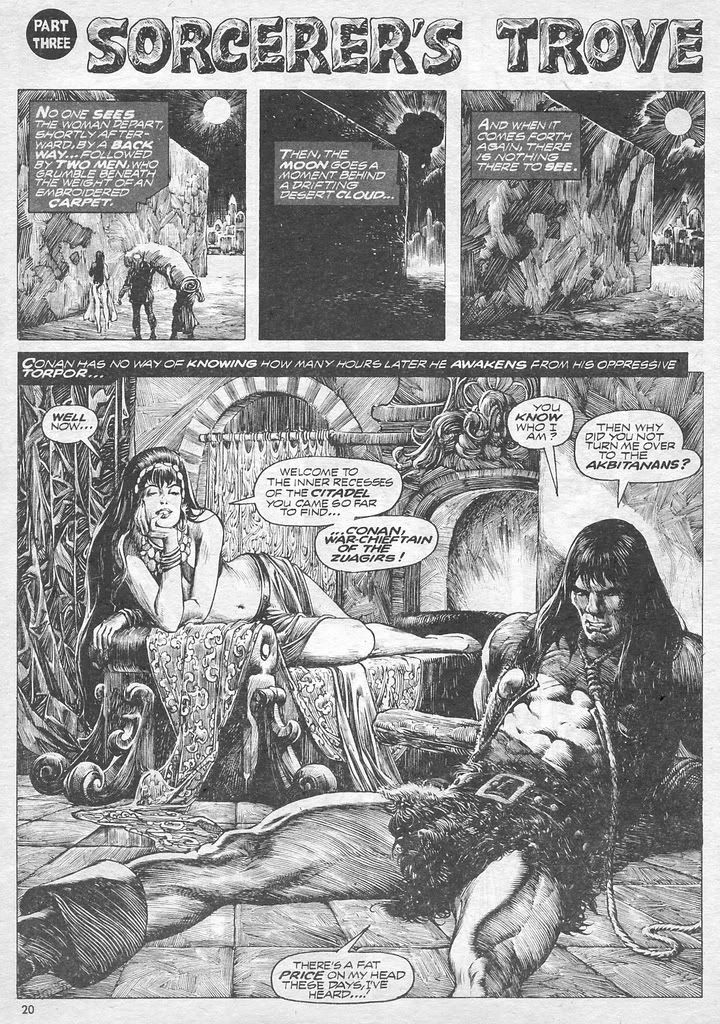
It's a long segue, but a lot of my reaction to things like Berlin ends up closely related to how I look at them. I spent some time in the above contexts trying to pinpoint Lutes' syle. The drawing is decent, passing the art bar, and including nice scenery shots, and I think is improved by avoiding color in the first place. It's a far cry from the tradition of the gory and lascivious detail you'd get in an old black and white Savage Sword of Conan, and if it did make use of all kinds of city views, the creative layouts are rarely rolled into large complicated images, and the scene changes are more in the lines of storytelling transitions than tricky artistic ones. When he does go there--I'm remembering the way he worked in art-school technique in one series of panes about a lecture, and how in a different series, he brought some full-bacchanal scenery in his glimpses of underground nightlife, and there were a couple intrusive uses of white space--it instantly becomes more interesting. Given the clever vehicle of making one of his characters sketch compulsively, you kind of wish he worked that conceit into his own art more. I will say that I enjoyed the way Lutes moves between a character's dreams and reality as a means to shift the point of view from the dreamer to the dreamed-of, and he does a nice job of employing the comics-equivalent of a roving camera to lead us between plot arcs too, but these aren't things that are contained in the drawing.


The usual dialogue balloons, thought balloons, and text boxes seem more ingrained to the medium to the point they're unnoticable. Lutes is big on thoughtful dialogue and faces, not really on any of the raw action and cheesey drama of the superhero tradition. He lets the characters' expressions reveal emotions most of the time, but still not in a way that feels very new. There's something familiar about doing it that way: it frequently reminded me of an old Lighter Side strip, where the point is more about writing, that is, more about setting up and delivering a piece of dialogue. The ways Lutes' conversations get spaced-out in a series of panels, the way that situations are introduced with people-free panes, and the use of facial shots with minimal background drawing, it all lends a strange quiet feeling to the book, and when Lutes falls back on comics tropes like punctuation marks over people's heads, big-graphic sound effects, and swirl lines, it feels like he's regressing. The quiet space does seem appropriate to convey the impending political fate that we know is coming for all of these characters.

Berlin did what I wanted it to do, what Sinclair Lewis failed to do, which was to set up a feeling of how it happened there. I'm falling back too much on my history-for-engineers classes here, but as I remember learning it, the usual story of the fall of the republic and the rise of fascism is told as a series of calculated political moves and power grabs by you-know-who, against a backdrop of economic depression. The classroom version sort of leaves out the city as a hub of European culture, the hopeful liberalism of the Weimar Republic, the personal wounds of the Great War, the vibrancy of urban life, and Lutes gets a good chunk of that in his comic, as well as the sense of how it is beginning to untie. Here in America, we also tend to leave out the Communist influence in prewar Germany and the National Socialist's definitional opposition to it. Lutes doesn't give up much love for the actual Reds--they're given to rallies and thuggery too--but he expends a great deal of sympathy toward those characters attracted to the philosophy, and none towards those inclined toward authoritarian Nazism. (Curiously, he has yet to draw a swastika--flags are represented with a big blank space devoid of party emblem.) A great deal of dialogue is devoted to the spectrum of characters' resistance to the growing popular ideas, and to their bonds of class, at a time, in the story so far, when they still feel free to express these things.

Berlin is advertised as a graphic novel with as much texture and depth as a regular novel. I contend that it makes good use of the comic form (with the caveats noted above) to tell the same kind of story, but if this is novel-like, then it's wicked thin. I think I knocked off each of the volumes in about an hour, less time than it's taken me to write about them, and I am not a fast reader. The art is reasonably well-done, but it's not so engaging as to make the eye linger. I think the bigger problem is that we have an ensemble cast in which none of the characters have enough pages under their belt to be especially memorable. This many people in a 150-page prose novel would be just as difficult to develop. It's worse that Marthe Muller, the closest thing we have to a protagonist, is devoid of much defining personality. She's a little introspective, and a little independent-minded, has a ghost or two, but her spontaneity, devotion, and likeability don't really seem to come from anything we can see her say or do. Worse, she's the most generically drawn of all of them (defined with a weariness in her face that marks her as slightly older than the other students, but younger than the workers and newsmen, but that level of detail varies by pane, and sometimes I was reduced to carefully checking noses to make sure I knew who the story was following at the time). The journalist Severing is a little better realized, but a downer, and mostly I wait for his descent into real depression. Marthe's friend and lover, Anna comes off the more sincere, with actual challenges with a modern identity and mixed cues in a straight socity, and the Jewish boy David is given some interesting private life beyond the external story as well. The bigger drama we see is from the folks from the working and poorer classes, but it's also a cheaper sort, more basic stories of violence and sacrifice. A runaway girl, and dead mother, and some unlikely compassion, and finally I'm finding myself engaged.

Berlin takes a look at a transitional place, and recovers the forgotten human and social elements, and I think this is very much its strength. As a comic, it's not deeply innovative, but it uses the medium well in getting this story told. As a novel, it's readable, but I can't bring myself to see it as the great black and white hope, whatever NPR would like us to believe.

Thursday, December 02, 2010

The Next Bubble?

[There was cleanup called on Aisle Keifus. This post is still among my most boring, not to mention borderline ignorant, but the more egregious writing errors have been corrected. It's not like this blog is going to hit the big-time, and sometimes I just have to get stuff out.]

Complicated life choices are an unavoidable consequence of living in interesting times. How can I guide the kids toward a positive life experience that doesn't charge the price of defiance (or doesn't insist on charging it), but can still minimize their indenture to the Way Things Are.* How to offer them options for success or happiness that aren't limited to the treadmill, or the rat race? Convince each of them to invest in a hundred fifty thousand dollars worth of college, with no savings to speak of, an unsure direction (as it should be at this point, before they're even in highschool), and no solid expectation of future employment? My feelings about the value of learning, the value of keeping our citizens educated, and my memories of the experience--let's face it, my elitism--are running straight at the wall of rapidly escalating costs. I prefer my kids to go if it fits into their still-hard-to-judge life plan, even if The Man callously demands it from them anyway. I just have no idea how I'm going to pay for it.

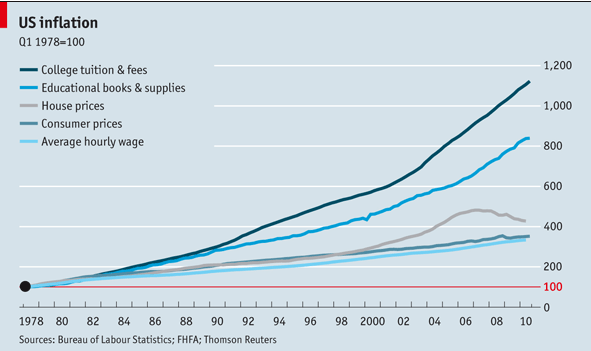
Here is a graph of college costs posted recently at the Naked Capitalism blog.


Since the early 1980s (at least), they have been rising a great deal faster than inflation, faster even than our monstrously inflated home values did. Given what happened there, Yves Smith points out in that post her fears of a bubble. Student debt (as oppposed to mere costs) has jumped up 25%, and meanwhile, a job upon exit is harder to come by than ever. Currently, unemployment rates among 20- to 24-year-olds is up around 15%, and even with the 2005 "improvements" on bankruptcy laws, defaults on student loans are also rising. Meanwhile the lifetime net income gain of a college education is estimated at a couple hundred thousand dollars, which might leave my kids just enough dough to put my grandkids through, assuming no one in this chain plans on ever retiring, or getting sick.

At some point in our lives, we all get the "savings" spiel, how compounded growth is magical and how great it is to get in early. But exponential growth applies to negative rates too, making it so much harder to get out of the hole (especially if you get in early), and differences in those rates tends to open up chasms when they're perpetuated over years. Here is a helpful aricle by the College Board talking about rising student costs. They estimate that the growth rates in college prices from 1977 to 2007 (approximately the same range as in Yves' graph), has been about 4.5% for public schools, 3% for private ones (which remain much more expensive), and about 1.5% for public 2-year colleges ("community colleges") per year over inflation. Factoring in room and board makes the four-year schools (students are assumed to commute to two-year ones) look a little better, knocking about a percentage point off of each of those values. This tells us that tuition alone is bloating faster than the cost of dormitories or apartment rentals, but that the net effect has still been growing faster than everything else has for 35 years.

What about all that sweet, sweet financial aid? I'm glad that the College Board reports this too, and net costs show similar trends. They also break 'em down relative to household income, and here's a result that I didn't expect: according to their data, "upper middle class" folks such as me have seen no change in the percentage of their income they devote to their kids' college costs between 1992 (when my college was getting financed) and 2003 ("now" for the purposes of conversation). Although, I can still salvage a little self-pity. Here in New England, both college costs and incomes are higher than in other parts of the country, so I can look forward to increased net payout, and also life in a lower income group than the national averages suggest.


On the other hand, and as usual, it's far worse for lower income people, who are not only getting pushed into college much more than they used to, but have a bigger burden than they once did. It's not just that a matter of costs growing equally for everyone. The increase on the lower end of costs relative to income is reflective of the fact that these families have become poorer since 1992. The growth rate of income has been much different for the different qunitiles (Why the census likes to bin things up in quintiles, while the college board prefers quartiles is left as an exercise to the reader. Downloadable tabulated data could have given you a better post, but would have wasted more of my time.). Lower income people didn't benefit from a growing economy at all, while rich folks did so disproportionality, and the speed of that separation has accelerated, a grand canyon of inequality. Middle class people (at least outside of New England) have been just barely keeping up with the growing expense of those important things that are not in the CPI, which is perhaps why we don't have a revolution yet.


But anyway, the data tells me, to my surprise, that it shouldn't be any harder for me to put my kids through school than it was for my parents (who pretty much killed themselves to do it), even while great other segments of the population are getting right fucked. Even there, there are a few key omissions in that analysis:

  • Fuel costs have risen relative to inflation since the early 90s.
  • So have housing costs, a lot. Note that first chart.
  • It's taking two individual incomes to make that same household rate of 20 years ago.
  • We just finished paying off our goddamned loans. Mom and dad didn't have that issue.
  • Income still ain't wealth, and savings in terms of home equity has been devalued.
  • Student loans are an expected finance mechanism, more, I think, than they used to be. There are industry incentives to push them, in terms of government guarantees and protection from bankruptcy laws. Like in Taibbi's Griftopia, these were legislated changes in policy.

    So even for the middle class, that nominally static fraction of our income still looks a lot like a growing debt trap, as the other demands on that income have increased, and as the cycle of debt closes to meet across the generations. As mentioned above, student loan debt has shot up 25% since the early nineties, which is far beyond what costs did. Mom and Dad have less to contribute, and so Junior takes on a bigger chunk himself. More people need to go to college to provide the credentialism that employers increasingly demand, (and to soak up the lack of quality jobs they offer) and meanwhile the economy is recessing, and unemployment is high.

    If it's a bubble, then how does it collapse? When you default on your mortgage, at least they can take your house. The justification for your college loan is your future income. What's in the deal for lenders when you can't cough it up? Are we looking at peonage? Debtor's prisons? (It's a trick question of course. Student loans are guaranteed by the government. They'll take your taxes and slowly rescind your benefits.)

    I'll accept that loan availability gradually drives up tuition prices. People can generate more money to go, and so they get charged more for the same thing. Where does it all go? Universities don't pay professors a hell of a lot more than they used to, especially given the purported value of their extensive education, and there are fewer tenure positions available, and more temporary ones, not to mention a glut of eager degreed people to fill them all. Administration as a buck-sucker is a good hypothesis, but even CEO-scale pay increases at the top don't really seem enough to be enough to soak up all those additional dollars. Not only are tuitions skyrocketing, attendance is going up too. In public universities, decreasing state funds is blamed, and that is no doubt part of the story, but it still doesn't account for the way that private education has similarly ballooned. It probably does explain the difference in the rates of cost growth vs. private school, but they're both still growing.

    Another usual story is that it goes to ridiculous infrastructure improvements: spiffy buildings, meticulous landscaping, sports teams, palatial dorms, sparkling research facilities. Speaking anecdotally, every residential universtiy I've been within a mile of has been sick with this improvement disease, and it probably explains why commuter schools are growing less fast (but dorms alone don't seem to cut it as a cause, looking at the mroe modest growth of room and board compared to tuition that the College Board reports). The story is that all of this is done to attract students, but that doesn't compute, considering there are more students than ever, coughing up more bucks. Even if they didn't raise the margin, colleges should be be raking it in based on volume. I have mixed feelings about these big collegiate infrastructure investments. I am sentimental about tradition, preserving the older feel of these places, and hate to see unnecessary changes, at absurd cost. But as for the attention, these institutions may be reinforcing the last connections with learning and culture our society can expect, and that strikes me as worth preservational effort. And the improvements don't need to be constant: if the money spigot does start to lose flow, they can always stop building all this shit, just let the basketball team go pro already.

    I've been intrigued (and not at all surprised) by statements, usually in blog comments, that the loan availability is also largely influenced by loan providers. More money lent means more business, and maybe sharking accounts for the baseline super-inflationary growth that we see in community colleges (which, as opposed to the residential four-years, don't spend anything on superstar professors, computer systems, and media castles). From the investment end, a couple percent growth per year seems like a pretty stable vehicle, and it's foolish to imagine they're treated as anything else, and naive to think that how this fact may benefit the borrower is a chief concern. [Editors note: Keifus was taken behind the woodpile and is now aware that baseline 1.5% growth is the increase in alleged value of an education, not of an existing investment. An already-written-up loan package only grows by its own interest rate structures, although it's perceived stability, the presence of side bets, and suckers to sell it to, no doubt help to increase what you can sell the next loan for, just like in the mortgage world. Does the increase in new loan values correlate with an actual 1.5% increase in value of an education? That's kind of the danger.] Are student loans securitized and ranked like mortgages have been? Yes, although asset-backed securities like this are reputed to be more stable and conservative than housing stock. I don't have the faintest idea whether these loan packages are as shakily insured and inappropriately leveraged as the mortgage obligations were--that'd take a real researcher to uncover. (It looks like they managed to remove caps on adjustable rates somewhere around 2000, although I might not be understanding that report primer correctly.) I'm sure nothing good will happen if people start massively defaulting on them in any case.


    * We're by no means there yet. My opinion is that it's worth it to learn what's good about life before you're forced to accept its inadequacies, which will happen soon enough.

  • Friday, November 26, 2010

    Review: Griftopia, by Matt Taibbi

    I can't believe it. It's even worse than I thought.

    In Griftopia, Matt Taibbi takes us through the series of financial disasters of the last decade, presenting them to us as a succession of long cons on the American consuming public, enabled by the government and perpetrated by the finance industry. He bookends the drama by a bit of political analysis, pointing out some basic and comic misunderstandings of the "Tea Party" demonstrators with a dollop of sympathy. They're right that the government is crapping on them. They just don't understand how it works, or who wins. (Writing this now with a family-time turkey hangover, and I'm appreciating Matt's point more than when I read it last week.) He tells us how it's intentionally complex, to obscure what the hell is going on, buried in miles of double negatives and lawyerly fine print, mostly as a justification for separating the rubes from their bucks. In the epilogue he notes how the political campaigns have sifted it down into idiotic narratives that ignore the essential conflict. In between, Matt offers the quasi-philosophical excuses for graft that began to seep up in the Reagan years, walks us through the tech bubble, the recent commodities spike, skims across the health insurance morrass, and spends a good couple chapters on the current real estate mess and its corrolary finance disasters, each given as a different view of the whole enterprise too structural to call a scam, each a different tentacle of some gigantic insensate octopus (his imagery), not much aware of the activities of the rest of it. At least one of the chapters is a reprise of one of his big Rolling Stone pieces, but the format is logical enough.

    Most of the criticisms I've seen Matt Taibbi receive from his articles have boiled down to attacks on his style, or hurt feelings. (The multitrillion net grift that he tosses up once or twice is something I've seen disputed, but he's obviously including some lending actions of the federal reserve that's not well-disclosed, and is necessarily estimated, and is used in the text as a synonym for "huge" I think with the appropriate amount of confidence.) Me, I like the colorful language so much (evidence: this-here blog, although both us might go a little heavy on the adjectives) that I worry that it probably soften up my objectivity, although I can see how for normal people, frequent superlative use of words like "collossal" and "insane" and "fuck-ton" may be mistaken for an absence of mathematical precision, and how calling Alan Greenspan "the biggest asshole in the universe" or Rick Santelli a "shameless douchewad" or Lloyd Blankfein a "motherfucker" may worry semantic purists that Matt could be offering a smidgen too much of a personal hit. But keep in mind that attacking the man doesn't necessary mean it's an ad hominem fallacy. Matt's not calling them names in order to discredit their argument. For that, he's offering a couple hundred pages of evidence. What Taibbi is instead doing is examining their behavior and reporting the logical conclusion that they are, according to any useful colloquial understanding, major-league assholes. Sure it's an opinion, but it's supported. And it's a good antidote for the beetle-browed driness, jargon-heavy passion, or Delphic gobbldegook that is the usually accepted tone for the financial discussion, at least when it is directed toward the public. The admonition against strong words can serve as a cover for behavior that is outrageous enough to be worthy of them. Taibbi's technique of generating an emotional connection is useful. And it's worth noting that some the basic humanity in the big-time profit-seeking calculus is so deeply ignored. Call it an incredulous style, but I would likewise avoid calling it a fallacious appeal to incredulity. It's more like a comic act of frantically trying to point out something too large and obvious to easily notice. ("The fucking elephant! Don't you see?") And yeah, even if you want to argue (and I don't really) that Taibbi's a one-eyed journalist, it still puts him among the sparse royalty of that profession. He's not a comedian, but fuck it, he's funny, and the emotional connection he generates is of that vein, the sort that can help you accept uncomfortable little truths.

    My objections to Griftopia are small, and run in the territory of praising the book with faint damns. I appreciate the research Taibbi did here, and his willingness to explain and condense things for his readers is bloody useful. But on the other hand, I'm wary of entertaining explanations of boring subjects. My spider-sense occasionally got tingling, got me thinking it's little too like an "edgy" kids' science show or something (a certain glibness that sometimes generates allergy symptoms, even if I don't generally find them to be wrong), and maybe he's missing important subtleties in the service of a greater valid point. The issue is that the grift penetrates deeper into some economic sectors than others, and even there, on some firms and practices more than others. I don't think this is lost exactly, but the chapters are given approximately equal emphasis, and I don't think all of them have purely economic causes, or were generated with the same level of gleeful amorality or outright contempt toward the lower classes.

    For example, like most people, I suspected that speculation played a role in the 2008commodities bubble, but how much of a role? Now, I didn't realize how much was of the disruptive speculation was of a newly legal type, and Matt makes a good case explaining what useful service commoditiy futures have provided since the Depression, and for the role the empowered commodity futures trading commission made in creating a structure so damn fragile and ripe for collapse. It explains why some worries about regional stability made the futures market go so much more flighty and generally fucktarded (not to be so casual about this--it made people go hungry, a worse thing than losing your house) than investors normally make things. But dude, there are very good reasons why "anyone would want to invest in a rise in commodoties prices over time". I don't think in the long term that we can really count on technologies to continually improve yields and so forth, not without a brand new energy source and a revolutionary chemicals infrastructure. The market scare that sparked it--middle east instability sparked by U.S. military actions there--were real, and if there was still any of the shit in Texas, wouldn't have been an issue in the first place. It's a response to oil peaking (and I'd love to see Matt Taibbi on oil, by the way). The spike was caused by the futures overinvestment, but I think it's still governed by gradual resource depletion. I think the inappropriateness of long futures in normally-functioning commodities markets makes sense. Would it be good to be able to short oil on some long-term scale?

    There is a later chapter on last year's health care reform, and Taibbi makes the case that, like other corporate actors, Washington sees insurers as among their real constituents, who need to be served more than they need to be legislated against on behalf of us lowly worker bees. He is certainly right to trash the anti-trust exemption enjoyed by the health insurance market, which flies against the public interest, and is, you know, completely inconsistent with the sorts of pluralist models that most people believe apply to our country and economy. It still takes amazing balls to ignore medical or insurance that work cheaply, and after basing parts of your campaign on spelling them out, to then take 'em right off the table before negotiations even start. Matt acknowledges that it's well-impossible to buck the insurers when you're a senator, for those even inclined to, but didn't any politician imagine an ounce of good could be done, that chink in the armor was useful as a price to give 'em something they'd get anyway? Aren't some of them merely misguided compromisers instead of pure sellouts? Isn't it good that at least some people are insured and we have a medical complex that works even if its finances amount to extortion? I am Taibbi's side here, but he offers evidence more than proof. Failing to rescind something evil is perfectly consistent with cluelessness or a broken system, but isn't actively malicious in the way that a financial con can be. And when they get that far in the book, Matt's going to make the commenters at Balloon Juice hate him all over again.

    When it gets to auctioning public utilities for short-term budget-balancing, I was similarly educated on the extent of it all, although I'm not sure if I've been convinced that foreign wealth funds are any specific problem here. Makes it seem more like "looting" than anything else. But Matt's at his best going over the stuff he researched so heavily for the Rolling Stone pieces. If the grift is merely good for commodities and health care markets, it's been grrrreat! for the investment banks, who, at the top eschelons, have not failed to garner their cut, even as pensions tank and our governors eye our federal benefits to fight the deficits they suddenly care about. I've read a fair amount about this (much like any reluctantly responsible citizen), and I liked how he added some depth and, really, some perspective to the mortgage racket as it all went down. There are so many details of this game, that it's difficult to organize and prioritize, and I thought as a summary of the chain of fraud it was splendid, and the wrapup (p. 121) was artful. I liked his quip that it's Griftopia for the handful powerful entities working in the priveleged sphere where they can manipulate the economy, while it's the free market for the rest of us. Which is the exact opposite of the message they sell.

    [Wrapped this one up in a hurry. Happy holidays, everyone.]

    Friday, November 19, 2010

    Unpacking Ayn Rand

    It's weird to think about it, but I've been haunting the internet for a long time--about twenty years if we count the time that my then-friend Mang (it got so I didn't see him so much sophomore year, and later I'd heard he pretty much disowned me when he found out I was pledging a fraternity) showed me some tricks with the email, where to ftp a few naughty pictures and local urban legends, and some especially nerdy ways to waste time--it puts me approximately in the Precambrian era of its evolution, just before AOL exploded the place with a diversity of lusers. A minor, sporadic and unnoticed spook I was then (and am now), but it was a long enough stretch for me to have eyeballed a few types, observe them, get bored by them, and still here they fucking are. One of these long-established members of the internet prickarazzi is the Objectivist (close! but this guy's too astute), the serious spouter of Ayn Rand's claptrap, typically a pustule-faced nineteen-year-old Rush fan, but also trending toward those unlovable middle-age stiffs who'd manage to be excitable and passionless at the same time, whatever humor generally veering to the nasty sort, the sorts of people who had unshakable theoretical views of human behavior, and whom you'd pray would never, ever have any kids. (And of course that's not fair, because even here I'm remembering "libertarian" types more clearly than "objectivists." The Randites were narrower and stupider.) Or that's how I grew to picture them anyway, while the characters who later evolved to pick on John Galt (or at a minimum, pick on his prose), enjoyed a mental picture that included a healthy laugh and a charming joi de vivre. In the meat world, most people seem to separate their beliefs from their lives, reserving philosophical passion for the rare times those worlds happen to intersect: it's turned out that either of these groups of people are indistinguishable from my officemates.

    I am embarrassed to come back to all this pseudo-philosophy as much as I do. It's sort of like being annoyed as an adult about Dr. Seuss's inaccurate grasp of physics and biology. (An elephant bird? You don't transfer genes by just sitting on an egg! And for that matter how did that tree hold Horton up, Ted? Answer me that one!) I never went so that far down as to believe in "rational self interest," but it's the sort of idea that I associate with those formative times. Being surrounded by other baby engineers was part of it, but our freshman experience was more about playing tennis, computer games, and endless rounds of Asshole, and, hard as this is to believe, never getting laid. To fill out the requisite dormroom bullshitting, I was forced to go online. I don't want to offer the impression that most engineers are so closed-minded, and there remain an abundance of people on the other side of the screen who aren't antisocial kooks, but bright, arrogant and immature? All I'm saying is that I know the type.

    I've read far more about Ayn Rand than I've read anything she wrote. And the anecdote doesn't lead up to a review of Atlas Shrugged even now. Still don't have the stomach for that one. No, I'm reading Matt Taibbi's Griftopia (good for a tangential post or two before the review), and it's a kick to read someone introducing Rand and the world of objectivism to newbies with appropriate contempt. It's a critique addressed to an audience insufficiently geeky, or composed of the wrong sort of geek, an audience lucky enough to have never inadvertantly let this crap suffuse anything in their thinking lives before Taibbi told them about it.

    Here's Matt, quoting:

    Rand's rhetorical strategy was to create the impression of depth through overwhelming verbal quanitity, battering the reader with a relentless barrage of meaningless literary curlicues. Take this bit from Galt's famous speech in Atlas Shrugged:
    Rationality is the recognition of the fact that existence exists, that nothing can alter the truth and nothing can take precedence over the act of perceiving it, which is thinking--that the mind is one's only judge of values and one's only guide of action--that reason is an absolute that permits no compromise--that a concession to the irrational invalidates one's consciousness and turns it from teh task of perceiving to the task of faking reality--that the alleged short-cut to knowledge, which is faith, is only a short-circuit destroying the mind--that the acceptance of a mystical invention is a wish for the annihilation of existence and, properly, annihilates one's consciousness.

    If you're sane, you skimmed that, and depending on what you're looking for, you might have come away with (a) that an external reality is important and is independent of belief, or (b) some unsettling bullshit about the infallibility of the rational mind. The former seems a reasonable-ish philosophical view, but the latter seems like a disturbing justification for something or other. Taibbi goes on to sum up the whole deal in four bullet points:
    1. Facts are facts: things can be absolutely right or absolutely wrong, as determined by reason.
    2. According to my reasoning, I am absolutely right.
    3. Charity is immoral.
    4. Pay for your own fucking schools.

    I love Matt Taibbi.

    Once you account for the hyperbole, this is not really so far from the Wikipedia entry (and if Wiki's going to represent anything more thoroughly and charitably than Star Wars, it's Ayn friggin' Rand). I look at the promulgation of "objective reality," and I worry. Why, that's not so much different from my own struggled-at epistemology! The one which I can't get myself to shut the fuck up about. I wouldn't go so far as to call "facts" unassailable, but on the question of whether there is a universe separated from our consciousness by our senses, then I have to agree that there is. I guess it's classified generally as a materialist viewpoint, a label to which Rand felt herself above, to the extent she acknowledged the history of the art at all. But objectivist philosophy seems to fall apart going forward from that. Details of knowing probably matter, but as a bottom line, I contend that knowledge of the world should, as a necessary minimum, not violate evidence. Objective reality taken as the-universe-is-the-universe (of which we are part, and not above) is something I get behind, and have blathered about. Getting down, however, toward such derivative concepts as facts-is-facts and existence-exists, well that now seems confuse subjective and objective realities (and is also conveniently circular), regardless of how the Randies prefer to organize their labels. How, after all, do you judge something a fact?

    My favorite summary joke about Ayn Rand (and I've mentioned this before) comes from Matt Ruff's book, Sewer, Gas and Electric (a near-future romp from ten years ago--I thought about re-reading it recently, but I wasn't in the mood to find humor in some of his structural gags). It features a pocket-sized Rand advising characters, and while Ruff mocks her, he does so fondly. He'd been a regular at rec.arts.sf.written, so maybe given that early internet environment, that's not completely surprising. In any case, my favorite quote still makes me laugh for its capsule perfection:
    "'Ayn' rhymes with 'sane'?"

    "Rhymes with 'mine'."
    My observations are that while objectivism looks evidence-based, it carefully limits the allowable evidence and then goes even further and supports its ideas with elaborate and boring fiction. It looks like it pushes a certain logical amorality, but it instead constructs a morality that is whatever the fuck creepy Ayn says it is. I like a focus on the value of inductive reasoning, but it appears to not think very hard about induction, to the point where assertion of "facts" is enough to support their validity. It is a "philosophy" that tells people that they're indeed exceptional and limited by a globe-full of littlebrains, which strikes me as more than a little dangerous. My long-standing impression, never disproven, is that objectivism is to real philosophy like scientology is to real cognitive science. No coincidence it rose to a similar sort of cult.

    My general feeling is that as basis of reason, objectivism is comically underripe. I may be philosophically impaired, but I'm smart enough to catch on to what's the kiddie material. Digging around, I found some excellent critiques. Here's popular blogger Incertus worrying about the inevitable hangers-on now that Rand disciple Alan Greenspan, with his copy of The Virtue of Selfishness under his arm, has pretty well fucked the whole place up. It's a good post, but I am hesitant about damning a philosophy just because the resulting movement was comprised of the worst sorts of assholes. That hardly seems exceptional. I also want to be careful about dismissing Rand on the basis of her wretched personal life, or of her turgid writing style (even though it's so very, very tempting to do this; I also want to be careful about confusing Taibbi's felicity for truth, although I admit I'm still riding on some ideas of humor and power). Her scholarship has been accused as, um, lacking, which I take as a serious accusation, although I don't really know if philosophy is enough like physical science to say that violating established thinking requires extraordinary evidence, but the contrarian approach doesn't strike me as a likely road to honest investigation. Here's a guy named Rob Bass dissecting the epistemology, and outlines the appeal and concerns better than I just did. I like this dude--he makes clear and interesting arguments in comfortable modern language, and he appears be coming from a similar direction, uncovering similar questions, as I have been over the last several years. I will try to remember to follow up with his papers. (Does Rob want to rock right now? I was curious enough to do a where-are-they-now search, and both he and Gary Merrill (the guy from the previous link) are in the UNC academic system these days, and good for them. Is the fact that these posts are 1993-vintage Usenet material also revealing of my formative experiences? It's not out of the question.)

    I entertain cautious apologies on behalf of Rand because I still haven't made myself read the doorstops, and that fact limits any substantive arguments I might raise against them, even though I find the objections quite convincing. Ordinarily, what with the limited lifespan and all, it'd be sufficient to weed out those bad ideas, but Ayn Rand has somehow managed to be important. I have read that even beyond her cultish band of followers, she grew into a more influential sort of quackery back in the 1950s, the results of which have helped fuck the country over for at least another half-century. You can imagine how people with money and power may have felt to consider that their self-interest was virtuous.

    If there's more evidence needed of objectivism as philosophical juvenilia, then there's always the fact that so many of those college kids grew out of it. I mentioned Rush, but Neal Peart never claimed inspiration deeper than a damned short story, hasn't gone down that road in his lyrics since he was 23 or so, and even back then he wrote about relationships, youthfulness, fantasy books, anti-authoritarianism, and balancing logic with compassion as much as he wrote about anything else. It's good to grow up: one thing you realize is that there's nothing wrong with empathy, that the world outside your experience is every bit as valid as the one between your ears. I can see the appeal of allegedly objective realith and intellectual isolation, especially when you're young and bright and dorky--lots of engineers are also capable--at least they were before colleges capitalized so heavily on the game--and anyone fucking around on the message boards before ca. 1990 had an independent streak--so maybe it's reasonable that my proxy bullshitting sessions were biased this way. But the most damning thing about objectivism is that objective reality has pretty well proven Ayn Rand's philosophy to be a collossal disaster, isn't that right Mr. Greenspan? Can we let the damn thing go now?

    Tuesday, November 16, 2010

    Review: Packing for Mars, by Mary Roach

    There is a premise underlying Packing for Mars, and best to address it before moving on. The idea for the book is that sending human beings into space is a fundamentally absurd, which is true. I don't, however, think that this enterprise is without intellectual merit, engineering challenge, and even if it limited itself at the beginning to the blue-eyed and ball-sacked variety, sheer American moxie. It doesn't really seem fair to go straight for the poops jokes, but she's right that the unintentional funniness of people who make it a poop business really needs to be acknowledged. Roach seems sharp enough--she handles pretty well stuff the scientific stuff she professes to have recently learned (the fact that she had no rough working knowledge of free-fall and orbits and so forth before writing the book, however, does bother me)--but she's not a NASA fangirl. And maybe it's just as well, there are enough stories about spaceflight that fit the required notes of geeky love. Roach is writing a secret history, an open secret history, and not forgetting just how weird it is for every human behavior and function to be engineered. Fortunately for this reader, I am by no means too mature to fail to appreciate personality quirks and crap jokes, and I'm also curious and respectful of the effort to make the ludicrous enterprise work--how does a space toilet work ("separation" is indeed an issue in zero g), how is nausea addressed, is it scary up there, does everyone get along, and if any astronauts endured some historic moments with a legful of piss thanks to a badly fitting urine collection device (condoms, not catheters), then you bet I want to know about it. Or look at it another way, here are hundreds of serious researchers and workers in the space program, each with a headful of inside jokes longing to be told. And finally here's some appreciation.

    It helps that Roach writes it well, balances a seriousness of subject, good journalism, with a comic tone. She's a good enough sport to do it, for the sake of the story or for the entertainment potential. She digs in and finds the details, and is not very shy about interviewing anyone, and wants to see everything. I've been stalling on the review because I think of anything better to say than it's like a book-length episode of Dirty Jobs, a different voice and a different medium than Mike Rowe's thing, but about as well done. It's humor without insult, it manages that rare combination of being good-natured, informative and funny. Roach has been doing it longer, but I doubt anyone's copying anyone. I suppose it's nice that the world managed to let two of these types succeed.

    Tuesday, November 09, 2010

    Review: It Can't Happen Here, by Sinclair Lewis

    It Can't Happen Here, published in 1935, is a famous book. It retains a cultural cachet (in way that political predictions do, but scientific predictions don't) for its contemporary awareness, for having been accurately cognizant of fascism when it was not politically nescessary in this country to be so, and for anticipating some of its expansionist aims. It is, as the title suggests, the development of an American version of the movement, developed shamelessly from our own national myths, and opposed (or not opposed) by various liberal cultural or philosophical elements. Having cultivated this sort of cynicsm for a couple of years, I was expecting to find some connection to this book, at least as a warning against the self-proclaimed authorities. And, so, how to put this exactly? It has a couple of moments, but I don't think it was a great work, maybe not even an especially good one.

    Sinclair Lewis (I learn) made his living, and eventually garnered a Nobel prize, for chronicling the middle class American angst of his pre-Depression day. This puts him as his generation's Franzen maybe, or Updike, or any of that stable of writers that I've neither read, nor can get myself to notice outside of their tedious "great writer" acclaim, which for me anyway, doesn't add up to an optimum set of associations, but still hardly enough to condemn. In any case, It Can't Happen Here is considered one of Lewis's late novels, published after his prime, and no doubt it got some penetration based on the famous name. The blurbs stress "important" and damn the reading with a faint "almost-as-good" praise when compared to his earlier works. Failing an easy connection to himself, you might be tempted to compare this novel with those of other authors who've also been astute and lonely critics of power, something like The Quiet American, but it doesn't hold as well as a character or a political study. As well as being observant, Graham Greene's will also go down as being an objectively good novel (to the extent that these things can be considered objective of course). Not to say it's awful--It Can't Happen Here has an impressive comic start, taking the gimlet to a couple Rotarian speakers—from the military and the DAR—but it doesn't decide well where it wants to be. The humor and the cuts don't keep up past the first 30 pages or so, and after that, the reader can look forward to only two or three episodes later in the novel that remind us that there was ever a satirical intent. The book makes a sorry bridge between the wit of Mark Twain and the bitter satire of Vonnegut or Heller. To my mind, It Can't Happen Here is closer in spirit to any number of late-model counterfactuals, and if AH writers like S.M. Stirling or Harry Turtledove might include more armchair generalism and less couched liberalism; more heroic violence and less subversive penmanship, the literary depths are similarly plumbed as by those more niche-oriented authors. Not necessarily a bad read, but it ain't indispensible.

    Here's the basic problem: it's not enough to say it can happen here, what made it happen here? There's only a smidgen of this, in the brief satirical opening and in the description of the growing appeal of president Buzz Windrip, but mostly what we get is mechanism, a sequence of events, a lot more what and not much why. Even there, the sections where external drama is given to unfold (outside of the protagonist's, Doremus Jessup's, point of view) are told in summary form, a lot of this-happened-and-then-that-happened, and the higherups don't develop into particularly understandable characters. These parts are like reading an outline of a novel instead of the book itself, breaking the cardinal rule of showing instead of telling. What's in the national (or hey, human) character that leaves us open to dictators? We don't get a good deal of the psychological landscape that let Windrip-mania take root, other than what's revealed through a few meetings and dismissive opinons of Jessup, who is standing in as an obvious proxy for the author. Jessup is the only real point-of-view character we get, the only head we get too far inside, and he's likeable enough, coming together as a gentle critique of the American liberal, drawn by circumstances into radicalism.

    Lewis was a writer, and his wife a journalist. Making heroes and martyrs out of writers and journalists (Doremus was an newspaper editor, and the plot revolves around his criticism of, punishment by, and resistance to the fascists; team Jessup worked against the "Corporate State" by printing and distributing pamphlets) may be drawing on autobiographical fantasies. We all like to think we'd be the ones to stand up to tyranny, and those of us with a wordy inclination like to think that we see the world clearer than others, and that anything we write matters. If we switch to a contemporary context, it's hard not to see Doremus as a blogger. I spent an inordinate time (supported by Lewis of course, and I bookmarked a bunch of well-written paragraphs that maybe I'll remember to throw at people who annoy me later, but which don't seem terribly relevant for the purposes of a review) wondering just what his political philosophy was. He identifies as liberal, but he starts out with a healthy (in that downplayed upstate Yankee way) wisdom about authority and politics and general. In a few occasions, Doremus defends middle-class intellectualism (we're not the same as the proletariat, he thinks, and that's okay), and finds both common ground and ultimate differences with the radical leftists of the 1930s brand. His viewpoint solidifies a bit in opposition to the Corpos, and maybe Lewis is offering a lesson that we resist to a degree that's appropriate to the political environment, mildly cynical in civil times, and bravely defiant in violent ones, a revolutionary that (somehow!) resists the formation of alternate tyrannies. This moderation moves from a weakness to, as Jessup's role solidifies, something definitive of the American version (evidently similar to the writer's own views), perhaps giving in to some myths of national character after everything. Pinning a philosophy on Corpoism is harder, and after some reading (particularly as he opens a succession of chapters with excerpts from Windrip's intentionally risible Mein Kampf knockoff), it's obvious that the actual version is vacuous. Some egalitarian-seeming or even Socialist measures are offered to the public, in a way that doesn't offend power interest too much, which I might have taken differently if Jessup didn't take a moment to pick it apart. It's funny how a fascist takeover is fronted by language of freedom and liberty.

    A couple of odds and ends. Increasingly, I'm looking, when possible, for personal figures to help place novels in time. Jessup's daughter Sissy (who seems like a great kid even though she was stuck with awkward dialogue) was born in 1917, the same year as my grandmother. In 2010, she'd have had a full life behind her, which feels like a strange and sad perspective. Also in 2010, we're living in the wake of a banking, um, crisis, sufficient to generate some real antipathy for the industry. In 1935, a complaint against "bankers" was often veiled anti-semitism, and Lewis certainly intended this to be an element of the Corpoist rhetoric. Is that the case today? It never before crossed my mind to make a connection like this when I get mad at the current financial industry. I wrote in my last post "the Democrats didn't exactly give the lenders a hard time." I was going to write "didn't exactly chase the lenders from the temple" but suddenly sensitized, I didn't want to go there. I guess I'll have to be careful to be precise about those sorts of things.

    Friday, November 05, 2010

    Five More Thoughts: Air Travel, Yet Again

    1. End of the line, pal.
    Flying is, as I've mentioned in some other mostly-forgotten post, it's own little universe, an ariport culture that exists outside of normal cultures, with its own bizarre and superstitious rituals, from the security screening to the demo of the oxygen masks (in the sixty-odd years of passenger jets, has anyone ever used these things?), and all the aggressively imported Americana only makes the experience more like a high-stress, undignified, and well-liquored Disneyland. I realize that we can look to the history of air travel for this, but for whatever the origin, it remains a special niche. People are less unwilling to admit they fear flying than other things. I think the usual aviophobia, at least mine, is not so much a fear as it is an anxiety. I don't worry that the thing's going to crash—the odds are with me there; I don't honestly think that it will—but rather it's that exclusion from the normal world, floating in such an otherwise unsurvivable place with so little control over the situation, that makes want to claw at the walls. It's the helplessness which the whole flying experience amplifies. We're herded through velvet ropes and crammed into narrow seats, paraded, penned, and locked in. It reduces humans to farm animals, and under the circumstances, it's no wonder the caged-sheep anxieties tend to leak out. You could forgive Juan Williams, if you could believe that he actually felt bad about it.

    That special slow panic of flight is common enough that it's a well-used target for fear. Not just for terrorists, although they sure judged Americans right on that one, but also for those Americans for whom it's convenient to ramp up insecurity of the masses from time to time. And on that note, I want to place a special shoutout to whoever the fuck "leaked" the reveal of a cargo bomb plot, shipped from the country in whose affairs our leaders desperately need some fig-leaf of justification, not to mention something to ratchet up worries on election day. Plot foiled! Security works, but stay scared! USA! Fuck you.

    Captive and herded, we go along, and no one is shy to push on those sensitive spots. And so here's one thing I don't understand...why don’t they advertise at us more?

    2. Flying creative class
    Speaking of which, I sat next to a woman on one leg of the trip (they'd nicely moved me away from the 400-ish-pound fellow who was originally next to me, which was awkward socially, but conceded to be in both our interests) who had ripped out a few pages of a recent Advertising Age. It's an industry rag best I can tell, and as I peeked (I'm not a good conversationalist when I'm flying, or otherwise, glazed looks being more my specialty), was carefully underlining names and important-looking trend statements. Maybe it was a job interview or something. I'm not a fan of being subjected so constantly to marketing, or of the way it influences our society, but I can understand why people consider it to be a valuable service. I consider the role of advertising people to be somewhat overvalued (not surprising considering that folks who are good at promotion will also advertise themselves), but it's not in financial captain territory, and they do still have to work.

    Anyway, what amused me was that every headline on those pages was like an assurance of their specialness. "Creativity corner." "Whither the creatives?" Don't they sell stuff that other people create? It's like they're overcompensating for those nagging doubts.

    In my industry, the word "innovative" is tossed around with similar abandon. Although not usually as a noun.

    3. How I book a flight.
    Some of my caged-animal instincts are to resort to borderline OCD behaviors, repeating a script that kept the misery in check last time (even though it didn't). When I get on a plane, one of those nonsense rules requires me to buy some new reading material at the airport. This is wise when you're planning a for a full day of plane travel anyway, adn the trick is to get something far removed from the situation, nothing that's going to angry up the blood too much. This meant that I didn't take Mr. Lewis out of my bag to finish reading about an American-style fascist takeover, but I managed to let the written word ruin my election week just the same.

    It's bad enough that half the airports I find myself in offer a forced reintroduction to CNN. Maybe it was only because the great game was afoot, but as I bellied up to the bar for lunch, I found the channel about as aggressively stupid as FOX News was ten years ago. (I concede that it's possible that my allergies have become more acute. I snarl at NPR these days too.) But on Thursday I picked up a presumably anodyne New York Times, not really expecting the Gray Lady to play up the election day gloat as much as everyone else. I mean, you'd think the revolutionary conservative takeover of our politics might have come with some context (or consequence!) of this story comprising about the past 30 years of boilerplate, but somehow the Tea Party has made it all wide-eyed and new.

    Reading the convenient summary section that the Times provided yesterday, I see they've already predicted that any government activity of which I might approve --or at least may have been naively hopeful about--is already consigned gleefully to the block. John Boehner is already getting juiced about reviving Bush's tax cuts and balancing the budget (and it's as laughable as it sounds, but to point out the poorly-camouflaged obvious, "balancing the budget" is cover for abolishing Medicare and Social Security, which they are reluctant to admit to their base, but are happy to balance on behalf of my generation), giddy about crippling NOAA and other science and technology programs that produce unwanted facts (it is not clear yet whether they will outlaw evolution), and is sharpening his sword to eviscerate the two or three good things that came out of Obama's insurance booster program (in America, the average health picture may be among the lowest in the first world, but at least it's twice the cost!) The Times informed me that Wall Street (wherein bonuses grow apace) and other carefully protected "free traders" are pleased with the Republicans ascendance, not evidently much concerned about their candidates' complaints about the financial bailout, which, by the way, was also getting to be getting a little more sugar from the Fed. That business-Republicans item may well be the usual lazy journalist stereotyping, since after all, the Democrats didn't exactly give the lenders a hard time.

    Look, I don't retain much faith in the integrity of the system, but given that I am stuck here, I do have to say that I find it precious that our oligarchs feel so uninhibited about taking that extra step from selfishness into assholery. I mean, we may lose hope in the ability to change the world, but couldn't we at least deign to work with evidence-based outcomes? (he asked rhetorically). In the rest of the civilized world, at least they get fucking health insurance to go with their institutional graft. I suppose I shouldn't be this upset by the Republican takeover, and I suppose it comes down only to a matter of style. We've lost one set of leaders that hems and hedges our way into the abyss, and replaced it with the one that marches triumphantly in. I'm not a big fan of parades.

    4. Anti-anxiety.
    My brother concurs with taking a Xanax on the plane, but this violates other OCD scripts of mine. He also has a system of smuggled nippers that he suggested I take, bagging them carefully within the legal fright-limit as if they were deadly toothpastes, and I refused these too. I never used to buy booze on the plane because I never had cash, and I don't at this point because it became something I don't do. If that makes sense. In the airports, however, I don't usually waste the opportunity to load up if the boss isn't around. Why yes, please, I'll have that second pint with my mayonnaise-smothered grease-fries. A third? I might just have time.

    Obviously you don't want to risk getting airsick, but on a long flight, a good buzz makes perfect sense. Not just for the point of relaxing you. The three or four times you get up to pee is a good opportunity to stretch your legs, and it gives you something to do. That much stasis, and feeling yourself slowly growing sober (controlling your boozy odors, beginning to taste that godawful lunch again, slowly regaining focus) is almost interesting. Sobering up becomes an activity.

    5. There ought to be a law!
    Or let's just say it'd be a small and inarguable step in world decency if airlines would agree to generous standards for carrying musical instruments on board. The Senate was debating as recently as August on the FAA reauthorization bill, and there was a petition to include such language in it (here, if you are given to signing such things), asking that regs be standardized so that people carrying instruments could at least more easily plan.

    I didn't have any chance for a conversation with the guy, but I did spot one mandolin case in the airport. These aren't difficult to fit in the overhead bin, but one argument with a flight attendant a couple years ago discouraged me from taking mine with me again. Guitar players have it worse, but there is no reason not to allow those things up on top at the expense of one or two of J. Random Traveler's obscenely large carry-on bags. Obviously other instruments are less negotiable, but how can you not encourage erring on the side of preservation? You don't really want 'em bouncing around in the baggage hold if you can help it.