Monday, October 12, 2009

No Really, Red. Let's Go.

"Hello, Dr. H--?"

It is well understood that going through a doctoral program takes some combination of brains, motivation, and persistence. I'd tell you it's one of those "pick two" problems, but for my money, it's the last category that is really the indispensable one, especially considering that persistence can look like a lot like inertia or procrastination when you get down to it. A high tolerance for criticism (constructive or otherwise) is helpful too, and extremes of humility or arrogance can be fine defenses against this sort of thing, and are always essential traits in any field. Brains may or may not include any ability for life-planning ability or street smarts, depending on how the opportunity costs weigh against how well you expect to live afterward. As for me, I've been lucky that my scant brains have generally kept pace just barely ahead of my even more unassuming motivation, and I've managed to Peter-Principle my way farther in life than I ever had a right to expect. The gratuitous self-loathing that comes with all that high-level underachievement is just a bonus.

Anyway, what I'm getting at here is that I don't put very much stock in the honorific. I certainly don't use it outside of professional settings, where it might make a proposal or report an iota more professional-looking (and I'm suspicious of people who wave that crap around, including and maybe especially physicians), and no one calls me "Dr. H--" unless they're trying to sell me something. Of course this was no exception.

"Can I help you?"

In certain situations, I don't obligated to control my emotions with a great deal of maturity. This line was delivered with my best Squidward impression.

"Hi, this is Smiley McCutiepie, class of '11, calling from the RPI alumni association--"

Of course you are. "RPI" has been coming up on my caller ID for a month now, and the odds weren't good that they wanted to offer a paid interview for Rensselaer magazine. Incidentally, I don't know when they went back to going by their initials again, but I am glad that they have.

"--and if it's okay we'd just like to verify your contact information--"

Well, it gets me the aforementioned magazine, which indeed gives me some fine distraction as the girls pound on the door.

'--and if you are interested, I can tell you about some of the exciting things that are happening on campus."

RPI, which of course you know, is a small-ish, somewhat respected science and engineering school in a region that's only "upstate" New York if you live in the city. It was made famous by the accomplishments of its old, great civil engineers, and by opening up and expanding to engage a host of technically-awakened GIs after the war. I'd say the engineering programs are (or were) more academically oriented than comparable ones, sacrificing a little of the hands-on, and (I am sorry to say) a little of the graduate research effort. It has enough character of its own to avoid calling it a second-string MIT, but such a comparison is probably inevitable anyway. RPI students seem to maintain a sort of geeky joie de vivre that I'd seen stamped out of MIT students. (Of course i saw it stamped out of my fellow engineers too, in real time, but those guys were decent enough to still hang out and drink with us.) I was pretty happy there. If piling higher and deeper had to be in the cards, and given that I seemed in tune with some of the chemistry staff, I should have stuck around. (I just wasn't into the idea of hanging out with the faculty after avoiding them so successfully for four years.)

Smiley explained that the campus happenings of interest to alumni included (1) the gigantic new Experimental Media and Performing Arts Center (EMPAC) building, and (2) a brand new athletic village.
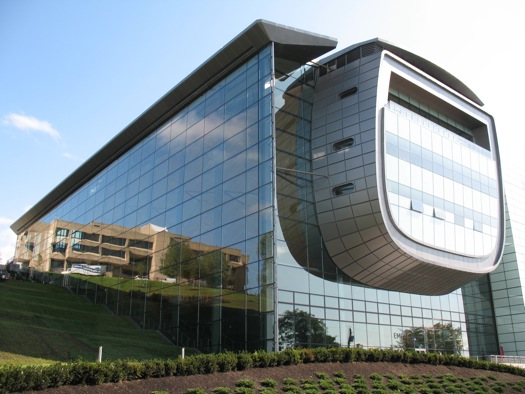
As for EMPAC, I have to admit it sounds impressive in principle, and a performance center and huge panoramic displays are great assets, even if it lacks that charming shoestring nerdiness of showing recent movie hits in the big lecture hall. And there's never a bad excuse to buy a supercomputer. I'm biased that they sought to erect this behemoth on a piece of my own personal collegiate nostalgia--I used to like to read on that hillside when the weather was nice--and you know, I can't shake the feeling that it's such an obvious knockoff of MIT's Media Lab. Better than MIT's, the press releases argue, but to argue that admits the comparison. The building tempts ass-ugliness too, more because it actually has an ass (note the photo), than by dint of sheer garishness. (No, that honor also goes to MIT, for the famous Tim Burton Stata center, that is now getting Frank Gehry sued. Evidently the architect--not RPI trained, I'll add--thought long and hard about how to make that monstrosity stand up, but didn't account for where the water would go when it rained.) I also don't like that EMPAC fails to match the odd-but-functional marriage of nineteenth century brick-and-ivy and 1970s brutalism that makes up the central campus, and in all, it's just a damned expensive bit of prestige. Maybe those kids who study there, if any do, will all go on to be CGI animators. I think that's something America still produces.

RPI is also not an Ivy League school. It does have a sports tradition, with a hockey team that performs well above what you think a geek school should (some players were athletes and geeks--Joe Juneau, to take the best example, makes us all look bad), and in addition to the quality facilities, there's a whole slew of local rinks, and all the intramural games were even more fun for the general incompetence of the rest of us. Hockey's great. And the mixture of hockey and engineering has character. There are other sports of course, and in recent years, RPI has taken it on itself to become a football school as well, and for the life of me, I couldn't tell you why. Have the alumni been secretly jealous all these years of the gridiron programs in corn country? Of the elite rivalries among the august Northeast institutions? I'm going to go out on a limb here, but I suspect there is a sizable population of bright kids whose well-roundedness has been thwarted by football all through high school, which may even have steered them away from state school in the first place. I think the sport's okay, mind you, but I see the effort as another expensive proposition to loudly trumpet that the alma mater is trying to be just like all the other ones, only not as winningnessly. (We is enjineers; English was already a casualty.) Have they thought this through?

(Also, I'll add more unwarranted bias. I remember the football fraternity as a bunch of douchebags back in the day.)

"Uh, yeah, Smiley, when I think of RPI, I have always thought...football."

Less Squidward now, and more joking. I won't let her off too easy, but she seems so nice.

"Ha ha. Also, would you like to pledge--"

"gotnomoney!"

"Oh, I understand. But even if you just donate $20 a month..."

You know, I don't send money to NPR either, and I actually get a service, of sorts, out of those pitiable bozos.

What a harsh mistress is prestige! It cost a lot of money to send me to college, and now, with this not-entirely-convincing donor-baiting, it's going to cost the next group of kids that much more. Even with all the education, I'm not so steady on my feet that I can go and throw cash around to everyone who asks. Apparently some of the alumni contribution goes to scholarships (I was told--I never saw evidence of it when I went to school), and, what is supposed to convince someone of my meager status, the more donors a school receives, the better it looks when US News and World Report comes along and does the top 50. That's pretty amazing too, if you think about it. Here's a magazine that can't stand up to the journalistic might of Time or Newsweek--talk about your runners-up--almost single-handedly, through the tyranny of a scholastic rating system ungenerous enough to include an evaluation of the old-boys network in the university equation, driving up college costs for the masses, and directing generations of kids into a lifetime indebted servitude. For that sort of investment in the American Dream, I don't know why anyone would be foolish enough to become an engineer.

"We can give more information in email if you like. Would you be interested in that?"

"Oh, all right."

I've already gotten the electronic notice that I've "pledged," and I suppose that means I'll have to break my "word," but the reminder is easy to ignore. I'm hoping that the emails will at least get them to stop with the phone calls.

Friday, October 09, 2009

Review: Declarations of Independence, by Howard Zinn

Declarations of Independence: Cross-Examining American Ideology might be regarded as something of a modern anarchist manifesto, focusing on the problems with American government and society, and, taking some of his own lessons and views of history, how, optimistically, these might be counteracted. I have a difficult time getting what exactly Zinn means by "ideology." He describes it as the dominant pattern of ideas informing the country's policy, but he goes on to develop discussions of how American policy is a thing apart from its ideology, attacking a set of deducible ideas-beneath-the-ideas or criticizing what happens when those ideas are put in practice in a given power structure. Zinn isn't against free speech, for example, when it actually means free speech, and he convincingly discusses how it doesn't mean that, and for whom it means something else, but I'm not sure that contradicts the idea of free speech. The dominant pattern of ideas to which Zinn takes specific exception comprises what he calls Machiavellian realism, a framing that really annoyed me, as I've already gone into at tedious length. He's rejecting some of Machiavelli's conclusions and goals, but he's sticking to a similar evidence-based reasoning that Nicky Mack followed.

It's a fair project to investigate on what evidence we proclaim the world's ideologies to be successes or failures, however, and if we're in the business of cross-examination, I am more than ready to get Dr. Pangloss up under the hot lights for his statement on America® brand liberty-n-capitalism. Zinn's grilling is pretty good. The book is heavy with ideas, but it reads quickly, in easy language, and Zinn makes the sort of appeals to emotion and decency that illustrate and engage without feeling superficial and cheap. Since his goal is to convince, I'd have been happier if he avoided speaking in the universalist code of the American radical, and especially not so heavily in the introduction. An example: when someone advances health care as a "right" or as "free," or throws around scientific truisms, I want to stop and nitpick, even though I realize what he's getting at. I suspect other readers would stop entirely right there. And while I appreciate his honest subjectivity, I'm hesitant when he goes back to personal anecdote to enforce his point. Zinn is better at supporting with some difficult aphorisms with well-known but less-discussed facts. (Some of his own quips: "Historically, the most terrible things--war, genocide, and slavery--have resulted not from disobedience, but from obedience." "[D]ependency on government has never been bad for the rich." "It seems the closer we get to matters of life and death--war and peace--the more undemocratic is our so-called democratic system." "If I can put in one word what has always infuriated me in any person, any group, any movement, or any nation, it is: bullying.") I've read a fair amount of criticism of The System by now, and it should be acknowledged that Howard Zinn is a modern father of it. The nearly 20 years that followed Declarations have not weakened his argument. His ultimate prescription, with the idealism shed away, is that we should evaluate what's worked for the human benefit over the years and what has not. How is that even controversial?

I agree with much of Zinn's criticism, but I don't really share his optimism. He gets positively hopeful when he highlights the few shining moments of historically successful anarchism, in the five minutes it took before it got hijacked by Leaders or before the tanks rolled in. I'm not convinced that if average citizens often prefer basic justice and morality, then their well-documented predilection for the alternative would allow a fair society to flourish. Racism, discrimination, and exclusion by belief have always been popular themes for us, and I don't believe democracy can come close to weeding them out, and if direct action, non-cooperation, and non-violent appeals to dignity have had their admirable and hard-fought successes--and may indeed be the only morally valid means of effecting mass change--there's still no reason they can't be employed by the monsters of our nature too (minus the non-violence, of course). I suppose it's Machiavellian to observe that the species is deeply susceptible to organizing itself in hierarchies.

Amusingly, and since I obviously can't leave it alone, I recently came across a TV Trope called "Machiavelli Was Wrong," which not only points out, in admirably few words, how the appeal to morality is usually played (the villainous prince underestimates human compassion) but also how it's played wrong (no one remembers that it's essential to avoid being hated most of all). Zinn's far smarter than your typical television writer, but searching for an optimistic conclusion, he's getting close to that rhetorical turnaround. And again, I don't think he's that far away from Machiavelli anyway:

And he who becomes master of a city accustomed to freedom and does not destroy it, may expect to be destroyed by it, for in rebellion it has always the watchword of liberty and its ancient privileges as a rallying point, which neither time nor benefits will ever cause it to forget. --from The Prince

Tuesday, October 06, 2009

Practical Geezerometry

It's well understood that human beings endowed with the epochal and geographical good fortune to go through their lives on a fast arc of percieved progress and economic mobility make precisely two imprints of the technological universe. The first one occurs during those formative years of early childhood, consisting of the suite of toys, family cultural accoutrements, and oppressive "labor saving" devices that enslaved Mom and Dad. We savor these doodads and doohickii with the sweet tang of nostalgia (oh, how we gathered around the radio, as Mother flattened shirts in the background with her electric iron), and if you ever wondered why we gradually gentrifying Gen Xers are such insufferable little shits, it's because we still fantasize about those halcyon days of sitting around in our Underoos and flipping the score on the Atari Pac Man (bramp! bramp! bramp!) just like our lying young peers used to claim. We are the television-gorged children that an older generation realized could actually be consumers, and our fondest memories are of the marketing pitches for those endless acres of plastic or sugarized crap we somehow lived off of.

The second lasting impression of the gadgetary zeitgeist occurs when you are old enough to buy all this cool stuff on your own, and you fill your own space accordingly, before you have children to suck up your disposable income. If you take the internet as an indicator, you'll note that any identifiable generation of its communication technology has a dedicated age group of users, spread out like a neat bell-shaped curve. At a premature 36, I'm a painfully typical blogger, demographically speaking, but I text-message only with great reluctance. My parents, meanwhile, are only recently seeing any value whatsoever to this electronic mail dealie. (And no, don't ask me why your elderly grandmother is on Facebook. Generational trendwatching isn't even a science, never mind an exact one. It's bullshit all the way down.)

As with youth, we often try to unconvincingly stretch out our technological coolness. Sometimes it's a valid pursuit: for example, I don't know anyone who has an iPod (or equivalent) that doesn't love it, and those of us who use them are always happy when the computers go faster. But there does eventually come a point where we fail to be impressed with technical improvements, and that's precisely where geezerhood starts. And sometimes that's valid too. After all, how many times can Bill Gates fool us with a new version of the dancing fucking paper clip and other auto-formatting? (But then again, a geezer would say that!) It goes from there to caviling about the newfangled gimcracks the kids are bonding with, whatever they do exactly, and, if circumstances demand that we late-adopt the silly thingamabobs ourselves ("here's your Blackberry, Keifus") we do so with voluble unwillingness and feigned incapability (and occasionally secret eagerness). In advanced cases, we simply opt out of those improvements altogether, and no doubt some of you are dialing up now (twEEET-ksh-kshhhhhhhh) to read this, and it's got you pissing and moaning about the adequacy of good old WordPerfect to anyone who is unfortunate enough to listen. Yellow on blue was a superior viewing scheme, I'm telling you.

And really, you'd think some things should have basically peaked, with changes about as ornamental and useless as the constant updates afflicting toothbrush and razor technology. I was surprised recently, as I went to replace my old telephone, that I didn't recognize the things they were selling. I mean, advance the landline interface? Why would anyone bother? Well, they have developed phone systems that operate wirelessly through the house from that single pedestal, using only one jack, and obviating the need to run endless filaments through your home. (I still have a little crimper tool that I bought in the nineties to cleverly wire internet into my bedroom. Obsolete! As a matter of fact, the phone company took out the old copper landline coming down from the pole, no doubt to recover miniscule costs, when they installed the fiber, but I still have a phone jack running from the modem.) Modular handsets are not exactly an improvement that people couldn't have worked in earlier, and I suppose it's too bad that it wasn't done in time to be really innovative and useful. Maybe they sat on it too long. Needless to say, they all work like shit. Nothing like Mom's old rotary dial, let me tell you.

If you happen to be a traveling geezer, there is some solace for you in the places you stay. It's interesting to me that the hotel room interface is upgraded significantly less often than home, office, or coffee shop technology. You don't find HBO advertised too often on the sign anymore (at least not in the city), but there are plenty of hotels with horrible wired-in internet service, which they feel the need to embarrassingly advertise as productivity enhancer. And you know, in my day, I could get wireless service in any Starbucks, for free. If you're evil enough to charge $12.95 for this non-service on top of the $300 stay, then you deserve the flop sweat I'm going to soak into your sheets. (I am accessing the internet through my Blackberry now, and no doubt a self-respecting teenager would be aghast at this cobbled-together access, having already thumbed the age-appropriate version of this nonsense into a pithy 23-character tweet.) It's only in the last year or two that many of the residences have clumsily retrofitted above-desk electrical outlets to drive your business electronics. You can still find big touch-tone phones with complicated and expensive instructions on dialing out (and at which you can still dial 'O' for a wakeup call), and fat CRT televisions with a tenth of the useful services that digital subscribers have been enjoying for ten years outside of the bubble, with the occasional NES-vintage video gaming systems as a dubious bonus for us ever-aging youth. Nostalgia is no fun when it's forced on you. It just makes you feel old.

This has all got me very depressed. I'm going to snuff the candle, and make a point to go off and read a book. Are the kids still doing that these days?

[Note: Updated some of the less-pleasing typography]

Thursday, October 01, 2009

I'll go to hell, then

On one hand, I scored way better (over 20%) than usual for this sort of thing, but I'll be damned if I ever get so bored as to read Tom-not-Thomas Wolfe, or, god forbid, Ayn friggin' Rand. (And for that matter, you're On Notice, Updike.)

I too am impressed with the scope of the banning (if I am reading that list right? Surely Atlas Shrugged isn't on the hundred best, but if we're including banned books that just miss the century cut, then where the hell is Huck Finn?). I don't know if it counts that at least half of these were assigned reading at one point or another.

1. The Great Gatsby by F. Scott Fitzgerald
2. The Catcher in the Rye by J.D. Salinger
3. The Grapes of Wrath by John Steinbeck
4. To Kill a Mockingbird by Harper Lee
5. The Color Purple by Alice Walker

6. Ulysses by James Joyce
7. Beloved by Toni Morrison
8. The Lord of the Flies by William Golding
9. 1984 by George Orwell

10. The Sound and the Fury by William Faulkner
11. Lolita by Vladmir Nabokov
12. Of Mice and Men by John Steinbeck
13. Charlotte's Web by E. B. White

14. A Portrait of the Artist as a Young Man by James Joyce
15. Catch-22 by Joseph Heller
16. Brave New World by Aldous Huxley
17. Animal Farm by George Orwell
18. The Sun Also Rises by Ernest Hemingway

19. As I Lay Dying by William Faulkner
20. A Farewell to Arms by Ernest Hemingway
21. Heart of Darkness by Joseph Conrad
22. Winnie-the-Pooh by A. A. Milne
23. Their Eyes are Watching God by Zora Neale Hurston

24. Invisible Man by Ralph Ellison
25. Song of Solomon by Toni Morrison
26. Gone with the Wind by Margaret Mitchell
27. Native Son by Richard Wright
28. One Flew Over the Cuckoo's Nest by Ken Kesey
29. Slaughterhouse-Five by Kurt Vonnegut
30. For Whom the Bell Tolls by Ernest Hemingway
31. On the Road by Jack Kerouac
32. The Old Man and the Sea by Ernest Hemingway
33. The Call of the Wild by Jack London

34. To the Lighthouse by Virginia Woolf
35. Portrait of a Lady by Henry James
36. Go Tell it on the Mountain by James Baldwin
37. The World According to Garp by John Irving
38. All the King's Men by Robert Penn Warren
39. A Room with a View by E. M. Forster
40. The Lord of the Rings by J. R. R. Tolkien
41. Schindler's List by Thomas Keneally
42. The Age of Innocence by Edith Wharton
43. The Fountainhead by Ayn Rand
44. Finnegans Wake by James Joyce
45. The Jungle by Upton Sinclair
46. Mrs. Dalloway by Virginia Woolf
47. The Wonderful Wizard of Oz by L. Frank Baum
48. Lady Chatterley's Lover by D. H. Lawrence
49. A Clockwork Orange by Anthony Burgess
50. The Awakening by Kate Chopin
51. My Antonia by Willa Cather
52. Howards End by E. M. Forster
53. In Cold Blood by Truman Capote
54. Franny and Zooey by J.D. Salinger
55. The Satanic Verses by Salman Rushdie
56. Jazz by Toni Morrison
57. Sophie's Choice by William Styron
58. Absalom, Absalom! by William Faulkner
59. A Passage to India by E. M. Forster
60. Ethan Frome by Edith Wharton
61. A Good Man Is Hard to Find by Flannery O'Connor
62. Tender Is the Night by F. Scott Fitzgerald
63. Orlando by Virginia Woolf
64. Sons and Lovers by D. H. Lawrence
65. Bonfire of the Vanities by Tom Wolfe
66. Cat's Cradle by Kurt Vonnegut
67. A Separate Peace by John Knowles

68. Light in August by William Faulkner
69. The Wings of the Dove by Henry James
70. Things Fall Apart by Chinua Achebe
71. Rebecca by Daphne du Maurier
72. A Hitchhiker's Guide to the Galaxy by Douglas Adams
73. Naked Lunch by William S. Burroughs
74. Brideshead Revisited by Evelyn Waugh
75. Women in Love by D. H. Lawrence
76. Look Homeward, Angel by Thomas Wolfe
77. In Our Time by Ernest Hemingway
78. The Autobiography of Alice B. Toklas by Gertrude Stein
79. The Maltese Falcon by Dashiell Hammett
80. The Naked and the Dead by Norman Mailer
81. Wide Sargasso Sea by Jean Rhys
82. White Noise by Don DeLillo
83. O Pioneers! by Willa Cather
84. Tropic of Cancer by Henry Miller
85. The War of the Worlds by H. G. Wells
86. Lord Jim by Joseph Conrad
87. The Bostonians by Henry James
88. An American Tragedy by Theodore Dreiser
89. Death Comes for the Archbishop by Willa Cather
90. The Wind in the Willows by Kenneth Grahame
91. This Side of Paradise by F. Scott Fitzgerald
92. Atlas Shrugged by Ayn Rand
93. The French Lieutenant's Woman by John Fowles
94. Babbitt by Sinclair Lewis
95. Kim by Rudyard Kipling
96. The Beautiful and the Damned by F. Scott Fitzgerald
97. Rabbit, Run by John Updike
98. Where Angels Fear to Tread by E. M. Forster
99. Main Street by Sinclair Lewis
100. Midnight's Children by Salman Rushdie


via

Wednesday, September 30, 2009

Seasonal Eats

Winter Squash Soup
Pork Chops with Ginger Carrot Sauce
Harvard Beets


Now, see, here's why I find it so hard to imagine going to the nouveau farming lifestyle (other than the compelling fact that I suck at it). How the hell could I continue to eat this well? Well, tonight's dinner might have made the grade. Presumably, I'd have grown bushels of leeks, fennel, and root vegetables and would have made a year's worth of stock six weeks ago or so and frozen it (or else most of the veggies would have kept at least till now--we've already stipulated access to refrigeration--and even my herbs are hanging on out there), and it's traditional hog-butcherin' time--don't want to keep 'em fat through the winter, after all--which we'll celebrate with some choice cuts. I don't know where you get fresh ginger in the historical reenactment.

If you're going to make a savory vegetable soup, it is imperative that you use a tasty vegetable stock. I haven't figured out a veggie stock that works without the combination of leeks, fennel, and turnip, so I call each of those ingredients non-negotiable too. I generally eyeball the amounts, but you do have to be careful about adding too much turnip. Surely you had some delicious broth on hand, but just in case, I added the recipe I use. Someday, I'll figure out what do do with the veggie mush that comes out at the end, which is not untasty. (Maybe make a puree?)

The pork chop is a tweaked up version of an old magazine recipe I found. I am pretty sure that today's issue would call the sauce a puree instead, which the teevee suggests is trendy to serve (so I think we can safely assume that the foodie fashion world has in fact already moved on). My only issue with this meal is that the sauce resembles the soup in texture and color. I think if I make it again, I'll make it mashed potato consistency and put the meat on top, just like they would on Top Chef.

As for the Harvard beets, Mom sent up a bagful of roots, and hey, I'm in Massachusetts. (Did you know that Hahhhvid is a wealthy town in central Mass as well as a prestigious university fifty miles away?) I am sure you remember the slimy, rubbery cubes that got slopped onto your lunch tray by some gruff, hair-netted, cigarette-reeking crone every Thursday, and you know what? Fuck you, I love them. The beets are fresh, they add a nice color contrast, and the flavors fit in perfectly. Plus, of course, they are deadly serious. I served up the beets and a generously sauced chop on a plate, and garnished with a little bit of orange zest (which ties the flavors up beautifully, but matches the color of the sauce, which definitely means puree underneath next time.) A tiny dollop of cream or a wilted sage leaf probably would have been nice to dress up the soup, but the kids were getting antsy.

Winter Squash Soup
Vegetable stock:
about 3/4 cup vegetable oil (my wife swears canola makes it foul; I obey)
2 lb. carrots, diced
2 lb. celery, diced (can that be right? seems like a lot)
1 lb. leeks, diced (use the whole thing--be sure to cut lengthwise and clean out the sand first)
6-8 cloves of garlic, roughly chopped
1 fennel bulb, diced (I chuck in the tops too)
4 oz. turnip, diced (maybe 1 baseball sized one)
about 1.5 cups white wine
2 bay leaves
good handful of fresh thyme
small handful of fresh parsley (or use a bunch of stems, you cheapskate)
water to two gallons (uh, I think that's the size of my pot)
salt

I actually divide the vegetables into two pots, and saute them in oil with a little salt to help them sweat, stirring now and then, until they are really soft and there's some sticky light brown on the bottom of the pan (that's why I start a bigger batch in two pots). Add the wine to deglaze the pan(s), and then add the water, more salt, and other herbs (now I combine them, because what the hell, I've taken up enough space) and simmer for an hour or so, and strain. Make sure there's enough salt. Freeze what you don't use.

Winter Squash Soup
(makes maybe three quarts)
-2 butternut squash (or whichever), peeled and roughly cubed
-2 leeks (just the white/light green sections--I bought too many for the stock and they're like $2.50 a pound!)
-butter, maybe three tablespoons
-1 or two large apples, peeled and cored
-decent-sized handful of fresh sage
salt and pepper to taste.

In a large saucepan, saute the leeks in butter until they're nicely golden, add the apple and sage and saute until the apple is soft. Add the squash and a few cups of stock, and cover and simmer till the squash is soft. Then dump the whole thing into a blender, with more stock as needed to get the texture you like. Return to the pot (with more stock if the blender got too full) and season with salt and pepper. I made it Sunday, and it was still delicious tonight.

Pork Chop with Ginger Carrot Sauce
(or you know, ginger carrot puree)
-1 lb. carrots, cut up
-1/3 cup cream (Really? What would happen if I used half a cup? This ain't baking.)
-about a tablespoon fresh minced ginger
-a couple tablespoons honey
-salt
-ground coriander (I buy the seeds in bulk and use a little coffee grinder)
-four pork chops (The number for Chateau Keifus. We actually have a meat guy, where we can get slightly better steaks, but I think he has a similar distributor as the supermarket)
-veg. oil.

Boil the carrots, covered, for half an hour with a little bit of salt. Then into the blender with them, along with the cream, honey and ginger, and add enough of the cooking liquid to blend to the texture you like and season.

For the chops, rub on salt pepper and ground coriander, and just fry in the pan. Easy peasy.

Harvard Beets
(Shut up, that's why)
beets, enough to make about three cups when cubed
1/3 cup sugar (1/3 comes from Mom's recipe, I'd restate my aversion to odd fractions, but the beets are already pretty sweet, and lets not get carried away)
1 tablespoon cornstarch
1/2 teaspoon salt
1/2 cup vinegar
about 2 tablespoons butter ("Mounting in butter." Um...yeah.)

Cook those nice seasonal beets whole, until tender, and cool a little. The skins come off easily when they are cooked. Do that, and slice into a pleasing aspect ratio that doesn't remind you of middle school. In a saucepan, stir in the sugar, cornstarch, salt and vinegar. Heat over medium until it thickens, then add the beets and the butter.

Hunker down. It's a long time till spring.

Monday, September 28, 2009

The Rat Race, Lap 36

[Update: that's Borlaug with a B.]

I am sure I was responding to movie ads, but at eleven years old (even more than now), a book was the ideal vehicle to develop the conspiratorial air that this story about rats promised (and delivered). The technological life that the former lab rats managed to pull off was almost as cool as the lair that the three investigators carved out of the heart of the junkyard, and as a quiet kid I really identified with the idea of creating your own advanced space amid the hustle and bustle of a world that was a lot bigger than I was, and although the refugees from NIMH were still bound by their rat natures, scavengers, they were human enough, perfectly allegorical little creatures. I remember that I liked the mordant jokes they told Mrs. Frisby about the so-called rat race, but the philosophical bludgeon bounced harmlessly off of that fifth grader, who was far more impressed by the clever doodads. ("Yeah Nicodemus, but vacuum cleaners work better than brooms!") I was horrified that the rats' plan, the solution to their precarious technological existence, wasn't to better outwit the human threat, but to haul off and start an agricultural commune and leave behind the coolest fort ever. "Fuck that noise," I thought (at eleven, using the equivalent language), "Jenner's got it right." I can't say I experienced very many you-must-be-an-engineer moments as a boy but that was one of them.

Grow plants and live outdoors, or better living through technology? I just read, in a blog that will make the sidebar just as soon as I can be bothered to update it, that the cheese has once again left the can: the world has lost one of the architects the green revolution. Norman VBorlaug was a seminal (so to speak) inventor, creating some high-yield strains of wheat, and advocated scientific advancement as a means to solve world hunger, and counteract the looming threat of deforestation. It's bittersweet, of course, considering that getting more yield per acre just got us less arable acres, and his strains also assumed infinite resource availability, unable to propagate at that capacity without massive infusions of irrigation and petrochemicals, and there was the unfortunate side effect of doubling up the worlds population, getting millions or billions scythe-ready for when the oil-based feedstock gets scarce. I've aired out my difficulties with the slow-motion pileup of demographics, resource management, science and macroeconomics at tedious length (I'll spare you the links this time), and if I'm about manifestoed out, well, here I am again. The verdict on the species hasn't much changed: (respectively) two guilties, one hung jury, and one twelfth angry man trying to talk fast. Improving crop yields was the right idea, but it wasn't thought through very well in terms of the other three items. Rats!

When I was eleven, my family lived pretty close (excepting the citrus and other odds and ends) to switters' proposal. Mom helped out the farmer up the street and bought us fresh milk and meat only from animals with names, sometimes one creature at a time. She gardened for (negligible) profit and canned, raised chickens, belonged to a natural food co-op (which even in the early 80s meant bulk cheese and all sorts of nasty whole grain products). Unfortunately for the Borlaug on my right shoulder, I know what real food tastes like. For the green angel on my left, it sure looked like a lot of work. I don't know how much the local fresh food helped my family stay frugal, really. My parents got less thrifty once we kids got older and my mother got back into the regular workforce, and it's contributed to the impression that living cheaply but well was easier even 25 years ago. Most of those old farms are now housing developments for a reason, and there's big open spaces only in the communities that are filthy rich enough to afford it, at least around here.

And freeze, okay? I've been stalling right at this point for a couple of days, and not just because it's hard to anything new to say on this subject. I keep finding my own experience inadequate to describe what I'm feeling about this, and generalizations keep coming out, boring and poorly supported, like angry student polemics. I've got my own fantasies about reducing my grid presence, and I've been focusing a lot on the tyranny of employment, debt, and society in recent reading. But I can't let it go that the modern labor economy is only a hundred fifty years old. Getting on the grid was a huge societal advance. The heavily subsidized (thinking of home mortgage discounts, lucrative development incentives, employer-based health insurance, artifically cheap central food production) worker/consumer economy has stabilized pretty well to a customary inequality (despite a few hard-fought and/or fortuitous historical windows), but agrarian America fostered no shortage of inequality in its day--not the best time to be a woman, for one non-trivial example, or black, or in debt, or seasonally employed--and was its own environmental clusterfuck, for that matter, even when there was an order of magnitude less people. Are we going to start cutting all the economic breaks to landowners (again)? Going back would be a catastrophe too.

The optimist's future of food, energy, and technology really has to thread the needle. It trends both toward more local production, and also toward greater integration. Some of this kind of organization will be inevitable if energy prices climb enough, nickel and diming our way into enough energy to power vital services, and being as independent as we can, optimizing the available space, maybe even make it sustainable for more than 40 or 50 years, doing our best with the existing Imperial vias, but there's no guarantee it'll be better. The best case will take no small amount of engineering miracles, and large-scale state or economic power will have to be less convenient, so, you know, good luck with that. But when it comes to the rats' dillemma, I still reject it as a false equivalency (convenient for me, since I posed it): science and technology is only what we have learned and what we have learned to do, and we ignore that knowledge, or apply it, at our peril. There is a future for innovation, probably even in agriculture, but if it's to keep working for very long (and it probably isn't), it'll have to keep local ecosystems in mind.

See what I mean about unsatisfying polemic? This sucks. Let's return to the inadequacy of anecdote, see if I can avoid going full retard David Brooks on y'all.

Those farmers I knew growing up didn't seem to live a simple life: uncomplicated, yes, in ways I don't love, but difficult, and I've seen a lot of them ultimately, and depressingly, fail. But as I think through more recent experiences, I can spot agrarian lifestyles working in better harmony with the consumer universe, and I have to tell you, they look a lot more satisfying to me: I've got a few personal stories, some of which I've already burned through, of western MA cheese, western CT farms, eating in the North Fork, connections to a local orchard/restaurant, and the mixed blessing of living a year in an attempted suburban reproduction of rural Italy (let's say I loved the idea, but it was hard to be a renter there), and while all of these things needed the local economy to really stay alive, not all of them were wealthy, and each one basically worked. I mean, there's no reason any other rat couldn't support a few food animals and some useful greenery. Maybe there's hope for compromise somewhere in there, if you're brave enough to demand one, or can afford it, or it becomes necessary.

Thursday, September 17, 2009

On the Use and Abuse of History

Even scientists making "scientific" observations know that what they see will be affected by their position.
It's a minor excerpt from Howard Zinn's book Declarations of Independence that I am currently reading (extending the political theme--sorry), which questions the content and purpose of American ideology. Now, this is an opinion I support in principle, but since he's an influential academic, and treading this close to my own thoughts, I'm going to hold his words to a higher standard than, say, rock lyrics. I've been getting stuck on the details of his argument a lot. The reading of Heisenberg wasn't relevant to very much, but it's symptomatic of Zinn's early discussion--something is askew with the presentation of how ideology works.

Here is part of the Richard Feynman passage I mentioned before, concerning measurement and cheap philosophy. (It's long, even chopped up):
So the fact that "things depend upon your frame of reference" is supposed to have had a profound effect on modern thought. One might well wonder why, because, after all, that certainly cannot have been necessary to go to all the trouble of the physical relativity theory in order to discover it…. [C]ertainly there must be deeper things in the theory of relativity that just this simple remark that "A person looks different from the front than from the back." Of course relativity is deeper than this, because we can make definite predictions with it. It certainly would be rather remarkable if we could predict the behavior of nature from such a simple observation alone.

There is another school of philosophers who feel very uncomfortable about the theory of relativity, which asserts that we cannot determine our absolute velocity without looking at something outside, and who would say, "It is obvious that one cannot measure his velocity without looking outside. It is self-evident that it is meaningless to talk about the velocity of a thing without looking outside; the physicists are rather stupid for having thought otherwise, but it has just dawned on them that this is the case. If only we philosophers had realized what the problems were that the physicists had, we could have decided immediately by brainwork that it is impossible to to tell how fast one is moving without looking outside, and we could have made an enormous contribution to physics." These philosophers are always with us, struggling in the periphery to try to tell us something, but they never really understand the subtleties and depths of the problem.

Our inability to detect absolute motion is a result of experiment and not a result of plain thought….Now is it absolutely, definitely, philosophically necessary that one should not be able to tell how fast he is moving without looking outside? One of the consequences of the relativity was the development of a philosophy which said, "You can only define what you can measure! Since it is self-evident that one cannot measure a velocity without seeing what he is measuring it relative to, therefore it is clear that there is no meaning to absolute velocity. The physicists should have realized that they can talk only about what they can measure." But that is the whole problem: whether or not one can define absolute velocity is the same as the problem of whether or not one can detect in an experiment, without looking outside, whether he is moving. In other words, whether or not a thing is measurable is not something to be decided a priori by thought alone, but something that can be decided only by experiment….

[I]f we have a set of "strange ideas," such as that time goes slower when one moves, and so forth, whether we like them or do not like them is an irrelevant question. The only relevant question is whether the ideas are consistent with what is found experimentally.
This, incidentally, is exactly the point where what seemed a fine idea for a post just wanders off somewhere, digressing itself down the precipitous road of closely-related philosophical terminology. Modern versions of empiricism or realism did struggle to work Einstein in there, but the summary that "of course you can only define what you can measure" is certainly older than that. (It's hard for me to believe that, whatever interesting reducionist attempts were made in the field over the years, that any practical person thought that rationalism or empiricism had to be an either/or proposition.) I'll echo Feynman's view that measurement is really the trump card in all this (even if we can reason beyond measurement and observe things we haven't yet deduced) and that at some level, it's synonymous with composing a question. Certainly without measurements and their consequences no one would have ever got to relativity. I'd love to believe, like Feynman, that the underlying philosophy isn't especially relevant, except here I am, treading ignorantly up against it once more. If it comes down to admitting stuff, I accept a physical reality that is independent from our mind and only somewhat like our perceptions (even though mind circumscribes our understanding of reality), and I believe that mathematics (and scientific theory) is merely descriptive, that it exists only in a medium, and is not otherwise a reality itself, even though the deductive power is amazingly rich, and speculation on where they diverge can be interesting as hell. Is there a school of philosophy that fits that in? Is it worth it to find out the history of my viewpoint? I am not sure what debt Feynman's essential modern "scientific realism" owed to the shoulders of earlier philosophers either.

I do like mashing up unrelated disciplines to see how the analogies hold--I'd better, given what I'm doing here--but like I said, the quick aside into physics didn't strengthen Howard Zinn's point very much here, and it constitutes the kind of thinking that could get the physicist into the posthumous whirligig dealie.

Everything humans undertake can be described as having a basis in some underlying idea, even when we don't care to spend a lot of time acknowledging them. (Even the notion that we don't behave as if governed by philosophical constructs is a philosophical construct, if you know what I mean.) Zinn clearly intends "ideology" as an external set of ideas, some governing set of philosophical principle that pushes society along (and I agree that the ideas can be sicker than they first look). The vernacular usually sets the ideologue in the realm of pure and simplified thought, well apart from the realist (and Zinn follows this too, a bit haphazardly), with the difference that, while realism is technically an ideology, it requires evidence to validate itself. Declarations of Independence is observational, but it calls for a new prescription, a new ideology.

Human behavior is different than physics, in that what they believe can influence the outcome, or, at least, that's the hypothesis. It's also different in that models of human behavior--even the phenomenological ones--are only accurate in the broad-brush and general-trends sense, as any of the generations of economists can tell you. History, by definition, is the data, even if we tend to be selective in what pieces of it we choose to measure. (The difference between the overview and the lives people must live is important, but it has a lot to do with why tend to ignore the little guy in historical contexts. Zinn's genius is to measure history based on the lives that more people have experienced.) On skimming the historical evidence, I'd say that actual human behavior suggests that the effects of ideology are actually fairly limited, and people tend to revert to some level of short-range decency among those with whom we identify, and a threshold for opportunism that drops as we migrate from the inner circle. I lean to a more anthropological explanation of human behavior, I guess.

Zinn spends more than a chapter complaining about Niccolò Machiavelli's ideology, and his take is infuriating. Mac didn't say that "the ends justifies the means," he said that leaders are only judged by the ends, which is important if you're trying to dissect his philosophy. Zinn could have emphasized that he thought Machiavelli was wrong, or that his advice was amoral, or that he was a woeful product of his times, or that his advice was so obviously self-serving. (I'd add that it may well have been a little subversive too.) There's a world of difference between following his advice (there, the discussion is good), and following his practice. Machiavelli may or may not have been a monster, but he was a scientist, not an ideologue. He was basing his views on measurement.

Take it away, Dr. F.:
What, then, are the philosophic influence of the theory of relativity? If we limit ourselves to influences in the sense of what kind of new ideas and suggestions are made to the physicist by the principle of relativity, we could describe some of them as follows. The first discovery is, essentially, that even those ideas which have been held for a very long time and which have been very accurately verified might be wrong. It was a shocking discover, of course, that Newton's laws are wrong, after all the years in which they seemed to be accurate. Of course it is clear, not that the experiments were wrong, but that they were done over only a limited range of velocities, so small that the relativistic effects would not have been evident. But nevertheless, we now have a much more humble point of view of our physical laws--everything can be wrong.
And here's the thing. History has shown a large diversity of human behavior, including drastic changes in how we behave, sometimes, amazingly, within a just a couple generations (agriculture, travel, communication). The aggregate behavior seems to be a response to environment, of which the pervading ideas and knowledge--not sure if we call that ideology--are only only a part. (I mean, I may seem like a reasonable guy, but you should see me when I run out of beer.) While history might exhibit observable large-scale patterns, and while our nature can't be too distinct from what it was 30000 years ago, we've messed with the environment significantly. Some of the effects of this we can predict (and it ain't looking too rosy), but as we move at new velocities, let's keep measuring.

Sunday, September 13, 2009

Review: Our Country, by Michael Barone

Our Country (full title: Our Country: The Shaping of America from Roosevelt to Reagan) is a survey of American political history. This is different than one of your usual histories, which might more strongly stress the sequences of large-scale events, or which might suggest windows into the minds of the decision-makers or even of the poor bastards that are stuck living under them. And it's not as if those viewpoints aren't worked into Our Country, but the here the emphasis is different, something more like modern political reporting than analysis of causes and plot. It sketches out voting blocs and census demographics and the newer science of polling. The heroes are senators, decision makers, and the drama is the campaign trail, the political debate, and the swings of public opinion. It is 60 years of American politics as written by the US News and World Report editorial staff (no coincidence). It is history as written by political reporters, with the notable exception that Michael Barone, in advance of cable television news, actually had to learn to read.

And there is some service in calling out the supporting players in more detail than we casual information consumers usually remember. I recognize a number of journalist tricks, for example the tendency to offer quick physical and personality sketches, as well as notecard-level issue summaries, to shortcut our engagement to the somewhat protean characters of legislators, and he does manage to paint the ability to get anything done in those chambers as a noble undertaking. And I did appreciate that, he fleshed these things out competently. The tricks of making campaigns come alive--defining electoral factions and pitting them against one another, dramatizing defining moments--are old hat by now (the book was written in 1990), and overplayed, but are generally successful, even if no human being could keep that stuff compelling for 670 pages. Barone clearly loves the political process, and clearly respects those who devote their lives to engage in it, loves the ones who are good at it, even those outside of his ideology. It makes him a sick fuck, of course, but a species of sick fuck that we all know well enough.

[There were a few interesting things I picked up, reading in the summer of 2009. His statements that neither California's Proposition 13 nor Reagan's (don't) tax and (military) spend policies had any negative consequences were a bit premature, as was his denial that Medicare created a constituency. His characterization of Dallas in LBJ's time, how badly staged protest helped get Johnson a senate seat struck unfortunate parallels to today's clumsy and vocal dissent. I was impressed (again) by the consistency in the pattern of 20th century conflicts, starting with covert actions and a defense sector build-up. And highlighting those particular sixty years made the national economic trajectory look a lot less impressive, the entire arc of industrialization, where blue collar became white collar became dual-income became service, started to look uncomfortably bubbilicious.]

Barone makes an effort to inform us of his conservativism, which appears closer to your uncle's conservatism than that of national movementarians. He interjects more than a few comments on "big government" and supports some level foreign policy aggression, but other than that, he's no more racist or sexist, for example, than any mainstream commentator, occasionally douchey for his lack of empathy, but supportive of civil rights in a general sense. His brand of conservativism is an affirmation that the usual story is the right one. (And maybe if there's anything more manipulative going on under the surface, there might be a grand unified theory in there of Reagan-style optimism in the works, one which could include the Gipper's youthful support for FDR.) He comes out early with a handful of conservative-ish theses: stating that "big government" is bad, except when it's not (usually it's bad when foolish liberals think the government is the solution to all their problems), and that social division was more important than economic politics, except when it wasn't (like in the 1930s, or the 1950s, 70s, or 80s). These views are not supported generally by the force of argument, and within the text are often contradicted within paragraphs. For example, when he drags out that social division point, he doesn't mention the economic factors that are complicit in that increasingly politicized social chasm, and for war, he's pretty selective about its big-government economics (although he's at least smart enough to recognize war as an effective stimulus, clearly preferring the blank-checks-to-private-contractors sort of approach). He cites economic tax policy a lot, especially while winding into the later part of the century, which hardly supports the non-economic divisions he mentions.

If you read this book looking for objectionable details, then you'll fill up pages of notes (and I did), but he's got a couple things in favor of his approach: (1) they're generally presented as clauses that introduce or close an otherwise uncontroversially factual sentence, and since they're minor, and largely irrelevant, they're easy to ignore--there is more data and accounts than there is opinion--and (2) they're not much supported by the text anyway. A history of campaigns and legislation isn't exactly the strongest venue in which to develop a pointed political philosophy.

Thursday, September 10, 2009

Oversized, Overpriced, and Crappy

One of the problems with being an occasional blogger instead of an occasional poster or commenter is that I need to sustain my own level of output. If nothing gets posted for a week or two, then the place doesn't go on without me. Any previously tempted reader (I kid) will simply wander away for lack of activity. Anyway, it's not a political post, even if you could parse the title that way with depressing ease. There's enough of that coming down the pipe in the form of book reviews (one turgid and one fervid), and I'm not exactly the rare writer that rises above being a bore about that sort of thing. So as I try to procrastinate my way through another rough month, are there some fallback Keifus posts I can depend on here: Recipes? Kids? Mediocre science writing? Home improvement? Colorful complaints? The last two, let's go with that.

I don't know if mentioned it in these pages, but in the last couple of years, my darling wife has re-educated herself (over-re-educated herself really), and worked her way into a new career, which, by all evidence, she thoroughly enjoys, at least for these first few months. If I don't say it enough, then let it be known--she has impressed the hell out of me. Now that we have more income, as well as less frustrating time to spend it (the mythical black positively looms), we're re-evaluating the pointlessly expensive home projects we've been putting off for seven years, things like a working drier (which could have easily paid for itself by now), replacing the tattered and filthy carpets that came with the place, replacing the kitchen chairs with ones that aren't broken and downsizing the table to one that actually fits in the room.

Pity the poor furniture shopper that doesn't live in a McMansion! All of our choices over the years have been made to creatively optimize comfort in a small space, having quickly found the overstuffed sectional with the built-in recliners and a pull-out drink holder (what a fucking mistake that thing was) isn't really designed to be tucked into a corner, or even to occupy a mere wall, or even to leave room for thoughtless family members, those who occasionally choose to disrespect the mighty altar of sedentariness, to perform the profane act of opening the door and walking out into the air. For a springy monster like that to fit, it either has to be the center of attention, or your living room has to be the size of a cathedral. And it's all like this. I want to fit a hypothetical new kitchen/dining table into a finite oblong space, but even the so-called pub tables you can buy demand to be massive centerpieces, only tall enough for a barstool. Yes, you can buy small items that are cut-rate in quality, but I want something to at least survive the kids here, without devolving immediately either into trailer-park chic or tasteless excess. The woes of the petite bourgeoisie, lemme tellya. I don't know how the city folk do it. Probably with less whining.

And let's not pretend the quality gap isn't intentional. I've lamented(in media now buried and forgotten) the extra engineering that it takes make lower-priced bathroom fixtures stay ugly, but that's mostly because it's a tube of metal without many moving parts. When there are obvious pathways to chintz, they're rarely left unexplored, even in the suspiciously sparse land of mid-level pricing. Home Depot, I want to point out, is the undisputed king of the shitty middle. Their basic hardware doesn't deviate very far from the standard (understandable enough, given the piece of the retail market they occupy), but it's the suite of more aesthetic and individual products--carpets, lighting, cabinetry, things like that--that carries that special vibe of inferiority about it. A knock in quality, but at all of the price. Even a hack like me can spot it a mile away. Back when my buddy Jay bought his suburban palace, I could identify every fixture and accent as a Depot special--it screamed. (He has since made a lot of subtle improvements that have classed the place up immensely. The fact that it's far better than my mashed-thumb, bent-nail masterpieces is only partly because he has better tools, space to work, and can sometimes afford contractors.) You will never, ever get a deal on anything at Home Depot, and its semi-exclusive product lines makes it very difficult to shop around if you do find something you like (except maybe at Lowe's, which is close enough to exactly the same to not really matter).

About four years ago, I tiled my kitchen, and it's finally looking like we can afford something comparable on the adjoining living room side, get rid of the ancient doggie damage at long last, and just in time for our own dog. We're planning on wood or laminate (i.e., fake wood) floors for the purpose, because it matches our general style (if you can call it that), and because while they might wear (or fade), I've been looking at stained carpet for altogether too long.

Flooring is an excellent window into pricing and quality standards of retail outlets. We were lured down to one discount flooring place, naturally enough, by $0.79/square foot laminate, which would have been all right as far as the thickness and durability went (sinking too much quality in this place is folly, and at that price we could just replace it in five or ten years), if it didn't look so godawful fake. There were about six samples below $3, two of which were the ludicrous choice of unfinished pine, and a big cluster of okay material between $3 and $4, before heading right off into exclusively furnishing the loathed hautes.

It turned out that matching the tile while not shrinking and darkening the bedrooms was a more difficult task than expected. (Dark wood would look great against light tile, but...) Nothing fit the bill at Discount Floors, but, God help me, the Depot had the perfect pattern. The pricing for flooring at Home Depot is, roughly, $1, $3, or $5-7 per square foot, with striking differences in quality. That rare match was a Pergo brand product, but made by subcontractors in some factory in Croatia, only for the store chain, and not exactly finding rave reviews online. Even at three bucks, I'd rather get wood, or at least get some known product that I could shop around for and compare. As it is, it looks like I'll hold out against my home improvement nemesis for just a little while longer.

Sunday, August 30, 2009

Another Last Hurrah

I knew I was in Massachusetts when I visited a restaurant with a JFK room. We ate there when we were still looking for houses, I think, and still brand new to the place. (You wouldn't find a Kennedy room in the godless badlands of Connecticut.) Hey, can we sit in that roo...umm? Every wall was covered with Kennedy kitsch: commemorative plates, oil portraits, framed photographs. Positively creepy, like dinner in a church with all the saints watching you eat from the stained glass. I'm the wrong age to have idolized John Kennedy. His sudden loss, and Bobby's, shocked my parents' generation. As presidencies go, I'll just say there are better and worse interpretations, and I'm an amply rewarded pessimist when it comes to politics. As far as nobility goes, I think we could have asked for better camera fodder in the age of snapshots and video footage, but I realize I'm in the minority about that one.

One of things to go right in the American experiment was the abolition of royalty, and this whole Camelot thing really bugs me. Pushing privilege through generations may be another inevitable pimple on the pizza-face of governance, but I refuse to celebrate it. Although if there were titled aristocracy here, I admit I could see the Kennedy family as a good Yankee version. Count old Joe Kennedy as the American product of balls, charisma, amoral investment strategy, and political networking, raising himself to the level of raucous nouveau noblesse, inventing tradition on the fly, but meaning, without question, to make it stick in the family through his heirs. What the family did with the power, once established, was as interesting as these things always are.

Ted Kennedy was a senator for longer than I have been alive. Young, irresponsible Kennedy was well before my time. Memories of a failed presidential contender are also vague. The Ted Kennedy I "knew" had the physique of a life-long drinker (who'd have guessed cancer would do him in?), spoke large, seemed sincerely and indiscriminately genial, and supported government programs without apologizing to conservatives, which is impressive for his time. Leave the political eulogy for the people who actually love this stuff.

For his efforts to help out the people, a sense of noblesse oblige is often thrown around, but while it gets to the point, it doesn't feel like the right term. Ted's grandfather was a Boston machine politician, and the give-back tradition is as much a system of an elaborate patronage, a dynamic, connected, interaction with the community, than it is a duty of the aristocracy. A political machine used to move, power had to be bought, and the system had to be maintained--city machines were run by bosses, not lords. Ted Kennedy's unapologetic caring for the little guys as he saw them, his garrulousness, his chumminess and comfortable movement within the bureaucratic sphere, seems like a throwback to the old urban versions. Ted strikes me as the Frank Skeffington of a modern age, now connected to a bigger web, better educated, evolved past the city, and incorporating contemporary electoral mechanisms and national avenues of power, but still able to gladhand every Joe on the street.

Like in Edwin O'Connor's novel, it feels like some era is passing with Ted Kennedy's death. I'd be hard pressed to tell you what era it is though. Politicians operating on some straightforward model of public morality? Political family legacies? Personable bureaucrats? These don't really seem to have left us. You can never quite shake out the last hurrah.

Monday, August 24, 2009

On the Median

April 9. I find many unusual things along the edge of the grass, many of the clothes I wear, for instance, and food sometimes, and other useful items. Today may have revealed the best find yet, or at least the best thing since I picked up my watch that tells me the days. It's a rigid folder with a lot of happy colors and animals on it, and inside there are three blue pads of paper bound with little spirals of wire, and several writing tools in a clear pouch. I am writing with it now.

I don't know if I will keep the folder, but I like pad and the pouch, and I have often thought I should keep more solid memories than the little marks I make on my tree to note the days.


April 10. One thing I can describe is my home. It is a small lean-to, packed tight with pine boughs, which keep me dry even when it rains hard. I can hardly see it even when I am looking right at it. At the very front opening, there are a few stones where I sometimes have a fire.

This lean-to is nested in a small stand of trees. This in turn is tucked into a little fold of hill, a narrow ridge on either side of me, as if I am in the center of a large "M". At the feet of the M, of course, are those long, black boundaries that define my space. My trees rise almost to the top of the ridge, it is one of many bunches of them. Swathes of grass weave in between, as if the little clusters of oaks and hickories and maples are bubbles in a green stream. There are stretches of bushes and scrub too, and in the summer, blue flowers pop up in the grass. My bubble has several nut trees, and it is cool (and sometimes a little muddy) at the lowest point inside. On the east side, there is a sandy bridge, a turnaround maybe, for the travelers on the blacktop, but a white plaque on a metal pole indicates that this use is forbidden.


April 11. When I walk straight west from my home, the peaks of the ridges rise for a few dozen paces, and the middle valley spreads out. There is a little white molded streambed that fills up when it rains, and empties into a pond in there that is not large, and not deep, but it teems with frogs and turtles. The water is very still on it today, and the sun is very bright and high in the sky, and I spent a few minutes looking at myself just now. My eyes appear very deep and dark against my wide face. My hair and my beard are the color of bark. I think they used to be blacker.


April 14. Did not leave my lean-to today. Was not hungry, and it feels like it will rain.


May 5. A lucky find this morning: a deer, nearly whole, resting a few short steps from the shoulder. It must have happened in the night, but nothing woke me up. The poor creature's hips were shattered, but he was otherwise intact. I wonder how long he managed to survive after he was hit.

As I sit here, I can smell the meat roasting on my small fire, and it is nearly too tempting to wait. Up near the top of the hill, where the breeze comes, many strips are hanging from my makeshift drying rack (just some sticks really, that I stripped bare of their bark), still glistening a little in the sun, and the deer's hide is spread out over a rock, also drying, close by. I will boil the heart and kidneys tomorrow, and I may have some meat to smoke too, but I will have to move up the hill for that as well, if I don't want water to seep into the hole, and I do not know if I want a fire that high up.

I am worried that so much meat will draw rats or crows, but I will camp near there for a few weeks, and maybe I can catch some of them if it does.


June 13. I woke up panicked this morning. The buzzing and shouting was not another nightmare, it turned out, and as I crept up the bank, I could see unhappy men dressed in orange crowding the bank, swinging around machines on rods in the open space between the blacktop and the treeline, sending clumps of grass, still wet from the dew, flying from the business ends, offering tiny glints in the morning sun. A hundred paces behind them, a large green vehicle growled near the edge of some of the closer trees, with a great arm that reached up to the branches and rent them horribly, with a ripping sound, as much animal as it was mechanical. I could see two men in yellow hats in the cockpit of the machine, pointing up in my general direction, and I froze.

I don't believe I am highly visible in my deerskin, but I felt that these men and their horrible machine were going to cut through straight to my home. Moving carefully, and as quickly as I dared, I crept backwards into the shadow, out of the immediate reach of the thing.

The rock that my hand closed on was about half the size of my head. When the monster finally approached, I felt the sound would deafen me, a hundred times worse than the big boxes that pass by so frequently in the night. When it was nearly upon me, I looked up a moment at the end of the arm, and it was less a fist than a mouth, spinning with brown and gray teeth, chewing up the branches and spitting bark and leaves. I hurled the rock where I thought the cockpit would be, and abandoning caution, I flew back to hide under the branches. As I write now, the sound is fading.


June 18. They cut the other side today. The crews are not hard to avoid when you watch out for them. On this side, I didn't find any sign of my rock, or of anything else but piles of cut grass, now drying and brown, and speared through with new shoots.


August 28. Laying down last night, I could see stars peeking through the breaks in the trees. I am sure I have looked up like that a thousand times, but last night, there was something about how the canopy was broken open and I could see the ragged line that separated the black of the underside of the leaves from the black of the sky, the nearby darkness from the darkness that surrounds the stars, and I felt somehow big enough to reach through it, walk up that shimmering corridor to the endless reaches. It was very quiet, and maybe that was the difference, and no lights went by. Looking out under my stand of trees, I could see the thinnest sliver of moon, hanging low in the sky. I swear I'd never seen the moon before either, not really seen it.

It was a good night for sleeping, dry and comfortable with the faintest crisp taste of autumn mixing in with the air, but I couldn't sleep, worrying about the hole in the trees. I moved out to the edge of the copse, and that helped.


September 19. I am not in my little stand of trees anymore. I feel like I have been restless for many months, but looking here, I can see it hasn't really been so long. It didn't feel like there was a decision made, but this morning, I stuffed my odds and ends into my little pack, what was left of the jerky, my hoard of nuts, and a pastry, now very hard, that I found last night still in the bag. (The bags are excellent for starting fires.) I kicked away my little ring of stones and started walking, clomping over the rough surface of the turnaround, and then on through the grasses, the gray and beige tops of the plants gently brushing my knees.

Maybe I will read this later and wonder what I was thinking. But I am sure I don't know.


September 29. I am standing on an overpass, and have been looking down at the world below me. I have seen many of these continents that intersect my own, both over and under, and crossed them in the manner as the circumstances have demanded. (Usually, like now, they don't even touch.) On these overpasses, my long island has often been cut off by a sudden canyon--and I am forced to navigate along the shoulder if I want to cross. Sometimes I'll wait for night to do this, and I'll sprint along the edge, dragging my hand on the rail while trying not to peer over the other expanse. But now it is not so dark yet, and I have stopped halfway.

Below, another path stretches out perpendicular to mine. It shares the air as my path, and without doubt, leaves blow back and forth and up and down the gorge. Maybe an acorn rolls over the pass and germinates into a little oak, grows, is cut and pruned sometimes, and its roots tangle with the roots from my trees through the mass of soil which is shared too, pulling at the same rivulets of groundwater running through the common earth like veins. I can imagine a man like me walking the lower way, looking up at the overpass. I squinted into the dusk to see if I could see anyone. Did I imagine a flicker of orange? A fire? At this point in the season, it's just as likely to be bears as anything else. I should move into the trees, I think.


October 4. Another turnaround, but this one apparently in use, or at least sort of. The machine is blue and white, and I was surprised to see it occupied, by a clean man, keeping very still. As close as I was, I could see many neat bumps and buttons and clocks on the inside. The man was faced outward, and he was holding a smaller item, although it was not really that small. He supported it with both of his hands.

It took me a long time to creep up to him, but I never saw him move. I think he was asleep. Or dead. But if that was the case, he couldn't have been there that long. I moved quietly past him anyway, crossing from behind. He could have just as likely been sitting at my turnaround.

It is later now, and I am lounging all the way out near the rail and thinking. The blacktop has become much more crowded and faster than I remember. I have grown comfortable walking just the same. I am getting hungrier faster, which is very inconvenient, but there are also many more containers that I can scrounge.


October 19. Thankfully back with some grass around me, with rocks and squirrels.

I kept walking even after my continent shrunk to a strip only twice as wide as I am tall, with a white divider, waist-high, running right down its center. With my feet on the grass, I could still pretend everything was normally sized, and that wasn't so bad. After a day or so of this, however, my grass walkway squeezed in too, and the barrier spread out slightly, and soon all that was left was a solid raised path that I could walk on. As the world closed in, traffic and signs seemed to come from everywhere, and large structures loomed in the distance. There were light poles stuck into the hard surface, and I counted a hundred of these before I gave up.

Far enough along, there were objects that spanned the macadam, a row of little blocks with people in them. I got just far enough see the last lightpost on my walk, where the path finally gave way to nothing at all. The end of the world as far as I'm concerned. I turned back.

The return was much worse, with the lights glowing above me, and also streaming at me fast from both directions. It made my eyes hurt, and I almost lost balance. I slept for a while leaning against a pole, I don't know for how long, before continuing on. Now I am here again, back in some normal space. It's getting a little cold, but I feel safe, and I am thankful for my deer skins. I miss my old camp, but I am happy that I can read about it.


November 5. I know that the world doesn't end there. Obviously the machines are filled with people, and I know that the surfaces are passable--I have crossed turnarounds and bridges made from the same material, and I have retrieved items sometimes a few steps out. I can read signs, and I can see landscapes like mine on the other side. Nothing stops me, and other than the remote fear of getting broken like a deer, there is nothing to even harm me.

I walked out almost to the center line tonight. That far, and I stood for a second before coming back to the comfort of the brown grass and coarse sand. I am sitting now on that edge, having gone that small distance, which is only a tiny fraction of all I have wandered. Vehicles pass by one after the other, humming, and they sound like the wind. They flood my eyes with yellow beams, they light up my dirty and yellowing notepad for a moment before receding red points in the washed-out aftermath. It is dark, and I am sure that they can not see me.

Tuesday, August 11, 2009

Blogger's Résumé

Blogging bores you;
Email's choked with spam;
The news depresses you;
And op-eds ain't worth a damn.
Titillation is nsfw-al;
The boards are full of jerks;
Facebook quizzes are awful;
You might as well work.

(with apologies, etc.)

Monday, August 10, 2009

Pierre Menard, author of Keifus Writes!

These days, it takes a true scholar to remember the work of one Pierre Menard (not the frontier politician, the other one). His legacy consists primarily of a few monographs published at the turn of last century, noted for their utter typicality and general existence within the academic circles of his own time, which to the wider world, not noted at all, even in the early 1900s. He did manage to achieve some passing fame, or notoriety perhaps, for generating a few original reproductions of a few paragraphs of Don Quixote, although most records of that have been unfortunately destroyed. I have frequently wondered about Menard the scholar in an abstract sense--I am sure I have referred to him before--and lately have considered that his legacy may be more significant than is commonly believed. Certainly he is no Cide Benengeli, but perhaps his painstaking transferal of cultural idiom went beyond the medieval Spanish that is normally considered his masterpiece.

Undertaking an anachronistic instrument of no small degree of futurity is a task with it's own set of challenges. The author must presuppose not only entirely new media (and the written forms appropriate to those media), but also a complete future history of war, civics, immigration patterns, communication, and all the other things that can inform a work fiction, memoir, criticism or commentary. By contrast, the task is significantly relieved by the fact that Keifus Writes! has little ambition for, and even less evidence of greatness or, even, any particular relevance. For Quixote , Menard called out in his letters as influential but sufficiently removed from his canon so as to allow premeditation. In the case of Keifus, additional difficulties arise in imagining any seriousness at all, divining the literary bona fides as they say, of a work that is so hopelessly amateur. Regarding Keifus' significance, one is tempted to quip about the legendary ingenuity of fools. (Timid and serous by nature, Menard was never known to pursue cliché or cheap humor, which is one point for the continued integrity of this blog, such as it is. But it must be kept in mind that any accurate transcription of Keifus Writes! would include a necessary element of low humor as well.) A prospective author of Keifus may further attempt a larger challenge, and write the blog through an entirely personal set of attitudes and histories, much as Pierre Menard did with the Quixote, which resulted in an impressive (or embarrassingly inaccurate, if you prefer the Beauchamps criticism) supra-textual nuance of the familiar words.

As for me, the first curious behavior was with Blogger's spell-check software. (That Menard might anticipate spell-checking, as well as the neologism-heavy verbiage of an M-list blog sounds impressive, but, I reiterate, nowhere near as impressive as creating an alternative presentimental mindset from which Keifus, and whatever he'd decide to write, including references to spell-checking, would emerge of necessity.) Several weeks ago, the program began identifying errors, but suggesting identical replacements. Now, I will frequently misspell words like "Massachusetts" (it has the opposite rule as all those English words), "receive" (except after c, dammit) and "manufacturible" (I am still not sure this is the correct way, frankly), as well as commit typographical errors with words like "radiation" ("radiaiton") in a maddening fashion that is clearly wrong in a way that is difficult to follow the lazy i (Menard was known to disparage puns as well), but lately, the computer has prompted me to replace the alleged error with the exact same word. And I have complied, every time.

Furthermore, anyone who knows me, or is familiar with "Keifus," realizes that I put a lot of myself into my blog. Not just for the boring anecdotes, or the vicarious naturalism, or the literature of the nerd that I so love. No, it's more: when I, for example, get worked up about the facile analysis of other commenters, it comes from what I see as an awakening of my worldview, that grew to include more situations than my own, while keeping some notions of fairness, pragmatism, and open-mindedness, at least when it's been convenient to. I like to think it's all been tempered by a well-cultivated tradition of distrusting true believers as well as a lot of deep, independent thought and observation, and even if I flatter myself with that interpretation, it doesn't matter. The point is that these observations, pointed and otherwise, the very language I use to describe them in fact, I have always considered to be in a fundamental sense a product of myself. Pierre Menard's upbringing did not include a modern science education that he would view as a vital tool in his personal crusade to entertainingly abuse of metaphors (Menard hated allegory, but by all accounts was entirely indifferent to the art of metaphor), nor did he suffer the scars of being rejected by Amy Johannsen in the seventh grade (a bachelor, he had a lifelong male roommate), and we can say with authority that he never watched Superfriends. When I create a post, it's with these accounts, as well as a thousand others, all deeply implicit, the product of a unique experience that lends Keifus Writes! my own shading, which simply can't be compromised. None of this mystical ghost-writing crap!

But more or less contemporaneously with the mystery of the spell checker, the blog has been going downhill. Or at least so it seems to me. Even I can notice that there have long been a few recurring themes and repetitive language patterns that I have always thought trivial, but perhaps those things make Keifus Writes! more predictable than similar publications. Maybe that's how Menard gets at it. When I type many of the same sort of text as awlways, it has a tendency lately to come out, well, wrong. The meaning of of the words skirls dismayingly away from my fingertips, so that even though the language is the same, all that I read on the screen is intellectual gibberish of the worst grade, with none of the wit or occasional clarity that I have come to associate with Keifus, nor even that had sounded clever as I recited it to myself moments before. Damn you Menard, why do you torture me like this! That's not what I meant to say at all!

Thursday, August 06, 2009

Random

1. I figure at 36 years old, I'm finally ready to buy a personal item like a watch all by my own self. Specifically, I want something that has a timer that I can use while swimming (more for bunches of laps than individual laps, because, well, look at me), but also which I can wear with my usual office-casual hobo look, as well as with a shirt and tie, when those circumstances arise. Basically, I want something that doesn't look out of place in the gym or when I'm giving a presentation, and can take a beating in chlorinated water. Unfortunately, almost all of the sports watches I've seen look like something I'd think was really cool when I was in eighth grade. (Look! The date flashes!) Any suggestions for an attractive men's watch that fits the bill? Twif, I know you're a man of high fashion.

2. Vacations and summer fun are over, the Missus is gainfully employed, and we are all getting close to the new version of everyone's miserable normal schedule--it's really been time to get back to those healthy habits that've been so hard to keep alive this last year. And jumping in for the last ten days, I just ain't been right. I've had this awful, listless, tired, outside-myself sensation, less intensity of feeling, slightly anxious where I'm not normally, a shitty night's sleep more often than not. It's most likely some combination of the sudden change in work habits (getting back), diet (better), exercise (more), and schedule (why am I doing all the cooking? how the hell can it be 5 AM already?!), but if I'm being really honest with myself, I can't quite rule this out either. Never worried before.

3. Just so you know: I'm not a fig plucker, nor a fig plucker's son, but I'll pluck the figs till the fig plucker comes.

4. I would have thought I'd drifted much further to the flaming radical end of the political spectrum, but I guess I don't trust any authority enough for that. (I came out strongly non-interventionalist and culturally liberal, so don't ask me how the silly quiz calculates the political vector. Probably the confusion is that I am not very emphatic about many of my opinions, especially when they don't match the offered wording. They should have a "difficult" axis, I'd nail that one.) I'll say that as my fearless leaders continue to drift toward full-on corporate whoredom and a militarized state, who won't spend a dime to actually help people even when the data is in that the programs are effective, and remain basically unresponsive to the various externalities the private owners ain't paying for, then those conditions make me feel like a fucking socialist. Anyway, I don't think this has changed very much at all since last time I took it a couple years ago, which was a surprise.
My Political Views
I am a centrist social libertarian
Left: 0.89, Libertarian: 3.66

Political Spectrum Quiz


5.I looked over some old posts quoting that old quiz (failed to find it, of course). The posts are about 70% of them godawful. And really, next time I feel the need to cough up yet another general statement of my political beliefs, the exact same hairball I apologetically presented six months ago, feel free to just smack me upside the head.

6. This is one of those things that looks like a possible upside to all the senseless killing, but is almost certainly batshit retarded in its own right. Turning the Monsanto corn crop into a global monoculture (the stuff is everywhere!), especially in some of the more bizarre climate zones, sounds like a recipe for worldwide food disaster. Here, it's being established at gunpoint (soldier farmers?), so score another one for the profiteers. What are the words to the Workers' Marseillaise again? (Via, uh, Newshoggers? I can't find the linking article. I suck.)

Tuesday, August 04, 2009

Why You Shouldn't Become Politically Aware

"Federal court injunctions became one of the standard tools of management...[F]or Taft, the growth of unions was not synonymous with progress, was perhaps antithetical to it...This change [in standard of living near the turn of the century] had been produced by a wondrous growth of industry and commerce, nurtured by a small but energetic government and made possible the freedoms, political and economic, that seemed at the heart of the definition of being American. Interfering with these freedoms or vastly changing the size and role of government might be attractive in some momentary crisis, Taft understood, or might commend itself to believers in some radical theory; but to a man who had seen the system work over time, to tamper with it was the height of folly, and the duty of men like himself was to preserve and strengthen the framework which had made this progress possible."

One of the worst passages in the book, right there on page six. I'll review the thing before very long (to the unfettered delight of all), but the short version is that Michael Barone would have been better off if he didn't try and pepper in these observations as if they were occasional theses. (Here, he's only channeling William Howard Taft, but those interjections are a running theme.) The basic issues with the quote shouldn't be hard to spot: (1) government's emphatic union busting obviously meddled with freedoms (2) standard of living may well have improved (especially by measure of consumption), but industrialization also brought new forms of pollution, workplace hazards, indebtedness, required specialization at the expense of other skills, and it mucked up family life and settlement patterns--it's a mixed bag even now, and in those days, the failures of the system vis a vis personal freedom were pretty stark; (3) interference in worker demonstrations isn't really the action of a "small government," the obvious fact of which isn't much relieved by his use of the word "energetic". A better sense of the passage might come from the phrase, "men like himself."

I suppose I remain a technological optimist. I subscribe to the idea that technological progress does increase the standard of living, and it's exciting for me to imagine the hypothetical limits of what progress can accomplish (and why I'm so pleased with novels like Steel Beach or Player Piano, which seem to get at some truths of it). I'd add that my starry-eyed vision isn't so rapinous as the early technological models, and next-generation solutions, in the unlikely event we are lucky enough to develop them, would require some harmonious development under the constraints of biodiversity, available energy, population, space, and, perhaps even, human spirit. But that's all happy-talk, and a tangent. In the case of industrialization, we have a few important leaps in medical science (that I wouldn't throw away), physical mobility and communications drastically eased (likewise), an immense increase in firepower, and a slew of innovations ultimately became labor-savors, but it took some hundred years for that set of benefits to seep in the direction of the many (thanks in part to the unions Taft mistrusted), and doing more with a bunch of souped-up waldoes hasn't freed us much, and the glorious convenience is overplayed. Since most of the population still has to work to live, the labor saving (and labor trading) has made Americans more than a little frantic. As it is, I don't know how I, with nine years of science education, can possibly afford to get the kids through college, and it's a shame they'll never afford a house, even if they have a relatively cheap tv.

(You can find a good discussion at the site of the incomparable IOZ, here.)

Does economic growth require innovation? I am disinclined to use the word when it comes to new financial, managerial or political developments (the recent unpleasantness looks less like real innovation and more like rediscovering ways to cheat, and I've had too many managers, followed too much politics), but there appears to be a correlation even there, one we wouldn't deny given enough historical perspective. Over on Sadly, No!, D. Aristophanes scored a good point regarding medical innovation: the "delivery of health care to more people at less cost" is a medical innovation. Certainly it improves the standard of living for more people, which, at the end of the day, is the exact same argument for capitalism. Why does the fact that it has such a good chance of being better piss off the alleged capitalists off so much?

You can correctly complain about means, but it's the ends that are a measurement of a system's worth, not that they are so easy to tell apart. Is a fair chance in a given economic framework the same as liberty when the "free market" systematically produces drastic inequality? Of course no market is free: usually, the capitalist political argument tends to ignore the tendency of power to accumulate by economic means, and ignores the reality that an economic/political advantage, once gained, is damnably difficult to dispel. That rising tide has tended to lift some boats a lot higher than others. If the failure to deliver meaningful freedom is intrinsic, then what the hell do we want that system for? I am by no means suggesting going full Commie here either, with an undisputed political/economic mandate as a non-rebuttal to the economic/political one. The point is, what the hell is the difference when the government and the titans of industry intermarry so fully anyway? As someone just trying to get by, unless you're on top of it, you're pretty damn frantic.

The advocate of conservatism considers that hey, the system works for me, sometimes with considerable effort, and it shouldn't be changed. I can be sympathetic with the desire to not give up even that much ground. Libertarians, best I can tell, think that hey, the system works for me because I'm just that fucking great. Thinking in terms of "men like yourself" is one thing when you're young, your future looks bright, and you don't really know anyone outside your social circle, but I'm finding the whole business tiresome these days. (Too much time on the internet. I didn't need to know what my old friends think about stuff.) It would be nice if personal success correlated better with effort and aptitude, maybe a little less egregiously with connections. It'd be nice too, if in this affluent country at least, there was enough embedded security that hitting the bottom didn't knock you right out of the game. In those markets models, the glib ones that have been irritating me anyway, it's generally a matter of assumption that we are working with roughly equal odds in life, but that's not really true. That condition could be considered the ends as much as the means.

Let me know if you figure out how to get to it.

(Update: also this.)