Tuesday, July 29, 2008

Review of A People's History of American Empire by Howard Zinn, Mike Konopacki, and Paul Buhle

A People's History of American Empire is a graphic adaptation of parts of Howard Zinn's more canonical A People's History of the United States, itself a controversial book, dubbed as anywhwere between demonically revisionist or brutally accurate depending on your prejudices . American Empire isn't the version I'd rather be reading, but I picked it up after reading a favorable comment on another blog, and typically, anything that's bookmarked on my Amazon shopping cart is only a six-pack away from ending up on my credit card. Zinn takes an overt anti-imperial tone here to which I'm sympathetic, and I was worried about the temptation to read it uncritically, especially a graphic version that's necessarily light on context. As it is, I've been squandering many of my thoughts on the official patriotic lies lately, and my next couple of book reviews , as well as an upcoming post or two, are doomed to the topic. Hopefully I won't alienate the last of my readers as I sit on my pasty ass and get all radicalized.

I guess I can start with the medium. The book is a graphic novel (or rather, in the style of one), adapted from sections of A People's History of the United States and Zinn's own autobiography. The historian gets top billing, but the actual text and art are by Mike Konopacki, who has been doing cartoons for labor publications for years. (Paul Buhle lists himself as the editor.) A couple of Konopacki's collages were affecting (one was gut-wrenching), and historical photographs were integrated cleverly into the pen and ink stuff--I particularly liked the segues between photographs and cartoon version of the historical actors, really made you appreciate the guy's eye--but that said, Konopacki clearly takes his inspiration more from cartooning than he does from comic art, and doesn't always make the best compromises to get the book into narrative form. There's something about his dynamics of moving from panel to panel that's a little bit too sprightly, using too many of them maybe, that makes the thinned content feel even thinner. His somewhat bulbous human forms feel more at home in various newspaper sections than in a graphic novel, and his facial renderings get that vibe too, where the victims of empire are in a constant state of honest sadness or righteous anger, and the perpetrators range in expression from self-righteous contempt to paunch-patting superiority, lacking only mustaches to twirl. Konopacki was much more effective when he deviated from the linear strip form, and turned his pen to more realistic representations and cleverer page spreads. I wish he did so more.

A People's History of American Empire takes us through a short tour of the imperial project, raising a stark and necessary reminder that the U.S. has been hungry for conquest nearly from the get-go. Zinn begins with the final stages of the subjugation of the Sioux (letting a sad-eyed Black Elk speak), the last nail in the artifice of our internal dominion. He gives slavery and our Mexican campaign a quick and ignoble mention, and proceeds to the disgusting lowpoints of the adventures in the Phillipines and in Cuba, of the labor movement, and of the first world war, painting a picture of a collaboration between industry and the government that generates or protects profits at the expense of lives. With the opportunity to intervene in Cuba's revolution against Spain for the right reasons, we declined, but as the sugar industry felt threatened, we are told, it gained critical importance. I find many of Zinn's interpretations difficult to refute, but on the other hand, I am doubtful that helping those serious Cuban peasants for their own good would have been any better, or any different, than doing it for protecting industry. His economic version of empire is an interesting and almost refreshing viewpoint in some cases though, especially when more recent history is concerned. For example, did the U.S. violently hasten Japan's surrender in 1945 so that they'd surrender to us instead of the Soviets? So that we'd guarantee an economic advantage? The privatization of military services is a fact that's become blatant over the last couple of conflicts, and it's depressing enough to imagine a hand in Middle Eastern resources as a motivator for war, doing it to gain exclusive contracts to slop swill and wash uniforms is even more depressing.

Given this sort of thesis, it makes sense for the authors to include the labor movement in the story of American conquest. Zinn's autobiographical sections are a little more sketchy in their level of relevance, but experiences in the war, and experience with the quantification of the alleged virtue of "hard work" manage to weave in what depth there is in the book. (Fair enough. I'm warped by the life stories around me too.) I felt he went too far to describe youth rebellion as a real movement against the subjugation of peoples (it never seems to stick as they grow up), and while I can dig the disrespect for authority, his lionization of zoot suit rioters is as filthy with nostalgia as anything the boomers produced twenty years later. To put it another way, I saw Kevin Bacon kicking his heels a dozen times in my day, and while I accept the final injunction to live well, I'm still not convinced by the power of the dance. Maybe you need to have a draft hanging over your head to really appreciate it.

If you look back on British colonial history, say, it's not hard to pick apart the root drivers: it was a money maker, at first kept breathing under government approval, and then government protection, and then finally absorption of business interests by the state. Missionary zeal for the betterment of backwards peoples may have been red meat to the masses by design or by apology, and relief of demographic pressures for the homeland (too many people with not enough to do) had its importance at different points in history too. I've read similar economic models advanced (by astute amateurs) for the Roman empire, and certainly I'd map similar mechanisms of conquest for the other European colonial powers. When the naked lust for dominion is thrown around, it's generally reserved for the evaluation of ancient empires, or those pursued by our mortal enemies, but it's not as if Americans are made of different genetic stuff. Probably it's well that I'm reading a cartoon book to support my own casual view of history, but enhancement of money and power are usually safe bets for motive, and they give Occam a closer shave than the litany of "existential threats," that in the case of our own empire anyway, have proven either vastly overblown or, perhaps, orthogonal to the underlying point. And here's why we need a guy like Howard Zinn: America, as a world power, is as hungry and as ugly as any other, and someone has to give it scholarly weight. I may balk at the insinuation that it's uniquely horrible, but what the hell, it doesn't need to be.

LATE UPDATE: From the posting on BTC News, Phil Ball replies:
You say "...but the actual text and art are by Mike Konopacki..."

This is not true.

This book was written by David Wagner. It was brought to life by Paul Buhle and inspired by Howard Zinn, and illustrated by Mike Konopacki.

But the writing, scripting, much of the original research and the organizational structure are the product of Wagner’s amazingly productive mind.

That he is not credited with writing the book when in fact he wrote the book is the result of childish squabbling and tantrums on the part of Konopacki; ‘credit me, and not Wagner, with writing the book or I won’t finish my drawings.’

And he won, simple as that.

But he did not write the book, and it should be a source of embarrassment and shame to all involved with this work that not only is credit not given where credit is due, it is purposefully given where it is not due.

I know.
I was there.

Tuesday, July 22, 2008

Review of Player Piano by Kurt Vonnegut

Player Piano rounds out a pair of reviews of books (along with The Space Merchants) that plot out American dystopias from the viewpoint of 1952. They are critiques of the American capitalist myth from square in its heyday, using the time-honored role of science fiction to pick apart the flaws of the present day. In Vonnegut's near future, automation has removed the need for human labor in manufacturing, leaving people at large with nothing much to do, nothing much to be proud of. Vonnegut has claimed that he got the idea from watching, on his return from the war, an automated milling machine at work and extrapolating some logical conclusions. The operator's added value had vanished, he realized, leaving only the management and design as the only useful human elements in the production chain. In a plot outline he says he cribbed from Brave New World, Vonnegut pulls the reader from the upper-eschelon management class to the world of the moron and the savage, where a revolution may be brewing. It's a fun ride, not short on the biting truths and heartbreaking wit you expect from Vonnegut.

And arguably, this is how manufacturing went down in the half century that followed Player Piano. The American shift from an industrial economy rides on the fact that the manufacturing staff could be automated out of existence, leaving behind underemployed engineers and a management in love with its own culture. A competitive skill set that developed overseas also rocked the boat, but the development of better tools has, by and large, obviated the need for bodies for rote machine tasks, and devalued the skilled hands that used to command better pay and more prestige. Vonnegut imagined lengthy and pointless higher education to absorb the non-demand for workers, and a segregated society of haves and have-nots based on incompletely-measured intellectual ability, or on nepotism that's pretending to be merit. Competing with slaves, a character proclaims, makes workers slaves too. He meant machines, and perhaps that's half right.

A lot of the black humor comes out at the expense of managers and engineers. (As an engineer, I'll greedily accept half of this bias, and cautiously consider the other half.) The most amusing part of the story takes the protagonist, one Paul Proteus, upstate to a management retreat, where he's stuffed with corporate platitudes, as vacuous 50 years ago as today, at a summercamp full of grown men, complete with sports, singalongs, and fake Indian legends. (And yeah, that's "grown men." Vonnegut picks up on his country's culture of managerial sexism, which in America may have actually moved past the 1950s vision, but the satire of the unruly boys club is still uncomfortably resonant. Even if they took down the sign, there's still the same treehouse.) Even with all the high-status knowledge workers, the economy still runs itself, and even the gifted just move along with it.

It's not a polemic against progress, more a statement about the inevitability of it. The faux naturalasm of the managers' retreat is perhaps telling, and Vonnegut similarly flirts with a throwback lifestyle--Proteus is charmed with the idea of farm life, of working with his hands--and rejects it. It's not lost on the reader that "we might need the bakery," and the flush toilets (and the medicine, education, wine, public order, roads, and the fresh water system). The Indian theme gets pulled out at the end again, as the revolting holdouts against automation at last get the stage. The rebellion is as doomed, unavoidable, and as pointlessly noble as anything the Native Americans did to turn the tide against the Europeans, and history, it keeps rolling. The knowledge economy is on the brink of the cliff too. So it goes.

Vonnegut's automation is of a quaint, clockwork kind, driven by tape reels and punch cards and vacuum tubes, displayed by blinking lights, a real old-fashioned future, but it's wrong to over-emphasize technical accuracy in a novel like this. The big picture is really the point, and anyway, the details are kind of charming. Unseen data handling is used to predict citizen preference, and to plot a life of moderately satisfying consumption, even as the rage of the unfulfilled boils just under the surface. I wondered about all of this dissatisfaction, and I think it's a spot where Vonnegut fell short in a more substantive way. The proles seemed to be kept in line by some sort of institutional depression, with minor make-work duties, and some dreary social functions (endless parades, sports) as moribund in their way as a summer camp for grownups. I think there needed to be a better mechanism to make them feel indebted to the system, or maybe the psychology needed to be less subtle. With that many people unhappy and, more importantly, bored, the shit would surely have hit the fan years before. There's no equivalent service economy to take a passionate hold, and the street economy is unenthused.

[I spent a few real-life years in "Ilium," NY (and many more years in places like it), during its decidedly post-industrial period. If Vonnegut failed to represent the decay of the non-University sectors, maybe I'm a little more sensitive to it than normal. His city is fictional, and the geography of the region isn't quite right either, but I had a good time mapping real Troy onto pretend Ilium just the same. It helps that I never had a good map in the first place (no car for most of the time), and it amused me to put his landmarks in the circle around the university, ranging from the bar districts near the bridge, to some of the outer residences up on the hill. Good times.]

Reading Kurt Vonnegut is a different experience from remembering him. I always take home the pith, the non-sequiturs, the bitter observations, the concision. Opening a new one, I am surprised to catch him transparently writing, going through the usual efforts of developing character and plot just like any other author, with mere competence. Player Piano is his first full novel, but I think I just tend to forget his humanism is developed by conventional means too. I don't even think this novel was the best social critique of its day, but the tough fatalism and the piercing, honest wit are what make Vonnegut noteworthy, what gives his novels a timelessness that transcends classification.

Major Key Chord Progressions and Fingerings for Mandolin

This isn't a normal blog post, but a placeholder to "publish" something that might be useful for other people learning to play the mandolin.

[Update: This post seems to get a lot of search hits: I'll add that I find the "chord families" probably the most useful, and am much too lazy to practice lengthy chord progressions I'll rarely use, although I still do sometimes. Also note that there are a couple errors in the charts--took forever to get all the dots aligned. Finally, if you're a relative beginner looking for someone to pick around with in the MA area, feel free to follow the email link.]

I have put together some tables for chord progressions, chord families, and suggested fingerings for the instrument. The tables were inspired by some of the drills suggested in Music Theory for Modern Mandolin by Thomas P. Ohmsen, and put together in a format that I find particularly useful.

The first table just lists some common chord progressions in each of the twelve major keys, written in a manner convenient for practicing. I didn't include all the variations of course. (The bottom part (II-V-I) of a circle of fifths progression can be expanded by including columns to the left, one at a time.) I listed them as triads only because it was easier to write, and I actually try to practice both the triad and 7th degree voicings.

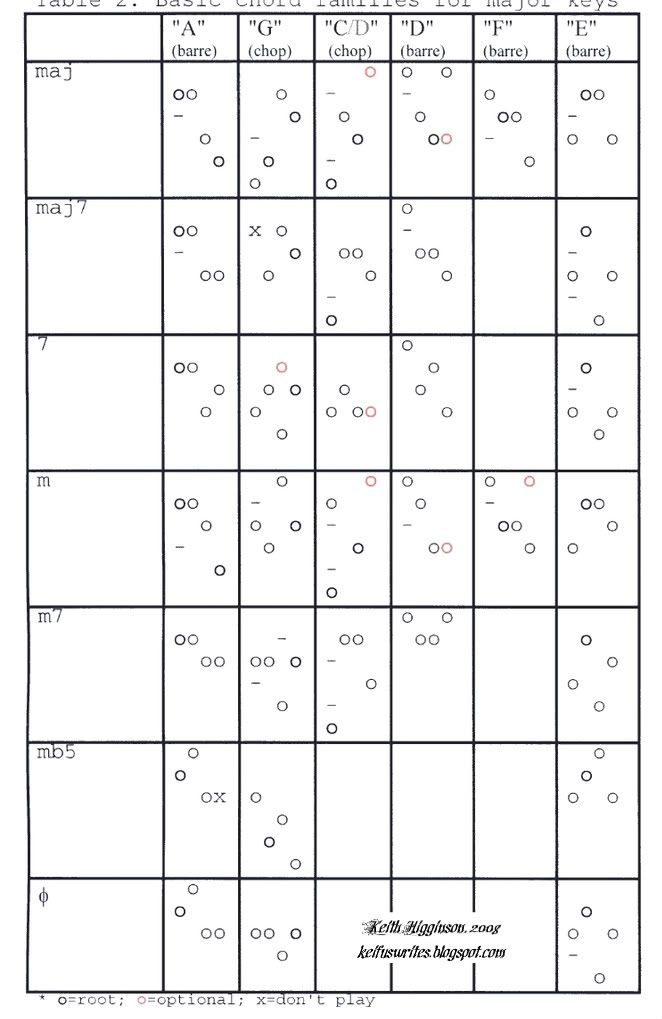
For the second table, I borrowed the idea of using chord families from Niles Hokkanen in his handy short book, Pocket Guide to Mandolin Chords (it fits in your case!), and I have used the concept to assemble a somewhat complete table, using labels I'm comfortable with. In the fingering diagrams, the root note is bolded, and the positions are consistent within the column. The actual chords can be moved up and down the neck easily, keeping track of the root notes for each family.

The third table shows the best fingerings I've worked out so far for the major-key chord progressions, all at roughly the same distance along the neck, and in some cases, they're the ones that flow really naturally into one another. Positions are consistent relative to one another across the rows. Some alternate shapes are also suggested (but I only wrote one set of fingerings for each progression).

I am a regrettably slow learner with this stuff, and sometimes find that one voicing over another will sound better in context, especially when playing by myself (which I normally do). Sort of thing that will come out with practice I imagine, and these exercises are meant to build up that foundation. Have fun with them, hypothetical readers, and if it was helpful, feel free to drop a comment or to cite it. (If you hate it, hey, it was free.)

(Click tables for a closeup.)
(Errors:

  • the II chord for "7th 1" should be moved down a fret.
  • I drew the "G chop" (of all things) without a fret between positions on the E and the A string.
  • On the chord families, the "Gm" is wrong--the lowest fret should be moved down one (pinky touching the "G," duh.)
)
Table 1. Common Major-Key Chord Progressions


Table 2. Chord Families


Table 3. Suggested Mando Fingerings for Major-Key Chord Progressions


Friday, July 18, 2008

Tuesday, July 15, 2008

Several More Thoughts: On The Road Ed.

[EDIT AND UPDATE: I have been shown a copy of the paper, and Larrick and Soll, referenced below, have conducted a serious study evaluating people's perceptions in making economic choices, rather more than the glib suggestions I made in an earlier draft of this post. As well, they received no external funding for the research.]

Among my many sins, I live my life as a dirty hypocrite of an exurban commuter. I get up earlier than I have to in order to turn eight hours into nine and a half by way of the Subaru, all so I can sink my extra cash into landscaping. (If I lived in the urban center, I'd probably have sunk it into questionable private schools instead, or maybe not) The ironic part is that I actually work in another suburb, and this distant shithole is still as close as I can afford to live, if I want to shack up my kids decently. I'm stuck with this fool's bargain for at least another couple years (at which point my suburban home will in all likelihood become unsellable). Thank god I got that PhD.

With an extra workday vaporized on the highway every week, at least I have some time to think (although not too deeply or I'll end up in a ditch). Unsurprisingly, a lot of that shallow reverie goes to politics and music. The rest goes to thinking, again unsurprisingly, about the reviled act of driving. I didn't quite have five.

1. Gonna write me up...
Everybody has seen this stupid graph by now, that shows automobile gas mileage as a function of speed, and topping out at a miserly 60 mph or so, it conveniently highlights the "don't speed" mantra of the obnoxious do-gooders of the world. I'm happy with the economic responsibility, but find the paternalistic safety business to be antithetical, and it's in my interest to disown this graph. What kind of vehicle are we talking about here? What engine? What conditions (on a treadmill)? In short, why the hell don't they design cars so that the fuel economy peaks at speeds people actually want to drive. And for that matter, even if Yuppie McDouchebag in his Magnum ought to be driving that souped-up hearse (I mean really, look at the ugly bastard) at 60, I, in my conscientious little econo-rocket, want to be exempted.

To make a car go, you need to overcome the forces arrayed against it, which in the case of the automobile include the rolling resistance, the air resistance, and the inefficiencies of the engine. The first two items both increase with velocity, and since I know dick-all about rolling resistance, and suspect there's little to be done about it, I want to concentrate on the airflow, which is significant. The drag force increases with the square of velocity (twice as fast means four times as much force to overcome), and the amount of power required to compensate it varies with v3 (and it needs eight times as much juice to do it). Now, you can engineer the proportionality constant, such that you're only squaring and cubing smallish numbers at highway speeds (and more on that in a minute), and this keeps many aeronautical engineers gainfully employed even today, but still, this dependence, the shape of the curve, is the unavoidable obstacle to automotive physics, at least for vehicles of the accustomed shape.

To help consider what it would take to make a car cruise at 70 mph and still be near its peak mileage efficiency, I constructed a handy, and necessarily qualitative, plot. The black line is the source of my complaint, the data from the previous figure inverted, because I want my scale to be energy (or as I'm now reading it, power integrated over some standard trip, which ends up equivalent to gallons per mile) instead of mpg. The total energy required to move the car will be what's needed to power the wheels, as well as to overcome the air resistance (shown by the red curve, and labeled as described above; it is proportional to the cube of the velocity; adding the rolling resistance will steepen this curve). In the limit of a perfectly efficient motor, these resistances are the only thing I'll need to compensate for, and my operating curve would be the same as the red line. The black curve becomes inefficient at low speeds because of the designs used in real-world vehicles. Engineers have no doubt played millions of games with gearing and combustion design and so forth to get a pretty decent gpm over a pretty wide stretch, but if I want that to extend out to span 70 mph, I still need to add more power overall (all of us know this from occasionally driving better cars, or pushing our own). Considering that my goal here is to use less fuel, finding a hotter 70 is kind of pointless. You still have to overcome that extra drag as you speed up, which takes more energy.

Experiments with my Subaru have verified all this, by the way, and to my regret. I suppose that the first step to meet growing global fuel prices will be the return of the shitbox compact, cars that feel like you're flying even when you're only going 50.

2. When a blunt object meets an irresistible force.
You may have noticed my careful qualifier "of this shape." That proportionality constant on the drag, at least the part of it we can change, is called the drag area (CdA), the product of the dimensionless drag coefficient and the area of the vehicles front-facing outline.

The graph at the right is a plot of the drag coefficient vs. Reynolds number (basically a dimensionless velocity). For auto travel, the Reynolds number is about 5x10⁶ (the extreme right of the plot). At this point, the drag coefficient is pretty constant, and remains so even as you keep speeding up. (Again, this is just the proportionality constant, the force still increases as you speed up, always.) This corresponds to the presence of a turbulent boundary layer, the air is moving randomly near the surface of the vehicle and doing a good job of shifting momentum around. At low speeds (low Reynolds numbers), the drag coefficient increases. Here, the boundary layer is laminar (flows smoothly over the surface), and skin friction matters a lot more. Interestingly, there is a minimum in the drag coefficient, for most shapes, at Reynolds numbers of about 3x10⁵, which corresponds to a normal car moving at about 6 mph. This minimum varies with shape a little though, and you can also make an object appear faster (in this dimensionless sort of analysis) by making it smaller. It's hard to imagine tweaking the "effective" speed by a factor of ten, but if you could design for that sweet spot...that would be pretty cool. (Studying transitional flow is hard, by the way.)

I had a professor once that argued in office hours that if a typical racehorse could go just a little bit faster, it'd break through that transitional flow wall, and dominate the track. (He hated me, he hated all of us.)

3. Always with the tradeoff.
Hey, did you like the way I inverted mpg up there to get a more useful measure of my car's performance? When you're counting your pennies, it's more useful to consider how much it costs getting from one place to another, the measure of which is gallons (proportional to dollars) per mile, and not the usual mpg. It's something to consider when comparing mileage improvements too. Economically, an increase in gas mileage from 10 to 20 mpg (0.1 down to 0.05 gpm, a savings of 0.05 gpm) is a lot more significant than an improvement from 40 to 50 mpg (0.025 to 0.02, a savings of 0.005 gpm), which, I guess, is good to know. It sounds like the sort of interesting but not earth-shattering observation that's good fodder for newspaper or magazine columns, but two authors have have taken it a little further. (Since you probably don't have a subscription to Science either, where their article appears, you can read here how Larrick and Soll tackle "the mpg illusion.") These two just got published in a premiere journal for what looks like a unit conversion, but it's more a psychological study and a policy question about how people underestimate the cost of car ownership. The price of a car for a few more high-end mpgs is a cost loser over the vehicle's lifetime, and a better consumer choice, and better policy choice, is to improve mileage of lower-performing vehicles. For American policy, I'll add, it suggests we'd be better off mandating minimum mileage standards rather than average ones.

4. I don't want a pickle, I just want...a ZAP!
Back to aerodynamics, it should be noted that the more obvious way to decrease the drag area is (duh) to decrease the area. This is one reason motorcycles get far better mileage than cars (decreasing weight helps a lot too). Bikes mean you don't have to stop for traffic jams, either.

But if you're a maniac like me, the combination of two wheels and 60 miles per hour is a death sentence, and even normal people prefer not to trek around on one of these guys in the winter, when it's raining, etc. One obvious solution to a less painful commute is to drive vehicles which trade off the lightness, speed, and economy of a motorcycle with the relative safety of an automobile. Lightweight one-person vehicles could take us pretty far in dealing with an oil crunch, and let poor bastards like me keep on with their miserable suburban existences. I'm thinking a motorcycle with a roof and a radio here--and a rollbar. We've done the Escort already, and the need to pretend the thing was a real car remains unclear. I say fuck the hatchback, the back seat no one could occupy anyway, the spare, the passenger side, and two of the four soda-straw cylinders, and get me from here to there at cost.

As of yesterday, all idle googling revealed to me on this front was Toyota's glorified Segway--an obvious death trap under the conditions I'd really need a car for (that is, too far to bike), and some similarly misguided efforts that looked like terrestrial jet-skis. But it turns out that I can no longer call myself prescient and wise: these are scheduled for next year, one-seaters, and they look absolutely badass.


Damn. I want one too.

Thursday, July 10, 2008

Merchants to the Left of Me...

Kurt Vonnegut, whose work isn't called science fiction only by whims of marketing, hasn't always had nice things to say about the genre, likening it to a forgotten file drawer or a private lodge in one interview, and in another , takes a perhaps more charitable route, acknowledging that he came to the genre by writing the stories he wanted to write, and not from imitating the pulps. I get where he's coming from but still it looks a little like a bigoted argument, allowing examples that he personally likes to be excepted from the stereotyped canon. But since it's Kurt Vonnegut, I'm willing to cut him some slack. For one thing, I had no experience with sci-fi (pronounced "skiffy," as a distinction) magazines as a kid either, and from what I've read, a lot of at has been forgotten for a reason. (But that was true of all the pulps). For another thing, I agree that you can still spot the cult of the space-hero in some fans and writers, and a lot of serious aficionados positively get an inferiority complex regarding the sf marketing ghetto that has limited some excellent literature to a narrow, badly regarded market. (I hope Kurt Vonnegut is thankful to his publishers.)

I love science fiction, and I prefer a broad definition of it. One of the things about sf, compared to other written genres, is that working your way around real-world constraints is expected, and any events or settings can be reimagined to suit the story, or to suit the point, and the best work in the genre uses speculative situations to pick apart the human animal, to conduct experiments in plot and character under a wider range of conditions than the actual world is known to offer. I don't want to understate the element of pure curiosity that science fiction is also built on, or the enduring lure of the adventure story, but I can still shoehorn those things into my viewpoint of a literary laboratory, the usual hypothesis being, "it would be interesting to live in a world where…" Of course, this sort of freedom seems like it could invite tendentiousness, and sometimes it does. It's easier to "prove" your crackpot philosophy when you can control how the world works, but even there, it can be undertaken more or less honestly, more or less well.

I can also forgive Vonnegut when I read stuff like this 'Political History of SF'*, which asserted that the heart and soul of the genre occupies some libertarian/authoritarian axis, and has in either case a right-wing spirit, a sort of violent American optimism, expecting change yes, but presuming that sticking to the current path is going to end up great. The pulp sensibility is pretty forthright. To get a feel of just why that's obnoxious, it's worthwhile to consider the history of sf, which goes back almost as far as you want it to. When you're speculating, it takes some contemporary points of reference to create a society, and consciously or not, the choice of what aspects to accept and reject, and at what consequence, is a social critique. It's hard to write well if you don't understand what people are like (or are not like) now. Looking back, Mary Shelly and H. G. Wells were working in this style. They were intentionally using technology to demonstrate their philosophical and political points. You could (and I would) go back even further to include the old Utopias (by Swift, Rabelais, More, etc.), and let's not forget, for that matter, the innumerable divine parables that waned and waxed with civilizations and tribes for as long as people have been speaking. You may not want to call those fiction, but the innumerable stories of magic beings were crafted to keep the political order. It's a similar animal: what happens at a higher level that helps us understand who we are today?

In early twentieth-century America, the pulp markets spent a few decades filling the cheap imagination of an increasingly disconnected and industrialized society, and the copy of those days was more interested in the clever, swashbuckling heirs of John Carter and Phileas Fogg than on the aftermath of Hank Morgan's or Henry Jekyll's bitter realizations. If the sf pulps had a political philosophy, it was the sort of stuff that got teenage boys going: can-do pluck, manly resolve, and American cleverness, the exact synthesis of the detective and western crap that was also being published at that time. When John W. Campbell took over Astounding in 1937, he began a campaign to expand both literary and scientific quality, but he didn't leave the adventurer mindset behind. He had a huge influence in his day, and yes, he grabbed up Robert Heinlein, who did, by all means, often write a higher grade of rugged individualism. But the general problem with the libertarian philosophy when it's expressed in the genre is that it overstates the individual's capability, and often overstates his influence over society. The usual problem with the military, or, God forbid, the feudal fantasies in space or time, was that the social utility of command hierarchies was seriously overvalued.

As the 'Political History' article describes, one of the earlier stands against the dictatorial Campbell style, was by a group of fans and writers called the Futurians, which included writers such as Isaac Asimov, Cyril M. Kornbluth, Judith Merril and Frederik Pohl. Mostly they were left-wing, and a few of them (including Pohl and Merril) were declared Communists. (I don't think any of the joiners held the faith through Stalin. Pohl was allegedly excommunicated from the Young Communist League because he failed the ideological purity test--they disapproved of his escapist writing.) Their mission as a literary society was to bring the social experimentation of sf to a higher level of seriousness. Pohl was successful. He was probably Galaxy magazine's most famous editor, and the publication styled itself as a more thoughtful and socially aware brand. The gadgetry and the spirit took second place, or tried to. Vonnegut had at least two stories published in Galaxy. Other writers did fine too.

I picked up The Space Merchants, written by Pohl and Kornbluth, a few weeks ago, following up on my suspicion that the American skill of consuming ourselves to death was spotted much earlier than is normally credited. I stand by it. Mom and Dad are bullshitting you when they tell you that in their day, everybody was debt-conscious and responsible. They spent it all on gewgaws and mortgages too. They were the first generation that could.

The Space Merchants is a monumental piss-take on American consumer culture, and the authors get some major props for writing it in 1952. Half of what was meant as outrageous satire in that year looks like documentary today, and what remains still looks like an all-too probable future. The plot follows the fall and the redemption of advertising executive Mitch Courtenay, who trips through a future culture of overwhelming pollution, depleted resources, and overpopulation. Pohl and Kornbluth get beaucoups bonus points for all the stuff they got right, including addictive products (and obsfuscatory marketing), the "philosophical problem" of political representation by voting per person vs. per dollar, marketing to neuroses (and creating them), outsourcing actual production to India and leaving the American export product as superior marketing (and the bottomless consumption), government services made inefficient through privatization, smearing political opponents as hippies and conservationists, horrifying synthetic food, paid insurance that doesn't insure, a government run by lobbyists, and, of course, reverence for the power of the CEO. In one of the funnier bits, Courtenay is thrust into a revolting job in food production--the life of a typical consumer--and his servitude is ensured as he trades off debt for a slightly less indecent life, and to satisfy his corporate-ensured cravings. There's also an element of contention between Mitch and his wife, who are both serious professionals (a physician and an advertiser), as they balance their lives as domestic partners and as successful individuals, which is probably it's least controversial prophesy (really, would this have happened to my grandparents?). The Space Merchants does what satire does best: it spots the bullshit with laser accuracy, and makes fun of it. It's a great book.

It's a horrible title, though ("Merchant of Venus," at least?). It comes out of Courtenay's big sell--a hard sell to consumers to convince them to relieve overpopulation by colonizing an unlivable hell-hole one planet closer to the sun--the obvious science fictional element. The style doesn't come off adventure-tale, but it's still a booze-and-cigarettes vintage of prose that I associate with short stories from those days. The plot zips along pretty well, a couple nights of enjoyable bedtime reading, and while I don't like to put too undue merit on self-described serious literature, if Pohl's and Kornbluth's prose were a little more timeless (and if not for the vagaries of marketing), The Space Merchants would be put up on the shelves and discussed by students along with Orwell and Huxley. Maybe it will be yet.

Brave New World (1932) was written in the worst of science fiction's pulp phase, and though it's been presented otherwise, it's sf by any reasonable definition. When science fiction is doing a good job at social experimentation, it chips away at the assumptions underlying the public truths, and if it's manipulating them, it does so consciously. Mainstream stuff evolved out of the right wing models soon enough (and Vonnegut was right--it was just a function of time). As for that 'Political History' dude, it takes some balls to rank Greg Bear and David Brin (two authors I could never get into--loved Greg Benford's Cosm though) as more "pure" than Philip K. Dick and Ursula K. LeGuin. (And for that matter, The Space Merchants is about as Marxist as Animal Farm is capitalist--don't confuse a critique with a prescription.) Much like in the nineteenth century, there's a lot today that could be labeled science fiction, and doesn't end up on the shelves. Claiming the mantle of the right wing is absurd. In my paltry library, I have Ken MacLeod making a case for Socialism by taking production--and capital--out of the equation entirely. Ursula LeGuin has sucked gender conflict out of a society, and examined the results under a sensitive microscope, and Stanislaw Lem has imagined an advanced space age under a moribund eastern European bureaucracy, a dated sort of realism. It turns out I've read most of the dreaded selections on the Socialist sf list and often preferred them. SF as a social critique hasn't gone away. Even as ole Kurt was bitching about it in the sixties and seventies, science fiction was breaking out in depth and style (and if it was still busy congratulating itself, well then). These days you can throw a dart at the bookshelves, and find brilliant stuff of any political orientation. Thank God.

 
*That link via this place. Read my retarded comment.

Wednesday, July 09, 2008

How I spent my vacation (and my rebate)

Much as I like to eat well, I don't like to consider myself a foodie. Part of that is just budget: getting that powerful culinary mojo is unattainable under my family's surprisingly modest circumstances (we continue to piss it away on college, after all these years), and the last damn thing I need is to develop a taste for truffles. As it is, the edjumucational wine extravaganzas we've taken on every year or so have left me, in their aftermath, skulking broken-hearted through the aisles of the local booze emporium, leaving face-prints on the glass cabinets that secure the French and Tuscan table vintages, sifting disconsolately through the mass-market exports and the unlimited bottles of oak-a-rrific California varietals. It's not that you can't get decent wine for under fifteen bucks a bottle--and just because it's common or local doesn't mean it sucks either--it's just that it's hard to find the bargains, and discovering exactly what you like takes a lot of sampling and research. Rewarding work perhaps, but doubly time consuming when you're on a budget, and even then, pricey enough.

Another reason that I'm a non-foodie foodie is that I think the foreign and the exotic can be over-emphasized amongst the movementarians. That is, some cuisine is popular precisely because we lowly hoi polloi can't get us none. Spending top American dollar to import European or Asian peasant ingredients, celebrated fresh in their own neighborhoods, strikes me as a particularly quixotic, and the obvious antidote, American local cuisine that doesn't suck, is a fucking embarrassment in most of the country. Top-notch fresh produce, or at least a tradition of it, is the purview of the wealthy, while the poor people choke down Twinkies and McNuggets. There are exceptions, mind you: peasant (and slave!) food has filtered up through the American south, and it's awesome. The natural foods movements of my parents' generation kept some awareness of actual produce growing among the dirty hippie types. But this nation of imports hasn't, by and large, been here long enough to establish a real culinary tradition of its own, and we have a habit of discarding the old ones, or putting them in a sweetened box. More importantly, we have heavily invested, subsidized, and mechanized food production in order to keep the crappier stuff cheap, and it's gotten to the point that trying to use your food better* takes cost and effort to learn, not at all unlike drinking wine well.

But there are places you can go, even in these benighted lands. In a rare confluence of events that included a restaurant shut-down, an anniversary, several summer vacations, a suggested destination, and a bribe from the federal government, my wife and I finally went out, after all these years. We took our mandatory loan and diverted it from its intended target--the heating oil company--and spent it on a vacation across the Sound. I've never been enamoured by Long Island. It's nice enough, but from the suburbs to the Hamptons, my experiences always saw too much money chasing not enough class. But if you live in the Northeast, you can do worse than to take your Champagne appetite to the North Fork. It's wine country over there, and farm country, and the locals have been working their brand long enough (the oldest vines were planted 30 years ago or so) that it's got some decent product. We spent two days driving up and down the strip, ducking into tasting rooms built by the two or three dozen local wineries, and eating fine meals that were almost worth the expense. As an aspring wine culture, the North Fork has its corresponding food movement going on, and the chefs all advertise ingredients grown just down the street. There are some big and impressive wine shops, but the best ones, more often than not, with the tastier wines, were smaller (my favorite). Random folks (not tourists) would filter in and out and have intelligent conversations about the product. Appropriately enough, there's a great cheese shop in the area too, another habit I should be careful about cultivating. Mostly the wineries grow your Bordeaux style grapes, but mixed together according to the Long Island tastes: a little heavier on the Cabernet Franc than elsewhere, and if the wines didn't taste quite French, I have a lot of posthumous (Keifus lives for a day) scribbles telling me they didn't really taste American either (caveat: I'd inevitably forget to take notes until four or five tasting sets in, after my palate went to total shit).

The economy of the North Fork is evidently supplying living wages, because, after all, people manage to live there, but it ain't cheap. Even knowing where to eat and shop, I can't imagine you're getting by if your family doesn't run the place (or commute, or considerately inhert it). We got into the occasional conversation with a local--the knowledgable kid at the cheese shop, the bus-girl, the wine pourer--and while obviously underpaid, they were usually into the whole culture. Some of them were taking the financial hit to follow their love, and I totally envy them for that. I can better understand how Alexander Payne caught the dynamics between the visitors and the residents in California wine country in Sideways. The tourists fantasize a better life of poverty in the name of good living. And from the viewpoint of the normals, a genuinely appreciative tourist is probably interesting. I saw a lot of annoying visiting retards (of course), and I flatter myself to think that my wife and I were better than the usual ugly Americans as we went through our comically awful cold-readings of flavor and aroma, but tried to take the experience for all it was. Call it the opposite of the story of the rest of my life.

Andrea Immer, in Great Wine Made Simple, includes an anecdote from Tuscany wherein customers brought their cherished ancient (at least as old as I am) Brunello Di Montalcinos** to be lovingly re-corked, such are they worth the wait. My wife's chef (and no, that doesn't help my resistance to foodie-ism one bit) recently returned from Italy on his honeymoon, glowingly describing the backyard garden culture. The restaurant salads were really local there, and everyone slavered over the perfect tomato, cheese, rabbit, whatever. Tiny pockets of the U.S. aspire to that, but regrettably the rest of the country has its head up its industrialized agricultural ass. One of the pourers we talked to, some 22-year-old kid, described how she spent a year in Italy, verifying chef Steve's picture of the idyllic, appreciative populace. For my own poverty years, I was living below alarmingly fecund rednecks, and nursing my professional ambitions with cheap-ass beer. I wouldn't say I've wasted my life, not at 22, but still.

Of course, Europe isn't that different from any wine country. Visiting Italy gets you to the ruins, to the tourist traps, but that experience is ultimately pretty lame. You don't learn a culture by just dropping by, and the appreciation (of both the good and bad aspects) only comes from living it for awhile. My wife and I left the North Fork happy, but more impoverished, and less fulfilled, than I care to admit.

The yearly oil contract politely arrived within days of our return, and it doubled last year's bill, which was about twice the increase we expected. After some serious sweating, I found an out: I've got nearly six years of unused vacation time, and I cashed a chunk of it out.

So to sum up, I accepted the federal tax break and took a couple days to get pleasingly drunk, and then pissed away my remaining time off so that I could heat my house. Is there anything more American?

I want better.

UPDATE: Mr. Riley's take on this is brilliant. Required reading.


* Really one of my best posts. Don't be shy to follow the link.

** I haven't been able to get enough of the Tuscan wines since the Italian experiment, and the Brunello knocked the socks off all the rest of 'em. Not exactly the ten bucks a bottle variety. Only one of the dozens of wineries we visited on the North Fork grew Sangiovese grapes--something about microclimates--and it was a tasty basic Chianti. Even there, I wish I bought a bottle or several.

Tuesday, June 24, 2008

Review of The Hunchback of Notre-Dame by Victor Hugo

I have my reservations about jumping into nineteenth century literature. I only have so much endurance for coal-filth and candles, gout and apoplexy, and meandering prose, and most of these books can just go on forever. But I was specifically looking for something down on love (completing the theme), and M. Hugo has been waiting patiently on the shelf for years now. Notre-Dame de Paris is a historical novel, which decently swaps out some of the usual period props, but it's still told in the style of the times, which the authorial voice periodically cheeps in to remind us faithful readers. And not unlike I feared: Hugo almost immediately drifts away from the opening scene to tour-guide our way through the Palace of Justice and a couple hundred years of its history, which is less effective getting me into 1482 than letting the characters open their mouths. Three chapters in, and Hugo drops another anchor, describing--no, delineating--the layout of medieval Paris over the course of 30 or 40 pages. It's not that he's boring when he talks about architecture, but these opening devices don't exactly kickstart his classic plot, they dismissed the characters just as they were getting interesting. And over these last few weeks I haven't had the luxury of time to just sink in and bask in a big heap of prose. And to be fair, even if I mildly object to info-dumping it, one of the writer's purposes was to evoke the character of the city in its time.

Hugo finds momentum well enough when he's not feeling up the masonry. Our opening scene is a mystery performed by the aspiring philosopher Pierre Gringnoire, mercilessly and hilariously cut down by attending students, and ignored by the crowd. Paunchy bishops and dignified statesman filter in and out to create a bigger scene, but much like the stage drama, they're an unloved spectacle, and it takes low humor to get the rabble really aroused. Hugo, to my pleasure and surprise, is really good at humor, and I love how he eyed up the intelligent and powerless (that is, the students) as the eagle-eyed observers of the human condition, and gave them all of the good lines. (As they deserve: I have an affection for the disenfranchised wiseasses of the world.) Unappreciated (and unpaid), Gringnoire wanders dissolute through the Paris streets, delivered into the court of the vagabonds and their sham Justice, and played out for laughs and the uncomfortable bite of satire. Official death loomed over the heads of the poor in Gringnoire's time, and hadn't exactly disappeared by the time Hugo was writing. The characters support the development of the story's tragedies or (as Mark Twain would say it) its sarcsasms, but my favorites were the latter. Our poet is an ineffectual blatherer, charming as a parody of a (real historical) writer, the king of the vagabonds is a debauched and lethal mockery of the Law, and young student Jehan Frollo (brother of Claude) steals every scene he's in, whether throwing about grandiloquent insults, or guilelessly conniving his way to his next bottle.

Even at his most discursive, Victor Hugo clearly takes great joy in the language, on which note, in a case like this, I usually start bitching about translations. The fact that my edition is rendered to The Hunchback of Notre-Dame instead of Hugo's more appropriate original title is a bad sign, as is the failure to credit the translator. How much better did the French flow along? How much more playful, how much more moving was the original? One `particular annoyance: French makes use of a formal second person, but the resulting English thees and thous read terribly. That forced archaism always come off as a cheesy anachronism for anything less than 350 years old.

The obvious liberty with the title is unappreciated because our well-known bell-ringer is only one of a cast of fully conceived players, and not even the best one. Hugo trots him out as not only physically hideous (and deaf), but also a mental defective, amoral, unable to perceive very well the antics of the crowd, nor the whims of Justice. Much later, when he gets speaking lines, he expresses himself differently than he was originally described. He's capable of metaphor, uttering sentences that require the self-awareness he was denied in his introduction. There's clearly an incomplete inner transformation that's intended here, which is similar to the way most of the major characters are developed: whether quintessentially noble, wise, beautiful or brave, Hugo drips with pleasure as he skewers their outward characters with reality, but the author's conflation of physical, mental, and moral deformity are confusing. They violate my admittedly modern understanding of their relationship beyond what I'm willing to give to artistic license.

As a love story, I couldn't be more pleased to read Victor Hugo's side by side with Graham Greene's. Hugo lets his play out with nearly as much cynicism: the hunchback's great love is a beauty; the repressed scholar's great love is a free-spirited ingenue; the sweetheart's is a handsome cad, who, at the moment of seduction, can't even remember her name. The love stories aren't weighted equally--those that contain a particle of actual compassion are allowed the heft of tragedy--but every one of them is ultimately a comedy of objectification that can only end badly, and does every time.

Marriage is painted as a farce too, but as a legal distinction, that's perhaps as much about Hugo's disgust with civic power, which is a much deeper condemnationthan his mockery of romance. Justice is doomed to end badly for its subjects, and the exclusive purpose of its proceedings is to deliver state violence, regardless of cause or merit. The comical vagabond court, we find, is the most pure authority, and the least corrupt. While it feels at times that Hugo is picking on the medievals, and if he taunts the king that his day is coming (that experience was brutal too), mostly he presents the Law as a timeless sort of evil. He's got a good trick where he reveals the mechanics of mysterious events off-handedly, and lets the process play out deaf and thoughtless of the minor truth. Hugo's Justice grinds on with tremendous inertia, abetted by the ecclesiastical powers and the expectations of the people. It exists to drink blood, and no one but a half-mad bell-ringer even thinks to stand against it, wrongly and badly. Notre-Dameis an artful blend of place and character, of comedy and tragedy. You'll laugh until you cry.

Saturday, June 21, 2008

Nine Billion Shades of Malthus

I've read (or read mocked) too much lately about the demographic pressures facing successful people. It seems like a cultural meme these days, with any number of authors sweating about the breeding patterns of the unlettered brown hordes, the perceived crises that threaten everything from economic growth we're all banking on to the integrity of the culture. I don't really understand this stance: isn't reduced fertility a good thing? In an earlier article, I wondered aloud whether there's a managable population ceiling for this fine globe, or whether some horrible Malthusian catastrophe will correct the numbers for us. For the record, I think agricultural independence is a wonderful way to live, and the idea that consumption patterns can approach zero sum, that is, that my habits can directly take food out of someone else's mouth, is deeply unsettling. (All the indirect consequences are bad enough.) Do we really want to get to the point where there's only so much to go around?

Read the rest on quiblit

[an addendum: when Arthur C. Clarke wrote Nine Billion Names of God, was playing with any established theological notions or just making stuff up? As I read about demographic predictions, expected to peak at nine billion or so if we're (less un)lucky, it was hard not to remember that old story. Nine billion names? I'm thinking doomsday cult as a way to get rich, and quick. I'd feel kind of guilty making money off of a pseudo-religion based on a 1950s science fiction story, but, well, I wouldn't be the first one.]

Wednesday, June 18, 2008

Nine Billion Shades of Malthus

I've read (or read mocked) too much lately about the demographic pressures facing successful people. It seems like a cultural meme these days, with any number of authors sweating about the breeding patterns of the unlettered brown hordes, the perceived crises that threaten everything from economic growth we're all banking on to the integrity of the culture. I don't really understand this stance: isn't reduced fertility a good thing? In an earlier article, I wondered aloud whether there's a managable population ceiling for this fine globe, or whether some horrible Malthusian catastrophe will correct the numbers for us. For the record, I think agricultural independence is a wonderful way to live, and the idea that consumption patterns can approach zero sum, that is, that my habits can directly take food out of someone else's mouth, is deeply unsettling. (All the indirect consequences are bad enough.) Do we really want to get to the point where there's only so much to go around?

In the eighteenth century, Thomas Malthus famously compared the rates of agricultural production to the rates of population growth, and frightened a generation into believing that the people of the world were rapidly hurtling to an overpopulated doom. Obviously, it didn't happen right away, and the refutation to Malthusian population dynamics was the observation that a higher population density also drives innovation, which, as you might imagine, was generated amid the most rapid technological transformation since agriculture, which Malthus, in 1798, was on the old hardscrabble, self-sufficient side of. The truth is that Malthus was wrong about all of his rate laws, but he was also still basically right about everything. The same is also true about the Cornucopians (as those armchair innovators came to be known), who also perceived important demographic trends, but either model still produces ridiculous results when considered in exclusion and extrapolated to infinity.

I'm not given to optimism about this sort of thing. The people who latch onto Cornucopian ideas of population growth remind me too much of the (misnamed) global warming skeptics whose goal seems to be to convince themselves that easy times will continue unabated. Eventually--and I wish I had a better understanding of how eventually--it's going to be limited by the fact that it takes energy to grow people, and once we burn all the stuff in the ground that we can reach, it only falls from the sky so fast. (And despite what professional optimists may believe, tapping into the zero point energy looks a lot farther out than oil will take us.) A human population ceiling may or may not reflect the global energy balance, and as I see it, whether it does is the pressing question facing the species over the next couple hundred years.

Demographic trends are estimated by analyzing fertility rates (how quickly people are born) and mortality rates (how quickly they die). Mixed in with that are better versions of Malthus's ideas about land use, about migration patterns, and other ideas about how better organization and technological growth improve agriculture, and how education and increased per capita income relate to fertility, and some reasonable models about how these things all affect one another. Of course, the end result is still an extrapolation, and there are disagreements about the respective rates of this thing or that thing, but a global picture is emerging, with a reasonabl(y large)e degree of uncertainty. Wolfgang Lutz of the International Institute for Applied Systems Analysis has developed a model that incorporates modern studies of food security, land development and degradation as they pertain to fertility and mortality rates. It's well known that fertility decreases with overall affluence, (or, that is, with food security), but land scarcity and poverty also tend to shrink fertility, despite the story you often hear. (I guess it depends on where you start: in Ethiopia, where he makes a case study, reduced fertility rates are due to both economic growth and remaining poverty conditions. They still haven't dipped below the replacement rate.) These authors also note that migration rates tend to remain relatively slow thanks to resistance to social change, but in their global model, they are obviously important, and will be the primary cause of population growth in the first world (as it is in fact now). Lutz predicts a median estimate of peak global population of about 9.3 billion, in 2070, after which it will decline. The U.N. adopts a number that's a little ower (9.1 billion" in 2050), and Lutz presents estimates ranging from a peak of 14 billion in 2100 at one extreme, to 6.5 billion peaking right now.

The land use model that he employs is broken into geographic bins, and the evolution of the population as a function of the above parameters is borne out per region. Lutz uses "expert surveys" as well as historical data to come up with some of the values of the parameters in his rate laws. That's okay as far as it goes, and he appears to go into acceptable detail in his book (I read a couple of highly redacted chapters on Google Books) even if it makes a letter to Nature look a little cheesy in its absence. I'll note that at the very least, historical rates haven't always varied gently, as the Cornucopians may have observed during the industrial revolution, or as the first world may have observed with the introduction of reliable contraception. Interestingly, he includes the effects of climate change, and it's probably easier to predict how deforestation and development will impact the drier and poorer communities of the world, since it's already impacting those places pretty hard, and they're presumably far enough behind the growth curve that they'll predictably follow hydrological improvements that are already well understood.

I wish he presented resource depletion in greater depth. Presumably it falls under his model of land degradation, but over the next hundred years, we should have a good idea of how finite fossil fuel resources actually are. Peak oil worriers espouse a similar timeline for energy resources as Lutz does for population, and I don't know the extent they're correlated on purpose. The limited supply of global real estate is a lot more obvious. The arable land per capita is approaching the exact area of my tiny lawn, and while I might have a better chance of growing spuds than grass, it'd still be pretty hard to feed the family for 12 months off a piddling quarter acre. Yes, there is land reserved for planting worldwide, and it's engineered to hyper-efficiency, and in the highly-developed countries approaching their population peaks, there remains even a tiny sliver of wilderness and recreational land, all of which is good, sort of, even if it breaks my naturalist heart.

But the prices today are startling, and a correction, if there's one to be made, will take seasons. The Commies at the U.N. are calling for more investment in agriculture worldwide, as well as more international aid. It's probably a redundant plea: the rising prices should encourage investment. As for food aid, the value probably depends on how it's implemented--I'm not sure it's a great idea to shift the food supply even more to subsidized first-world growers, but I'm also pretty certain it's a bad idea to wantonly develop the Amazon or the edges of the Sahara into crappy farmland--but sooner or later investment will mean using the land that we can. Will we go gently over the peak? Will we fight or bargain over the limiting resources? Will prosperity win out over starvation? Lutz's model suggests we may barely get away with it. Here's hoping for the best.

Friday, June 13, 2008

Random Roundup III

1. Link this.

Michael Agger on Slate boldly throws down the glove: "you're probably going to read this," he dares. His goal is to develop an exercise that describes what readers direct their attention to while reading online. I'd advise against following the link. Agger advocates writing from the Bill Gates school, in which content-free bulleted lists are highlighted, every other thought is bolded, and lots of white space separates the readers from the content (such as it is). I kept on for a page--hoping for humor--but he lost me on the first hyperlink. You lost, Mike.

Style is a tell. One of my first rules on visiting new blogs is the thought-to-quote ratio. Some cut and pasted material is forgivable, if there's a comment to be made. Composing ones thoughts primarily of other people's is a travesty, however, and any number of people live to break the news of what other people are thinking. Really, I'll just get a reader. Another really unforgivable sin of online journalism is explaining things through links. Agger claims they look authoritative, but that's only if you use them right. My rule: if the article doesn't make a point that I can decipher without clicking the blue text, then it's almost certainly not worth reading. Used properly, hyperlinks are a way to provide the reader the choice to verify content, and they similarly can provide sidebar information that doesn't necessarily fit in the text of the article or post. The benefit of using link text is that it's unobtrusive, and that it's optional. Nothing makes me less likely to follow through with an article than requiring me read linked material. It advertises that the very point the writer is trying to make is borrowed.

I actually don't think his is a bad idea for an article, but he comes down for quantity of product (by which I mean his audience) over quality, which as a discerning member of the same, I find insulting. Like any writing, you have to consider what you're trying to communicate and to whom. The tricks Agger advocates are designed to tell me that an atom of content must be rendered as smooth and flavorless as possible so that the lowly reader may have a passing chance of digesting the learned wisdom. It's about as cleverly written as a chain letter, or a marriage book by John Gray:

  • imply knowledge
  • belabor the point
  • use small words.
  • bite me

    2. Karma visits the Busch family

    The great American icon Budweiser is going to be bought out by Belgian company InBev. As you might imagine, real Americans are angry about the threat to the beloved corporate icon, which is"'an American original,' in league with baseball and apple pie" (purpose of link: to cite the story and verify the quote). What's more American than nepotism?

    I think that we can safely call A-B an American company, and at this point, the American pilsner a style that's a child of United States. Unsurprisingly, pilsner began in this country with an influx of German and Czech immigrants in the nineteenth century. Prohibition choked off the American pilsner, as it did many other styles, but the Busches kept alive by selling brewing ingredients and near beers during the dark, dry days. The pilsner style appealed to Americans after the second world war, both for its lightness, and it was well-suited to accommodate commodity grains, and mass production--refrigeration made lagers a lot easier to brew. The American light beer suited the twentieth century fondness for the industrially revolutionized food industry. The makers of Bud have committed a lot of sins against real beer, but at the end of day, it's just another style, and I don't revile it for being what it is, even if its popularity is a little mystifying.

    But Budweiser's name has a European root, the rights to which has been contested for decades. "Budweiser" means that it comes from the Bohemian town of Budweis, (now) in the Czech Republic. Breweries in the area would really prefer to call their local beer "Budweiser" for obvious reasons, possibly including a wish to associate their name with something that doesn't suck. Pilsn--which got its name tagged to the style--is also a town in Bohemia, and the idea of a Budweiser pilsner is as oxymoronic as an American pilsner or as Budweiser from America.

    And now we're looking at a European-named American beer being bought out once again by the Europeans. There's a joke in there.

    (I'll add that Belgian beer, with its funny and sometimes delicious yeasts, is nothing like any of these things.)

    3. It's the silly season.

    Composing this post probably cost an hour of being here on Saturday. I'm telling myself I'll be less distracted. Certainly this is what I'd rather be doing.

  • Monday, June 09, 2008

    A Proposal for The Party

    The heat (if not the light) from the six-month collision of Hillary Clinton and Barack Obama has revealed deep division in the Democratic party. It's sort of funny watching the Kossies get het up about it, but more regrettably, it's affected people I like and respect. The Party, they argue, can not survive with split loyalties. Elderly white women may not recover from their Clinton support, and will stay home on election day. Jobless Midwesterners can't get past the mean things she said about Obama, and they will vote, inexplicably, for John McCain in protest. Racists, real and imagined, make battle against the living and the phantom sexists. Gaffes (a word that deserves to be buried) are researched with the compulsive zeal of sports statistics, and no one talks much about foreign policy or energy policy (allegedly buried in there somewhere), at least not enough to make an easy comparison, and probably because there's not much to argue about. Schism among the Democrats? I'm registered, but I have to tell you, this is the lamest party I've ever been expected to attend.

    As one lucky Democrat prepares to battle an old man who only becomes visible if his voice gets high enough, I hope he's grateful that The Party has managed to milk six months of free air time from the internal contention that was no doubt trying for him and his other alpha contender. I don't discount (and I completely support) the idea of fighting to the last hope, but I doubt that The Party's very upset about the oceans of lucre that the fight has drawn in, nor about all of the brand new cash contributors floating behind Obama's "winner" pheromones like a gang of cartoon hobos entranced by a pie. Each one of those donors has an address, and reeks of a youth that the pledge committees will find irresistible. They can expect to receive mailed donation cards from now until the time they're sucked dry.

    Switching metaphors, playing hard until the end of the game ("sixty minutes of football") isn't just good for the team's morale, it's good for the whole system. You keep your advertisers happy, and you don't want to piss off the people that pay for their tickets. And all those scary skeletons drawn out in the primaries? Surely the Republicans, of all people, would have managed to figure out that Hillary is married to Bill Clinton and that Barry Obama is black.

    Party unity is an idea that is more important to the system than the people in it, or the people served by it. Unity is like Mom and Dad keeping an air of strained civility so as not to alarm the children, and avoid the notice of their friends at church. It puts a happy face in public, even if he hasn't gotten it up in years, and even though she spends four hours of quality time with gin and sitcoms every night, both of them bored to death of the life, and neither yet reached the point where they realize that no one else could possibly put up with either of them, and the kids are just as fucked up, and everyone's whispering anyway. Party unity is angling for the broadest common connection, and ending up with the nothing but the institutional shell: some made-for-everyone canned satisfaction, huddling in the soulless 'burbs, where they hunker in their garages and entertainment rooms terrified of, and secretly titillated by, their unseen neighbors. Party unity is important: single people don't buy McMansions.

    I have a constitutional antipathy for an organization that would command any act for the good of The Party. It calls to mind the political unity imposed by a purely ideological government, and it speaks uncomfortably of the corruption and reach of twentieth-century Communism. Two parties may be better than one, but keeping a steady platform that appeals to the most people doesn't allow a great range of political alternative, comrade. Proposing that The Party stop the fundamental abuses of American government, or that it advocate a fundamentally different service model is hella divisive, exactly the opposite of unity, which is why everyone laughs at Denny Kucinich and Mike Gravel. The Democrats might win this if they heal the razor-thin rift between Hillary's and Barrack's visions of the American dream, but really, what do they win? Or rather, what do the voters win?

    So on that note, I move (finally) to a modest proposal. (Since American Idol didn't answer my letters, maybe the chairmen of The Party will.) Instead of voting for a candidate, I want an opportunity to vote against one of them. I know just how popular negativity can be, and here in America, it can give the goobers something really fulfilling to get behind, to cast down their superficial one-issue horrors or their caricatured evil. Do you hate black people, women, or idiots more than you want universal health care? Cast your ballot against one of them. It'll feel good.

    The idea would work pretty easily, provided the necessary committees understand how to add negative numbers. Rules would be needed to control the pool of candidates--more stringent than today's rules perhaps, but maybe not much--lest someone completely unknown pull in a victory, and once the ballot is set, citizens will have the opportunity to cast a vote against the candidate of their choice. When tallied, the person that ends up least in the hole proceeds to not lose the race.

    This strategy has some serious advantages: it's anti-incumbent (who do you hate more than the person that's been stiffing you for the past four years); it's already adapted to American campaign styles; and it allows the goofy, marginal candidates a greater share of the attention (alarming questions about how the Republic works will be shot down with vigor!). Sure, it's got a downside that it might sneak through even less inspiring suits peddling mild lies about how great everyone is, but this caveat is greatly outweighed by relieving the voters of the embarrassing burden of actually voting for yet another one of these turds. We can admit that we're only letting through the least bad. Imagine the voter satisfaction when elected officials start their terms with negative approval, before signing their name on anything.

    Detractors may further argue that a candidate may come along every now and then that really is truly inspiring, but even that could be worked into my system, in fact, it would improve it. An option for "for" votes could coexist with the usual vote "against." In fact it could even be weighted more highly. Idealists that are actually worthy of a lever pulled in their favor can even have an aye vote count extra, and even better, this would preserve an essential comedy of today's system, allowing an odd candidate to take the inspirational high road, or pretend to.

    As for me, I'd be a lot more enthusiastic to kick the bums out of office than support their contenders, even at a discount, and I don't think I'm alone in that mindset. Even if the negative vote were half the value of the positive, turnout would still double, and, just like our founding fathers emphatically didn't want, more Americans than ever will have a reason to participate in this wonderful democratic process.

    Monday, June 02, 2008

    The Deep Magic

    The best thing about Catholicism is the apologists. It takes a special mind to wrestle all of the difficult concepts of faith into the observed realities of the world, the modern version requiring a certain combination of complication and muleheaded resolve. It's not something that those Protestant kids have had the time to cook up, having never gone through those tough historical times when religion was the only science, free to flit off and have wild sects every time they disagree on some minor point of catechism. Protestant Christians just don't have the rigor for apology. If their authorities start throwing dogma around, the parishioners can always find their own personal versions of Jesus who, if necessary, can be counted on to tell them more or less what they want to hear.

    Of course, I had none of these connections when I first fell into the world of rationalizing the Sprit. Reading C. S. Lewis as a theologically naïve ten-year-old, I didn't get the ham-handed Jesus parallels, but I hardly missed the feeling of the momentous clockwork that the author placed just behind the curtain of his fantasy universe, every action dripping with portent and echoing the divine design. There is beauty in Narnia, and not just the fanciful visions of nobility and naturalism. In that world everything fit: the truths that children could sense made up the deep magic of the place, to use the author's words. But it wasn't really the beauty or the meaning that did it for me. The Lion, the Witch and the Wardrobe had all that, and much as I loved the opening volume, it didn't grab me at a fundamental level the way the sequels did. Narnia worked out well enough for Aslan's four chosen people, but it wasn't until Prince Caspian that Lewis opened his Elsewhere up to anyone lucky enough to stumble down the right rabbit hole. The second publication offered more than a whirlwind tour, it gave us a few days in the life, it put actual people into an actual ecosystem, threw in some hardship and earned some emotion. It made a fantasy world that was magical and real. I tore through the rest of the Narnia books after that, and wouldn't let myself read anything else for the rest of the summer, holding the faith against less pure fantasies and looking out for any funny-looking portals that might pop up in the back yard, because I'd have taken the plunge through one of them in a heartbeat…

    Middles can prove the storyteller, especially when they're writing in these richly imagined settings. Once the rules are dispensed with and the obvious parallels are announced, before the denouement (a word that means the opposite of what it means) dutifully shapes the text into a conclusion, the author has an opportunity to pull off some real exploration of his space. I don't begrudge Lewis for crafting a Christian universe, nor for weaving it into some generic mythological setting. I have a soft spot for that sort of thing, and as far as writing goes, it's always what you do with it anyway. Prince Caspian was the first of a middle stretch of four Narnia books that gave us fuller characters, grittier locales, and drama on a variety of human scales. If a blighted land and a crucified lion presented interesting philosophical puzzles, getting in the heads of a few of the menschen and finally getting a chance to peek into the corners the scenery was the stuff that actually made me buy in. (What do you want, I was ten.)

    I've really enjoyed the movie versions so far. Although they've suffered from the breezy development that is the usual failing of epic story adaptations, and even though Caspian had an egregious Leo ex Machina for an ending (that didn't even have symbolism to redeem it), I have found them both to be a satisfying ride. There was good acting in parts--Tilda Swinton is great, and Peter Dinklage communicated more with his eyes, under two pounds of latex, than the sum total of all the speaking lines in the second film--and when the script or the talent didn't manage to generate performance, the look of the thing was always spot on. I could lose myself in Ben Barnes' princely hair, and the rest of the Telmarines sported fabulous Spanish scruff. The surly, ambivalent dwarves and the dashing mice were wonderful, and even if she's growing out of it, Lucy still looks a little bit like my daughter. Do they give out awards for casting and character design, or what?

    But Narnia aspired to be more than a ride. If the Conquistadors had a certain fashion sense, it doesn't change the fact that they were, in the course of things, rat bastards. Lewis's Telmarines flaunt some piratical charm, but they've committed their share of unnamable horrors in fantasyland. The film showed off some biblical frights, but the parts of this family picture that were actually scary were hidden in the endless swordplay. All the gore, needless to say, spattered and stank just off camera, but there was still plenty of clanging metal and desperate exhaustion, and it got awfully intense under the Dolbies. Does this sort of epic violence seem out of touch with a peaceful, redemptive sense of divinity? When your bad, arrogant decisions cost lives, does it matter that you feel bad? When has the institution of hereditary monarchy ever been worth an apology, and what, for that matter, is all this bullshit about superior races and the divine right of kings?

    As a child, I didn't always welcome these ethical intrusions into my escapism, but I have to credit Lewis for struggling with the challenge. (A couple others from that point in my life need revisiting too.) I mean, I appreciated some of it even at ten: I liked Lewis taking on ideas of personhood, where it is the prerogative of the being to speak and assume the mantle of moral consequence, and I was blown away at the idea of pulling a world together (as Aslan did in The Magician's Nephew) out of the essential ether that must have existed before concepts became concrete things. It still fascinates me, but it's definitely an anthropocentric viewpoint (as if there's an alternative), or maybe better call it a philological one. Tying creation to speech is one of the cleverer bits of wordplay the Semites passed on to the world, and the transition from prehistory to civilization, to a world of writing, resonates strongly with the idea of a transition from inchoate mysticism into a physical reality, and it can sure be fun to fantasize what's just over that lost horizon. All of the human beings in Narnia, if I recall right, are non-native, and there is a message that the land was created as an alternative to the Passion Play we've come to know and love. As if a land populated by sentient creatures couldn't be real until humans came along.

    Yes, Narnia is biblically informed, and the book of Revelation played strongly in the ultimate volume, The Last Battle. As C. S. Lewis let reality sneak into his pure land, the narrative insisted that it couldn't withstand the indecency and failure of actual people, and eventually it reached a critical mass. What to do but create another fantasy land--this pissed me off even at ten. Calling in a real Narnia as a refuge from an ever-more-visceral Narnia is just insulting. How many times are you going to make me escape, Clive? Not only were my chances of visiting Fairyland vanishingly slim in the first place, now I have to die and get to heaven too? Way to move the goalposts. It's been too long to remember if Lewis rejected the violence, the means to his noble ends that, when examined, were really pretty horrible, or if it was, as usual, a divine instruction to "just trust me." As an adult I take some satisfaction at imagining his Catholic self writhing around these issues, how he must have tortured himself to bring about a world that put evil only in the hands of devils. But in the end, Lewis punted a conclusion straight into the realm of heaven. Once humanity and Christian theology were made to mix it up too much on the same board, victory could only by cheating. Again.

    Wednesday, May 28, 2008

    Review of The Honorary Consul, by Graham Greene

    The Honorary Consul, published later in Graham Greene's career, is not listed among his major works (at least by the tools at Wikipedia). This is probably why I was able to nail a hardback for a buck from the Friends of the Library, but evidently it was one of the author's favorites, and also one of his most personally challenging. I can see how the way it's constructed might defy momentum. Greene asks, basically, "What if they started a political incident, and nobody came?" It's not the sort of question that keeps the reader (or, presumably, the writer) insatiably ripping through pages in search of a resolution. It's context is northern Argentina in the 1970s, and Paraguayan dissidents, in an attempt to coerce (the American-supported) General Stroessner to release political prisoners, have attempted to kidnap the American ambassador as he visits ruins south of the Paraná (South America has fabulous proper nouns), but have instead wound up with an irrelevant local British diplomat.

    With a political anticlimax practically built in, the tension must play out on personal levels, and it's as if Greene upped the challenge with his variously disaffected protagonists too. The usual fault of novelists creating ambivalent characters is that they're either completely unsympathetic or completely unlikable (Robertson Davies is the first offender that comes to mind here, but I'm sure I can think of others), but Eduardo Plarr, the unemotional physician who is tangled in the intrigue by virtue of childhood ties, and Charley Fortnum, the sentimental drunk (and honorary consul), are both easy to relate to. Especially Plarr--Fortnum could get annoying, but the doctor comes off as a man with whom it would be comfortable to pass time. People are drawn to him, but the company he prefers is with others that are similarly distant and self-involved. It's a manifestation of the stiff English half of his heritage, and Plarr, like all of the characters, is to some extent a stereotype, but there's a difference between making up complicated individuals that represent some notions of national character and using ethnicity as an unflattering shortcut.

    Likewise, Plarr's occupation may either have been a facile characterization or a brilliant inspiration. Everywhere, he shows a detachment from the moral concerns of family and of the hardship of living that could be best called clinical: analytical, and strangely incurious. It's not a defense mechanism with Plarr, it's his basic constitution, and scribbling off a prescription he has no confidence in, or making a snap judgement based on some hurried palpation is in character (even if those acts didn't show his medical training in convincing detail). Plarr is not an empathetic man, but he is accessible. He has childhood friends, difficult parents, he has opinions, close connections to atrocity, fond memories, things that make him angry, even if only people's annoying tendency to care about life's petty theater.

    And he reads fiction (writers writing about reading is always a little precious) but the Argentine predilection for melodrama makes the local literature (the literature not written by Borges anyway) difficult for him to swallow. Greene takes great care to draw out and ostensibly revile South American versions of machismo, but Plarr makes a poor opposite to his own notions of that stoic and formulaic melancholy. (He is, it's made clear, only half English.) His solitary suffering is not so far removed from the noble gauchos of the Argentine litererary universe. It is amusing that his sexual feelings are dispatched as efficiently as the self-serious local writer's, and when he develops an attraction to a prostitute, even that is only on an intellectual level. Quite possibly her own job skill of clinically returning her clients' desires is what draws him. He treats women selfishly, but it's too easy to call it misogyny. He's aware of others' individuality, but only in the abstract.

    Cleverly, Charley Fortnum makes a better contrast to Plarr than the Spanish-speaking nationals from which he (Plarr) feels apart. Fortnum is an alcoholic, overly friendly, and, if he were given to self-examination, deeply lonely, and he projects his simple emotion onto every person he meets, some English version of forced bonhomie and patronizing affection. Fortnum has married the prostitute, now pregnant with Plarr's child, and the doctor is too detached to care, and Fortnum too simple to suspect and too sentimental to hold it against him. I don't think it's a spoiler to say that they meet and conflict over the relationship, and despite the fact that they don't meet minds any more than anyone does, they get closest, as opposites, to fulfilling one another than anyone else in the novel. I don't know that the story is always perfectly paced, but the conclusion and the coda are spot on, and they bring the themes brilliantly together.

    I would call this book, above all, a love story, or entwined love stories. Greene plays off it on several levels--it's subtly glimpsed in almost every minor character, from the married priest-turned-dissident, to the British ambassador, even to the blind old man that accidentally walks in on the kidnapping, they all work around a similar depressing theme of love as scripted comedy (as Plarr calls it), which rarely involves seeing past your own projected image and unlikely ideals, even when the others' need is uncomplicated. The occasional actual connection is poignant... and unlikely to redeem a goddamn thing.

    Saturday, May 10, 2008

    Debate, 2088

    The candidate was an imposing presence, with great bushy eyebrows hanging down over his eyes, themselves settled deep in their cavernous orbits. With his aquiline nose, somewhat reddened, and broad ruddy cheeks, and in his uniform, he looked like a figure pulled from some previous century, from the pages of Kipling maybe, or C.S. Forester, every inch the aging admiral. The truth was, he'd fought on the ground in Syria as a young marine, and had been injured by a bullet in the thigh which still caused him to limp, although he preferred to hide it. He was a career soldier in an era where there the need for his kind diminished by the year, as nations, those few civilized lands that had staved off anarchy anyway, had turned to maintaining the battle against dire domestic threats. The sections of the Department of Defense that hadn't been reallocated toward research and food distribution were aimed at controlling separatist movements that occasionally flared up among the variously indignant geographic and economic centers. As the titular head of these federalist endeavors, the candidate was beloved by his soldiers, which most voters did know, although his actual capacity was more as an administrator, which most voters did not. At his advanced age, the candidate spent most of his time, as he himself often phrased it, glorifying the troops. A real throwback.

    He had a booming voice, and when it filled the room, it left little space for thought. "I, for one, am sick and tired of so-called 'infrastructure limitations' of the sun sector," he said. "As usual, it all comes down to the council that calls itself wise."

    The audio techs amplified the crowd response for the purposes of the broadcast, capturing the predictable gasps.

    The candidate went on. "Americans who should be able to use choose their hours of power use for their own benefit. When I was a boy..." he leaned his towering frame forward and glared at the camera, "we had something called the free market that we used to swap goods and services around efficiently. People got the power they were willing to work for!"

    His opponent, by contrast, was a dark and wiry little man, with small round glasses that nonetheless made his eyes look enormous. He also wore a tight and archaic necktie, which coupled with is high smooth forehead and magnified eyes, gave the impression of a curious frog peeking from the mud. He needed to tip up on his toes to get his head over the podium and close enough to his mike to offer a rebuttal.

    "Now look," he said, and the candidate did, turning his shaggy head toward the little frog man. "As something of a student of economics, I can inform you that most sources say that the rampant growth in capital of the last century was predicated on several irreproducible factors, to wit..."

    "Haw! The last century would have turned out fine, if money was concentrated in the hands of the real movers. My Granddaddy used to tell me about Communism! Central government planning! My own father was head of the Walton Conglomerate, got the distribution done right, made the decisions himself!"

    "...and growth that was unsustainable vis a vis the finitude of natural resources, and the short-term focus of the so-called capitalist model, which in fact was not capitalist at all, but was heavily supported by the government. In fact, the Wise Council even today encourages free markets on a local scale, but..."

    "The council! Haw. The council is the one that declared itself 'wise.'" The candidate had copious gray moustaches, which he used for effect.

    "Well, that's not precisely true, but--"

    The moderator chose this moment to interject. "Excuse me, honorable candidate, honorable incumbent." The incumbent looked at the moderator, and the candidate glared imperiously at the camera facing him. "This conversation is getting far from the mark. Honorable candidate, how would you propose to increase the power flow to every American?"

    The candidate harrumphed. "An excellent question, and I'm glad you asked it. First of all, power should flow to the honest citizens who contribute most to society. Second of all, it's common knowledge that the council hoards petroleum reserves.."

    "Hoards? That is not true!"

    "Sir, please. You will get an equal chance at a reply when it's your turn to speak. Go on, Mr. Candidate."

    "Yes, thank you. As I was saying, if we concentrate the flow of power to honest hardworking Americans, families that have been contributing to our cause for generations, they'll know what to do with it. Make our economy strong. In my Daddy's day, we could always find more oil. If the Wise Council would bother to look for it--"

    The incumbent had been fidgeted at his podium, but he couldn't let the last comment pass. "Sir! You know as well as I do that what oil deposist that are still known are preserved for research and in case of invasion. And for that matter, waste from that industry nearly destroyed our arable land and has surely limited our lifespans. If it were not for the work of Wise Council's life sciences commission--"

    "Invasion, you say. And what about the South American menace? How will that affect our lifespans? I ask you Mr. Incumbent, and you, America, what about the South American fighters so eager to come across the border? The Free States of Venezuela is starving its people in the name of weapons research." He spit the word. "And breeding an army. They'll re-introduce the nuke, you mark my words. Can we afford to leave America underpopulated?"

    "Underpopulated? Sir, have you no memory of the century you lived through? As it is, we already allow the maximum sustainable--"

    "Do you want them to come over the border and attack us? Our precious sun sector rests right on their doorstep."

    "First of all, the Mexican Federation, which borders us, is our ally. Second--"

    "Gentlemen please," the moderator said, " both sides of this argument deserve equal time. Now Mr. Incumbent, why do you want to expose our precious power resources to the Venezuelan hordes? "

    "The Venezuelan hordes aren't--"

    "Do you see? He admits they're waiting just over the border! My Daddy, he used to tell me stories about what they do to their women. Can you imagine if they invaded?"

    "Your assertions, sir, are simply bizarre."

    "Now please, the candidate deserves his chance to speak."

    "Thank you. As I was saying, our population would be stable without the South Americans coming over, and--"

    "Our population is stable, thanks to the strict administration of the Wise Council."

    "Haw. A matter of opinion, of course. Another talking point of the so-called wise. Can you even think for yourself, sir?"

    "If it weren't for the Wise Council..."

    "Who gets to be on the council? I, for example, am a decorated field commander." The candidate gestured at the patchwork of ornaments on his chest. "And yet, I am childless. I come from a long line of Americans, sir. My ancestors came aboard sailing ships, defying English elitism. My ancestors commanded the American economy, and yet, the Wise Council insists my line must end. You call this a system of merit? Nobler societies fought wars over this, sir."

    "We all know the tests are extensive, Mr. Candidate. My own children have not--"

    "Your children. So you admit you are a lazy, privileged elitist, then?"

    "The council works as hard as anyone."

    "Haw! My Daddy used to say 'show me a politician without a manicure, and I'll show you a chicken without henfeathers.'"

    "Didn't your father sit on the board of the Walton Conglomerate?"

    "And proud of it! A man of the people! Worked hard for his living, just like his Daddy did, on the very same board. With his own two hands!"

    "Most historians agree that the loss of industrial base due to corporations like Walton's was one of the primary causes of--"

    The moderator interrupted. "Sir, are you going to defend against the candidate's charges of elitism or are you not?" The camera turned to the man, who was shuffling papers, or what looked like them. Like the incumbent, the moderator wore glasses and a necktie, but was somewhat younger, and heavyset. The clothing was the fashion of the leadership academies and frequently it was adopted by the socially conscious, or worn in formal settings like this one. Arranging papers was an old-fashioned on-air gesture, but like the debates themselves, they were a part of American tradition. "Our insta-poll suggests that nearly 53%, an overwhelming majority of respondents, feel that you are not being honest with your responses."

    The candidate cleared his throat, which, when processed through the gigantic speakers, sounded like stentorian thunder. Production assistants in the sound booth slid levers to tone down the effect for the viewing public. "The fact is" the man said, "is that my opponent is positively un-American."

    "What?"

    "And he is bordering on hysteria. Can we really entrust our national security to such an excitable little man?"

    "Look, it's only because of the council that our children will--"

    "Aha! He meanshis children, America. His children, he admits it from his own lips. Not mine, and not even yours. Who would you like to see living here in a hundred years?"

    "Well, I admit," the incumbent said, "that in a hundred years, things will have hopefully improved, and--"

    "Elitist!"

    The incumbent jumped from behind the lectern, in order to be seen. "Now, see here, this is simply not fair." He took a step across the stage, but stopped when the towering candidate rotated his iron gaze toward him. The incumbent was not a physically imposing man.

    The moderator pressed a button, and a bell rang. "I believe our mandatory broadcast hour is drawing to a close." He looked at his notes and raced through the catchphrases of the New American Federation. "Remember citizens, conservation-is-our-strength, and natalism-is-starvation. Good night."

    As the cameramen dismounted their rigs, the production booth announced, "power out in two minutes." The incumbent, the moderator saw, was already making his way offstage, gesturing with animation at one of his assistants, something about South American diplomacy and damage control, and then onto something about how plastics mining was looking more productive than ever. The candidate remained at his podium, blinking and staring at nothing. His attendants were making their way over.

    South American diplomacy, eh? He'd have to remember that for the next debate. The moderator simply didn't trust those filthy little jungle howlers. American women! He knew as well as anyone that they were hoarding oil, living like Incan royalty in their tropical paradise, half naked women all around them, and dripping with gold, while honest Americans struggled just to keep alive.

    The moderator shuffled his meaningless papers and stowed them under the production desk as the fluorescents clicked off, on cue. With the mandatory power-down, the only light was the late summer sun that filtered down through the high windows. Not fair? He'd always wanted children himself, but like the candidate, had never passed the tests. Still, he was smart enough to read history, and learn from it. With such limited and exclusive access to information, the media could be powerful once more, maybe more powerful than they'd ever been in the previous century. He thought of Venzuelan gold, nubile mestizo women, dozens of fawning children. The candidate must get his chance. His own prestige--no, America's prestige--depended on it.