Showing posts sorted by relevance for query Niccolò Machiavelli. Sort by date Show all posts

Sunday, December 14, 2008

Review: The Prince by Niccolò Machiavelli
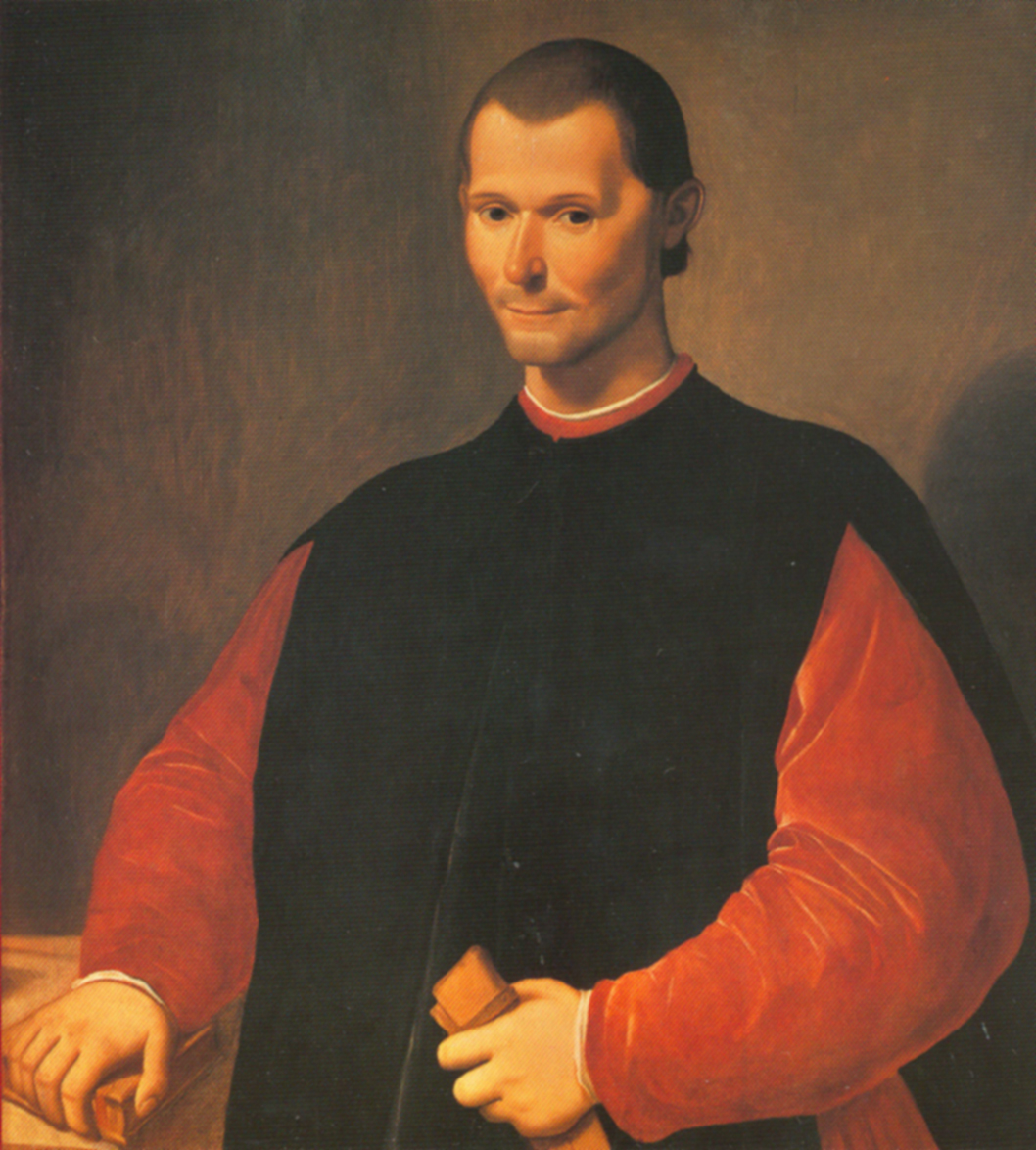
I find the portrait of Machiavelli by Santo di Tito intriguing (shown on the right, generously sponsored by Wiki-something), and I'm evidently not alone: it graces most editions of The Prince that turn up on a quick browse through Amazon. (My own edition, translated and excellently annotated by Wayne A. Rebhorn, is from the bonanza of Barnes and Noble cut-rate classics, and sports a contemporary Portrait of a Gentleman by Bartolomeo Veneto. Those Tuscan Renaissance painters had a thing for knowing looks.) It's a young, boyish Machiavelli, and his smile is a little impish, his eyes are bright and eager. Niccolò looks like a man who is hiding nothing, happy in his knoweldge of the system, unconcerned about its smaller consequences. I hate to judge his work this way, but that smirk is affecting how I scope out how I feel about Machiavelli, raising up a small affection for the man.

Machiavelli is on a par with the big set of Renaissance geniuses, and it's fascinating to me how art and politics became scientific well before chemistry and physics did, how in Machiavelli's case, the study of the workings of the state took such a pragmatic, evidence-based turn under his pen, a good hundred years before Galileo's scientific reasoning got him into trouble with the church. Machiavelli had actually collaborated (unsuccessfully) on some civic works projects with that other great empiricist of his generation, Leonardo da Vinci, and had extended the occasional professional courtesy to the artist. Did one's epistemological sense affect the other's, crossing disciplines, as they were? Certainly there was something in the Tuscan air in those days.

The Prince is written as a primer to young rulers, an alarmingly honest instruction manual to supplant the idealistic moral lessons that new princes might normally receive at that time. (According to Dr. Rebhorn's notes, Erasums had at the time of Machiavelli's writing, recently published such a hopeful instruction manual for instance, chock-a-block with decent Christian humanist motivations.) The Prince came instead from the author's careful diplomatic observations, and from his personal study of Latin historical texts. Machiavelli's tone is a little didactic, but there's a sense of irony, a hint of sarcasm, the occasional wordplay. He's lecturing, and going after the truth as he sees it, but there's an inner amusement behind the writing. The damn smirk.

Although he writes in a lot of thinly supported declarative sentences, he allows himself a great deal of room to work through his thoughts and entertain alternative ideas in the text, and he provides plenty of examples. These are not always easy to follow to his conclusions, in part because his times are so politically complicated to the eyes of a non-historian (or at least this non-historian). He's surrounded by a divided Italy that's constantly shifting alliances with foreign imperial powers, throwing up short-lived rulers and popes to pursue neighboring territories and cities under a too-limited set of proper names. The lengthy supplemental material could take away from the reading if you paused at every footnote, but it's very welcome. Contrasting his complex political environment, the examples Machiavelli pulls from antiquity are often suspect for their simplicity. He's pulling heavily from Livy and other Roman historians, as well as a couple Biblical anecdotes, and when the history gets distant enough, he doesn't shy from accepting the occasional legendary origin story at face value. If the stature of rulers are necessarily fallen in Machiavelli's present, it's unclear whether it's his nostalgia that's coloring his opinion, or his disappointment with Italy's international impotence, or if the mythology is intentional in the comparisons the practical man is trying to draw.

Machiavelli's motivations for The Prince are transparent--he's trying to work up some favor from the Medicis; Niccolò wants his old job back--but it's also clear that Machiavelli is hungry for the renewed international power of a reunited Italy, a new Rome, and he exhorts a new prince to take command and resist the other European powers with Italian forces. He also hungers for a modern version of a Roman-style republic, and there's a strange undercurrent in the writing where, he instructs a prince to power, but the message that he must never earn their contempt through oppression (through theft and disrespect of their customs--they get past love easily enough) or displays of weakness, seems at odds with the contention that a populace allowed to remain accustomed to freedom will eventually overthrow a prince (or will be able to hold out for a weak one). Nor does Fortune, according to Machiavelli, favor the longevity of princely rule. The Prince is a stark lesson on how to be a monarch, but it doesn't really justify monarchy. Aside from that final urge to cast off Italy's foreign bonds, Machiavelli fails to ask the obvious question, the one that contrasts so oddly with his advice to let the people be the people: what good are princes in the first place? They're a natural way to organize society, he implies, but Niccolò the republican also has his own agenda. Are the failures of monarchs built in, and would Italy be better unified under a king, who could then be cast off? Machiavelli is certainly smart enough, and cynical enough, to write in a couple layers of meaning.

Niccolò Machiavelli's political philosophies are very much products of that complicated international context. When wars among small states were inevitable, a military-minded monarch was well-advised, and controlling people with fear and respect could be considered a necessary defense against foreign powers. Machiavelli often notes that a prince succeeds when the people are motivated to fight for him, and he discards other "nobler" internal motivations that idealists would assume lead men to that end. As a modern reader, an obvious question is whether his lessons carry over to today's world, or whether they have been borne out in practice in the intervening five centuries of civilization. Certainly, militarism is alive and well, and those who've risen from the barracks have earned respect, but we moderns often like our bureaucrats too. Machievelli's advice on colonies probably didn't envision such vast cultural differences as the West would eventually encounter in those efforts, but his advice about governing foreigners in their own states while preserving their customs can probably be interpreted on similar grounds. Did the invaders instill fear and respect in the locals? Did they take care to understand local ways? Did they give too much gravy away too early? Did they steal and tax unduly? His advice in conquest to embrace the powerless opposition while keeping them powerless, and domestically to use consel without letting the counsel lead, has likewise not been rediscovered in many an adminstrative post-mortem. There remains a problem of the extent to which a foreign prince is damned by failure to understand the local power structure very well, or the local customs, or even the extent to which he can. (I'm reminded of recent readings of Graham Greene, say, who'd eloquently novelize its inherent doom, and Howard Zinn, who reported the success of stamping out customs and local power on the North American continent, both voicing the people's views of history instead of a prince's.) Machiavelli's advice to project an image of honesty, respect, and fear which is at odds with any personal qualities a leader may have is almost too widely taken and obvious to mention these days, but still, it's best not ignored.

Thursday, September 17, 2009

On the Use and Abuse of History

Even scientists making "scientific" observations know that what they see will be affected by their position.
It's a minor excerpt from Howard Zinn's book Declarations of Independence that I am currently reading (extending the political theme--sorry), which questions the content and purpose of American ideology. Now, this is an opinion I support in principle, but since he's an influential academic, and treading this close to my own thoughts, I'm going to hold his words to a higher standard than, say, rock lyrics. I've been getting stuck on the details of his argument a lot. The reading of Heisenberg wasn't relevant to very much, but it's symptomatic of Zinn's early discussion--something is askew with the presentation of how ideology works.

Here is part of the Richard Feynman passage I mentioned before, concerning measurement and cheap philosophy. (It's long, even chopped up):
So the fact that "things depend upon your frame of reference" is supposed to have had a profound effect on modern thought. One might well wonder why, because, after all, that certainly cannot have been necessary to go to all the trouble of the physical relativity theory in order to discover it…. [C]ertainly there must be deeper things in the theory of relativity that just this simple remark that "A person looks different from the front than from the back." Of course relativity is deeper than this, because we can make definite predictions with it. It certainly would be rather remarkable if we could predict the behavior of nature from such a simple observation alone.

There is another school of philosophers who feel very uncomfortable about the theory of relativity, which asserts that we cannot determine our absolute velocity without looking at something outside, and who would say, "It is obvious that one cannot measure his velocity without looking outside. It is self-evident that it is meaningless to talk about the velocity of a thing without looking outside; the physicists are rather stupid for having thought otherwise, but it has just dawned on them that this is the case. If only we philosophers had realized what the problems were that the physicists had, we could have decided immediately by brainwork that it is impossible to to tell how fast one is moving without looking outside, and we could have made an enormous contribution to physics." These philosophers are always with us, struggling in the periphery to try to tell us something, but they never really understand the subtleties and depths of the problem.

Our inability to detect absolute motion is a result of experiment and not a result of plain thought….Now is it absolutely, definitely, philosophically necessary that one should not be able to tell how fast he is moving without looking outside? One of the consequences of the relativity was the development of a philosophy which said, "You can only define what you can measure! Since it is self-evident that one cannot measure a velocity without seeing what he is measuring it relative to, therefore it is clear that there is no meaning to absolute velocity. The physicists should have realized that they can talk only about what they can measure." But that is the whole problem: whether or not one can define absolute velocity is the same as the problem of whether or not one can detect in an experiment, without looking outside, whether he is moving. In other words, whether or not a thing is measurable is not something to be decided a priori by thought alone, but something that can be decided only by experiment….

[I]f we have a set of "strange ideas," such as that time goes slower when one moves, and so forth, whether we like them or do not like them is an irrelevant question. The only relevant question is whether the ideas are consistent with what is found experimentally.
This, incidentally, is exactly the point where what seemed a fine idea for a post just wanders off somewhere, digressing itself down the precipitous road of closely-related philosophical terminology. Modern versions of empiricism or realism did struggle to work Einstein in there, but the summary that "of course you can only define what you can measure" is certainly older than that. (It's hard for me to believe that, whatever interesting reducionist attempts were made in the field over the years, that any practical person thought that rationalism or empiricism had to be an either/or proposition.) I'll echo Feynman's view that measurement is really the trump card in all this (even if we can reason beyond measurement and observe things we haven't yet deduced) and that at some level, it's synonymous with composing a question. Certainly without measurements and their consequences no one would have ever got to relativity. I'd love to believe, like Feynman, that the underlying philosophy isn't especially relevant, except here I am, treading ignorantly up against it once more. If it comes down to admitting stuff, I accept a physical reality that is independent from our mind and only somewhat like our perceptions (even though mind circumscribes our understanding of reality), and I believe that mathematics (and scientific theory) is merely descriptive, that it exists only in a medium, and is not otherwise a reality itself, even though the deductive power is amazingly rich, and speculation on where they diverge can be interesting as hell. Is there a school of philosophy that fits that in? Is it worth it to find out the history of my viewpoint? I am not sure what debt Feynman's essential modern "scientific realism" owed to the shoulders of earlier philosophers either.

I do like mashing up unrelated disciplines to see how the analogies hold--I'd better, given what I'm doing here--but like I said, the quick aside into physics didn't strengthen Howard Zinn's point very much here, and it constitutes the kind of thinking that could get the physicist into the posthumous whirligig dealie.

Everything humans undertake can be described as having a basis in some underlying idea, even when we don't care to spend a lot of time acknowledging them. (Even the notion that we don't behave as if governed by philosophical constructs is a philosophical construct, if you know what I mean.) Zinn clearly intends "ideology" as an external set of ideas, some governing set of philosophical principle that pushes society along (and I agree that the ideas can be sicker than they first look). The vernacular usually sets the ideologue in the realm of pure and simplified thought, well apart from the realist (and Zinn follows this too, a bit haphazardly), with the difference that, while realism is technically an ideology, it requires evidence to validate itself. Declarations of Independence is observational, but it calls for a new prescription, a new ideology.

Human behavior is different than physics, in that what they believe can influence the outcome, or, at least, that's the hypothesis. It's also different in that models of human behavior--even the phenomenological ones--are only accurate in the broad-brush and general-trends sense, as any of the generations of economists can tell you. History, by definition, is the data, even if we tend to be selective in what pieces of it we choose to measure. (The difference between the overview and the lives people must live is important, but it has a lot to do with why tend to ignore the little guy in historical contexts. Zinn's genius is to measure history based on the lives that more people have experienced.) On skimming the historical evidence, I'd say that actual human behavior suggests that the effects of ideology are actually fairly limited, and people tend to revert to some level of short-range decency among those with whom we identify, and a threshold for opportunism that drops as we migrate from the inner circle. I lean to a more anthropological explanation of human behavior, I guess.

Zinn spends more than a chapter complaining about Niccolò Machiavelli's ideology, and his take is infuriating. Mac didn't say that "the ends justifies the means," he said that leaders are only judged by the ends, which is important if you're trying to dissect his philosophy. Zinn could have emphasized that he thought Machiavelli was wrong, or that his advice was amoral, or that he was a woeful product of his times, or that his advice was so obviously self-serving. (I'd add that it may well have been a little subversive too.) There's a world of difference between following his advice (there, the discussion is good), and following his practice. Machiavelli may or may not have been a monster, but he was a scientist, not an ideologue. He was basing his views on measurement.

Take it away, Dr. F.:
What, then, are the philosophic influence of the theory of relativity? If we limit ourselves to influences in the sense of what kind of new ideas and suggestions are made to the physicist by the principle of relativity, we could describe some of them as follows. The first discovery is, essentially, that even those ideas which have been held for a very long time and which have been very accurately verified might be wrong. It was a shocking discover, of course, that Newton's laws are wrong, after all the years in which they seemed to be accurate. Of course it is clear, not that the experiments were wrong, but that they were done over only a limited range of velocities, so small that the relativistic effects would not have been evident. But nevertheless, we now have a much more humble point of view of our physical laws--everything can be wrong.
And here's the thing. History has shown a large diversity of human behavior, including drastic changes in how we behave, sometimes, amazingly, within a just a couple generations (agriculture, travel, communication). The aggregate behavior seems to be a response to environment, of which the pervading ideas and knowledge--not sure if we call that ideology--are only only a part. (I mean, I may seem like a reasonable guy, but you should see me when I run out of beer.) While history might exhibit observable large-scale patterns, and while our nature can't be too distinct from what it was 30000 years ago, we've messed with the environment significantly. Some of the effects of this we can predict (and it ain't looking too rosy), but as we move at new velocities, let's keep measuring.