Sunday, December 14, 2008

Review: The Prince by Niccolò Machiavelli
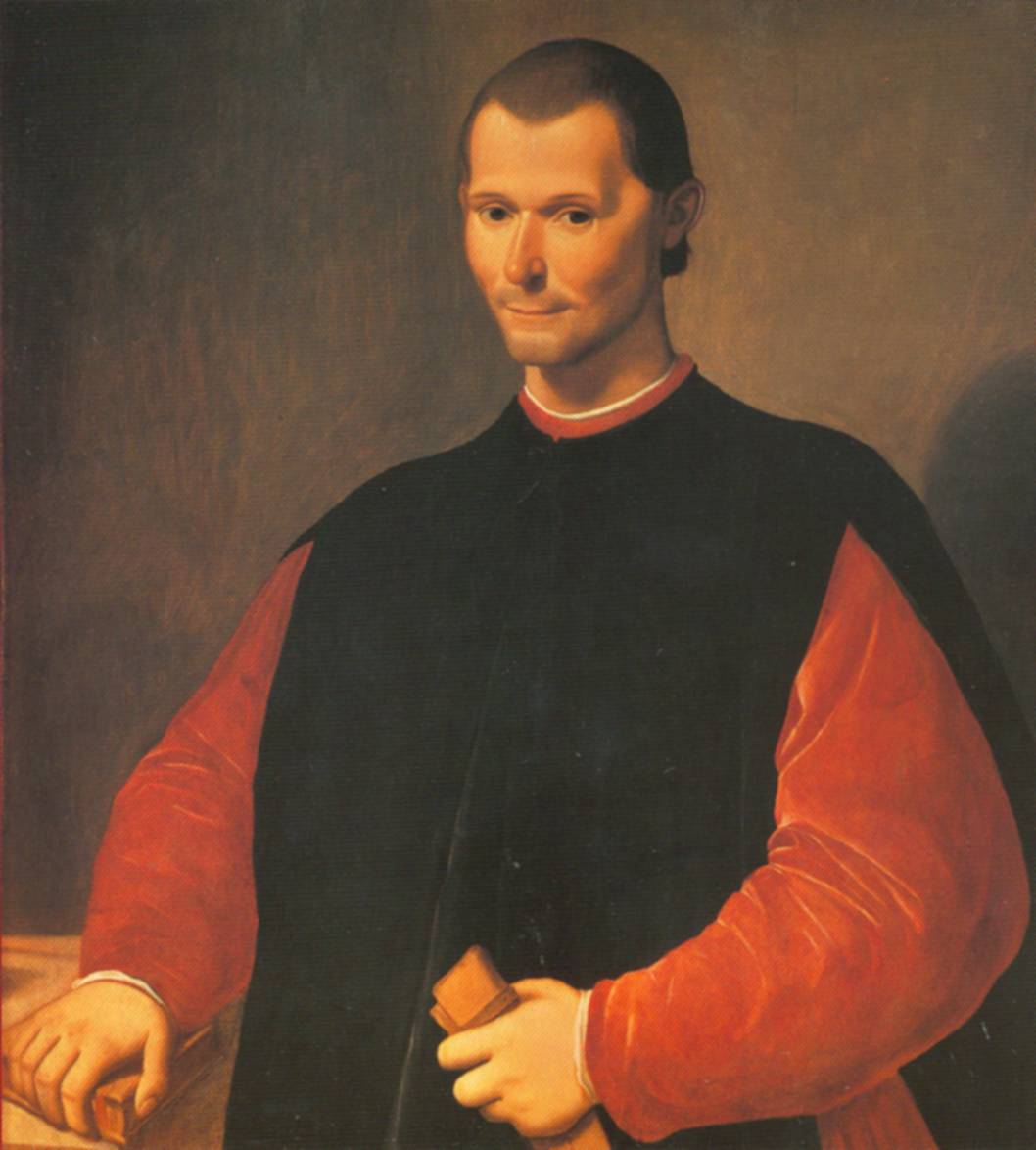
I find the portrait of Machiavelli by Santo di Tito intriguing (shown on the right, generously sponsored by Wiki-something), and I'm evidently not alone: it graces most editions of The Prince that turn up on a quick browse through Amazon. (My own edition, translated and excellently annotated by Wayne A. Rebhorn, is from the bonanza of Barnes and Noble cut-rate classics, and sports a contemporary Portrait of a Gentleman by Bartolomeo Veneto. Those Tuscan Renaissance painters had a thing for knowing looks.) It's a young, boyish Machiavelli, and his smile is a little impish, his eyes are bright and eager. Niccolò looks like a man who is hiding nothing, happy in his knoweldge of the system, unconcerned about its smaller consequences. I hate to judge his work this way, but that smirk is affecting how I scope out how I feel about Machiavelli, raising up a small affection for the man.

Machiavelli is on a par with the big set of Renaissance geniuses, and it's fascinating to me how art and politics became scientific well before chemistry and physics did, how in Machiavelli's case, the study of the workings of the state took such a pragmatic, evidence-based turn under his pen, a good hundred years before Galileo's scientific reasoning got him into trouble with the church. Machiavelli had actually collaborated (unsuccessfully) on some civic works projects with that other great empiricist of his generation, Leonardo da Vinci, and had extended the occasional professional courtesy to the artist. Did one's epistemological sense affect the other's, crossing disciplines, as they were? Certainly there was something in the Tuscan air in those days.

The Prince is written as a primer to young rulers, an alarmingly honest instruction manual to supplant the idealistic moral lessons that new princes might normally receive at that time. (According to Dr. Rebhorn's notes, Erasums had at the time of Machiavelli's writing, recently published such a hopeful instruction manual for instance, chock-a-block with decent Christian humanist motivations.) The Prince came instead from the author's careful diplomatic observations, and from his personal study of Latin historical texts. Machiavelli's tone is a little didactic, but there's a sense of irony, a hint of sarcasm, the occasional wordplay. He's lecturing, and going after the truth as he sees it, but there's an inner amusement behind the writing. The damn smirk.

Although he writes in a lot of thinly supported declarative sentences, he allows himself a great deal of room to work through his thoughts and entertain alternative ideas in the text, and he provides plenty of examples. These are not always easy to follow to his conclusions, in part because his times are so politically complicated to the eyes of a non-historian (or at least this non-historian). He's surrounded by a divided Italy that's constantly shifting alliances with foreign imperial powers, throwing up short-lived rulers and popes to pursue neighboring territories and cities under a too-limited set of proper names. The lengthy supplemental material could take away from the reading if you paused at every footnote, but it's very welcome. Contrasting his complex political environment, the examples Machiavelli pulls from antiquity are often suspect for their simplicity. He's pulling heavily from Livy and other Roman historians, as well as a couple Biblical anecdotes, and when the history gets distant enough, he doesn't shy from accepting the occasional legendary origin story at face value. If the stature of rulers are necessarily fallen in Machiavelli's present, it's unclear whether it's his nostalgia that's coloring his opinion, or his disappointment with Italy's international impotence, or if the mythology is intentional in the comparisons the practical man is trying to draw.

Machiavelli's motivations for The Prince are transparent--he's trying to work up some favor from the Medicis; Niccolò wants his old job back--but it's also clear that Machiavelli is hungry for the renewed international power of a reunited Italy, a new Rome, and he exhorts a new prince to take command and resist the other European powers with Italian forces. He also hungers for a modern version of a Roman-style republic, and there's a strange undercurrent in the writing where, he instructs a prince to power, but the message that he must never earn their contempt through oppression (through theft and disrespect of their customs--they get past love easily enough) or displays of weakness, seems at odds with the contention that a populace allowed to remain accustomed to freedom will eventually overthrow a prince (or will be able to hold out for a weak one). Nor does Fortune, according to Machiavelli, favor the longevity of princely rule. The Prince is a stark lesson on how to be a monarch, but it doesn't really justify monarchy. Aside from that final urge to cast off Italy's foreign bonds, Machiavelli fails to ask the obvious question, the one that contrasts so oddly with his advice to let the people be the people: what good are princes in the first place? They're a natural way to organize society, he implies, but Niccolò the republican also has his own agenda. Are the failures of monarchs built in, and would Italy be better unified under a king, who could then be cast off? Machiavelli is certainly smart enough, and cynical enough, to write in a couple layers of meaning.

Niccolò Machiavelli's political philosophies are very much products of that complicated international context. When wars among small states were inevitable, a military-minded monarch was well-advised, and controlling people with fear and respect could be considered a necessary defense against foreign powers. Machiavelli often notes that a prince succeeds when the people are motivated to fight for him, and he discards other "nobler" internal motivations that idealists would assume lead men to that end. As a modern reader, an obvious question is whether his lessons carry over to today's world, or whether they have been borne out in practice in the intervening five centuries of civilization. Certainly, militarism is alive and well, and those who've risen from the barracks have earned respect, but we moderns often like our bureaucrats too. Machievelli's advice on colonies probably didn't envision such vast cultural differences as the West would eventually encounter in those efforts, but his advice about governing foreigners in their own states while preserving their customs can probably be interpreted on similar grounds. Did the invaders instill fear and respect in the locals? Did they take care to understand local ways? Did they give too much gravy away too early? Did they steal and tax unduly? His advice in conquest to embrace the powerless opposition while keeping them powerless, and domestically to use consel without letting the counsel lead, has likewise not been rediscovered in many an adminstrative post-mortem. There remains a problem of the extent to which a foreign prince is damned by failure to understand the local power structure very well, or the local customs, or even the extent to which he can. (I'm reminded of recent readings of Graham Greene, say, who'd eloquently novelize its inherent doom, and Howard Zinn, who reported the success of stamping out customs and local power on the North American continent, both voicing the people's views of history instead of a prince's.) Machiavelli's advice to project an image of honesty, respect, and fear which is at odds with any personal qualities a leader may have is almost too widely taken and obvious to mention these days, but still, it's best not ignored.

Saturday, December 06, 2008

Scam-A-Rama

Dearest reader(s),

I deeply apologize for the sparse output lately over the past several months. I've been nearly as awful a reader too, and I'm even more sorry for that. There's work, and that's one excuse, but it's really more the recurring awareness of my own basic idiocy that keeps me down, that dreaded and unwelcome knowledge that, despite my buffed veneer of knowitallism and that carefully rehearsed cynical smirk I so like to flash around, I'm not fit for even the most quotidian aspects of life planning, the results of which inadequacy have left me impoverished, down a car, and too full of self-loathing to haul myself out of bed, never mind over to the computer to scrawl out my signature mentobabble.

I've been robbed, my friends! Used! If traffic cops sometimes let me off with warnings for looking like such a goofy, sincere young man,* that gullible visage of mine is like pink meat to the confidence artists of the world, and they are legion, lurking behind every form, infiltrating august institutions like parasites. And my defenses are weak.

Scam the first: If you grew up in a certain small, liberal (sort of), Northeastern state (hi twif), you may remember the public health measures routinely administered to grade school students. I remember the primary years as an endless succession of dispassionate headphone tests, finger pricks, colored dots and sideways Es, and hair toothpicks. (I remain proudly cootie-free to this day.) Of these, the dental visits were the most fun. Yeah, the "swish" was dumb, but once a year, we got to waste half a day in the auditorium watching 8-mm films of tooth-brushing propaganda, and then they sent us home with those awesome red chewie tablets that allegedly revealed plaque deposits, and which we (naturally) used to concoct vampire dramas on the school bus or wasted in efforts to alarm Mom when we walked in the door.

The grand picture of public health was never appreciated by the eight-year-olds, or not this one, and I can't say that I've spent much time since thinking how it was all paid for. If pressed these days, I'd guess some sort of minor, half-assed health measure ponied up by the state, which probably did less good than intended (though we're all happy the lice outbreaks were controlled), but not a hell of a lot of harm, considering. Nor even a lot of cost: how much for an eye chart, and the school nurse could only spend so much time on her nails.

So when my darling C. stuck the permission slip in front of my nose (that very morning of course, while running fifteen minutes late already) a couple months ago, I didn't think much of signing it. We're more litigious these days, and more cost-conscious. If they can convince my dental insurance to pay for a portion of the overpriced jug of fluoride rinse and for someone certified to administer the squirt pump, then I can live with it. (And if I have to pay thirty bucks to do it, that's okay too.) And among a population that fights every public fluoridation proposal with voluble ignorance, I figured it was just less trouble to tally the people who would opt into a fluoride program in this silly burg. Naive assumptions, all of them (well, except for the "silly").

Turns out the "fluoride rinse" I signed junior into was actually a group of visiting dentists, swarming the local schools to provide oral exams and some sort of tooth sealing that is quite beyond the "fluoride rinse" indicated on the very brief form (which of course I had reserved no copy of, and which, of course, is not held through any official school channels). Now, why anybody would want an allegedly comprehensive oral exam to be administered at school when you have dental insurance that lets you do said exam in a place with, you know, dental care facilities, is beyond me. I rather resent the insinuation from my phone conversation with this office that people opportunistically jump at free medical care, and also resent the fact that they contacted my insurance company, who told them that C. had very recently had the same exam performed, the result of which was a hasty action to make sure they got their bill in before my regular dentist did, the insurance co. having understandable limits on the number of those sorts of procedures in a given year. I thought I was signing her up to swish.

Why would dentists visit schools to administer "comprehensive" oral exams? The only honest reason I can think of is charity, in which case there's no need to talk to the insured kids in the first place. The more likely reason, is that their scamming some bucks out of schools and worried parents in a semi-legal operation. This is probably why they use second graders to disseminate their dubious information instead of school staff. The cost of this is about $150, an angry dentist, and enough fluoride in my daughter to effectuate the worst possible government mind control schemes.

That, and now I have a little red S in the lower right-hand corner of my credit report.

Scam the second: The main reason I still have the Citibank card I held in college is that it sports a great old picture of me. ("That's you? You look so...happy.") Also for emergencies, uh, yeah, that too. Back in those ancient times, I somehow** agreed to buy "Protection Plus," a plan which evidently offers insurance beyond my normal legal recourse against identity theft and credit fraud. They sent a letter saying that I had to call them to cancel the useless service, which would otherwise appear on my credit card bill. Protection Plus keeps tighter bank hours than Citibank dreams of (Citi, for whatever its other sins, features live, articulate and accommodating customer service people who are available 24/7), and they were hard to reach for the day or two their threat remained on top of the pile. Before long I forgot about trying, and as promised, a prurient $70 charge popped up on my 5-years-celibate Citi account.

I paid the damn thing, fearing late fees and a little black D next to the red S more than I worry about the loss of 70 beans and my dignity. I'm not enthused about the two dozen phone calls it'll take to abolish these fuckers from my life, and it's not a remote possibility that I'll eventually forget about them in the absence of any new Citi bills. I suppose I could actually accept and utilize the "service" Protection Plus renders, but for some reason I don't want to give these assholes my other credit card numbers.

Like many scams, it was a play on my vanity, however indirect, but it didn't stop me from falling for it. I am unfit for the public.

Scam the third: I didn't buy an American car from any patriotic impulse. It's just that after some minimal research, the Chrysler dealership was the closest place that sold minivans and luckily, I was able gimp my old (and short-lived) Toyota there before the boiler exploded. (Did I really want a minivan? Does anyone ever?) I drove out of there with the same model that Consumer Reports now places on its worst of the worst list, but who knew that then, and it was indeed spacious, and over the years, it trucked a lot of drywall.

Our T&C has suffered electrical hiccups since we've owned it, and we've entered that glorious stage when the monthly repair bill costs more than the loan payment used to. It's been predictable and inevitable stuff, brakes and suspension and, reaching back to plug myself, some shit rotting underneath, but rapid-fire proximity of auto disasters can work up some mighty distrust. That vehicular suspicion is much stronger in my wife than myself, and my doubt in her opinion is why I was driving that enormous shitbox as it shuddered through its final roadworthy lurches. Oh, those clunks really are noisy, just like she said. Whiiirrrrr! She didn't mention that. The engine's revving, huh. Wow, now I'm not going anywhere at all, ten miles from home.

The failure to move was, it turned out, a failure to transmit, if you catch my meaning, and the knocks and creaks were (yet another) suspension issue and haven't been addressed. The mechanic disassembled the transmission, discovered a missing o-ring on the filter (!), and suggested we hold off on the suspension repair. He did this to build trust, I'm sure, and he even cited the golden rule in his reasoning. The o-ring was, he acknowledged, a hopeful band-aid, but it seemed to be running fine for the time being.

Now, I really like my mechanic, or at least I want to really like him. He is, unlike some of these guys, very easy to talk to when you can reach him, quietly confident, and he has one of these bright, open faces I feel inclined to trust. He's also a local institution, which has to speak for something. On the other hand, he's a mechanic, and as such, he's a nemesis, just itching to ream me with his information asymmetry, and as a general rule, I always try to imagine how the garage might be screwing me anyway. One of the previous times he worked on it, he kindly alerted me to some other problems (alarm bells!), which I let him work on (sucker! rube!), but he just doesn't seem as shifty all those other mechanics (fool!).

If I had more brains and less conscience, I'd have rolled that duct-taped tranny to the nearest dealer for a trade-in, but I unwisely hoped for the best. The repair held up for a weekend. On Monday, on my way to work, the transmission shuffled its coil (spring, pulley, valve, etc.) with a more dramatic flourish--it felt something like hitting a speed bump at sixty--and those gears no longer spun ineffectually, they ground ineffectually as the engine impotently revved. It's now back in the shop facing a $3100 repair, not to mention the certain death that's still looming unrelated in the rattling front end. Did I mention it only has 107,000 miles? Fuck Chrysler anyway.

I'm clearly not going to do this repair: the car is worth less than three grand, and I'm not even sure a new transaxle will do the trick (I wouldn't rule out the persistent electrical problems as the root cause of this). The second breakdown was a lot more dramatic than the first, and I can't shake the nasty questions: did my mechanic soak me for the first $200 realizing that he'd be out for the larger repair, realizing no sane person would put a new transmission in that rolling turd? Did the first repair make it deliberately worse, make a new transmission unavoidable? It's reasonable that the quick fix was made in good faith too--it's not like he lied to me about it doing the trick. These are worrisome, expensive questions, and to my disadvantage, I'm obviously not mentally equipped to deal with quick-witted repair people, especially not nice ones.


I summarize, dear reader, that I am one of nature's dupes. With this insight, I'm preparing to spend the morning at the Honda dealership shopping for a highly priced used Civic or Accord, at least if my credit report isn't too marked up. (This is based, on the off chance anyone's curious, on Honda's general reputation for reliability, and the fact that my rotting 10-year-old '87 Accord was the only awful car I drove that I ever liked.) I mean, surely I can trust a used car salesman, right? I'll be sure to let my mechanic take a look at it.

Sincerely,

Keifus


* As a matter of fact, I am also plagued by the real injustices that this petty whine contrasts. Awareness is a rough ride.

** Yeah, somehow. Probably something associated with my being a dope. I feel like I'm narrowing in on it.

Monday, November 24, 2008

Review: Naked Economics, by Charles Wheelan

The stated goal of Naked Economics is to break through the drear of the undergraduate study, cast off the bowties of the professorial set, and present the field of economics as the exciting and intuitive subject it actually is. I am happy to report this effort a success. Wheelan's book is well-written and makes its points in plain, clear English that people outside of the field (including myself, and also my wife) can easily follow. He's got a cogent global picture of economic theory and a sensible framework for its applications, and even while name-dropping half a dozen Nobel Laureates, he managed to tell me everything I thought I already knew, and who doesn't appreciate that?

Wheelan uses the skills of a good lecturer, laying out a hierarchy for understanding, that is, helping the interested student to stress what, in the mass of dull explanation, is the underlying idea and which are the more illuminating and useful details, which is an especially handy tool when your input is not so much a dry textbook, but endless piles of magazine articles and blog posts of varying levels of crackpottery. As someone who's forced to bullshit his way into new fields with some regularity, I appreciate this sort of quality overview approach those rare times I actually find one. I have a long-standing complaint about the dearth of good intermediate-level texts in any subject at all, but Wheelan's fine for taking a basic view, and in economics, it's hard to be very quantitative anyway. Wheelan also performs a novelist's trick I love: he leaves hanging some obvious questions and objections in early parts of his text, but shows enough awareness of them, and enough promise of resolution, that I, the reader, plow into the next section to find out what he'll reveal.

Wheelan writes for The Economist, and appropriately to his audience, his economic spectrum spans a conservative American model all the way over to a conservative European one. He does take a digression to the developing world under that framework (which includes a curiously circumscribed discussion of root causes of the horrible economies, but we can say for now, and Wheelan would probably assert, that the systemic flaws he cites are meant to be considered independently of their origins to the extent possible), and he does talk about Communism, although it exists more as a counterpoint to his generalist aproach than as part of it. And allowing for these huge caveats, I don't think it's bad to be inclusive, and I do agree with him that the flow of capital does follow some predictable rules. I appreciated the dynamic he presented between government and the private sector. He acknowledges that the government creates a market in the first place, and provides services (of various levels of merit) in exchange for hobbling parts of the economy, which is an admirably neutral position. Wheelan is certainly sane enough to realize that there is any range of things that can be bought or commanded by the gang in charge, and many of them will have positive or negative economic or social consequences, but smart policy-minded people can argue calmly over what is involved in the better administration. My long list of objectionable points is mostly a disagreement on the specifics of what we should pay for, discomfort at Wheelan's embrace of uncertain authority, and disagreement on what is a smart incentive. Keep in mind that my sense of rightness is aided by the wisdom of the past six years, and this guy wrote his book in 2002.

Naked Economics, in short, gives you all the tools you need to read and enjoy op-eds. Wheelan does an excellent job of explaining the accepted economic viewpoints, and they're as reasonable, universal, and honest as those of the best policy-maker or paid commenter.

Monday, November 17, 2008

It was November fourth, I last held your hand

Last Friday, legions of teenage girls lined up in the rain in Saugus, Massachusetts hoping to get a glimpse of Robert Pattinson, erstwhile of the Harry Potter films, now the pretty young star of Twilight, soon to be relased. The movie is based on a series of young-reader books about vampires, the sort of PG-13 dark fantasy literature which has boomed in the last ten years, as evidenced by my occasional bookstore perusal of the teen section (intending to have some copy lying around if/when Junior ever gets into reading). Maybe they're anticipating the evolving Potter audience--Pattinson's star turn is appropriate--and certainly all these new series have been doing their damndest to capitalize on Rowling's success for a while now.

Twilight is about a young girl's attraction and relationship to a hundred-year-old vampire, conveniently stuck in the body of a seventeen-year-old boy. They find some common emotional ground. Against all traditions of the genre, this sort of teen vampirism is a big new thing. In addition to Twilight, HBO has been running True Blood based on another book series, where Rogue makes friends with the local Nosferatous Jeunes and they all try to fit into high school or something similarly insipid. I like a good fantasy now and again myself, but I this is not my brand. I'm not a teenage girl, for one thing, and for another, it's all just wrong, wrong, wrong.

It wasn't much better in my day, of course. The first inkling I had that vampires could be more compelling characters than Count Chocula came through that awful 1980s flick Fright Night, in which a teenage guy, with the help of a goofy old man, matches wits against the timeless specter who moves in next door. The kid wins out against the dark forces, but this generation of bad films didn't have it all wrong. Charlie's success is at the expense of his dignity (accurate: for teenagers, everything is at the expense of dignity), and the vampire sports a classy front, like he should. His bastard friend is the guy that inherits the curse and he was, let's face it, a whole lot cooler than Charlie Brewster. If your vampires must be young--and they do have to be new at some point--then they work better as outcasts and rebels. People who are already outsiders won't be have quite the same dorky constraints as, say, young Corey Haim. But then again, outcasts and rebels are Romance interests too, and I guess it was just a matter of time.

(Parenthetically, I see eighties cinema delivering a more powerful commentary on youthful lycanthropy. Werewolves fit into adolescence so much more perfectly. Teenagers know all about strange animal urges and the horror of sprouting hair in unexpected places.)

The popularity of vampires is enduring. They were early film stars, and maybe some aficionado can come along and tell me whether the image of a vampire as the charismatic seducer is an invention of Bram Stoker or Bela Lugosi. As folklore and cinematic convenience began to accrete around these creatures, certain character traits began to logically emerge. A nearly human creature that is immortal, confined to dark places, and yet must beguile its victims requires a certain temperment. Seduction requires a grasp (clinical or intuitive) of the desires of one's prey, and the pool of victims is selected from society's most gullible and dumb, just like a lion can spot the young and the sick in the herd. The vampire can't be expected to respect the passionate, transient emotional appeals of young humans. He's seen it all, anyway. The vampire has had centuries to accumulate style, and lifetimes to grow weary of the pleasures of the world, and it's no wonder they make such fine aristocrats. They may be attracted to innocence, and they may have private longings, but such a creature should know by now the inability of some young ingenue to fill their sophisticated emotional voids. The bloodsucker is wise of the world, good at manipulating people, and is possessed of a deep, well-earned cynicisim. He is, in other words, the polar opposite of an American teenager. He gets her easily, but it would take many years to get him. You're fooling yourself, Bella.

I'm all for messing with old stories--and nothing's been more messed-with than vampires--but it's good to respect the source material at least a little. Twilight just looks horrible in every way. I expect to see a copy in my daughter's hands any day now.

.

Sunday, November 16, 2008

Five More Thoughts: Socialism! Edition

I hate writing about economics. For one part, I'm a little dull on the subject (for multiple meanings of the word), and I distrust my opinions, which are too strong for their own good. My overheated skepticism is stoked by both the repeated assertion that the subject is as hard (harder!) than the physical sciences (even without all that "data" stuff), and the continued indignity of working in the corporate world and discovering the limitations of my human capital. But the worst part about these redundant screeds is that they're unpopular. It's not like I can hold them in--sometimes I release my inner babblings to paper because I have to.

My opinions here come primarily from the hastily scribbled objections to Charles Wheelan's easy book, Naked Economics. A favorable review is forthcoming, and while I agree with the usual Capitalist concepts as fine rules of thumb regarding the way the world works, I can't let go those few important places where the model looks like it's way the hell off, kept that way, it sometimes seems, for the purposes of semantic purity. One or two points are belated replies to other people's comments here and there. I fluffed the exercise up to five heretical, but not terribly original, thoughts. I'll try to remember to cite.

1. Why Don't They Use a Grand Unified Theory?

These deviations from fiscal orthodoxy worry me because they make me sound like a dirty Commie Socialist. Horrors. In the early part of Wheelan's book, he goes through the bad standup comic routine I've come to expect from any survey of western economics: Capitalism is all like this [nods soberly and pats his chest] and Communism is all like this, yo [drags knuckles on the ground and shrieks in a Russian accent]. Capitalism, we're told, allocates resources efficiently by price mechanisms, whereas Communism sorts them by diktat, which, of course is bad because it's Communism. But I'm not even sure there's really a difference of kind here.

Here's one problem: Capitalism also tends to allocate resources by decree. Get enough success in a capitalist system, and you can engineer the information available, engineer the alternatives available, and stick people with your product. Consumers don't purchase KFC because it's better, and not just because it's the more predictable alternative: we do so because it's presence is obvious, because it's low cost per calorie, and because our decisions are warped by the pervasive advertising of the PepsiCo. The thing about branding and marketing isn't just that it provides valuable information (as suggested in the Stiglitz chapter, which may or may not represent Stiglitz's theory accurately), it's that it supplies false information. Successful businesses suppress alternatives if they can, in order to engineer the landscape. We don't make choices, necessarily, to optimize our utility. We make choices from among the ones that are given to us.

The market, Wheelan says, is like gravity, and that's approximately how I think of it too. But that's just telling us the direction things roll and how quickly. It's the study of how human behavior responds to that downhill force generated by compulsively producing stuff, but that doesn't really say much about the governing philosophical "isms" at play. That would be more about the shape of the hill, which is controlled to an extent by the government, but also by captains of industry. There are little divots to the left and the right that the system can roll into on its way down the slope, and stay there until it's bumped out. There are banks to fall off of as well.

"Economics," of the sort they award Nobel prizes for anyway, appears to have been written by Capitalists to describe our rules, and if Wheelan (who writes for The Economist) fits in modern European-style Socialist into the theory too, Communism is still an adversarial outsider. That doesn't seem right. It's not as if "economists" pit themselves against some insane, slavering, equivalent Commie discipline. China doesn't have the exceptional awesomeness of the west, but it certainly has an economy.

2. Business and Government: Why Pretend It's an Exchange?

I'll add (again) that the extreme end states of successful Capitalism and Communism seem to look the same anyway, consisting of a poorer and badly controlled stratum that allocates resources in the textbook ways, combined with a behemoth of power that directs the overall drift of the thing, more or less, and concentrates most of the wealth to its chiefs. If China needed to develop the former to get there and the U.S. had to develop the latter, then, you know, whatever.

I'll certainly accept Wheelan's (paraphrasing Gary Becker's) point that small interests that can spread the cost over a large population will be the most effective at lobbying. His examples get as large as farm subsidies, as if the politicians were shopping for midwestern constituents, but it's a little more insidious than that. It's not just that business bargains with power, and it's not just that government economic policy affects industry and people in strange ways. To a large extent, big business is power; representing employees much like the republic represents citizens, and with about as many temptations and as much abuse. Agribusiness is huge not just thanks to the outright subsidies to get Iowans' vote (because really, how hard is that?); it's also huge because the green revolution was based on cheap fossil fuels. Government happily distributes the external costs of the oil-based economy (wars, highway infrastructure, and emissions), which allows those corn calories to be dirt cheap to produce. This low price, with it's deferred and obligatory tax support, influences the rest of us to eat the stuff. Flooding the market with cheap, crappy food is a tyranny of sorts.

But did profitable corn products give agribusiness big influence in Washington, or did their political influence make the market carry their product to near exclusion of everything else? Does the distinction really matter? There's a difference between economic and political will, but it's along a continuum, and the agents are many of the same people. To Becker's point, power is the small, moneymaking interest group that keeps soaking the rest of us. Corn's maybe not the ideal example here, although oil's a painfully clear one lately. Banking is another obvious seat of shared power. BTC News threw up a great old Harper's article about similar banking stimuli offered up during the Great Depression, the captains of industry were too big to fail then too. Military procurement is the example closest to me. I often work with prime DoD contractors, and even in the R&D world, it's a fuzzy line as to who's directing policy to whom.

3. Why are Collective Costs Considered Inefficient?

Speaking of the Great Depression, the staunch capitalist (at least the sort of smug little shit that follows the Megan McArdle's blog, e.g. this one, linked via) believes that FDR's federal resource allocation was axiomatically ineffective (Socialism: bad), and that it took the war to haul our ass out of that hole. Official Libertarians are supposed to make grudging exceptions for the collective need defense, but war is also something that the government is good at allocating resources for. The government has excelled at directing resources to killing people at least since the Industrial fucking Revolution. It's not called Socialism, but it's not like invading Afghanistan is some choice I made to maximize my personal utility either.

The lesson I take here is that a free market is good at allocating some resources, and maybe most resources. It's good for optimizing the price of eggs or cars or whatever. On the other hand, the collective is more efficient for a handful of things. It's certainly better at violence, but can the power of the economic state be harvested for good too? (Or at least something other than killing people?)

One of Megan's pet glibertarians sassily made the point (in the context of auto bailouts) that it doesn't matter how health insurance is allocated, because, like, someone still has to pay for it. Yeah, the money has to come from somewhere, but why cluster up the costs so that they take away from labor, which (a) are mostly the consumers of autos, and (b) makes them uncompetitive against foreign markets, which is, at a minimum, a dick move to the working class. If you accept that insurance models are a rational way to distribute health risks among some group (aren't businesses collectives too? fucking communists), then embiggening the pool is the obvious improvement. For universal health care, we collectively trade some economic drag on the general economy for freeing up some of the constraints on the poor bastards who are in the working world (not, Dr. Becker would note, a small group). It sounds logical, but does socialization allocate the costs effectively in practice? Well, judging by the rest of the First World, it beats the hell out of the half-socialized measure of private insurance.

4. Am I Better Off Than My Parents?

Wheelan throws around some amazing statistics in his book. Chickens cost eleven times as many hours worked in 1919 vs. 1997; the GDP per capita has doubled from 1970 to 2000. And, of course, poor people now can afford more consumer electronics.

Based on the limited pool of everyone I have ever met, the best indicator of financial success is still parents' financial success, or spouse's. There are impressive exceptions: it's wonderful that bootstrapping to the top is possible (and who doesn't respect the effort?), and polluting your life down to the gutter isn't off the table either, but the landscape of opportunities hasn't improved too much. (Well, not for white guys.) The idea that everyone can get their college degree, command productivity (usually while not actually producing much), and get ahead is oversold. Food's cheaper now than when my parents were my age (and the stuff that isn't cheaper is better), but that's not the whole of the cost of living. Energy is expensive, and so is housing. When my wife and I bought a house, we dropped a similar portion of my income into a mortgage as my father did at the same age, but unlike Dad, I have a PhD and our family has two earners. We're in about the same place, but it took a lot more investment in (presumed) human capital to get my family there. (Presumed: I think my job is less worthwhile than the skilled labor Dad did in the industrial sector, but if I followed the old man's path, it's unlikely I could have afforded this hovel at all.) If we add medical care into the mix, then it doesn't look like we're doing well at all, but we can do more with medicine these days. I probably need to wait another 25 years before those advancements really improve my (by then less vigorous) standard of living, however.

(The big increase in the average living standard over those 30 years has got to be information technology. Life before all these integrated communications sounds like the Dark Ages, and I'd hate to go back. I remain unimpressed, however, by economists and pundits measuring me up to my parents' television.)

For GDP to have really doubled per capita, then it's likely that a lot is being lost in the averaging. I'm aware that inequality has increased over that stretch, although I don't know if the measurements match wages and cost of living very accurately (and anyway, this isn't a hard science), but I could be swayed here with some data. It's not like that has improved since Wheelan wrote his book: wages, famously enough, have been stagnant since 2003 (and to compensate, credit has been bizarrely easy) while executive pay has skyrocketed that much more, a situation which would increase GDP per capita, and I suspect has.

5. "Scarcity" is Bullshit, Right?

As we all increase our human capital--the stuff we train ourselves to do--then the idea is that the whole economy grows, because everyone can do more fabulous shit. We movers and shakers will discover demand by making more exciting things with rented capital until some fraction of them is discovered to be wanted, and the economy grows overall and on average as more net production activity is added to it.

Now, I don't actually think "scarcity" is bullshit (it describes a condition where resources are more or less scarce is all), but that growing pie thing only goes so far. You can't go on producing things that aren't valuable, and there's some saturation point where even new, exciting, scarce things aren't really that important. Educating one of the local dimwits, SnollyG says the economy is demand-driven, and I agree. I prefer the phrase "demand-limited" actually, describing that when production is cheap, you can only productively make things when people want to consume them. (It's easy enough to imagine a supply-limited economy too, and it's no doubt been the more common historical mode.) In the U.S., we have a glut of supply of capital, which, absent sufficient demand, is so desperate to try to find the new thing, that it chases every spark, from housing, to the internet, to shady financial instruments, to the university system, investing futilely into the glut of human capital we're also suffering, pushing out ever more MBAs.

I mean, these financial bubbles keep happening because we have more capital than consumers, right? And it looks like our economic ball is rolling into a sink, as money and government ease the concentration of capital around a small number of investors, who can only do so much with it. Shouldn't that cash be heading back down to workers--to consumers--to get out of this demand-limited situation? By this reasoning, it looks like large inequality helps to create asset bubbles, and I think that sounds plausible.

So how about that bonus already, eh boss?

Thursday, November 06, 2008

Review of The Dharma Bums by Jack Kerouac

Jack Kerouac came into into my literary purview over ten years ago, when I combined my meager estate with my wife's. I'm not sure which of her wannabe bohemian boyfriends had originally inspired the purchase, but I can't really begrudge the guy for ultimately adding to the library. On page twenty-five or so, I found the bookmark that I placed in this copy of The Dharma Bums in 1997, where I stopped reading it the first time. It seems like the sort of novel that wouldn't begrudge me for resuming it after so long an absence, and which would be happy to be accepted from some unknown former love interest. It's all good.

The Dharma Bums is more atmospheric and philosophical than it tensely plotted--it doesn't demand a breathless page-whipping race to the finale. It's a buddy story, and a travel novel, which does ramble from somewhere to somwhere else, but not with a particular urgency. Kerouac writes himself in as Ray Smith, and the story details his friendship and experiences with Japhy Ryder, together exploring Buddhist philosophy as well as the natural landscape of California and the Pacific northwest. Ryder is based on a real writer of Kerouac's acquaintance (who is still writing in fact), as, evidently, are all the other characters in the novel as well, not that it would have helped me to keep score. I liked most of the odd bastards, and if they weren't a particularly responsible bunch, they were benevolent, and they seemed like great fun to be around. Stuff happens, and the friendship evolves over time, but any given ten pages of this book give a similar satisfaction as any other ten, and it's a natural to limit the reading to an easy evening, pleasant to pick up and just as easy to put down. Which is probably what happened eleven years ago.

Self-discovery on the road is a time-worn storytelling approach, and in that respect, I hold Fear and Loathing in Las Vegas as a worthy companion read. I like even better to put these novels in broader arc, and the antecedant that leaps most immediately to mind is Jerome K. Jerome shipping friends around at the turn of the last century in different conveyances. (Were I more ambitious about these of reviews, I'd take on another of Mr. Jerome's for this series, but I happily managed to get through Three Men in a Boat in the same year I stalled on the Dharma Bums--there's only so much of that sort of thing I'm willing to take at a time.) Each has the same thinly fictionalized autobiography, presented with similar mixtures of escape, male bonding, comedy, and philosophical interjections. The escape is for the characters, and the hideout isn't so much the wilderness as it is civilization's fringe, not a matter of pitting brawn against the savage forces of nature, but rather a retreat to a place safe enough and independent enough to explore the world from the writer's own perspective. Over the arc of these novels, this required increasingly drastic measures for the getting away. Late Victoriana could be ditched in a comfortable outing down the Thames. Kerouac needed the deep woods and old weird America to hide himself in, and only thirteen years later, it took Hunter S. Thompson copious amounts of drugs. I also like imagining this progression for the delivered philosophies, which are poked in as wistful or wondering asides, and over the intertextual century, there is a growing refutation of the status quo: from ambivalent glimpses of the human condition, to an escape from Western philosophy, to, in Thompson's case, a horrified rebuke of it. Read the three of them together, perhaps, as commentary on how invasive society has become (and how quickly).

In The Dharma Bums, Kerouac's embrace of Zen Buddhism is a sort that reaffirms his own lifestyle, absent any spiritual effort that doesn't satisfy him. Not that it didn't take some personal effort, but it did often feel self-serving, and maybe even a little self-aggrandizing. I could see the author as that mild, friendly, half-baked, humbler-than-thou sort you sometimes find at parties. It's like a Bohemian slacker superstar version of, say, Deion Sanders glorifying Jesus with his touchdown-scoring awesomeness. Admittedly, I like Jack's sense of splendor a lot better, and his voice is nice enough too, moving along at an elemental groove, and able to summon as much child-like enthusiasm for immense natural wonders as for simple human pleasures. Although I distrusted the spirituality, and found the book a little skimpy on cerebral jollies, Kerouac is out to find and celebrate the things of the world that are still pure and good, and in his travels he always gets there, and it's nice to be along on the trek. The solitude and the friendship, the spirituality and the beauty, they all get through just fine.

Tuesday, November 04, 2008

I've got to pay more attention to those sell-by dates

Well, I voted, and I look forward to watching the returns from a boring hotel room in Ohio--if I'm lucky some of that exciting swing-state mania will rub off. I don't feel noble about my decisions or anything (I voted for John Kerry because one of his committees is actually fighting to protect my job, and anti-incumbent for the rest of it). On the other hand, who doesn't love a good pie fight? I'm looking forward to Stewart and Colbert making nonsense out of the nonsense.

I regret that the post that's been kept barely alive in my wallet as a tattered post-it note for the last two weeks isn't going to make it. Well, not really much regret: it consisted of some redundant observations about awful debating and crappy political reporting (I'd been processing even the reputable "journalism" with pretty much the same mental skills I use to spot the increasingly clever junk mail come-ons), and there are plenty of better places to get that sort of thing.

Book review tonight, probably. (Update: tomorrow night, probably.)

Wednesday, October 22, 2008

Posts are made by tools like me

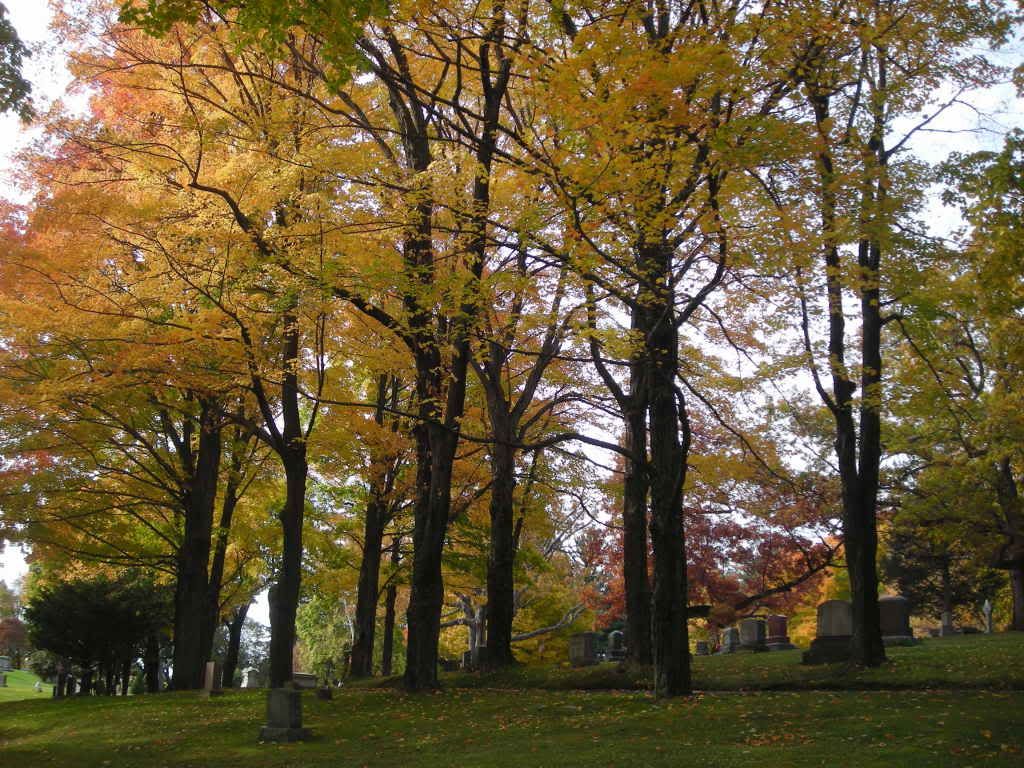
There are hikes you can take in New England--and I take far too few of them--where you can climb one of the many rolling hills and low peaks and bare granite crags of the ancient glacially-scrubbed foothills and look out over expanses of foliage only modestly interrupted by the intrusions of civilization. In October, this stretches out in red and yellow and matte evergreen, and there's no better time of the year to breathe: woodsmoke wafts from some distant chimney, the fallen leaves rustle up healthy earth scents not yet given over to chill or rank decay. It's strange that the season of dying can be so life-affirming, but so it goes. We value the moments most as the last of them tick so rapidly away. Autumn is the nostalgic time of year. The soft-focus light is less a function of the angle, after all, but a function of the leaves, with the chlorophyll dropping its job of corralling the yellows (as well of the blues), the deep green shade of summer is lost, and the skeletal gray shadows of winter are staved off for another couple weeks. The color of autumn is sepia.
well, yellow anyway
The beauty of trees is a function of the elevation of the observer. Get a high enough view, a couple thousand feet up one of the taller local peaks maybe, or even out the window as you glide in towards Logan Airport, and the tree cover brings out a sense of rural serenity. It covers up the byways and the front yards, and from above, suburbia could be mistaken for a forest, cut through (depending on your view) with the occasional well-groomed highway or parking expanse, with rooftops and fields emerging tastefully from the canopy here and there. It's a different impression from treetop level. If you're on one of those lower outcrops, or if the roadway swerves into one of those scenic overlooks where the landscape stretches out in front of you, you can see the trees blanket the geography like a bumpy ocean of polyps, an endless tray of bloated past-due fruit that can be grabbed and crushed in your fist in pustulent bursts. At this time of year, these sudden vistas are the seasonal glamor shots, and they're nice for their color and expanse, but it's not my favorite perspective. It reminds me too much of a mold colony viewed under a microscope. It reminds me that there's nothing special about the shape and the color of the things, just another example of a million self-similar natural structures, unique only because they're slightly bigger than people and most of the stuff we build. I like the trees best when viewed from below, filtering down yellow light. The walk up is the best view of the hill, as the as the branches loom and sway over you in majestic expanse, and you trudge leaf-blown paths and trip over gnarled old roots.

The forests aren't very old in New England, maybe a hundred years, most of 'em. That's enough to grow some species of trees for a solid lifespan or two, but it's still hard to go hiking and find anything like old growth. They're not the same forests that once teemed with chestnut and elm, that the pre-industrial white settlers thoroughly hacked down to clear farms and heat a couple centuries worth of homes. Nor are they the same woods that the Algonquin speakers still had to respect. People have been part of this nook of the biosphere for at least 30,000 years, and the warm chapter in the climatological novel has been developing over more or less the same time, and different plant species thrive or die under different conditions. The forests were in flux enough without chainsaws and imported Asian fungi, but probably at nothing like this rate.
reforestation
You don't see too many elder trees around in the woods, no trunks that have grown stabilizing feet at their base, no wind-tortured branches, no rotted-out boles for ghosts to hide in. The remaining ancient members are all loners, allowed to survive near the earlier homes and churches, as docile and as assimilated as old house servants, watching, twisted and benevolent, over people's front yards, scarred into submission with decades of grooming.

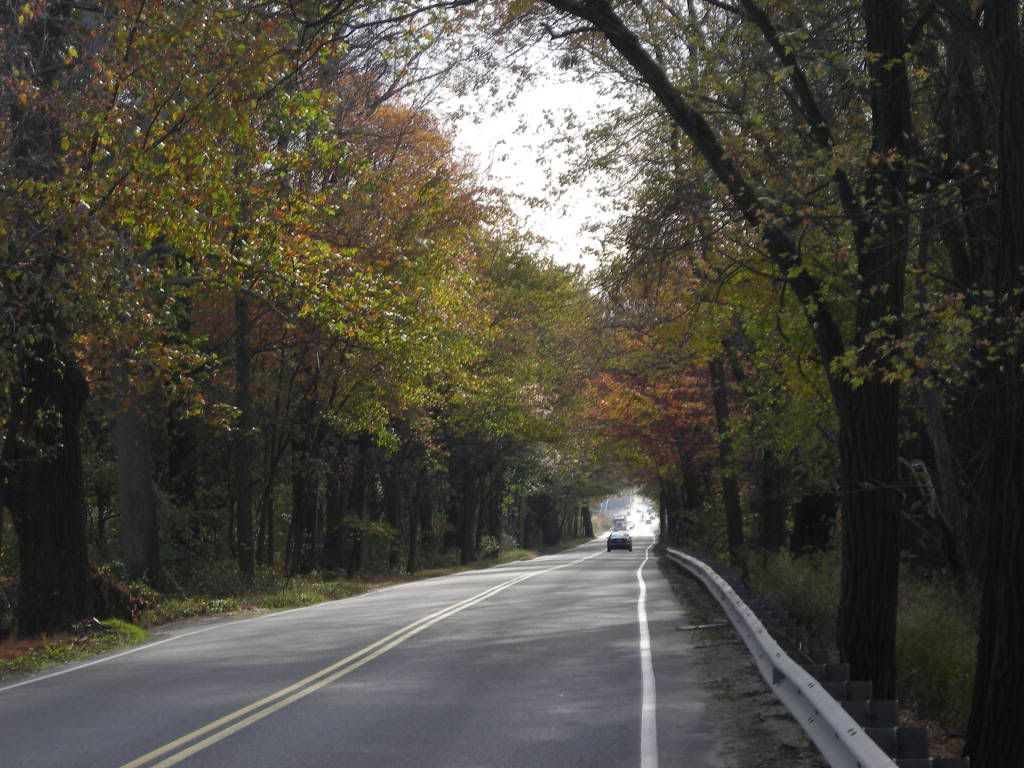
The biggest malpractice of tree surgery is along roadsides, to accommodate power lines. We're so used to seeing telephone poles, but they're nasty, ugly things, and to me, they look like relics out of 19th century urban photographs. Along some roadsides, they're noticable for their absence, and it's comforting to me when the hardwoods get the opportunity to stretch their arms over the pavement and meet hands in the middle. It adds drama when these arboreal tunnels are allowed to open up, and then swallow the traveler again. There's mystery around every corner.
no powerlines
It's tempting to universalize the experience of the New England autumns, disregarding untold generations of people feeling out their souls in every niche of climatic and civilizational diversity. No doubt they feel their own seasonal quickenings. But the fall makes me happy to live here.

Thursday, October 09, 2008

Review of Fear and Loathing in Las Vegas by Hunter S. Thompson

Prior to cracking Fear and Loathing in Las Vegas, I'd never read Hunter S. Thompson, which no doubt gets me behind on the mythology. What can I say? In some ways I've lived a sheltered life. But don't think of me as an ignorant naif, instead think of me as that great legal fantasy of an impartial juror, a man who, but for the surprising exception of the famous case at hand, is relatively well-informed. Well, another disclosure: maybe not that well-informed. But you know what I mean.

Fear and Loathing is a binge through sin city, following Thompson (as Raoul Duke) as he, with his attorney (one Dr. Gonzo) in tow, ostensibly reports on the fabulous Mint 400 motorcycle race and a DA's conference on the threat of illegal drugs. Pursuits, as the subtitle goes, of the American dream? Well maybe, but more on that in a moment or two. First, an objective reviewer such as myself must address the drug theme, which is what inflates maybe a dozen pages of journalism and commentary to something novel length. Now, I don't have much of a purchase point with such high-level debauchery--at no moment do Duke and Gonzo escape the influence of substances swallowed or inhaled, and maintaining that state requires some industry on both their parts--but I've spent enough irresponsible time with (mostly) legal drugs to appreciate the motif. It's not quite a comedy, but it's got some good comic timing, centered about the recklessness and the shrewd insanity of a drunk. I got some quality laughs out of the characters' carefully debated illogic, and the shoestring confidence games they had to wield to get out of those same scrapes they got themselves into in the first place. The alarming acid hallucinations fit in well enough as metaphor, or as grounding, but I'm still square enough to have been horrified at the random experimentation, ingestion of industrial chemicals, and some of the physical effects of their extreme dilettantism.

That comic voice does have a familiar tone, and I'm not sure if it's borrowed from film, or from a thousand next-day accounts of foolish escapades (or, for that matter, from however many of Thompson's intellectual heirs). He conducts that timeless brilliance of "acting nonchalant" as the world goes to hell around you like a maestro, and he's mastered the classic art of puncturing assumed dignity with irreverence. He sets a considered pause here to frame a gag, he's got the contrasts of outward calm against the thoroughly absurd or of drug-addled mania over the bland and mundane. The language on the whole is witty and apposite, and it utilized mock-seriousness very well. Our heroes sincerely throw around words like "vile," "swine," and "maniac," which are funny on their own, and on a higher level, the sober truths (and ironies) of them are carefully considered, even as they pertain to their own unsober selves. (Their petty criminalities against The Man are funny by similar measures, especially in that town, but one or two innocents may have been abused. This was much less so.)

But Fear and Loathing is not just for the jokes, and there are sober truths behind it, that need to lie behind to keep the book from achieving anything more than a blivot of props and gimmicks. I would have preferred a firmer bedrock of substance: there were ten pages of hijinks for every three-paragraph insight. I'll admit there are some fine juxtaposition and contrasts, but maybe there's too many left to the reader to decipher. Vegas is portrayed as your standard-issue den of iniquity, but the point's made that it's an ugly conservative version of sin, a real cop's-night-out sort of lawlessness: implicitly violent, outright objectifying, and personally destructive in an orderly and artificial sort of way, from which the real (and presumably less harmful) weirdos are exiled. You might call it an affirmation of genuine feakiness, although I didn't come out approving of Gonzo and Duke's lifestyle either, and these two carefully refute the drug-fueled idealism of the previous decade's youth movements as well. "The American dream," when they find it, is burnt out and irrelevant to any personal quest either Horatio Alger or Timothy Leary may have proposed, just a dangerous journey with not much at the end of it. You might say it takes lunacy to show the lunacy.

As a final note, I found the lamented demise of 60s idealism a bit tired in 2008--the boomers have reinvented their generation half a dozen times by now--but I expect it was potent in 1971. I have no reason to believe, however, that Thompson himself ever gave up his integrity. Before I finished writing this, I came across his 1994 eulogy of Nixon, now the second piece of his I've read, and I recommend it. It's brilliant without all the drug gimmicks.

Tuesday, September 30, 2008

Confidence Racket

No matter how complex the story, however brilliant the invention or well-played the situational ethics, every confidence scam always comes down to that same perpetual nut to crack, the razor-thin line between a fool and his money, that transitional point where on one side there's a fistful of cash in my hands, and on the other side, in someone else's. Up to that critical point, the act must go on to its tension-filled climax, the con artist has to keep a straight face to that last second, maximize the urgency, the sincerity, thank-you-thank-you-good-sir-what-a-blessing-mom-can-have-that-operation-now, a-a-a-a-and now it's his. Sucker. If there's no more to gain, the grifter can turn around and run here. If he's stumbled on a particularly lucrative mark, he'll walk away calmly, smiling, keeping up his oscar performance in the hopes of repeat business. It's what separates the con men from the con boys, I suppose.

The art of acting and invention that's esssential to the con is what keeps a warm place in our hearts for those criminals. Or at least for the movie versions--I don't imagine those bastards stalking the internet from their Nigerian redouts to be such a bunch of lovable scamps. I advocate a healthy suspicioun for anyone trying to sell you anything, but if it gets confusing, you can always try to evaluate a transaction by looking at the process flow sheet. A nasty scam will show money input from me, and nothing tangible coming back out to me. A better one will promise some sort of return, but it might be out of whack, and highly conditional on my good feelings. At some point in the scamminess continuum, the line is eventually crossed into legitimate business, where the returns are based on telling enough of the truth: real products are exchanged, or investments are based on actuarial data, or on roughly sound economics. In the real world, we don't usually get to evaluate a single enormous transaction with this yardstick, but still, it can be useful to draw a big box around the system of them and look at the ins and outs for groups of parties, which will be true regardless of the insane things churning around inside.

Look, I don't know what to make of the bailout, and maybe the blogosphere doesn't need yet another half-informed voice. There's an asset bubble under there that even I can see, and letting it get bigger, still, more, just can't be wise. It seems like reducing liquidity, at least in terms of real estate and consumer spending, is a necessary condition of healing the basic long-term problem of this nation consuming more than it produces. Less borrowing is ultimately the cure, in other words.

On the other hand, the idea of credit screeching to a halt is a deadly serious one, if it happens. I wish I could convince myself it's just a reductio ad absurdum argument, but who can tell when everybody is panicking, the LIBOR is shooting up, and smarter people than me are scared shitless? (I just read a post about how farmers typically use credit to pay for harvesting their crops. Good god.)

So I can see taking action to the extent it's necessary to keep that functioning-credit part of the system alive. I may even be convinced that a patch that keeps the existing crazy system capitalized is a good idea, provided steps are taken to assure those new funds aren't also over-leveraged and the thing blown up further. (I guess I haven't sunk to an IOZ-ian desire to watch the thing disintigrate just yet. Dissolution has as big a problem with the "how" as does, what the hell, any other ethos.) Paulson, if I understand it correctly, wants to assure this short-term credit flows by injecting money into the system to lend, assuming it's a crisis of Depression-era proportions (and not everyone agrees with that), by buying the suddenly-obvious bad loan obligations. The counterproposal that just failed in the House did so much as to dangle a little oversight and a hint of justice onto the basic package. Two alternate ideas I've seen (of many) are: (1) the Federal Reserve temporarily takes over the operations of the banks, to preserve the system of payments (which allegedly will eliminate freezing of credit by panic); (2) capital is supplied to banks by taxpayers purchasing ownership shares of the banks (rather than their shitty debt obligations). There have been a few more, probably more than a few, but I don't remember them. None are happy fixes. One supposes we taxpayers might even be better served if we offered to buy up the threatened properties themselves (at a price referenced to historic baseline growth) and hold them against inevitable population growth. As it is, under the conditions of urgency, given the history our administration has had with threats and promises, my con-job reflexes have been twitching like mad. I keep looking for the point where the money's changing hands, and to whom. Seven hundred billion is an investment in confidence, right?

Saturday, September 27, 2008

Review of Watchmen by Alan Moore and Dave Gibbons

Here's an interesting scrap of personal trivia to throw to my multitudes of adoring fans: I'm pretty sure that Watchmen counts as my first voluntary book review. Back in the eighties, I got into comics for about as long as my best friend could afford to buy bales of them every month, which amounted to a span of a couple years in high school. When I was sixteen years old, he sent Watchmen along with me on a three-week trip to Spain, and I read it, and commented. I spent some time yesterday looking for what I wrote, but it wasn't in that diary, and so I think it must have gone into a letter sent back to old R.D.. The gist of my back-then review was that Watchmen really put the "graphic" in graphic novel, and even though years of desensitization still hasn't quite managed to erase that impression, I must have also missed a lot of the depth then. (I wasn't a very mature teenager, you see, not any more than I am a very mature thirtysomething, but at least I now have the ravages of youth safely behind me.) I caught the movie trailer recently, and damned if one of the images presented wasn't a beautifully rendered copy of one of the frames in the comic that I barely remembered. Was my memory accurate? (This time it was.) Does my impression stand? (Yes and no.) Should I go out and watch the flick? (Maybe.)

Watchmen, if I understand correctly, was intended to make the most of the medium, to show off the sort of story that a graphic novel is uniquely suited to tell. It pretty clearly borrowed techniques from film, especially this business of transitioning between scenes using a constant image, or at times splicing twin sequences together, switching back and forth between analogous settings while keeping the narrative constant. Moore (writer) and Gibbons (artist) mix these effects smoothly in print, and if the cinemtographers follow the existing storyboards, those borrowed tricks are going to look pretty classy back on the screen. The panoramic shots, and Gibbons could have added even more of these, will translate well, and the camera will also love the too-much violence and the sex. Often, Moore uses a textual trick similar that's similar to the visual one, and maps dialogue or action on top of exposition and prose, letting the two synchronous narratives unconsciously inform one another. This is a thing indiginous to the comic medium, which naturally puts text in boxes as commentary, and I'm impressed with the degree it was pulled off here. There are some parts where it has to be text. The elements of the story written in short graffiti and newspaper headlines can get their way on screen I guess, and Rorschach's journal entries (set against silent action) can be voiced over, but there are a few places, those involving the Tales of the Black Freighter (a text story spliced into the comic) and Doctor Manhattan's soliloquy on his perception of time (wherein he experiences all the moments of his life at once) that are going to get murdered, which is too bad.

He borrowed from pure text media too, but the prose sections, mostly spaced in between the chapters, although informative, tended to be a chore to read. The interludes are creatively formatted to support the recent narrative, and the less formal versions bordered on entertaining, but he veered purple at the drop of a hat. That his fictional comic book writer could go on to become an accomplished novelist defied belief. The dialog is unremarkable, but adequate (at least if you're comfortable with the genre's liberal use of bold and italics in the speech balloons).

Gibbons' art is decently done, and it's well laid out. I didn't much like the way that the thing was inked though: too damn many purples and oranges, filled too solidly into too large areas. And it might be a matter of technology is all--I'm used to the three-color newsprint format from my couple years of fandom--the one with all the dots--and I think that cheap texture actually allowed greater depth to show up in the coloring than this solid magazine style. The contrast of the printing techniques is made clear within the story. Black Freighter is a comic within the comic, and it's colored in that old newsprint style, and (if you ignore the subject matter) is easier on the eyes. Even when I used read these things regularly, I was always more impressed with the great pencil-and-ink work, and preferred the few books that left it black and white--the color always seems to cheapen the art underneath.

Of course Watchmen tackles the other thing that's only ever been done well in comics, the obvious one: men in masks and spandex that fight crime. There's been a spate of superhero "realism" done this decade, but here is the only case I've found that adequately addresses the underlying question of, even in a alternate world where circumstances better favored vigilante justice, what kind of nutbar would try to intimidate people with guns while dressed up in a Halloween costume. 90% of the heros in Watchmen are perfectly normal people dressed in tights...looking like world-class dorks and sporting cheesy nicknames. There are a range of motivations for the goofy vigilantism: altruism, publicity, lawlessness, government mandate, god complex, but all of these characters have the deluded/perverted/naive streak that's necessary to dress like a clown for a fight. And no one keeps up with it forever: if they're sufficiently warped (and actually effective), then their internal demons grow to maturity; if they're more decent sorts, they quit and get on with their lives like normal people.

There's a large cast of characters, and they're generally well done. Only one is really super, almost unlimitedly so, and he has been transformed so thoroughly beyond humanity that he gradually loses his connection to life, even while the (un)balance of world power centers around his existence. The alternate world of 1985, with energy independence but the looming threat of nuclear war, is thoroughly developed and convincing, and enough bit characters are filtered in and out to make you believe there's a context for all of this. Dr. Manhattan's atomic creation is the big pseudo-science mulligan that you can allow in something like this, and I consider it bad form to pull out another pair of silly tricks (cloning and ESP) at 11:58 to support the conclusion.

The plot that gets us there moves around Rorschach (and here's the exception to the superhero look: a great costume, a mask that's like a disturbing pshche test mood ring) who's investigating what looks to be the serial murder of former costumed crime fighters. He's a great character--a right-wing animal, simple but crafty, violent, difficult, unlovable, inflexible--and the authors get you to sympathize with him, deeply so by the end. All of these heroes are on the creepy side of moral purity, and Rorschach's investigation leads to the most capable of the normals, polymath genius Ozymandias, the man who's convinced himself that the world needs to be remade by his design and may be uniquely talented to pull it off. They're monsters, all of them, compromising lives for their version of the greater good. The wrong people win here--even though they believe otherwise, even though it's outwardly presented otherwise--and if their victory looks appealing on the face of it, the purpose of the whole graphic novel is to wrap it in ten clever layers of ambiguity. It's the story's biggest success.

Monday, September 22, 2008

Buy my virginity!

Hi, I'm Keifus and I'm a virgin. No, really! I am completely unaware of any internet traditions. But given the hard economic times of today, I think my virginity is a small price to pay for getting a chance in life. I'm willing to go on line for highest bidder.

You may wonder why I'm willing to do such a thing--isn't virginity a sacred trust? will I give it up to just anyone?--but I can assure you that I have thought this through carefully, and I'm sure that I've come to the correct decision, with all of the legally verifiable consent. (It's kind of embarrassing that I had to take lie detector tests and had to prove that my student accounts were idle for all those years, but you can find all that boring stuff in the documentation below.) I had planned to save going online until I got my first real job, where I would waste time in a cubicle surfing the net just like everyone else, but in this day and age, with the peer pressure and all the marketing on tv, it's really difficult to wait that long. I am taking my decision very seriously. I plan to use the money to pay for a communications degree and eventually become a middle manager somewhere.

I've heard all about it from my friends. You may wonder if I'm only "technically" a virgin, "how far did he really go?" you may ask, and the most I ever did was receive a text message from my best friend one time, and even though it was really tempting, but I didn't open it. You can read about that in the legal documentation as well, but I'm pretty sure that doesn't even count as rounding first base.

You may wonder how it is you are reading this, too. Well, my sister is a total blog-whore (whatever that means!), and she is helping me out by posting this online for me. When you reply to this message, it will go through her manager. I don't understand how the bidding process works, but they tell me I'm getting a fair percentage, and I totally trust them. They're awesome.

You may wonder what's in it for you. I am really anxious to learn about the internet, but I'm not nervous, and I'm not shy! I am sure that once you deflower me, I could perform like an experienced user, and you'd be the first to show me how. I have a lot of really attractive qualifications:

  • I have at least five really close friends. I am totally concerned about their luck, and even though I don't email them (yet), I know that I'd share all the coolest deals and vital alerts with them if I did. What else are friends for?
  • I also looove kittens and funny pictures. Does the internet have those things? I'd email my minimum of five friends those too! And you know what would be even better? If babies could dance. Oh man, I wish I could see something like that.
  • I have always been interested in investment opportunities in Africa. And meeting royalty? Oh wow, how cool is that?!
  • Oh what are the odds I could have won the lottery, but no one ever told me? I'd pay anything to find out.
  • I have my credit card numbers and social security number all memorized. My sister says I might need them, and I'm sure that anybody who's smart enough to meet the standards of operating online is totally reputable.
  • I think solitaire is pretty fun, but those cards are so annoying! I wish there was an easier way.
  • Even though I'm not shy, I do have an occasional problem with my, um, "penal colony", if you know what I mean. I'd buy anything--anything!--to ensure that I could make her love me for hours.
  • I am very concerned about my credit rating, the balance on my bank account, the status of my credit cards, and how to invest my money. I wish there was a way to get my credit report without paying any money! If there was someone that could help me keep track of all that stuff.
  • I like to think of myself as a conflict solver. There's nothing I like more than getting in the middle of an argument and listening patiently to all sides of it. I wonder if the internet has any long-standing arguments I could join in on. I sure hope so.
  • I don't have any idea who to vote for. My sister says that there is a lot of advocacy online, and I know if anyone could give me an honest, well-thought-out argument, I'm sure it's someone who really cares about his party.
  • I'm fascinated by the way my friends talk. I've spoken the words w00t and lol, but I'm still not really 100% sure what mean. Some online thing, my sister says, and I'm dying to find out. And anyway, I'm not a very good typist (no practice), and a shorter way would be really helpful.
  • I'm very confused about religion, and I'm worried about my soul. I wonder if there are any warnings about it that could help me with my concerns.
  • I'm sick and tired of paying top dollar at the pornography store. I wish there was an easier, more discreet way to get my hands on perverted videos and images.
  • My sister says blog whoring is really hard. I need at least five tips to get my posts read by more people.
  • I like bright shiny things! I don't know what a "link" is, or how to "click" one, but oh man, I'd follow that sort of thing anywhere. Maybe it could even run programs on my computer for me!

So as you can see, I'm don't know anything about the internet, but I really want to learn, and only you can show me the way. Please follow the link below to contribute your donation, and we'll announce the winner on the first of the month. Don't forget to sign the waiver!

I can't wait to meet you. I'm just tingling with the online buzz!

So good luck, and don't forget to bid early and often. It'll be fun, and you'll helping someone in need.

Love,

Keifus

Friday, September 19, 2008

Blogger's acting funny

Usually, it takes a couple rounds of editing to get the typos and brain-farts out of a given post, and I've gotten in the habit of posting them, then editing out what stoopid I can retroactively find.

With the last two, I've only been able to access old saved versions of them when I hit the edit button. There's only the outlines I wrote a couple days ago, not the stuff I spent a furious hour scribbling. You're looking at first drafts down there, and those tend to be even worse than my second drafts. Sorry.

Thanksralph

My political philosophy, such as it is, hasn't been filtered through the loyalty of any party machine, and based more on a set of ideas, eventually worked out based on a few basic principles (Golden rule stuff, mostly, respect for personal space, a decision on which few social tasks and risks are best dealt with collectively, awareness of physical conservation laws), and a gradual (thanks to an overabundance of inadequate data and worse reporting) observation on how things might be reduced effectively to practice, such as it does the least harm getting there given that people are pretty nasty when they get to empower themselves. I've been mildly surprised to find this makes me more or less a leftist, in those instances where it doesn't make me a flaming, but suspiciously sedentary, radical.

It's not a shock to discover that neither party satisfies my ideas well, certainly not in practice, and even if I'm better informed thanks to endless dicking around on the internet, the mindset's still typical voter. My decision to vote third party, to do so in a solidly locked electoral state, is a lazy act of defiance, but a fairly uncontroversial one. You'd think. Fucked if I didn't wander into a lecture on it yesterday though, in a place where I usually visit to avoid such humorlessness. I'll happily vote for individual Democrats when they show signs of doing anything I want, but I'll be damned if there's been any meaningful environmental legislation passed since the Clean Air Act, if the insurance nationalizing bastards will ever develop a universal health care program, if a cogent energy policy appears this side of the oil crunch, or if the party will oppose a war for any reason whatsoever. If you want to blame it on a new breed, fine, let's keel-haul Nancy Pelosi, but voting for a blue dog isn't going to prevent the blue dogs pulling the party to the right. (Whatever that means. Sometimes when they pull right, they balance the budget, which is something the right is unable to do.)

Dad asks me why he shouldn't vote for a Republican president. If you aren't much the target of their noxious social views, and aren't too inquisitive about them, you can get away without noticing the bigotry. If you're a policy Republican, you go in for "fiscal responsibility," "personal responsibility," and "mature foreign policy." Those are fine nouns, modified by sensible adjectives, but the reason you shouldn't vote for America's right-wing party is that those descriptions are complete bullshit. They're pure Newspeak. Fiscal responsibility means profligate defense spending and cutting capital gains; mature foreign policy means blowing shit up first and explaining later; personal responsibility means an expensive and frequently immoral prosecutorial policy, legal sheltering of corporations from the individuals they've fucked over, de-nationalizing industries and handing the contracts to buddies, fellating PhRMA, and shitcanning those programs that actually give the hard-luck cases a shot at playing the economic game at all.

I can't support a Democrat whose antiwar platform is just as mythical as fiscal conservatism. I'll give Barryo some lukewarm credit for an inadequate and scattershot energy plan, but Jesus, these guys market the American way of life as shamelessly as any of them, and you can't squeeze an acknowledgement of unsustainable military, economic or land-use models out of a damn one of them, not in a way that actually informs policy. Just like the Republicans, they won't do those things because it's not in their business interests.

So anyway, based on their stunning inadequacy, made particularly obvious since 2006, I'm meekly registering a protest vote. I for one welcome our kooky, rainbow overlords.

I apologize for the political screed.

Wednesday, September 17, 2008

Review of A Bridge of Years, by Robert Charles Wilson

There's a lot to be said for doing something consistently well. Robert Charles Wilson may not have developed the stylistic innovation that it takes to be a Notable Writer (which is a little unfair when you consider the innovations he takes in the background and the setting, but that's why science fiction is a ghetto), but he routinely pulls off three feats that are too rarely encountered, and he makes them look easy: he keeps his characters interesting, his ideas consistent, and best of all, he can juxtapose human nature against the vastness of a weird universe, and find the beauty in that. Gets me every time. (I should probably stop buying his books used and make sure he gets a buck.)

In the novel, these bridges of years are navigable (but not controllable) passages through time, probably engineered by some far-future beings, and utilized by other beings, historians from some less-far-future societies, for the study of "early" civilizations. These archaeologists quietly and carefully recruit contemporaries for maintenance of the passages and to supply them with present-day data. Nervous about paradox, they don't interfere much, and aren't much involved in the actual novel. The characters are from several timelines, not too distant in years. They have some different personal technology though, and Wilson also plays around with a couple fictional generations of cybernetic enhancements, from a digital watch to highly integrated (but still removable) performance-enhancing battlefield armor, to a complete menagerie of beneficial insect- and germ-like life-supporting machinery, to something hardly glimpsed, for which any remaining organic component at all is unclear. He has a lot of fun exploring the details of these augmentations (probably because it's easier to make believable), but even if my description sounds questionable, and despite what you might guess from the cover, he's not whacking off over some imaginary technical doohickies. What I really like about Robert Charles Wilson is that he's all about using these clever ideas and gadgets to tell a good story.

That story entwines major characters from four nearby timelines: a protagonist (Tom Winter) from 1989 who stumbles onto the passage; a woman (Joyce) from about thirty years before, whom he meets at the other end; a military deserter (Billy) from about 75 years ahead; and the man (Ben) from a century and a half out, who's supposed to be keeping an eye on things, but has been incapacitated by the fleeing soldier. Wilson does a good job with developing each one's credulity, and keeping their actions in line with their character, even if it chokes off a lot of bizarre what-if speculations about monkeying with causality. They have believable mixes of fear and curiosity, and you can buy the character of someone who'd want to go back and stay. Tom is at a low personal point, has had fears of an ecological future drilled into him by his wife (who left him), and a quiet cabin is only his first escape. The soldier is hiding in the past too, a monster, a scary one. His armor manipulates his biochemistry past the point of sociopathy, and if he's sort of simple and needy without it, he's also got some stubborn quirk of character that makes him resist it in the first place. It's modeled straightforwardly on a drug addiction, and it's not too noble a fight, but here's the inner struggle that's missing in Lucius Shepard's soldier from last time around, some believable inner workings that make him act the way he does, under and through the artificial stimuli. Billy, of all the characters, earns a touching moment of grace in the epilogue.

The sixties sequences were entertaining. It was fun watching a science fiction author play around with what are (by now) period archetypes of Greenwich Village bohemians. Tom's status as an outsider (more than his future knowledge) lets the author poke at these people a little, and reduce them to human scale about as fast as Tom inevitably has to do. The character didn't expect to find love in that time (didn't quite expect real people) but it happened, and the the inescabable existence of their fates--and his own fate, however unknown--depress many of the characters who think about it. The consequences of Tom and Joyce's cross-decades relationship are ultimately unsatisfying, but they still have the literary conceit of being the right ones.

Time travel stories are older than people realize: the rules are very much like the old tales when prophecy was inviolable. You get to play some of the same clever and satisfying tricks, and I've read a lot more good time travel stories than bad ones. If an author uses time machines to play with cause and effect, he's got only a few choices: (1) that the shape of time is fixed, and anything you do on your jaunt to the past has already factored into your future (call this the Bill and Ted version), or (2) the future is changeable from whatever point of view of the time traveler (Back to the Future version). In between, you can still find some working room. A good compromise, informed, sort of, by chaos theory, is that even though a lot of local effects can be changed, the basic structure of history is still circumscribed by some known pattern, and the time traveler can mess around a little without dismantling the fabric of the universe. Another compromise, taking a mighty handwave toward quantum mechanics, suggests that many possible worlds simultaneously exist, and, perhaps, the others don't even disappear when one is examined. (In fact the general shape of observed space-time may be some optimum probabilistic condition where the universe remains unraveled.) From a storytelling perspective, I don't know if it's better to take a stand on this or not: people need the illusion of time for the story to unfold, and its hard to avoid the passage of subjective time (although some fine nonlinear plots are out there). I don't think that Wilson avoided the consequences, but he didn't waste the story on them. A good, solid effort.

Wednesday, September 10, 2008

Review of Life During Wartime by Lucius Shepard

Lucius Shepard is an author I've been meaning to read more for years now. It's not just the great name (wolf guarding the sheep--thanks Mom), but the occasional short story I found of his would always catch some levels eloquence, depth, sensitivity to visual cues, and a certain honest sentimentality about the human experience, a lot of the right buttons to push for a reader like me. And to be fair, Life During Wartime isn't a total disappointment in those respects, it just seemed to lose its way in the overall telling. It's well-written on the micro level, and in parts, but it fails to meet more mundane criteria of long fiction: I didn't believe the characters, I didn't buy the premise, and the plot held nothing together. I'll still keep an eye out for this author.

The first disappointment isn't even Shepard's fault, but the blurb writer's and whatever anonymous creatures crawled out of the Amazon.com jungle to describe the thing. For my purposes, this was meant to be the third book to riff on an anti-imperialism theme, the consequences of an unjust American war on the soldiers and the unlucky people living in the field, and the summaries (as well as the author's worldview) led me to expect as much. But this book was no Viet Nam transplanted into Central America, even in the rare parts of the novel where life during wartime was featured. Yes, it's in a jungle, and yes, the army is a feckless murdering behemoth, and there are drugs too, and a little cold war language is thrown around by the grunts, but it hardly feels a critique of that conflict, or of any particular conflict. There was little analysis of U.S. foreign policy in general, the veneer of which has gotten even more tired and frail in Shepard's universe than in ours.

The basis of this war is something other than politics and money. It's a slow letdown to incrementally learn that the strings are all inexpertly pulled by an unlikely cabal of magical Panamanian families, whose internal struggles radiate onto the landscape of world affairs without the slightest evidence of influence, with no apparent relation to any known conduit of power. I could believe in the context of the novel that these families had hijacked the local war effort because, well, those mechanisms are shown, but these folks certainly don't make convincing political or corporate demiurges on the larger stage. The hero, a soldier named David Mingolla, never notices that he doesn't leave the supervision of the families at any point in the book (even his favorite rock band is under their influence, in a particularly annoying twist), but to the reader, it only makes the setting feel more artificial. It might have made sense under the circumstances to show this as the ascension of a cabal, not as the apogee of a quasi-mythical conflict that spans continents and generations.

The magic is a brand of ESP that is brought about by rare drugs (native to the country, and discovered by these warring families long ago), and the protagonist, David Mignolla is a gifted prodigy. When he's introduced, he's unaware of any of this, and the drug-induced powers, distributed to soldiers to varying degrees, are presented as a sort of hallucinogenic battlefield horror-show mixed in with a heady dose of magic realism. The first hundred pages of Life During Wartime are engaging, filled with images of creepy deaths, possession, and supersition. The magic realism is a perfect fit to a jungle war--there are no shortages of ghosts after all, and, as Shepard keeps mentioning, the light sure is funny under the trees--and it worked in seamlessly with technology and drugs and conducting life on the verge of panic. He should have stuck with that. The supernatural elements are more compelling than the psychic mechanisms when they're explained, and after the fine opening, the novel goes through long boring sections of developing those technical powers in Mignolla, and in developing his romantic relationship with Debora, another psychic, with whom he's jumpstarted into love because they're hyperaware of their emotional resonance. Occasionally, Mignolla finds himself dropped into surreal chaos again, at which points the book picks back up.


Mingolla's background is art, and Shepard uses that to make a few clever connections. One of the quality scenes featured the work of a "war artist" who painted brilliant murals on buildings in battle zones and then blew them up; in another good one, Mingolla's in a poverty-stricken and psychedelic closed-in barrio and uses his background to pull out images that Goya or Bosch could have painted, and it's an effective tool. It's a flaw that Mingolla is really inconsistent about his eye. It's brought out when the author wants to make a point, but it doesn't inform his character. He's likewise selectively perceptive, and a selectively decent human being, both traits trotted around for the same authorial purpose as the art history. I get that Mingolla's sociopathic tendencies have been amped up by drugs and combat, but his core stays too protean to really, well, care about him. It's as if Debora and Mingolla and the unconvincing story about the families were used to string together a novella and a series of otherwise well-written, loosely related vignettes. If he put together the book that way, without imposing narrative structure on the damn thing, it would have been much better.

Thursday, September 04, 2008

The Dismal ...what now?

I'm sympathetic to old-school economists (not sympathetic enough to plow through extended stretches of their original tedium, but the ideas are fine enough), and I like to put them into much the same bin as the classical scientists, who managed, in many cases, to be clever enough to understand what affected what, even if they didn't always nail the relations down precisely. Some of it was amazingly brilliant: Michael Faraday, for example, famously used next to no math to deduce his many insights into electromagnetic phenomena. I've gabbed about this business of scientific rightness and detail before (most recently), and it helps to understand how the business of mapping the universe to mathematical space works: first comes the basic model, and if it's good, subsequent revision to detail gets piled on, and it gets as good as possible in that framework.

I caught this editorial by Robert Nadeau today. It's also funny to read a scientist science historian ragging on economists. Borrowing mathematical tools from other disciplines is time-honored and instructive (they're usually describing similar phenomena anyway), especially when someone else has done the challenging work of solution, and it's my running hypothesis that scientific study of all kinds has been heavily shaped by the solubility of certain math problems. Nadeau states that the nineteenth- and early twentieth century economists borrowed liberally from contemporary physical models in a way that had no basis in economic reality (according to the physicists), and nyah, the physics turned out to be wrong too, but I don't think any of that is very damning, so long as the resulting math can describe reality. It helps to have physically intuitive variables, of course, and measurable ones.

He goes on about the assumptions implicit in the neoclassical theories, which, he claims, basically ignore the effects of limited energy, real estate, biodiversity, clean air and water, etc. He's probably correct that this is a real failure of these economics, but that's still not really an indictment of the mathematical framework, and secondary relationships could presumably be worked into the set of governing equations. Amusing as it is, poking those sorts of assumptions doesn't really require a science background these days, just some basic observational skills. But if Nadeau didn't mockingly point out that the models were cribbed from falsified physics, he wouldn't have had an editorial in Scientific American.

I find it unlikely that study of economics has failed to grow in the past hundred years to include ecological effects. I recall the term "environmental economics" thrown about a couple of years ago, but never followed up on it. I don't know if it's a serious academic discipline yet, and even nerds are staring down brain-numbing texts all along the hallowed halls, the bigger problem is that environmental economics sure as shit doesn't inform policy in any comprehensive way, really more like these goofballs proposing eternal supply. An imperfect editorial by a long shot, but these people deserve to be picked on.

Tuesday, September 02, 2008

Hymns to Labor, Part Two

You can't really call mine a white collar family, but even though I sometimes throw menial roots around like a white rapper's street cred, I don't think you could rightfully put the kin in coveralls either. Management and administration are not in our blood, not for the most part, but we do tend to be professional types, with our brains generally operating in some close proximity to our hands: we're engineers, scientists, toolmakers, contractors, carpenters, accountants, electricians, teachers, and medical professionals, that sort of thing. Majestically, we span that divide of token neckware like a mountainous archipelago across the straits, just waiting to be torn asunder with, say, a Herculean political argument (or maybe a really strained metaphor). We get by on a lot of training, but without the perks or the power of the decision-makers, no ins to the old-boy's club beyond the generic whiteness.

As a budding nerd engineer, my experiences of labor unions were both vicarious and unsavory. When my wife used to work at the plant, the union was the reason she couldn't run experiments without the superfluous assistance of Labor. She couldn't turn a wrench, monkey with hardware, or truck chemicals around, as certain activities had been negotiated in the dark times, and engraved as sacred to union employees on the corporate stone tablets and stored behind grimy glass. Typically, the union was less than enthusiastic about carrying out their designated subtasks, especially for some pipsqueak girl engineer, and they were, by and large, a surly work-around. (If buckets of resin got illegally carried across the floor when no one was looking, don't tell anyone.) My friends who veered off into the hardcore manufacturing world had similar stories, although I can't tell you these days who stayed there. Labor wedged itself into my mind as a relic associated with heavy machinery, a living anachronism from the days when the U.S. used to make stuff.

Engineers aren't usually considered labor because we aren't usually hourly. Our jobs are instead defined by extended projects and long-term deadlines. So we get salaries instead of the clock, and even if it's easy for me to avoid (I write proposals all the time), a certain measure of devotion is expected too. For lots of people I know, engineering is as much a lifestyle as other full-time jobs can be, just devoid of the "overtime" that labor gets, as well as the "bonuses" that our bosses snag. Engineers aren't unionized, of course, not really invited to the club, and the ambitious career path for us geeks usually abandons the realm where anything useful is done to fretfully advance into the murky networks of managerial bonus-land. The points in my life where I've been suspicious of Labor were the ones where I and my loved ones were only a small and theoretical step ahead of union workers, discovering that all that advanced training and skill development gets you not so far up the ladder at all. I mean, how much does a dock worker or an auto assembler make? What the hell did I go to nerd school for? (And if it pisses me off that inventing chemistry is less well rewarded than schmoozing, I'll honestly admit I'd be a terrible butcher, mover, drywall hanger, or writer without years of effort, and my job pays more than any of those difficult, high-demand fields.)

I don't want to speak exclusively from personal experience in this post, but I do want to advance a generalization about personal experiences. Namely that you're most sensitive to what breaks the people closest to you are getting. Assumed is that privilege enjoyed by someone else will tend to be noticed by the non-privileged (and privilege enjoyed by yourself hardly noticed at all), and what's more, any small difference in status will be played up for resentment during the political season, subtly or ham-handedly, depending on who can get away with vilifying whom, because scaring up distrust of Others is both a more reliable vote-getter than crafting real policy and requires far less work. In terms of class struggle, all of us schmucks who land in between labor and manglement--uncool professionals, small business workers, shop owners, all those poor bastards in retail, probably you can call us the middle class for want of a better definition--are going to save their economic resentments for the advantages enjoyed by those most like them. Income distributions are shaped like a skewed bell curve, and since there are a lot more people on the lower end than on the upper, these small distinctions of advantage can be played up for a larger number total of votes. There are fewer people getting sensitized against the much more substantial gimmes afforded to the small class of heirs and the politically connected, and in the tally of numbers, the internecine friction is concentrated among the saps who actually work for a living. It's easier to get mad at the people you're stuffed into the kiddie pool with than it is to revolt against the ones that make the rules. It's how the democratic part of the system perpetuates itself.

When a narrow group of beneficiaries start making the rules for everyone, the results are predictable. I claim suspicion about the effectiveness of those dinosaur unions, but I'm certainly no fan of the Man, and outside of the old industries, I can't detect too much influence of organized labor these days. It's worth remembering that the nineteenth century labor movement rallied against real abuses by business and government, and gradually secured real gains. When I read about Wal-Mart's modern attempts to crush the organization of their abused labor force, I don't side with the company. And when I read about (and experience) wage stagnation while high-level executive pay skyrockets, I think with naïve fondness about the power of the unruly mob.

Are union bosses corrupt? Of course they are: the organization of power is such that it moves to promote the group in charge, but this isn't unique to labor, and our governors or our captains of industry have had the upper hand lately (and through most of history). So here's for labor in 2008, at least until it gets crooked, in which case fuck 'em. Whether the inevitable corruption of any organization is a function of scale, longevity, or just success is something I have mixed feelings about, but I'll save that redundant chunk of drear for another day. In the meantime, in honor of the most un-capitalist of American holidays, I'm going to fantasize that a more adversarial balance of domestic powers would somehow result in a greater fairness for the workers.