Showing posts sorted by date for query joseph conrad. Sort by relevance Show all posts

Sunday, January 03, 2010

Review: Heart of Darkness, by Joseph Conrad

Several years ago, I spent the better half of a summer reading Lord Jim. Picking my way over the dense, congested prose was a slow business, and the effort became more tiring than rewarding if I kept at it too long. I was advised at one later point that Conrad is better traversed paragraph by paragraph--there is no shame in keeping a copy by your bed and conquering a little bit every night. I find these interesting observations, because I'm hard pressed right now to understand what the hell my problem was. Heart of Darkness, while some of the heaviness of the writing was still there, tore right along. (And in the other novellas in that economical Barnes and Noble canon fodder edition--Amy Foster and The Secret Sharer--were also quick reads.) It might be that Conrad works better at the shorter length. Or I might just be reading differently nowadays. Who knows? I'm mostly shocked that the count is "several years."

You might call all three of them allegorical stories, fictionalized memoirs built up around Conrad's larger ideas of imperialism, the immigrant experience, or the alienation of command. Heart of Darkness, is the ringer of the bunch, taking a deep look at human nature, civilization and savagery, yet again. As everyone who was forced to read it in tenth grade, or who has seen Apocalypse Now knows, the plot is the chronicle of a seaman's journey up the Congo River to relieve the ivory trading station furthest up, and to meet his counterpart in Kurtz, the enigmatic chief of the inner station. This is put into a frame story of an afternoon yarn shared among comrades, the main purpose of which appears to challenge the reader to pay attention to quotation marks, although it does allow Conrad to avoid speaking in an authorial or autobiographical voice.

Like many novels written at the turn of the last century, the bridge between the modern and the pre-industrial is palpable. Certainly Conrad snapshots the technological transition from wind to combustion marine power, and in Africa, the empire has dug deeper into the colonial model, deeper into the continental interior and its other-than-human resources. The unreliable narrator that Conrad uses to subtly balance the moral dimension of the novel seems to me (and I am probably wrong) like a more modern trick, and if Charles Dickens might have written any number of scheming, soulless bureaucrats, he lacked the context of a national corporation to describe the general manager in the unsettling way Conrad that did. The madness that fractures the nobility of Kurtz is an ancient theme too (though maybe his final assessment isn't), and we find Conrad following any number of nineteenth century writers contrasting man's wholesome instincts with his barbarous ones, but here he's looking more directly at whom his fellow Europeans are actually "civilizing."

It would be too simple to say that the Africans represent the savage aspect of man, although it's clearly a concept that Conrad entertains, and it would be easy enough to take that as a superficial reading (as his contemporary audience likely did). He is looking at race here, in colonial Africa, and, through a tangle of dichotomies and contrasts, comes off with suitable ambiguity in his condemnations and approvals. What is missing here, and what really makes the novella so challenging, is that there's very little authorial empathy for the dark-skinned Other. We end up with some complex jigsaw puzzle with the contours of the missing pieces discernable by their absence. There's no major black character--the psychological dynamics are among the whites, between the narrator Marlow and Kurtz primarily, and also Marlow dealing with his own and Kurtz's relatives, and the company managers. Kurtz clearly has as much powerful leadership mojo on the locals as he does on everyone else, but the exotic savages are not the ones interviewed. Of course, it's natural that these are the people Marlow actually talks to, and the author can release any moral judgments through his mouth, or else leave them obviously hanging.

Marlow observes the Africans and toys with the idea that they're like us, and dismisses it without justification. The men he first meets are a sorry bunch, conscripted into forced labor by the Belgian company. He offers a cynically accurate judgment on imperialism in general, but chooses to expiate it with some vague ennobling idea. He judges the British colonial efforts to be a more beneficent sort (and judging against Leopold's efforts in central Africa may have had something of a point), and does not fail to observe, at the beginning of the story, that in antiquity, Albion was a dark continent too (uh, despite the name). Marlow's bond with the black crew, to fellow seamen, even though he judges them inferior sorts, is stronger than with the white passengers. He offers the shipboard cannibals the dignity of self-restraint in difficult circumstances, while the white passengers also on board are ignorant loudmouths with hair triggers. For so little screen time, Kurtz offers the richest contradictions. He's introduced as an emissary of civilization, as a possessive monster, a leader, and while he has beguiled and intimidated the exotics into his service on their own terms, it's not at all clear that his savagery is an adopted native sort. I take him as a stark raving parody of the civilizing influence. The horror.

Conrad paints the African jungle as dark, eternal, mute, indifferent to man. The effect is supposed to include predatory tension, but it reminds me of modern observations of the big empty universe, the infinitesimal significance of humanity in the big void to anyone but ourselves--an observation that resonated a little with a science fiction nerd. I hadn't known that Conrad was friends with H.G. Wells, although it's the wrong generation of the genre: nature was smaller back then, and I think Wells' was more social speculation. I was also impressed with the virulence of the dark continent. According to the notes, fully a third of the International African Society were casualties of malaria and other disease. And yet they kept at it, until it was no longer profitable. That the manager rose by means of his stomach doesn't sound like an exaggeration.

UPDATE: Responding to LentenStuffe's comment below, and since I want to write here what I actually mean: I didn't intend to suggest that Africans as savages was the correct reading, just one that Conrad appeared to be aware of, and which he was contradicting. I was trying to list some aspects of the way he discusses it that may be challenging (supporting the idea of Congolese "savages" with weak arguments, and with ugly proponents, and showing a whole lot of the opposite; selecting a narrator, and characters with whom the narrator most empathizes, that doesn't offer much light to an African point of view). And I don't think the contrasts tend to be cut and dry, but to my reading, one of the important take-homes is that Kurtz didn't go native so much as he went around-the-bend colonial. He brought his savagery with him.

He nails me on another point too, and makes some great observations.

Also, this is one of the banned books selections, and is now labeled appropriately. It was a good excuse to finally read it.

Thursday, October 01, 2009

I'll go to hell, then

On one hand, I scored way better (over 20%) than usual for this sort of thing, but I'll be damned if I ever get so bored as to read Tom-not-Thomas Wolfe, or, god forbid, Ayn friggin' Rand. (And for that matter, you're On Notice, Updike.)

I too am impressed with the scope of the banning (if I am reading that list right? Surely Atlas Shrugged isn't on the hundred best, but if we're including banned books that just miss the century cut, then where the hell is Huck Finn?). I don't know if it counts that at least half of these were assigned reading at one point or another.

1. The Great Gatsby by F. Scott Fitzgerald
2. The Catcher in the Rye by J.D. Salinger
3. The Grapes of Wrath by John Steinbeck
4. To Kill a Mockingbird by Harper Lee
5. The Color Purple by Alice Walker

6. Ulysses by James Joyce
7. Beloved by Toni Morrison
8. The Lord of the Flies by William Golding
9. 1984 by George Orwell

10. The Sound and the Fury by William Faulkner
11. Lolita by Vladmir Nabokov
12. Of Mice and Men by John Steinbeck
13. Charlotte's Web by E. B. White

14. A Portrait of the Artist as a Young Man by James Joyce
15. Catch-22 by Joseph Heller
16. Brave New World by Aldous Huxley
17. Animal Farm by George Orwell
18. The Sun Also Rises by Ernest Hemingway

19. As I Lay Dying by William Faulkner
20. A Farewell to Arms by Ernest Hemingway
21. Heart of Darkness by Joseph Conrad
22. Winnie-the-Pooh by A. A. Milne
23. Their Eyes are Watching God by Zora Neale Hurston

24. Invisible Man by Ralph Ellison
25. Song of Solomon by Toni Morrison
26. Gone with the Wind by Margaret Mitchell
27. Native Son by Richard Wright
28. One Flew Over the Cuckoo's Nest by Ken Kesey
29. Slaughterhouse-Five by Kurt Vonnegut
30. For Whom the Bell Tolls by Ernest Hemingway
31. On the Road by Jack Kerouac
32. The Old Man and the Sea by Ernest Hemingway
33. The Call of the Wild by Jack London

34. To the Lighthouse by Virginia Woolf
35. Portrait of a Lady by Henry James
36. Go Tell it on the Mountain by James Baldwin
37. The World According to Garp by John Irving
38. All the King's Men by Robert Penn Warren
39. A Room with a View by E. M. Forster
40. The Lord of the Rings by J. R. R. Tolkien
41. Schindler's List by Thomas Keneally
42. The Age of Innocence by Edith Wharton
43. The Fountainhead by Ayn Rand
44. Finnegans Wake by James Joyce
45. The Jungle by Upton Sinclair
46. Mrs. Dalloway by Virginia Woolf
47. The Wonderful Wizard of Oz by L. Frank Baum
48. Lady Chatterley's Lover by D. H. Lawrence
49. A Clockwork Orange by Anthony Burgess
50. The Awakening by Kate Chopin
51. My Antonia by Willa Cather
52. Howards End by E. M. Forster
53. In Cold Blood by Truman Capote
54. Franny and Zooey by J.D. Salinger
55. The Satanic Verses by Salman Rushdie
56. Jazz by Toni Morrison
57. Sophie's Choice by William Styron
58. Absalom, Absalom! by William Faulkner
59. A Passage to India by E. M. Forster
60. Ethan Frome by Edith Wharton
61. A Good Man Is Hard to Find by Flannery O'Connor
62. Tender Is the Night by F. Scott Fitzgerald
63. Orlando by Virginia Woolf
64. Sons and Lovers by D. H. Lawrence
65. Bonfire of the Vanities by Tom Wolfe
66. Cat's Cradle by Kurt Vonnegut
67. A Separate Peace by John Knowles

68. Light in August by William Faulkner
69. The Wings of the Dove by Henry James
70. Things Fall Apart by Chinua Achebe
71. Rebecca by Daphne du Maurier
72. A Hitchhiker's Guide to the Galaxy by Douglas Adams
73. Naked Lunch by William S. Burroughs
74. Brideshead Revisited by Evelyn Waugh
75. Women in Love by D. H. Lawrence
76. Look Homeward, Angel by Thomas Wolfe
77. In Our Time by Ernest Hemingway
78. The Autobiography of Alice B. Toklas by Gertrude Stein
79. The Maltese Falcon by Dashiell Hammett
80. The Naked and the Dead by Norman Mailer
81. Wide Sargasso Sea by Jean Rhys
82. White Noise by Don DeLillo
83. O Pioneers! by Willa Cather
84. Tropic of Cancer by Henry Miller
85. The War of the Worlds by H. G. Wells
86. Lord Jim by Joseph Conrad
87. The Bostonians by Henry James
88. An American Tragedy by Theodore Dreiser
89. Death Comes for the Archbishop by Willa Cather
90. The Wind in the Willows by Kenneth Grahame
91. This Side of Paradise by F. Scott Fitzgerald
92. Atlas Shrugged by Ayn Rand
93. The French Lieutenant's Woman by John Fowles
94. Babbitt by Sinclair Lewis
95. Kim by Rudyard Kipling
96. The Beautiful and the Damned by F. Scott Fitzgerald
97. Rabbit, Run by John Updike
98. Where Angels Fear to Tread by E. M. Forster
99. Main Street by Sinclair Lewis
100. Midnight's Children by Salman Rushdie


via

Tuesday, July 03, 2007

Youth!

Or, Notes on the Mojo of Automotive Field Repair

One of the glorious parts of being young in a rich country is the ability to combine poverty with freedom, to maintain a state of economy based on selfish tradeoffs instead of on the unremitting brink of cold, hard nature. Being responsible to no one is an incredible liberty. Insufficiency with a visible lifeline is totally worth it for the good stories.

As a student (or a recent student), you're not worth very much skill-wise, probably neck-deep in debt and sinking, and that beer money has to come from somewhere. I lived in a succession of shitholes that were comical in their abjection, from the uninsulated summer cottage (memoirs of Spring Weekends a decade past still carved into the wood paneling; we bought a dartboard to match the pattern of holes in the wall) to the cat-damaged apartment block maintained by a scary-looking backwoods dude (3/4 of the apartments unrentable) to the old Victorian house that fit a ping-pong table on the screened porch (fucking bliss; too bad no one got along).

Getting me to class or the lab from the series of condemnable shanties was, naturally enough, a series of dilapidated wrecks, a half dozen versions of chugging death (averted!) on wheels, replete with rotting hoses, bald tires, rusting bodies, misaligned doors, shot rings, corroded batteries, rotted mufflers, stuck valves, name it. Statistically, these shitboxes should have failed in a stunning variety of ways, but somehow the same things seemed to go wrong over and over again. I'm pretty sure I can still pinpoint a dying alternator from miles out (even though they should outlive any car), and I know exactly how to hobble an automobile home when it's spewing coolant all over the highway. There's a certain mojo, some weird mystical juju, that sends recurring themes my way. Or so it pleases me to believe sometimes, and who am I to tempt the fates?

Now if I were being scientific about my problems with cooling systems, I might note a possible correlation with the tendency of a young Doofus McDreamy to rear-end people when futzing about at low speed. These accidents tended to produce spectacular results in a tinfoil and chewing gum jalopy, and didn't agree with radiators very well at all. I am not an enthusiastic mechanic, but necessity can drive these things, and for a rank novice, I remain proud of my creative re-assembly of that '82 Dodge Ram 50 in my senior year of college on the snowy driveway of the wannabe Delta house. (It was only technically a truck, incidentally. Think a Dodge Omni--remember those?--with an improbable pickup bed behind it. I drove it because it was free.) The collision took out the water pump as well as the radiator, some other things too, but I got it together without too many leftover parts, and eventually even bought a stock fender in the right color and replaced the grille. Even though I thought the milk crate made it look sort of badass, I got pulled over enough for good reasons.

The five-pound hammer (I wasn't ready for bluegrass yet) that I used to pound the thing back in shape was considered lucky and I still have it, mostly for pounding in rebar these days. I accumulated tools randomly over the next ten years, and they'd gain or lose mojo based on how successful the project was. I got in the habit of keeping a supply of them in the car. The summer following the accident (after one of those eight-month eternities--O, youth), I was foolish enough to attempt a road trip in that thing clear across the state of New York.

I should have been more worried about the clunk-n-rattle in the front end, should have been more cognizant even then of my special radiator magic. I had needed to tighten the belt to the water pump before the trip, which seemed to shut it up. The part was salvage--frugality demanded no less--and when I picked it up, a friendly junkyard dog trotted right up and pissed on my leg. It was a special time. The shaft inside that water pump had already suffered unknown levels of wear and deterioration, but was decent enough to choke and sputter a bit before giving up the ghost.

It happened on the highway, in Middletown, NY, on one of those scorching August days. The temperature was spiking again. (Uh-oh.) I turned on the heater and slowed into the shoulder, trying to assess my chances here. Not good. I pulled over and felt the cap--it was ice cold, but the engine was in the red. Kill it, wait. The stretch of road is clear in my mind, the highway gently curving around the dry, grassy hillside. Somehow, an hour or two of redlines and pauses got the thing off the exit, and I was fortunate to catch an older guy out watering his lawn. I begged a few minutes with the hose, and he was good enough to supply a milk jug of water to go. As I filled her up, steam coursed angrily from the front and back of the radiator.

I hadn't given up on getting across the state, or, failing that, at least back home, and I parked it in the first place I could, and prayed for an auto parts store within walking distance. My habit of unlocking the door with a coat hanger convinced me that leaving my tools--which aside from my stereo were the most expensive things I owned--in the truck, and I loaded them into my duffel bag and hiked a couple or three miles until I found one. I bought, optimistically, some pour-in radiator sealer, a gallon jug of antifreeze, and some RTV silicone. As I walked back, I was struck by fat raindrops, and a crack of thunder followed as though Zeus himself were hurling personalized juju from the sky onto my errant head. My gym bag included two days worth of clothes, the better part of a wrench set, a small but decent hydraulic jack, and a gallon of liquid. I had the handles around my shoulders so I could wear it like the backpack it wasn't. It hurt.


my Rocinante

Resting Place of a Trusty Steed

Sometimes my memories look like action photos, snapshots in time. This one is a classic, lit by lightning, for it's rather late by this point, and there's me eyeballing the radiator, trying to tell if it's rain coursing off of it, or if it's just spewing more coolant. I uncapped the RTV and squirted it prodigiously into the general area of the breach, a whole tube's worth of orange goo sticking through the fins like icing. The sturdy screwdriver I used to gently spread it is still stained, and for years afterward, that tool bore some serious mojo indeed. Bedraggled, dejected, I unpeeled the plastic from my sodden wallet and sprung for a hotel room, agreeing to pay for it when I grew up. The truck never made it out of Middletown. A year later, I got a ticket driving through there on other business. Fuck Middletown, New York.

I'd have preferred not to go back through that bad mojo burg, but you can't go through life with superstition weighing you down. It might have been through Middletown that the cooling lines went on the minivan last week. There was serious stress on the system what with the summer heat and the stop-dead traffic. At least the leak was slow enough to wait until evening to reveal its overheating. (I still habitually watch the temperature gauge.) It's existence hung like the day's ominous cumulonimbi, but it was still about as enjoyable as family vacation can get, and minor adversity can be uplifting when the mood is right. Soaked to the bone and fleeing the park in a thundering torrent, had us giggling uncontrollably, and here I was cranking drinking water into the radiator in the middle of it again, and praying the family truckster got us back to the hotel.

More field repair in the morning: the leak was not in the radiator, but it was huge, and I epoxied the living shit out of the guilty heater lines and stocked up on gallon jugs for the eight hours home. We needed them, but damn if we didn't make it. As far as auto repair goes, I don't even bother to change my own oil these days, but I'm still not about to fork over five hundred bucks to pay for something I can fix jury-rig myself for ten. I shortened the corroded section, and made the rubber hose six inches longer, and that worked out fine too. I made sure to use my old orange-stained screwdriver to tighten the clamps. Completely rehabilitated the motherfucker.

You look for symmetries to bookend events in the arc of life. I couldn't have ended this bad luck streak on a more positive note, nor started it on one more comically heartbroken. I'm glad to have the story, but now it's only a story, purged from my current reality. Given the hypothetical chance, I'd love to be once again driving some wreck or other back to the projects, with life's realities still ahead of me.

And we all nodded at him: the man of finance, the man of accounts, the man of law, we all nodded at him over the polished table that like a still sheet of brown water reflected our faces, lined, wrinkled; our faces marked by toil, by deceptions, by success, by love; our weary eyes looking still, looking always, looking anxiously for something out of life, that while it is expected is already gone--has passed unseen, in a sigh, in a flash--together with the youth, with the strength, with the romance of illusions.
from Joseph Conrad's Youth

Wednesday, December 20, 2006

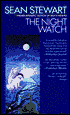
Immortal Folly III: Review of The Night Watch by Sean Stewart

Grade: B+

So we walked out of the jungle and settled down as men. But the trees didn't let go of us so willingly. The Wild Wood, the forest primeval (to scatter my sources), held our primitive thoughts in its captive tendrils for centuries. Taming it has made us more than amimal-men, but what if the wood reasserted itself? (Well, it'll be pissed off, for starters.)

Sean Stewart has created a world in which the earth has woken up. Dormant for half a millenium, from (as he belabors) the sixteenth century until the end of the second world war, the old-world magic has returned. It was a horrible thing too: turning great men into terrible gods, stirring the dead, and transforming the lesser of us into ghostly deformed creatures that feed on fear. The awakening, in Stewart's universe, was slow at first and then climaxed in a Dream that, but for the efforts of a noble few, nearly wiped humanity off the map. Some communities survived the Dream intact, through guidance and grit, and The Night Watch looks at two of them, the south side of Edmonton, that made it through with stark denial, and Vancouver's Chinatown, which persisted with considerable more flair.

From this palette of earth powers and the living supernatural, a good writer can paint some gorgeous and haunting scenes, and this indeed is Stewart's strength. (He describes his own work as happening "at the confluence of Faulkner and Tolkien, Dostoyevsky and Enid Nesbit, Joseph Conrad and Lloyd Alexander and Ursula Le Guin," which, neglecting Nesbit whom I've not read, isn't a bad description at all.) He's got a splendid eye for detail, whether it's detail of setting, detail of emotion, detail of character. And they're wonderfully rendered: his vignettes and snapshots range from frightening to fulfilling to poignant. The primitive forest of Vancouver, grown to near sentience, the magical depths of Chinatown (where's Jack Burton when you need him?), and the cold gods of the freezing prarie that demand sacrifice all seethe from the page.

My only wish is that he could have used more a little more expository detail. To turn all those scenes into a novel, you have to connect them somehow, generate some faith in the reader in the causality of events, that one thing leads to another, that there's a purpose to grouping them in such a fashion for display. You need to to have a consistent setting, too, and a few words as my second paragraph here (necessarily better written) would have gone far if applied near the beginning. Stewart's early info-dumps were, unfortunately, not terribly relevant, and I was damn confused on how the world fit together. Technology has advanced nearly to artificial intelligence, but fuel and other chemicals must be scrounged. How was that possible? The "barbarian" and many of the other magical threats were so unclear at first as to be non-alarming. They got told eventually, mostly, and by the end, I was tempted to re-read the first half to verify that I wasn't the problem. But it wasn't me: for all that beauty the individual plots never mesh quite well enough. A shame, but hardly a damning one.

A couple of non-thematic notes: he painted a relationship of a formerly married couple that I liked. Stewart often writes women that annoy me (relying overmuch on some Madonna/whore thing to complicate them past the point of likability). Here there was none of that: he made a woman that was tempestuous and difficult and still strong and feminine. He recognized how well paired such women are with solid man-types as unflappable bulwarks against their storms. He matched this pair believably enough, and made it a nice vehicle to display the culture clash. Another point that I enjoyed was the serendipitous pairing of this novel with Jitterbug Perfume. Future Edmonton is beet-eating town it seems, but it couldn't be more dispassionate. Meanwhile, the lusty residents of Chinatown loathe the things. Is it a nod? It's an amusing one if so.

Organization
Author:
Title:
Genre: , , >,

Wednesday, August 23, 2006

Book Review Index

Since I bother to rate my enthusiasm for the books I review, it will be helpful to both of my readers to get a feel of my tastes. Here's the index since 2004, when I started keeping it. I omitted books that I either couldn't remember well enough or reviewed too poorly to re-grade. I also omitted most of anthologized shorts, and all of the world-events and opinion stuff I read when I am supposed to be working (and of course the technical stuff I read when I actually am working).

The grades reflect my subjective enjoyment more than any objective evaluation. (How else to explain how Conrad did so poorly? Tuan Jim just didn't have the snappy move-along plot I needed at the beach that summer.) The grades may seem to be on a curve, but I think that's less due to inflation and more to my care in choosing reading material.

  • Anderson, Poul Operation Chaos (B)
  • Bellairs, John, The Face in the Frost (B+)
  • Benford, Gregory Cosm (A)
  • Blake, Katharine The Interior Life (B)
  • Blish, James A Case of Conscience (A)
  • Bourdain, Anthony, Kitchen Confidential (B)
  • Brown, Dan Angels and Demons (C+)
  • Bujold, Lois McMaster Diplomatic Immunity (A-)
  • Carroll, Jonathon After Silence (A)
  • Carroll, Jonathon Sleeping in Flame (B+)
  • Chabon, Michael The Amazing Adventures of Kavalier and Clay (A+)
  • Clarke, Arthur C. Childhood's End (B)
  • Clarke, Arthur C. Rendezvous with Rama (B)
  • Coatzee, J. M., Elizabeth Costello (A)
  • Conrad, Joseph Lord Jim (B)
  • Dahl, Roald The Roald Dahl Omnibus (B-)
  • Davies, Robertson, The Rebel Angels (A)
  • Daniel, Tony Superluminal (B+)
  • Dean, Pamela The Secret Country (B+)
  • Dean, Pamela The Hidden Land (B)
  • Dean, Pamela The Whim of the Dragon (B+)
  • DeLillo, Don Underworld (B+)
  • Eco, Umberto Baudolino (C)
  • Friesner, Esther Wishing Season (C+)
  • Gaiman, Neil Anansi Boys (A)
  • Gibson, William Idoru (B+)
  • Gibson, William Pattern Recognition (B+)
  • Gibson, William Neuromancer (B)
  • Goldman, Willian, The Princess Bride
  • Greene, Brian The Elegant Universe (B)
  • Greene, Graham The Power and the Glory (A)
  • Harris, Bob Prisoner of Trebekistan (B+)
  • Helprin, Mark Winter's Tale (A-)
  • Holman, Sheri The Dress Lodger (A-)
  • Juster, Norton The Phantom Tollbooth (A+)
  • Kay, Guy Gavriel The Last Light of the Sun (A+)
  • King, Stephen Wolves of the Calla (A-)
  • King, Stephen Song of Susannah (B+)
  • King, Stephen The Dark Tower (B+)
  • Kushner, Ellen Swordspoint (B+)
  • LeGuin, Ursula K. The Dispossessed (A)
  • LeGuin, Ursula K. The Left Hand of Darkness (A)
  • LeGuin, Ursula K. The Telling (A-)
  • Levitt, Steven and Stephen Dubner Freakonomics (B+)
  • Lieber, Fritz The Big Time (B+)
  • McCarthy, Cormac The Road (A)
  • McEwan, Ian Saturday (B)
  • Mirrlees, Hope Lud in the Mist (A-)
  • Morrow, JamesTowing Jehovah (B+)
  • Nafisi, Azar Reading Lolita in Tehran (A-)
  • Noon, Jeff Vurt (B+)
  • O'Connor, Edwin The Last Hurrah (A)
  • Park, Paul Celestis (B+)
  • Park, Paul Soldiers of Paradise (A)
  • Patterson, James and Andrew Gross The Jester (C)
  • Powers, Richard, The Echo Maker (A-)
  • Powers, Tim The Drawing of the Dark (B)
  • Powers, Tim Declare (A)
  • Powers, Tim Last Call (A+)
  • Pratchett, Terry Maskerade (B)
  • Pratchett, Terry Soul Music (B-)
  • Pratchett, Terry The Wee Free Men
  • Pressfield, Steven, Gates of Fire (B)
  • Priest, Christopher The Separation (A)
  • Robbins, Tom Jitterbug Perfume (B+)
  • Roberts, Keith Pavane (B+)
  • Ryman, Geoff Air (A)
  • Saberhagen, Fred The Berserker Throne (B)
  • Stephenson, Neal Zodiac (A-)
  • Stephenson, Neal Snow Crash (A)
  • Stephenson, Neal Cryptonomicon (A)
  • Stephenson, Neal The Diamond Age (A-)
  • Stewart, Jon Naked Pictures of Famous People (B)
  • Stewart, Sean The Night Watch (B+)
  • Swanwick, Michael Bones of the Earth (B)
  • Tolstoy, Leo War and Peace (A)
  • Twain, Mark Letters from the Earth (B)
  • Varley, John The Golden Globe (A+)
  • Varley, John Millenium (B-)
  • Vinge, Vernor Across Realtime (A-)
  • Vinge, Vernor Rainbows End (B+)
  • Vinge, Vernor Tatja Grimm's World (C+)
  • Vonnegut, Kurt Cat's Cradle (A-)
  • Vonnegut, Kurt Jailbird (A-)
  • Westlake, Donald E. Bad News (B+)
  • Westlake, Donald E. Drowned Hopes (B)
  • Williams, Walter Jon City on Fire (B+)
  • Wilson, Robert Charles Blind Lake (A)
  • Wilson, Robert Charles The Harvest (B+)
  • Wilson, Robert Charles Spin (A+)
  • Wolfe, Gene The Knight (A-)
  • Wolfe, Gene The Wizard (A)
  • Wolfe, Gene Nightside of the Long Sun (A)
  • Wolfe, Gene Lake of the Long Sun (A)
  • Wolfe, Gene Calde of the Long Sun (B+)
  • Wolfe, Gene Exodus from the Long Sun (A)
  • Wolfe, Gene On Blue's Waters (A)
  • Wolfe, Gene In Green's Jungles (B)
  • Wolfe, Gene Return to the Whorl (A)
  • Wolfe, Gene Soldier of Sidon (A)
  • Zelazney, Roger Changeling (D)
  • Zelazney, Roger Damnation Alley (C-)

  •