Showing posts sorted by date for query graham greene. Sort by relevance Show all posts

Thursday, November 26, 2015

Review: The Windup Girl, by Paulo Bacigalupi

I never realized it before reading this novel, but what the world needs is a dystopia in the style of Graham Greene, where the sadness, secrecy, danger, ubiquity... the altogether oppressiveness of a failed social effort can be written up as the perfect pot to stew the uneasy moral gristle of the characters.  Greene, of course, had a knack for spotting these tired pockets of the real world, but your better science fiction is all about removing constraints like that, and it has a long history of creating sorry futures as a critique of political ideas.  It'd be a great marriage, is what I'm saying.

The Windup Girl is not that novel, for better or worse, but I will admit that I read a good third of it really wanting it to shape up as a new Quiet American.  The setting works: it's in a future southeast Asia, in a region historically resistant to imperialism, yet eternally dealing with the attempt, simmering with potential coups and clogged up with its own webs of loyalty, history, crime and general hardship.  Generations of resource depletion and biological capitalism have left humanity diseased and dependent, and in the Thailand of the story, have put subsistence living toe to toe with modernity.  We are also introduced early on to a character I wanted to read as a reinvented Alden Pyle.  Similarly named, Anderson Lake is likewise more of an interloper than a proper protagonist, who, along with the boozy expats of his acquaintance, doesn't quite jibe with the culture.  He's in truth a powerful political agent, a fact belied by his willingness to risk himself within the intrigues of Thai society.  He takes a possessive interest in a local woman, and, well, even if that's as far as the similarities go, you can at least see why I was rolling with this.

But the cracks start early.  We're in Lake's mind from the beginning of the book, and it doesn't take long for the his schemes to be revealed, in context, as probably malignant.  Nor is there any allegorical love triangle here.  Emiko may be a trophy object but, well, she's not Thai for one thing (not even Japanese, strictly speaking), and more importantly, she is a challenging individual in her own right.  There is overall too much action, too many characters, and not the right kind of internal space to really qualify as a Greene knockoff.  It's not a tenuously drawn inner balance, this novel, it's the usual point-of-view plot mosaic.

Bacigalupi imagines a world where food sources have been monopolized by a handful of "calorie companies," modern-day Monsantos who have long since succeeded in suppressing local agriculture in exchange for imports or rights to grow non-propagating proprietary strains that the companies sell.  (It's the American Midwest extrapolated to a global hellscape.)  It's not spelled out whether the succession of plagues that have further eradicated old species and leveled the human population were intentionally waged by the calorie companies, or whether they were a result of tempting the world's fate with highly engineered monoculture.  In any case, the political arms of the companies actively seek out what biodiversity is left, with an aim to develop it (no doubt with similar results down the line), and keep the business one step ahead of the next pandemic.  Thailand has made it this far by vicious containment measures, and a rumored pet scientist.  The nation has also maintained an old seed vault in the capital that Anderson Lake wants very much to negotiate. 

The detail of this sorry world is very well drawn out, and the author has really done a good job in fleshing out a location for its conflicts, and selecting characters to witness it from different angles.   This Bangkok seethes with people and squirms under the weight of history.  There is a languor to the city that comes from more than the jungle climate, it's heat, fatalism, decay, a struggle that's more necessary than hopeful. The impact of global scourge and dearth of kilowatt-hours is so effectively shown that I kept noticing the times it was told.  (My only mild complaint about this book is that he uses just a hair more neologisms than I felt were necessary.)

Most things are windup in this world.  The earth has been so poorly used that hand-crank power has become the ubiquitous poor-man's alternative to carbon.  However, Emiko (the girl of the title) isn't throwback tech, she's been made to have jerky toy-like motions.  Emiko is an engineered person, a New Person in the book's language, one who has been bred, altered, and conditioned from birth for a role as a high-end courtesan.  Not just with the creepy doll motions, she's genetically predisposed to obey and please, to seek male guidance, and what the hell, that's three novels in a row (not to mention a tv show) now where subservience is governed by sci-fi technicalities, and although it's gotten under my skin, Emiko's arc is quite satisfying in this story, because this is a girl whose mind has a slim chance of conquering her genetic tendencies.  This far from removed the microcosm for which she's been designed, obedience has treated her poorly.  Abandoned by her old patron and forced into a lesser life of prostitution, in an unsuitable physical environment, she wants safety in Anderson Lake, and that is something her world will also probably not allow. 

A spoiler here, but among the many plot whorls, a new disease has been simmering in Lake's business front, an entirely natural one.  It is managed with the scientific tools at hand, but not before it gets Lake.  Emiko (and new people in general) are resistant to it, and, we gradually learn, often have other strengths, provided the bullshit low-status-signifying mods can be weeded out (or gradually bred out, or can somehow provide into an ecological advantage).  It's heavily suggested that these new organisms are the future of the planet, and our true legacy.  The fact that the disease strain evolved from a natural mutation (i.e., not engineered and as a random element to the plot) is significant, and we're offered a question here about the nature of nature.  Is human meddling an affront against nature or is it an aspect of it?  Most of us prefer the anthropocentric answer, that we're the end result of evolution, and that we have some relationship with the biological world.  But the honest answer is that we're part of the process that has no goal, and in the book, all our activity has been the kind of catastrophe that increases speciation (and the earth's had a few).

Tuesday, November 09, 2010

Review: It Can't Happen Here, by Sinclair Lewis

It Can't Happen Here, published in 1935, is a famous book. It retains a cultural cachet (in way that political predictions do, but scientific predictions don't) for its contemporary awareness, for having been accurately cognizant of fascism when it was not politically nescessary in this country to be so, and for anticipating some of its expansionist aims. It is, as the title suggests, the development of an American version of the movement, developed shamelessly from our own national myths, and opposed (or not opposed) by various liberal cultural or philosophical elements. Having cultivated this sort of cynicsm for a couple of years, I was expecting to find some connection to this book, at least as a warning against the self-proclaimed authorities. And, so, how to put this exactly? It has a couple of moments, but I don't think it was a great work, maybe not even an especially good one.

Sinclair Lewis (I learn) made his living, and eventually garnered a Nobel prize, for chronicling the middle class American angst of his pre-Depression day. This puts him as his generation's Franzen maybe, or Updike, or any of that stable of writers that I've neither read, nor can get myself to notice outside of their tedious "great writer" acclaim, which for me anyway, doesn't add up to an optimum set of associations, but still hardly enough to condemn. In any case, It Can't Happen Here is considered one of Lewis's late novels, published after his prime, and no doubt it got some penetration based on the famous name. The blurbs stress "important" and damn the reading with a faint "almost-as-good" praise when compared to his earlier works. Failing an easy connection to himself, you might be tempted to compare this novel with those of other authors who've also been astute and lonely critics of power, something like The Quiet American, but it doesn't hold as well as a character or a political study. As well as being observant, Graham Greene's will also go down as being an objectively good novel (to the extent that these things can be considered objective of course). Not to say it's awful--It Can't Happen Here has an impressive comic start, taking the gimlet to a couple Rotarian speakers—from the military and the DAR—but it doesn't decide well where it wants to be. The humor and the cuts don't keep up past the first 30 pages or so, and after that, the reader can look forward to only two or three episodes later in the novel that remind us that there was ever a satirical intent. The book makes a sorry bridge between the wit of Mark Twain and the bitter satire of Vonnegut or Heller. To my mind, It Can't Happen Here is closer in spirit to any number of late-model counterfactuals, and if AH writers like S.M. Stirling or Harry Turtledove might include more armchair generalism and less couched liberalism; more heroic violence and less subversive penmanship, the literary depths are similarly plumbed as by those more niche-oriented authors. Not necessarily a bad read, but it ain't indispensible.

Here's the basic problem: it's not enough to say it can happen here, what made it happen here? There's only a smidgen of this, in the brief satirical opening and in the description of the growing appeal of president Buzz Windrip, but mostly what we get is mechanism, a sequence of events, a lot more what and not much why. Even there, the sections where external drama is given to unfold (outside of the protagonist's, Doremus Jessup's, point of view) are told in summary form, a lot of this-happened-and-then-that-happened, and the higherups don't develop into particularly understandable characters. These parts are like reading an outline of a novel instead of the book itself, breaking the cardinal rule of showing instead of telling. What's in the national (or hey, human) character that leaves us open to dictators? We don't get a good deal of the psychological landscape that let Windrip-mania take root, other than what's revealed through a few meetings and dismissive opinons of Jessup, who is standing in as an obvious proxy for the author. Jessup is the only real point-of-view character we get, the only head we get too far inside, and he's likeable enough, coming together as a gentle critique of the American liberal, drawn by circumstances into radicalism.

Lewis was a writer, and his wife a journalist. Making heroes and martyrs out of writers and journalists (Doremus was an newspaper editor, and the plot revolves around his criticism of, punishment by, and resistance to the fascists; team Jessup worked against the "Corporate State" by printing and distributing pamphlets) may be drawing on autobiographical fantasies. We all like to think we'd be the ones to stand up to tyranny, and those of us with a wordy inclination like to think that we see the world clearer than others, and that anything we write matters. If we switch to a contemporary context, it's hard not to see Doremus as a blogger. I spent an inordinate time (supported by Lewis of course, and I bookmarked a bunch of well-written paragraphs that maybe I'll remember to throw at people who annoy me later, but which don't seem terribly relevant for the purposes of a review) wondering just what his political philosophy was. He identifies as liberal, but he starts out with a healthy (in that downplayed upstate Yankee way) wisdom about authority and politics and general. In a few occasions, Doremus defends middle-class intellectualism (we're not the same as the proletariat, he thinks, and that's okay), and finds both common ground and ultimate differences with the radical leftists of the 1930s brand. His viewpoint solidifies a bit in opposition to the Corpos, and maybe Lewis is offering a lesson that we resist to a degree that's appropriate to the political environment, mildly cynical in civil times, and bravely defiant in violent ones, a revolutionary that (somehow!) resists the formation of alternate tyrannies. This moderation moves from a weakness to, as Jessup's role solidifies, something definitive of the American version (evidently similar to the writer's own views), perhaps giving in to some myths of national character after everything. Pinning a philosophy on Corpoism is harder, and after some reading (particularly as he opens a succession of chapters with excerpts from Windrip's intentionally risible Mein Kampf knockoff), it's obvious that the actual version is vacuous. Some egalitarian-seeming or even Socialist measures are offered to the public, in a way that doesn't offend power interest too much, which I might have taken differently if Jessup didn't take a moment to pick it apart. It's funny how a fascist takeover is fronted by language of freedom and liberty.

A couple of odds and ends. Increasingly, I'm looking, when possible, for personal figures to help place novels in time. Jessup's daughter Sissy (who seems like a great kid even though she was stuck with awkward dialogue) was born in 1917, the same year as my grandmother. In 2010, she'd have had a full life behind her, which feels like a strange and sad perspective. Also in 2010, we're living in the wake of a banking, um, crisis, sufficient to generate some real antipathy for the industry. In 1935, a complaint against "bankers" was often veiled anti-semitism, and Lewis certainly intended this to be an element of the Corpoist rhetoric. Is that the case today? It never before crossed my mind to make a connection like this when I get mad at the current financial industry. I wrote in my last post "the Democrats didn't exactly give the lenders a hard time." I was going to write "didn't exactly chase the lenders from the temple" but suddenly sensitized, I didn't want to go there. I guess I'll have to be careful to be precise about those sorts of things.

Sunday, December 14, 2008

Review: The Prince by Niccolò Machiavelli

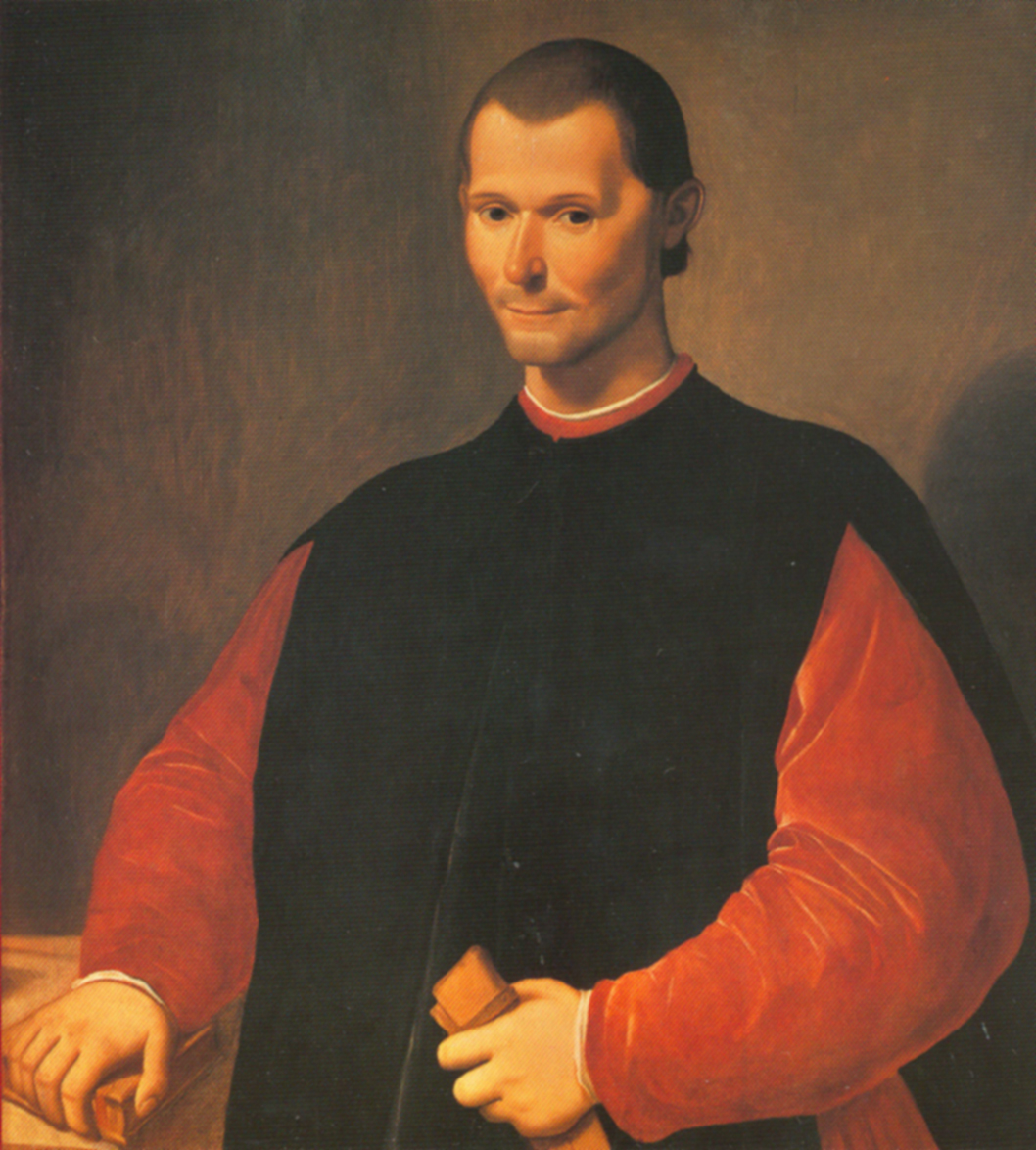
I find the portrait of Machiavelli by Santo di Tito intriguing (shown on the right, generously sponsored by Wiki-something), and I'm evidently not alone: it graces most editions of The Prince that turn up on a quick browse through Amazon. (My own edition, translated and excellently annotated by Wayne A. Rebhorn, is from the bonanza of Barnes and Noble cut-rate classics, and sports a contemporary Portrait of a Gentleman by Bartolomeo Veneto. Those Tuscan Renaissance painters had a thing for knowing looks.) It's a young, boyish Machiavelli, and his smile is a little impish, his eyes are bright and eager. Niccolò looks like a man who is hiding nothing, happy in his knoweldge of the system, unconcerned about its smaller consequences. I hate to judge his work this way, but that smirk is affecting how I scope out how I feel about Machiavelli, raising up a small affection for the man.

Machiavelli is on a par with the big set of Renaissance geniuses, and it's fascinating to me how art and politics became scientific well before chemistry and physics did, how in Machiavelli's case, the study of the workings of the state took such a pragmatic, evidence-based turn under his pen, a good hundred years before Galileo's scientific reasoning got him into trouble with the church. Machiavelli had actually collaborated (unsuccessfully) on some civic works projects with that other great empiricist of his generation, Leonardo da Vinci, and had extended the occasional professional courtesy to the artist. Did one's epistemological sense affect the other's, crossing disciplines, as they were? Certainly there was something in the Tuscan air in those days.

The Prince is written as a primer to young rulers, an alarmingly honest instruction manual to supplant the idealistic moral lessons that new princes might normally receive at that time. (According to Dr. Rebhorn's notes, Erasums had at the time of Machiavelli's writing, recently published such a hopeful instruction manual for instance, chock-a-block with decent Christian humanist motivations.) The Prince came instead from the author's careful diplomatic observations, and from his personal study of Latin historical texts. Machiavelli's tone is a little didactic, but there's a sense of irony, a hint of sarcasm, the occasional wordplay. He's lecturing, and going after the truth as he sees it, but there's an inner amusement behind the writing. The damn smirk.

Although he writes in a lot of thinly supported declarative sentences, he allows himself a great deal of room to work through his thoughts and entertain alternative ideas in the text, and he provides plenty of examples. These are not always easy to follow to his conclusions, in part because his times are so politically complicated to the eyes of a non-historian (or at least this non-historian). He's surrounded by a divided Italy that's constantly shifting alliances with foreign imperial powers, throwing up short-lived rulers and popes to pursue neighboring territories and cities under a too-limited set of proper names. The lengthy supplemental material could take away from the reading if you paused at every footnote, but it's very welcome. Contrasting his complex political environment, the examples Machiavelli pulls from antiquity are often suspect for their simplicity. He's pulling heavily from Livy and other Roman historians, as well as a couple Biblical anecdotes, and when the history gets distant enough, he doesn't shy from accepting the occasional legendary origin story at face value. If the stature of rulers are necessarily fallen in Machiavelli's present, it's unclear whether it's his nostalgia that's coloring his opinion, or his disappointment with Italy's international impotence, or if the mythology is intentional in the comparisons the practical man is trying to draw.

Machiavelli's motivations for The Prince are transparent--he's trying to work up some favor from the Medicis; Niccolò wants his old job back--but it's also clear that Machiavelli is hungry for the renewed international power of a reunited Italy, a new Rome, and he exhorts a new prince to take command and resist the other European powers with Italian forces. He also hungers for a modern version of a Roman-style republic, and there's a strange undercurrent in the writing where, he instructs a prince to power, but the message that he must never earn their contempt through oppression (through theft and disrespect of their customs--they get past love easily enough) or displays of weakness, seems at odds with the contention that a populace allowed to remain accustomed to freedom will eventually overthrow a prince (or will be able to hold out for a weak one). Nor does Fortune, according to Machiavelli, favor the longevity of princely rule. The Prince is a stark lesson on how to be a monarch, but it doesn't really justify monarchy. Aside from that final urge to cast off Italy's foreign bonds, Machiavelli fails to ask the obvious question, the one that contrasts so oddly with his advice to let the people be the people: what good are princes in the first place? They're a natural way to organize society, he implies, but Niccolò the republican also has his own agenda. Are the failures of monarchs built in, and would Italy be better unified under a king, who could then be cast off? Machiavelli is certainly smart enough, and cynical enough, to write in a couple layers of meaning.

Niccolò Machiavelli's political philosophies are very much products of that complicated international context. When wars among small states were inevitable, a military-minded monarch was well-advised, and controlling people with fear and respect could be considered a necessary defense against foreign powers. Machiavelli often notes that a prince succeeds when the people are motivated to fight for him, and he discards other "nobler" internal motivations that idealists would assume lead men to that end. As a modern reader, an obvious question is whether his lessons carry over to today's world, or whether they have been borne out in practice in the intervening five centuries of civilization. Certainly, militarism is alive and well, and those who've risen from the barracks have earned respect, but we moderns often like our bureaucrats too. Machievelli's advice on colonies probably didn't envision such vast cultural differences as the West would eventually encounter in those efforts, but his advice about governing foreigners in their own states while preserving their customs can probably be interpreted on similar grounds. Did the invaders instill fear and respect in the locals? Did they take care to understand local ways? Did they give too much gravy away too early? Did they steal and tax unduly? His advice in conquest to embrace the powerless opposition while keeping them powerless, and domestically to use consel without letting the counsel lead, has likewise not been rediscovered in many an adminstrative post-mortem. There remains a problem of the extent to which a foreign prince is damned by failure to understand the local power structure very well, or the local customs, or even the extent to which he can. (I'm reminded of recent readings of Graham Greene, say, who'd eloquently novelize its inherent doom, and Howard Zinn, who reported the success of stamping out customs and local power on the North American continent, both voicing the people's views of history instead of a prince's.) Machiavelli's advice to project an image of honesty, respect, and fear which is at odds with any personal qualities a leader may have is almost too widely taken and obvious to mention these days, but still, it's best not ignored.

Monday, August 11, 2008

Review of The Quiet American by Graham Greene

Before I get too far along, if you're the sort of irresponsible reader who (like me) has gone this far without reading The Quiet American, be advised that this review contains spoilers. Normally, I don't get too worked up over ruining the suspense of something over fifty years old, and canonical (or if it's not on the short list, I agree that it deserves to be), but here's one where the ending caught up to me late. It took the author's hand to make me realize that there was depth to the mystery of Alden Pyle's death, and I'd offer another reader the chance to still get that feeling of awakening as Greene bolts his so theme neatly into place. But that theme is a lot of what I feel like discussing, so consider yourself duly warned.

The novel takes place in Viet Nam during the French occupation, rather notably before the American one, and it's a nation whirling in colonial and civil conflict, with bloody front lines protecting unsteady cosmopolitan zones of Vietnamese urbanites, Chinese businessmen, French authorities, American missions of various types, and any number of international correspondents. Pyle, as the title says, is a quiet American, a bookish, well-bred kid from Boston who is set apart from his loud, uncultured countrymen by what the narrator, Thomas Fowler, repeatedly calls innocence. Part of Greene's brilliance is in setting up a contrast between what's shown and what's told, and to pick apart Pyle as a character (about half of my scribbles are attempts at dissecting him) takes some serious wringing of that noun. Pyle is far from guiltless, and if he's deluded, he's got unusual blindnesses, it's not right to say he's naive about human suffering. Here's Pyle poling his barge alone in the dark up a river swollen with floating corpses, here he is wooing Fowler's girlfriend, there he is reducing lives to bloody bits exactly as planned. Pyle does those things competently, and without damage to his self image. His ego is not fragile, and if there's innocence, it lies wrapped up in childish beliefs about the value of love, chastity, friendship, the magic of growing up, and, perhaps especially, of Democracy. His courtship must be played out on a fair field with unspoken rules, a friendly competition, but the lives of soldiers and bystanders are beneath his notice. If Pyle were written as a caricature, he'd be funny, but he's taken seriously by Fowler and certainly taken seriously by himself. If his warped morality is an affectation, Greene never lets the shell break, not even under the force of Fowler's exquisitely bitter verbal assaults.

Pyle's interest in war is an academic one, some febrile understanding of grand currents of ideas (democracy and communism, a "third force"), and Greene is good at pointing out how reputed grand designs reduced to practice: young soldiers huddling in a guard tower, casually murdered families, a peasant boat obliterated without warning from the sky, the banal lies about necessity of murder. There is no countervailing notion of nobility of the soldier's duty, and the stronger message comes from the fact that Fowler has a better view of the civilian sphere, both in terms of policy and of consequences, he can see how the former is empty, and the latter is hopelessly violent. Fowler is a reporter, a professional cynic, and maintains a stated neutrality on the conflict. He witnesses horrors with a steady eye, but every one adds up and weighs on him. On the outside, it could be believed that his betrayal of Pyle (there's the spoiler) was over romantic contention, but it's clear by the text that the man had seen one too many children killed for idealistic ends. Pyle is not the man that's forced to grow up in this novel.

The political and the romantic are not separate conflicts. It's important here that Pyle is American, Fowler is English, and Phuong, their mutual love interest, is Vietnamese. I read it as representing a larger contention between the old colonialists (as Pyle calls the British) and the new, and a great deal of the mixed-up love and contempt that Fowler feels for the young man is brotherly. They share some common traits, their bad dancing overlaps in their respective pursuits of Phuong, they keep themselves apart from their peers (from other reporters and other Americans respectively), and undertake a patronizing sort of love for Phuong, neither quite able to understand her character. And they are undeniably drawn to one another. Pyle feels a depth of friendship for Fowler that is incongruous with how the men treat one another, and Fowler, in his personal asides, takes more protective notions about Pyle's evident guilelessness than the young man earns. Together, they sniff and bat paws like contenders for alpha male status, but remain members of the same pack. If Phuong also represents her nation, her character remains unpenetrated by either of the overly intellectual men, and for the abuse she receives, she remains lovely and simple. But surely Fowler is as wrong to regard Phuong as innocent as he is Pyle.

On that allegorical plane (sorry Kevin), it can't have been lost on Fowler (who'd reported in India) that Britain has as bloody hands as any Empire. Indeed, his self-awareness is his misery. While Greene, through the journalist, makes brilliant rhetorical points on the American character, the difference between the older and younger world-spanning brothers is one of style, the distaste is for the particular set of lies Americans tell themselves as they repeat another bloody cycle of imperial history. Fowler's cynicism is based on experience, his contempt is for youth as much as for anything else, and not just Pyle's youth, and maybe not just America's. Near the end of the novel, Fowler finally sees fit to reminisce on his own idealism in context of the dead young American's. Fowler claims neutrality in the local events, but it's really just a different version of Pyle's put-upon innocence, a more developed, grown-up version of it. Fowler's neutrality, his love, his very horror at the conflict, also have the consequence of murder.

At the heart of a cynic, you'll often find a broken romantic. Greene's touch is often droll, and while love, pain and guilt are what this novel is about, the main characters habitually hide these things behind various masculine (and probably undiscovered feminine) disguises. It's spare, it's bitter, it's witty, but it's not that Hemingway he-man crap, there's no hidden nobility in the pose. When Fowler admits that he hurts, that he causes hurt, it's the more powerful. This is a novel to break through detachment.

ADDENDUM: Okay, so I haven't seen the most recent movie adaptation, but I'm interested. Michael Caine is a brilliant choice for Fowler--I can't think of anyone who could better communicate the cynicism, the emotion, and the killer arguments--but unfortunately he needs to be about thirty years younger. I like the idea of Brendan Frasier as Pyle, he looks right, and he may even be an underrated talent. I mean, he really carried Encino Man.

Tuesday, June 24, 2008

Review of The Hunchback of Notre-Dame by Victor Hugo

I have my reservations about jumping into nineteenth century literature. I only have so much endurance for coal-filth and candles, gout and apoplexy, and meandering prose, and most of these books can just go on forever. But I was specifically looking for something down on love (completing the theme), and M. Hugo has been waiting patiently on the shelf for years now. Notre-Dame de Paris is a historical novel, which decently swaps out some of the usual period props, but it's still told in the style of the times, which the authorial voice periodically cheeps in to remind us faithful readers. And not unlike I feared: Hugo almost immediately drifts away from the opening scene to tour-guide our way through the Palace of Justice and a couple hundred years of its history, which is less effective getting me into 1482 than letting the characters open their mouths. Three chapters in, and Hugo drops another anchor, describing--no, delineating--the layout of medieval Paris over the course of 30 or 40 pages. It's not that he's boring when he talks about architecture, but these opening devices don't exactly kickstart his classic plot, they dismissed the characters just as they were getting interesting. And over these last few weeks I haven't had the luxury of time to just sink in and bask in a big heap of prose. And to be fair, even if I mildly object to info-dumping it, one of the writer's purposes was to evoke the character of the city in its time.

Hugo finds momentum well enough when he's not feeling up the masonry. Our opening scene is a mystery performed by the aspiring philosopher Pierre Gringnoire, mercilessly and hilariously cut down by attending students, and ignored by the crowd. Paunchy bishops and dignified statesman filter in and out to create a bigger scene, but much like the stage drama, they're an unloved spectacle, and it takes low humor to get the rabble really aroused. Hugo, to my pleasure and surprise, is really good at humor, and I love how he eyed up the intelligent and powerless (that is, the students) as the eagle-eyed observers of the human condition, and gave them all of the good lines. (As they deserve: I have an affection for the disenfranchised wiseasses of the world.) Unappreciated (and unpaid), Gringnoire wanders dissolute through the Paris streets, delivered into the court of the vagabonds and their sham Justice, and played out for laughs and the uncomfortable bite of satire. Official death loomed over the heads of the poor in Gringnoire's time, and hadn't exactly disappeared by the time Hugo was writing. The characters support the development of the story's tragedies or (as Mark Twain would say it) its sarcsasms, but my favorites were the latter. Our poet is an ineffectual blatherer, charming as a parody of a (real historical) writer, the king of the vagabonds is a debauched and lethal mockery of the Law, and young student Jehan Frollo (brother of Claude) steals every scene he's in, whether throwing about grandiloquent insults, or guilelessly conniving his way to his next bottle.

Even at his most discursive, Victor Hugo clearly takes great joy in the language, on which note, in a case like this, I usually start bitching about translations. The fact that my edition is rendered to The Hunchback of Notre-Dame instead of Hugo's more appropriate original title is a bad sign, as is the failure to credit the translator. How much better did the French flow along? How much more playful, how much more moving was the original? One `particular annoyance: French makes use of a formal second person, but the resulting English thees and thous read terribly. That forced archaism always come off as a cheesy anachronism for anything less than 350 years old.

The obvious liberty with the title is unappreciated because our well-known bell-ringer is only one of a cast of fully conceived players, and not even the best one. Hugo trots him out as not only physically hideous (and deaf), but also a mental defective, amoral, unable to perceive very well the antics of the crowd, nor the whims of Justice. Much later, when he gets speaking lines, he expresses himself differently than he was originally described. He's capable of metaphor, uttering sentences that require the self-awareness he was denied in his introduction. There's clearly an incomplete inner transformation that's intended here, which is similar to the way most of the major characters are developed: whether quintessentially noble, wise, beautiful or brave, Hugo drips with pleasure as he skewers their outward characters with reality, but the author's conflation of physical, mental, and moral deformity are confusing. They violate my admittedly modern understanding of their relationship beyond what I'm willing to give to artistic license.

As a love story, I couldn't be more pleased to read Victor Hugo's side by side with Graham Greene's. Hugo lets his play out with nearly as much cynicism: the hunchback's great love is a beauty; the repressed scholar's great love is a free-spirited ingenue; the sweetheart's is a handsome cad, who, at the moment of seduction, can't even remember her name. The love stories aren't weighted equally--those that contain a particle of actual compassion are allowed the heft of tragedy--but every one of them is ultimately a comedy of objectification that can only end badly, and does every time.

Marriage is painted as a farce too, but as a legal distinction, that's perhaps as much about Hugo's disgust with civic power, which is a much deeper condemnationthan his mockery of romance. Justice is doomed to end badly for its subjects, and the exclusive purpose of its proceedings is to deliver state violence, regardless of cause or merit. The comical vagabond court, we find, is the most pure authority, and the least corrupt. While it feels at times that Hugo is picking on the medievals, and if he taunts the king that his day is coming (that experience was brutal too), mostly he presents the Law as a timeless sort of evil. He's got a good trick where he reveals the mechanics of mysterious events off-handedly, and lets the process play out deaf and thoughtless of the minor truth. Hugo's Justice grinds on with tremendous inertia, abetted by the ecclesiastical powers and the expectations of the people. It exists to drink blood, and no one but a half-mad bell-ringer even thinks to stand against it, wrongly and badly. Notre-Dameis an artful blend of place and character, of comedy and tragedy. You'll laugh until you cry.

Wednesday, May 28, 2008

Review of The Honorary Consul, by Graham Greene

The Honorary Consul, published later in Graham Greene's career, is not listed among his major works (at least by the tools at Wikipedia). This is probably why I was able to nail a hardback for a buck from the Friends of the Library, but evidently it was one of the author's favorites, and also one of his most personally challenging. I can see how the way it's constructed might defy momentum. Greene asks, basically, "What if they started a political incident, and nobody came?" It's not the sort of question that keeps the reader (or, presumably, the writer) insatiably ripping through pages in search of a resolution. It's context is northern Argentina in the 1970s, and Paraguayan dissidents, in an attempt to coerce (the American-supported) General Stroessner to release political prisoners, have attempted to kidnap the American ambassador as he visits ruins south of the Paraná (South America has fabulous proper nouns), but have instead wound up with an irrelevant local British diplomat.

With a political anticlimax practically built in, the tension must play out on personal levels, and it's as if Greene upped the challenge with his variously disaffected protagonists too. The usual fault of novelists creating ambivalent characters is that they're either completely unsympathetic or completely unlikable (Robertson Davies is the first offender that comes to mind here, but I'm sure I can think of others), but Eduardo Plarr, the unemotional physician who is tangled in the intrigue by virtue of childhood ties, and Charley Fortnum, the sentimental drunk (and honorary consul), are both easy to relate to. Especially Plarr--Fortnum could get annoying, but the doctor comes off as a man with whom it would be comfortable to pass time. People are drawn to him, but the company he prefers is with others that are similarly distant and self-involved. It's a manifestation of the stiff English half of his heritage, and Plarr, like all of the characters, is to some extent a stereotype, but there's a difference between making up complicated individuals that represent some notions of national character and using ethnicity as an unflattering shortcut.

Likewise, Plarr's occupation may either have been a facile characterization or a brilliant inspiration. Everywhere, he shows a detachment from the moral concerns of family and of the hardship of living that could be best called clinical: analytical, and strangely incurious. It's not a defense mechanism with Plarr, it's his basic constitution, and scribbling off a prescription he has no confidence in, or making a snap judgement based on some hurried palpation is in character (even if those acts didn't show his medical training in convincing detail). Plarr is not an empathetic man, but he is accessible. He has childhood friends, difficult parents, he has opinions, close connections to atrocity, fond memories, things that make him angry, even if only people's annoying tendency to care about life's petty theater.

And he reads fiction (writers writing about reading is always a little precious) but the Argentine predilection for melodrama makes the local literature (the literature not written by Borges anyway) difficult for him to swallow. Greene takes great care to draw out and ostensibly revile South American versions of machismo, but Plarr makes a poor opposite to his own notions of that stoic and formulaic melancholy. (He is, it's made clear, only half English.) His solitary suffering is not so far removed from the noble gauchos of the Argentine litererary universe. It is amusing that his sexual feelings are dispatched as efficiently as the self-serious local writer's, and when he develops an attraction to a prostitute, even that is only on an intellectual level. Quite possibly her own job skill of clinically returning her clients' desires is what draws him. He treats women selfishly, but it's too easy to call it misogyny. He's aware of others' individuality, but only in the abstract.

Cleverly, Charley Fortnum makes a better contrast to Plarr than the Spanish-speaking nationals from which he (Plarr) feels apart. Fortnum is an alcoholic, overly friendly, and, if he were given to self-examination, deeply lonely, and he projects his simple emotion onto every person he meets, some English version of forced bonhomie and patronizing affection. Fortnum has married the prostitute, now pregnant with Plarr's child, and the doctor is too detached to care, and Fortnum too simple to suspect and too sentimental to hold it against him. I don't think it's a spoiler to say that they meet and conflict over the relationship, and despite the fact that they don't meet minds any more than anyone does, they get closest, as opposites, to fulfilling one another than anyone else in the novel. I don't know that the story is always perfectly paced, but the conclusion and the coda are spot on, and they bring the themes brilliantly together.

I would call this book, above all, a love story, or entwined love stories. Greene plays off it on several levels--it's subtly glimpsed in almost every minor character, from the married priest-turned-dissident, to the British ambassador, even to the blind old man that accidentally walks in on the kidnapping, they all work around a similar depressing theme of love as scripted comedy (as Plarr calls it), which rarely involves seeing past your own projected image and unlikely ideals, even when the others' need is uncomplicated. The occasional actual connection is poignant... and unlikely to redeem a goddamn thing.

Wednesday, August 23, 2006

Book Review Index

Since I bother to rate my enthusiasm for the books I review, it will be helpful to both of my readers to get a feel of my tastes. Here's the index since 2004, when I started keeping it. I omitted books that I either couldn't remember well enough or reviewed too poorly to re-grade. I also omitted most of anthologized shorts, and all of the world-events and opinion stuff I read when I am supposed to be working (and of course the technical stuff I read when I actually am working).

The grades reflect my subjective enjoyment more than any objective evaluation. (How else to explain how Conrad did so poorly? Tuan Jim just didn't have the snappy move-along plot I needed at the beach that summer.) The grades may seem to be on a curve, but I think that's less due to inflation and more to my care in choosing reading material.

  • Anderson, Poul Operation Chaos (B)
  • Bellairs, John, The Face in the Frost (B+)
  • Benford, Gregory Cosm (A)
  • Blake, Katharine The Interior Life (B)
  • Blish, James A Case of Conscience (A)
  • Bourdain, Anthony, Kitchen Confidential (B)
  • Brown, Dan Angels and Demons (C+)
  • Bujold, Lois McMaster Diplomatic Immunity (A-)
  • Carroll, Jonathon After Silence (A)
  • Carroll, Jonathon Sleeping in Flame (B+)
  • Chabon, Michael The Amazing Adventures of Kavalier and Clay (A+)
  • Clarke, Arthur C. Childhood's End (B)
  • Clarke, Arthur C. Rendezvous with Rama (B)
  • Coatzee, J. M., Elizabeth Costello (A)
  • Conrad, Joseph Lord Jim (B)
  • Dahl, Roald The Roald Dahl Omnibus (B-)
  • Davies, Robertson, The Rebel Angels (A)
  • Daniel, Tony Superluminal (B+)
  • Dean, Pamela The Secret Country (B+)
  • Dean, Pamela The Hidden Land (B)
  • Dean, Pamela The Whim of the Dragon (B+)
  • DeLillo, Don Underworld (B+)
  • Eco, Umberto Baudolino (C)
  • Friesner, Esther Wishing Season (C+)
  • Gaiman, Neil Anansi Boys (A)
  • Gibson, William Idoru (B+)
  • Gibson, William Pattern Recognition (B+)
  • Gibson, William Neuromancer (B)
  • Goldman, Willian, The Princess Bride
  • Greene, Brian The Elegant Universe (B)
  • Greene, Graham The Power and the Glory (A)
  • Harris, Bob Prisoner of Trebekistan (B+)
  • Helprin, Mark Winter's Tale (A-)
  • Holman, Sheri The Dress Lodger (A-)
  • Juster, Norton The Phantom Tollbooth (A+)
  • Kay, Guy Gavriel The Last Light of the Sun (A+)
  • King, Stephen Wolves of the Calla (A-)
  • King, Stephen Song of Susannah (B+)
  • King, Stephen The Dark Tower (B+)
  • Kushner, Ellen Swordspoint (B+)
  • LeGuin, Ursula K. The Dispossessed (A)
  • LeGuin, Ursula K. The Left Hand of Darkness (A)
  • LeGuin, Ursula K. The Telling (A-)
  • Levitt, Steven and Stephen Dubner Freakonomics (B+)
  • Lieber, Fritz The Big Time (B+)
  • McCarthy, Cormac The Road (A)
  • McEwan, Ian Saturday (B)
  • Mirrlees, Hope Lud in the Mist (A-)
  • Morrow, JamesTowing Jehovah (B+)
  • Nafisi, Azar Reading Lolita in Tehran (A-)
  • Noon, Jeff Vurt (B+)
  • O'Connor, Edwin The Last Hurrah (A)
  • Park, Paul Celestis (B+)
  • Park, Paul Soldiers of Paradise (A)
  • Patterson, James and Andrew Gross The Jester (C)
  • Powers, Richard, The Echo Maker (A-)
  • Powers, Tim The Drawing of the Dark (B)
  • Powers, Tim Declare (A)
  • Powers, Tim Last Call (A+)
  • Pratchett, Terry Maskerade (B)
  • Pratchett, Terry Soul Music (B-)
  • Pratchett, Terry The Wee Free Men
  • Pressfield, Steven, Gates of Fire (B)
  • Priest, Christopher The Separation (A)
  • Robbins, Tom Jitterbug Perfume (B+)
  • Roberts, Keith Pavane (B+)
  • Ryman, Geoff Air (A)
  • Saberhagen, Fred The Berserker Throne (B)
  • Stephenson, Neal Zodiac (A-)
  • Stephenson, Neal Snow Crash (A)
  • Stephenson, Neal Cryptonomicon (A)
  • Stephenson, Neal The Diamond Age (A-)
  • Stewart, Jon Naked Pictures of Famous People (B)
  • Stewart, Sean The Night Watch (B+)
  • Swanwick, Michael Bones of the Earth (B)
  • Tolstoy, Leo War and Peace (A)
  • Twain, Mark Letters from the Earth (B)
  • Varley, John The Golden Globe (A+)
  • Varley, John Millenium (B-)
  • Vinge, Vernor Across Realtime (A-)
  • Vinge, Vernor Rainbows End (B+)
  • Vinge, Vernor Tatja Grimm's World (C+)
  • Vonnegut, Kurt Cat's Cradle (A-)
  • Vonnegut, Kurt Jailbird (A-)
  • Westlake, Donald E. Bad News (B+)
  • Westlake, Donald E. Drowned Hopes (B)
  • Williams, Walter Jon City on Fire (B+)
  • Wilson, Robert Charles Blind Lake (A)
  • Wilson, Robert Charles The Harvest (B+)
  • Wilson, Robert Charles Spin (A+)
  • Wolfe, Gene The Knight (A-)
  • Wolfe, Gene The Wizard (A)
  • Wolfe, Gene Nightside of the Long Sun (A)
  • Wolfe, Gene Lake of the Long Sun (A)
  • Wolfe, Gene Calde of the Long Sun (B+)
  • Wolfe, Gene Exodus from the Long Sun (A)
  • Wolfe, Gene On Blue's Waters (A)
  • Wolfe, Gene In Green's Jungles (B)
  • Wolfe, Gene Return to the Whorl (A)
  • Wolfe, Gene Soldier of Sidon (A)
  • Zelazney, Roger Changeling (D)
  • Zelazney, Roger Damnation Alley (C-)

  •