Showing posts with label Theme Music. Show all posts

Friday, January 22, 2016

Review: Songs of Earth and Power, by Greg Bear

[Songs of Earth and Power is a combined edition of Greg Bear's two novels, The Infinity Concerto and The Serpent Mage, "substantially rewritten" so that they hang together better as a single story.  Recommended by my music instructor.]

Talented musicians, they say, can reach an elevated state of focus, where extraneous thought turns off and the moment is fully attained.  It's as if they become a conduit for the music itself, channeling some pure entity that exists apart from the instrument, apart from the player, the written notes, the composer, or the audience.  Parts click in place, improvisation becomes inspired, and the notes seem to find themselves.  (So I've heard, anyway.)  My man Switters has written about how the debut of The Rite of Spring all but broke polite society a hundred years ago, a piece clearly intended to convey music's connection to this more primitive source.  It's hard for me to imagine that a tightly written score is really the best way to get across that kind of pagan and improvisational sound, and I don't see how it could be played worth a damn without an orchestra full of crack musicians all deep in the zone.  But even a blues riff is light years beyond any notes you could put on a page. 

What is the zone?  Athletes and writers talk about it sometimes too, as do theoreticians.  Is it (in music) the result of extensive practice, where muscle and ear memory team up to satisfy or confound biological expectations of tone and rhythm?  Is it being good enough to express our intuitions about the modes and patterns we've been conditioned to since birth?  Alert enough to make subtle adjustments--right when our inductive brain functions are going full-fire--to connect nuances of tone to similarly subtle emotions?  Or skilled enough that the hands finally respond at the speed of thought?  Is it a non-language conversation between fluent players who are sharing similar ideas?   Are body resources are being siphoned away from cognitive centers (or are brain chemicals being flooded in) to produce a sensation of euphoria?  Maybe!  Or maybe there's a simpler and more appealing explanation.  Maybe it's magic.

Greg Bear couldn't have come up with a better conceit for Songs than this, where music is not just magic, but the Deep Magic, the stuff that worlds themselves are made from.  (Which, to be fair, has often been a song.)  The mystery is introduced in the story when elderly composer Arno Waltiri befriends unassuming youth Michael Perrin at a suburban Los Angeles party.  Michael aspires to be a poet, and Arno forms a bond with the teen over that, and we learn before long that back in the 40s, the old man had gone full Stravinsky on the LA crowd, not just scandalizing them, but literally transporting listeners away to some other plane.  Before he passes away, Waltiri leaves Michael some instructions on how to make the same trip over the hedge by foot, where he finds a small community of lost listeners and other artsy types who inadvertantly got themselves a little too close to the source.  As it turns out, the native fairy folk haven't been governing them especially well.

The first two thirds of The Infinity Concerto read like a certain 1980s-vintage urban fantasy (kind of like these), which shows a contemporary person reacting somewhat realistically to a strange and unexpected  world, not necessarily with high stakes.  Throughout the book, Michael remains fairly calm given his circumstances, and he's even somewhat genre aware.  (I might argue that his reasoned temperament is the only real constant through the story.)  He is not mean-spirited, but he is not gifted with great empathy either (which may seem strange for a poet, but is not for a 16-year-old).  In fact, one of his magic tricks is to bundle up and discard parts of his essential self, and the first thing he sloughs away is guilt, self-recrimination, or anything else that might make him whine.  As his role morphs from confused interloper, to unwitting tool, to full-on Chosen One, we are spared a young man's agonizing about the sacrifices required to save the world.  There are points where I'd expect the kid to offer up a little more understanding for the people he's hurt, but if this story must turn into another Hero's Journey, then it's nice to make the trip with someone who's a little more rational about getting on with it.

The realm of the Sidhe, where Michael ends up, is an interesting place to visit--its vaguely archetypical geography (decaying manor house, border town, wasteland, forest), sudden boundaries, unclear sense of time and distance, spooky inhabitants, and subjective magic combine to give it a sort of half-baked fantasyland feel.  Intentionally so.  The Realm is a world that's a little less real than ours, richer in possibilities because it was not as well glued together by its creators.  It's worked as a home for the Sidhe since they walked out of Earth a couple dozen millennia ago, but the human settlement is one of the cracks that have recently appeared in its winsome fairy-ness, along with (or maybe because of) a rogue half-human mage named Clarkham, who has been busy annoying both worlds for a couple centuries now.  After a long opening stint in town, Michael finally makes it out into the larger Realm, and eventually confronts Clarkham at a broadly telegraphed replica ("all should cry, Beware! Beware!") of Coleridge's Xanadu, where we are reminded that Michael is a poet.  By the time we get to The Serpent Mage, the tired gods have really let the Realm go, and now the Sidhe are emigrating by any possible means, as the whole construct starts to splinter away into the void.  Michael is now faced with how universes are created anyway, and how anyone is going to deal with merging the two of them, if it can be done at all.  Let's hope he knows some crack musicians back on Earth.

I don't have any reason to think that Bear was getting creatively meta with these novels, but the Realm is not a bad metaphor for the books themselves.  They are occasionally lovely or delightfully bizarre, but the story doesn't hold together well enough for its inhabitants to last in it.  It is really inconsistent in focus and scope.  A full two hundred pages are spent in the human and mixed-race refugee camps, and none of those relationships had a convincing impact on the later plot.  Bear's fabulous premise gets diluted to encompass any creative art (hiding a small world in the taste of a fine wine is cute, and while oenology can be inspired to the level of art, I was not convinced that it creates the same elemental thrill as music), and when it's finally about the music again, as it was at points in the second book, I'd kind of forgotten about it.  Here, after long neglect, are a group of players literally rocking worlds as they perform Waltiri's and (why not) Gustav Mahler's lost concertos (didn't they feel anything all the hours they practiced it?).  And there, at the end of things, comes along Mahler himself, along with the likes of Homer, Mozart, and (why not) Hillel--anyone who was anyone in human history--who were totally not long dead, but had been chilling in elfin purgatory, available at just the moment Michael needs a song of power to be improvised on the spot.  As a series of related episodes, these sorts of things are sometimes fun, but I lost faith in anything like a coherent arc, and when the author would go on about the core mythology that bound all the threads together--something about mages and makers of many different races--I didn't find those parts especially compelling.

But here's for putting the creativity back in Creation.  Songs of Earth and Power maybe didn't amount, in itself, to the grand symphony it sensed behind all things, but it had a few nice tunes, and that's fine with me.

Wednesday, November 28, 2012

I Just Want to Bang on the Drum All Day

The devil's in the details, they say, and god is in the gaps. We organize the world into thoughts, clauses and words, even though the real conversation happens in the transitions and in the spaces in between them. True meaning requires context and nuance, and true dialogue requires some understanding beyond what the words are saying, some faith of intent, some invisible working models of yourself and your partner (and of reality itself) which are always the hidden participants in any exchange, interacting above the robotic flow of data. Inflection matters. What's not said matters. It's why we go nuts over irony. Or poetry. Or fiction. It's why online conversations can be difficult sometimes. And it's what, in music, gives life to what is otherwise a bunch of notes.

Music is just one more thing that we humans--or maybe the universe itself--has made an annoying effort to discretize. And I'm not just talking about rhythm here. In many ways, pitch, to be arranged artfully into music, has to get stacked in set intervals in frequency space. The urge to do this may well be biological. The pleasure of hearing harmonics--frequencies that are integer (or simple integer fraction) multiples of each other--may well be a necessary artifact of being blood-and-guts machines. Deep in our inner ears, the actual business of sound detection occurs via arrays of tiny electromechanical resonators, and while the transduction of sound into nerve signals is complex and interesting, the vibrations themselves still must be supported on a bunch of actual, physical things, in order to get the sensation funneled into our brain. The fact that we have, fundamental to our hearing, all these bunches of guitar-string cells, each tuned to different notes, means that the same receptors will be sensitive to harmonics, and when we register "consonance," we're thrumming groups of hair cells that naturally buzz together, massaging them in a similar way, in somewhat different proportions, and it can't help but feel good, like scratching each other's itch.

To step it back for the non-nerds, we can envision sound harmonics as waves on a string. When the string is plucked, it will want to vibrate back and forth, keeping the ends anchored. It can move in lots of ways under these conditions, but after a very short time, only a few stable vibrations (standing wave modes--the picture shows a few of them, taking a few snapshots in time) will emerge, corresponding to how many wavelengths can fit neatly on the string's length. The second mode has half the wavelength, and, as though a string was fretted at that node point, it will move back and forth twice as fast as the first mode, and so on. Likewise, when a string encounters an external source of motion that pushes it at one of its natural frequencies, then it will start to buzz there on its own (what it means when a mode is "excited"). Some wiseass is going to say, "Hey Keith, sound waves are longitudinal, man, those vibrations breathe in and out instead of bend up and down," but the modal analysis is the same--a solid sustaining a vibration at some frequency (possibly in a complex way) will radiate longitudinal sound waves into the air. Maybe less obviously, the modes are evenly spaced here only because we're imagining the string as a one-dimensional system, where the disturbance at points along the straight line is the only one that matters. That's a fine approximation when it comes to your hair cells, which are rod-shaped, and for almost all musical instruments, which excite strings like in the picture or the air inside a pipe. (I think the brass family is the only group of instruments that is designed to excite higher order modes when it's played, however. Usually, you just change the length of the cavity. Imagine how fast you'd have to blow across a flute to get the n=2 stuff out! You can do it on a stringed instrument, if you hit it just right, tap it halfway down its length, but there's not a whole lot of point to that.)


You might argue that once you choose a frequency to tune the band on, you're pretty well stuck with the corresponding set of modes. And it's true! There are entire volumes of musical conversation that are ruled out once you define your key. But fortunately, not all is lost. We can add in a lot of obscure modes to give a given instrument a unique timbre, and there are an important class of instruments that don't work this way (and more on this later). Even all the ones that do, they allow varying access to this space, letting the skilled player suggest all the drama that lies just off resonance. Also, we are given to work with the fact that Western tuning is inherently fucked.

Personally, I find the intersection of musicianship and acoustics to be vexing. It's irritating to me that a "third" interval has nothing to do with the third harmonic up there, that a "fifth" is a half, and so on. (The problem is really the English language: the ordinal number and the fractional number should never have been the same word.) In the usual convention, we break up every doubling of the frequency (every octave) into twelve equal divisions. (Equal on a logarithmic scale, that is. It's twelve even ratios, really, and, well, people seem to have a biological imperative to divide things by twelve too.) But let's note that in terms of harmonics, this makes sense only going from the fundamental to the second one. Let's also note that any in-between harmonics that might please our ears--however many 1/3s and 1/2s it'd take to add together to sound consonant to our ears (as though we were hearing the double and triple of some lower frequency)--don't get represented very well in this scaling.

It's a lot easier to see that when it's written out. I put some notes and frequencies in a table here, starting with the reference A at 440 Hz and proceeded up the "equal temperament" chromatic scale. It gets pretty close to true with the fourth (1/3) and the fifth (1/2) which is presumably the primary point of it. The fact that our music hammers so hard on the IV and the V chord no doubt has a lot to do with tuning, but these are important harmonic intervals, and we probably would have stressed them anyway. The major and minor thirds (1/4 and 1/5, grrrrr...) carry a lot of musical weight too, and now we're getting a little degraded. Every other step is struggling to get any real harmonic significance, and I swear they're there only to make more use of the frequency space, to give some means for the musician to move on and off of the scaffold imposed by the more basic harmonics.


[I mean, okay, the point of equal temperament is to universalize twelve keys too. I understand that they used modulation before they began to tune instruments this way, but did standardizing the space make it easier to wing chord progressions around? I don't really know, but that is my suspicion. Because for anything with fixed frets or pipes, tuning with a just (as in, "just the harmonics, ma'am") temperament is going to be pretty damn limiting. The question of tuning is an old one though. When you got instruments that could efficiently hit multiple strings, the wizards of the day quickly realized that tuning could be easily designed to support some harmonics or other ones, as well as more universal temperaments that fudged them. I know even less about music history than I do about music, and I realize that the tuning argument had been circulating for a couple hundred before his time, but from this angle, I'm convinced that the only reason J. S. Bach didn't solve every remaining technical question in the field was because no one had invented the pianoforte yet. I almost wish he ended up on team leftbrain instead.]

I understand a lot of the musical conversation as dissonance that resolves to a more pleasing consonance. (I don't mean to suggest that I can carry on such a conversation, mind you--which ones are the blue notes again?-- but you don't necessarily need to be able to build a house to have a feeling for how a hammer works.) And the scale notes are in there to lead us toward or away from the (more) harmonic chords or intervals, which is great and all, but it's still holding us back. We're better off when we can weave in and out of consonance on a smaller level. You goddamn well need to have slurs and slides and hammer-ons, vibratos and bends. Honestly, it's what makes playing with feeling worth a damn. A minority of instruments are really flexible in this regard, either by using a fretless fingerboard, or else they have a sensitive enough action that you can change the pitch continuously within some range. On a fiddle or an electric guitar--or with the human voice--we can pinpoint the harmonics precisely (choirs often do it by sheer instinct), or we can wheel nauseatingly away from them, and do it all on purpose. I imagine that this is about 2/3 of the reason violins came to rule the orchestra, and why Les Paul came to rule the rock band. [Why not the trombone, slide whistle, dobro, or theremin? Because those instruments just aren't as cool. Sorry.] Man, when you're playing them right, nothing sounds more lugubrious than a violin or an electric guitar. And that's because they can avoid or accept the tyranny of harmonics at will.

I mentioned timbre. Even though instruments are producing the same pitch, or almost the same pitch, they all have different sounds. Any given instrument is going to have enough subtleties in its structure or action so that a number of minor vibrations can get through into the output as well. The one-dimensional assumption is great, but it only goes so far. Shaped cavities and resonators are the usual way to do change the voice, increasing or decreasing the quality factor (a measure of how "wide" in frequency the modes are, how much impure sound can sneak in at the edges) to soften or strengthen the tone, or which can set the instrument's modes just off even so as to avoid producing the overtones. Materials of construction can be more or less lossy, and even odds and ends such as handles and bolts might resonate at some unexpected frequencies and contribute to the sound as well. The nature of the input matters too. A vibrating reed is going to produce a different spectrum of frequencies at the front end, which may or may not be supported in the tube, than buzzing lips or a bowed string will (and when you strike things, the input is really different). If you took an oscilloscope and measured the waveform, you'd see it was periodic at the expected frequency, which is where the primary pitch comes from, but the shape of the pressure wave would be pretty funny-looking, with a bunch of little spikes and blobs in it. It's as if a whole bunch of clean sine waves that might have "fit" in that frequency were added to the primary one. Which would be exactly how to think of it mathematically.

The math would suggest that any periodic function can be correctly represented as combination of a lot of simpler periodic functions. That the physics suggests that it really does contain smaller waves is something I have occasionally found a little spooky, but it's not really any different than breaking things out in terms of other orthogonal components, just like on a rectangular grid. The idea is that any periodic function can be represented exactly by a sufficient number of sines and cosines. When you have a wave that can be imagined to persist for so many cycles that it doesn't matter where it begins or ends, then adding simple waves together is easy to imagine, but it really does get a little more mystical when you mix it in with the time domain. A quick pulse is fundamentally different than a blown or a bowed note.

If you think of the latter as a wave extending, for all practical purposes, infinitely, then that's what a sine function looks like. A pulse, although it has a discernible duration, is different because it disappears at the ends. Maybe you get something close to this from a really stiff drum, just one big and more or less uniform burst of pressure coming out its ass end. For a moment, let's ignore what happens far from the ends and just imagine a square pulse--on suddenly, and then off suddenly--as if it's inside one period.  (For math purposes, we have to think for now that it repeats after this period.)  One big bubble of a wave is obviously what you need to get the basic size of it right, and from there on, you can keep adding waves of different integer frequencies, each with smaller and smaller contributions (which you can calculate), to make the ends and the top get flat. That's Fourier analysis, and it's cool stuff. To make an exact square wave, you'd need an infinite many small sine waves. But even here, you could rightly argue that we're still using lots of little harmonics to finally address the non-harmonic space. Well, we did have to assume that the pulse repeated...

To describe just one pulse, you need to imagine frequency as a continuous thing, and the contribution of frequencies as a smooth curve too. (This is the Fourier transform now, and not just the coefficients of an added-up Fourier series.) It's got a straightforward formula, that we can at last apply it a single pulse, which is what has been done in the right side of the figure below. The wavy curve represents how much any given frequency contributes to the simple beat. (If we were, by contrast, to take the Fourier transform of a continuous sine wave, it would only have one value, and not be curvy. A sine wave is only defined by just one frequency.) This has some interesting implications. First, a pulse has an infinite number of frequencies associated with it, even though they get really small far away from the center line. If the pulse is shorter, the frequency curve will widen, and the strongest frequency component will be higher-pitched. If the pulse is stronger, then the Fourier transform of it has higher amplitude too, and the fading end bumps are more likely to be noticed.

There is only one part of the band that produces pulses of sound, and I had never quite managed to cross the line and think of drums as musical instruments before. But last week, talking to my friend switters, I had an epiphany, and music hasn't looked the same since. (I'm going to steal a little from that conversation here.)

Here is the only access we have, in tuned music, to all of the dark and lonely corners of sound spectrum. At last. Rhythm is powerful all of itself, don't get me wrong, but good lord, it's the sound of the drums that is used evoke deep spirits and eldritch horrors, the primitive hordes, all the powerful forces that are unseen. (Hell, we "drum them up," don't we?) It's accord and discord rolled together all at once. Here is why, in the movies, a sonar ping sounds so heavy and ominous. We don't march to drums just to keep time, we do it because the sound of them compels hidden forces within us. Strings and horns will stroke our ears and minds, but drumbeats slug us right in the guts. A drum corps will move us in a way that a wind ensemble never will. In a way that it can't.

[Plucked strings might count as a middle ground, although most of the time you let them ring, so that the secret frequencies fall right out. Redneck bands use the mandolin for rhythm usually, and there you try to "chop" it, arguably working it like a drum--whack the strings and then immediately deaden them. Done right, it gives a pop that only suggests the chord. Good rhythm players will have a little conversation of their own, opening the chops and closing them back up.]

Do drums really produce a pure pulse? Well, a taut drumhead does have a set of vibrational modes of its own (2-dimensional now, so hitting the surface in different locations can excite different ones, and the modes are no longer consonant), and there is a very short resonator section. And you can, to an extent, control the duration of the strike (expand that envelope of frequencies or narrow it) by softening the head or the mallets or by hitting it harder. So obviously, different drums and drummers have different voices. Some orchestral ones are built to sound more tuned (evidently for depth), and that's great, but I'll take a deader head to fuzz out the harmonics, hit hard, with a deep primal voice. Get some of that big voodoo to come out the other end.

I think that the primal sound is difficult to get with a single drummer, and that modern popular music too often fails to get all that it can from the shadowy acoustical depths. (Although I believe that this is exactly why the standard rock drum break is a couple of quick hard-pounded phrases down along the heavier toms. Whacka whacka, thudda thudda, boom.) Two ways you can try and get it with the one-man kit, either with an overwhelming quantity of accurately placed and voiced notes (color, as switters calls it) or to just beat the living fuck out of the things in order to get a denser (not just louder) piece of sound to come out. On the drum kit, for normal human beings, this seems like it must involve a serious tradeoff. If you hit the skins hard, it's going to be more difficult to hit them with speed and precision. I suspect that a bomber type needs a very good time sense (but what drummer doesn't?) if he's going to get by with fewer whacks.

We can all name some of the bombers--Keith Moon, Jon Bonham and Lars Ulrich immediately came up. I'm going to add this clip though, because for me, the itch started here. I never much thought of Bad Religion until I got this CD, and the difference is entirely this young guy with the sticks. This track might make an especially good example, because the lyrics are pretty sub-par for these guys (a shitty pun, a cheerleader chant, and no rhyming big words) and the musical flavor is pretty damn unsubtle (talk about hammering on that fifth interval) without much contribution from of the usual vocal harmonies. I'd call it a phoned-in effort, but sweet holy fuck, those drums. They fill the lower register with ominous power. If you have to hear it first on this youtube clip, at least make sure you put on some headphones to get any of the effect. When that phrase at about 2:13 comes in, you can feel from the first roll that the whole thing is going to explode in a couple of bars. Well, too bad the rest of the song wasn't better.


I've had that BR itch for a year or two now. But of all places, the revelation came while watching and discussing the Battlestar Galactica remake, which has a surprisingly excellent score. And while I have never considered myself a real audiophile, I have come to absolutely love this home theater setup I sprung for; it gets a lot of the primal sound fidelity that I never knew I was missing. To go with the clever orchestration, the show incorporates some serious drum rhythms (more than one player, I think, judging by all the darkness they're getting out of them) fit in with some complexity and nuance, pulling you every which way, and for a drama that slugs you in the guts so much, it's just a brilliant touch.

That conversation went to a lot of interesting places, and at this point I have a lot of things I need to be off listening to. That's all for now!


Wednesday, October 17, 2012

Weave Out The Fiction...

Clockwork Angels (The Novel), by Kevin J. Anderson
Clockwork Angels (The Album), by Rush

I am not not much the fanboy type, but there are any number of things I've come to like enough where you'd call me a fan. I have a few buy-on-sight authors, online and offline haunts, and if the running soundtrack to my life is (as every listener likes to pretend) somewhat open-minded, it actually ends up a little insular in practice, because I have always developed music tastes slowly, and because it's hard to break through and warp my mind to the state of fandom. But it happens, even to a special little flower like me. My theory is that it starts with a song that's good enough to listen to more than twice. To get me, there's something in there which rewards those extra listens, something I get itchy to explain maybe (it is often a question of why it fits a particular mood so well, and so much of favorite my theme music contains a very specific association, which can make it hard to ever talk about with anyone else), or to figure out how it's getting what it's getting right, maybe I can uncover more of the underlying trick, or, since my music appreciation skills are so minimal, find myself forever puzzling over the same parts. Enough of this kind of investment, and it gets comfortable enough to reside pleasingly at some appointed spot in my life, and the next CD gets an automatic listen too. That's when I become a fan.

So. Rush. They made it to soundtrack level back when I was a college kid, and if I've shifted away from heavy fandom, I can't deny it's brought me pleasure over the years, and I can't wait to see them in a couple weeks. In my freshman year, I distinctly remember a constant duel down the corridors of Crockett Hall between one kid who blasted his Rush CDs, and another who cranked back slightly more eclectic stuff--Nine Inch Nails, The Black Crowes, Living Colour--from the other end. I'd heard exactly none of it before, but it was the first guy that was my friend at the time, and before long I knew a bunch of other kids who were fans of the band too, and that's what got me through those off-putting vocals* into second- and third-listen territory. I liked the interplay between the instruments, how the bass carried a lot of melody, how the guitar-playing was amorphous and textural, but still filled in all the space it needed to (like nougat!), and how the beats were hard to follow but still got my feet tapping. I liked some of the themes.** I've painted the picture a handful of times by now, and my group of nerds was no more like the creepy little Objectivist retards of popular imagination than we were like the Cool Kids (who in 1990, let's point out, often enough had that chucklehead from two posts down featured on their mix tapes). And it is funny to see the band rise to sudden mainstream acclaim, pretty much just this year--garnering kind words from dozens of younger and now-established artists and writers, who act as though they're coming out, and they've even been nominated to the pointless Rock and Roll Hall of Fame--after almost four decades of critical unlove from the establishment that turned their fans into fanboys, and makes me, even now, itch to asterisk the living fuck out of this blog post.***

This is a book review, by the way, and all the buildup really does has a point. Clockwork Angels is a novelization of the album of the same name. The music itself is good: very riff-heavy, with a lot of precisely picked notes (maybe a departure from their older styles), heavy blocks of sound, simple verse-and-chorus structure (but don't ask me about the progressions, which to this tin ear seem random sometimes), and plenty of room for instrumental breaks. The songs which are more fully composed sound a lot better, and they do a nice job with their more thoughtful tracks. (I like The Wreckers as the best all-around song. Seven Cities of Gold is very rock-ish, and it drives.) You get bits and pieces of sounds that would fit into their last several albums, but the whole things sounds less Rush-like than usual. They claim to have been inspired to tell a story in a steampunk setting, and there is, as mentioned, a lot of precise timing going through it, although I'm surprised that Neil didn't get a lot more tickity-tock sounds in the drumming, even if they did sometimes gather up some worthwhile huffs and wheezes to fill up the background space.

If you read the footnotes, you may gather that Neil Peart is happy to read all manner of literary books, and he's not terribly shy about peddling their influences. This can be a good thing or not, depending on the original material and what he gets from it. Xanadu, for an old example, is an decent atmospheric song, but it's pretty embarrassing to stack up those lyrics against the Coleridge poem that inspired it, which is famous for a reason. The arc of Clockwork Angels roughly channels Candide, and it works well so long as the young optimist is treated as an archetype, venturing naively or discovering the real-world price for it, but it suffers when the comparison gets too specific. The Garden is a lovely song, but it has the same problem that Xanadu does, that it overexplains and overextends a line that was originally great for its subtlety and nuance.

When my kids were younger, we had a pile of these terrible Disney-licensed books that they always wanted me to read, short "chapter books" versions of the cartoon movies. Really painful stuff.  I always imagined that they were written by underpaid temps who stopped self-editing as soon as they hit the word count. They were crappy knockoffs of the original films, which were in turn, more often than not, uneven**** knockoffs of famous literature.

You can probably see where I'm going with this.

Clockwork Angels the novel... there just isn't a whole lot there for me to review. It's as though Kevin Anderson tacked together the points of the songs with just enough verbage to cobble up the continuity necessary for a plot and setting, and not more than that. There's very little added depth--not enough character, and not enough world--not much more than stretched over the skeleton. It could have been an entertaining fantasy in the escapist tradition (and maybe it doesn't help that I just read a brilliantly written fantasy about an optimistic young kid who grew up in a weird clockwork society, that had parallel universes and everything), and given that it's fluffed up with a bunch of the compelling album artwork, it could have inspired a real kickass graphic novel, and it's a damn shame that they didn't go this way instead, because the scope would have much better fit. Maybe it was written to a younger audience, but I have to think people who'd be buying the book are well into their forties by now. Probably it was nothing more than a vanity project.  I will say, positively, that Anderson and Peart did seem to enjoy the idea of writing this thing, and that does come through a little bit in the text. The most entertaining reading experience was uncovering a bunch of Rush lyrics that got slipped in here and there (and if Anderson is quoting less-impressive songs like Countdown, then he's doing okay by me on the nerd spectrum).

Well, I suppose I didn't have high expectations, and I've been off my reading game lately anyway, so it was a good time to pick this one up. No more books cowritten by rock stars for me though.


*Yes, it's true that poor Geddy Lee sounded like he was shrieking through an autotuner a full quarter-century before the technology was even invented. I will argue that he's perfectly pleasant-sounding when he controls himself a little more, and even the wailing works fine when there's an appropriate spot in the song for it. And hey, if we weren't supposed to laugh at Robert Plant's emasculated moaning all those years--and that was basically Lee's starting point--then I don't see how we get to pick on this guy.


**The first two tracks of Signals were the ones blasted down the hall, and I picked up the albums Moving Pictures, A Farewell to Kings, and, when it came out, Roll the Bones over the next year. The themes from those selections, the ones that moved me, can be summarized as, "life is complicated but beautiful," "freedom is awesome when you're a kid," "compassion and understanding are important," and "authority is easily abused," which are by far the most common ones for the rest of their work too.

I bring this up because I already know what you're thinking. Yeah, "the genius of Ayn Rand" did get written into the liner notes of 2112, embarrassingly. Songwriter Neil Peart got rather impressed with the novella Anthem when he was 20 years old, but in his defense, (a) unlike all too many people who came across that dreck in their formative years, he by all evidence outgrew it before very long, and says as much when asked, (b) he gets caught up in left-wing literature (i.e., the entire rest of it) just as easily, and he pretty much comes to the same places with it, which (c) in the case of Rand, the parts of her "philosophy" that actually got into his lyrics, even back then, were much more an expression of individualism than the smug fuck-you-I-got-mine selfishness that the desiccated and sadly unforgotten hag foisted on the world. 

A reader or two may remember this happening, but getting into an argument with an Objectivist retard who did fit the fanboy stereotype was pretty much what convinced me it was time to walk away from the Slate Fray for good.  I spent two weeks (that I'll never get back) refuting his free market wackjobbery entirely using quotes from Rush. 

Peart is not completely forgiven--he projects a certain kind of humorless and instrospective self-regard that seems to require the other two guys to break up--but there's plenty enough good in there to enjoy, and I happened to stick around long enough to learn how to acquire the taste. The title of this post, in fact, comes from one of my all-time favorite lines in rock music, that he wrote. And I should say too, that for such successful people, and keeping in mind that I don't actually know them, all three band members seem like utterly decent human beings.  Those damn Canadians.


***See?!


****Oh come on, we all hate The Mouse, but they do have their moments, and I was forced for a few years to become a connossieur of these things. I think the Mad Hatter scene in the Alice movie was brilliant, for one example.

###

UPDATE!  They played Boston on Wednesday, and it was badass.  They just jammed it out, lots of solos and long intros.  Before they got into the new material, they played a lot of tunes from the mid-eighties--maybe not their best period--but even least-favorite songs like Territories sounded pretty impressive live.  They still played the synth parts, but those songs sounded more guitar-heavy, which helped a great deal.  They noted that The Analog Kid (one of my all-time favorite songs) isn't remotely a kid anymore.

I bought two tickets, thinking I could drag a friend along, but I ended up going with my 15-year-old daughter instead.  Her comments: "those guys look pretty old, but oh my god, they're really playing the living crap out of the guitar and the drums."  She also opined that the vocals were getting a little Steve Tyler-ish by the end, and I think Geddy was pushing it by then too, but he did just fine for the first three quarters of the show. 

As for me, the live show was great.  They worked out the songs from Clockwork Angels a good deal better than they had on the album.  Neil's third solo used electronic percussion to generate those steampunk sounds I thought were wanting, and I think he's improvising these days too.  The videos and shorts were well enough done to support the "graphic novel" theory (instead of a blowoff novelization that sucked), and a shame, it was.  They had a string section for the second set, maybe ten cellists and fiddlers, and unlike any other time I've seen that with rock music, (a) it wasn't gimmicky, (b) they were really into it, and got visibly tired out well before the 60-year-old headline band did, and (c) it worked very well to smooth out the sound, and make the whole thing seem more intended.  If the progressions hadn't always lead me around where I thought made sense, the strings filled in those gaps, and one thing I've gathered from bluegrass is that long, drawn notes are often a good counterpoint to those fast finger-twisters.  It felt like the sharp edges were filed off.

Good times.

Tuesday, April 17, 2012

Down With Disease

I want to defend--in a completely irrelevant context, pointlessly after the fact, and to a totally different audience--something I said recently. After a little nudge in this direction, I've been trying over the past few months to expand my musical horizons a little (comically, maybe, at my age), and I've been asking around here and there. I have been soliciting, more than usual, stuff that will feed a taste that I usually describe to people as "upbeat, but pissed off." Mysteriously, I caught mytself putting a Phish song in that category, and although it's a ludicrous description on its face, I think I must stand by it.

For the minimal effort of keeping my conversations separate-ish and my blog posts less redundant, I am not going to back up here too much. Suffice to say that one of the great things about music is its ability to play off of expectations, to establish them by virtue of tradition, even-numbered tempos, or harmonics, and then to delay or reward that expectation at will. That it's so effective is still pretty much magic to me (in other news, goddamn you talented people anyway), much as I like to pretend to puzzle it out* (boring whoever will listen). And when it comes together it's indelible. I've needed other moods served too, but my favorite is still something that takes frustrated energy and gives it any kind of positive conduit. And if it gets me to sing along or run in double-time, then it's very special indeed. The blues is the legendary embodiment of this kind of thing, except that in my preference, I'm not so much about channeling misery into a perverted joy. Or maybe it's better to call it a different kind of misery that I need to channel, something that's keyed in the middle ground between defiance and defeat, a little closer to the brand that I am forced to live in, or that I create prodigiously my own damn self.

There are about three or four Phish songs on my forever playlist that evolved only slowly since the Napster days. If Down With Disease** had an ancient cameo on this-here blog once, that's because my eternal rotation only contains forty-two tunes. I can't help it. I fall into music like friendship, and I have a difficult time with casual acquaintance.

Me and Phish never did quite became BFFs (er, BPhPhs), but I've always gotten along with them well enough. They are a band that defies my rule of thumb that good recording artists tend to be terrible live ones, but then I understand that their live shows, with their lengthy and tight jams, really eclipse the experience of popping in a CD and getting caught up wondering if the lyrics mean anything at all. And I'll get to find that out for myself next month. My brother has supplied me with about 4,032 continuous hours of concert bootlegs in preparation, and hopefully by the time the damn hippies get to Worcester, I'll be properly brainwashed. (My hair is still long, so at least there's that.) They do sound great live, and I'm looking forward to the show. Upbeat? Sure, it's delightful. But I've never heard anything less pissed off in my life. Phish, of all bands, has none of this negativity going on. They find a groove, and just stay happily there, making it look effortless. I think they've been in the same one for almost 30 years. It's like if the Grateful Dead were happier, and did funky jazz.

But I can find something in Down With Disease. It's a little pissed off. It's explicitly about being pulled off your game (by these demons in your head), about being held down when you want to move on. It ain't deep by any means, and Wikipedia tells me that it was, just like it sounds, the writer's (and non-band-member Tom Marshall's) ode to the joys of mononucleosis. The fact that it's performed with those zippy riffs and silly chants makes for an odd juxtaposition, but here, it doesn't amount to nonsense. It captures the giddiness of being feverish in an entertaining way.

But if you want to map it to deeper frustrations you can, and by a fingernail, that's what grabbed me. There's a fuck-you solidly embedded in the joyous sentiment, looking forward to a perfunctory goodbye. It's delivered with an open smile, mind you, and the smile's as sincere as the irritation is temporary. But somewhere in this unlikely song too, in that weird dichotomy, is a secret that I can only find those rare times when I'm actually on my game: how to channel that churning internal conflict into a positive life-affirming force. How, in a strange way, they're both the same thing. I do my best to write that way, or write about that kind of subject, and do a lot less well to live it, but at the end of the day, it's still alchemy to me, and I struggle to even spot the thousand barefoot children that I know are out there.


*Been at it for some time, speaking, as I was, of my own underwritten schtick. The CD I was listening to with my daughter when she was nine, by the way, was The Cult's Sonic Temple, which is still awesome. And yes, I did manage to warp her. We used to groove to this Phish song too.

**Evidently the only video they ever made, for painfully obvious reasons. Back in 1994, they forced you to.

Tuesday, October 04, 2011

Review: Anarchy Evolution, by Greg Graffin and Steve Olson

[Full title: Anarchy Evolution: Faith, Science, and Bad Religion in a World Without God]

Most of you have never met me in person, but rest assured, I am not, by any measure, one of the cool kids. I've been historically bemused by any social movement, and if there's any indication that the scene is years past its prime, then look for my enthusiastic presence. There you'll find me on the trailing edge of fandom, a day's detour from the concert, with only nine bucks in my pocket. "What's on your iPod, Keifus?" Same shit as last year, and it's no more interesting now. Although I have always had issues with rolling along the same general direction as everyone else, and I am not a big booster of authority, I'd rather heckle or dream than angrily defy it, and I'm certainly nothing like punk (even if, in theory, there may be punks like me).

So I've had a Bad Religion CD or two gathering dust for I'm not sure how many years, finding, as I mentioned a couple years back (that one time I did dare bare my playlist), that the music saddled an odd (and not exactly unappreciated) line between brilliance and trying way too fucking hard. Not long after that though, I picked up their Empire Strikes First album, and this time it did grow on me, to the point where I must have worn out the grooves on that CD. Not bad, considering it was already five or six years past its sell-by date, and these guys are even older than me. You're not supposed to pick up on punk in your mid-30s, right? Even the stuff made by emotionally and financially stable geezers. Empire perhaps picked up more coherent social messages than religious ones, which scratched a big itch I was developing, and it rides BR's usual themes of heady skepticism, empiricism, anger in the face of life's futility, and some mystery at the contrast between its depth and its smallness, which are tingles I've always had. More importantly for my enjoyment, I found it musically far more compelling than what had formerly occupied my playlist. They were writing more engaging (if not exactly unfamiliar) harmonies and arrangements, composing with some welcome dynamic range, and they dug up a kid drummer (named Wackerman!) who can really pound the things and very satisfyingly fill up the deeper parts of the acoustic space. (Disclosure: I have no clue the path they took between 1994 and 2004 to make that transition, and this is by no means a scholarly musicology. I'm nobody's goddamn fanboy.) This isn't the hardcore stuff that those couple of skateboarding kids in my high school were into; it's melodic and catchy. It sounds a little like Social Distortion with more composition, fun vocal harmonies, and a couple more chords. Throw in the lyrics and you have, in Empire anyway, something like the world's angriest and wordiest folk music (to hear Greg Graffin list his influences, I see now that that's no coincidence), and I am forced to conclude it's probably not cool, but I really like it anyway.

So what the hell, I went and bought the guy's book. Even here on the lower tiers of giftedness and drive, I'm sympathetically interested in those times that artistry and scholarship can find interesting ways to intersect. The book, however, is a mixed bag.

It's divided among memoir, life observation, and a scientific discussion, I think recreating, in a way, the bullshit sessions that passed the time and drove the lyrical content of the band all these years. The personal sections are arguably the most interesting. Graffin sets himself up, even as a high school misfit discovering punk while it was still real, man, as the world's most well-adjusted bad boy. (This describes his personal appearance pretty well, too. He reminds me a little of Matt Taibbi.) I can picture Mrs. Graffin clucking, not very far behind the scenes, that they're basically nice boys, and if some of them are a little wild, I know Greg's got his head in the right place, and at only 16 years old, he's already so successful. Graffin is wise enough to realize that he's lucky to have ended up with solid emotional grounding and alternate skill sets, and to be gifted without the addictive proclivities that were ruining some of his peers in those days. When the music track got too jaded, he managed to duck into an academic setting, and then back again, and today, he's somehow stabilized himself switching between teaching duties at Cornell, a popular music career, and a devoted family and community life. As a memoir, I thought that the conflict and interplay of these different drives was interesting, and could have used even more of it. It's a life not without its own small tragedies, but the dude's clearly got something figured out.

If the scientific content were presented in the style of a collegial bullshit session, I think I'd have been more down with it. Some of his takes are at least interesting (hell, I've been there often enough myself on some of them), and more than most people, I love stretching a metaphor, and letting empirical thought mingle with life wisdom, but you have to be a little careful about how seriously you take that sort of thing. There are some interesting speculations on how cultural evolution—human or animal behavior—may be a companion to genetic evolution, and patient readers of this-here blog may have noticed that I really love poking around this subject myself, but I think it's too much to say that animal behavior overrides genetics. I will agree with him (and I've been riding the theme a little lately in other conversations) that loving or even knowing people does require a well-placed element of faith, even for a naturalist.

The book's just not so deep. There's more to be said about the environment's role in evolution than he did in this little survey, and I'd have accepted as an answer that environment determines (a variety of possible) social behaviors, which feeds back to genetic selection, which feeds back again to the environment. I can't disagree that there's something a little more complicated going on in selection than mere adaptation, and I think it's cute to observe that "unnecessary" genetic selection (attractions to plumage, musicianship, or other things that don't produce a Darwinian concept of fitness*) can be a significant response to abundance instead of scarcity. As far as evolution being anarchic, well and good, and a popular vote against the whole "becoming man" thing is well placed, if not very novel, but it'd have been more interesting to read deeper thoughts about how the social context of evolutionary theory has affected the understanding itself (especially since one social context is being rather liberally extrapolated here). Why did eveolution get so radicalized in the public consciousness while other equally remarkable scientific revolutions sort of flew by? Well, it's touched on, but not much. Graffin comes off at his most scientifically interesting and competent in the role of a field biologist, and he's better in this book at interplaying evolutionary anecdotes with those from his life than he is in weaving together the shakier generalities, even if the effort sounds like it should be fun.

The big ideas are undermined by a scientific and philosophical outlook that comes off lightweight enough in the places I know pretty well to make me suspect the whole rest of it. I come off thinking that Graffin is a more enthusiastic biologist than a brilliant one. There's a piece, and I don't know if it's him or science writer Olson, that generalizes chemistry as mating puzzle shapes and the big bang as a giant cosmic fart of hydrogen atoms, which I found all sort of embarrassingly simplified. Nor do I think that a proper scientific philosophy demands that the universe be knowable, as suggested early on, and I tend to be more careful than to describe scientific (and if I accept the central metaphor, biological, social, or musical) creativity as embodied by big Eureka! moments, as I've blathered endlessly over the years. In the early stages of the book, he describes his religious views like the world's most patient internet atheist, and the science views are similarly pedantic but survey-ish. If he's taking it all down for the benefit of his intended audience (probably the college freshmen he also lectures to), then okay, I guess that's one thing, but for the guy who can put together some astute wordplay in his lyrics, using the biggest thesaurus in rock-n-roll, then I expected a lot more from the prose.

One thing I will take home is the use of "naturalist" as a worldview. Might be bad religion, but it refreshingly doesn't have to define itself against anything. It's good to base our understanding on what we can observe and deduce, and be open to the fact that the authorities, and we too, may damn well be wrong.

*Erratum: the idea of sexual selection did originate with Darwin. Oops.

Monday, May 09, 2011

And I'm Over Getting Older

Well, it's obvious that thinking about the state and trajectory of the species couldn't depress me very much more, so maybe it's time to change the subject to something that is a madcap buzz of positivity and optimism, you know, like getting older. Thirty-eight and counting, and somehow, without realizing it, I've crossed over into crinkled-forehead, responsible adulthood. This sucks! I mean, what the fuck, how did this happen? How did it happen to me?

I was never huge into trendy music movements, but there were a few bands I'd try and see if I could, and I generally liked the experience of a good crowd enough to try and get out once in a while. I haven't gone and seen a big rock show for ten years now, and I'm not sure how I got permission even that time, but the last experience was typical. Waiting in traffic, watching everyone toke weed in the parking lot, a run to the beer tent to pleasantly remove the edge, sweat, noise, screaming, darkness, dancing with minimal rhythm. It was almost exactly ten years ago, and I tell you, there's nothing like being outdoors with a beer in a crowd on a summery evening. It's exhilirating. I've never seen a professional baseball game, but last weekend's concert had me walking the kids on the sidewalk outside of Fenway park right before the Red Sox game, and there was something similar. Since the last show though, my live music experience has generally been limited to bar blues (meaning the setting rather than the musical structure), and your more ecumenical sort of outdoor event (a number of bluegrass festivals in that last category). I've really come to appreciate the summertime show that can get multiple generations up there and dancing around. Somehow, I've drifted away from any venue where you might readily spot a defiant youth.

I went to my first "real" concert when I was 15, when a friend dragged me along to go see Cheap Trick at a small outdoor venue. Good times, enjoyable show, but there wasn't a lot of 'em I needed to see at that age. At 13, safe to say that I had no friggin' clue at all about the music scene. My daughter, well, hasn't been quite the same. She's been following a Canadian band for about a year, and in February not only got her chance to see them, but actually got her picture taken wih her favorite singer (supervised, thank goodness). Since then, she has become totally insufferable, branching out into an appreciation of the general scene, blasting the radio or plugging herself into it, and coming up with all these annoying expectations.

What's her music like? I'm googling up some descriptors of the genre, including punk, rock, pop, and emo, but I probably would have used none of those words. Or maybe you need to use all of them, either as some kind of post-generational fusion, or (depending on the artist) the usual approach to the lowest common denominator. I've found it to be musically competent (even if it failed to melt my face off, dude), and it doesn't suck out of the gate. I'd describe the sound as something resembling dance tracks that someone finally decided would be more worthwhile with actual instrumentalists playing them and with songwriting that actually aspired to care what the lyrics said. I'd warrant a guess that the fan community occupies some transitional ground between the factory-made teenybopper garbage and whatever the college kids are into nowadays. Or maybe it's the legitimate big thing--who can tell now that there's no radio anymore?

Suggestively, it rises to about an entendre and a half, which appears to fly right over the heads of the fangirls (and it's just as well). I can't tell if the whole thing has been strangled down to semi-authenticity by what's left of the music industry, or if they're all just resigned to not out-do their parents and grandparents. I mean, our rock icons have already got the sexual ambiguity, religious affront, tuneless shouting, drug culture, music comprised entirely of sampling, death iconography, creepy body art, and angry rebellion covered, so what's left to piss off the parents? All that hasn't gone out of style is the stuff that never will: sex and youth. I mean, if these guys were to pump their fists and scream how it's all bullshit anyway and fuck The Man, then Mom and Dad are going to be cheering louder than the kids are.

Anyway, I digress. Here's the scene from a couple weeks ago. "Please Daddy, my friend already bought tickets. I love this band, you can't say no."

Now, I am a pretty permissive parent, but telling me that I can't say no is right up there with telling me that that's all you can eat--I'll show her what I can or can't do. Also, I really didn't want to have to deal with it, so I thought that saying the dad thing played up nicely to the family gift for contrarianism and reverse psychology. "No way are you going to a concert without an adult. Thirteen years old? You must be joking. Hell no." (Yes! Triumph!)

Which how I ended up with a ticket to go see All Time Low on Friday, along with a couple of other bands a that fanned out a little bit in either direction on the teenager/adult spectrum. (The headlining band collected bras, which is a bit creepy given the fans' age, but I suspect they weren't removed at the scene. My daughter's friend brought some pajamas in her bag to throw, but we were too far to reach, and had a better chance at hitting the sound guys and so refrained.) As mentioned above, it wasn't the music that was so bad, but the crowd was definitely ...offputting. A two-hour drive with the Fenway traffic, and the beer was overpriced and crappy, but the line to the bar, as well as to the men's room, was non-existent. There were 13-14 year old girls as far as the eye could see, and I failed to pass myself off as a teenager, even though I tried to dress down. On the second-tier section, where we were, the kids all lined up along the along the balcony, and there was enough space behind them for the straggling minority of parents to mill around and look bored. The cheering was decidedly high-pitched.

(Late in the show, they put the Bruins game on in the bars, and sometimes male cheers would sound up out of nowhere, drowning out the kids for a few seconds. I think it pissed off the band a little, but you know, welcome to Boston.)

When I used to go to rock concerts, people would hold up lighters during the inevitable ballads. (The one Grateful Dead show I watched, the place looked like a Christmas tree the second the lights went down, as the lighters got to more normal use as well.) Now it's constantly-waved iphones and cameras, to similar audience effect. It's weird without the (absence of) smells, but smoking is now outlawed here in Massachusetts for just about all public places (the single most benevolent accomplishment of the nanny state), and it's weird without the general intoxication, but most of the audience was too young to drink. There wasn't much press of crowd up in the balcony, as I said, but it looked somewhat energetic down below. Kids still mosh evidently, to varying approval of the bands.

My daughter and her friend snapped about ten dozen pictures, and at least one bedroom now has a new All Time Low shrine. And of course I'm curious what it will grow into. But what's the rush? Older comes before you're ready anyway.


Close it out, kiddos:
Maybe it's not my weekend, but it's gonna be my year,
And I've been going crazy, I'm stuck in here...


Monday, February 01, 2010

How Do You Get To Carnegie Hall?

I always knew that if I stayed in one place long enough, coolness would eventually catch up with me. I wonder if it's too late to actually learn to play the thing.

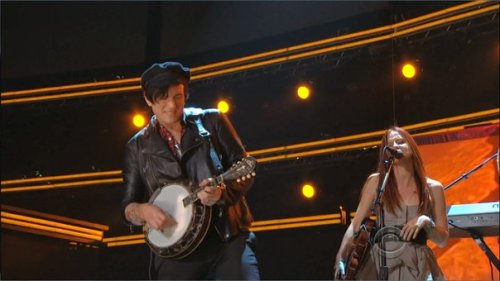
The instrument in the picture is called a banjolin (or a mandolin-banjo--why "manjo" didn't fly, I have no idea), and it was featured (okay, "present") at last night's Grammy awards.* It's evidently got your regular mandolin tuning and string set, as it has eight pegs and I recognized the chords. With the drum head and resonator, it's got to sound twice as obnoxious as your normal mando. The guy playing it is Butch Walker, an eclectic musical dude about whom I'll clearly have to learn more. Butch was just chopping along here, threw in a nice fill or two, made it easy to keep up.

Butch's manjo could have lots of meanings
[UPDATE: I found the photo with a google search, which ended up here. Will be happy to credit it properly if anyone happens to know.]


*For the record, the show was just background noise. My daughter was trying to stay up late enough to see AC/DC awarded. I only got up and looked for the spectacle of Stevie Nicks playing a duet with whatsername phenom Taylor Swift.

Friday, June 19, 2009

The Beats of Different Drummers

More proclamations from the Royal Wii.


There are various versions of the story about how the musical odyssey began at Chateau Keifus. Was it the failed attempt at violin lessons? The short-scale mandolin that Dad managed to foist off on us one day? C.'s kiddie music class? All of these things certainly happened six or seven years ago as parts of a sort of uneven group awakening, one of those creeping gestalt dealies after which we began to see ourselves as a musical family for some reason (and without much evidence). All of the variations are about equally true if we're looking to plot out the beginning of a chapter in the family saga, and with that in mind, I've got to go with the drum set as the beginning of it all.

I know that I've told this story before (to hipparchia if I recall), buried down some thread or other. My wife had been interested in playing drums for years, and so on her birthday--or maybe it was Mother's Day, or Valentine's, but you get the idea--and lacking funds to purchase a drum kit outright (and, I admit, anticipating certain outcomes enough to be cautious about a big investment), I rented out an unladen snare and purchased an instructional video for my sweetheart. Naturally enough, the video recommended a more complete arrangement, with at least a high-hat and a bass drum to occupy the other hand and the feet, and better to work on the basic backbeat pattern that will get you farthest when trying to fake American music. A couple of toms and a crash cymbal are also obviously necessary because they sound cool. A careful observer may note that my initial cash outlay contained none of these things, and rather than hurry back to the music shop, I instead thought it more romantic to cobble together various approximations of these devices. In the photo, the multipurpose cymbal is a trash can lid, painstakingly and lovingly mounted, and you bet that random plastic vessels made fine toms. I regret that my foot pedal, which never did leave the base of the trash can (because where else would the sound come from?), doesn't show up in the picture as well. It had already been removed with extreme prejudice, I guess. The experiment didn't work as a musical instrument, but all in all, I feel it was funny enough to make it worth it.

Playing pretend music better suits our talent level anyway. Fast-forwarding half a decade to my daughter's birthday, we had more disposable income than in the single-drum times (and wisely, we didn't rely exclusively on my personal version of thoughtfulness), and sprang for Rock Band 2, complete with USB mike, plastic Stratocaster, and, of course, drum pads. (We have also a tambourine, a real one, so that whoever's stuck fourth, can at least be a backup singer or just keep time.) My little angel--yes, that same thoughtful wee poet you may have met a few days ago--enjoys certain mildly inappropriate tunes (guilty!) and we'd been eyeing the game as a potential family outlet for awhile now. It took the timely coincidence of her duodecannual and the release of the AC/DC trackpack with her to put us all over the edge. [And it's another thing entirely to sing along with the printed karaoke, isn't it? MTV games (surely a bad sign) mutes the curses ("you can say 'poop' if you want to, dear"), but there's metric tons of suggestion in there, which is a lot more unnerving than a "shit" or two. I'm hardly sure I'm doing the right thing here, but I'm thinking it's a safe place to explore somewhat controversial ideas, and at twelve, you're starting to learn that your traitor body is discovering suggestions all its own, like a walking innuendo. Moreover, if the thought does take her to rebel, here's the stuff she'll be rejecting. The eight-year-old, meanwhile, remains happily clueless.] If you were thinking about purchasing the game, be aware that this post officially makes it not cool anymore.

Rock Band is immensely fun. It's as if that air guitar you carried around since you were twelve somehow acquired a kickass amp connected, and without actually learning how to do very much, you can sound like you've spent countless hours in your bedroom learning the basics and mastering every famous riff. Playing together as a group, you do get some sensation of feedback, or, if someone isn't keeping up their part, of collective failure. (And when the tambourine is off time, we really hear it.) We were all doing our living room rock moves before very long--it just felt natural. After the first week, we'd all stayed up past our bedtimes every single night, unlocking half the tour, and we shambled around during the day like zombies, night creatures out of our element, nursing the wounds we suffered in the name of our imitation art. Junior lost her voice for a while. My wife's shoulder and kick-pedal leg got sore. My damn finger went numb--the counterfeit guitar doesn't have nicely sanded and careworn surfaces a real one does, and the injection-molded neck evidently has been digging into the base of my fragile pointer, but the show must go on. It was fun to make rocker versions of ourselves too, to which the game gives the characters convincing band mannerisms, and the video bits synch up impressively with the music. I'm pretty sure I've caught the Keifus avatar lusting after the cartoon drummer.

My conclusion about drumming back then, incidentally, was that's it's fucking hard. Too many body parts acting completely independently--walking and chewing gum, but also waving, and being sure to count the cracks. It takes a certain type, I think. Out of all the ersatz equipment, Rock Band only pretends that the drum pads are anything approaching a real instrument, and there's a drum jam tool buried in there somewhere--might even work with old training DVD. I guess they have a sufficient number of things to hit at the appropriate moments, representing all of a basic kit. As for the guitar, it only has one "string," and since the fret buttons are only loosely associated with the notes the recorded guitarist is playing, there's no knowledge of music that will help you very much, and if your hand is in the wrong position there's no immediate feedback (wrong note), even if it's obvious you're doing something that's not right (no sound at all). On the easier settings the sham guitar is pretty pointless beyond informing you a little of the fundamental shape of a song. On the harder settings (or at least on the harder settings on the easier songs), you fret most of the notes that are played, and if you're willing to suspend disbelief, you can almost convince yourself that those great sounds are coming from you. Which rules.

My imaginary music playing is cutting into my actual music playing time. (And much as I love the thing, a mandolin doesn't substitute a good electric guitar. It's like when you just want a good burger, already.) When I get my reduced time on the little mando, I surprise myself to find that I'm not any worse for the lack of practice. Even if my pretend guitar playing is meaningless pitch-wise, it does force me to keep a good rhythm, which hasn't ever been my strong point, which is something of a problem when you're playing a rhythm instrument. As for the quasi-fretted notes, I have the same issues, actually. Poor accuracy, and there's a speed threshold I can't generally surpass. I have never been able to gradually ramp it up to sneak my way into a faster tempo. At some bpm, my fingers just go from "adept" to "flail."

Since C. is summoning me to play, I need to wrap this up, and indeed, here's where I originally intended to end it, but I learned this morning that they have published an expansion pack of a certain Canadian progressive rock trio (shut up! that's why!). Which is badass. I figure I have to do better at it than these guys:


Saturday, August 09, 2008

Ten Random Songs

[You want to talk about scraping the bottom. Real posts next week, honest...]

If I've learned one thing about cooking Indian food--and it's even possible that I have--is that it's worth it to clarify the butter and use fresh-ish whole spices. If I've learned two things, the second is that for curries, all the goodness comes out of cooking down the onions (and some spices) first, and then cooking all the liquid out of the tomatoes (and some other spices), then adding water, and cooking it all down some more. If I've learned three things, it'st that frying the spices...well you get the idea. The whole process takes a fair amount of waiting around to make it good, to make it taste as authentic as I can judge by the occasional dinner at acquaintances' and the buffet in the next town. If I were running a restaurant, I'd make vat-sized versions of a basic curry sauce like this, and use it for two dozen dishes of exotic, but surprisingly pronouncable, names.

While the flavor simmers down and develops, instead of finishing my book or polishing off the two or three substantive posts I keep meaning to write Real Soon Now, I've got the computer serving me tunes at random, which is enough to make me happy. Here's my first ten eleven. Admit that you're bored too, and share your own.

1. Don't Pray on Me, by Bad Religion. I still can't decide if this band is brilliant punk rock or it it's just puerile. I can picture Greg Graffin, scowling and sticking his tongue out like Lucy Van Pelt, angrily challenging Christian ideas on paper. The lyrics come out clever and scathing, but it's also obvious that they're trying really hard to be. The music is exciting, and while I'm always thrilled when one track kicks up in the mix, the entire cd somehow ends up as less than the sum of its parts (and I think they made like a dozen of them). This is one of the better tracks on this one, anyway.

2. Jet City Woman, by Queensryche. When this band is connecting, they're phenomenal. When they're not, they're something closer to embarrassing. Here's the first song I heard by them, when they played it on the radio in 1991 or so. It's caught a certain mood now and again.

3. Swamp Thing, by Sam Bush and David Grisman. Some indulgent noodling around by a pair of mandolin players who are good enough to. I seem to have an inordinate bunch of their music on the hard drive.

4. Walk of Life, by Dire Straits. It can't have been too long ago that I caught Mark Knopfler, along with Eric Clapton, Sting, and Phil Collins (the last two akin to putting Teddy Roosevelt on Mount Rushmore) performing Money for Nothing on TV, and I thought that this is the hardest any of these guys had rocked for twenty years. Anyway, Walk of Life is a good tune too.

5. Shine on You Crazy Diamond (pts 1-5) by Pink Floyd. More college vintage. I remember sitting in the "penthouse" and having a discussion about how, dude, Pink Floyd is like really mellow an' shit, but turn it up, and it's like, really intense. Thanks to Ted Burke (I think it was Ted), I notice how much studio electronics went into their albums now, but fortunately, I don't care. I love Pink Floyd.

6. Cold, Cold Night, by the White Stripes. More about Meg White trying to sound sexy than about writing guitar rock. I'm not going to tell you she doesn't sound sexy.

7. The Lights of Home, by Bela Fleck. Dad: the only piece of music on which he can tolerate a dobro. Mom: the only piece of music in at least forty years, and possibly ever, that's "got" her. Very important note: my parents are sixty years old.

8. The Dream/Indiana, by Patrick Street. A recommendation by some Irish dude. This one reminds me a little of Mr. Knopfler (above) at his more quiet, or of an American folk ballad, but it's neither of those things.

9. Ugly, by the Violent Femmes. They're a better live band, I think, especially when it comes to tracks like this. Good times, needless to say.

10. The Camera Eye, by Rush. Oh, so I'm a geek. I think I've been over this one, too: this is one of my favoritest songs. I love the chord changes, love the flow and rhythm of it. It's like the very definition of the word "vibrant."

11. Down with Disease, by Phish, "Waitin' for the time when I can finally say, that this has all been wonderful, but now I'm on my way..." I've been there. My kids love this tune too, for different reasons.

There's nothing I can say to make it stop, sooo....what's on your iPod?

Tuesday, July 22, 2008

Major Key Chord Progressions and Fingerings for Mandolin

This isn't a normal blog post, but a placeholder to "publish" something that might be useful for other people learning to play the mandolin.

[Update: This post seems to get a lot of search hits: I'll add that I find the "chord families" probably the most useful, and am much too lazy to practice lengthy chord progressions I'll rarely use, although I still do sometimes. Also note that there are a couple errors in the charts--took forever to get all the dots aligned. Finally, if you're a relative beginner looking for someone to pick around with in the MA area, feel free to follow the email link.]

I have put together some tables for chord progressions, chord families, and suggested fingerings for the instrument. The tables were inspired by some of the drills suggested in Music Theory for Modern Mandolin by Thomas P. Ohmsen, and put together in a format that I find particularly useful.

The first table just lists some common chord progressions in each of the twelve major keys, written in a manner convenient for practicing. I didn't include all the variations of course. (The bottom part (II-V-I) of a circle of fifths progression can be expanded by including columns to the left, one at a time.) I listed them as triads only because it was easier to write, and I actually try to practice both the triad and 7th degree voicings.

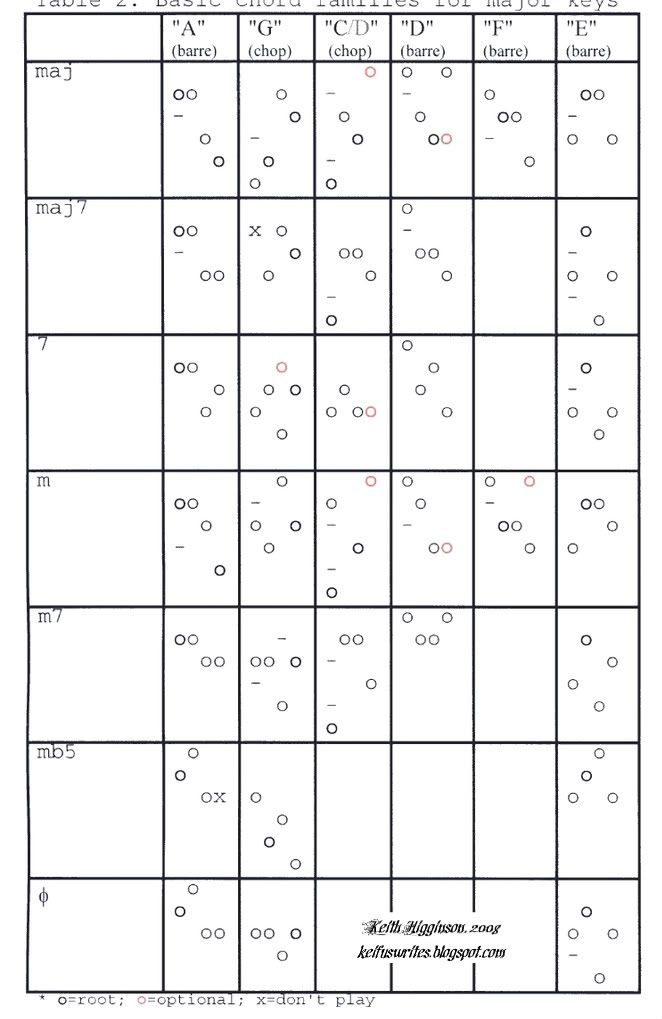
For the second table, I borrowed the idea of using chord families from Niles Hokkanen in his handy short book, Pocket Guide to Mandolin Chords (it fits in your case!), and I have used the concept to assemble a somewhat complete table, using labels I'm comfortable with. In the fingering diagrams, the root note is bolded, and the positions are consistent within the column. The actual chords can be moved up and down the neck easily, keeping track of the root notes for each family.

The third table shows the best fingerings I've worked out so far for the major-key chord progressions, all at roughly the same distance along the neck, and in some cases, they're the ones that flow really naturally into one another. Positions are consistent relative to one another across the rows. Some alternate shapes are also suggested (but I only wrote one set of fingerings for each progression).

I am a regrettably slow learner with this stuff, and sometimes find that one voicing over another will sound better in context, especially when playing by myself (which I normally do). Sort of thing that will come out with practice I imagine, and these exercises are meant to build up that foundation. Have fun with them, hypothetical readers, and if it was helpful, feel free to drop a comment or to cite it. (If you hate it, hey, it was free.)

(Click tables for a closeup.)
(Errors:

  • the II chord for "7th 1" should be moved down a fret.
  • I drew the "G chop" (of all things) without a fret between positions on the E and the A string.
  • On the chord families, the "Gm" is wrong--the lowest fret should be moved down one (pinky touching the "G," duh.)
)
Table 1. Common Major-Key Chord Progressions


Table 2. Chord Families


Table 3. Suggested Mando Fingerings for Major-Key Chord Progressions


Sunday, February 10, 2008

Finding the Funky Kink

"There are two types of people here: people who play instruments, and musicians."

I'm sure it's a quip that gets uttered any time both types of people gather together in the same room. In this particular case, it was some toothless codger at my mother's fiddle club, a talented old bastard stuck among a group of screeching, caterwauling octogenarian farts that celebrates more funerals than gigs. I've heard their practice cd and I'm sympathetic to his aphoristic feeling, even if it stings. The sound of them recalls all the joyless horrors of high school band sessions, and my mind fills in the details of a harried, underpaid director, hopelessly trying to flail three dozen instruments into the same time and the same tune with his little wand as the musi players all saw away with an urgent confused focus or with blithe, individual abandon. It's not an inappropriate venue for my poor dear Mum (who, I'll emphasize, is not reading this) as she hardly feels it in her at all. Even now that it's inexplicably become a family thing, she still hasn't found that funky kink in her soul, the smirking, expectant, excitable little asperity of animus that coaxes music into being, or responds to it. You can imagine the mindset that got her auditioning solo in front of all those geriatric cranks, that certain combination of stubbornness and cluelessness. It runs in the family. And she impresses the hell out of me.

Still, I'd much rather be the musician in that epigram. It's not because I'm a particularly aspirational sort of person (really kind of the opposite), or because I'm particularly good at it (I'm not), but it's a growing torture to have this body of understanding looming so close to the edge of my apperception. It's like a familiar face I can't put a name to, or a missing phrase that will perfectly express my thought--or maybe like that enthusiastic but retarded little psychic drummer that was happy enough to keep my jerky internal rhythms going at their own idiot pace for thirty years before noticing the sounds around him, and who is now deluded to think he can march the body to that external time, or even worse, maybe has the idea he can express our own oddly syncopated thrumming to outside minds--and it taunts me just out of my reach. If I get nothing else out of music lessons, maybe I'll convince myself to eradicate these sorts of shitty metaphors from my vocabulary.

I'm up to two of 'em so far (lessons that is, already in double digits with the language thing), and I think they're great. I don't know how good a teacher I have (certainly he's a hell of a player), but I appreciate for now the loose approach we've been going at it, focused more on opening up paths than on inflicting instructional drills. I can go ahead and wade through the drear on my own, and playing (nervously) along with someone (much) better after I've been getting some pointers lifts me right up. I'm almost annoyed that I have to pay someone fifty bucks a pop to show me where the door is, but there you are.

An example of what I mean: in the middle of teaching me this one riff, I ask him about the rhythm he's backing me up with, and it breaks off on a tangent about the chord shapes I know, and some of his more arthritic variations. "I like the chop chords, but these barre ones sound nice sometimes. Is it important to practice them in general, you think?" "Dude, it's good to practice everything." It's like I needed permission. But as importantly, it's like I needed to be told the point of developing more than the usual default shapes.

This tidbit kicked off a quest to develop some better understanding of music theory. It had gotten to the point in the various intermediate and introductory manuals where it was more difficult to keep explaining the simplified version than to just come out with a reasonably comprehensive approach to the subject. I needed a little more of the why of it, and a little less ad hoc explanation. (I sometimes had similar problems with undergraduate engineering courses.) That five-minute tangent is also providing a new appreciation for contortionism as I twist my fingers through sixty pages of mandolin chords. I don't expect to memorize them all, but it's great for limbering the digits and feeling out the constructions by ear and hand.

The frustrating thing on a mandolin is also one of the things that makes it simpler to play than an instrument where you can theoretically reach everything. With only four (pairs of) strings and only so many physically possible ways to wrench your knuckles, the number of chord voicings is limited. In almost every case, you're stuck playing an inversion, or for anything past the seventh degree, with a chunk of the middle cut out. I find both of these things to be a little maddening, because they can sound very different to my primitive ear, and the right voicing, in the right context, can be the difference between euphony and cacophony, even when you're plucking the same basic notes. I mean, how do you know? You could learn the half-dozen fingerings for each of the eighty-three motherfuckers I've had named to me so far, and there's still no guarantee you're a musician. There's more to knowing the tones and the shapes, more even than knowing when to use them. There's this business of the funky kinks: that killer intuition for what sounds right, and much as I think the book-learning can augment musicianship, build it up to dizzying levels in fact, it sure ain't the source of it.

There are a couple of keys on a mandolin that lend themselves to strumming with hardly any input from your fingers. On his blog, Claude Scales featured a musician a month or two ago, some pie-faced, but still rather handsome, chap (must be the hair) grooving out a Canadian folk tune in the key of G. He sings well in his style, but I'm hesitant to call anybody who's showing off something even I can pick up in half an hour as a mandolin player. What even took me that long is that I didn't immediately recognize the chord he sneaks in between the G and the C, the one that gives the song it's real character. It feels like an anticipatory lift, a ride over a swell just big enough to change the view for a moment before sinking back into the usual pattern, temporarily vertiginous, but well in control. It's exactly the thing that makes it feel like a sea chantey instead of the all the bluesy redneck versions of the same Island tunes, what puts it on the shores of Nova Scotia in fact, and not in the hills of Appalachia. The open (unfretted) chords lend to that feeling too, as does his non-percussive rhythm strumming. The sound flows instead of stomps. I doubt the Bard of Cornwall is a theory nut--based on his videos, he only seems to know four or five chords and play in one or two keys--and I doubt in my thick mando tome, I'll find a picture of the Gorton fisherman next to a chord progression with that major seventh in it. He hit that fret, I imagine, for no other reason than it felt right. I could read music theory all fucking day long and never make that leap.

It's not different in any field. The reason I remain a mediocre engineer or chemist (or whatever the hell it is I do) is that I don't find so much satisfaction from scratching the itch that it justifies the depths of scientific monomania. (My employers only make this worse.) It's too easy to yank the tension out of my internal geeky knot. I'm undoubtedly less musically inclined, but here I find it more rewarding. If you find one of those funky kinks, I guess the best thing you can do is stroke it, get the joy out of it you can.

Saturday, February 09, 2008

"Something I'll never be able to perfect"

Dig the initials.  Dig the shamrock.
It just says Keifus, 35-year old Hawaiian organ donor
For Christmas, my parents gave me a photo album documenting the process of creating the "Keifus" mandolin. I wish they had a better feel for those modern, digital, cameras, because the blurs and the thumbprints detract a little from the representation of the whole creative experience. As brilliant as the old man may be--and he is--it's still a little more comfortable to give up the goods (and the faces) behind the process to some tech-savvy strangers.

Here's one dude going through the closing steps of gluing the faces to the sides, doing the finish, and providing some requisite 21st century nattering. Enjoy...

Monday, October 01, 2007

Lairnin an' Such

I've lost track of the exact sequence of events that got me into playing music. My daughter was taking violin lessons for a short while several years ago--is that what prompted my father to send her back with a short-scaled mandolin, or was it the other way around? It is for sure what started my wife's sporadic interest in the fiddle, as she tried to show Junior some of the practice moves. Regardless, that neglected little mandolin (yeah, I think it showed up a good year before the fiddles) proved infectious, and to this day I have no idea why. I played a trumpet in high school, and it took as poorly as the kids' violin lessons did. Maybe it just took thirty-plus years to grow the proper mindset. (I should be great when I'm 80.)

I'm not an overbearing music parent (or husband), and aside from the little brown lute, the efforts come and go around me. Far from overbearing: if the girl's not interested, then I can't see the point of springing the funds that could otherwise help inch the family out from our crushing mountain of debt. Private music lessons don't come cheap. Learning through school is covered by your taxes though (there may be a libertarian anecdote in this one), and through those channels, the rented kid's fiddle has been replaced with a rented (full-size) trombone after a merciful two-year hiatus. The bias of school music programs toward wind instruments is a mystery to me, really. My current theory is that it's an insidious scheme by The Man to completely dissociate music from sex (the emasculating band uniforms I remember from high school would support this), in which case, my daughter's going to remain unmolested if she manages to drag that ridiculous trombone around until she goes to college. ('You know, I have a trumpet,' I tell her, 'it's a lot easier to take on the bus.' 'Daddy!')

Of course I had to try it when she brought it home, and I can't say whether it's with pleasure or disappointment that I observe my hatred of brass instruments holds. They seem like they should be my thing, all about the mouthfeel, but before you can start slobbering lasciviously into one of those, you have to learn to clamp your cheeks (your embrochure) vise-like to even get the first fraction of the available notes. (I think it also helps to have an appropriately shaped mouth.) That was a frustrating thing--you need some stern measure of discipline to even find most of the damn notes, never mind to play them well. Even though I've been clenching my jaw for about a year straight, I still could only come up with hissing farts on Junior's trombone. The visual/aural/tactile combination of a stringed instrument has, to my surprise, suited me much better.

The other frustrating thing with the old trumpet was just my basic laziness. I didn't want to learn it badly enough to actually learn it, and it didn't come nearly as effortlessly as the schoolwork. It's funny what you value. My wife has had no time for fiddling since she started taking classes this fall. She's busy relearning chemistry for the biomedical field, and this time around she's fascinated with it all. She's taking notes and studying hard, not to get through it, but because she's paying the cash and wants to learn what she's paying for. Also because it interests her. It's great to see her this excited. When you're learning because you want to, you can get a sort of positive reinforcement going. When you feel obligated, the knowledge can still get in there, but it's not treasured. In my case, this has been the difference between the tiny handful of good projects at my job and the innumberable shitty ones (that have been better spent blogging).

I've been an autodidactic menace on the mandolin for more than three years now, and, as I've been saying, cruising along a low-grade upward spiral of interest and accomplishment. Which isn't to say I don't suck--I'm atrocious--but I'm at the point where some pointed advice, advice about where to focus, some tools and tips, would be highly valued. I landed in music lessons by another odd sequence of family events. My wife ran into a mandolin player at a wedding and cornered the guy by the bathroom. (My wife's tactlessness makes up well for my shyness--we work great this way, except when we infuriate one another.) I may be terrible, but this guy is an ace--I really love his fusion thing. (And I'm sure he won't mind the plug.) At fifty bucks, I'd better value the lesson, but even one visit is pointing me in some of the directions I was too puzzled to find. I'll write about that soon, I think (this post is a boring introduction to that one that flowed over the wall), but it feels good to be gaining knowledge without pressure, for no other reason than because it satisifies me.

Keifus (with apologies to the usual gang of idiots)