Tuesday, February 24, 2009

Review: The Devil in the White City, by Erik Larson

The Devil in the White City arcs through the life of the 1893 Chicago World's Fair--the white city--from conception to abandonment, and follows it along with the story of the first big serial killer to emerge from the nation's headlines. It's non-fiction, but it's told in the human scale of a novel, not presuming quite so far as to invent dialogue and carry on with the narrative authority of an novelist--it's not fair to call it fictionalized but it does develop the story with some familiar thematic elements, in a fashion that reads like a plot advanced through the usual means of witnessing human conversations and travel, and revealed in descriptive passages of what a narrator might have seen were he present. When possible, he includes actual first-hand impressions, from letters or diaries, and this fills out the details pretty nicely. The prose styling felt a little too conscious to me, Larson peppers in some undergraduate-level wordplay here and there, and it reads a little like a weekend news magazine piece, but it's not meant to be a deep meaningful novel, and fine for what it is (and it's not like I don't sympathize).

I think he's got a bigger problem with filling out the character of the serial killer, one (pseudonymous) H. H. Holmes. He admits (his notes are very considerate) that he took some liberties about Holmes' motivations and mannerisms, basing it largely on modern criminology. And that's just it: pretty much anyone who's read a mystery novel, watched a movie about one of these monsters, or cringed at yet another expert profiler (like a police psychic, but with university credentials) offered as a resident experts by an ever-hungry news cycle exploiting the horror du jour, and you sort of realize that even if this Holmes guy coughed up the first sick nugget, this is still the exact same vein of twisted criminal psychology that's been artistically mined for a hundred years now, readily identified even to someone like me who normally goes far to avoid this kind of crap.

And Larson had an opportunity to make him something different too, maybe something scarier, because this was one industrious psychopath, a man who carefully worked in a crematorium and laboratory space within the hotel and retail space he creepily and inexpertly engineered. The views of the facilities got to me a lot more than the customary(!) psychological portrayal of a mass murderer. In terms of a physician's curiosity he was not really that far afield from the popular concept of the ghoulish efforts of the earlier Victorian medicos, with the important caveat that Holmes hastened the cadavers to his studio. He couldn't have been good at it, and here I'm left wondering what lies this sick motherfucker told himself as he donned the apron. His amorality and his obsession were the scary parts; his oily smoothness and whatever frisson he might have attained from a murder was less convincing, absorbing too much from popular research. I am not grateful for imagining these things.

I'll give Larson some credit, though: the horrifying spectacle of our first signature serial killer seems to grab something essential about late nineteenth century America, as does the sensation of the 1893 fair. The world's fair, chock-a-block with corporate exposition, artificial landscapes, Bowdlerized history, inaccurate ethnicity, and engineered marvels, feels like it's catching the modern American mindset at its source. It's like the lies we told ourselves were fresh enough to be charming, a fake paradise designed with real integrity. Reading about the world's fair is like witnessing the arrival of a beautiful throwaway culture developed before injection molding made it reproducible and ubiquitous. We get a great tour of the architectural and engineering* talent of the day, all management and salesmen with big ideas and an eye toward the grand. It took big imagination, persistence, and a hell of a work ethic, pulled off at great expense and just in time. People a hundred years from now will doubtlessly be curious about our quaint optimism about, say, the digital age, and marvel how it belies the horrors of our time. They'll see their own culture in here too.

The fitting counterpoint to the ideal of the white city was, of course, the dismal squalor of urban life, the reeking stockyards and fever and coal dust (which, I'll add, Larson portrays very effectively). To the theatrical fact of the fair, the criminal is a fine juxtaposition. I can't believe that this was the first serial murderer our country housed, but his was the first case to grow into a modern media circus, and probably the first such case to really get absorbed and solved. Maybe, oddly enough, it was a function of the growing value of life.


* And what the hell, here's Ferris and Roebling, and no mention of the college that positively owned nineteenth century engineering?

Thursday, February 19, 2009

Housing Recovery

On the radio yesterday, I listened to snips of President Obama's speech about housing recovery. NPR had a streak of reports from boom towns now gone bust, and the president gave his speech from the home-flipping mecca of Phoenix AZ, offering a plan in which the banks would be forced to finance so that monthly payments don't exceed a third of gross income. Sounds like an entire circle of hell might fight over the details of that one, but it's possibly an equitable out.

(You know, I live in an unloved little burbclave too, and even paying a fifteen year mortgage in a pricey region I never quite got to a third of my net income. It was by choice, and it's why I don't live in a bigger house or in an even pricier region, as my means are not exorbitant. I still wonder: what the hell do all the palace dwellers do for a living?)

Anyway, it occurred to me that at least part of the problem is that there was suburban sprawl booming in waterless places like Phoenix. Is that a development model that's particlularly wise to recover? Probably not so much. Then I read this today, and it depressed the hell out of me.

American Idol Season 8

First of all, let's get the yearly apology back on the table, and then out of the way. I hate the show: it's transparently manipulative, it highlights an awfully narrow (and frequently awful) spectrum of musical taste, and the only judge that's not a simpering retard is the production genius that brought us Il Divo. Since, however, 3/4 of my household is comprised of young girls and moms--the precision demographic of the show--there's no escaping the chugging dawgs and the paint-peeling glory notes, not at that volume, and really, talking about it is my minor act of subversion. I've tried to follow Vote for the Worst, but it doesn't strike quite the right groove for me… I think I'm still a little itchy from last year's marathon Idol conversation with the excellent company on quiblit.

I watched this year's buildup of young talents, and the most remarkable thing about the pre-singing episodes is that they're really letting the talented clowns shine this year, going all the way to the feature stage, while downplaying the truly pitiable. As a captive audience, I support this both for it's entertainment value, and it's reduced malice (people really delude themselves, and AI scores ratings on humiliating them--someday I'll post a heartfelt lament for all of us untalented dreamers). From the show's perspective, I suspect that they want to send the message that yes, they need freaks and drama queens of ambiguous sexuality to show up and be exploited, but no, they're not what "America" wants. (Unless, of course, it is. After meddling in "country," "rock," and "soul," maybe they're now fishing for the next Fallout Boy or something).

Anyway, even with a few quality nutbars in the wings, Tatiana Del Toro with her starry-eyed neediness and her infectious SpongeBob-like giggle is already missed. But the thing is, Tatiana actually has singing talent, and she was a lot less painful to watch on the stage than that stumbling tuneless troll Michael Sarver, whose only talent appears to be the fact that he's really white. And a roughneck. On a real Texas oil rig. They have some kind of wildcard round this year, so maybe the judges will allow Tati to re-emerge in her scary, hungry glory. Anoop ("Noopsy") Desai also lost to Mikey Roughneck because he doesn't fall into a ready American ethnic stereotype. Also because the song he sang was boring as shit. He has a good voice though, and he seems nice, and he's been pimped madly by the judges, and I take this to mean he is sure to get wildcarded, even if they have to cheat.

A couple of teenagers were disposed of last night too, deservedly. One of them sang "Every Little Thing She Does is Magic" because it's so fun and uplifting, not that childish disconnection from the material is always a deal-breaker on this show. The thing about Sting (who now joins Whitney Houston on the AI verboten vocal list) is that he can't really sing, but in spite of this, he's able to communicate the emotion of the music, which is at least sometimes interesting. Our young tart got it wrong from both angles.

I've already forgotten the name of the girl who sang "Natural Woman," but I think she got a bad deal from the judges. I don't pretend to have a good ear, but her singing really felt like it clicked into the music, which I identify as a sign of good pitch and good time, and while it may not have been a star performance by any means, given the flailing of the other eleven, I felt that singing pleasantly in key should have counted for something in the judges' comments. In the car I was thinking how "Natural Woman" is to soul what "Whipping Post" is to rock or country. Would you ever want to hear anyone to a simple, straight take (smiling smugly, fingers snapping jauntily) on that one?

Finally, at what point did Danny Gokay turn into one of a pair of undertalented not-gay nerds (he looks like the creepy progeny of Robert Downey Jr. and Bud Bundy) to the next sure thing? (And why does my wife love the guy?) I know he's got a sob story, but his style is mediocre, and even though he sang better on Tuesday than I'd heard him before, I still don't want to hear him again. And . I thought the producers where playing him up so that he could face his best friend in a sing-off, but it looks like he's an anointed contender. Judging from the people who passed through, it's going to be a long dull season of this terrible show.

Tuesday, February 03, 2009

Review: U.S.A., by John Dos Passos.

U.S.A. is Dos Passos' landmark trilogy, containing The 42nd Parallel, 1919, and The Big Money, and although they've been sold in omnibus editions at various points in their publication history, I bought each one separately. Now, I consider myself too old to fall for the trilogy scam: I read to slowly for one thing, and I'm just too damn judgemental to suffer an author who can't decide how to market his bloated epic. Write one book or write three, dammit. But anyway, this isn't formula fiction and U.S.A. is epic enough as it stands to bustle its way into timelessness. It feels almost like a Western War and Peace, a tale of class struggle honoring the oppressed but expressed lengthily through the intersecting lives of sympathetic middling elites, this one full of obnoxious quick-talking (quicktalking) American verve. It was, at a minimum, engaging enough to break my rule of reading the same author sequentially, which, given Dos Passos' technique of breaking the book into stylistically different sections, it half feels like I'm doing anyway, even in one book. Stupid rules.

The bulk of U.S.A. follows the characters, a rat-a-tat exercise in plotting, drawing them from childhood through their adult lives, a miniature life story pulled quickly this way and then that, actions and consequence, ongoing. What the plot narration lacks in introspection, Dos Passos brings out in a long series of highly subjective snapshot segments, "The Camera Eye," closeups of what are presumably his own experiences told in a kind of freely structured prose, heavy on perceptions. (Heavily influenced by Joyce, I understand, but can't personally assert. The Camera Eyes are not challenging to follow.) I find some resonance in this approach, it captures the dynamic of early memories, images and feelings caught in time, both lucid and dreamlike. Here and there a detail sneaks out of these restless memories into the general plot, which is interesting, but not so frequently done as to write an easy thesis about it. He reserves his more obvious social commentary for another separate section, a series of snapshots of historical figures, painted tragically, lovingly, with contempt or irony. These figures lead more stable and pointed lives than do his various characters. "Newsreel" is the fourth running segment, short sections made up of song lyrics, newspaper clippings, and headlines pasted together into bits of found art, which sometimes informs the story clearly and sometimes vaguely, and generally gives the external context of confusing stuff happening all around. I enjoyed the Newsreel segments a good deal, and they'd be a fun motif to adopt in a short format like this one (much as I try to avoid being topical), in the modern wash of low-quality information.

What the U.S.A. trilogy conspicuously lacks is a discursive narrative heavy on analysis, on interpretation, on assumed significance, on romancing the horrors and the joys of the human condition. Even the introspective sections don't appear to go after any deep parallels, and whether Dos Passos was attempting to reveal a grand arc with all of small pieces is really what kept me reading until the end. Leisurely descriptions are also missing from these novels, although short serviceable ones abound. (It's interesting to read the characters describe one another differently, for example.) There's a solid sense of place that evolves, which almost surprises me, and many places get highlighted, a good fraction of which I've visited. Dos Passos takes us through industrial Connecticut, suburban Washington DC, Seattle,* Chicago, California, Paris, Miami, Pittsburgh, and while New York City is frequently featured, it's blessedly not the center of the universe, and as a canonical experience, farm life is (thankfully enough) completely neglected. There is humor, although not much, and it's delivered in small patches like everything else. If Dos Passos' Wildean quips felt sort of tortured, he was in his amusing element when he let the plot and dialogue unwind with a quick-spoken huckster's absurdity. The sense of time is most poignant, and it wasn't lost on me that this is my great-grandparents' generation. The survivors of U.S.A. would have been checking out just as I was checking in. Tag.

Considering Dos Passos' abrupt sort of plot exposition, the length of it is impressive. Stuff happens, and then it keeps happening. I started out really digging the short-story-ness of this approach, motivation and character economically dispensed with, and then scenes unfolding and closing like a life does (and as quickly). After a few iterations, this mode of exposition gave an impression of a mixed-and-matched set of plotlines, tracking a life through a sympathetic childhood to a disagreeable adulthood, going through some benchmarks in between: young impressions, walking out on the home, making friends, drinking, having sex, business success, drinking, dealing with unwanted pregnancy and/or closeted homosexuality, and eventually getting older. When the lines start interacting with one another, it's actually surprising, it seemed till then that the intent had been to present slices of so many unrelated lives, and if that trick is bordering on tiresome by the middle of 1919 (when everyone is in Paris somehow), it grew interesting again as the third novel progressed, as if he were looking, like I said, for a broad point as similar life events got repeated under evolving circumstances.

Ultimately I see the trilogy as a critique of the times. People have similar impulses, and the scope of their consequences is directed by external stimuli, and it's the latter, the external, which Dos Passos is really commenting on here. The 42nd Parallel features bright young people making their way, following their short-term desires, and if there are ideals tied up in their motivations, they are more tied to their upbringing or their character than to any universal good. Though it's clear where the author's sympathies lie, their ups and downs aren't governed by anything more than their own shallow decisions, and for all the bad times, the trend is upward in the first third. It's weird--really weird--that we see so little of the war, but the war still feels like a turnaround. Some characters suffer more tragically (almost in a conventional literary way). History gets warped as a consequence of the conflict, and importantly to Dos Passos, the Labor movement becomes more critical and (he appears to hope) adversarial. By The Big Money, some of the big events are hitting the character's lives in an obvious fashion, there's influenza now killing people on screen, and the lives lived in the boom twenties brings are larger, the self-destruction is deeper into society and more personally deadly to the people we're supposed to relate to. We see, by the end, shots of hopeless mine-town squalor, and of idealists getting beaten down and shot. We see a movement rise, which I'll tell you, is impossible to advocate in historical hindsight. But it's a subtle picture that emerges from the whole, put together almost like a mosaic of similar pieces, and it's an epic one.


* For the first several entries, it felt like Dos Passos was following me around, and there are enough O'Higginses, Higgenbothams, and Higginses sneaking around in the margins to make me positively paranoid.

Thursday, January 29, 2009

Drunkard's Walk: Ten Short Thoughts

1. More digital age obsolescence: Cars, at least until recently, still got sold listing AM/FM radio (yup, frequency modulated signals processed at no extra charge) and tape decks, and while I'm aware that you can get modern car audio at a premium, I am not willing to pay for it. It was a shock that my '06 had come so far as to include a CD player standard. I don't want the fucking bluetooth, nor do I want to drop an extra hundred bucks (forty more than my beloved little MP3 player) on that broadcaster that sends signal to my radio, but Jesus, let's ease the transition here. It strikes me that it would be a simple engineering matter to add one of those TRS style audio jacks that have been around since forever, and which every pocket audio device has sported for the last 30 years as a headphone connector. In a sane world, I could just use my car stereo as an amplifier for whatever, without necessitating hundreds of dollars of electronics in between. Is it not expensive enough a solution to add on every car radio? It'd sure make me happy.

2. Warpaint: When the Black Crowes' seventh CD came out last year, and some hack at Maxim took the opportunity to unload his pent up opinions about the band without wasting the time to listen to it, I totally put the album on my to-buy list. Naturally, it took awhile. Admittedly, the project is not terribly inspired: the tracks have the casual brio of a talented hippie-party jam band, and compared to Shake Your Money Maker, the whole thing sounds a little...optional. But still. Criticizing them for knocking off the Rolling Stones? I am pretty sure that the Rolling Stones (not even mentioning their more embarrassing efforts) are not even aware that you can put so many instruments in a band, and tired as the Robinsons may be, when they play the bluesy, weed-baked, countrified rock songs, it sounds like they're at least vaguely in tune with wherever it is they came from.

3. Via IOZ (and recycling my comment): I don't know much about running companies, but from my passing association with certain kinds of nerds, I'm pretty sure that Carly Fiorina is the reason why people now say "Hewlett ...what?". But at least you could call her an economic expert by dint of some ruinous joyrides through corporate America. What have George Will, Cokie Roberts, Sam Donaldson, or George Stephanopolous ever fucking done or learned? Check out the video. Paul Krugman looks like the tired foodie ringer they put in with the actors and celebrities that for unknown reasons make up the Iron Chef judging panels. At least there, people don't live and die by culinary art.

4. But let's not get carried away: But then, I don't fully accept economics anyway. No matter how furiously you model, how clever your mathematical simulations, even if you uncover some amazing truths about behavior in the ensemble, no matter how interesting it is, or how useful, and even if it can be an excellent approximation, economics ain't quite dealing with natural law. (Uh, probably.) How much people will pay for stuff is not, at the bottom of it all, a fact--it's an opinion. And let's face it, people's opinions tend to be stupid.

5. Anyway, we're still damned if we do: Speaking of economics, the new bailout is super (if you're creating money, then let's print a little for everyone) and so are green jobs, and maybe you can even change some of the deeply held public opinions about our relationship with energy (not that that's the intention), which would be awesome. But you can't trump physics with enthusiasm. No amount of legislated work projects is going to circumvent the usual conservation laws. If we're lucky, we'll keep ourselves from going too far or too quickly down the other side of the peak (and maybe economics will slow it naturally, provided we don't all lose the public faith), and maybe if we're far luckier than we deserve, we'll buy enough time for nuclear fusion to come on line or some such shit, but let's not pretend we're not limited by the rapidly disappearing black ooze. This is the second-biggest reason I hate American politicians, by the way, and if Obama's less aggravating than most of them, then, well, he's still going to molest my children sometime down the line. Maybe keeping up the infrastructure that connects the burbs with easy highway access shouldn't be the first priority going forward.

6. Bad Graphs: That said, while I buy into some version of peak oil, there are good and bad arguments going on there. The charts are famous enough, and it's easy to grasp how regional production peaks and then tails (pace Dr. Hubbert), and to picture that fact against how much many regions are still likely to be out there (e.g.). On the other hand, graphs that pretend to pinpoint the dramatic peak have to make their point by extrapolating heavily, and should therefore be regarded with caution. Penciling a line that tanks starting, always, one year from now (some more egregiously than others) is particularly inelegant. I believe you in the general sense, so please stop going out of your way to look like you're lying.

7. Spelling America with a 'K' are we?: Reading John Dos Passos (link forthcoming) got me thinking about the timing of anti-Communist sentiment in America. It Anti-Labor feelings had settled in pretty hard before the Great War, and a good historian would probably catalogue the movement as a response to conditions following the good ole industrial revolution, an answer to the new aristocracy and the condition of the filthy underpaid masses that grew out of those innovative times. Anti-communismlabor was, naturally enough, the response of that aristocracy, of the political and economic power. The Bolsheviks across the sea were hated by authority well before they earned it, and although they were conceived as anti-Capitalist, the notion of resisting Soviet geographic expansion came about somewhat later. That the Communist revolutions turned out to generate their own tyrants, that Communism turned into a competitor for big global authority...it all would be sort of funny if it weren't for the millions dead.

8. Last bit of radicalism, I promise: And you know, as a good technical guy (bourgoisie by way of Sallie Mae), I'm not a huge fan of labor unions, I'm unimpressed by their leadership, and have been occasionally miffed by their (okay: media-exaggerated) demands. If bad business practices must be countered with organization, then I still don't cherish the idea of yet another numbnut garnishing my wages in the name of alleged representation. This morning, WBUR's media analyst (now there's a job) John Carroll, showcased some ads on either side of the Employee Free Choice Act, featuring caricatures of both Labor and Corporate bosses, and I felt tempted to acknowledge a truth that might lie somewhere in between, if just this once. But if Communism was a disaster, limited Socialism didn't seem to tank Western Europe, and on a national or corporate level, either economic model can serve its people well or poorly enough. Democracy may be a bulwark against tyranny, but it's a temporary and often marginal one. The bottom line is not the vote and it's not the economic model--it's really more what we're conditioned, by ourselves and by experience, to expect. (You know, in the aggregate. I don't think any of us can just will our job back, at least if we don't work in marketing.) That can be changed in rare instances, sometimes surprisingly, and within some constraints, and for sure, it can be supressed.

9. Thought experiment: It's hard for humans to avoid identifying with one another according to sex or tribe, but the average opinion seems to be a little bit malleable vis a vis inclusivity. I'd argue that with some good marketing, and without longstanding systemic barriers (slavery, complicated pregnancy, and a good justification for the division of labor come to mind--admittedly I'm talking a sort of frictionless spherical social paradigm here), racism and sexism would likely relax to some inclusive equilibrium within the American tribe, such as it is. Unfortunately, homogenization still appears to be an ugly, generations-long process, walking toward uniformity according to some slow-ass rate law, a few hundred million individually diffusive events, human bumping into human. In this experiment, I think sexism would let go of its hold on public opinion sooner than racism. Why? Because we all have at least one parent that's of the opposite gender. (We could outgrow racism the same way of course, but I haven't had the nerve to even mention the Bulworth plan to my wife.)

10. My tribe didn't even make the playoffs: I'm rooting for the Steelers next week because it reinforces my long-held notion that the Arizona Cardinals are a clown factory of football, a perennially laughable franchise where stars go to underperform, and where playoffs are best viewed from a drunken self-loathing stupor. And it's not that it should have been so much different this year, with a 9-7 record going in, but, like, there they are. It took getting to the conference championship to match the win record of the New England Patriots. Now there may be some irony to take this position as a New England fan--you want to talk about your decades of quasi-football--but I point out that the Pats earlier Super Bowl appearances (even under that douchebag Parcells) were hard to imagine too back then too. On purely aesthetic grounds, if this be Arizona's 1997, then the world remains fathomable. I can live with however well or poorly they perform afterwards.

Thursday, January 22, 2009

Layered Roasted Goodness

It's not a good week when you come home too tired to drink. It's depressing when you're so damned important that by Thursday, you've already suffered through three late lunches with the boss, and skipped the fourth. Job security in tough times, sure, but if I really must work, then the whole enterprise is a lot more bearable when I have my daily allotted hour to hole up in my office and eat the food I cook as I dejectedly denote my inconsequence.

So all week, my fabulous leftovers--roasted vegetable lasagna--have been gathering mold in the nasty, crowded corporate fridge while I scarf free sandwiches on the fly. The original recipe below comes from my wife's chef, as a rough outline. It's one of those where the exact quantities are sort of flexible, at least as far as satisfaction goes, but we're still working out some of the ratios to get the flavors and textures we like best.

Roasted vegetables are one of those food items that are just great, so use a lot of them. Almost anything becomes distinctive and delicious when roasted, even things most people tend to hate. Roasted Brussels sprouts rule, as do roasted turnips. My Dad grew up with a special loathing for parsnips until Wifey and I roasted them for him. If you start out with something that everyone already loves, onions say, then you roast them then the result is heavenly. For the recipe, I go with most carrots, onions, and mushrooms, fewer parsnips, turnips, maybe a little Brussels sprouts or fennel or green beans or sweet potatoes if they're kicking around. I recommend avoiding red peppers, or none at all--at least if you want taste anything else--and zucchini works, but it's not my favorite. Generally, I roast them at 350o for an hour or so, but if you're cooking something else, you can do in whatever oven. Here, it doesn't really matter if they're crispy.

As for eggplant, I'm not, as a rule, a fan, but when you process it enough it enough to abolish the spongy mouthfeel and infuse it something like taste, then, hey, it's fine. My favorite eggplant preparations roast it to goo and then flood it with savory goodness. Someday (soon, if I keep finding nothing to say), I'll post a recipe for Indian "eggplant mush," which is where the idea of grilling whole eggplant comes from. Just poke a few holes in the skin so it doesn't explode, and then cook the whole squash over low heat on your covered Charmglow. (If it's January, you can do it in the oven with veggies, but there won't be that slight smoky taste.) It'll get soft inside and a little burnt on the outside, and that's when it can be most convinced to be delicious.

This lasagna recipe has no tomatoes, by the way, and a good amount of pasta, and it doesn't ever come out like soup. It's not as starchy as it sounds, and it tastes wonderful. Here's a recipe for approximately one large and one smaller lasagna.

Roated Vegetable Lasagna:
- about 4 cookie sheets worth of vegetables (carrots, onions, mushrooms mostly, and whatever else you like), cut up into ~3/4' chunks and spread in a single layer
- 3 good-sized eggplants
- 2 lb. marscapone cheese
- 3 lb. fresh mozzerella, sliced or grated as best you can (I get the soft packaged logs usually, but real fresh mozz is surely better. Whatever you do, don't buy the bagged shredded crap, not for this.)
- about 1 cup fresh grated paremsan cheese
- stale bread or dry breadcrumbs
- lasagna noodles (you know, "enough" noodles. Two boxes, maybe, I forget.)
- olive oil, salt, fresh pepper

Toss the vegetables in oil, salt and pepper, and spread them on their pans. Prick the eggplant. Roast the vegetables and grill (or roast) the eggplant, as discussed above--the veggies are done when they're a little black and crispy on the outside (and you can't stop putting them in your moth); they'll shrink a lot. About halfway through, turn or toss them (they'll stick to the sheets a little, which is fine), turn the eggplant every once in a while too. The eggplant are done when they're soft. Do this in advance and let the eggplant cool. Set out the marscapone too and let it come to room temperature, so it's spreadable.

Peel the eggplant and dump the pulp in a food processor. Add the parmesan and some bread/breadcrumbs. Process, adding bread until the mixture is firm but spreads easily.

Cook the noodles until almost done. (Usually, I leave them in the water and let it cool a little, pulling them out with tongs as I nee them: a venial sin probably.)

To assemble the lasagna, drizzle a little olive oil on the bottom, then place a full layer of noodles. (I leave a little extra noodle going up the sides, for the first layer anyway.) On top of this, I spread some marscapone, layer some mozzarella, then more noodles, then the eggplant spread, then the vegetables, then noodles, etc. I try to get two whole rotations. The top is a layer of noodles, and on that, I distribute more mozzarella over it all, maybe add a couple twists of pepper.

[You can prep this on Sunday, by the way, and leave it in the refrigerator to cook during the week. I freeze the second lasagna, and then thaw and cook it during a less enthusiastic food week.]

Bake the assembled lasagna at 325 o for an hour. The top will get a little crispy, but since there's relatively little liquid, you don't need to let it rest very long before you serve it. Dig in.

Thursday, January 15, 2009

Five More Thoughts, LCD Ed.

1. I join the digital age, whining all the way
I know I talk a big game about the evils of consumerism, but the truth of the matter is that I really enjoy my technological comforts, and as such, I'm willing to devote some small fraction of my undeserved paycheck for the purposes of entertainment. My desire to get a flat television was actually less to bow before the alter of the great glass-eyed Polyphemus (I kid, please put that stick down), and more to float that gigantic old blown-speakered CRT box off the floor of my tiny living room. Like a good American, I got a big TV with all the latest available interfaces, which, unsurprisingly, is pushing my aging video equipment into obselescence, but if I ever get a signal that's good enough for this television, I tell you, it's going to be awesome.

So far, my biggest gripe is the aspect ratio. Naively anticipating cinematic film viewing and football games with enough resolution to pick out chipped teeth, I quickly discovered that all of my cable and DVD content is broadcast in 4:3 aspect ratio. Even the "widescreen" content coming from my cable and my two DVDs is still spaced 4:3 and keeps those letterbox stripes, which ends up giving me a box all around the picture, which in the end is about the same image as on my old TV. For the lo-res widescreen stuff, I can get fiddle the settings around to make it to fill the screen with approximately the right proportion, but it's imperfect (top and bottom edges cut off), and it's kind of a pain in the ass. When blown up, it acquires texture too, like a film projected onto burlap. Although the unit has some preset settings for different viewing environments (not to mention plenty of extra buttons on the remote), there's evidently no way to customize them, nor to toggle quickly between them.

To get signals that are meant fit in the viewing box, it looks like I need to spring for blu-ray or for HD cable, which I'm sure is part of the marketing plan. I half suspect they're intentionally blurring any picture riding an old style feed. And yet I'm sure I don't care to spend any more money to boast an additional six inches of picture. Damn you, Samsung.

2. The Wire, Season 1
Now that I have something to watch stuff on, I opted into a Netflix free trial to find out what all the stuff was about. I've seen The Wire advertised as the best show ever, the sort of thing that (to paraphrase some commenter somewhere) art historians will review centuries from now, and deem, disregarding everything else that has wandered pixellated space, to have made the invention of the medium worth it. Or at least good enough to justify owning a TV. Some praise. I decided to check it out.

And let's be clear, I could've cared less if I ever saw another police procedural. Opening up, here's yet another charismatic-but-rough-around-the-edges white guy in what looks to be the lead, putting in long hours, bending the rules for the sake of the case. I mean really, is police detecting such an all-encompassing job? Really the sort of thing that pulls in the top analytical (and intuitive) talent, staffing an assortment of geniuses that's willing to scrape every stain, yank every file, bend every rule for the sake of an infallible personal sense of public Justice? How much does a detective even get paid, anyway? I'm watching the first episode of The Wire, and I'm thinking, wow, it's the same old crap with bonus office politics. Cop drama written by Aaron Sorkin with a humorectomy. A first impression mind you: it took the introduction of the unlovable crowd of incompetents to warm me up to the environment of the cop shop, and the thin, human line the writers drew between the police competence and the actual underworld made it suddenly more interesting. I'm leaning toward buying in, at least for the sake of enjoying the drama. (But still, if the competent multiracial policewoman isn't (a) killed (b) a victim of violent crime or (c) addicted to drugs by the end of the first season, then I don't know television writing.)

The setting in the projects is more engaging from the get-go, even if they'll leave no metaphor untortured. (Will I ever see that chess set again?) We quickly find young murderer D'Angelo plying his trade with what, once he can get past the wretched necessities of the job, could almost be called decency toward his customers and employees. It shapes up rapidly to highlight the accident of birth and the arbitrariness of the law, and the way lives are accordingly shaped. I think the moment The Wire won me over was when D'Angelo noted that the inventor of Chicken McNuggets probably is not, in fact, rich, but is probably still shuttered in his bolthole in the nether reaches of the McDonaldland empire, concocting taste sensations for a pittance as the executives get rich and neighborhood kids juice up on corn oil and chicken by-products. I'm sure that bit would have hit home even more if I'd ever invented anything of value.

3. Burn after Watching
[Spoiled!] Okay, just after watching the last 15 minutes. The first 3/4 of Burn After Reading brought us through a series of comically unlikable people behaving like assholes to one another, and I like that just fine. Highlights include (an ever-more emaciated) John Malkovich taking his turn at indignant white collar anger mismanagement (would that Ted Knight were still alive), Tilda "White Witch" Swinton's bedside manner as a pediatrician, Brad Pitt in his most natural role since he played Floyd, horrifying geek intercourse, and a secret project that works up to a great sight gag. Some Netflix troll mentioned that the film would have benefitted from better dialogue, and I can't disagree. Even if the acting was top notch, a little repartee would have sold the comedy more. Quite possibly, it's one of those that works better on repeat viewings (like the Coens' other comic masterpiece).

Well and good as it went, right up to the point where it got splattered against the back of the closet wall.

I'll take my dark comedy with a mordant dose of cynicism, usually. But I can't get myself to laugh about the gray matter spewed across the back of the car--one fucking Tarantino is already too much. I mean, I make a plenty of exceptions to graphic violence, but the context is, you know, everything. We wouldn't have been too worked up had even the Malkovich character been murdered on screen, it's a common enough literary conclusion to fate-tempting, but taking the opportunity to dash the brains out of the two people in the film who could be called anything like "innocent" broke my amused suspension of disbelief entirely. Charitably, I could say it made me think about my assumptions about film violence, but so much for my entertainment.

4. Polarize me, sensitize me
Empirical evidence of the relationship between electrical currents and magnetic fields had been plugged away for a while by then, and the equations themselves look suspiciously similar to the famous Euler or Navier-Stokes formulations for fluid mechanics, and yet James Clerk Maxwell's contributions to physics sure feel like one of those lightning-bolt strikes of brilliance that changed everything. It's as if he took all that bizarre phenomenology, derived something like Newton's laws from it, and then instantly mapped the subsequent 150 years of post-Newtonian theoretical development onto electromagetics to bring it perfectly up to speed. Good stuff, and the mad genius part is that he also brought an explanation of light into the fold. Maxwell told us that light was an electromagnetic phenomenon, a coupled wave, and while it didn't quite resolve the physical argument (even Maxwell didn't believe it propagated without a medium, and there were still a few odd tricks it did with materials), it did offer a rigorous mathematical framework for electromagnetic theory, which, at least according to the hagiography in my old undergrad physics book, hasn't needed revision since.


So we all know that light can be thought of as an oscillating electric field, which jiggles up and down perpendicular to the line of the wave's propagation, and a coupled magnetic field also jiggles along at 90o to the electric one, also along the line. The orientation of that single wave in the picture is up-and-down, but light from most sources is understandably going to have the orientation going every-which-way, made up of lots of little waves. The orientation of the electric field (for a given wave) is the polarization direction (when you're talking about visible light, pretty much all materials don't have any disagreement with the magnetic component and everyone just ignores it, but pretty much all the materials we see interact with the electric field).

When light is incident on a flat surface, some part will reflect, some transmit (and some absorb, but we don't have to go there just now). Where it all meets, the component of the electric field of light that's actually aligned with the surface needs to be the same. For light polarized parallel to the surface, that would be all of the electric field, and for light polarized differently, only a component of the electric field needs to satisfy those conditions. For all angles, a beam of light reflected off of a flat surface will be polarized a little more in a direction parallel to that surface (and for one special angle, it'll be completely polarized) than for other orientations. [Fresnel worked this all out before Maxwell was born, by the way, but I guess he didn't have to acknowledge any electromagnetic character of the light wave.] It's like a handful of skipping stones get thrown at the surface, and the ones that hit it flat manage to bounce off more often.

That horrible road glare is polarized a little more in the horizontal plane, which is why polarized sunglasses (that is, which will only pass light polarized in the vertical direction) are supposed to be better than just dark ones without any directional sensitivity. I got myself a pair of those this Christmas too, and I love them. I can't tell the difference compared to regular sunglasses, but it's a lot of fun walking around with a couple of polarizers on my head.

LCD displays use polarizers too. Depending on whether voltage is applied or not, the liquid crystal molecules will orient so as to pass light of one polarization or another. There's a polarizer on the front of the display which will either block the output, or pass it, and that's one pixel blinking on or off, depending on which way the LCs inside it are orienting the light. I've had a lot of fun this past week looking at LCD displays, including my spiffy new TV, through my sunglasses. Twist my head parallel to the output polarizer and it's nice and bright; turn at a right angle and it all goes black. Turns out that pretty much all LCDs are oriented 45o from the vertical. Who knew?

5. Spoon!
My internal conversation is full of ridiculous little in-jokes, some of which were once shared with people, and some that no one gets but me. Now and then, they sneak out, and after subjecting my kids to apposite quotes from the olden days when cartoon binges were limited to Saturday morning and an hour after school, I finally thought to just buy the DVD and share the source of more than a little bit of my nonsense.

The Tick vs. Season 2 suffers from a missing episode, and also because the second season only ever gave a certain bomb-throwing anarchist a cameo and denied us scenes of the superhero night life, but still I'm watching it a dozen years later, with my kids, and I'm having giggling fits at the extended Doctor Strangelove outtakes, at blaxploitation star ShTaft (complete with funky theme music) working as an orderly where he dresses up to assist in a series of confrontation therapies, and I'm wondering to myself what the hell was this ever doing on Saturday morning? (And why did the Disney empire ever gets it's verminous claws on it?) To get it's place in the kiddie slot, a lot of adult humor had to be filtered through the G-rated personality of the infantile man of action, and the sensibility really had to target the silly to make the balance work. The bizarre part is that it did work, that it was such a winning combination. Unfortunately for the producers, immature college kids were the only demographic that would ever think to watch the show more than once. I guess it could have had a worse run than three seasons.

(It was also a comic book, one of several mock-superhero titles that I never read. The cartoon evolved into a live-action show, which was awful by any measure.)

American animation often suffers from the whims of marketing, shifting from adult to childish orbits, with more or less artistic effort, depending on the times and the people in charge. Some manages to break through to universality (good writing is good writing), and if I seem overly impressed by this, then you have to keep in mind that I grew up in the absoulte nadir of cartoon artistry. It's also a pretty common trick to pepper some adult jokes into kiddie fare, throw a bone to the parents forced to sitt through another jejeune pile of crap (or maybe the writers do it to keep themselves sane). It's rare that the adult and the childish humor manage to feed off of each, rounding out the simplicity of kids' tastes, and highlighting the basic absurity of adults'. I don't think I'd recommend it unreservedly, but The Tick did manage that silly synergy brilliantly, probably because it was forced to. Good times.


[Will append a screen capture if I can ever get it to work.]

Friday, January 09, 2009

Piccata!

My wife nailed the good lunch this morning, dammit. I'm dreaming of my savory, lip-smacking piccata, and the little lady is no doubt gloating with every bite.

I don't think there's a better optimum in the cooking parameter space of effort, reward, and cost than chicken piccata. It's the number one meal requested by my kids, and it's ready to go in half an hour, even starting from scratch. My wife and I have judged restaurants by this dish, because it's so wonderfully unfuckuppable, and making it well is a good sign that the chef is at least awake. (Now you may wonder why on that extremely rare excursion to some place we actually want to be, we order something we do better at home. the answer is because we're idiots.)

Piccata translates as "pricked" (which only happens if comes out real good), but generally it's taken to mean cutlets cooked in some kind of lemon sauce. Since my version is so lemony, I like to drink one of those potently citrus down-under savignon blancs with it, which is great for cooking too, but as an inveterate cheapskate, I more often use the yeasty California stuff in the pan. (We keep it on hand for my Mom if she visits, or else for the occasional binge.) If I'm planning to make this stuff during the week, I'll usually buy a couple chickens on Sunday and fillet the breasts and thighs, and pound them out to paillards, using the backs and other assorted remains to make the stock (canned stock is pretty serviceable here too).

I get the fried lemons from Lidia Bastianich's cookbook, which also more or less supplies the recipe below. The lemons are delicious little wagonwheels of leathery tartness, with a flavor a that's identifiably the fruit, but not the same as raw juice, richer, less acid. They're almost impossible to catch at that golden moment, and you'll inevitably end up with some black specks of burnt pulp in the pan. Sometimes I continue with the same oil for that extra lemon flavor, but the floaties aren't that appealing, and sometimes I am motivated to change it. You simply can't wipe out the pan after cooking the chicken, however. Piccata comes out even better when you make more servings, cycling through a couple batches of cutlets and ending up with more fonds sticking to the bottom of the pan. If you prefer a colorless piccata to a flavorful one, I'm not sure I can help you.


Chicken Piccata:

~3 lemons
1-2 lb. thin chicken cutlets
2-3 tablespoons of fresh minced garlic (thinking closer to 2)
olive oil
butter
flour
salt and fresh pepper
~3/4 cup white wine
~2 cups chicken stock
~1/4 c. capers (or more; I like the little nonpariels)
chopped fresh parsely (optional)
pasta for serving

Thinly slice up enough lemon for two or three slices per plate. Squeeze out the rest of them for juice. Anywhere between a third and half a cup is pretty good.

Fry the lemon slices over medium heat in olive oil, flipping when one side is golden brown. Keep an eye on them, because they're black (but still edible) about a second later. When you've cooked both sides, remove them and set aside. Wipe out the pan if you want to.

Salt and pepper the chicken. Add oil and butter to the pan. Dredge the chicken in flour, and in batches, brown the cutlets nicely on each side. Add oil between batches if you need to. Set aside when done.

Add the garlic, and let it cook a minute or two, just until that sauteed aroma really begins to float up, then deglaze the hot pan (with the garlic and brown junk in it) with the wine, scraping the bottom and letting the liquid reduce. Add the juice and the stock, the capers, and the cooked chicken, and let it simmer until the flour on the meat thickens the sauce a little. It can sit for awhile like this.

Add a little chopped parsely at the end. Serve over pasta, with plenty of sauce, with the lemon rings on top.

Monday, January 05, 2009

Sins of Our Fathers

...Yet he does not leave the guilty unpunished; he punishes the children and their children for the sin of the fathers to the third and fourth generation. (Exodus 34:7)

Several months ago, I caught Traces of the Trade on PBS, a documentary about the descendants of a prominent North American family that, back in the day, made its fortune shipping and selling African slaves. As film goes, the whole thing is hit and miss. It indulges in long, heavy-handed sessions of modern confrontation and reconciliation, and while the accessibility of the various present-day DeWolfs is relatively interesting (why, they look just like my family), there's only so much wallowing in guilt that I really want to see. The lengthy discussions looked too much like half a dozen white folks struggling to find some depth of character. The documentary does establish, however, a fairly innovative and damn interesting historical context. The largest traders in sugar, rum, and forced labor were centered in Bristol, Rhode Island (America's most patriotic town!), and operated with special government dispensation well into the 1800s, well after slavery was officially banned in the state, and well after we normally imagine the peculiar institution to be a strictly southern evil and a strictly southern economic base. I mean, think about it--Rhode Island was a Quaker hotbed of abolitionism. The film documents the attenuated boons that the trade has provided the family in the late generations, some hundred fifty years out. Even if an hour and a half of self-flagellation is too much for you, I still recommend reading PBS's synopsis.

The documentary managed to illustrate the way that slavery fit into the small northern community. The DeWolfs were honored residents of Bristol, philanthropists, men of station, worthwhile citizens, and the reputation passed down through the generations. The presence of Africans in town, according to the film, was surprisingly low-key, but there was plenty of influence--the DeWolfs were traders and sugar magnates, sucking in money from operations in Cuba and customers in the south. And the slave fortune eventually dissolved, but the heirs of it have still done well in the birth lottery, made it as Harvard legacies, and come from of a family tradition of success, measured against good stock. More than a boon to the individual DeWolfs, the trade floated the local economy even for those not directly involved, even for those who objected to the fucking practice. Thanks to the family's filthy enterprise, all sorts of outfitters had jobs, and so did shipbuilders, grocers, construction workers, retailers, and Bristol prospered, owing its collective livlihood to slavery. Did J. Random Cooper love or hate the slave trade for granting him his livlihood? More likely he was just trying to keep up with the property values. But Bristol loved the DeWolfs just fine.

In the engineering community, Rhode Island these days remains a center for ocean and fluid mechanics research. The Navy Undersea Research Center is there, and General Dynamics, builders and designers of fine Navy submarines, keeps half the state, as well as a good chunk of southeastern Connecticut, employed. Slavery ranks up there with the Nazi movement as an example of uncontested nastiness, but it's not hard to extend the thought to other industries. What's defense busy applying itself to these days? Old-moneyed dorks like Tom Friedman may extol the sciences, but if you're ill-disposed to university research, there's not a hell of a lot of alternative funding outside of the defense sector, and even entering the academy your odds of serving it are still pretty high. In the world of contracting, health sciences take a distant second to defense, and the Department of Energy labs are not much differentiated from the contractors anymore. And to be fair, they're just giddy when civilian applications are generated from the effort, and for serving the military, you can get a pretty sweet entrepreneurial deal. Government funding is a business model that ain't entirely broken, at least for applied science, and if you think it's fine to offer a little extra libation to the DoD in exchange for egghead welfare, then it's doing fine indeed. But let's not kid ourselves: the potential to kill or defend is what drives the development. How much defense do we need?

And that's not the only industry that's centrally enhanced. How much power do we really need to grant capital? You will do better than other workers if you're skilled in a challenging field, but Jesus, you still can't do better than your cut-rate simpleton who has his hands on the payroll. The finance industry is absurdly lucrative because that's where the money is, and thanks to policy, it's been that much safer a bet, provided you're deep enough in the game. Investment is a good thing, and opportunities for innovation and ownership are great, but when capital concentrates it has a damnable tendency to keep itself in the in-club over the generations, and iniquity seems to be the usual historical course.*

It would have been nice to see working people benefit more from the recent boom, but wages pretty much crapped out in the midst of the valuation balloon, but there's another unpleasant truth here too: the whole American economy tends to ride just a little bit high. The macroeconomic balance begins to address this global inequality a little--we've been consuming a whole lot more than we produce for a while now--but there's more than that. The American economy has often grown at the expanse of injustice to others, and you can quibble about how the tide affects the boats, but have you looked what you're floating on? In our case, the idea of the inviolability of American capital seems to be contemporary with its seizure (but we're a young country and all of our atrocities are relatively recent). I'd rather leave the important discussion of the precise timing of individualism, classical economics and colonialism to better historical minds (these things are all roughly simultaneous in my cartoon brain), but it's hard to deny that slavery and genocide really got us that leg up. In an otherwise reasonable economics discussion, Charles Wheelan has ascribed the woes of the third world to craptastic government policies--which they no doubt have--but that's not why they suck. They were on the losing side of slavery, colonialism and military-industrial complexes two centuries ago. You don't break into the top tier overnight.

I'm sure that many a crafty preacher has woven a fine sermon around the biblical passage. The most charitable analysis I can think of would require that worldly success is trumped by supernatural disapproval, which seems to fit a Christian message well enough. After all, sin at a big scale has often made the generations stinkin' rich, and just ask the DeWolfs for starters. It's difficult, at least for me, to picture the many mechanisms of how rational individual decisions can result in a collective political evil (or good), although it's not hard to accept that they do. Unfortunately, I have fuckall of an idea what to do about any of it, but if it wasn't a hard question, if it would ride on any number of convenient approximations, and the economists, sociologists and politicians paid to ponder it would earn no respect. It's an easier ride for Americans than for a lot of other people, and if that's not really fair, it's not like very many of us has the luxury to quit.


*I'm really sorry for this post, by the way--I keep bumping into radicalism from every angle, and I swear it's not my fault. I didn't expect, for example, that Neil Peart's favorite author would be a hardcore communist sympathizer. I'm not clear how much Dos Passos documented his late-life conservative turn--I suspect it had something to do with how those workers' revolutions actually turned out.

Tuesday, December 23, 2008

Happy Holidays

It's said great Gautama sat 'neath the Yule tree and pondered,
"How do all the toys fit in the sack?
And when the temples discovered Saturn's forehead uncovered
then how'd that bring the sun back?"

And on Solstice Joe thought that he'd surely get caught
so he conceived of a divine affair.
And when the baby got swaddled, he passed Mary a bottle
and they hung socks by the manger with care.

With the temple degraded then reconsecrated
the Macabees were heard to admit,
"If Elijah came sooner, we could've had that newcomer
turn that oil to sweet Manischewitz."

As mistletoe sprawls through midwest shopping malls
Baldur spins in his cold mountain grave
and tells Ahura Mazda to light the candles of Kwanzaa
to lure Amaterasu back from her cave.

The athiests sneer, "well, it's just about beer"
and the humanists politely agree.
But they'd best get it right, else the Goddess will smite
(which would just mean more dumplings for me).

And everyone's gotta share the wealth for al-Adha
(or at least that one works out this year)
So on the eve of Hogmanay, I wish everybody
the appropriate seasonal cheer.

Sunday, December 21, 2008

Lupe's Christmas part 2: The King of Diamonds

Reginald Wayne Dupres cinched his immaculate overcoat against the wind as he stepped onto the porch. He breathed deeply of the city air--a small city to be sure, and a bit far from its heart, but then Wayne Dupres was a small man in many ways--and doffing his hat, a beret as neat as his overcoat, into the cup of his hand, he turned and bowed deeply at the front door of the home. It was an ineffectual gesture to be sure. By now, she'd already be returned to the fireplace or to the kitchen table, where she'd pore carefully over the family ledgers, drifting into the comfort of checking sums, lulled by the careful skritch of her pencil, till the safe smells of rubber and shaved woods calmed her, until her mind came to that rest state, where Wayne's meaty, visceral reality could dissolve back to that thing of straw she carried around in her mind, that sexless empty vessel that was wrong about everything, always, always wrong. Wayne allowed himself his moments of irony, at least when she wasn't watching.

Stepping down from the stoop, he walked into a surprise drift of snow that had come up the short walk from the street. The damn plow had come off schedule, burying the cars on the side of the road, with an extra swerve to the house he shared with her. Figures. Wayne brushed the snow carefully off of his wool leg, frowning. He had so few pleasures, so few that he could wear outside anyway. He brushed his lapel--ermine--and thrust out his lip with a brio that he imagined to be sincere. He strode through the snowdrift, finding it passably clean, and thrust his hands in the deep pockets of his overcoat, forced a whistle. Marie could sink into caricature as well when they were apart, and before long she was a supporting presence in Wayne's mind, that rare soul who matched his goals and whose pecadillos matched his own.

Pecadillos, you say? No, Wayne and Marie are not nice people, they're our antagonists in fact, but if our characterizations are bad, they're not quite that cheap. Marie, as we've hinted, resorts to accounting under those long periods of personal stress, and she possesses a shelf of many neat books, carefully maintained. What on earth does she account, haunting, as she does, that tidy kitchen table for so many hours on end? Well, we'll get there, but suffice to say that there are a number of government programs which warrant returns. Her enterprise has a lawful paper trail at least, and a carefully tended one. She keeps track of her husband's ample failings as well, and those of others around her, but I suppose we've hinted at that too.

For his part, Reg. W. Dupres is a grown man who plays with dolls. This, we admit, is a trifle stranger than his wife's compulsive bookkeeping. When Reggie (Wayne) Dupres was a boy, some of his sister's Barbies had met strange ends. This wasn't rare in the neighborhood, but as his schoolmates terrorized the girls' royal court with kidnappings and torture, firecrackers and disturbingly bloodless decapitations, Reggie secreted the disproportioned creatures to the back of his closet and set them on golden chairs, where they could sit judgement from a private Olympus. Sometimes the his sister and her friends would lose hats and clothes too, and if there were suspicions, they were never voiced. No one knew how the outfits would be carefully scrubbed and rinsed and matched, organized into tiny concealed boxes, and set to carefully occupy a series of nooks and keepsaked drawers, from which the queens could rise and rule on many a neglected evening.

Yes, little Reggie had cared a great deal for his appearance, and fine clothes mattered more to him than summer camp, or video games, or friends, but bullies nonethelss found little purchase in the boy. They'd scatter his perfect class notes, and he'd steel up his little neck and walk, seemingly oblivious, to his house. They'd brake their bikes in front of him, and get it in their minds to throw mudballs in summer and snowballs in winter, and yet Reggie was an unrewarding target, soon forgotten. He swallowed his dignity and continued on, marched home where he could take out his aggressions in private, and calm himself with the joys of accessorizing, braiding and combing little plastic tresses.

Fancying himself a businessman, he made it through a college degree, keeping a few private boxes from an assortment of obnoxious roommates, mostly successfully. One evening, he came home from classes to a small bonfire of Mattel treasures, but by that time, Wayne had already graduated to more realistic figures. He'd kept a wish list for American Girl, then Creedies and Kishes, and eventually a taste for antiques, perfect little Victorian girls and boys. Without appetites for alcohol, food, or sex, he'd started a few investments in the brands without any further reservation, each carefully arranged on, at first, particleboard bookshelves, and eventually in places of honor on the walls and corners of his various apartments. Meeting Marie was a surprising thing, and in those days, she admired his fastidious notes, complete with receipts and collectors' appraisals. Before long there were signatures, carefully recorded in front of a justice, and then, without much warning, it had been ten years.

They told themselves they were a fine match, and perhaps they were. The decade between had found them overseeing a few well-subsidized foster creatures, complete with complicated paperwork and a great deal of attentive grooming. They managed not to kill any of them, and each found new homes in the system or winded their way back to their old ones, but the lucrative nature of the arrangement was lost on neither of the couple, and they told themselves they were doing good deeds in the process. And the necessity of guardianship did draw a speck of personality out of Wayne at least, a jaunty smile that could match some of his more cavalier outfits, and he evolved into the couple's public face. The children generally met Marie a little later. It had been a year without a ward, however, and ice was setting in, a slow crackling freeze, as each of the two regarded the other's highly defective nature and picked yet another cold battle to fight.

Wayne clumped through the snow, letting his aggression dissipate with steaming breath. Before long, he imagined himself a nineteenth century gentleman, with fur boots, gloves, and capacious overcoats. Perhaps he should invest in a pipe, but regrettably times had evolved, and you couldn't smoke one of those things just anywhere. He decided it wise to be on the lookout as the weather turned. Winter could sometimes reveal a few strays, and it was a good time to look. He'd walk about town, starting at the library; they liked to gravitate to the warm places, and they rarely knew how to dress properly for the cold.

Wolfman and young Ms. Guadalupe had a deal: he'd take care of the provisions, so long as she agreed to learn something constructive once in a while. The learning wasn't challenging (or unwelcome) for Lupe, but the whole business of guidance certainly was another matter. Wolfman didn't think in terms like "single parent" and "homeschool" as a rule, but even without the legal distinctions, he'd wandered into such a role. He didn't think in terms of "education" even, but he certainly valued knowing stuff. Perhaps he imagined Lupe could grow into one of the powerful women of his occasional temporary acquaintance, and he was pretty sure that whatever the motions most of the world went through to go about their incomprehensible mass-produced lives, such players were a product of something else. Perhaps Wolfman wished to guide her into an adulthood free of the malice that seemed to fester in other effective minds like hers, or maybe he just acted in some vague sense of parental responsibility, or a more acute feeling of love.

And Wolfman's responsibility brought him closer to the manners of the masses than he realized. In the evenings, he'd study what Lupe had gone over the previous day, in a futile attempt to keep up with the girl: she flitted insatiably from physics to philosophy, from business to biochemistry, from mathematics to music. Wolfman did his best to keep up enough to propose leading questions (as I suppose we've previously mentioned). Their mornings would be spent on a meal, purchased from a rapidly dwindling bankroll, and some quality time (another horrifyingly unfamiliar term to Wolfman) before the girl was let loose to prowl the public institutions of knowledge. The public library had computer access, but the university library was, while she was not strictly allowed in there, much easier to lose herself in. In between, Lupe would trot about town, enjoying the weather if it was enjoyable, or causing trouble with the hapless townies (the students annoyed her particularly, dull and entitled and arrogant) when she felt secure, and pondering how to prank her mentor when she felt less so. She didn't have much heart to do that today. As Wolfman waved at her and turned around, she could almost see the tail drooping behind him. Like him, she had a finely tuned sense of indignity. She'd never tell him how much she admired his sacrifice.

Wolfman made his way back to the trailer, which from the outside looked like a derelict leaning against a brick building, butting agaisnt a weedy lot. Entering it was a careful deal though, and he checked the tracks in the unwelcome snow, and found the bit of string still pulled across the door. He figured sooner or later someone would notice the extension cord, or some light seeping out of the door, and if no other arrangements could be made by then, they'd have to find some other cave to huddle into. He sighed and his shoulders drooped, as if he could feel the weight of life on them. Freedom had never used to be such a challenge. He kicked his shoes at the base of the door and walked in.

Inside, Wolfman smacked his hand to his chest, and dug a paw into the pocket there, gave the deck a desultory shuffle or two, and pulled off the top card. We already know its identity.

Wolfman wasn't a fan of kings. It wasn't for the authority--queens are much more regal, really--it was more that they seemed such dissapointed, dangerous spirits, their sad disinterested eyes guiding hands of violent design. Three of the four were frowning (at least in the pack with the naked, bike-straddling cherubs), finding their own inevitable deeds distasteful. (The exception was Hearts, who smirks as he swings, and thank the gum-throwing boy Hey-zoos that it wasn't that crazy fucker.) Diamonds had cash though, cold cash, and an open hand giving, taking, or sometimes both. Wolfman shurgged, and pensively twirled the card over the back of his knuckles, hiding the stub of his ring finger for a moment. Well, he considered, looking at his home, what the hell did he have to take anyway? He flipped the card onto the floor and tore his hat off the surface of the table (an unnoticed triangle of vinyl came along for the ride). He supposed he'd have to ask for a new beard. He tilted the cap at the most rakish slant he could manage, and stalked out of the trailer. Wolfman was sure that he had the worse end of their bargain, but if you could press Wolfman, he'd surely admit that any such bargain was not what their relationship was all about. Some people just belonged together.

He leaned a block against the door to keep it shut while he was gone, fixed his primitive alarms, and slunk off to his thankless job.


[Finish this by Christmas? The cards see it as unlikely.]
Thursday, December 18, 2008

Lupe's Christmas, Part 1: The Four of Clubs

The hat scurried across the card table chased by a growl. It pinwheeled across the scarred, stained surface, and caught on a tear near the edge, white polyester fuzz grabbing onto cracked vinyl in an ancient oleaginous liplock (hot polymer on polymer action), unlikely to be broken without tearing off a piece of one or the other. Wolfman eyed the hat, sighed, and slumped into his rickety folding chair.

"This is no way for a man to live."

He dropped from the chair to his knees and dug through the little fridge parked crookedly beneath the table, and pried the last beer bottle off the sticky surface. His red shirt hiked up to reveal his lean, hairy back. Lupe giggled.

"Not funny," he said. "Bullshit." He popped the beer and then sat back up, patting his pocketless shirt.

"It's called 'work,' Wolfman. I know you've done it before."

"Not even work. I can handle work--well, for a little while. No, this is more like 'bullshit.'"

Lupe lowered her book and looked at him with lidded eyes, said nothing.

"I mean, Jesus! One kid threw gum at me, it caught in my beard!"

"Where is your beard?"

"The white one? Who knows."

"Damn kids, huh?"

"You should talk."

"He probably pronounced it Hey-zoos, you know."

"What?"

"Not Jesus. He-e-ey-zoo-oos."

"Huh? Who's Heyzoos?"

"And you say I should go to school."

"I'd never say that. That was your aunt. Your last one, or maybe the one before that."

"Yeah. She didn't really get me."

"Who does?"

"Or you."

Wolfman made a face. "Yeah, well, the alternative is living like this--" He waved his hand around the den, stopping at the leather jacket piled into a corner. He put down his beer and dove at the coat, began rifling through the pockets. A deck of cards appeared in his hands, or maybe half a deck. Red bicycle backs.

"Or work?"

"Yeah, or work."

It's worth it, maybe, to expand the scene a little at this point, let the camera zoom out and examine the tableau from a second-person present tense that separates ourselves nicely from the action, such as it is. We now see Wolfman hunched over the grimy table, shoulders arched high as he fiddles with the cards. The Santa hat still clings to its filthy crag on the corner, ignored by everyone. Wolfman has his chin thrust out, and long brown hair spills out over the back of the hated red shirt. He's grinning lascivously at nothing in particular. Immediately to his right is an ill-fitting door, which, when the string holding it baack is released, opens outward into the dark and the cold. We can follow the extension cord from the crack beneath the door to the fridge and to the bare light fixture screwed into the plywood wall and fitted with a yellow bulb. Its soft light makes the interior feel more homely, and warmer, than circumstances would otherwise suggest.

With its back to the card table sits an old, formerly blue couch. From its stains and tatters, you might assume that its a roadside rescue, and you would probably be right. The short couch--more of a loveseat, really, or maybe a fat chair--is wedged in between wheelwells, and at its foot, at the rear of the trailer, are a couple of milk crates filled neatly with books, two battered suitcases, and an unkempt pile of blankets. (The blankets are Wolfman's responsiblity; Lupe is small enough to curl up on the couch, of course, and that section is relatively tidy.) The books might also be salvaged, or maybe someone has a library card, taken out bashfully, or with rolled eyes, under an assumed name. In any case, both books and luggage belong to Lupe, a scruffy but attractive girl of about twelve, who is doing her level best to exude a womanly calm. She does this not because she's good at it (although she's getting better), nor because the situation calls for it. No, it's an expression that she's picked up from an aunt (not a real aunt--the closest thing she had to one of those is now bolted up in a Canadian country club), and it has a remote possibility of annoying Wolfman, who can become comically irate those rare times that Lupe can break through. It's not working now.

All right then, let's bring the camera back in.

Lupe sighed and released her aloof vigil. "Did you really mean it about school?"

Wolfman gestured at the crates of books. "I think we've got that covered."

"How long do you think we'll be here."

Wolfman grimaced. "Wish I knew, Frankenstein. But I can tell you that something usually comes up." He tugged at the hat, which was indeed stuck.

"How about a card?"

Wolfman whimpered. "Aw, man."

"Maybe it'll tell us something?"

"Nah, it just tells us where we are, not where we're going to be. They, uh, respond to the present circumstances. It's not magic or anything."

"Then let's see."

"All right. Fine." Wolfman whipped off the top card from his partial deck and slapped it on the table.

"The four of clubs," said Lupe. "Boring and strong."

"Sure," said Wolfman. "It's telling us we're here. The four points, they trace out a door, right? With darkness behind it. Like that door" He gestured to his right. "It's just this bullshit little trailer, and this bullshit job."

"Maybe tomorrow will be better."

"Maybe."

Now, it could be noted that a door isn't just a place, but more like an exit, an observation that was not quite lost on Wolfman, who licked his lips when he thought about the flipped card, and possibly it wasn't lost on Lupe either, although neither mentioned it. A four is also a double pair, a dark twosome with its shadow close by. Could it mean an evolution of the first two into some different two? Is the shadow pair something external to the first one, trailing it? It's not as though Wolfman's astrology is an exact science. Indeed, divination is no science at all, even if some people are gifted in making the symbols look true.

Sunday, December 14, 2008

Review: The Prince by Niccolò Machiavelli

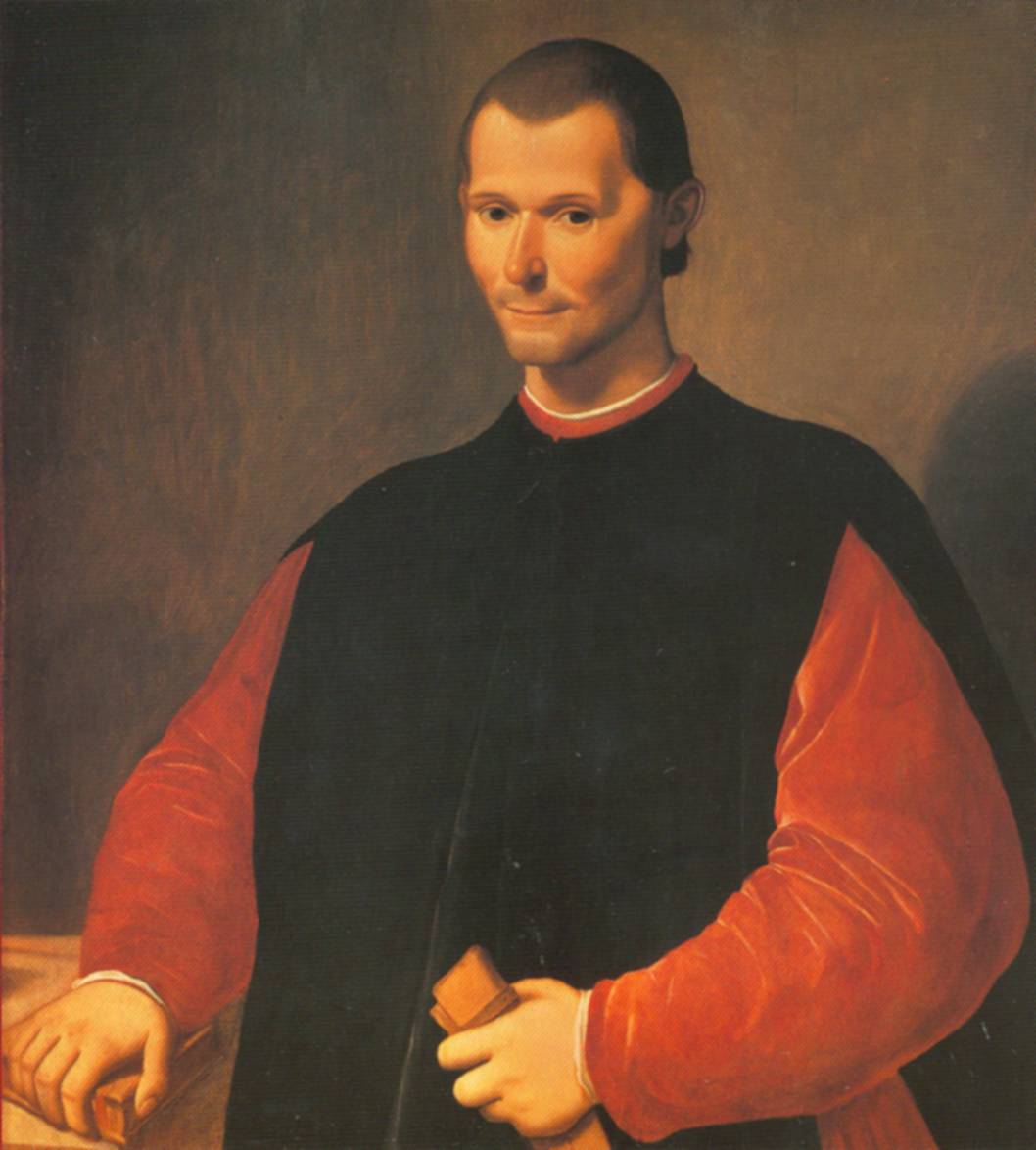
I find the portrait of Machiavelli by Santo di Tito intriguing (shown on the right, generously sponsored by Wiki-something), and I'm evidently not alone: it graces most editions of The Prince that turn up on a quick browse through Amazon. (My own edition, translated and excellently annotated by Wayne A. Rebhorn, is from the bonanza of Barnes and Noble cut-rate classics, and sports a contemporary Portrait of a Gentleman by Bartolomeo Veneto. Those Tuscan Renaissance painters had a thing for knowing looks.) It's a young, boyish Machiavelli, and his smile is a little impish, his eyes are bright and eager. Niccolò looks like a man who is hiding nothing, happy in his knoweldge of the system, unconcerned about its smaller consequences. I hate to judge his work this way, but that smirk is affecting how I scope out how I feel about Machiavelli, raising up a small affection for the man.

Machiavelli is on a par with the big set of Renaissance geniuses, and it's fascinating to me how art and politics became scientific well before chemistry and physics did, how in Machiavelli's case, the study of the workings of the state took such a pragmatic, evidence-based turn under his pen, a good hundred years before Galileo's scientific reasoning got him into trouble with the church. Machiavelli had actually collaborated (unsuccessfully) on some civic works projects with that other great empiricist of his generation, Leonardo da Vinci, and had extended the occasional professional courtesy to the artist. Did one's epistemological sense affect the other's, crossing disciplines, as they were? Certainly there was something in the Tuscan air in those days.

The Prince is written as a primer to young rulers, an alarmingly honest instruction manual to supplant the idealistic moral lessons that new princes might normally receive at that time. (According to Dr. Rebhorn's notes, Erasums had at the time of Machiavelli's writing, recently published such a hopeful instruction manual for instance, chock-a-block with decent Christian humanist motivations.) The Prince came instead from the author's careful diplomatic observations, and from his personal study of Latin historical texts. Machiavelli's tone is a little didactic, but there's a sense of irony, a hint of sarcasm, the occasional wordplay. He's lecturing, and going after the truth as he sees it, but there's an inner amusement behind the writing. The damn smirk.

Although he writes in a lot of thinly supported declarative sentences, he allows himself a great deal of room to work through his thoughts and entertain alternative ideas in the text, and he provides plenty of examples. These are not always easy to follow to his conclusions, in part because his times are so politically complicated to the eyes of a non-historian (or at least this non-historian). He's surrounded by a divided Italy that's constantly shifting alliances with foreign imperial powers, throwing up short-lived rulers and popes to pursue neighboring territories and cities under a too-limited set of proper names. The lengthy supplemental material could take away from the reading if you paused at every footnote, but it's very welcome. Contrasting his complex political environment, the examples Machiavelli pulls from antiquity are often suspect for their simplicity. He's pulling heavily from Livy and other Roman historians, as well as a couple Biblical anecdotes, and when the history gets distant enough, he doesn't shy from accepting the occasional legendary origin story at face value. If the stature of rulers are necessarily fallen in Machiavelli's present, it's unclear whether it's his nostalgia that's coloring his opinion, or his disappointment with Italy's international impotence, or if the mythology is intentional in the comparisons the practical man is trying to draw.

Machiavelli's motivations for The Prince are transparent--he's trying to work up some favor from the Medicis; Niccolò wants his old job back--but it's also clear that Machiavelli is hungry for the renewed international power of a reunited Italy, a new Rome, and he exhorts a new prince to take command and resist the other European powers with Italian forces. He also hungers for a modern version of a Roman-style republic, and there's a strange undercurrent in the writing where, he instructs a prince to power, but the message that he must never earn their contempt through oppression (through theft and disrespect of their customs--they get past love easily enough) or displays of weakness, seems at odds with the contention that a populace allowed to remain accustomed to freedom will eventually overthrow a prince (or will be able to hold out for a weak one). Nor does Fortune, according to Machiavelli, favor the longevity of princely rule. The Prince is a stark lesson on how to be a monarch, but it doesn't really justify monarchy. Aside from that final urge to cast off Italy's foreign bonds, Machiavelli fails to ask the obvious question, the one that contrasts so oddly with his advice to let the people be the people: what good are princes in the first place? They're a natural way to organize society, he implies, but Niccolò the republican also has his own agenda. Are the failures of monarchs built in, and would Italy be better unified under a king, who could then be cast off? Machiavelli is certainly smart enough, and cynical enough, to write in a couple layers of meaning.

Niccolò Machiavelli's political philosophies are very much products of that complicated international context. When wars among small states were inevitable, a military-minded monarch was well-advised, and controlling people with fear and respect could be considered a necessary defense against foreign powers. Machiavelli often notes that a prince succeeds when the people are motivated to fight for him, and he discards other "nobler" internal motivations that idealists would assume lead men to that end. As a modern reader, an obvious question is whether his lessons carry over to today's world, or whether they have been borne out in practice in the intervening five centuries of civilization. Certainly, militarism is alive and well, and those who've risen from the barracks have earned respect, but we moderns often like our bureaucrats too. Machievelli's advice on colonies probably didn't envision such vast cultural differences as the West would eventually encounter in those efforts, but his advice about governing foreigners in their own states while preserving their customs can probably be interpreted on similar grounds. Did the invaders instill fear and respect in the locals? Did they take care to understand local ways? Did they give too much gravy away too early? Did they steal and tax unduly? His advice in conquest to embrace the powerless opposition while keeping them powerless, and domestically to use consel without letting the counsel lead, has likewise not been rediscovered in many an adminstrative post-mortem. There remains a problem of the extent to which a foreign prince is damned by failure to understand the local power structure very well, or the local customs, or even the extent to which he can. (I'm reminded of recent readings of Graham Greene, say, who'd eloquently novelize its inherent doom, and Howard Zinn, who reported the success of stamping out customs and local power on the North American continent, both voicing the people's views of history instead of a prince's.) Machiavelli's advice to project an image of honesty, respect, and fear which is at odds with any personal qualities a leader may have is almost too widely taken and obvious to mention these days, but still, it's best not ignored.

Saturday, December 06, 2008

Scam-A-Rama

Dearest reader(s),

I deeply apologize for the sparse output lately over the past several months. I've been nearly as awful a reader too, and I'm even more sorry for that. There's work, and that's one excuse, but it's really more the recurring awareness of my own basic idiocy that keeps me down, that dreaded and unwelcome knowledge that, despite my buffed veneer of knowitallism and that carefully rehearsed cynical smirk I so like to flash around, I'm not fit for even the most quotidian aspects of life planning, the results of which inadequacy have left me impoverished, down a car, and too full of self-loathing to haul myself out of bed, never mind over to the computer to scrawl out my signature mentobabble.

I've been robbed, my friends! Used! If traffic cops sometimes let me off with warnings for looking like such a goofy, sincere young man,* that gullible visage of mine is like pink meat to the confidence artists of the world, and they are legion, lurking behind every form, infiltrating august institutions like parasites. And my defenses are weak.

Scam the first: If you grew up in a certain small, liberal (sort of), Northeastern state (hi twif), you may remember the public health measures routinely administered to grade school students. I remember the primary years as an endless succession of dispassionate headphone tests, finger pricks, colored dots and sideways Es, and hair toothpicks. (I remain proudly cootie-free to this day.) Of these, the dental visits were the most fun. Yeah, the "swish" was dumb, but once a year, we got to waste half a day in the auditorium watching 8-mm films of tooth-brushing propaganda, and then they sent us home with those awesome red chewie tablets that allegedly revealed plaque deposits, and which we (naturally) used to concoct vampire dramas on the school bus or wasted in efforts to alarm Mom when we walked in the door.

The grand picture of public health was never appreciated by the eight-year-olds, or not this one, and I can't say that I've spent much time since thinking how it was all paid for. If pressed these days, I'd guess some sort of minor, half-assed health measure ponied up by the state, which probably did less good than intended (though we're all happy the lice outbreaks were controlled), but not a hell of a lot of harm, considering. Nor even a lot of cost: how much for an eye chart, and the school nurse could only spend so much time on her nails.

So when my darling C. stuck the permission slip in front of my nose (that very morning of course, while running fifteen minutes late already) a couple months ago, I didn't think much of signing it. We're more litigious these days, and more cost-conscious. If they can convince my dental insurance to pay for a portion of the overpriced jug of fluoride rinse and for someone certified to administer the squirt pump, then I can live with it. (And if I have to pay thirty bucks to do it, that's okay too.) And among a population that fights every public fluoridation proposal with voluble ignorance, I figured it was just less trouble to tally the people who would opt into a fluoride program in this silly burg. Naive assumptions, all of them (well, except for the "silly").

Turns out the "fluoride rinse" I signed junior into was actually a group of visiting dentists, swarming the local schools to provide oral exams and some sort of tooth sealing that is quite beyond the "fluoride rinse" indicated on the very brief form (which of course I had reserved no copy of, and which, of course, is not held through any official school channels). Now, why anybody would want an allegedly comprehensive oral exam to be administered at school when you have dental insurance that lets you do said exam in a place with, you know, dental care facilities, is beyond me. I rather resent the insinuation from my phone conversation with this office that people opportunistically jump at free medical care, and also resent the fact that they contacted my insurance company, who told them that C. had very recently had the same exam performed, the result of which was a hasty action to make sure they got their bill in before my regular dentist did, the insurance co. having understandable limits on the number of those sorts of procedures in a given year. I thought I was signing her up to swish.

Why would dentists visit schools to administer "comprehensive" oral exams? The only honest reason I can think of is charity, in which case there's no need to talk to the insured kids in the first place. The more likely reason, is that their scamming some bucks out of schools and worried parents in a semi-legal operation. This is probably why they use second graders to disseminate their dubious information instead of school staff. The cost of this is about $150, an angry dentist, and enough fluoride in my daughter to effectuate the worst possible government mind control schemes.

That, and now I have a little red S in the lower right-hand corner of my credit report.

Scam the second: The main reason I still have the Citibank card I held in college is that it sports a great old picture of me. ("That's you? You look so...happy.") Also for emergencies, uh, yeah, that too. Back in those ancient times, I somehow** agreed to buy "Protection Plus," a plan which evidently offers insurance beyond my normal legal recourse against identity theft and credit fraud. They sent a letter saying that I had to call them to cancel the useless service, which would otherwise appear on my credit card bill. Protection Plus keeps tighter bank hours than Citibank dreams of (Citi, for whatever its other sins, features live, articulate and accommodating customer service people who are available 24/7), and they were hard to reach for the day or two their threat remained on top of the pile. Before long I forgot about trying, and as promised, a prurient $70 charge popped up on my 5-years-celibate Citi account.

I paid the damn thing, fearing late fees and a little black D next to the red S more than I worry about the loss of 70 beans and my dignity. I'm not enthused about the two dozen phone calls it'll take to abolish these fuckers from my life, and it's not a remote possibility that I'll eventually forget about them in the absence of any new Citi bills. I suppose I could actually accept and utilize the "service" Protection Plus renders, but for some reason I don't want to give these assholes my other credit card numbers.

Like many scams, it was a play on my vanity, however indirect, but it didn't stop me from falling for it. I am unfit for the public.

Scam the third: I didn't buy an American car from any patriotic impulse. It's just that after some minimal research, the Chrysler dealership was the closest place that sold minivans and luckily, I was able gimp my old (and short-lived) Toyota there before the boiler exploded. (Did I really want a minivan? Does anyone ever?) I drove out of there with the same model that Consumer Reports now places on its worst of the worst list, but who knew that then, and it was indeed spacious, and over the years, it trucked a lot of drywall.

Our T&C has suffered electrical hiccups since we've owned it, and we've entered that glorious stage when the monthly repair bill costs more than the loan payment used to. It's been predictable and inevitable stuff, brakes and suspension and, reaching back to plug myself, some shit rotting underneath, but rapid-fire proximity of auto disasters can work up some mighty distrust. That vehicular suspicion is much stronger in my wife than myself, and my doubt in her opinion is why I was driving that enormous shitbox as it shuddered through its final roadworthy lurches. Oh, those clunks really are noisy, just like she said. Whiiirrrrr! She didn't mention that. The engine's revving, huh. Wow, now I'm not going anywhere at all, ten miles from home.

The failure to move was, it turned out, a failure to transmit, if you catch my meaning, and the knocks and creaks were (yet another) suspension issue and haven't been addressed. The mechanic disassembled the transmission, discovered a missing o-ring on the filter (!), and suggested we hold off on the suspension repair. He did this to build trust, I'm sure, and he even cited the golden rule in his reasoning. The o-ring was, he acknowledged, a hopeful band-aid, but it seemed to be running fine for the time being.

Now, I really like my mechanic, or at least I want to really like him. He is, unlike some of these guys, very easy to talk to when you can reach him, quietly confident, and he has one of these bright, open faces I feel inclined to trust. He's also a local institution, which has to speak for something. On the other hand, he's a mechanic, and as such, he's a nemesis, just itching to ream me with his information asymmetry, and as a general rule, I always try to imagine how the garage might be screwing me anyway. One of the previous times he worked on it, he kindly alerted me to some other problems (alarm bells!), which I let him work on (sucker! rube!), but he just doesn't seem as shifty all those other mechanics (fool!).

If I had more brains and less conscience, I'd have rolled that duct-taped tranny to the nearest dealer for a trade-in, but I unwisely hoped for the best. The repair held up for a weekend. On Monday, on my way to work, the transmission shuffled its coil (spring, pulley, valve, etc.) with a more dramatic flourish--it felt something like hitting a speed bump at sixty--and those gears no longer spun ineffectually, they ground ineffectually as the engine impotently revved. It's now back in the shop facing a $3100 repair, not to mention the certain death that's still looming unrelated in the rattling front end. Did I mention it only has 107,000 miles? Fuck Chrysler anyway.

I'm clearly not going to do this repair: the car is worth less than three grand, and I'm not even sure a new transaxle will do the trick (I wouldn't rule out the persistent electrical problems as the root cause of this). The second breakdown was a lot more dramatic than the first, and I can't shake the nasty questions: did my mechanic soak me for the first $200 realizing that he'd be out for the larger repair, realizing no sane person would put a new transmission in that rolling turd? Did the first repair make it deliberately worse, make a new transmission unavoidable? It's reasonable that the quick fix was made in good faith too--it's not like he lied to me about it doing the trick. These are worrisome, expensive questions, and to my disadvantage, I'm obviously not mentally equipped to deal with quick-witted repair people, especially not nice ones.


I summarize, dear reader, that I am one of nature's dupes. With this insight, I'm preparing to spend the morning at the Honda dealership shopping for a highly priced used Civic or Accord, at least if my credit report isn't too marked up. (This is based, on the off chance anyone's curious, on Honda's general reputation for reliability, and the fact that my rotting 10-year-old '87 Accord was the only awful car I drove that I ever liked.) I mean, surely I can trust a used car salesman, right? I'll be sure to let my mechanic take a look at it.

Sincerely,

Keifus


* As a matter of fact, I am also plagued by the real injustices that this petty whine contrasts. Awareness is a rough ride.

** Yeah, somehow. Probably something associated with my being a dope. I feel like I'm narrowing in on it.