Sunday, November 22, 2015

AKA Earned Suspension of Disbelief

Several months ago, I put aside a post about the Daredevil series that had recently aired on Netflix.  I couldn't file it down to the narrow point I wanted to make at the time (and I was also conscious that I have one about the Marvel live-action universe still on the page), but last night, I stayed up binge-watching (as the kids do these days) the followup series, Jessica Jones, and I think I want to work a few things out here. 

Daredevil was the only reason I gave in and got a new Netflix subscription early this year.  On the whole (and like most people), I thought it was fantastic.  There are any number of ways to take on the space-aliens-and-superheroes fare and keep it entertaining--god knows that like 90% of these books I read fall neatly in the sci-fi/fantasy basket--but I've always liked the stories best when they keep a strong connection to known reality.  I think this was as important for the oldest hero stories as it is for the new ones: you can't make anyone larger than life if no one around them is life-sized.  Almost always, the believable angle comes as a plausible approximation of human nature in the response to all the craziness (I always love the sane, marginalized characters who point out just how nuts everything around them is, or who can't help lampshading the plot flaws), but what I'm finding so interesting about Marvel's live-action efforts is how they've been very creative about the places the stories touch ground. 

I don't think Iron Man would have worked nearly as well, for example, without a 20-minute cut of Tony Stark's touch-and-go experimentation.  Something in there got the process of innovation some exaggerated flavor of right.  Shit never works too well at the beginning, even when you're a tech genius.  Agent Carter wasn't in the same league as the Netflix dramas, but it was occasionally very strong, and that one was held to earth by the unexpected tethers of institutional bias.  When I write it like that, it sounds like it's been done before, but it's a very different animal here, and the distinction is important.  Peggy isn't smashing her way through the sexist 1940s and punching oppression-themed villains in the eye (not yet anyway), she is more like a well-realized character who is struggling within a confining peacetime reality. 

Daredevil went on to do a whole bunch of things right in this regard too.  The grounding theme of this show was the human consequences of movie-theater violence.  In a stroke of genius, the aftermath of all the skyscraper toppling in The Avengers reverted New York to an old film-school version its corrupt, shabby self.  (Because for anyone who's been there recently, today's Hell's Kitchen is a world of safe boring storefronts, and modern Times Square looks like some unholy lovechild of Disneyland and Tokyo.)  And of course when the hero can get his ass kicked, get ground down, get laid up as painfully as Matt Murdock did, it makes any of his successes feel earned.  Seriously: Daredevil was a great urban Kung Fu story before anyone got in spitting distance of the red suit.  It would have worked every bit as well if he were just an athletic blind guy--the story didn't really need the "abilities."  I bought wholly in to the first ten episodes, even as syndicates of mystical old ninjas were running through the city, and this viewer didn't bat an eye.  Those places where it gave in to its comic self, that's when it stumbled a little. 

(The other way that Daredevil established its emotional stakes--and this is a strength of Jessica Jones as well--was by giving the characters room to act like believable friends.   To get close to someone as likeable but remote as Matt, you'd have to keep ignoring all of his subtle keep-away vibes, and they found a couple sorts of people who could.  It required some decent acting and direction to communicate it.)

So on to Jessica Jones, a character I was only vaguely aware of through the nerdblogs, who came out 15 years after I gave up on comics.  On TV, she is more obviously powered with enhanced strength and (at least some) resilience, and it's terrifying how all of that power means precisely fuck-all when it comes to the emotional challenges of acting like a hero. 

If Daredevil was about the consequences of violence, Jessica Jones is about the consequences of abuse.  Looking back on the binge, I see it mapped on every character thread, but as before, this is the tether to human realism.  David ("Tenth Doctor") Tennant plays the villain Kilgrave, who can make people obey him, who can make people want to obey him (and what good is super strength against that?).  This is an abuser who is additionally enabled by mindfuck powers (and it's not at all clear which came first), and it's damn interesting how often he resorts to conventional abuse too, because that's the kind of person he is.  It's damn interesting how willing the show is to get right in the head of people like this and develop it as a theme (not just Kilgrave, but a number other male and female characters act abusively as well), treating them with empathy, encouraging the viewer to understand their motives and to weigh their charming apologies, without forgiving a damn thing about what they do, and without ever ceding the agency of the victims.  It's a bit of a spoiler, but Kilgrave starts out as casually menacing, and the show gradually recasts his behavior as obsession, and then as petty obsession.  And the truth is, the Purple Man would be nowhere near as scary if he were bent on world domination, or revenge, or any of the standard supervillain schtick.  Nor is Luke Cage (Jones's lover, and total badass) allowed to ride in as a savior, even though if anything he is more powered than she is.  He understands that this is her demon to overcome, and the wannabe good-guy types who feel it is their job?  The ladies don't even let them drive.  It only sounds like a textbook in hindsight, because it's a character drama before anything else, and they do an good job of keeping it real.


Saturday, November 07, 2015

Review: The Sparrow, by Mary Doria Russell

I remember the buzz in the science fiction groups when The Sparrow first came out. It populated almost everyone's best list for awhile (and the ones who didn't love it felt that the acclaim came at the expense of the genre's roots, which is silly enough to make me wonder if I am not in fact misremembering things), and among that crowd, it's not hard to see what the appeal was. The book is genial, lightly philosophical, hard-ish on the science, and tends to be empowering of women, introverts, and technical people. But as a plotted novel, Russell kind of botches the delivery, and I suspect that anyone's enjoyment of it is going to depend an awful lot on what they are reading for (even more than is usually the case).

The story is set in the near future (that is, 1996's near future, which is getting very close to the present), and it's set in motion when an astronomer at the Arecibo radio observatory in Puerto Rico picks up an unexpected signal. The politics of the times, the brevity and intermittancy of the message itself, and the protagonists' personal and professional networks, all have plausibly coincided in such a way that the is revelation is confined to a very small team at first, long enough that they can begin the project themselves, under the discreet hand of the Roman Catholic church (Jesuits, so, you know, the good discreet Catholics), before the public really gets wind of it.  The team determines that it's in fact a snippet of an extraterrestial broadcast. Music, Hot Hits from the next star over. Could this be investigated further? Well, the church is genuinely interested, and consider it within the Society's historical context of mission and scholarship.  Our primary character, Father Emilio Sandoz, is a preeminent linguist, and makes a compelling case for a cultural and scientific effort.  Could we actually get there and check it out?  Surprisingly yes: 2019 technology sometimes moves asteroids during mining (chucking mass out the back), and a sealed rock could in fact keep up 1g by doing this for a couple decades.  The team already includes a pilot, an astronomer, and a polymath, and holy shit, this is all really happening. 


The discovery aspects of the book are done pleasantly well.  It reads like sf "competence porn" that for once isn't driven by male ego.  Russell makes a lot out of the collaborative process, doesn't discount luck (enough things have come together that the Catholics, and Emilio particularly, can't help but see it as God's plan), and keeps a group dynamic based on open communication.  So much of the planning and travel--it must be at least half the book--takes place over intelligent dinner party conversations, where people laugh a lot, and reveal themselves over that extra glass of wine.  The individuals are diverse, likeable and interesting enough (Anne Edwards, the middle-aged den mother of the group, appears to be a real Mary Sue character here, the writer herself herding them along), and these kinds of scenes continue even through the voyage to the planet eventually known as Rakhat, where contact with the alien species is first made.

And even if it takes a while to get there, the events on the planet are interesting.  Finally, the long-developed situation starts changing, and it's the best part of the book.  The characters misjudge the nature of Rakhat's intelligent species (who are about as responsible with civilization as humans are, even if they're much better stewards of their planet).  There are two of them, nearly indistinguishable, and of course people always overestimate the Eloi at first.  Russell's understanding of ecological relationships drives the plot here, as well as inevitable cultural ignorance, and it's quite cleverly done. 

It's a perfectly cromulent way to develop the story, but these parts are all told in flashback, and it's explicit from page one that something went terribly wrong on Rakhat.  Emilio Sandoz is the only member of the team to return, and he's disfigured, cynical, sick, and with what little knowledge that's revealed, disgraced.  His illness seems alien or supernatural (it's not, although he's been plenty traumatized), and the investigatory committee is hungry for his side of the story (although they have years worth of reports, and the popular conclusions that they have allowed are fairly ridiculous assumptions--I'll try not to spoil it). 

Sending the mission off the rails and breaking Sandoz's faith would have worked fine as a linear progression, but this extended flashback business was not the right way to manage the contrasts.  In effect, Russell has decided to set up two kinds of novels and make them sit awkwardly side by side.  For a mission that has succeeded on a foundation of open communication within a group, the author is keeping information from the reader here only to delay Emilio's big reveal.  Since none of the church officials we meet really do much to move the plot that way, I didn't really care about any of them, and yet they occupy a substantial chunk of the text.  Russell wants The Sparrow to be a voyage of discovery and a tense character drama at the same time, but in the discovery part, the characters aren't behaving dramatically, and in fact, any sustained personal tension would have been inimical to the kind of story that's working itself out.  Most of them don't even change in any meaningful way.  And the one guy who does have an arc--Sandoz--is also the hardest character for the reader to approach.  He starts off a somewhat enigmatic man--withholding his inner self from others as a sort of self-enforced humility--and keeps this level of remove throughout the story, a trait which grows sort of beatific as his faith deepens.  When he's recovered afterwards, he's closed off for less subtle reasons.  We spend the whole novel revisiting him in his broken state, but it doesn't become meaningful until the end, after all of his relationships are established, and we finally understand what caused it.  Probably Emilio's more genuine opening after the trauma is the point of these sections, but even though it feels good to point him in a direction of recovery or redemption, it's still a tremendous anticlimax, and it would have made a better epilogue than ongoing plot.

Wednesday, October 21, 2015

Review: Fledgling, by Octavia E. Butler

[This morning, I upended a mug of coffee all over my grandfather's old desk, splashing my computer, a small stack of books, and all of the usual office detritus.  I mean, usually I reserve that sort of thing for work, where I can dramatically imperil valuable documents instead of 1950s scholastic-grade oak.  But apparently I've grown weird about books, and maybe this was nature's way of telling me to write a couple of those up and put them away.]

Fledgling, in 2005, was published just a little bit ahead of the modern wave of attractive, socialized fictional vampires.  It's similar on its face to all the Twilight clones, but unlike most of the selections from the Paranormal Romance section, this one still feels like an innovative concept, turning a traditionally supernatural relationship into an evolutionary one.  (And unlike I imagine those selections to be, this one is very well written.)  The Ina, as they're called in the book, have been on the earth for as long as humans have, existing in symbiosis with select human individuals.  They live longer than us (and believe themselves wiser), have very low birth rates, and are gifted with more intense strength, dexterity, and senses (especially scent), with the attendant animal-like compulsions to feed, breed and sleep, which, as with their sister sapients, they arrange their society to accomodate and govern.  They're light-sensitive, they require human blood for nourishment, and with proper care, they can heal like Wolverine.  So standard vampires, more or less, except with a more compelling backstory, and a more interesting relationship to people.  Their venom is intoxicating--it feels gooood for us humans to let blood--and it creates dependency, basically mood-altering people into a state of loyalty, contentment, and (not counting the addiction) physical health.  The Ina maintain long-term partnerships with their symbionts, ranging from something rationalized as mutual benefit, to the relationship of an ant to an enslaved aphid.

And now enter the protagonist Shori, a pubescent Ina (looks 12, but is in fact in her fifties) who possesses some genetic advantages due to experimental interbreeding.  Notably, she has dark skin that protects her in the daylight, but she's also improved in her Ina-ness compared to the rest of them--faster, stronger, more desirable scent, more intoxicating saliva, an objectively better specimen. 

You will have perhaps noticed that in a few strokes, Butler has transformed an overused fantasy trope into a complicated question of race, power, sexism, sexuality, consent, agency, and morality. 

It's a highly accessible read, too.  In the opening pages of the book, Shori wakens from a near-death injury, without her memory, amid corpses, ashes, ruins.  What happened to her?  What's her place among her kind?  It's a fairly linear (if somewhat episodic) path to answer those questions, and the prose doesn't wander too far off into the philosophical depths, even though Butler's given herself every opportunity to do so.  Shori herself is a sympathetic outsider, and her personal stakes are high enough to keep the plot chugging.  Focusing on the better people of either species, and pushing the really incorrigible brand of racism onto the snooty vampire elite, dodges a lot of the challenge for readers.  (Or at least for white readers--I'd be very curious to know how this book reads from an African-American perspective.) 

But the thing is, this story would have failed without a strong and nuanced understanding of those big themes, and they provoked a strong emotional reaction in me.  I left it disappointed how the adult Ina couldn't avoid the same traps of prejudice and patriarchy that have ruined so much of human history.  I liked Shori, but I couldn't let go of how damn patronizing she was toward her harem, or how her first symbiont was not a willing addition to it, how his intellectual antipathy toward obedience and revulsion at sexualizing a child's body had no chance against Shori's vampiric love juice.  I was affronted by the idea of people as pets, either abused or loved.  I was mad at the Ina for not creating a better society, and then angry, yet again, at my own damn species for the same reason.  It seems like a small novel to contain such big currents, but then, that's what makes it good.

Friday, May 15, 2015

Review: Time's Arrow, by Martin Amis


I don't know how I feel that the cover of my copy of Time's Arrow gave the plot away.  Not because it ruins the story so much--we know that this Tod Friendly character's a creep, nursing some nasty past or other--but I wonder how I would have received it if I hadn't known already that the scale of evil reached all the way up to the Nazi death camps, if the escalation would have startled me (more), or if I would have found a different perspective on a re-read.  (Welp, I guess I also just blew the chance for you to go read it and report back to me.  Sorry about that.)

The conceit is that the narrator, whoever that is exactly, is stuck in Tod's body as a traveler, unable to exert his will on it or to see beyond what Tod sees.  He perceives time going in reverse, only able to guess at the demons in his host's past until he actually gets there.  The narrator opens his eyes and gasps in the man's last decrepit breath, as doctors batter him to sensation on the table.  He painfully retraces his backwards way home, slowly getting more vital as he de-ages.  He retains a forward-thinking sense of cause and effect, and Amis wrings comic irony from any number of vignettes told from that point of view.  Beautiful things are lovingly destroyed, food is masticated into form and returned to the store for money, arguments and hurt feelings are suddenly reconciled with insensitivity or violence, and the toilet and the trash are the benevolent wellsprings and motive forces of humanity.  Sometimes the bits are well-written enough that they almost work in either direction, at which point I had to stop and read them again.  Even for a short book, and even with the humor,** it got tiring.

And it's a pretty well-worn shtick by the time we get to the real horrorshow, where Friendly finds himself with a proper German name, working under some fictionalized Mengele.  He relates Auschwitz as the asshole of the world, and can think of no higher praise.  Here, people are nursed from death to health, often with the urgent intervention of the doctor's own hand, and he soars with the good feeling of it.  After the war, his story devolves to anticlimax, as the narrator fades away from consciousness toward the innocence of infancy.  Amis suggests that Tod's a product of his time, that anyone could be corrupted with his empowerment and influences, but I don't buy it--even as a young man before the war, Tod (now Odilo) reads like some kind of sociopath. I don't think people abuse their wives and terrorize their neighbors just because they're allowed to.  Too many of us drift along with the historical tides, but others smile and merrily dig in an oar.

Heavy stuff, and you know what?  Enough already.  I want to say that the problem here is that Time's Arrow either deals with far too weighty a subject for a gimmick book, or it's far too gimmicky and ironic for a Holocaust book. 

Or maybe that's not exactly the right complaint.  This backwards thing** is well-suited to terrifying experience, but, I think, it invites a more existential and universal sort of anxiety, giving us readers a rare alternate angle on these nagging questions of what it means to briefly be thinking meat in an incomprehensibly complex universe.  I mean, you don't need genocide to make that point. 

I found myself fixated on the reality of the narrator.  I don't actually think Amis addresses "the rules" to my satisfaction, but he manages to squirrel away from scrutiny because it's such a short book.  The speaker knows back from forward, and for that matter, he's stuck working in the language and metaphor we know, which is inevitably built on a foundation of causality... so why does he accept the mode of his experience?  (And when he briefly asserts normal time, why doesn't the return to reverse chronology keep bothering him?)  And who the hell is he narrating to?  What is his perception of elapsed time?   Because the continuity of his thought (that is, this short novel) sure makes it seems like he's walking us through a whole backwards life in the space of an hour or two.  I settled in my mind that it was not an alien presence talking to us, but some other projection of Tod/Odilo himself.  That is, another artifact of the same bolted-together biohardware floating there in space-time, one that is merely perceiving things in a different way, because after all, who the fuck knows the hidden depths of how all this works.  And the message here--the holy-shit, make-you-think part that has really kept this novel alive in my mind--is that we can't condemn the widdershins experience for being any more arbitrary and bizarre than this one.  We are only along for the ride on time's forward arrow too.  The best we can really do is comment.


* Speaking of detached humor, and evil, and layers of irony, oh look, Martin Amis wrote the introduction to the copy of Lolita  that I read.  Seems fitting.

** It's not the most common one, but I think it's fair to call it a trope.  I was tearing through my shelves trying to find it, but once again, the internet was the better tool:  the first story I remember reading in this vein was called Divine Madness, by Roger Zelazny (which, I will add, didn't suck).  That one got to the scary and sensitive too, and didn't even require awful people doing unimaginable things. 


Sunday, April 05, 2015

Review: Reamde, by Neal Stephenson


When I was reading this book last December, up popped a spookily coincident NPR story about new developments in ransomware, where hackers would only take payments in bitcoin to free up your locked files.  Bitcoin, meanwhile, isn't far removed in either concept or practice from in-world video game currency, and we all remember the karmic hilarity when its largest exchange, Mt. Gox (still hanging on to its original name, when it was made for investing virtual gaming loot), went ass-up a couple of years ago, with hundreds of thousands of electronic Fun Bux still unaccounted for.  In Reamde, Stephenson only got ahead of these stories by a couple of years.  Science fiction?  Maybe just barely.

The story is set in motion when reclusive billionaire Richard Forthrast and his niece Zula inadvertently cross paths with a small-time criminal connected to the Russian mafia.  Chases and movie violence follow, but the nut of it all is that our short-for-this-novel thug had been contracted to deliver some data to the mobsters, but it got locked up in ransomware that infected his computer while he was up the night before playing fictional online RPG, T'Rain.  Zula winds up kidnapped and dragged along with the Russians as they look for these hackers to get the data, and a growing cast of interesting characters scramble to respond.  (It already sounds complicated, right?)  Will the kidnappers realize they've got the niece of the guy who struck it filthy rich inventing the game?

And here's a confession: I played World of Warcraft sporadically for a recent year or two.  I didn't really play it right*--because hey, it's me--but I can certainly attest how compelling is the sheer size of the world and all its official supporting background lore, as well as the organic depth it has grown from all the people wandering around and feeling out the stories.  The fictional T'Rain is fashioned as the next generation of WoW, and Stephenson delivers a pile of backstory on how something so broad could come together. 

We're introduced to many of the fictional game developers, various sorts of geek obsessives who make Richard Forthrast (Vietnam-era draft dodger, erstwhile weed smuggler, with his family of borderline survivalist crackpots) look like a grounded member of normal society.  The game world is built on an inappropriately thorough (and otherwise uselessly fictional) geological model developed by one of its founding geniuses.  One conceit of T'Rain is that it does its world-building from, literally, the ground up--that is, it is a planet which generates its mineral wealth (a big deal when everything in it priced in gold pieces) by some academic-level approximation of natural processes.  The reason it isn't called Terrain is that Richard also brought on a couple of by-the-pound fantasy authors to crank out a world's worth of cultural backstory, one of whom is a prolific hack, unapologetic about chucking apostrophes into every proper noun.  (The other fancies himself a scholar and a linguist, and they drive each other amusingly nuts.)  Sadly, these guys amount to not much more than subplots, but it's a secondary challenge to somehow fold players' rogue behaviors into the proper game.

The other conceit of the game is that it's built to encourage gold farming.  Gps are transferrable to the outside world as currency, and players can fall under one anothers' vassalage.  Low-level users are effectively paid a pittance to mine out T'Rain (often using bots), while players with higher purposes typically pay dues and have better quests.  If WoW once gave economists a small thrill to observe it as a microcosm of a regulated economy, they'd go nuts about T'Rain, which has a permanent labor class and extraction-based wealth baked right into it.  Stephenson is a good enough writer not to make this into a polemic, although I think he wants it seen as more mutually beneficial than fundamentally unequal.  He does wind out a longer picture of the players behind all the exploited toons--the world where the Chinese hackers grew up, but those guys frankly end up okay.

So anyway, the key to some criminal filing cabinet is locked up in T'Rain somewhere, and all the best scenes in the book--mostly because they're so strange--have the characters chasing one another around in the game environment.  Outside, there is a real-world pursuit going on too, and we see these hackers and trolls get to see fleshed out as real people, which is something anyone who's spent time online wonders about.  (It doesn't take long for us to get squarely sympathetic with this guy who basically writes spam emails for a living.)  There's a tightly-plotted novel in those events, and some logical conclusions. 

And instead, we have a thousand-page monster here.  It's an undeniably entertaining one (this is possibly the fastest kilopage I've ever been through--I was up late reading it every night), but there's a great big action movie that grows out of the central plot like an aggressive tumor, complete with spies and terrorist extremists and numerous deaths just off screen, just to show how evil these terrorist assholes are.  It's enjoyable as entertainment, and I'm glad that Stephenson takes moments in all this to point out actual physics of ballistics and human endurance, but there's a sense of just cranking it all out at top speed.  Romances don't really go anywhere, some of those natural conclusions are forgotten about (why didn't Richard take Marlon the hacker under his wing, just like he did his niece?  that would have been perfect) and we kind of forget about all those eccentric game developers too.  And why are the baddies so cartoonishly evil, when there's such rich comedy to be mined by pitting them against the American version of jihadis (Richard's more eccentric relatives) in the final showdown?  Especially considering that getting the whole cast to this improbable point took so much effort.

I won't fail to recommend this one (and Stephenson isn't known for his endings anyway), but I would have enjoyed the carefully tied-together version more.  I like to think he was writing as fast as he could to keep current events from catching up to his speculation.

*I think to get the most of any MMORPG, you really have to go in for the team aspect of it, block off time, and talk out loud to others.  Instead, I mostly played as a means to randomly and quietly get away from people, which is pretty much the opposite thing.  You can play WoW as a solo quest game, but it only goes so far that way.  I still miss wandering around sometimes, though.

Saturday, January 03, 2015

Review: 2312, by Kim Stanley Robinson

In the story of 2312, the emotional world of a gentle young acolyte explodes open when he discovers an ancient musical instrument in the caves outside Megadon city, under the twin moons of his home planet.  But, deterred by Father Brown and the other Temple priests, he suffers a mental breakd--

Oh shit.  Wait.  No, I'm describing the progressive rock epic, 2112.  The science fiction novel, 2312 is set a couple hundred years later.  Obviously.

It (the novel) primarily serves as a wide-angle view of life in the civilized solar system that takes place on almost all the other planets of the solar federation.  It's conveyed mosaic-like, primarily filled with point-of-view character sections, soaring across diverse geography, liberally broken up with creative lists, encyclopedia entries, interpretations of contemporary art forms, and highlights from historical documents.  (I'd bet that Mr. Robinson has also enjoyed a John Dos Passos phase.)

The year 2312, in Robinson's history, is a pivotal one.  The plot is... well, there is a plot, I guess.  The story begins with an attack on the primary human settlement on Mercury.  Swan Er Hong and Fitz Wahram, our two protagonists, are connected in different ways to one of extended humanity's key independent political and scientific groups, and in that capacity, they chase the whodunit clues around the solar system.  I believe that, plot-wise, the effect is meant to be one of various paths intersecting, showcasing kind of an inflection point between the ages in that titular, and no solid climax is really intended.  That's fine, but it's centered on a mystery and a chase, and that motor doesn't propel things forward worth a damn--seriously, I recall finding myself 200 pages in, trying to catalogue whether any movement toward solving the central mystery had occurred at all--and even by the end of the book, all that's really revealed is that the human sphere is a little bigger than realized, and that there are new factions in it, with different motivations. 

But for all that, it's not an unpleasant traipse.  Robinson's schtick, as I understand things, is environmentally-themed sf.  If we presuppose that human capability could advance so far, then how the heck could it be done?  I believe that 2312 takes place in the same continuity as his more famous Mars trilogy (probably why it's skirted here in favor of everything else), in which Robinson took to task a plausible-within-known-physics approach to making the red planet habitable, complete with planet-scale engineering and challenging political ramifications.  (Or so I understand without having read them--this is a theme of interest to me, but with a new author, I preferred a standalone volume for an introduction.) 

2312 takes place in the century following an established Martian civilization.  Most of the rest of the system has been worked over similarly by that year, and Robinson takes care to describe how, in the case of each sterile alien desert, a stable human environment could conceivably be engineered, trucking nitrogen from Titan, for example, or cooling Venus and whacking it hard enough with celestial objects to give it a day.  And if people lived on that toxic, cataclysmic rock, then what would the transition be like?  Or could a city could thrive by constantly fleeing the blazing hellscape of Mercury's bright side?  How could small bodies could be turned into floating terraria of all varieties?  (Robinson creates a lot of cultural diversity in these outskirts, and he smirks at a lot of classic science fiction societies along the way.)  How could our own earth possibly be un-fucked?  Robinson really enjoys humanizing these landscapes (figuratively and literally), and he shows at least enough scientific grasp of ecology, and paints enough limitations and constraints, for me to suspend my disbelief.  Even in 2312, with the ability to shift matter throughout the system at will, humanity is starting to confront resource shortages.  And so it goes.

My disbelief in human cooperation was a little harder to suspend, though.  One problem for me is that his society me an unfortunate parallel with those John Varley Seven Worlds novels (which I love), which maybe didn't wrangle the angle of geological science in such a detailed way, but understood us hairless apes so very brilliantly, and that society spread hypothetically across the ecliptic plane was dysfunctional enough to accept.  Real governments and populations are so diverse and cloying--and Robinson worked at this, I realize, he was taking a good approach to express exactly this, but the locals were still not shown as stultifying enough or brutal enough to convince me they could overcome themselves.  Maybe it's just my cynicism: I can't convince myself that 20 billion of us would survive indefinitely in a state of high technology, even after extending the odds by moving into every abandoned shack in Sol's neighborhood and squeaking a few minor gods out of the machine.

Not to say Robinson's individual characters are unconvincing.  I liked them well enough, and they kept me reading.  I think he did succeed in creating very exotic and altered people who could, superseding every homer prejudice we would ordinarily have, be easily recognized as not only regular folks, but good, decent, and distinguishable ones.  Of course, if, before I invested in them, I had caught on that impulsive, self-destructive Swan was not only from Mercury but mercurial, and that patient, thoughtful Wahram, from Titan, was literally saturnine, I might have found it a hair too cute.  So I may have just ruined them for you, but it worked out for me.  In all, it was a enjoyable tour.

Thursday, January 01, 2015

Review: Hyperbole and a Half, by Allie Brosh


it's the beard that does it
It feels a little silly that this review will take me almost as long to write (an hour or two, depending on my level of focus) as it took to read the book, but, you know, someone needs to tell you to go out and buy it.  It's not just that it's funny and insightful (it is), or that the author's primitively drawn dad is so darn compelling and handsome (he is!), or that you want to read the handful of strips of new content written just for the book (you do).  Do it because you'll feel better about finally sending a few nickels Ms. Brosh's way for the comics you enjoyed for free for years. Because, now that I made you think about it, your image of being a Good Person who cares about independent authors is finally coming into conflict with your cheapness and your glee about getting a quality freebie for this long.  Agonizing over whether to pay the writer will give you all the tools you need to love, hate, and become bemused with yourself, all at the same time, which is precisely the correct motivation for reading her strip in the first place.

Oh, and also there's general-purpose life stories and bits about dogs.  Here's a woman who knows how to tell you about the dysfunctional mind of a canine.  Another great reason.

Before buying the book, I hadn't checked the Hyperbole and a Half blog since she'd apparently left the game, ostensibly to assemble the book, but also with a cliffhanger about depression, which is a hell of a place to last see anyone.  (She followed it up two years later, and, reassuringly, there's an unrelated new-ish post up there as well.)  I don't share the manic, imaginative side of Brosh's temperament, which is why I will never create a comedy routine out of it all, but I get all too well the inward-looking side, where self-awareness comes perilously close to self-image, and as another person who perceives himself as just barely smart enough to detect my own delusion, irrationality, and inadequacy, I understand how it can get you down, and farther down.  (The bits about identity got to me most.  As for depression, I sometimes think the only thing that staves off the clinical version is my abject terror of getting trapped in there without the tools to get out.)  You, dear reader, probably know this balance pretty well yourself (introverts of the world, unite! think quietly about this by yourselves), and I commend Brosh for the ability to write poignant (and sometimes silly) jokes about the kinds of things that can go on in the deep places.

Although it's illustrated, the form is not really a comic, and although it's written, it's not really a book or an essay either.  I wish the thought were original with me, but I've read the form of Hyperbole and a Half described as the text equivalent of a standup routine.  To capture the timing of that delivery is very impressive, and it couldn't be done without using the pictures, without an intuition of how long it takes them to convey the content, and without reducing that content to some kind of essence.  They're crude, yeah, but they're brilliantly crude.

So buy it, or, if you're too cheap, go troll the blog.  Laugh mostly, and cry when you need to.

Tuesday, November 04, 2014

Review: Home, by Marilynne Robinson

Way back in April, I reviewed the novel Gilead by the same author. In a comment, Bright (who as usual was right) recommended the followup Home maybe a month later. I eventually got to reading it a month or two after that, and, finally, I'm just now am writing something about it. I guess that's how things are these days.

The reading part flew by though, a flickering instant in my current slow time. I don't even know how it could have been such a page-turner. It fills in the other half (or the other third--it looks like Robinson has recently followed up with Lila as well) of the story that was told in Gilead, but it does so straightforwardly, without layering in new mysteries or misdirection, or much new plot. Lost is that strange meta element from the last novel with its weighty and unspoken secrets to decode (some of those relationships don't look so meaningful from the other side, sadly), but it kept my interest just the same. It's the story of Jack Boughton (imagined by John Ames of the last novel as some kind of secret-sharer, but now just a man) and his return visit home, now filled out from a closer perspective.

Jack remains irresolute, although he's more likeably so this time, because we see him trying so hard to overcome himself. We get to know his sister Glory as the primary point-of-view character too--the lone sibling who stayed home with their father--and it's satisfying to watch her (inhabited by her own doubts and failures) form an uneasy alliance, and eventually a genuine understanding, with her brother. Neither, in their way, has lived up to their family ideal, but then that perfect family is given to be a bit of a veneer too, and one which has worn through with the passage of time. It's as though the Boughtons were the family that tried a little too hard to express a joyous bond, the one that laid on the Christian middle-American values a little too thickly.  (Their reverend father had no worse motive than practicing what he preached, but his version of the story wasn't quite big enough for the world.)  The edifice itself, even, is a big pile of kitsch, with an unused tire swing and red barn in the view, and choked inside with dusty bric-a-brac, loaded up with tired ideas of family. The Boughtons never solved the inevitable scandals and disappointments in their lives with love, but they used a prescribed kind of love to paper them all over.

(Their house, by the way, reminds me of my grandparents' house, and Mr. Boughton a bit of my grandmother in her late days. It's a little uncomfortable.)

To this Jack returns, a ship at sea, either fleeing or seeking harbor, take your pick. His father is in failing health, and although it's not really why he came back, Jack can't avoid facing him in his decrepitude. It's no stretch to paint the old man as the fading embodiment of home itself, and I feel very guilty about it, but he's irritating. Whenever a real conversation starts to develop between Jack and Glory, in dodders old Boughton to demand attention, always diverting the story into the boring territory of meals, naps, and efforts at comfort. He keeps interjecting these small vanities, and it builds up to a sad climax where he finally judges, finally castigates Jack after all these years.  And thus spent, he's at last free to drift away for good.

I could relate to Jack and Glory's discomfort in their home and with their father, and with their degrees and methods of distancing.  Some ideas of "goodness" are really in contrast here (in terms of worldly matters like equality or American hegemony, Jack is by far the better man; in terms of preserving their father's idea of love, overlooked Glory is by far the more noble of her several siblings).  Jack's difficult to connect to just the same, as his rebellion is a matter of his constitution, and his sins remain big ones, even though a desire to poke a stick at his postcard existence makes sense to me.  Glory's hidden shame (living in sin, OMG!) was easier to relate.  Her descent, such as it is, is more inadvertent, and there's a balance here between accepting her own agency and society's in making her life choices into false dilemmas.  I kind of wish Robinson had removed a few of the pancake breakfast scenes in order to paint these personal vs. social notions of goodness more starkly.

Jack, of course, doesn't stay, and Robinson is unlikely to ever let us know what happened to him next.  But he can't really ever separate from his own life either, and his general disconnection, it's clear, is a lot like homelessness.  The question floats up near the end, is home the soul we can't get away from?  It's an artifice, but is it essential to our humanity just the same?  We are all, after all, written into the world.  How much distance can we really get away from the plot? 

Tuesday, August 19, 2014

Review: Maus: A Survivor's Tale, by Art Spiegelman

Maus, as currently published, is a collection of graphic stories that were serialized between 1974 and 1991. (It has been previously released as two volumes--My Father Bleeds History, and Here My Troubles Began, and this edition combines them all.)  I'd heard of it over the years, but finally read it after my daughter was assigned a copy for her history class. (At 17, it was the kid's first experience with the comic book format, which makes me feel as though I've failed as a parent.) It's a family memoir, his father's recollection of the Holocaust, and the author's own reflection of the legacy it left on himself and his family. I've been finding it difficult to review, and obviously it's taken me some time.

I can't do much service describing Spiegelman's significance in the underground comics movement (go to Wikipedia for that), but suffice to say, don't think superheroes and adolescent nerds here: this is a man who advocates cartooning and comics as an intellectual art form (Maus is the first publication in this format to win a Pulitzer), and experiments with the dense quality of the medium for storytelling. He is particularly invested, I think, in working out which sorts of things comic frames are particularly well-suited to convey, and how working concepts out in that medium can add something unique to the storytelling, with a taste for pushing boundaries. (In an explicit example, there's a clever segment discussing how voices and stories can be impositions on memory, but graphic art is unique in that it can communicate wordlessness.)

Although it's told in a visual medium, Maus, as a comic, relies less on the spectacle of those visuals than you might think--it's not a painting, in other words, it's a narrative, and the art serves as an ongoing comment to the plot and character, and often bears the forward motion and rhythm of the story. (The book is entirely in black and white, which I tend to prefer, but it's drawn somewhat roughly and is heavy on the inks.) Speigelman draws humans with animal faces, different ones for different cultures. Jews are mice, rooted out by the Nazi cats. Christian Poles are pigs, Americans are dogs, and there's an occasional French frog or Gypsy cricket in the mix. To me, it called to mind those vintage Donald Duck comics I had in the pile as a kid, and eventually I came to realize that the evocation of Disney was intentional--Maus as the Mouse--a borrowed iconic motif. But the drawings didn't remind me of Mickey and Donald so much as those chimerical dog-faced creatures--whatever the hell species Goofy and Pete are supposed to be--that seemed to populate the entire cast of Disney comic extras, and I found the effect creepily anonymizing. The few times Spiegelman draws the characters with human faces, they get some sudden impact as individuals. 

Sometimes the animal faces are shown as masks. When old Vladek pretends to be a non-Jewish Pole, his piggy face is tied on with a string. And the times when Spiegelman the author gets a little closer to the fourth wall, his mouse mask is revealed too. Is cultural identity something you wear or something you are? I like to think it's the former, but I realize that's a privileged opinion to have. The Polish Jews had no choice in the matter.

Vladek's story is given to his son in a matter-of-fact way (they are based on real-life taped interviews with his father), and even as the world constricts around him, he gets right on with what was happening then and what happened next.  The old man often erupts in incredulity or irritability, and he recalls many people fondly, but the sorrow and the loss are deeper emotions for him, clearly harder to access.  His story is one of luck and uncanny pragmatism as he evades one scrape, buys a bit of time till the next (worse) one, networks within his limits, shaves any tiny advantage, bails when he must.  He and his wife give their first son to an imagined safer haven, and the poor kid and his cousins are poisoned rather than face capture by the Nazis.  One of the scenes that sticks with me is how, at the war's end when prisoners were shipped from the camp, stuffed into railroad cars by the Nazis, Vladek manages to hoist himself up on a hammock made out of a hoarded shirt, while the crowd is jammed in below him.  How can you survive as people suffocate and die in piles below you without shutting off some chunk of your empathy?  And yet it's when his wife--another survivor--commits suicide years after the war, that the old man finally turns into himself, the last moment we see of him before crossing over to inflexible geezerhood. 

It makes it hard for the American son.  Nearly half the story is set in the book's present day, with Art dealing with his relationship with his father, trying to put his own grownup feelings of guilt and inadequacy and irritation in a context he can grapple with.  In some ways, Vladek is everyone's aging parent, caught behind modern sensibilities and too old to care too much about them.  But not much deeper than that, it's been impossible to live up to a dead older brother, or to a dead sainted wife and mother, and given what the old man has been through, it's got to feel incredibly selfish to demand any kind of attention.  So Spiegelman gets him to open up about the experience instead, lets it serve as both therapy and tribute, and the world gets Maus

Friday, May 23, 2014

Wave Upon Wave Of Demented Avengers March Cheerfully Out Of Obscurity Into The Dream

You know, I was looking forward immensely to using that title, and meanwhile, despite my best plans to hoist it up there in a timely fashion, Captain America came and went. Today, the X-Men will take the reins of cinematic superheroes-of-the-month, which actually gives me some good points to compare and contrast (and a reason to finish the post!), even before I see the movie.

But first, I want to say that I enjoyed the hell out of the new Captain America flick. My first thoughts about it were less to do with the title character, or with comic book movies in general, and more to observe just how far action movies have come in these late days. Winter Soldier doesn't really develop as a cerebral Cold War-style political thriller (maybe they thought Robert Redford would carry the office scenes? He didn't.), and maybe that wasn't the intent, but it does communicate the emotional immediacy that I associate with movies of that era, now with a sense of explosiveness that modern cinematography can actually deliver, which kind of balances the whole equation. As viewers, we know that the rumbling threat of shit going down, can, if necessary, and with good enough direction, be delivered with full fan-splattering spectacle.

And they got the kinematic balance right in this one, in a big way. The scenes in Washington traffic were great, as one small example. Somehow people and cars were depicted at the right first-person level--the aggravation and frantic energy of disrupted driving in that town was believable--and when the holdup turns out to be an armed weirdo standing stock still in the middle of the road, it was incredibly intimidating. I'm reminded of Paul Greengrass style tension again, and maybe that's part of the development of the art, except that these couple of guys were apparently directing sitcoms two years ago. What a break for them.

As a character, Captain America was always a tough sell in a modern age. Like Superman, he's one of the lazier concepts of the comics world, and like Superman, he's a throwback from a time when readers were, apparently, more comfortable with silly patriotic hyperbole. I thought the first Cap movie was somewhat enjoyable in its attempt to bring the yay-rah goofiness into a contemporary framework. The movies confront it (as did the comics, or so I understand) head-on. The first Captain America flick gave a big hat tip to the cuffed boots and dollar-bill shield of the character who once punched Hitler in the jaw (putting silly patriotic hyperbole right where it belongs--in entertainment!), and it wisely allowed some measure of cynicism about it from people who were the actual bloody, tired fighters. I've read that the directors of Winter Soldier intentionally kept the CGI to a minimum, as though people are finally learning that even with comic exaggeration, these movies aren't better as cartoons, and Chris Evans does a very good job of communicating the character with a kind of pure-hearted capability--Americans as we pretend ourselves to be--struggling to find a footing in a more cynical time, and his performance in the role gives credibility to everything else.

I only really read comic books with any kind of seriousness for a year or two of my life. Even then, I didn't care enough to actually spring for the damn things, and if my friend hadn't convinced his mom to buy him a stack every month, I was unlikely to have smeared as much teenage acne grease over as many collectible pages as I did. I never got much from the power fantasies they laid out, but I did relate to the otherness that these characters endured with such over-the-top pathos, and I absolutely loved the full-spectrum weirdness that Marvel added with a combined universe--where every story is epic, and you have gods, war heroes, scientists, freaks, aliens and athletes working at similar purposes and on improbably equivalent scales, and everyone looked impressive in spandex, which they probably needed less to show off their abs than to keep the requisite two tons of angst crammed tautly into every 180-lb body. I admit it was fun while it lasted.

The Marvel universe was just huge, with a gigantic B-list of characters, connected to itself on hundreds of levels. It was brilliant in its way, but it was also a problem, because with so many writers pulling these characters in different directions, it proved impossible to keep anything like a consistent story or even vision going. And it didn't take me long to realize that even within a given title, any investment I made in the story, setting, or character growth would never be rewarded, doomed instead to be split prematurely on the rocks of the next writer's unfaithful (and inevitably worse) vision, buried unceremoniously in some awkwardly shoehorned retroactive continuity. The word "retcon" comes out of the comics world in the first place, thanks to this pervasive, and fundamentally inconsiderate, practice. It's one of the main reasons I stopped reading them. (The other one was that in those days, nerds weren't cool.)

Adaptations in the movies have suffered the same problems, and also added new ones. Even with the ability to lift and adapt the best stories from decades of comics, it's a challenge to stuff something that develops slowly over many issues, using a large cast, into a two-hour film. I am looking forward to the next X-Men flick, but Days of Future Past is one of the few arcs I do remember from my brief fandom, and if I'm hopeful that it's maybe an easier (that is, shorter) one to adapt, even as they omit or combine characters, I still haven't forgotten that the "Dark Phoenix" storyline, goofy and elaborate as it may have been, couldn't have been Ratnered any worse in X3, so we'll see. A diversity of directors and writers have utterly wrecked any hope of continuity for those mutants, and poor Spiderman's a similar mess of reboots and overstuffed villains. So that part is just like the old comics, then, and it's kind of a shame.

I think the most forgivable way to look at all these disorganized and diverse efforts (some of them ranging over 70 years), is that through repetition and retelling, they've produced icons, characters that have been averaged out to a set of timeless and identifiable traits, fighting characteristic battles over and over again, living and dying, but never really changing. Ironically, this imbues them with something like the mythic status they originally copied.

Well, it was like this until recently. Captain America and the rest of the Avengers properties are taking a different and (for this kind of material) innovative path. I know from reading the nerdblogs that the film rights for the Avengers cast are owned by a different studio than the others (which means they'll never meet the Silver Surfer), and the tie-ins and cameos have all been intentionally part of a loose, overarching plan by the producers. (I'm on record as thinking this approach was gratuitous and unlikely to work. And I was wrong--it's great.) It's allowed for hit-or-miss individual films (really, this is the first one that's as good as the original Iron Man), in a variety of styles, but it's brilliantly correcting something that ruined the comics for me 25 years ago. These characters are actually developing over the course of the big arc. They're aging (live actors give you little choice on that one), and they're getting wiser. Superheroism is affecting the world around these guys, and those changes keep growing into more developed settings for the next movies. My inner fourteen-year-old fanboy is squealing at finally seeing the dream done right. And it's big, it's weird, and it's all kinds of fun.

Saturday, April 19, 2014

Review: The Goldfinch, by Donna Tartt

Well, I suppose I should finally get around to reviewing this novel, now that Donna Tartt has gone and let Pulitzer get all over the thing. It's taking up a lot of room in the pile anyway.  I'm embarrassed to find myself riding the critical bandwagon for those these sweet, sweet Google hits (dozens of them!), but I want you all to know that I read it and formed opinions of my own a good month or so before it was Literary.

The goldfinch in the novel isn't a bird, but rather The Goldfinch, the famous painting by Carel Fabritius, reproduced way down below.  In the alternate timeline* of the novel, it goes missing in a terrorist attack on the New York gallery that it's touring. (The attack is an undisguised parallel--and really, all the big metaphors in the novel are out there in the open and enjoyably discussed--to the artist's life, which reached an early end when the gunpowder factory next door to his studio blew up, taking the poor man out, and most of his work too. Tragically so: Fabritius was the most respected pupil of Rembrandt, and to read Tartt describe him, he was innovative almost to the point of anachronism, a rockstar back in his day.) In the mayhem around the museum explosion, the small painting falls into the hands of 13-year-old Theo Decker, and even the actions that lead the boy to keep it are innocent enough at the beginning--he couldn't be more traumatized--but as the novel unfolds, the piece persists through his young life, hidden under beds and in secret lockers, a token of undeniable significance that he feels lends similar significance to his own life struggles.

The Goldfinch is a long one, but it flies right by, even while including its share of heavy thoughts. I find a lot to admire in Tartt's writing style. It's as though every scene washes in and washes out in a heady wave of intelligent free-associative goodness, but it never lingers too long, never bogs down in the details. And if the plot, at times, appears to be tacking back and forth a bit, it doesn't stop moving, and doesn't lose its momentum. It's as if the author has found some interesting new middle area between tightly-mapped literary convention and what the sloppy course of a life is actually like. The dialogue reads like this, too. It's full of the inhibiting awkward pauses and stutter-starts that infuse real conversations, but it doesn't lack the usual storytelling impact that dialogue gives. It just makes it feels a little more natural.

[And since it came up at one point, does Tartt have any tells as a female author? Well, about 40% of the novel discusses Theo's relationship to his mother, and for a bildungsroman, it doesn't focus much on the usual checklist of boys' "firsts."  And as in the last novel, the role of Manic Pixie Dreamgirl is now occupied by a full, complicated female character who could have had a story of her own.]

Or maybe what's telling is more an old-school sort of character development. The book reminded me a great deal of Great Expectations (and if there's a character named Pip in there, then probably this can be taken as intentional), which I admit I haven't read since high school. I find that to be a bizarre connection in some ways, because Tartt really doesn't share anything I could spot of Dickens' voice, and certainly isn't infected very deeply with his morality. Nor is there anything in any of the settings that I would remotely describe as "Dickensian." But on the other hand, our protagonist does, like the original Pip, skirt among the gray spaces between upper-crust society and underworld criminality though he doesn't really belong in either sphere.  It's a schism struck by a random event, and the book takes us readers on a tour through both worlds. He's given a benefactor, given a love interest by dint of authorial placement (damaged, magnetic Pippa), of similar non-chemistry as Pip and Estelle ever had, but with a conscious statement to make about all of that. And if our new cast members fit perfectly modern molds, the characters have that same kind of fullness and extravagance as Dickens', here pulled up short of caricature (at least most of the time**).

As he develops, Theo comes to incorporate both poles, class and corruption, into his character.  After the startling loss of his free-spirited nurturer of a mother, we turn to sad, grand outskirts of Las Vegas and his alcoholic gambler of a father, possessed of a kind of blowsy self-centered charm and lurking viciousness.  (He probably doesn't deserve his fate either.)  Theo develops into a bright underachiever with a self-destructive streak (ha--unlike Pip), and gravitates into the world of antiques and fine art, which is the commercial side of that same morally vague intersection. I don't actually think I like Theo all that much Nicholas Hoult as Theo[and I need to mention this somewhere: my mental images of characters are almost never cast as real-world actors, but in this case, he's clearly played in the movie version by this kid], but I do like how he looks at the world. He has a good eye for the flaws in beauty--like the natures mortes style that his mother describes--the chain on the golden bird--but he values the beauty for its own sake too, which is richer and somehow sturdier for the vulnerability it can't escape. 

Life, of course, is infected by death, treachery, decay. And we, artists and observers, look to uncover the universals that make it beautiful. Does the painting make Theo's life significant? I think we, as per the novel's themes, have to concede that in his life, this is a conceit, but we also are left to recognize that if Theo's life can turn over one of those artistic truths, then that is a worthy thing to have done. Theo's infatuation with Pippa is unfounded, and even he knows that it's not real love, but then, blobs of paint (that, as composed, draw attention to themselves as paint) aren't a living bird either.  Nor, of course, is a gigantic stack of words a real life--Theo and Pippa don't exist any more than the bird does.  But on one very important level, it doesn't matter. There is power, truth, (and irony), and permanence in what these fleeting things can make us feel.


Regarding the painting: several prints of it can be found online, but the lighting was apparently different when some of them were photographed.  There is a set that is a weak sea of browns--the print that's supplied on the page of the book is like this too--while others quite nearly glow. I tried to catch one of the latter, which is more how the book describes it.

* It doesn't fit into the flow of the review, but there is something just a little hinky about that timeline, and though it's a small complaint in what I found to be a great read, I can't quite let it go. I read the first 50 pages of the book thinking the whole thing took place 60 years ago, and it wasn't until  people whipped out cell phones and laptops around the museum that it became clear to me that it's a relatively modern setting, though the precise when is even then not quite pinned down.  (I was looking for reference points by then--I believe Theo says he was alive on 9/11, so we have a range.)  Late on, when Theo's 27, the date is revealed as 2012, which puts the bombing in 1998--would people have had ubiquitous cell phone video cameras then?  (She evidently wrote the book over approximately this span.  Did she write it out linearly?)  Tartt lets the characters watch well-loved old campy movies, but she is mostly vague about current ones.  And for some reason, the kids devote time to video games that I am pretty sure don't exist.  I got the feeling that some art doesn't make her radar.

** Okay the other faint damn amid the praise.  I loved Theo's puckish bad seed of a friend, Boris, but that accent did cross the line.

Saturday, April 05, 2014

Review: Gilead, by Marilynne Robinson

In order for me to get to what I found interesting about Marilynne Robinson's short novel Gilead, I think I need to first describe the basic shape of it, the turns it took, and as such, this review is chock full of spoilers. So you know.

The book is framed as a long, open letter from Congregationalist minister John Ames to his son. Ames is in his seventies, a man who has married (for a second time) late in life to a much younger woman after many years alone. Now he has been diagnosed with heart disease, and he writes in part to fill his time as the living winds down, and more overtly to offer an account, as well as what wisdom he possesses, to the boy whom he realizes will grow up without him. It's a lovely tone in these beginning parts--sweet, slow-paced, and contentedly lonely. Ames is a thoughtful and humble man, and a deeply loving one, who sees fatherhood and family as an expression of Christian grace, and his philosophies feel like wise ones, informed by his theology.* He's an inquisitive soul--well read--but he's also an accepting one, declining the excursions from the obsolete old abolitionist settlement that others in his life had taken. He's at peace in Gilead.

And so it's going to be that kind of book then, just like the cover blurbs would have you believe. Except that it's not.

Returning to town in these days is one Jack Boughton, that is to say John Ames Boughton, the son of his best friend, who was named after the old pastor. Jack's a charming man and an uneasy soul--your better sort of scoundrel--and one who, despite the name connection (or more likely because of it), old John has never felt comfortable around. There is a dynamic between them as if the younger man had always insouciantly challenged the older to solve and save him, but the older one never figured out an access point. Ames' narrative starts concentrating unduly on his godson, who grows from a snag in his thoughts to a full-on obsession. (And it's not even just Jack: Ames' old firebrand grandfather is clearly not as put to rest as he'd hoped either.) The pastor understands and respects reasoned debate, but it comes out that he has an insurmountable difficulty with people who don't accept existence at face value, who are restless and uneasy in it.

It's flat-out unpleasant to read the old man's narrative veering off from his peaceful adages, but it's also fascinating, and I truly didn't anticipate the story going that way. Though he still keeps his unbreakable decency and his calm religious persepectives, the reader can see that these tools are now failing him. Jack is a man of many sins, but his mortal one was to father a child (when he was college age) with a broken-homed, criminally young girl, and then more or less ignore her. His revealed secret at the time of Ames' writing, which comes late in the novel, is that he's returned less to care for his elderly father and more in hopes of finding a home for his new and already troubled mixed-race family, which in the early 1950s might not be an easy fit, even in a town founded for the cause of abolition.

It took the featured biblical story of Hagar, about halfway through this novel, to clue me in that there's some subtext going on as well, that doesn't quite penetrate the consciousness of the kindly old man. He pictures himself in the sermon as dutiful old Abraham, trusting the godly advice that his difficult actions are indeed for the best. But let's not forget that this is also one of the more perverse Old Testament stories (and sure, hello The Handmaid's Tale), which in novelistic terms, must present some kind of meaning. Old man, young slave, creepy inappropriate sex, reluctant but obligatory shunning. The map isn't perfect, but I still jumped from here to the conclusion that Jack and Mrs. Ames surely had some kind of history with one another, and this is in fact confirmed before long. And although it is not made explicit, it didn't take me much longer to suspect that this young woman (thirty years younger than John and ten younger than Jack), this quietly-spoken woman of mean upbringing who chose to walk into a more socially well-adjusted world, is the very same feral girl that Jack knocked up years before and thereby nailed shut the coffin of his own ruin. Is there a better reason that she would be drawn to curiousity about the first John Ames? If it's not the same person, then it's her deliberate analog.

There is some weird goings-on too, I want to add, about names. The young wife is named only once (for all her presence, she's usually "your mother"), and not by the reverend. She's an interesting character, and I wish we could have had her presented her more as herself. The boy (also deeply present as "you") is not named at all, nor is Jack's Folly (if she is someone different from Mrs. Ames), and her tragic child with Jack, it's noted, is further impoverished by never receiving one in the first place, despite living to three years old or so. Meanwhile, John and Jack are connected by name. "John Ames" is the source of their bond, and of their difficulties as such radically different people.

And okay, I guess I'll make a nod after all to the German-style dialectic as I see it here. John breaks out of his unsettling focus on Jack by opening up about the passion he felt for his wife, in a way he had elided before. It's an innocent sort of passion to be sure, but he was still an old man who fell improbably in love with someone, and he had all the usual symptoms. He truly and genuinely doesn't give a calm fuck about his wife's past, whatever it is, and he loves her for precisely who she is. Which is really a pretty awesome thing. And it's over this understanding where he at long last finds a bond with his living antithesis. Old Ames is as decent a man he believes himself to be, but the wisdom of his days delivered him a late-burning fire in his belly that his rootin' tootin' forebears would have understood. His accepting worldview doesn't leave him, but he's now leaving the world as a whole person. It's brilliantly done, the whole thing.


* If there's conflict evident in this stage, it's a philosophical discussion with the likes of Ludwig Feuerbach, the pet philosopher that his late brother had once taken home. And even that ends up as a gentle chide, respecting the atheist's joy of life, but finding it incomplete without the axiomatic divinity that informs his own spiritual views. (Feuerbach evidently took spirituality as a kind of anthropological epiphenomenon. On those grounds, I'd probably like him quite a bit.) Unfortunately, I'm not a good one to tell you how deeply this philosophical argument underpins the novel, but based on Ames' limited name-dropping, there very might well be a sort of dialectical structure to sniff out here.

Wednesday, March 26, 2014

Notable Corporate Actions Following the Hobby Lobby v. Sebelius Decision Going To The Plaintiff in the Summer of 2014

August 6, 2014: Bain Capital cancels the complimentary employee expense account with CoffeeStop Cafe at the ground floor of the home office building, saying consumption of caffiene conflicts with Mr. Romney's Mormon principles.

December 18, 2014: The staff of Google, Inc. is surprised to find that their expected Christmas bonuses have been canceled because they do not comport with the founders secular humanist beliefs. (This creates a minor lawsuit, but Google lawyers hold the day by pointing out that a "private company" doesn't necessarily mean a privately-held one, just a company that is owned by shareholders and not the government.)

January 23, 2015: Earthlink (which apparently still exists) strikes all prescription coverage from their company health plan. According to founder Sky Dayton, just too many medical drugs interfere with the mental and spiritual wellbeing of thetans, and he and the current owners have a religious objection to providing them.

April 1, 2015: The managers of The Christian Science Monitor completely remove medical benefits for the entire company, because, duh, Christian Science. Prayer consultation, however, is offered at a discounted rate.

June 20, 2015: The Boston Manufacturing Company requests that female employees remain on campus the entire day, all week, locked in with low light, so that their good Christian morals remain uncorrupted by the external world. Oh wait--sorry--that happened in 1815.

February 12, 2016: Citing their devotion to Mammon, Goldman Sachs announces that they will completely suspend the pay for all janitorial staff, then the office assistants, and finally all positions up to low-level brokers by the end of the year, even though everyone will still be expected to work. In press interviews, senior management embrace former CEO (and now Treasury Secretary) Lloyd Blankfein's 2009 claim that 'god's work' gets done at Goldman.

January 10: 2042: M. Cletus Sitwell, current CEO of Massey Energy, requires that employees supply all of their own safety apparatus, although it is discouraged entirely around the flaming pits, especially on bring-your-kid-to-work day. "Don't forget," said Sitwell, "the M. stands 'Molech,' and when I am in charge, every year is a bull year for Massey!"

[Edit: Um, that is, "Hobby Lobby v. Sebelius." Who's suing whom, Keifus?]

Wednesday, February 12, 2014

You Suck at Romance, and Here's Why

In honor of Valentine's day, I present to you a couple of quick links to stories that have somehow penetrated my gruff, jaded exterior to find the tender-hearted boy within and wake him up with a mighty slap across the face. (Which of course reminds the little weenie why he built the scabrous shell in the first place, but I guess it's nice to know that he's still breathing in there.) Here are two stories touching enough to get even to me:

When I think of a template for the world's most romantically devoted men--Romeo, Orpheus, McLovin--about the very last person to come to mind would be Carl Sagan. Yes, I am talking about the popular astronomer, the man who drawled Cosmos on tv when I was an impressionable kid, the professional skeptic and rationalist who, on his deathbed, refused to accept any faith at all. That guy. I could imagine an academic sort of passion from a person like that, a bookish devotion to knowledge, but to another human being? It seems so unlikely, and yet there it is.

Sagan worked on the famous Voyager message, the gold record that was sent along with the craft. During that time, he was close, as friends, to his collaborator on the project, Ann Druyan. While exchanging phone messages about one of the musical entries, they discovered something more compelling than their work and stronger than their friendship. With the clichéd suddenness of Cupid's archery, they both realized they were deeply, impulsively, and irrevocably in love. [It worked out so sweetly for Carl and Ann, but what his wife at the time came to think of all this is not part of the story.] There is certainly a rare power in discovering chemistry with someone, but that is not even the part of the story that makes my inner romantic get misty-eyed. What Sagan and Druyan proceeded to do was to put an audio translation of her brain patterns onto the record, and the human biological noises that were added were also hers. The idea of pitching a doomed probe eternally into the void is sad and sweet and hopeless enough all by itself. In the infinitesimal chance it's discovered by alien civilizations, if they manage to decode it (if they even even get so far as to put together that we odd beings perceived the universe with gestalt images of narrow-band scattered light and linear mechanical vibrations), then it will happen millions of years after our species has guttered out and gulped its last. And if these hypothetical intelligences do get the LP turning properly, then what they will hear is the heartbeat of a woman who is newly and crazily in love.

[I first heard this on an NPR story a year or two ago, and it made me cry while driving into work.]

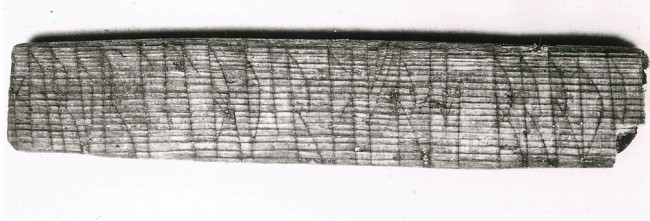
We humans lack the span of billions and billions, but hidden messages seep forward even from our meager past. Some 900 years ago, people in Norse cultures (when they weren't sailing away to massacre my ancestors) would write messages to each other, and remnants of carved notes on wood or bone are found occasionally in archaeological digs. Although Norse writing is known and can be translated today, these small totems can be hard to decipher, sometimes because they were copies of messages chiseled in by illiterates, but the carvers would also tend to get playful with the writing, using phonetic codes or decoratively bastardized script, which were pretty accessible then, but can be hard to pull from context when you don't happen to live in medieval Scandinavia. When one of these "Norse rune codes" was cracked last week (link via), it was a big deal.

What does the message say? What was important enough to painstakingly gouge out of a plank and pass on? 

"Kiss me."

Awww. Now go get my insulin.

Monday, February 10, 2014

Review: Replay, by Ken Grimwood

Replay is a book that is well-regarded among science fiction circles, one of those perfect-length novels that doesn't say anything more than it needs to say, that takes a simple speculative concept and spins it out into a meaningful comment about life. You can almost pull the story synopsis right out of the title. On an otherwise uneventful morning in an otherwise dull mid-life, Jeff Winston suffers a massive heart attack. In his own experience, he dies, but then immediately comes to in his 18-year-old body, the whole of history reset to exactly where it was 25 years before, with the exception of Jeff's intact memories. For inexplicable reasons, he's been given his life to start over again. And, as it painfully turns out, again and again and again.

Does the novel deserve the praise it gets? On page one, I thought I was in for something very special indeed. It opens with this guy dropping dead in the middle of a sad, dull, and strangely sweet conversation, and I thought that Grimwood captured something brilliant there, showing us the banality of life and death at once. As the story goes forward, however, the effect becomes rapidly less impressive--the unelaborate evocation is just Grimwood's writing style--but while I think the story succeeds overall in a related way, and is a rewarding read, it didn't blow me away with its genius. Each time Jeff goes back, he tries things a little differently, and the author walks us through his attempts (which we slowly learn are shortening). Jeff is successful in that he sets up his replayed lives with more in less time, and, as almost anyone would, he puts some effort in to change the broad course of things, and to seek out the deep meaning of life, and the point of his unusual experience of it. But it takes him as much work as ever to get better at living, and all he ever really manages to figure out is what's valuable to him, over which he has limited ultimate control. There are no answers, and the only lesson in the end is the one that is offered to any of us.

[A short novel? With a simple, elegant concept? That doesn't rely much on the depth of prose? It would probably make a great movie, and it's too bad that Groundhog Day went and happened in between.]

It's fun to imagine what you'd do if you got your own clock turned back like that. Speaking for myself, I am sure I'd handle Round One differently than Jeff Winston did. Twenty-five years ago today would put me as a junior in high school, which would be awful, but just around the corner was a college experience that I loved. I am not sure I remember world events (and certainly not sporting events) with enough precision to fund me in 1989, but it's nice to imagine that I'd enjoy the whole span a great deal more with some useful people experience and self-understanding under my belt. Moving on, I could see myself obsessing on those points where I wish I chose differently, and on a replay, I'd look forward to being sure I'd zig where last time I regrettably zagged. If I were writing this story, my version would have the character going back, determined to set right a couple of those long-brooded-upon wrongs, only to find that on a second try that he's still the same schmuck he always was. Ah fuck it, I tried.

Wondering what else he may have written, I looked up Ken Grimwood on Wikipedia, and learned that he died of a heart attack ten years ago at the age of 59, a bit before his time. There can be no news on whether he went back. I won't hold it against him if he did; he seemed like a decent enough guy.

Friday, January 24, 2014

Review: The Hobbit, by J.R.R. Tolkien

It's telling that I can't remember if I read The Hobbit before or after I discovered the Lord of the Rings novels. (I know that I encountered them in unrelated circumstances. One was pulled from the middle school library based on word of mouth, the other discovered like some alluring treasure in a closet in my grandparents' house, the exotic covers teasing me for awhile before I opened them.) I think I read the epic at the later date, aware that it was a sequel, but I read it for its own reason, not because I was so excited about a followup. The Hobbit is a standalone, and it remains so, a pleasant little story that only hints at bigger things (I did love the maps and illustrations as a kid), as befits the audience. Modern readers can pull up all the rest of his fiction for the level of background that suits them, or if you want to import another kind of depth, read it trying to suss out the adult elements that are working beneath the story, which is more or less how I feel like looking at it now.

And make no mistake, this is definitely a young adult book. Tolkien takes on the aspect of a grandfatherly storyteller, occasionally addressing the reader or referring directly to himself (e.g., "I wish I had time to tell you even a few of the tales..."), which is a fairly annoying affectation, however kindly intended. The story escalates in scope, but starts small, and stays light in tone throughout. We're given danger and threats that a child could understand (violent, unpredictable, or manipulative people; scary dark places), and Bilbo's actual struggles are not ones of mastery, but are rather personal efforts of will. He has to work up courage to face the situations he finds himself in, and, on occasion, to do what is evidently the right thing, a moral bravery that he slowly earns. There ends up being plenty of violent death, but the acts are sanitized (sometimes with humor and song), and are mostly outside the immediate point of view. Bilbo basically cringes and hides when it comes to battle and war, and he is only vaguely aware of the political forces that are driving his quest, but we are given that his own actions are worthwhile, even pivotal. Hell, you've read 'em all too: Tolkien puts a unique value and agency on "steadfast."

Also avoiding some of the usual high-fantasy lard, none of the supporting cast of The Hobbit is particularly noble and capable as all that anyway. They all tend to be thinly drawn (sometimes elegantly so--the quick rendering of Smaug's vanity and greedy indignation is great, and so is Gollum's madness--but others are inadequately sketched out--at least four of the dwarves have no distinguishing characteristics at all), but almost all of the outlines contain a serious deficiency of character. There are silly or vain elves, unheroic dwarves, grim men, aloof eagles, and volatile um, bear-dudes. The most intact archetype is Gandalf the wizard, who is indeed wise and great, but only intermittently helpful, and certainly unable to give the quest his full attention, even though he shows up for all the good meals. Next-best is Thorin Oakenshield, the dwarf leader and hereditary ruler of the mountain kingdom, and can I even tell you how much I love Thorin? Tolkien paints him as self-important and serious, but missing some critical element of leadership. (Peter Jackson allows him a brooding noble bearing in the films, and plays him as a tragically flawed figure, which I've been liking even better.*) He plays up the part, but it was less obvious to a kid that he is just not very good at the whole "king" thing.  He is sort of a high-end fuckup, even given just thirteen subjects and the best advisor in Middle Earth. Yes he's an exile with no experience at actual rule, but it comes more down to problems of temperament, really. He's confrontational when he needs to be reasonable. He quits and mopes when he needs to persevere, and with the unexpected success of the effort, he pretty much implodes under the responsibility of it. He gets a heroic sort of redemption at the end, at full cost, but he has to give up on his regal dreams to do it.

What becomes clear on reading is that there's no way his quest should have ever succeeded. Putting yourself in the minds of the dwarves brings out a dark dimension to the whole endeavor. It's as if their itinerant lives had grown so meaningless and futile that grimly throwing themselves on the rocks of an entombed city, if they could even make it that far, seemed like a good idea. Likely to fail, sure, but if they were to die trying, then at least they would die trying something. (And if Gandalf saw how Bilbo could improve the slim odds, it was still pretty rotten of him to send his small friend along.)  Perhaps, at best, they could have hoped to swipe an ancestral artifact or two, but the defeat of the dragon was never in the cards for them. Until, of course, it was.  When the beast does vanish (killed with a lucky shot by Bard down at Lake Town, which character I think Jackson is also justified to fill out), the company bumbles around cautiously for awhile, and then, as the truth finally comes out, they hole up. Thorin is stuck with a number of practical matters beyond the world of questing: he's got an empty city he can't rule, a mountain of cash he can't spend, one fourteenth of which is allegedly Bilbo's, who can't exactly walk away with the stuff, never mind take it back home through the hostile wilderness. When a faction of the townsfolk arrives to quite reasonably point out they made their own share of painful contributions to the dragon's hoard, but they'd be interested in some sensible arrangements for mutual development of all this reclaimed infrastructure, the dwarves' response is funny at first, but the situation gets pretty hostile pretty quickly.

When I read this book as a child, the Battle of Five Armies seemed like the anchor for everything, the titled event that made it significant in the history of that world.  And in a way it was, even though Tolkien shows only the chanciest sequence of action that brought it together.  As competent leaders emerge to dispute big conflicts, Bilbo and the gang look like the underqualified amateurs they are, but more subtly and sweetly than in the grand-sweeping sequels, it shows that small people doing good things can change the world.  As I said, it's a nice enough story all on its own.

*I could keep a long catalogue of Peter Jackson's cinematic rights and wrongs, but suffice to say that some of the things he added did help to fill out the story, and I think in a good way. Another irritating habit of Tolkien's narration is catching up the reader with "oh by the way, all this other stuff also happened while Bilbo was gone" sorts of deliveries.  Sure, it keeps the story in scope, but it also makes it look more episodic and badly planned than it really is. Hovering behind Bilbo's adventure are a few other plots. For example, after Thorin &co. run through the Great Goblin during their escape from the tunnels, they set loose headless legions of bad guys which finally converge at Erebor. Say what you want to about the development of the "pale orc" (which is mostly Jackson's creation--Azog is briefly mentioned in the beginning of the book, and that's all)--and to some extent I'd say it too--it fits the hidden story pretty well to give the disparate goblin and warg forces some power dynamics of their own, and offer some reason they should all arrive angrily at the battlefield together.

Tuesday, January 14, 2014

This Is Why We Can't Have Nice Things

Like many a cartoon American male (actual photo!), I've been drawn (heh), more or less against my will, into watching Downton Abbey. Of course, I don't like to think my initial aversion is so comical as all that: the show basically encourages the viewer to empathize with the idle lives of a bunch of repressed, inbred, aristocratic motherfuckers. Yes, there are real struggles with class and status presented on the show, sometimes with a shred of cleverness and sometimes more as a scrubbed and kind-hearted anachronism, but on the whole, these mostly are just props to steer the characters, highborn and low, toward soap-operatic plots. (God help me, I think Maureen Dowd has just the right take on it, which has got to happen about as often as a hit shows airs on PBS. Downton Abbey as Gone with the Wind? Yowch!) My own opinion of the show is that when the omnipresent reality of ruin is better presented--in the war or in the workhouses, say--then it is more compelling than when it's just a drama of manners of these surprisingly egalitarian-minded overlords. [And sure, I agree the individual characters are well-enough conceived so that I care what happens to them, and that the costume is great, and that most of the (gulp) casting and acting is a whole lot better than the actual writing deserves.] But the ultimate case for Downton Abbey is the one that the show itself makes again and again. It is, well, Downton Abbey itself. The message is that even though change happens, nice things are worth having because they are nice things.

Granted, this is an insufferably English view of nice things (and it's one that I've seen often enough in British novels to pick right up on), but it's a hell of a step up from the "glory and conquest" view of nationalism (er, not to say the self-styled empire lacked that either). The motif of Downton is preservation, and the principle conflict in the show is one of sustainability. It's made of idealized rustic green estates that are topped off with a comfortable grandeur, one which imagines that all of its elaborate gimcracks and mannered conventions--livery, variegated flatware, gravelled walking paths, riding and hunting, all the forelock-tuggings and "m'lords"--hell, the nobility and the smiling peasants themselves--all are explicitly useful, that there's a good reason the chairs are a set distance from the table and you that you should pull up the right claret from the cellars, just like there's a good reason to rotate crops and to pass on the right. Downton Abbey imagines that the land and its customary adornments are things worth holding on to, that they are essential parts in a long-ago optimized machine which needs to produce nothing but itself. Of all the apologia for aristocracy, conservation of nice things is the only one that I have found not to be laughable on its face. The family is allowed to inhabit the manor because the estate is worth having, not because the family is.

Downton Abbey, in other words, is a community that is valued as such. The community needs to be complicit in the concentration of its wealth, to support the estate. It's an enabling fiction of a community, and I don't forgive that. It's built on the backs of those kindly-seeming laborers, on net ancestral plunder, and on a system that allows one entitled and unproductive class to drain its resources from others. The antebellum American south copied the model consciously, and it was a horrorshow. (Meanwhile, the somewhat more communitarian settlement of the colonies to the north set up some of our nation's enduring conflicts.) The recent pretense to democratize American greenspace only got us the suburbs, a boring, shoddy clapboard fiction built on consumption instead of conservation. The people's revolutions of last century--though you have to appreciate the generations of effort it took to get outside the thought box--often earned central parties and widespread repression. It's a real conflict of the human animal, and it sucks that we can't seem to have nice things without massive inequality railing along with it. Authoritarianism, stifling of individual expression, and a devolution to oligarchy seems to be part and parcel with any of them.

One novel I recall very fondly is Gypsies by Robert Charles Wilson. This author uses science fiction constructs to flesh out and deliver some sock-you-in-the-eye humanist themes. In this one, a family of young people possesses the power to step between alternate realities--some are better than others--but only, as the painfully delivered climax reveals, worlds which they are capable to conceive. We are limited, he says, all of society is limited by our collective imaginations. It's Candide with a quantum-mechanical kludge, that only keeps 99% of the cynicism. It's a nice empirical shortcut to allow a writer: some societies do evolve to be more sustainable, beautiful, and happy, and it would be nice if we could somehow sample for them with better tools than history, theory, and propaganda. The problem is that I wouldn't believe anybody who told you that any one of them is as good as it can be, or that this is the way it must be. Anyone who spews that is romanticizing some nonexistent ideal (as they do on DA), or else is using you. I've been a technical guy all my life, and I place a great value on evidence, consistent thinking, and proper weighting, which certainly applies to something as grand and important as culture. As I get older, however, I understand that we need to cultivate imagination every bit as much. If we don't let ourselves dream better, then we also fail.