Saturday, September 11, 2010

Review: Inherent Vice, by Thomas Pynchon

Airport books come with their own sorts of baggage. It's not that my expectations are low going in so much as that they're negative. Unless you're lucky enough to have that big Borders store in your terminal (which will stock a fair supply of canon and cult, for irritatingly precious travelers like myself), then the selection is geared toward more saleable names (I don't know what kind of books Nicholas Sparks writes, and I don't want to know), political and economics schlock (the cover with a white background, high-contrast typeface, and either a catchy graphic or a picture of some sweat-soaked hack trying to look stern), paperback mysteries and romances (the two science fiction books are of the embossed cover variety), and recent literary fads (you can bet that they're stocking up with Jonathon Franzen as I type). Also, David Sedaris, who's entertaining enough those rare times I catch him on the radio, but I'm disinclined to read something called "when you are engulfed in flames" as I fly.

My best bet is usually to pick up the popular-but-indeterminate-genre selection (i.e., the fad) if I can find any connection to it at all. I've come across lots of people with tastes similar to mine who like Pynchon, and there's a stable of authors who can't avoid saying dropping an homage every once in a while. And Inherent Vice, unlike the doorstops he's more famous for, is nice and short, so I figure it was a good time to introduce myself to the author. It was important for the blurbs to communicate that there's an essential Pyncon represented here. It's not a good sign when the pocket reviews invoke an indescribable style to tell me why I should read the book: it's not convincing for a newbie, and it's not a good sign if the faithful need to be reassured like that. You can find a good normal-length review here of Pynchon's early book, The Crying of Lot 49, which, looking at in hindsight, comes out as a good guide for Inherent Vice as well. So let's call the style discursive, willing to take a detour for humor's sake or to showcase an entertaining character sketch (not inconsistent with the guy who broke his lifelong reclusiveness for a silly guest spot on The Simpsons), some intentional blurring of perception and reality, and a simmering critique of the social order. (See? Blurbs aren't so hard.) I am given to understand that Pynchon also likes to indulge in point-of-view experiments and shifts that are nearly Joycean (which, I must admit, could be a good deal more enjoyable to read in a contemporary author with a worldview closer to my own—same playground, lower monkeybars), but that's not so much in evidence with this novel.

Our hero in Inherent Vice is Larry "Doc" Sportello, P.I. and connoisseur of beach culture, and if his grip on reality is slipping by a claw or two, then all the weed isn't helping. I've said it before: intoxicated people are funny when they accomplish stuff, when they're successful in spite of their best efforts. Acting nonchalant in unlikely circumstances is a timeless humor device. Doc admittedly appears to be sharp at drawing connections (even the questionable ones), and the indignation and paranoia endemic to the counterculture serves him well, but he's easily distracted, by women, friends and acquaintances, unlikely food, good tunes, and kind bud. The forced and unforced detours he finds on his investigation are made up for by some certain cosmic juju imparted by (entertaining) bodily excursions and the general grooviness that gives him a needed perspective. Among the various characters of his acquaintance, Doc's admirably countered by the hyperarticulate Christian "Bigfoot" Bjornson (got him as Kevin Smith meets Jesse Ventura), a Nazi square of a cop who, when they fall into moments of honesty, occupies only a small blue shift from Sportello on the spectrum between humanity and authority.

Doc doesn't sound like the private dick type, but part of the brilliance is just how well these styles mesh. I'm not a bit mystery guy, or noir guy: I'm not, as a rule, convinced that the trip through discovery is honest in these kinds of books. In mysteries, it's always easy enough to manipulate the reader by just lying about the stuff, or failing to divulge key information. I generally like the uncovering of a theme better than I like the gradual discovery of an act, but then, I have to be careful with those sorts of statements, as everything's always in the execution anyway. I am just suspicious of mysteries, in a way that's obviously not fair. I am always reminded of seminal stuff like The Murders in the Rue Morgue, trying to outguess the reader by moving beyond reason. It was an ape, Edgar? That's fucking stupid. Or maybe I just don't really impressed by superhuman deduction when the author is always able to whisper in the protagonist's ear. In any case, when I find myself in certain kinds of mystery—and noir is one of those kinds-- I'm not willing to fatten up my own conclusions with the author's early fodder, not without a sign that such attention is worth it. I let the case wash over me as it develops, trusting the writer to guide the thing along or not. If it's a good book, it'll have made sense all along and when I look back, I will be happy. If the plotting is sloppy, at least I can hope for some interesting scenery to accompany the ride. I finally clicked on Pynchon when I realized that he's a good enough writer to be playing with those not-necessarily-rational leaps. He is cognizant enough of his style that the flood of random-looking, significant-sounding, and culturally-referential information, which may or not be connected very well, is a knowing part of the whole mystery-solving schtick. I mean, Sportello is basically following Batman logic to crack the case, but getting along through inherent brains (vice?) and a certain infumated Grace. It's a funny understanding of noir, and it's perfect for druggies, not to mention the uncertain strain of semiotics that Pynchon likes to monkey with.

From my personal perspective, I can spot another common element between the Chandler-esque mystery and the Pynchon-ified plot. In both cases, I'm more familiar with the influences than I am with the original material. Detective fiction often enough serves as an entertaining cross-genre experiment (and since I have, like, four readers, I'll note that it ain't hard to derive a common genealogy for Sportello and the likes of Tom Robbins' Switters). When it comes down to it, the combination of jokes, winking technological revisionism (I remain puzzled how ArpaNet fit into the plot, or how what we saw fit within 1960s computational capabilities), deep cultural and mythological signifiers (Lemuria, frex), and vague shadow conspiracies (a minor word about the Golden Fang in a sec) may fall better among the small handful of science fiction authors that you don't know you're missing out on--I mean, I loves me some Neal Stephenson novels--but Pynchon gets big points as an innovator, for such a strong sense of his own flavor, and he wins hands down when it comes to the zany and the madcap. He gives us surreality that is sneakily real. I don't think Joseph Heller and Hunter Thompson are young enough to be Pynchon's heirs, but that's more of the same school.

I have read that deep conspiracy is a big part of Pynchon's M.O., but it took some time for this novel to get there. If it introduced thematic elements as fast as it introduced characters, I'd have been more down with it at the beginning. The connections to the Golden Fang eventually start to bring heavy drama, and [spoilers follow, but I don't think they're the hurtful sort] I like how it culminated with some token rich old fuck shipped in as a proxy to argue for The Man ("the bums always lose..."). I don't know if Pynchon really puts so much stock in the hippie as a revolutionary; they're steeped in their local American cultures far too heavily to be very useful, and they're still consumers, part of the machine like everyone else. In fact, Sportello's intermediate life as a private investigator might be telling: here he is, half cop and half citizen. The band's corrupted by an unspecified zombie mojo, and, for one dude, by the sinister attention of the Fang. It took the whole novel to finally force a confrontation with the string-pullers, and not unusually, it was like a man screaming attention from the universe. Which is unsatisfying, solves nothing, but seems like a worthy effort just the same.

[Minor edits. I was sipping glasses of loudmouth as I wrote that up last night, and if the prose fell apart by the end of the fist draft, then that's why. I have no excuse for the second draft.]

Tuesday, September 07, 2010

Five More Thoughts: Whine Tasting Ed.

You folks don't know how lucky you are. A lengthy post months (garnering months in the procrastination) has been averted yet again due to some recent reminders about both being boring and the overestimation of sincerity. So maybe just this once, I'm going to limit my woeful indictment of society and shadowy conspiracy theories to more obviously deserving microcosms (the NFL and the French wine mafia), and then crank up the goth records and complain bitterly to the dog. Meantime, let's keep it light, 'kay K?

1. Back East – What's up with that?
When I was on the left coast last month, I kept telling people I was from back east, in Massachusetts. Now, this made sense considering the relative geography, but I worry that "back" is a universal modifier in this country for "east." Do people who grew up on the west coast also say "back east?" I am pretty sure I have never heard anyone come from back west, instead they are from "out west." At least the latitude is more sensible. When one is from "down south," you might go and visit "up north," perhaps reluctantly if you are sensitive about your redneck cred. People who are already up north only have the option of visiting "upstate," even if they live in a different state.

2. Maybe ...mesquite?
Little did I suspect that I am incapable of a week straight of wine tasting. In the course of a day, your palate gets so swamped with tannins (mostly Bordeaux styles in Napa and Sonoma) that you can taste little else after a while. Even worse, I have somehow inherited the stamina of a 37-year-old, and day after day of drinking just wore me the hell out. By the third day, I was actually using the spit cups. The indignity, I tell ya.

A lot of your wine's flavor (naturally enough) comes from the fermentation conditions, and I heard some interesting discussions about the grades and sources for the oak barrels that are often used. I'll concede that toasted oak does possess many similar flavor notes as the grapes do, but my smoking experiments verified earlier impressions that oak, and especially burnt oak, is about the most chemically intense, acrid tree you'll find among the common hardwoods.

The tradition of aging wine in oak barrels is, I believe a French invention, and at least seems consistent with their culinary heritage of twisting out the most variety and subtle perfection out of a limited set of ingredients. I mean, just look what they did with eggs and dairy. (Is French oak considered superior to American oak? Do American oaks produce garrulous obnoxious wines? Naturellement! Or at least some of them are, where it occurred to them somewhat earlier to be careful about cutting them all down. Older trees (and different species also may) have tighter grains, which gets you less surface area and more subtlety of flavor.) So oak because it's been known for centuries, but man, it's just so inherently nasty, and there other fine woods out there—when will the innovation in wine-making finally hit us?

As just one example, Twif mentioned the awesomeness of smoking meat with bourbon-soaked maple. Something like this has real possibilities. People love the flavors you get out of maple, and think of all the pleasing nuances it could impart to wine, ramp up the vanillas and cooking spices maybe, with less of the peppery or astringent. Or let's defy Europe and take a purely American wood, age a wine in hickory, maybe, see what we get. How about cherry wood to age a nice cab or anything else with a big dark fruit character? Walnut is pretty heavy with tannins, and probably is to be avoided unless you're an oak nut (an acorn?), but maybe age a brandy in it. A port made with walnut brandy? Now we're talking.

When I mentioned this question to a guy on one of the wine tours, he said that one reason was a shortage of coopers these days. He told me that some of the early California vintners worked with barrels made from the local redwoods. You must get some really shitty flavor notes from conifers. Mmmm, turpentine...

I'm also convinced that while it takes a well-trained palate to appreciate wine, any half-drunk oaf can make it. (Not grow the grapes or make a predictable batch, but rather make something that tastes like wine that you can explain after.) Some people were fermenting with wild yeast out there. The high sugar content in the grapes ensures that once the yeast gets chomping, their populations will soar and exclude any other bugs. The high alcohol content keeps them from growing afterwards. Your off flavors come from the grapes (and all that went in growing them) and your barrels, and in wine, let's face it: off flavors are a feature.* Grain, on the other hand, takes major coaxing to ferment, and there's something that can go wrong at pretty much every one of the 3,204 stages, including brushing your hand on some piece of equipment and infecting the whole batch with your disgusting finger-print bacteria. This guy at the winery was manhandling a siphon, that he dipped right into the storage barrel. Right into the barrel! If you did this to beer, you'd be growing macaroni noodles** in it.

*I'm exaggerating, if only a little. It's interesting that these flavor notes all correspond to known chemicals, and, since they have to remain soluble, there's a good concentration of fairly simple chemical species that add flavor. Some of these are common in an industrial chemical lab. Ethyl acetate is easy as hell to spot, and some reds develop simple thiols. I react very negatively to these flavors. Will avoid the Semillon grape in the former case, and catching the latter in the occasional red made for the very rare times I called something undrinkable. (I had to really choke it down.)

**True story.

3. What happened to Engineering?
Back when I was more impressed with myself (the 90s, roughly), I thought engineering was the shit. I liked what Scott Adams said (back then) about other fields appending "engineer" to lend themselves significance. We engineering students mocked the sciences as people who couldn't do honest math. By grad school, of course I'd learn that this was wrong for any discipline that had the "physic" strung anywhere in its title sequence, or any discipline given to modeling complex systems, but (especially when it comes to the Chem/ChemE chasm) here are engineers more invested in questions that anyone cares about or can ever make work. (Chemists were the sorts of hopeless buffoons that'd spend four years synthesizing just barely enough of a chemical they could hope to prove existed.) In the internet age, I've been horrified to see a diminution of the engineer. Somehow, we've gone back to automatons who can't handle the deeper understanding and the thirst for fundamental knowledge that is the provenance of big-S Science. People see that engineering badge I once wore proudly as something like a junior technician of the sciences. Possibly it's because I approximately joined the sciences, and this is just their prejudice surfacing.

In the research areas, they blur anyway, and on a good day, I can't tell you where I fall on the spectrum (applied scientist? that's probably closest), and what the hell, it's not like I'm a sterling example of either anyway. I guess the trouble is more conversational. I've always imagined "engineer" to carry a certain freight, and I've been derailed by short comments or funny looks. Different times, or different circumstances, and most importantly, how come everyone doesn't think exactly like me?

4. A Good Doodle, Spoiled.
Recently quipped (and deleted): Writing is a lot like golf. Early on, you hit a few good ones and think, "yeah, this could be a really satisfying activity for me." Keep going, and you find that not only is it difficult to relive those positive performances of your style, you somehow get worse trying to repeat or improve them. Even longer, and there's the grudging realization that at best you can achieve terminal mediocrity, unable to stop, and unable to prevent yourself from doing the same dumb things over and over again.

And look, I know it's not true of everyone. Some people can swing the club or dash a sentence with a natural talent, or can actually improve to amazing levels. And it's no less true of any other field or activity you'd ever want to take up. Why compare it to golf, and not, say, music, or science? Well, I have been wise enough to not take up golf.

5. At Least They Still Have To Share It.
I'm finally starting to understand why people have hated the Patriots for the past ten years. I always blamed it on the fact that they were awesome and their team wasn't, or on Bill Belichick's lifelong dyspeptic troll impression, or on Tom Brady's clean-cut good looks and junior partner attitude. Or maybe the conservative NFL was supporting the 2001-vintage jingoism by shedding a little love for the Revolutionary-themed team. But I'm finally starting to see that there was something specially annoying about getting the national media soft-pedal for ten years, and it's taken a shift in affection to the hated rivals to really make me understand it.

The Jets have brought in a few named, although not young, players, and Darelle Revis finally signed, and yeah, part of it is the loud blathering of their coach Rex "strong men also cry" Ryan. And there's the HBO special, which seems to have gained some traction, but it's hard for me to tell because (a) I don't watch it, and (b) I never sprang for the service before this year. But there's something even more: the perennially disappointing Jets seem to have a whiff of media magic about them this year. As a full disclosure, I don't hate the Jets as much as a good New Englander should. Got me some close friends who are big fans, and the only NFL games I've ever attended were home games at the Old Meadowlands, and there's something cute about their colorful, loudmouth, drunken, asshole fans you meet there. But I am conditioned to not really respect them either, and I remain enough of a local to wrinkle my nose at the attention they're getting.

You can't watch a televised Pats game without one of the flaks telling you how amazing the stadium is. This is because three years ago, the Krafts teamed with CBS to develop some silly mall complex around the stadium, which combined the business genius of bringing in the crowds to absorb more sports-themed crap at gametime and getting big plugs in every CBS broadcast. I'm a fan of the team, but it's a little hard to listen to them lionize the civic goodness of the pie-faced old nepotist who dandled Hartford and Providence on his knee in a successful effort to leverage $70 million in state infrastructure, subornation of existing zoning codes, etc. from Massachusetts just in time for me to move here and help pay for.

One thing I didn't realize was that Kraft secured a hefty loan for the stadium from the NFL itself. I assume that this is not uncommon, and I picture the owners' meetings as proceeding according to rules of shadow organizations you find in Bond films, with lots of hairless cats. As stadiums go, Gilette was not so expensive as the more recent builds, but he seems to have been pretty shrewd in investing the broadcast media into local fame as well winning some conspiratorial league support, as mentioned above. I remember some enhanced positive chatter about Indy when they built their stadium, although they were actually winning games in '08 and the constant-circumference head of Peyton Manning was already achieving Orwellian ubiquity, and the Cowboys (who deserve an eternity of ignominy for being a Texas product ever labeled "America's team") also got the HBO deal coincidentally with their then-record stadium build. A new bowl rehabilitated Arizona's record, but I'd be committing the fallacy of small numbers to get too impressed about that one, and anyway they did land them some talent. Maybe anyone in Chicago can tell me if Soldier Field, the sequel, did anything for the team.

I don't know what soul-selling it took to get the New Meadowlands stadium built. I know that the fucker was expensive ($1.6B) enough to price workaday lawyers and marketing pukes out of season tickets, and one assumes the blue collars in green jerseys will be watching on teevee a sea of greige suits ogling the Flight Crew from the stands. Go corporatism! Man, I expect nothing less from the NFL. Just so long as they don't start winning.

Wednesday, August 25, 2010

Review: Jayber Crow, by Wendell Berry

Jayber Crow opens with a riff on the opening of Huckleberry Finn*, admonishing interpreters and explainers of the novel, taking a more fitting revenge on the offerors of cheap analysis than the summary execution that Twain recommended. (As for me, the subtext is staring me right in the chops, so it's with a heavy heart that I accept my banishment.) It's an interesting contrast. I read Twain with a cutting sense of humor and sarcasm, a conflicted soul and a precise stylist, a sense of innocence that he embraced or lambasted with varying degrees of intent. I confess to a preference for the more playful style, and with Twain I do feel a certain sense of Yankee homerism, as well as a minor resonance with a tone that I often try to achieve. I'd say it's that divided spirit, but then here's Berry again, telling us that someone must be "troubled enough in their own hearts to have something to say." Maybe it's all a matter of delivery. Berry's writing is calm and mature, the narration clipped of any cynicism beyond maybe a gentle head shake as Jayber muses on the past. Words are chosen deliberately, in short sentences, and there are hardly any contractions used in the prose. It is a slow voice, like a beloved grandfather saying: stop, sit, listen. He weights everything with a sad foreknowledge of the future. There's a danger of saccharine here, but Berry is in command of the prose, and his heart is sufficiently troubled. The writing is often beautiful.

The novel, as you can pick up from the cover, is the memoir of an elderly narrator from the river town of Port William, Kentucky. He's a bachelor, a barber, janitor, and gravedigger by trade (which contents him well enough), a man of few words, who is excluded from certain of the upstanding social circles. But using his own sparing language, Berry gradually paints him as a man of deep and sensitive character. Jayber gradually decides to join the "membership" of the community, and tells various stories of its people and himself. Like all of us, Jayber Crow sees his world as hopeful and vibrant at the time of his youth, and as lost and dying when he is old. That the age of this man is meant to accurately reflect the Port William's health is a novelist's conceit. In his understanding of Port William, Jayber sees loss of farm space as an inevitable component of the march of civilization. Introduction of debt financing and a consumption economy (as I've recently babbled) to an agricultural community that was formerly self-sufficient is one part of it, but it's more a matter of overdevelopment, of the quiet and insensate expansion of powerful machinations into quiet rural life. Switters managed to pick the one quote in the whole damn book that rubbed me the wrong way, which used the word "scientific" to describe this progress, and I can't quite agree with that, even though I liked the other 14,000 words on the subject very much. Berry is pushing for simplicity here, and Jayber himself, the literary autodidact and chronicler of natural connections, is a simple man who doesn't by any means embody ignorance. It's a distinction which I appreciate, and if we can find a world where those two concepts don't correlate, it seems like a good one to live in. (Would that it's where this one was going.) But there are crimes of connectedness (just like there are sins of segregation), and the loss of the simpler community is a very real loss. We're offered a eulogy for it here, each departure catalogued as a tug on individual heartstrings.

In order to perform as a narrator, Jayber has to be both an observer and an insider. Berry accomplishes this by giving him a background that's common to novel characters. The familiar stuff is all there: the young orphan, the boarding school, the prodigious and independent reader, the outcast, the nature-lover, the reprobate, the unrequited lover with a hope of something like redemption: these are roles more common to the population of literature (and people who resort to literature) than, I think, to your typical small-town barbers. I suppose you could look at it the other way too, and say that as a habitual reader of novels, that's the format in which Jayber is likely to represent his own life. That story of unresolved affection is for one Mattie Keith (later Chatham), and is telegraphed early, but brought into the story at leisure. The central Port William story is the transformation and fate of the Keith farm over a couple of generations, which I imagine was meant by Berry to be a synecdoche for the casualties of the march of progress. Jayber's life story sometimes seems tacked on around this longish episode, possibly as a vehicle to give more views of the little society. His infatuation with Mattie is, I think, meant to mirror his feeling for the town, and the youthful Odyssey and the establishment of a home by the river** are meant to further fill out his sense of love for the place. It feels a little episodic, but Jayber Crow's understanding of the place feels solid and heartfelt.

Port William at its peak is almost an idealized farm town, and certainly the Keith farm is thrown up as an ideal approach of resource management, independence, and honest labor. I can see the inspiration in there. It's also a southern tobacco-growing town with hardly any black people, suspiciously insulating it from history. (Kentucky didn't really maintain the plantations that other southern states managed, but less-bad is still unconscionable. It's written out because I don't think Berry wants his paean to the farm to include the forced indenture of a whole population.) The town is also carefully isolated by its ruralness, connected to the outside world (in its best times) by only the narrow thread of the river. Although it's filled up with real people, I don't quite believe in Port William, at least not as a typical place. And it's not that I have to: the setting actually feels like well-written science fiction, where consistent application or removal of some real-world constraints can illustrate aspects of the world better the actual muddy past can. Call it America's Shire, and when Jayber goes There and Back Again, it's to witness the filthy industrial machine, the "real world", that'd eventually overrun the place.

(I also can't see the Kentucky River agricultural civilization as timelessly as Jayber can. Anyone living there, say, 200 years before Jayber Crow might have had a similar reaction to Whitey wandering by, cutting down all the trees, and scaring away the game. Sustainable local or regional agricultural models do certainly get some better credit than mechanized ones, having in some cases stood for many centuries pre-industry. Farming technology was slow but hardly static in the east and west, and even then not without environmental effects like deforestation and soil erosion, but it still looks like a much better record for stability of human population, at least if you don't mind the occasional famine.)

Eventually we get to the love story. I can be a softie for tales of true love denied, but taken without text, subtext, or analysis, it's an infatuation that came to Jayber's life far too late. Developing an excruciating crush when you are not a teenager can't possibly be healthy, when opportunities to grow into your senses come up considerably less frequently. If you can take the situation objectively, Jayber's feelings for Mattie were a lot like those of a 14-year-old nerd, and I kept wondering what her view of him might have been all those years. His strict hands-off affection must have been obvious and intense, and her own cautious distance was a perfectly logical response. I don't take Jayber as an unreliable sort of narrator--I trust the sincerity and chastity of his feelings--and of course a not-much-deeper reading says that this emotion is about more than just Mattie. A great theme of his story is learning how to love the world that won't necessarily love you back. It forms the essence of Jayber's religious ruminations. Like his younger self, my own agnosticism comes from an unwillingness to accept the Biblical (or equivalent) story as some kind of useful description, accurate history or comprehensive moral map. On the other hand, I very much understand the idea of loving the world so much that it can break your heart. The very idea breaks my heart. Does Christianity really follow from that? Is it too generous (or too insulting) to humanize God that way? I don't quite see it, but then I'm still far from Jayber's age. Or Berry's.


* One of the small handful of things I actually remember from Twain's novel, having last read it when I was 11 or so. I've read other Twain more recently.

** Quite a lot of these associations are switters' fault.

[some edits]


Friday, August 06, 2010

Pay It Forward

Last time it was Fred Pohl and Cyril Kornbluth, this time it was Wendell Berry. From 1952, The Space Merchants was satirizing indebtedness in the industrial sector, imagining a system of corporate indentureship where wages, by design, could only contribute to paying debt, which of course accrued faster than the pay could cancel it in the company town. It must have been funnier in foresight. In Berry's novel, Jayber Crow (review pending), it's a look back on the 1950s, when mechanized farming really started taking off, and we're given object lesson in debt and sustainability, where the borrowing against the yield for consolidation and growth broke the land use cycle and stabbed the community in the heart. (If I find a handy pull-quote or two, I'll add them later.) It's an interesting piece of historicity: Jayber's reminiscences take place a good century after America's Populist movement. Agriculture was already getting infected with finance in the eighteen-fifties, with fungible grain and futures trading already starting to deliver their mixed blessings. I'm not 100% sure where I stand with respect to agrarian Populism. I'm certainly sympathetic, and I think centralized industrial agriculture has been civilization-scale fuckup, but I also think shrinking the world with technology and transportation has largely been a good thing. Or could've been at least.

And of course (like the Populists), my interest is self-centered and my worldview is heavily projected. I'm more familiar with the debt traps of the modern knowledge-work economy where we aren't actually making anything, and they're alarming in their own way. Wage growth has been poor over the last thirty years, and has been nonexistent for the past ten. Meanwhile, household debt has skyrocketed (and recently declined a little with house prices, but remains enormous; I'll add some charts later if I can find any that summarize it neatly), and loan-based assets (like your house, your car, and your education) are more essential for existence within the model and have likewise puffed up with dubious prices, and escape-free legal clauses. With new legislation designed to prevent it, we can look forward to more creative gouging from our credit card masters (I need to ask what the "minimum interest charge" was all about). Instead of exchanging our labor for income, we're exchanging it for debt. (Poetically just, maybe, considering what our labor produces, but it's no way to live.) Individually, we may or may not be doing okay, but collectively, we're getting screwed.

Like most technologies, the indecency of debt depends a lot on how it's used. Anyone who's made an online purchase can appreciate how great is that liquidity that easy debt (or really, the easy transfer of funds). It is not difficult to justify borrowing when it's temporary, borrowing a little when times are tough, or for the sake of convenience, provided you can expect to repay in the normal course of things. I want to complain about what I guess is called structural debt, the kind that most of us plebes are stuck with, whether it's the mortgage, student loans, or all those pizzas we ate in college. It's those debts that are caught up inexorably with our working lives that really control us.

From a personal vantage, these running obligations are basically liveable, even though they tend to stay you in your course. We're still doing the same things, approximately: working and getting paid, and, unless we're producing our own essentials, paying for approximately the same things. That big tab sure as shit removes freedom though. Try being without a paid job, downgrading your existence to raise a family, or raise food, or even to actually observe life for a moment as it passes you by. It's like forward differencing, you get the same area under the curve, but instead of working with existing data, each time step is one out into the unknown and poorly modeled future. (Or maybe I'm wanting model-predictive control as my analogy. Do they make economists take control theory? They probably should. Understanding dynamic systems is helpful. e.g.)

Even temporary debt presumes your income will grow or at least remain predictable. Taking on a deficit restricts your future. Debt is the engine that drives the treadmill of the rat race.

People who are not you are have gotten rich off of your debt, of course, and they've fought getting poor when you couldn't pay it. It's diffuse, and there's a great deal of overlap because debt issuers are also employees and consumers and there are a million modes of lending, and a lot of small investors, but if we're looking at the extremes, it's the issuers that generally have the upper hand in society. You can argue that there's mutual benefit when it comes to lending, and I think that's probably true. Lending can enrich the borrower too, enabling him to do things that can produce growth (although even when it ends up win-win, the lender and the debtor are not advantaged to change roles), but I don't believe that this is the equilibrium that naturally emerges when the debt-holders are left out of the rule-making loop, and when the debt-originators become few in number. As human history generally exhibits.

It's appropriate to contrast government debt with private debt. Government borrowing also performs the task of supplying liquidity for social programs, but in addition, it offers the service of a stable investment for excess capital. (It's one of those things that works out in an argument of scale, like insurance pools, conservation, or colonialism, when they fall to the state, or to an agency with similar scope.) In that case, the debt-holders are more diffuse than, say, mortgage lenders, but you can worry about the concentration or composition of power there too if you want to, and a different set of worriers pops up quadrennially in this country. The government (or at least its quasi-subsidiary banks) also has additional powers over its debt, controlling things like money supply, exchange rates, and the overall amount of securities it chooses to issue. I'm not excited about the concentration of those powers either, but in bonds, there's a point to their stability, and the monetary entities are at least countered by the fairly democratic population of bondholders, who'd all be pissed if things changed obviously and quickly.

No one likes a welcher, but weaseling people into debt has got to be the bigger evil. The government also makes laws that govern all of these loan contracts, and can you tell me that, say, fractional reserve lending isn't letting independent banks that hold people's debt fuck with the money supply to their favor? Nominally, the U.S. government represents us marks as well as the sharks, but the large banks have little such interest. Legal conditions that enabled easy and high-level private financing have correlated to tuition and real estate bubbles--is there causation at play there too? Someone is making money off those deals.

The basic idea of the liquidity model that works for my home finances seems to make sense for the government, however. My economic expertise is obviously shaky, but there are some differences there too: the bureaucracy doesn't have to eat, but I suppose it can identify baselines for its services or for its existence. Deficit spending to spur economic growth isn't quite the same mechanism as our household plans, but it's still demanding that the future get bigger. I've worried about this a lot. Given limited resources, that can't really be a good thing.

On the other hand, we can take government spending from a money-is-not-real perspective, and keep in mind that money describes the economy, and not vice versa. Sure, the central deal with capitalism is that money is a good representation of our economic activity, and that under rules of its exchange, we can optimize producing or doing some things. (Just like you can take silly unintuitive thermodynamic variables like "fugacity" or do a coordinate transformation to more easily describe or design certain systems, with the caveat that in physics and engineering, those math tricks still describe real things.) The Populist farmer/economists are interesting in that their understanding of the fundamental relations of money to labor and commodities was a lot keener than most people's. Money is a contract, ultimately a matter of mutual agreement or of law. The dynamics of that can drive human behavior, but to a large degree it's as reflective of our human organization as the law is. People making, doing, or exchanging stuff is what the economy is, and we can spur that in various ways and then define the accounting around it. Arguably, that's the way we always have done it when someone has had greater access to Da Rules. The wealth distribution, even where it goes negative, describes power concentrating or decentralzing as much as it is a mechanism of those processes. By that measure, this place isn't particularly progressive or democratic.

Now if you'll excuse me, I've got to get to work here.

Tuesday, July 27, 2010

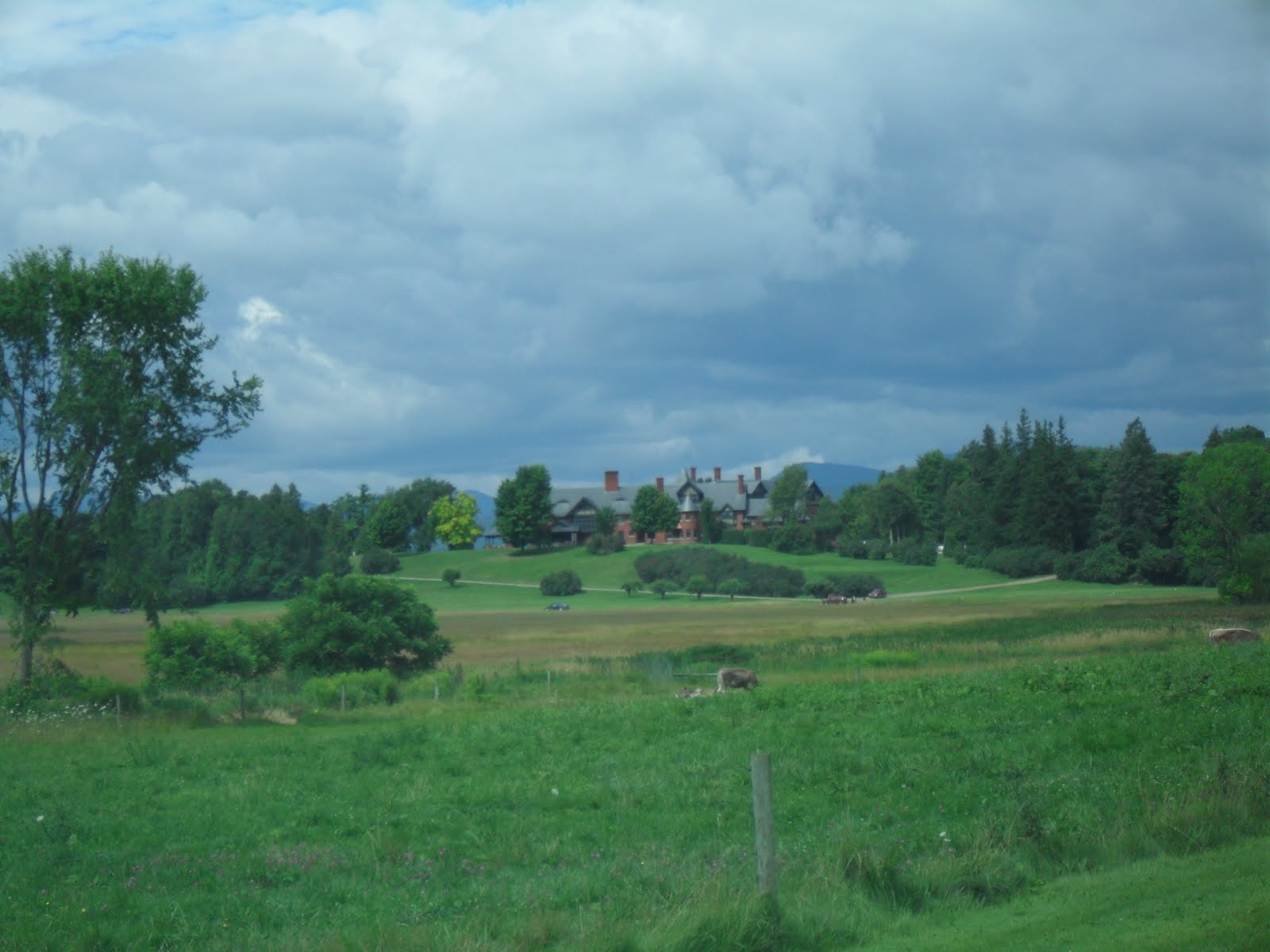
Vermont

When I was a kid, I often imagined that I'd end up living in New Hampshire. There is no particularly good reason for this, and it probably had a lot to do with the fact that by the time of my seventh birthday, I'd only ever stayed overnight in two different states. I guess if I take my net migration up till now, then I have made it halfway there.

Although I only get rare occasions to visit, I have always liked northern New England. It has the right mix of civilization and population, the former of which retains scraps of the notions of self-sufficiency and sometimes overeducated cleverness that makes us homers think we're better than everyone, and the latter is suitably low for my comfort. That emptiness isn't the intolerable openness you might find in other rural localities, but is decently surrounded by old hills and endless trees, interspersed with the occasional farm. I'm most familiar with the Litchfield Hills in western Connecticut, as well as the wooded mountains of the Massachusetts Berkshires (which are the lower part of the Green Mountain range). Proceeding north, the major difference in the landscape is the scale length. The trees are just a hair more sparse up there; and the hills are more spread out and significantly larger. The southern mountains are scrappy rolling affairs, but up in the vert monts, they spread out into majestic peaks, between which roads more calmly wind. Vermont also lacks the industrial towns that are nestled into every one of the Connecticut foothills, suddenly visible around every turn of the highway.


Around the time of American independence, the state spunkily carved out an identity from New York and New Hampshire (and earlier, from Quebec--if we want to go back even further, Vermont appears to have been caught between Iroquois and Algonquin power centers as well). I get a kick out of the comparison. New Hampshire's license plates command us to live free or die, features a self-important conservative rag as the state paper, and even today it attracts these "free state" chuckleheads hoping to turn it into a market utopia. (With hardly any people, libertarianism has a chance of working there if anywhere, although with all that money in that little section near the coast, a tax-free environment where the right to property gets equal billing with life and liberty is going to work out better for some than others. As usual.) Although it had a mind to eventually integrate, Vermont is one of the handful of states that was originally a separate republic. The Green Mountain boys were the ones that actually lived under their neighbor's motto, keeping the Brits down and backing its the New Somethings the hell off. The Vermont constitution is the first new world political document to outlaw slavery, and it didn't limit the vote to property-owners. When it comes to living free, New Hampshire is a fucking poseur.


The original Vermont constitution also provided for public education, and has generally been ahead of the curve (by U.S. standards) for public health care. Also: Bernie Sanders. I don't know if Vermonters feel the government is intrusive--nothing feels very obtrusive in Vermont except maybe tourists in ski season. (My wife came across a brochure advertising that "what happens in Vermont stays in Vermont...although nothing really happens.") Here progressivism, and what with the various farm cooperatives, something maybe approaching mutualism stands a chance as well, also thanks to having hardly any people. Competing notions of freedom.


Thanks to college students I knew, occasional skiing trips when I was that age, and Phish, I think of Vermonters as hippie-ish, and generally easygoing. [Actually, the green mountain state has at least two free state/secessionist/teaparty movements, at least one of which is pushing batshit territory.] Certainly Burlington is like that, with more hemp stores and breweries per population than I've seen anywhere else. I haven't quite worked out the connection, but these kids somehow have to turn into the outdoorsy enflanneled geezers that populate the Vermont of my imagination, but even on last weekend's trip, I saw few people over 40. Maybe they hole up and become recluses when their knees give out, eventually snowboard into a tree (to the extreme!), get beaten to death with lacrosse sticks, or eaten by bears. Vermont has a growing foodie culture, excellent cheese, and, importantly, a fine local beer tradition. The college breakfast joint we stopped at had over five excellent beers on tap, which seems mandatory for about anywhere I breezed by in the state. I should also add that of the New England states, Vermont has the least ridiculous accent, approaching the dialectical perfection of Connecticut English speakers.


For the first six months of its independence, Vermont was called New Connecticut. I like that. I'm more seriously entertaining the idea of changing where I'm from. Since the dump I live in now was so cheap, there's some actual cash flow now that we've entered dual income world. Doubling our mortgage still keeps us under McMansion territory, and the market right now favors picking another one up. Here's the theory: buy now (actually a year from now), and use the upstate place as a vacation home, just in driving distance, for the next ten years. When the kids are done with high school, we'll make it a permanent residence, or, if we change our mind, we can sell it, confident that the housing market will rebound in the longer term. (Or if the whole world goes to hell by then, it's a place where there's a chance to fall back on some hard-lived self-sufficiency.) The goal is to make the fastest possible living exit from the rat race. Flaws in the plan include paying for the kids' college educations (yup, one of the awesome things about overpriced education is extorting parents to stay on the goddamn hamster wheel even longer), and the interim possibility of lost jobs and an extra home we can't sell. What are the odds?


Pound for pound, two states worth of Berkshires are prettier than the Vermont range, but except for the aforementioned difference of characteristic dimensions, the main distinction is that a whole lot more of the northern state is like that. Growing up in Connecticut, I didn't get to live in the beautiful hills. There's a north/south industrial line that runs up the state I landed just opposite. A town west, and there were the rich (dominant now) and the farmers (fewer), and the foothills begin rising up with more earnestness. I've only just now realized that the crappy burg in which I currently reside is at the same point relative to the Massachusetts urban divide. I'll complain about the terrible compromise with any provocation at all. I'd like to live west in either state, or in a quality urban center--anything but in-between--but those settings not only fail to let me off the wheel, I'd need to run a lot harder to not get there.


Do I really need to head north? It's not that southern New England lacks codgers, it's just that you have to inherit the land, or somehow get rich working. Mom and Dad blew it in the first department, and I'm in the wrong field for the second. I fantasize about moving to a low-stress job instead of early retirement (community college professor? follow my wife into clinical lab benchwork?). I mean, I think well on outdoor activities and I like the trees, but only a small commute stops me from being more enthusiastic about that stuff here. I'd like a goat and a few chickens if I had room, but I'm incompetent at growing things. I'd consider taking up hunting and fishing with enough outdoor space, but that's really not my religion. By looks, I am sufficiently hirsute to pass for a hippie or (before too long) a codger, so I'm covered there, and if I'm happy whiling away my weekends cooking, tinkering, reading, blogging, hacking talentlessly on my mando, and being an irritating know-it-all, could I really do it for decades on end? Part of me worries that the answer is no, and the rest worries that it's yes. I fear an easy (or difficult) seasonal drift from the wood stove to summer porch, and eventually dying of existence. Maybe there are worse ways to go. Or maybe that's the way we all go, whatever we pretend.

[some edits]

Monday, July 12, 2010

Five More Thoughts, Ahoy-ahoy Ed.

ahoy, ahoy
I drafted an outline of this post, and I found myself wondering: what the hell is it with me and telephones? I hate talking on them--for the usual reasons (hi bright) and more--and maybe that's what chafes my inner Andy Rooney. Dwelling three generations behind the technology curve--I am just starting to enjoy the web access feature of my corporate Blackberry--makes all this moaning about the voice features rather quaint, but I tell myself some of the issues are universal, even if they're befuddled among cliches that were boring back when they were confined to my grandfather's latest theory on the remote control. I'm not complaining about the tangled wires, but man, I'm getting down there. Oh wait, I am whining about the wires. I mean, I'm supposed to be a technologist of some kind. I can only conclude that fogeyhood is finally setting in.

1. First, let's address the getting old part.
This summer marks my tenth wedding anniversary, and I've been looking at some of the old photos. They're animated with a youthful sheen that depresses me to realize I've lost. I've been living in the same place for over 80% of that decade, and still somehow employed at the same hated job. The milestones just crept up on me, and like many an incipient geezer, I'm scratching my gray-kissed head as to how it happened so quickly. This last span of years was a vastly different experience from all the ones before. It used to be that the life markers flew by at a yearly pace, if not faster (grades, birthdays I was excited about, a new place to live every single goddamn year for a decade), with a reliable quadrennial shift to a completely new setting. It's a little disappointing to think how much all that was scripted for me, but even when I was allegedly allowed off the treadmill, the piped-in scenery kept rolling along into grad school, then kids, postdoc, job. Lately, however, the video's been on a loop (or maybe they just ran out of billboards?). Without going through any conveniently-placed "phases of my life" wickets, I discover that life has passed by just the same. I meet the new kids here, and it's weird to realize that I don't have anything in common with them, even though we're both in our First Real Job.

Of course I'd prefer to remain young, or at least stay youthful. Impermanence may be a part of early life, even though the idea has been abused by the relentless marketing of a standard package of experience, but I think society exploits our fear of settling down to a similar and maybe more detrimental degree. I have mixed feelings about the value of our connection with place and community, but there is certainly a quiet beauty in permanence, and even if we prefer to wander, there is a wisdom to be found in remembering our fundamental connection to the solid earth. You shouldn't have to grow roots, even if it can be good for you, but it shouldn't be excluded from the narrative of our culture, and this endless succession of expensive hydroponic strip-mall communities isn't really the answer to a question that matters. Eight years is a good stretch. Few jobs are so stable these days, and I'm especially surprised that mine has been. In my more radical moments, I suspect that normalizing our sense of impermanence and insecurity serves our elite class well, relaxing the oblige of our various nobles. Someone get out the folk guitar, I need a new ringtone.

2. Make-work pay?
Confusing issues generally arise on Saturdays. Although the mail still comes, every other official agency or call center is as reliably closed on the weekend as a Puritan state liquor store or a local bank. Last Saturday, I got a government check in the mail, which would have been more warmly received if I knew why the hell I was getting it. There was no explanatory letter that came along too. After having to scrounge up a $2000 payment, nickel and diming for every nonexistent deduction, I'm not really convinced at the moment on the mathematical precision of the bureaucratic process. It would have been nice to just exempt the sum at the beginning.

When Monday came, I called the IRS. There was a time when you could defeat a phone tree by pressing zero, but these information systems only get more byzantine as customers learn them. (For questions about your refund, press seven, to get your full tax history, press C, to repeat this message, press π, for other questions please digitize your ZIP code, and calculate the first root to the spherical Bessel function of that order, followed by the pound sign.) It's like those rebate programs where the seller wants to give the illusion of a discount without actually offering the savings, and so you mail in highly specific proofs of purchase, under highly complicated rules, and in the off chance you manage to get everything right, they will just forget to send the damn thing anyway. The provider of the phone tree answer system would similarly like to appear helpful without the difficulty of actually supplying you with useful specific information. Like a troubleshooting guide for the latest gizmo, it is designed to toss out the laughably obvious questions, and prevent any other ones from being answered at all. As the customer gets wiser, the tree gets more complicated, with more dead ends and tempting signs to see the fabulous egress. I like the bit where I call it an arms race, but of course that's stolen from the Hitchhiker's Guide.

It took three climbs up the phone tree, and then 45 minutes hold time to get my question answered (they were helpful when finally cornered), wherein I discovered that it was from president Obama's Making Work Pay program (part of ARRA). On the paper filing form, it's listed on line 63 as: "Making work pay and government retiree credits. Attach Schedule M." I see why I missed it--I'd say it was another rebate scam, buried under language like that, but they fixed it for me. They want to get 'em out.

Belatedly, I'm remembering the marketing campaign. It was to reduce witholding and free up the cash over time. (Since my witholding is predictably fucked up year to year as the nature of our second income constantly changes--my wife hasn't been so stranded by stasis as me--I was thinking uh-oh.) And this is what prompts Obama's refrain for cutting taxes on family incomes under $250,000 from every campaign stop. I take it as the same bullshit vote-grabbing buyoff that Bush used a couple of times, that ought to highlight how much the usually considered adjustments in tax rates don't affect people's standard of living (especially if you withhold it), that is, not people working and making less than $250k a year, but somehow never actually imparts that lesson. The Bush PR team was better in promoting the thing though, or the press was more behind it. Whatever.

3. But it says "universal" right there in the name
When various computer manufacturers came together to create a standard for periferal devices, it made consumer life a little better. I have to admit, a discussion of data transfer protocols makes my eyes glaze faster than a discussion of taxes, and when it comes down to the finer details, I care about as much as I do about the workings under the hood of my car. I want to know how to fix some basic problems, confident that I can perform proper maintenance should it come to that, and I'm still turned on by the general principles, but what I really want is for the thing to work. (This isn't the case with all technical things, but when I'm so far from the realm of discovery to talk the benefits of competing industry standards, I can't really pretend to get too worked up anymore. Computer electronics, like cars, also make the mistake of marketing such distinctions, which aren't deeply meaningful to anyone who is not designing around the things, reducing systems to technobabble. Does a 30 mH degaussing magnet affect demultiplex rates faster than a 50 kBd sampling chirper? Who the fuck knows?)

So look, it's a universal connector, with a device standard that is remarkably convenient. So why do they make my life so annoying for the connection on the other end? The cell phone has a different plug than the camera than the mp3 player than the portable drive. In the tangle in the box (see, I do get this pathetic) the cords all look the same, and since they all have a different small end, I take turns nearsightedly jamming the that side into my sensitive electronic device like a particularly slow child figuring out one of those shape puzzles. And if I lose the wrong one, there will be no pictures to share with my friends and family. Also, what's up with these remote controls? If I aim it at the tv, then nothing happens, but when...

4. Why I need to plug that in.
When the battery on my Blackberry gets low, it politely tells me that there is not enough power for radio use. I feel that this is essentially taunting me, as it has enough power to show the picture of me kissing my beautiful wife on our wedding day, to play the worst version of Breakout ever, or, you know, to inform me that the battery is too low for a call, but not enough to actually make the call. This is merely insulting, and therefore an enormous step from the outright hurtful technologies employed by the primitive cell phones that the rest of my family still uses.

One of the most irritating ideas ever is the beep warning for a low cell phone battery. It has the unpleaBEEP!t property of disBEEP!rging high-decible tonesBEEP!n your ear when you're speaking, which only pales in annoyance to the battery's tendency to fail at night. It's like an alarm clock going off in aBEEP!er room. You start drifting back to sleep, anBEEP!ere it is again. It's not yours (or you hope it's not), and you knoBEEP!hat everyone else in the house is waiting for someone else to get upBEEP!d either plug the thing in or pitch it off the nearest cliff. Now which one is the riBEEP! wire? Shut up alreadBEEP!

5. A sufficiently backwards magic is indistinguishable from CGI
M. Night Shyamalan has been dead to me for at least three movies now, two of which I didn't bother to watch. The Sixth Sense was clever, but if there was any gilt left on his lily, this last flick has got to be enough to shake it off, and then light it on fire and stamp it into paste.

It would be a stretch to say I watch the cartoon, but it's on a lot, and for kids' programming I admit I've seen worse. Its best success is in working kung fu along with elemental magic, going so far as to imagine forms, styles, and (unevenly) mysticism that blend in well with the different magical families. They sketch in some nice backgrounds, and have attractively drawn people with recognizable individuality and a good sense of kinesthetics. A whole cartoon series leaves room for a ton of pointless crap, and the entire arc appears to have been truncated and revised as it went along, but just the same, it's passable, the people and world are not so uninteresting that you couldn't glean a worthwhile quantity of metal from the inevitable heap of dirty ore. (Point of reference: when I was a college-age layabout, I programmed my own VCR--some jokes are too low even for me--to record Gargoyles and The Tick every week. The former was, similarly, a lot better than it had to be, and the latter I still think is entertaining. Adults write it all of course, and I'm sure there's got to be some artistic urge here and there, even when they're prostituting themselves for a buck.) It doesn't hurt my feelings that the cartoon was Americanized anime, and even though it was strange that the one white family among a group of vaguely Inuit people ended up the heroes in the live action version, by and large he didn't eschew the vaguely non-Caucasian hues that the cartoon mostly preferred. These things weren't the problem.

It's not in M. Night's favor that we have a whole string of beloved fantasy fare turned into films since he first came on the scene as an auteur director. Lord of the Rings had its flaws with respect to fidelity, but it caught enough of the spirit of the books to make a body comfortable to nitpick a handful of the details. No one really complained about the Harry Potter flicks. [edit: so far as I knew!] The two Narnia movies caught every bit of the vision and the beauty of the children's stories, while toning down those aspects that would bore the crap out of an adult audience. And I admit the kids these days are spoiled with semi-serious filmmaking. I remember that Krull came out when I was ten, and I thought it was amazing. But compare the filmed Telmarines from Prince Caspian (I believe rundeep quoted "straight out of Velasquez," which was spot on) with M. Night's Fire Nation troops, which started out as fairly compelling animation. The principle difference wasn't the source material, it was direction with a sense of pacing and drama, and (much as I love Aasif Mandvi and all) acting that could be coaxed to, you know, sell the essentially goofball stuff going on on the green screens behind them. Instead, the lines were read with the heft of a late George Lucas script. Hold me like you did by the lake on Naboo. Shyamalan copied the pivotal scenes from the cartoon almost exactly, but still managed to somehow strip the whole thing of dramatic power. It needed a cleaner exposition, some banter, some reason to care about the characters in any of the events that followed, and a better connection between those events. I really wanted to like it, but even my nine-year-old had complaints.

[Okay, partial credit: the kid who played Aang actually turned in a good performance, and the couple of scenes meant to evoke his innocence produced the movie's only charm. The shipboard settings looked cool, the Tai Chi moves were decent, and some of the scenic shots, borrowed note for note from the original animation, captured the beauty or majesty they were aiming for.]

Well, at least we were able to leave with fart jokes. Air- water- and earth-bending all correspond neatly to amusing bodily functions. We're still working on fire-bending. Spicy food? We'll think of something.

Thursday, July 08, 2010

Book Review: Ulysses, by James Joyce

Well, that took a while. Ulysses (maybe you've heard of this one) is really a special kind of challenge: the plot isn't terribly complicated, and the characters and their motivations are not indecipherable. It's not the kind of puzzle novel that obscures plot points amid selective omissions. It's got its share of jokes and analogies that probably require the better part of a bachelor's in liberal arts to get behind. I didn't get as many as I'd have liked--I realized, for example, that I was missing a lot of Stephen Dedalus's classical philosophical motif on his long walk on the beach--but I don't think they're unassailable. The real challenge is just the reading, it's the form, the structure, the confounding sense of flow. I've frequently been thinking of it as a long-form experiment with the language, which isn't wrong, but which is a little unfair. Ulysses does what novels generally try to do, even if takes the long way around. It explores and reveals some insight about the human condition using plot, character, setting, and the tools of language. What Joyce is doing is looking closer at the English's relationship to the other things. It's one of those books with a high entry fee--it's a lot to ask to decipher structure, theme and plot all at once--but I think it's actually easy to enjoy, provided you can get used to it and don't mind the length.

I guess the briefest of summaries is in order: 18 sequential chapters of novella length, each varying the frame in one way or another. Sometimes Joyce is getting in his characters' heads in a narrative that reads a little closer to the loopy curlicues of actual thought than the usual exposition-and-dialogue. Other times, he takes on some formal analogies here and there (headlines, a stage play, an oral defense). Some are chapter-long thematic vehicles, and there are a few episodes of unreliable, flawed narration, connected to the story or omniscient. A real hodgepodge of style, but it's connected, and you can get the authorial voice in all of them. I realize (based on reading part of the introduction) that each section is informally titled based on episodes from The Odyssey, but not familiar with the critical convention, I gave them nicknames of my own. (I try to avoid certain background reading before I get going with a review, because I usually find someone who has already did a better job of saying what I'm thinking. This'll probably be the worst case.) Although there are a number of throwaways to Homer's epic, I imagine it's "Ulysses" mostly for the general thematic case, a story that is meant to be some canonical representation of a bunch of stuff that happens in the wandering between a departure and a return. (Although having only read it once, I'm awfully hesitant to tell you what's not in there.) The narrative styles seemed intermittent to me, possibly selected for what might best illustrate a plot or thematic point, but if there was an overarching method to choosing the modes of expository madness, I missed it.

The most painful chapter? I found "Maternity" (ch 14) dreadful to get through, most frustratingly, because it's where the plot really begins to coalesce. It starts as a nearly unintelligible drumbeat of connected words, resolving to more sensible, but still difficult, prose, possibly meant to evoke the confusion of the exit which finally sends Stephen and Leopold Bloom on a parallel journey. For all the female points of view Joyce daringly got into in other chapters, here among Bloom, Stephen, and the medical students, for all of their clever contrasts about procreation, we never did quite hear what the ladies might have thought about it. Buck and the gang are never more annoying than in this chapter, and what actually bothered me most was that I just didn't understand the nature of the place--why did the ward have a bar in it? My favorite chapter ("The Tales of Brave Ulysses," Ch 12) was a more normal bar where a loquacious bigoted drunk recounts Bloom's visit, getting seamlessly interrupted by some other brain which goes off on silly, purple tangents. Bloom isn't represented as a potent soul here and his climactic rejoinder isn't impressive. The chapter balances the sympathy of the presumed listener and the distaste of the reader, and both voices of the narrators are, for their personal or intellectual failings, droll as hell, with even more smiles in the contrast. This is the chapter you most hear the brogue.

A great deal needs to be said about the audible element. It took me to Ch 11 (lamely, "Music") to finally realize that Joyce is doing more than offering a few occasional teasers on music, but he's often structuring his prose that way. It's not lyrical in the sense I'd usually mean it: although you'll find the occasional alliteration, repetition or rhyme, and the words are certainly chosen for aesthetic effect, it's not words to a song (well, usually--a short sample of lyrics are in fact how the chapter opens). Joyce is instead trying to make the language itself do the the things that music does. There are recurring rhythms and patterns that go along with episodes and characters. Right down to the syntax, he's trying to work harmonies, sometimes letting a sequence of thought or words trail up while another drifts down, like a dominant closing in on the tonic, or, you know, declining to close (hi switters). Maybe you'd say it's unrhymed poetry, but I think I'd rather call it prose music. Now, it's got to be hard to make literature do this on so fundamental a level, or at least it was tougher to read than a stage play. Do you really need prose to copy something that sound is already successful at conveying, that is, are there more reasons to read this than some experimental satisfaction? Well, there's more to Ulysses than that obviously, and Joyce eventually gets a payoff or two for his themes, which is probably a lot clearer on a second read.

The word I'm looking for up there by the way, is leitmotif, which, like I said, isn't exactly unfamiliar in other media. Stephen's theme music, the rhythm of his streams of consciousness, is scholarly and complicated, and is most likely to incorporate these language tricks I just described. I have him as played by a string quartet, an adagio on the beach, an allegro in the library (musical terms suit his Italian scholarship), possibly a march-timed interlude in the maternity ward. Bloom, on the other hand, is simpler than Stephen, he's a complex man too, but more linear, something just a hair odd in the gait and the tonality but still speech-like. A little uptight, and a little pervy. I don't doubt for an instant that Joyce had him as klezmer. (Although when I got bored of his section, I found that singing the lines to the melody of Blackbird usually worked.) Molly Bloom needs a Spanish guitar, slowly accelerating and upping the pitch to build to an offscreen climax (yes). These difference sound trite to describe, although I think I'm right about how they're intended, but they are executed very carefully. We get a treat when Joyce finally contrasts a pair of them in chapter 13 ("Voyeur"). On the beach, Gerty MacDowell's inner voice is (disappointingly) immature and most closely resembles the streams of consciousness you'll more commonly find in literature, and halfway in, as always without warning, we're back Bloom's agreeable up-tempo to learn about the other side of the skirt-peeping. What I most appreciated about this technique is that it built a real feeling of the differentness of the various characters, highlighted them as individuals, very separate in their own minds. It's different than the usual tools of character-building, in which the author identifies a few traits as a skeleton, then fleshes them out as needed. You can put traits on Joyce's characters too, but they're more emergent, the result of an accretion of representations by themselves and by others. Which is more realistic?

It's hard to read words as allegorical musical notes, but these various styles tapped other veins too. The visible is the other modality we can't avoid, thanks to Stephen. Chapter 15 ("Hookey") is a lengthy sequence of the shifting perceptions and thought excursions we got used to in the musical chapters, now written as if they are externalized and viewed, with elaborate props, costumes, gimmicks and stage cues inserted by the narrator. Joyce's go-to analogy was theater or vaudeville (or some fusion thereof--Stephen's friends always caper around in a gaggle, but here every bit player is a member of knowing extras, like a multipurpose chorus or a portable peanut gallery), but these absurd stretches of sight gags are very accessible to, um, a student of modern visual media. Imagine the visit to Dublin's night town as a cartoon and it loses its weirdness quickly. I get from chapter 10 ("Tales of Springfield") a similar feeling, this one closely resembling the kaleidoscopic visuals that John Dos Passos made a lot of hay with a few years later. And there's a hell of a cultural difference between 1904 (the setting) and 1920 (published) to account for this sort of perceptual thing, following along the rapid development and meteoric popularity of film. In those intervening years, the roving camera eye became a staple of the Western experience.

As the novel progresses, the frequency of leitmotifs declines and we get a number of formally structured chapters before it goes out on Molly's big solo. Although the narrators could get verbose, these more obviously engineered chapters were easier to digest, a straight story under the avoidable modifiers and cliches appropriate to the style of the mystery lecturers, or the mandates of the framing. Jesus, in a similar context did I write that "there's a fine line between cleverness and excusing yourself for bad writing, between showing your authorial hand and distancing your readers from your characters"? Well, it's the execution, right, and I think one reason that these skits go on so long is that Joyce wants to show beyond doubt who's in control of the language here; he tosses off a profundity now and again to let us know he's in on the ideas as well. We're not going to forget that it's good writing and not a hobble on some literary crutches.

So, how serious is Ulysses? The thing is full of humor really (a lot more ironic smiles than gut laughs), and a lot of the "important" subject matter gets subsumed under the imperfect characters and faulty narration modes. I don't think the characters are particularly deep, not in the sense of a direct and profound analysis, or of the sterling character traits with which novels usually present people, and Bloom, our main dude, nearly falls under the weight of stereotypes when it comes to the littler descriptions. Stephen is complex in an intellectually facile way, but he comes off as unfocused (understandable: he lost his mother and got sucked back to Dublin; he's broke and too proud or too decent to go home to a family that is also broke; his friends are assholes), and as a wounded idealist. We don't forget that he's young. Mind you, I have gotten this vibe from Shakespeare too (although in his case, he had defining adjectives run through his characters like pillars). 300 years of literature later, and I don't believe Joyce is exactly trying to sell us shallow characters either, more, maybe, on the idea that a lot of human depth in literature is illusory, that our actual nature doesn't map as well to storytelling as we pretend. Joyce is without doubt taking the novel representation very seriously indeed.

I should be in bed, but there's one last thing I want to say here. I think the reason Ulysses is liked because it has a good heart. It's got jokes, jerks, pontification, losers, fuckups and oddballs, life, youth, age, and death, satisfaction, disappointment, marriage, sex, food, drink, beauty, music. It's about the things we care about, and it may take a while, but eventually you find that you care about the people in there too. A lot of the story is a variously one-sided and unflattering portrait of Leopold and Molly's marriage, which is unfaithful in action and constantly disregarding or misrepresented in thought. But the funny thing is that the Blooms are always thinking about one another. They're in mutual orbit, and in their way, they do connect as the primary people in one another's lives. It's strange, but really quite genuine and sweet. After a long journey home, I found myself touched at the end.

[Some edits.]

[Update: I'm a fan of these sorts of synesthetic cross-media explorations in general, which is probably why so much of the review glommed onto that area. I happened to catch Ratatouille last night, and to blabber again what I loved about it, it did a great job expressing on film how food tastes, and in the sequence where the food critic was converted, the expression of the emotional connection we have with food crossed over into brilliance.

It's an activity we do all the time, right? We talking animals are always finding ourselves explaining how things feel or how things went down. It's central to our experience, and in one sense, it's what literature basically is. Joyce really broke some molds in finding and then using different representational modes in writing. A little higher-level (probably) than using jazz and fireworks to show how flavors feel, although I think future art historians will look kindly on the Pixar efforts too. Film, stage, music, and fuck it, even lectures (and maybe cuisine too) are interesting media in that they've always struggled with the reverse of what telling normally does. They take a story, and must then convert it to display and sounds. Always a challenge, and it can obviously be hard to do well, judging by the endless reels of crap out there. All the failures to make a decent movie out of a good book. But even there, we've assimilated some fairly complex things to teh point where we take them for granted. Imagine the work that goes into a good movie score, for example. I think when it hits, it can be a higher level of craft than we usually give it credit for. Much as I like words and all.]

Tuesday, July 06, 2010

Dope, Smoking

INTRODUCTION

I like to think of myself as resistant to marketing, but I just couldn't take it any more. All of these loudmouth food personalities (now there's a job) hawking piles of stringy brisket, pulling apart ribs, slurping up pulled pork, with the sauce dribbling down there chin. Look, it's another barbecue competition in Texas (dry rub) or Tennessee (look at that sauce), with a parade of prunefaces dourly judging what, by all appearances, is a tower of animal sacrifice enticing enough for even the most observant vegan to cast aside his sacred vows and convert to the profane church of the flaming hog. It's only dirty if you're doing it right.

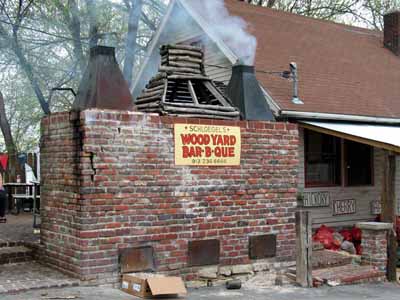
There were few saving graces in the strip mall paradise of Northern Virginia I was unfortunate enough to relocate to at the beginning of the aughts. Here's one: right off I-95 if you happen to be driving through. I can't tell you if it compares to infernally tempting meats of the deep south, but it sure as hell was the best thing around. It was stupid to ask how they made it taste so good. Having a family tradition helps, but at a minimum you need one of these things, or these, or, if you sell your soul completely, maybe one of these. It may also work if you're the kind of person who has ready access to a junked home oil tank and brazing tools. The point being, you, you little suburban pissant you, can't possibly do it right. I think that's why it makes such compelling tv.

EXPERIMENTAL

But a decade of this kind of pressure, and we finally bought a home smoker last month. A $60 Brinkmann charcoal smoker, looks like a little capsule, or a footless R2-D2, or--and I think this is the real inspiration--a half-size prettified version of your standard 55-gallon industrial drum. They stocked a ceramic version too, which cost an order of magnitude more, and with the various doodads and the heft of it, looked like a Flintstones submersible robot. I imagine they perform the same function, if you ever actually use it, but are mainly decorations for your McMansion and I am not that far gone. For the price of the little Brinkmann, I figure if I get one good meal out of it, it will make up for its costs in comparable restaurant fare, factoring in wood (there's some oak and possibly some not-yet-rotten cherry in the woodpile, but not much mesquite around these parts), and the gas to get to Cambridge. Casual observation finds it is indeed cheaply made with the ill-fitting top an actual problem even before I dropped it off the porch, but still functional, main failures being the lack of any means to adjust the airflow (and hence, the temperature) and a badly conceived thermometer. I can't believe it would have cost any more to put some damn numbers on it, and let me judge for myself what temperature is "ideal."

Right, so week by week, I've been running experiments with smoked meats. The first was a rack of ribs and a beer can chicken, done at the same time. Hickory smoke, which was, approximately a thigh-sized log, broken up into chunks, and a couple big handfuls of these compressed hickory pellets we've had around the house since forever. I lit the charcoal with lighter fluid only for this trial. (You can probably guess the result, dear reader, but I don't want to get ahead of myself.) The second week, it was a rib eye roast, smoked with three or four large chunks of woodpile oak. Third week, it was more ribs, with mesquite, properly soaked this time, and about three handfuls of chips in all.

This weekend it was hickory-smoked trout. For reasons I'll describe below, here is the fish recipe:

- three whole trout (about 10 inches), gutted.
- 2 lemons
- fresh marjoram (I have bales of this stuff growing around the house, and have little idea what to do with it, other than a nice garnish and decoration once it blooms. It's like oregano--would that the oregano did so well--subtracted of flavor. I figured it wouldn't mess up the fish.)
- fresh thyme
- fresh parsely
- fresh-ground black pepper
- pickling salt (no iodine, which I understand can get you off flavors)

Add 25 Tablespoons salt (12.5 oz in your measuring cup) to 10 cups of water, and add one and a half sliced-up lemon for the brine. Soak the fish in there for about half an hour. In the fish's cavity, I put a generous sprig or bunch of each herb, two half-slices of lemon, and a nice twist of pepper. I smoked it over hickory for 1 hr 15 minutes (three smallish chunks, soaked in water while I got all the charcoal going and fish prepped). The four pounds of charcoal or so that I put in there wouldn't have gotten me any further.
I tried to smoke some corn on the cob (July 4th is early enough, turns out), but you need more than fifteen minutes to do this. It was pretty great on the regular ole grill in any case.

RESULTS AND DISCUSSION

I had visions of these weekly experiments conducted joyously, an attempt to perfect something that was already awesome. I'll tell you though, it's possible to just have too damn much smoke. The hickory ribs were so strong with the stuff that they were nearly inedible. The chicken wasn't bad when you took the skin off, but it dried out even with the beer can. And yes, I managed to leave some beer in it. It was shitty beer. (Oddly, the meats were pretty good once they mellowed in the fridge for a couple of days. This step is not going to get adopted as part of the procedure, however.) The mesquite ribs achieved a good level of smoke flavor, but I didn't keep the damn things on there long enough, and they were unpleasantly tough. Going back on for a couple more hours did the trick, but my wife doesn't give me a second chance on that sort of thing, and so although the experiment earns a valuable data point, it still gets marked as a failure.

As for the rib eye roast, keep in mind that this is a boneless prime rib. Would you cook one of those over a campfire? And oak smoke, as any New England camper knows, is a nasty, acrid, almost chemical sensation when you get a faceful of it, and on a fine cut of meat, it's not much different. You could eat the stuff if you don't like throwing your money away (I made sandwiches for as long as I could stand it), but there's a reason they usually smoke brisket and ribs instead. What the hell was I thinking?

The little bullet smoker is designed to approximate the industrial versions, but I don't think you can really make up for the basic problem of volume ratios. In the small guy, you've got just as much smoke choked up all in a tiny cavity, really close to the wood. It's the slow heat, and it's steady application of a low-concentration flavoring in the big cookers that's so wonderful--the goal isn't to toxify it. Number one lesson has been that it's very easy to choke your meat to death in a white cloud. (And I also wonder how much Food Network barbecue I really want to eat after all. The green pill has me questioning gluttonous gospel. I repent!) Getting the balance right has got to be harder in that small and direct space, or at least it took me some trial and error to get it even to "pretty good." I didn't have too many more chances to whiff on this, but then on Sunday I did the trout...

For starters, it looked great. A whole fish makes a good presentation, and the skin and the stuffed center kept it deliciously moist till the end. The flavor came on strongest with salt and lemon and fish, and the herbs and smoke filled out the rest of it deliciously. I think the strong flavor of the trout helped calm down all the other intense elements, and I got a wonderful balance. A citrusy savignon blanc (or the local equivalent) makes a nice pair, and, after some consideration, a pitcher of mojitos (the marjoram only bows before the mint) did the trick too. Here's a plate, with some recovered garnishes, and the last scrap of early corn pulled from my complaining daughter's hands. (I gave it back after the photo.)


CONCLUSIONS

Smoking dopes can be good to you, at least after a few attempts. That trout was so tasty that I'm seriously considering taking up fishing.

Thursday, July 01, 2010

Is that a pistol in your pocket?

Guns: they're written into the Constitution from a time when a citizen militia was an essential tool of national defense, and today, enough people love the things to keep the second amendment free of any narrow-minded application (or amendment to a modern context) of that clause. Lobbying organizations dismiss gun violence with similar weasel-word qualifiers as A2. It ain't the guns, dude (they rarely discharge themselves), it's, like, the use of guns that's dangerous. I'm not a fan of the rhetorical technique, or the need for it, but I also don't quite go all the way down the hole of calling for a complete ban, in spite of everything. Maybe to shut the NRA up, we could ban people with guns, but the problem with this is that we'd still rely on other people with guns to uphold it. With this week's Supreme Court ruling to strike down a Chicago law against pistols, perhaps it's a good time to make a highly sought-after statement of my own principles on gun rights. (Readers--Smutty and that other one--might recognize this post as consisting of about 50% recycled material.)

Look, I admit I don't care about the things very much. First-hand experience leaves me agnostic. Shooting some .22 rifles in boy scout camp was fun, and playing with ersatz guns (from pea shooters to squirt guns to bows and arrows) has always been a blast. I'm not entirely sure, but I may not have even held one since I was twelve. Sometimes I tell people they make me uncomfortable, but it's not true (about the guns), I say that just so they'll leave me alone. There are a couple firearms floating around the immediate family, and when they eventually pass into my hands, they'll go out of their hidey-holes into similar ones accessible by me, as heirlooms and to have just in case the umbrella of civilization retracts. That's my model for responsible gun ownership.

Moving out a degree, my second-hand experiences with guns range from awkward to horrific. My notion of being prepared falls short of others', for example. It was one of my great-grandfather's generation who kept a loaded pistol under the pillow in case the colored folk ever had need for an uprising, which wasn't the phrasing he used. (It was another time, I tell myself, and it was a kooky scary thing even then, but my god, that's horrible. He's not from the named side of the family for whom I hold out hope of a genetic line.) I knew a good number of gun aficionados growing up, most of whom were not particularly annoying about it, not most of the time, or who just kept 'em for hunting, but I also know enthusiasts close enough to their aggression to make me discomfited to think what's under their bed. When I was a kid, two of the boys from my scout troop were playing with a parent's handgun, and I got to go to a funeral for one of my peers, one dead and half a dozen seriously fucked up. (I'll tell you, I often find it eye-opening to look at events from my past with a broader adult understanding of things.) One of my college buds tells a story of some guy who threatened him at a party by jamming a pistol in his mouth. Hilarious stuff. And do ask Cindy about the recent death of her young friend. If I'm just weighing anecdotal evidence, this ends up a lot heavier than the any number of successful counter-threats where potential harassment was thwarted, which, I'll add, I suspect are usually about as apocryphal as all those conversational triumphs people tell you about on the internets (of the 'and that shut him up' variety).

And for my carrying friends, here's the problem with the social contract you advocate: if you require me to be comfortable with your preferred habit of gun-totin', demanding that I trust your judgment and discretion with a deadly weapon you insist on carrying among people who know you, then you're the one who has a problem. Namely, that you're a dick. Not just that big slick rod you're waving around, but you are a penis, in the colloquial sense. And hunters? You're dicks too. In principle, hunting wild animals is a respectable thing: I think it makes you an honest meat-eater; it's more humane than an automated feed lot; self-sufficiency is a salutary endeavor; it's got to taste good, or at least taste real. But if the idea of hunting is okay, then hunters are still dicks, they still demand to be in the gravitational center of a universe that alleges to be mutually consenting. I have to watch out for them in other words. Hunting season has made it harder for me to enjoy the woods going on thirty-something years now. Any wild-ish sanctuary is despoiled when you have to watch out for wretched coffee- (or maybe Budweiser-) breathed chuckleheads dressed in orange raincoats. And look, if you push for a rigorous, universal course of gun safety, so that anyone with a piece takes it as seriously as you take yourself, then you're furthermore an insufferable dick, even if you're right on your own terms. (Insufferable people are often narrowly correct.) This wonderful world where a society remains polite because we're all busy threatening one another? That's one of the sorriest utopias anyone has yet imagined.

(And yes, I think drivers are basically dicks too, but we can make a better case for the unfortunate necessity of piloting a car in the modern world.)

The thing with guns is that there are legitimate civilian uses for them, that don't even always involve killing people. They really are fun to shoot, and as gunpowder-fueled clockworks, they're outstanding little machines. Keep 'em in your cabinet, and impress your friends; take 'em to the range. Maybe someone out there still has to protect themselves from bears and wolves, I don't know. The problem is that the politically important uses of them are all hypothetical. The militia clause got out-dated by a standing army, but individual-minded folks often take the position that a means to resist the state itself is a good thing, even though actually resisting the state is near-impossible. So let's please count among the insufferable penii the Usenet-vintage internet libertarians. We're not going to keep our overlords in check with our guns, not without enormous violent upheaval, and that hardly ever goes disastrously wrong, right Mr. Robespierre? Consent of the governed is a fine political theory, but violent withdrawal of your consent is a self-inflicted sentence of martyrdom. Keeping yourself apart from the local state-like powers--such as the cops or the mob--isn't going to do you much better (but note below), but maybe after the apocalypse, you'll be glad of the guns to keep out the roving bands of mutants, or prevent the bandit sheriffs from running over your moonshine still. It's just paradoxical in the current American context: so long as the federal power infrastructure holds up, and to the extent it effectively circumscribes the local entities under it, the federally-honored right doesn't do much for you in its potential to confront it. Their guns are bigger, and everyone loves the winner that everyone already loves.

And that's why so much advocacy revolves around fantasy crime scenarios. Not so much real crime scenarios, although there may be some anecdotal for that sort of thing (much of it of the type mentioned above; I believe the statistical evidence has been long since shot down, so to speak). To be fair, if people legally holding their tools are annoying, then illegal gunslingers are much worse. It's just that I don't voluntarily associate with them very often. People feel threatened by crime a lot more than they feel threatened by the government, and given that making the armed boogeymen magically disappear is unlikely (especially when you need them around to blame stuff on), then a natural impulse is to become intimidating enough so that you're left alone. But it's a hypothetical defense, most of the time. Guns can't be brought to bear in a timely enough way to arrest most encounters in an otherwise civil environment (ask those poor Seattle cops, or all the soldiers at Fort Hood). Not without that special American movie fantasy of a society full of hair triggers, which, as I've mentioned, is only a paradise for dicks.

It may be what the Constitution says, but it's still a shame that this Chicago ruling reminds us that state and local regulations are subordinate to the second amendment. In more rural areas, you've got more legitimate uses for firearms, and I don't know if the stats bear out fewer gun deaths per capita in the less densely populated parts of the country, but I am sure the entire number of deaths is much lower. (It's funny how where there's lots of actual crime, like in Chicago, that's where guns are more likely to be controlled.) A troubling idea though, is that more traditionally rural areas, with more local independence and a more historical love for shootin' arns, correlate with those places once supportive of justice against hypothetical crimes committed by an unarmed classes of citizens. Gun rights for the protected members, maybe, such as my great-great-uncle considered himself. (A little closer to the perfectly isolated village, and the libertarian position looks less crazy, but then I don't think that's who has, um, called the shots among conservative gun proponents from those parts.) If we bear down hard on the Constitutional position that everyone should have a gun, then we'd have to manufacture some other paradigm under which to incarcerate the dusky-hued. A war on something would be our usual style. Sounds absolutely crazy in this country, I know, but it scares me to think it could actually happen.